
LECTURE 9 AVOIDANCE RESOLUTION AND SETTLEMENT OF DISPUTES
- Slides: 24
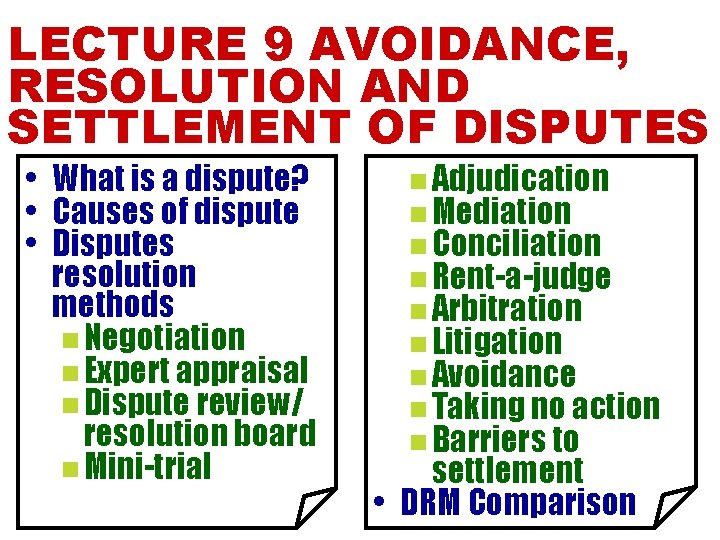
LECTURE 9 AVOIDANCE, RESOLUTION AND SETTLEMENT OF DISPUTES • What is a dispute? • Causes of dispute • Disputes resolution methods n Negotiation n Expert appraisal n Dispute review/ resolution board n Mini-trial n Adjudication n Mediation n Conciliation n Rent-a-judge n Arbitration n Litigation n Avoidance n Taking no action n Barriers to settlement • DRM Comparison
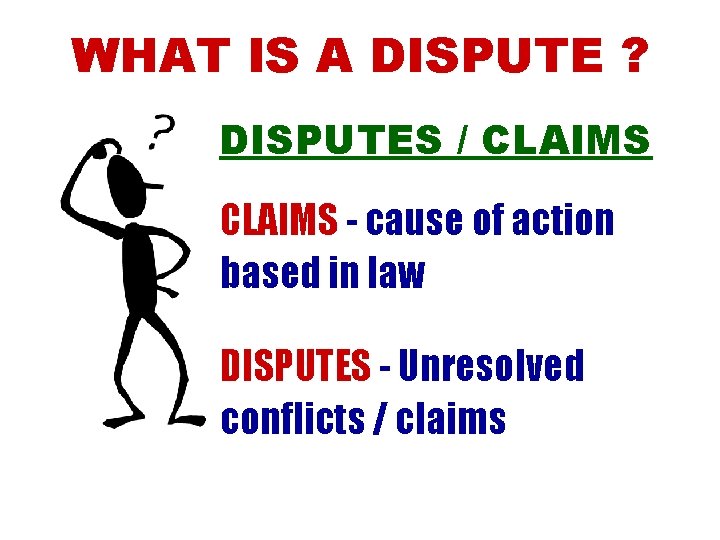
WHAT IS A DISPUTE ? DISPUTES / CLAIMS - cause of action based in law DISPUTES - Unresolved conflicts / claims
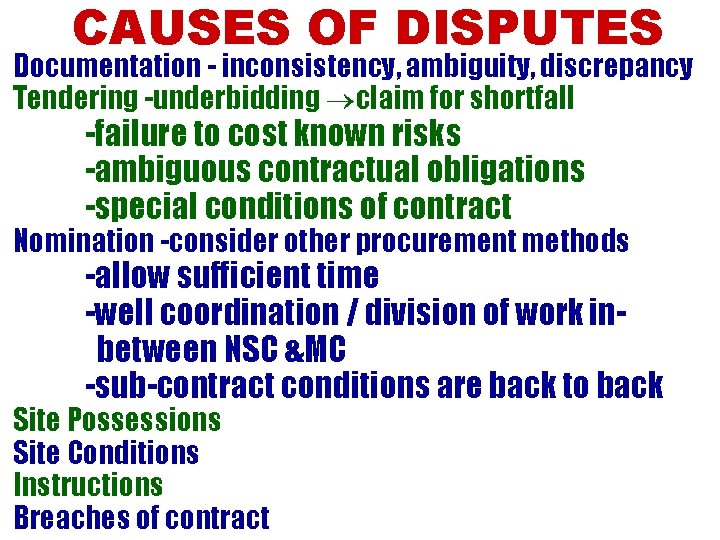
CAUSES OF DISPUTES Documentation - inconsistency, ambiguity, discrepancy Tendering -underbidding claim for shortfall -failure to cost known risks -ambiguous contractual obligations -special conditions of contract Nomination -consider other procurement methods -allow sufficient time -well coordination / division of work inbetween NSC &MC -sub-contract conditions are back to back Site Possessions Site Conditions Instructions Breaches of contract
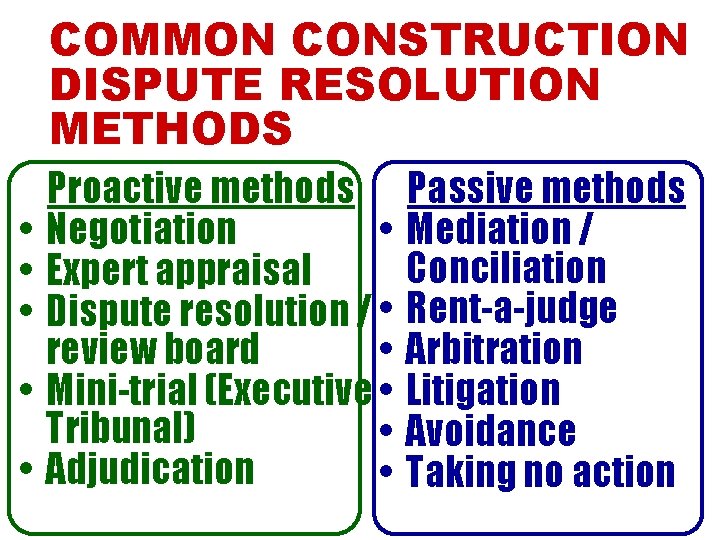
COMMON CONSTRUCTION DISPUTE RESOLUTION METHODS • • • Proactive methods Negotiation • Expert appraisal Dispute resolution / • review board • Mini-trial (Executive • Tribunal) • Adjudication • Passive methods Mediation / Conciliation Rent-a-judge Arbitration Litigation Avoidance Taking no action
NEGOTIATION Negotiation of disputes is that the disputants try to resolve the dispute directly without escalation and without assistance of a third party. • The preferred method to settle construction disputes. • The essential component in all dispute resolution processes. • Most disputes are settled by negotiation.
EXPERT APPRAISAL • A third party expert is appointed to assess the merits & quantum of the claim or disputes • The expert must have an impartial view, even if it means criticism of the party who engaged him • He may also be asked to give opinion on the range within which an arbitrator would probably make an award and the likely costs of arbitration
DISPUTES REVIEW / RESOLUTION BOARD þThe board is established at the very beginning of the project, not upon the disputes arise þEach party nominates a panellist þBoth parties approve the other's panellist þThe panellist selects a chairperson þAny small issues of disputes during the construction period can be resolved immediately & regularly by the board
MINI-TRIAL (EXECUTIVE TRIBUNAL) JUsually a three member panel is formed J 2 of whom are senior executives / management from each party who are not involved in the dispute issue JThe third is an independent facilitator, usually a lawyer or judge experienced in contract disputes resolutions, who chairs the panel JThe parties with disputes present their cases to the panel JThe process is not standard & its flexibility enables the parties to choose the most appropriate method to settle the disputes JThe costs are slightly more expensive than mediation and they are shared by both parties
ADJUDICATION ÄAdjudication is a formal method of dispute resolution as in a court litigation, but the process may be conducted outside the court by agreement of the parties. ÄA third party will be appointed as a full-time impartial adjudicator at the outset of the contract. ÄHe will follow closely progress and record the events throughout the contract period. ÄBy doing this, identification and more accurate assessment of any potential dispute could be rectified at an early stage.
MEDIATION / CONCILIATION Mediation / conciliation is a method of dispute resolution in which a neutral third party, mediator / conciliator, assists the parties to reach a negotiated settlement. Meaning of mediation / conciliation: PA private voluntary and confidential process PThe mediator / conciliator is a neutral person, chosen by the parties usually because of particular expertise PThe mediator / conciliator acts as a facilitator to help the parties to reach a negotiated settlement PThe conciliator must meet both parties together but the mediator normally meets each party separately PThe outcome is non-binding unless by agreement
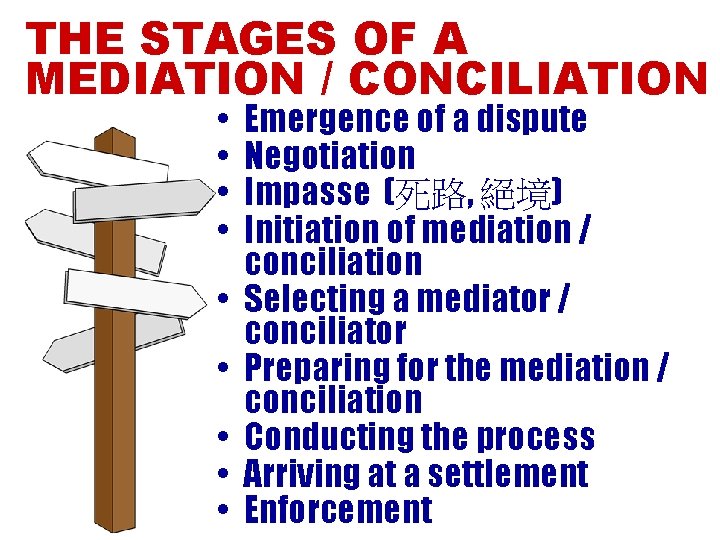
THE STAGES OF A MEDIATION / CONCILIATION • • • Emergence of a dispute Negotiation Impasse (死路, 絕境) Initiation of mediation / conciliation Selecting a mediator / conciliator Preparing for the mediation / conciliation Conducting the process Arriving at a settlement Enforcement
WHAT HAPPENS IN A MEDIATION? • pre-mediation preparation for mediator and parties • preliminary meeting • conduct of the mediation • concluding the mediation
RENT-A-JUDGE • A private litigation process which involves a judge (a retired state) • The process is very similar to litigation except the whole process is not open to public
ARBITRATION ÄAs defined by Atkinson (1985), arbitration is 'the resolving of an issue, or issues upon which the parties have failed to agree, by way of solution imposed by one or more impartial persons. ' ÄArbitration has become the traditional method of dispute settlement in the construction industry where a third party makes a final and binding decision. ÄThe traditional method for resolving construction disputes as an alternative to court litigation.
ARBITRATION þProcedures are prescribed by arbitration rules þRules can be varied by agreement þProcedure similar to litigation but less formal þUsually written and oral submissions þEvidence subject to questioning þHearing in private or confidential þBinding determination but subject to review by the courts in certain circumstances þNeutral appointed by the parties, usually because of particular expertise
ARBITRATION PROCEDURES • Preliminary meeting n appointment of arbitrator n preliminary time table • Pleadings n Claimant submits points of claim n Respondent submits points of defence & counterclaim n Claimant submits points of reply to the defence & defence to counter-claim n Respondent submits points of reply to defence to counter-claim • Discovery of documents n Strict duty to disclose all materials n Without prejudice correspondence letters can be excepted • Agreed bundles of documents are formed from the discovery of documents
ARBITRATION PROCEDURES • The hearing n The opening address given by the claimant n Presentation / examination of claimant's witnesses n Respondent cross-examining claimant's witnesses n Re-examination of claimant's witnesses n Respondent's opening address n Presentation / examination of respondent's witnesses n Claimant cross-examining respondent's witnesses n Re-examination of respondent's witnesses n Respondent's closing address n Claimant's closing address • The award
ARBITRATION & MEDIATION ÄArbitration may be invoked unilaterally ÄMediation is not governed by any legal provisions, neither the award nor the procedure itself. ÄLegal representative is usually excluded during mediation Arbitration : Cost follow the event. Mediation : Costs are usually equally borne by the two parties. ÄThe proceeding of meeting or hearing are not formally recorded for Mediation. ÄA mediator is not compelled to take evidence only. With the presence of both parties, he is also allowed to use his own 'knowledge’ on factual evidence. ÄDiscovery of documents is usually limited to files of direct relevance in mediation. ÄThe time limit to invoke mediation is usually shorter.
LITIGATION Dispute settlement in the Court. üCourt rules define the formal procedures üSubmissions in form of written pleadings and other documents üDocumentary and oral evidence given üEvidence subject to questioning and cross examination üHearing usually public üBinding determination subject to appeal üNeutral is a court appointed judge or official
ARBITRATION & LITIGATION Arbitration • Save Time • Cheaper • Location can be chosen by agreement by both parties • More privacy • No appeal on the decision • More simple and less formal procedure • Less focus on legal point • Choice of Arbitrator is allowed • Decision made by one arbitrator in previous case need not bind other arbitrator's decisions • Arbitrator usually have technical knowledge on that case • • • Litigation Take longer time Expensive Location is fixed Less privacy as hearing is opened to public Can appeal to higher court Complicated and formal procedure More focus on legal point No choice of Judge is allowed Need to follow precedent decision Judge may take more time to understand technical detail.
AVOIDANCE Avoidance occurs when a disputant withdraws from the situation and terminates the relationship.
TAKING NO ACTION The party which takes no action usually does so because • it lacks information, • it decides that the cost for resolving the disputes is too high • the amount under dispute is too low • it wants to preserve a good relationship with the other party.
BARRIERS TO SETTLEMENT OF DISPUTES • • poor preparation wrong party representatives poor negotiation tactics lack of authority multiple issues in dispute psychological barriers overcoming the last gap
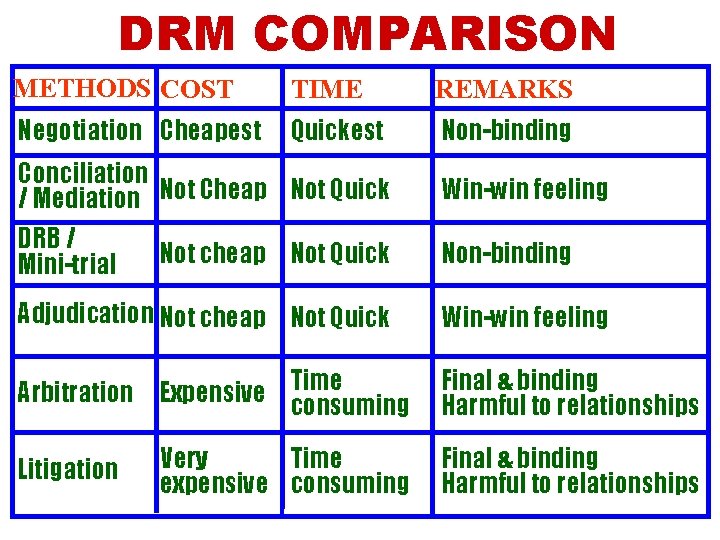
DRM COMPARISON METHODS COST TIME REMARKS Negotiation Cheapest Quickest Non-binding Conciliation / Mediation Not Cheap Not Quick Win-win feeling DRB / Mini-trial Non-binding Not cheap Not Quick Adjudication Not cheap Not Quick Win-win feeling Arbitration Expensive Time consuming Final & binding Harmful to relationships Litigation Very Time expensive consuming Final & binding Harmful to relationships