
Lecture 8 Web Search Engine Architecture Part 2
Lecture 8 Web Search Engine Architecture Part 2 1
What is a query? (group No. 1) • 3. 1 Query: Parsing. When a query q is typed into the search box of a web search engine, i. e. it is presented to the search engine, such a query is ”parsed” by the search engine first i. e. it is treated by the search engine as if it was a small document. Any query must adhere to the syntax (query language) supported by the search engine (and this language should be simple enough for the average to use it correctly). • 3. 2 Query: Text transformations. The words described in the query are then manipulated by the same text operations/-transformations that were applied to the documents of the corpus to thus derive the index-terms corresponding to the query. It would not make sense to look for algorithmic just because a user typed it in a query box, if all instances of algorithmic in the corpus are treated as synonyms of algorithm and only this latter word becomes an index-term. If the query contains not only words but some operators supported by the query language of the engine this processing becomes more evolved. • 3. 3 Query processing. Then for every document d j of the corpus, the query engine establishes the similarity s(q, d j ) or closeness of query q and document d j (i. e. of two ”documents”) by comparing the index-term logical view of the query to the index-term logical view of every d j of the corpus. The more rare index-terms two documents share the more similar they are. The similarity s(q, d j ) is established by using statistical properties of the two ”texts”; no attempt is (usually) being made to understand the contents of q or d j. This approach is a pure information retrieval one to measuring similarity. 2
What is a query? (group No. 2) • 3. 4 Keyword stuffing and purely IR approaches. One can fool such a statistical (or purely information retrieval) approach by creating a document that includes several (i. e. all identifiable) rare words or possible index-terms, a technique known as keyword stuffing. This was a problem with early generation search engines. Afterwards, search engines started using not only structure (aka keyword) information but also linked-ness or age information of the page or the site hosting the page to determine its similarity or ”closeness” to query q. A rank r(d j ) for document d j or r(q, d j ) can be computed that is more reliable than s(q, d j ). • 3. 5 Link farming. Even such schemes that use link information could also be defeated. Link farming has been used to defeat a primitive ranking algorithm that relies solely on links. Create artificial links between phoney/phony webpages and populate them with keywords (keyword-stuffing). 3
A simple example: Altavista 4
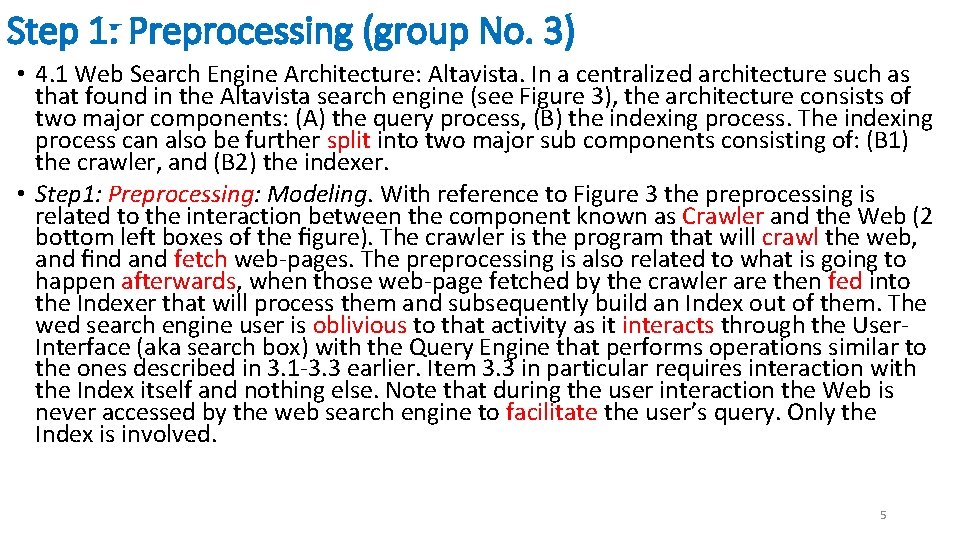
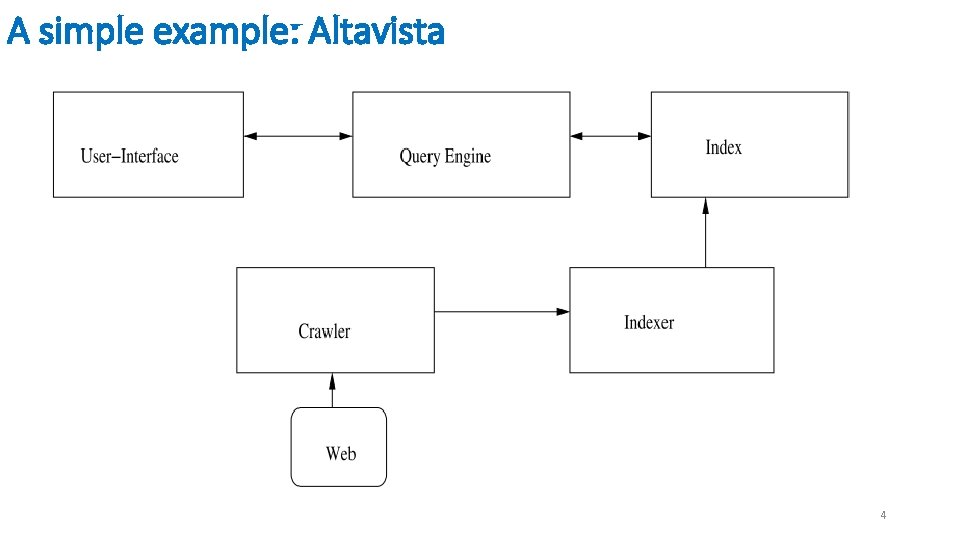
Step 1: Preprocessing (group No. 3) • 4. 1 Web Search Engine Architecture: Altavista. In a centralized architecture such as that found in the Altavista search engine (see Figure 3), the architecture consists of two major components: (A) the query process, (B) the indexing process. The indexing process can also be further split into two major sub components consisting of: (B 1) the crawler, and (B 2) the indexer. • Step 1: Preprocessing: Modeling. With reference to Figure 3 the preprocessing is related to the interaction between the component known as Crawler and the Web (2 bottom left boxes of the figure). The crawler is the program that will crawl the web, and find and fetch web-pages. The preprocessing is also related to what is going to happen afterwards, when those web-page fetched by the crawler are then fed into the Indexer that will process them and subsequently build an Index out of them. The wed search engine user is oblivious to that activity as it interacts through the User. Interface (aka search box) with the Query Engine that performs operations similar to the ones described in 3. 1 -3. 3 earlier. Item 3. 3 in particular requires interaction with the Index itself and nothing else. Note that during the user interaction the Web is never accessed by the web search engine to facilitate the user’s query. Only the Index is involved. 5
Step 1: Preprocessing (group No. 4) • Step 1: Preprocessing: Repository and its organization. All the documents that will be fetched from the web will be locally stored in some format. The organization of these documents and their storage determines or defines the Repository: a local copy of (all or a subset of) the Web, as determined by the Crawler and Indexer. A repository of actual documents in possibly compressed format will be built. Metadata information collected related to these documents will be collected, stored and used for a variety of tasks including the determination of future Crawler schedules for the retrieval of updated copies of these and other documents. 6

Step 2: The crawler (group No. 4) • Crawlers are programs (e. g. software agents) that traverse the Web in a methodical and automated manner sending new or updated pages to a repository for post processing. Crawlers are also referred to as robots, spiders or harvesters. • Crawler Policies. A Web crawler traverses the web according to a set of policies that include • • (a) a selection policy, (b) a visit policy, (c) an observance policy, and (d) a parallelization/coordination policy. 7
Step 2: The crawler (group No. 5) • Selection Policy: A selection policy is in fact defined in Step 1 when based on the capabilities of the Indexer it is determined that only a fraction of the web-pages on the Web will be accessed, retrieved and subsequently processed/parsed and indexed. That fraction would depend on file extensions, multimedia handling, languages and encoding, compression and other protocols supported. Thus the implementation of the preprocessing modeling is realized through the selection policy of the crawler. Moreover, the location of potential Web documents needs to be determined. • For example, in 2009, out of a universe of 4 billion IP addresses (IPv 4) only a sixth or so were registered. That number was expected to grow to one fourth by 2013 or so. The number of web-site names registered in 2009 was estimated to roughly 200 million, with that number growing to 950 million or more by 2015. These web-sites correspond to a number of approximately 300 million domain names and over 1 billion host names. Roughly 75% of the web-sites are inactive (what we call ”parked web-site/domain-names”). The number of unique IP addresses corresponding to the web servers supporting the non-parked web-sites is even smaller. As a reminder, for reasons of load-balancing a given host name might get resolved to a different IP address at different times (or at different locations). 8
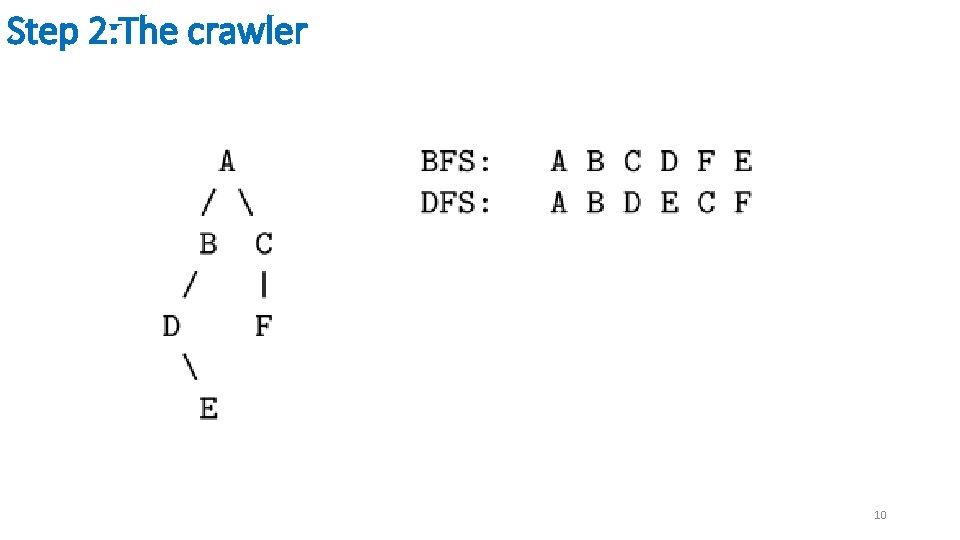
Step 2: The crawler (group No. 6) • Visit policy: Techniques for crawling the Web or visit policies are variants of the two fundamental graph search operations: Breadth-First Search (BFS) and Depth-First Search (DFS): the former uses a queue to maintain a list of to be visited sites, and the latter a stack. Between the two the latter (DFS) is more often used in crawling. (Why? ) • Starting with a node say A (see example), BFS first visits the nodes at distance one from A, then those at distance two, and so on. In other words, for document A it finds its links to B and C and visits those pages one after the other. Then it extracts from those pages links to other pages and goes on as needed. In DFS on the other hand, you go as deep as you can go on any given link. Thus after A you follow the first link to B and then you realize that B points to D and that link is followed that include a link to E. Because E has no links DFS backtracks once to explore other links from D that do not exist. It then backtracks once again and as B has no other links to follow DFS backtracks all the way to A to realize that A has one more link other than B to web-page C (and so on then to F). 9
Step 2: The crawler 10
Step 2: The crawler (group No. 6) • Visit policy: Techniques for crawling the Web or visit policies are variants of the two fundamental graph search operations: Breadth-First Search (BFS) and Depth-First Search (DFS): the former uses a queue to maintain a list of to be visited sites, and the latter a stack. Between the two the latter (DFS) is more often used in crawling. (Why? ) • Starting with a node say A (see example), BFS first visits the nodes at distance one from A, then those at distance two, and so on. In other words, for document A it finds its links to B and C and visits those pages one after the other. Then it extracts from those pages links to other pages and goes on as needed. In DFS on the other hand, you go as deep as you can go on any given link. Thus after A you follow the first link to B and then you realize that B points to D and that link is followed that include a link to E. Because E has no links DFS backtracks once to explore other links from D that do not exist. It then backtracks once again and as B has no other links to follow DFS backtracks all the way to A to realize that A has one more link other than B to web-page C (and so on then to F). 11
Step 2: The crawler (group No. 7) • URLs and doc. IDs. A web-page first crawled might be assigned a unique ID usually called doc. ID for document id. Subsequent crawls that retrieve the same or newer versions of the document may not change the doc. ID of that URL. A doc. ID may be a “hash” (aka unique fingerprint) of the document’s URL. More often however the hash is not the doc. ID but is being used to assign to the document’s URL a doc. ID from a predetermined range. A doc. ID can be a 32 -bit word (used to be so in Google up to around 2004) or a 64 -bit word. It is easier to reference a document by its 4 - or 8 -byte doc. ID than say its variable length (50 -byte or more) 12
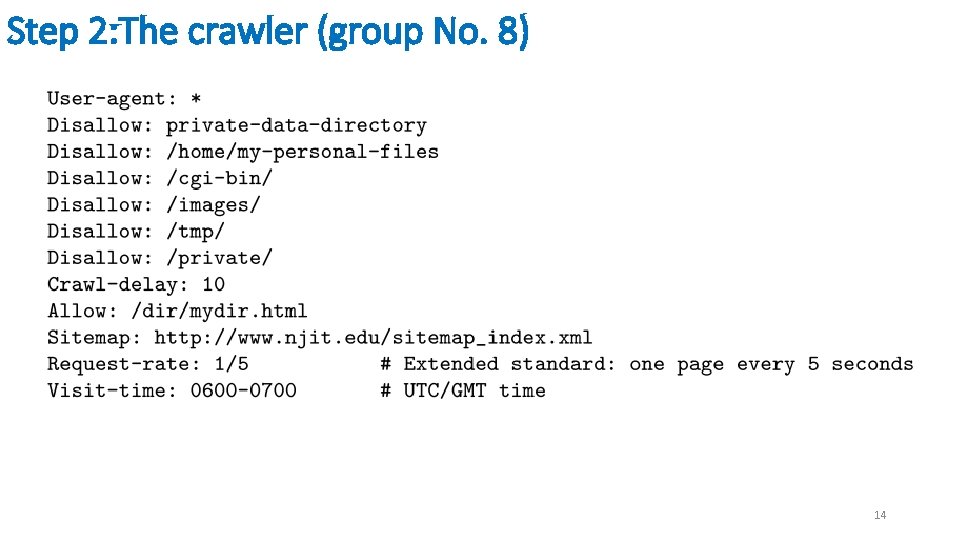
Step 2: The crawler (group No. 8) • Observance policy: Other issues that can affect crawling include the visited web-server load. This is taken into consideration so that the crawler does not slow down the server’s work or overload it. Some guidelines provided by the server will also help determine the robot’s/crawler’s behavior. Such guidelines are expressed through a robots. txt file and are called observance policies. • An example of a robots. txt file is depicted in the following Figure 4. Equivalently, one could include in the body of a web-page a <META> tag to request that the web-page not be indexed. This for example can be achieved as follows: <META NAME="ROBOTS" CONTENT="NOINDEX, NOFOLLOW">. A web -page that includes this tag is not only not indexed, but its links are not followed by a web-crawler that respects these tags. 13
Step 2: The crawler (group No. 8) 14
Step 2: The crawler (group No. 9) • Parallelization or coordination/synchronization policy of the crawler. Because of the vastness of the Web, there is not such thing as a single crawler (program). There are multiple crawlers running multiple threads of crawling each directed to a different set of URLs supplied by a URL server. In such cases their activity needs to be properly synchronized. The URL server might thus send URLs affecting a given domain or country to the same or different crawler. 15
Step 3: The indexer and the indexing process (group No. 9) • The indexer. The input to the indexer is the collection of web pages fetched from the Web by the crawler and then delivered to the indexer directly or indirectly through the Repository. The output of the indexer is the (inverted) index. The index (aka inverted index) is an efficient data structure that represents the documents of a Corpus and allows fast searching of the Corpus documents using that indexed information. 16
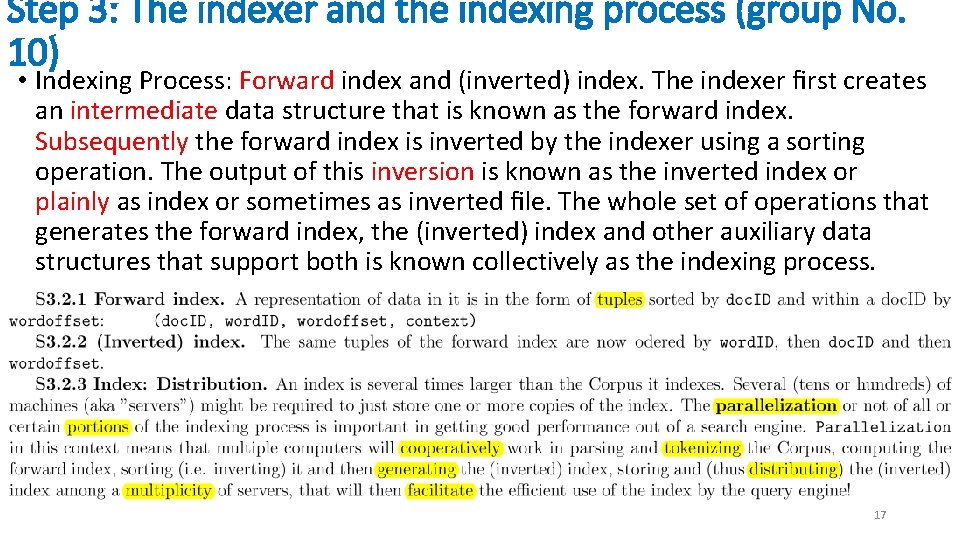
Step 3: The indexer and the indexing process (group No. 10) • Indexing Process: Forward index and (inverted) index. The indexer first creates an intermediate data structure that is known as the forward index. Subsequently the forward index is inverted by the indexer using a sorting operation. The output of this inversion is known as the inverted index or plainly as index or sometimes as inverted file. The whole set of operations that generates the forward index, the (inverted) index and other auxiliary data structures that support both is known collectively as the indexing process. 17
Step 3: The indexer and the indexing process (group No. 11) • Web Search is Searching the Index of the Web not the Web itself! When we perform an ad-hoc search of the Web, we do not search the Web directly but the representation of the documents of the Web as abstracted by the constructed index. The index usually stores a representation of a (sometimes incomplete) copy of the Web. • Forward index. For every document in the collection, the indexer generates a sequence of tuples that describe that document. Each such tuple contains information about the document (doc. ID), the token/keyword/index-term encountered (word. ID), an offset of the token etc in that document from the start of the document (word or character offset), and some context information (does the word appear in the title of an HTML or other document, or in the anchor field of a link, in modified font such as in bold or emphasized font or in elevated font size). Compression of the forward index is quite possible: all tuples of the same document have the same doc. ID, the one of the document itself. Consecutive tuples have offsets that are close to each other, i. e. two consecutive offsets differ by a very small number (such as one or two for word offsets). 18
Step 3: The indexer (group No. 12) • Index or Inverted index. A sorting operation is applied to the forward index to derive the index (inverted-index). This inversion (sorting process) would sort the forward index tuples by word. ID first, then (for the same word. ID tuples) by doc. ID, then (for the same word. ID, doc. ID) by offset/context. • This way the index is defined for a given index-term to be the list of documents (doc. IDs/URLs) that contain that index-term. Implicit to it is also an ordering by doc. ID, word (or otherwise) offset. The index needs to be efficient and easily updated when new web-pages or updated versions of a current web-page are to be reencountered. • S 3. 7. 1 Why Inverted? It is called an inverted index because its information is the inverse of that found in a file: a file contains a list of index-terms (i. e. the words or tokens in the file) whereas an inverted index contains for a given index-term the documents that contains that term. (And inversion is the sorting operation that converts one form into the other. ) 19
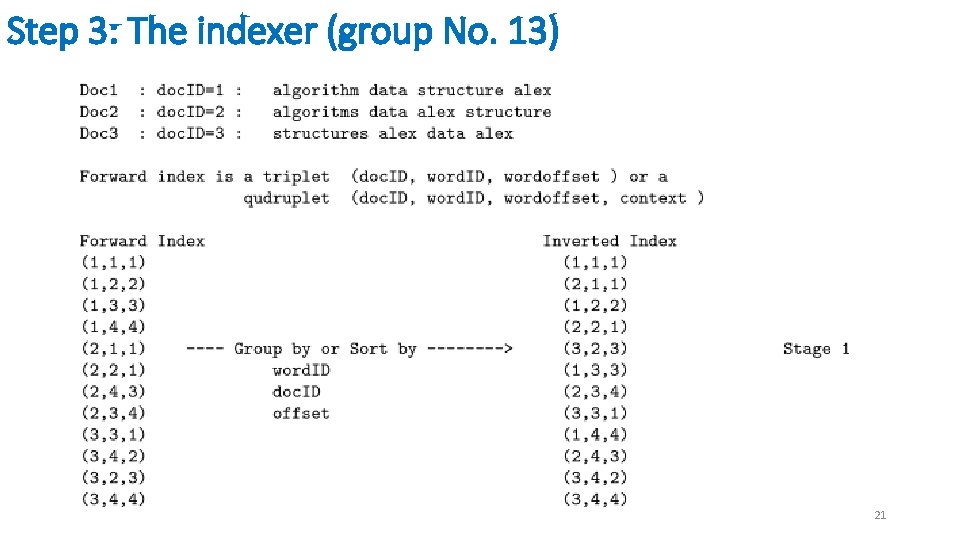
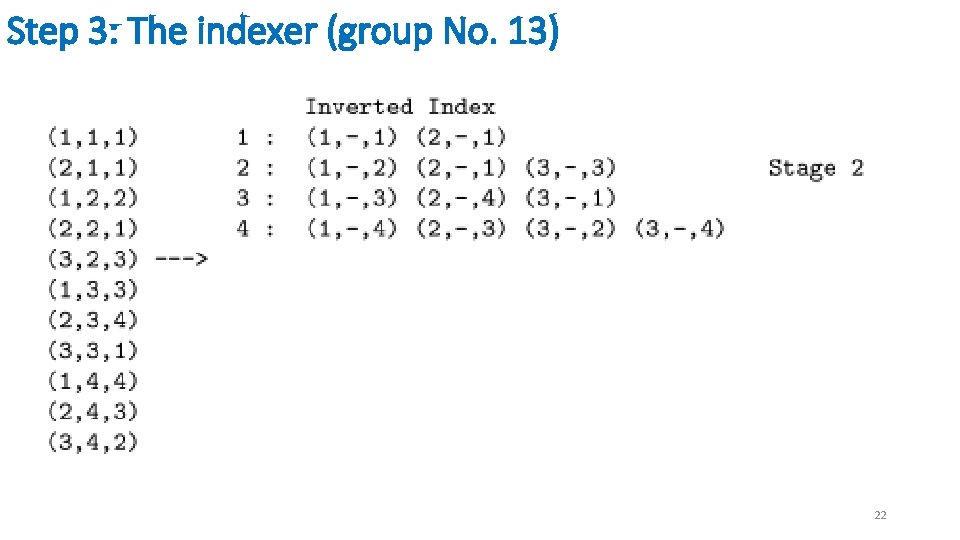
Step 3: The indexer (group No. 13) • An example. On the example of the following page, Stage 1 generates the inverted index from the forward index after the sorting operation by word. ID, doc. ID, offset as stated above. Consecutive (top to bottom tuples) of the inverted index are thus ordered by word. ID (middle i. e. second field) and those tuples that have the same word. ID value are also ordered by offset (i. e. third field). Thus by a linear scan we can group those tuples by word. ID. This is stage 2. There are two tuples with word. ID equal to 1. Thus for each word. ID we build a list of tuples i. e. the instances of appearance of the corresponding word in the Corpus. Thus the word with word. ID equal to 4 (i. e. alex) appears 4 times in the Corpus. Auxiliary structures include a doclist aka a mapping of doc. ID into ”document descriptors aka URLs”, a ”vocabulary” that maintains in sorted order the word with associated word. IDs plus other interesting information, and a ”hash table”-based Lexicon that allow for fast look-up by a word value to retrieve the word’s corresponding word. ID. Hashing is faster than say binary search (on the average). 20
Step 3: The indexer (group No. 13) 21
Step 3: The indexer (group No. 13) 22
- Slides: 22