
Lecture 8 Monosynaptic Reflexes Reflex Common misnomer an


- Slides: 14
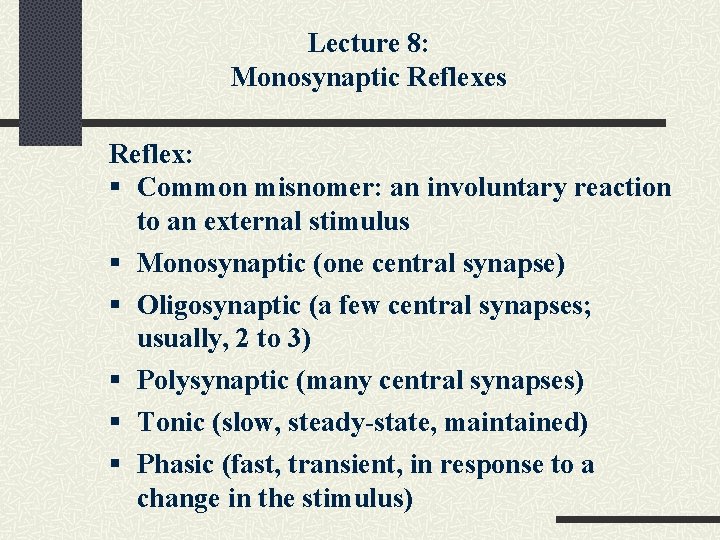
Lecture 8: Monosynaptic Reflexes Reflex: § Common misnomer: an involuntary reaction to an external stimulus § Monosynaptic (one central synapse) § Oligosynaptic (a few central synapses; usually, 2 to 3) § Polysynaptic (many central synapses) § Tonic (slow, steady-state, maintained) § Phasic (fast, transient, in response to a change in the stimulus)
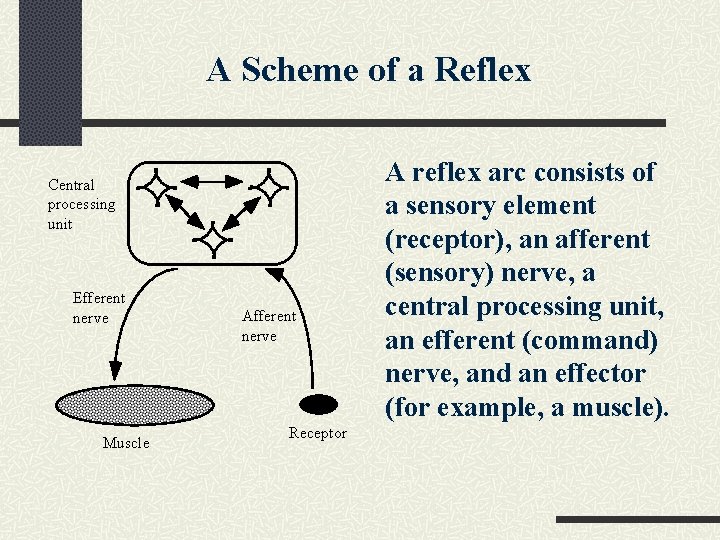
A Scheme of a Reflex Central processing unit Efferent nerve Muscle Afferent nerve Receptor A reflex arc consists of a sensory element (receptor), an afferent (sensory) nerve, a central processing unit, an efferent (command) nerve, and an effector (for example, a muscle).
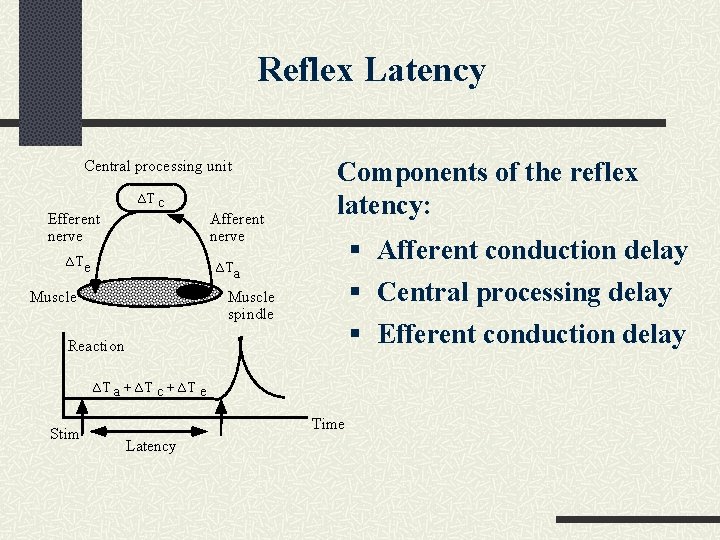
Reflex Latency Central processing unit Efferent nerve ∆T c ∆T e Afferent nerve Components of the reflex latency: § Afferent conduction delay § Central processing delay § Efferent conduction delay ∆T a Muscle spindle Muscle Reaction ∆T a + ∆T c + ∆T e Stim Time Latency
Monosynaptic Reflexes a-motoneuron Efferent nerve Muscle Ia afferents Muscle spindle Monosynaptic reflexes involve one central synapse. In humans, they originate from Ia spindle afferents and induce responses in the same muscle or in muscles in the vicinity.
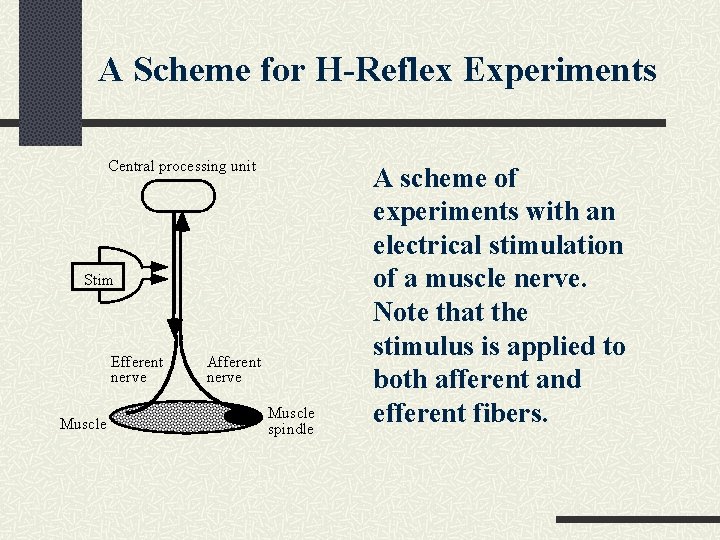
A Scheme for H-Reflex Experiments Central processing unit Stim Efferent nerve Muscle Afferent nerve Muscle spindle A scheme of experiments with an electrical stimulation of a muscle nerve. Note that the stimulus is applied to both afferent and efferent fibers.
H-Reflex and M-Response (I) EMG Time St EMG H-reflex M-response Time St Afferent fibers are the first to react to a slowly increasing electrical stimulus. They induce a reflex muscle contraction (H-reflex). Later, efferent fibers become excited and induce a direct muscle contraction (M-response).
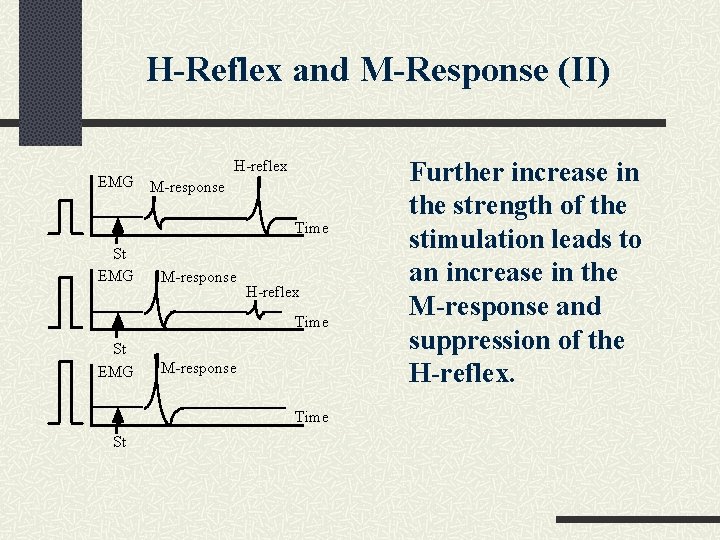
H-Reflex and M-Response (II) EMG H-reflex M-response Time St EMG M-response H-reflex Time St EMG M-response Time St Further increase in the strength of the stimulation leads to an increase in the M-response and suppression of the H-reflex.
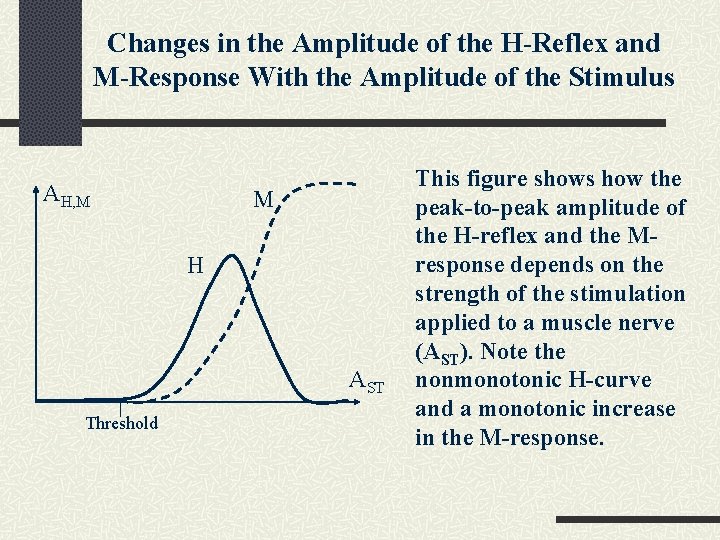
Changes in the Amplitude of the H-Reflex and M-Response With the Amplitude of the Stimulus AH, M M H AST Threshold This figure shows how the peak-to-peak amplitude of the H-reflex and the Mresponse depends on the strength of the stimulation applied to a muscle nerve (AST). Note the nonmonotonic H-curve and a monotonic increase in the M-response.
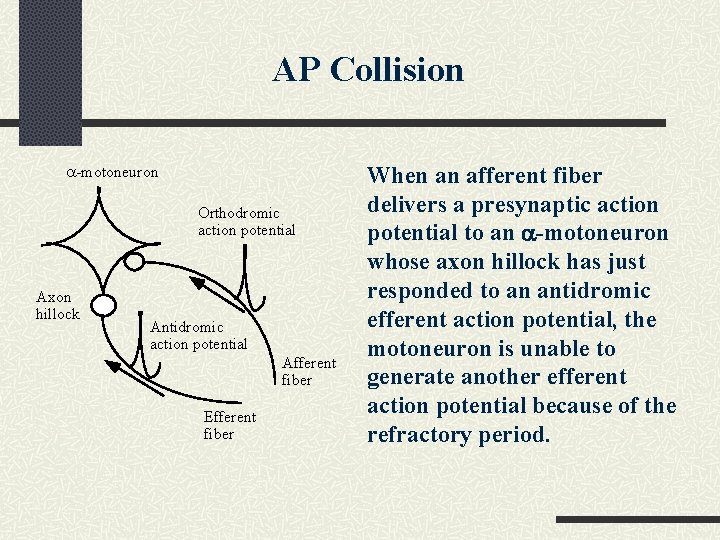
AP Collision a-motoneuron Orthodromic action potential Axon hillock Antidromic action potential Afferent fiber Efferent fiber When an afferent fiber delivers a presynaptic action potential to an a-motoneuron whose axon hillock has just responded to an antidromic efferent action potential, the motoneuron is unable to generate another efferent action potential because of the refractory period.
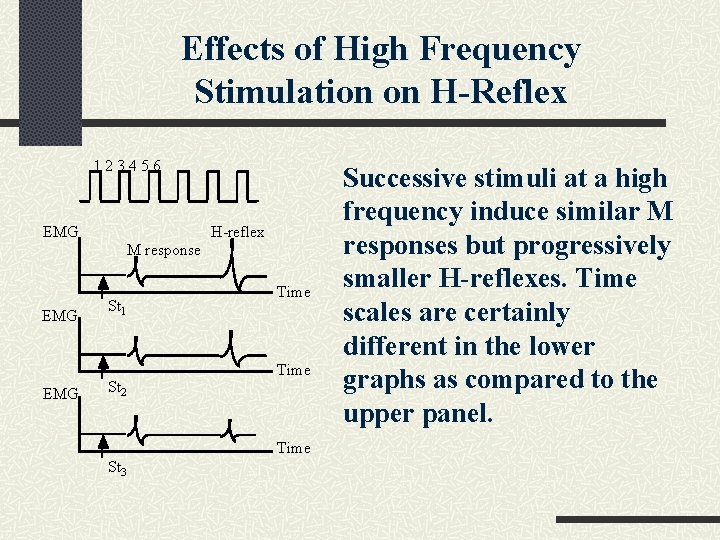
Effects of High Frequency Stimulation on H-Reflex 123456 EMG H-reflex M response EMG St 1 St 2 Time St 3 Successive stimuli at a high frequency induce similar M responses but progressively smaller H-reflexes. Time scales are certainly different in the lower graphs as compared to the upper panel.
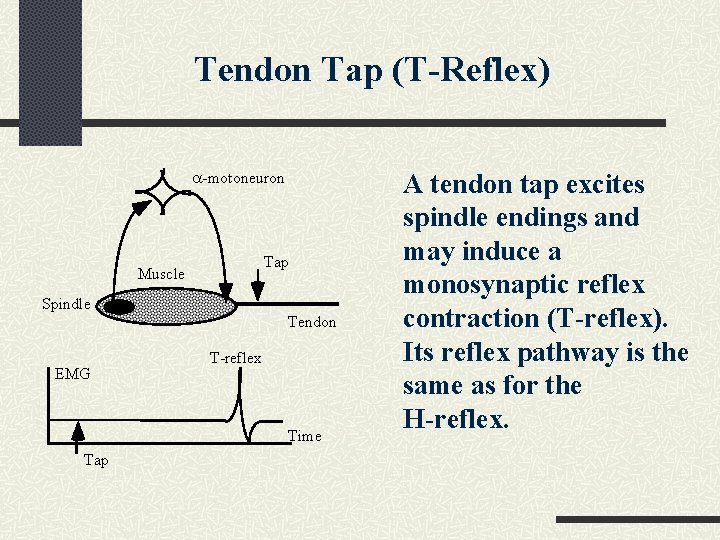
Tendon Tap (T-Reflex) a-motoneuron Tap Muscle Spindle Tendon EMG T-reflex Time Tap A tendon tap excites spindle endings and may induce a monosynaptic reflex contraction (T-reflex). Its reflex pathway is the same as for the H-reflex.
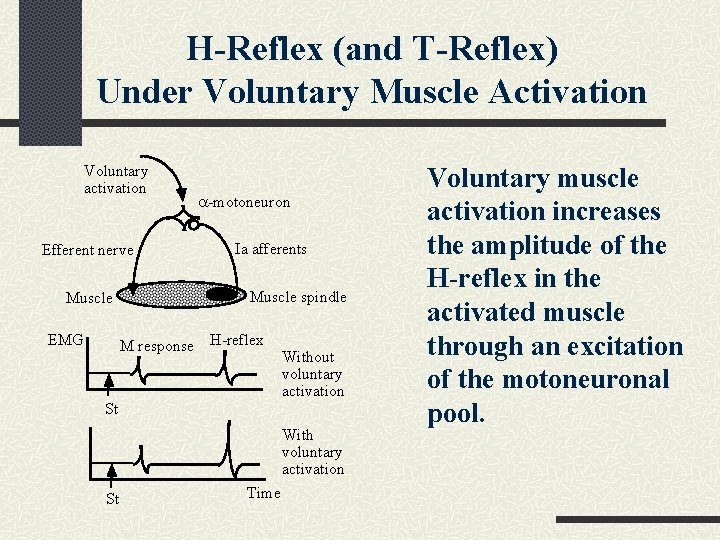
H-Reflex (and T-Reflex) Under Voluntary Muscle Activation Voluntary activation Efferent nerve Muscle EMG a-motoneuron Ia afferents Muscle spindle M response H-reflex St Without voluntary activation With voluntary activation St Time Voluntary muscle activation increases the amplitude of the H-reflex in the activated muscle through an excitation of the motoneuronal pool.
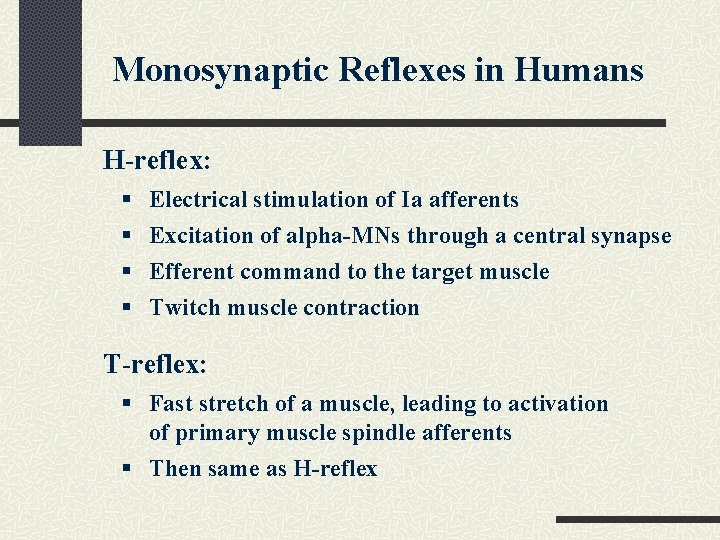
Monosynaptic Reflexes in Humans H-reflex: § § Electrical stimulation of Ia afferents Excitation of alpha-MNs through a central synapse Efferent command to the target muscle Twitch muscle contraction T-reflex: § Fast stretch of a muscle, leading to activation of primary muscle spindle afferents § Then same as H-reflex
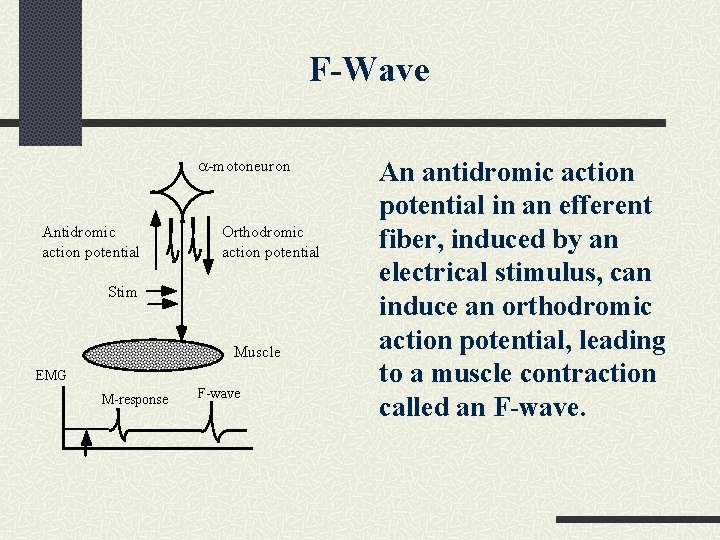
F-Wave a-motoneuron Antidromic action potential Orthodromic action potential Stim Muscle EMG M-response F-wave An antidromic action potential in an efferent fiber, induced by an electrical stimulus, can induce an orthodromic action potential, leading to a muscle contraction called an F-wave.