
Lecture 8 MARKETING MIX PLACE ISSUES CONCERNING DISTRIBUTION
Lecture 8 MARKETING MIX: PLACE
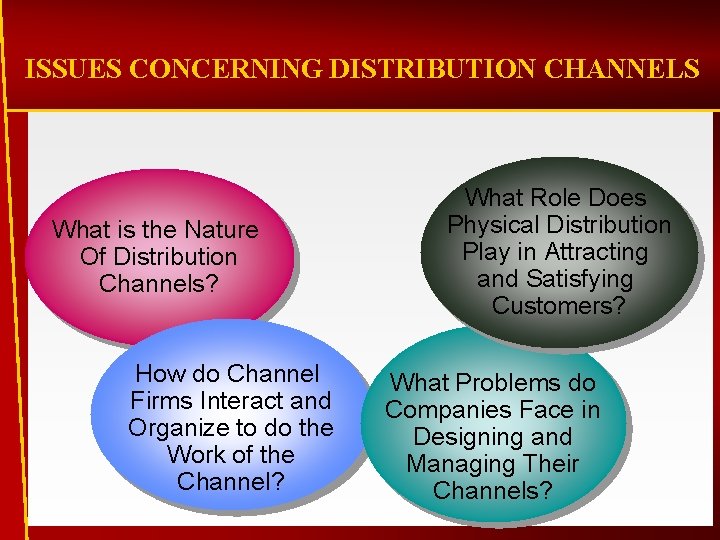
ISSUES CONCERNING DISTRIBUTION CHANNELS What is the Nature Of Distribution Channels? How do Channel Firms Interact and Organize to do the Work of the Channel? What Role Does Physical Distribution Play in Attracting and Satisfying Customers? What Problems do Companies Face in Designing and Managing Their Channels?
WHAT IS A DISTRIBUTION CHANNEL? l. A set of interdependent organizations (intermediaries) involved in the process of making a product or service available for use or consumption by the consumer or business user. l Marketing Channel decisions are among the most important decisions that management faces and will directly affect every other marketing decision.
WHY ARE MARKETING INTERMEDIARIES USED? l l l The use of intermediaries results from their greater efficiency in making goods available to target markets. Offer the firm more than it can achieve on it’s own through the intermediaries: l Contacts, l Experience, l Specialization, l Scale of operation. Purpose: match supply from producers to demand from consumers.
CHOICE OF DISTRIBUTION l Distributing through company’s own sales outlets. l Selling through franchised outlets. l Using the services of the manufacturer’s agents to market the product through specialised or non-specialised wholesalers and/or retailers. l Using the company’s own sales force to distribute product directly to end-users or through specialised or non-specialised wholesalers and/or retailers. l Distributing through mail or parcel delivery services on the basis of orders from catalogues or coupon advertisement placed in the mass media. l Selling through the Internet.
IMPORTANT CONSIDERATIONS l The maintenance of distribution outlets. l The position of products on the shelves- near the entrance or the back door, at eye level, at the top or the bottom of the shelves and so on. l The extent of provision of after sales service/technical facilities. l The size and physical set up of retail units (Small shops / corner shops/ developed - retail chains, Supermarkets/ Hyper markets).
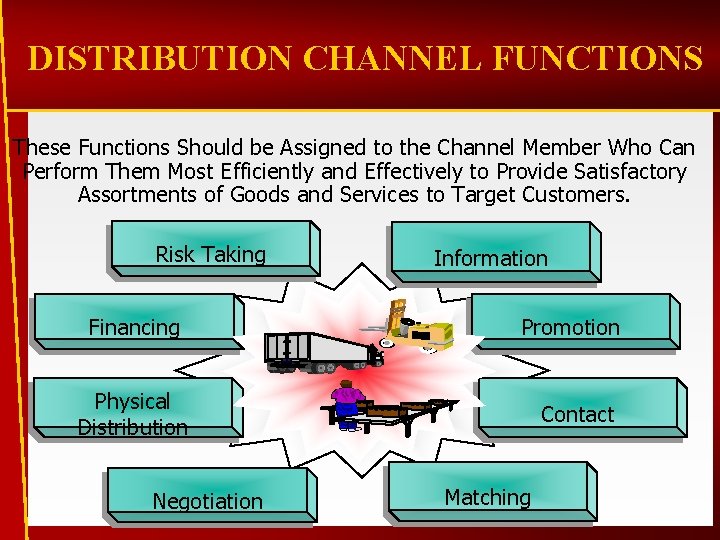
DISTRIBUTION CHANNEL FUNCTIONS These Functions Should be Assigned to the Channel Member Who Can Perform Them Most Efficiently and Effectively to Provide Satisfactory Assortments of Goods and Services to Target Customers. Risk Taking Financing Information Promotion Physical Distribution Negotiation Contact Matching
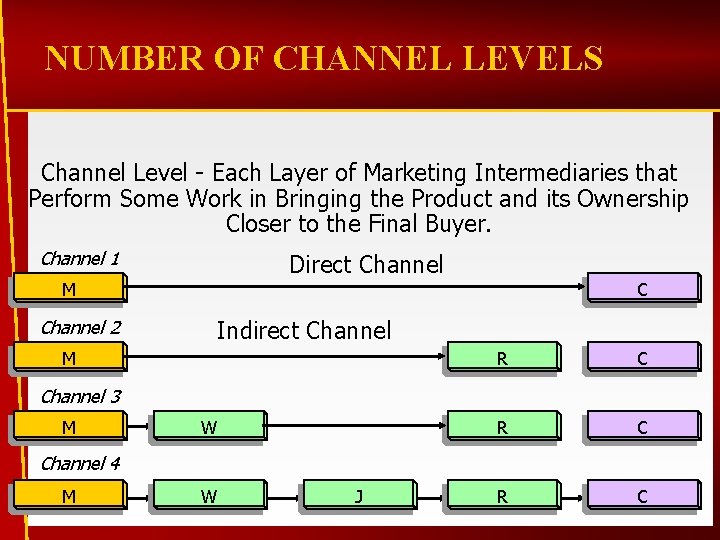
NUMBER OF CHANNEL LEVELS Channel Level - Each Layer of Marketing Intermediaries that Perform Some Work in Bringing the Product and its Ownership Closer to the Final Buyer. Channel 1 Direct Channel M C Channel 2 Indirect Channel M R C R C Channel 3 M W Channel 4 M W J
CHANNEL BEHAVIOUR AND CONFLICT l l l The channel will be most effective when: l each member is assigned tasks it can do best. l all members cooperate to attain overall channel goals and satisfy the target market. When this doesn’t happen, conflict occurs: l Horizontal Conflict occurs among firms at the same level of the channel, i. e retailer to retailer. l Vertical Conflict occurs between different levels of the same channel, i. e. wholesaler to retailer. For the channel to perform well, each channel member’s role must be specified and conflict must be managed.
VERTICAL MARKETING SYSTEM Vertical Marketing System (VMS): l All the stakeholders of an organisation work in partnership with one another l Conflict is minimised and customers benefit from the value added from such interrelationship.

MODES OF DISTRIBUTION l Intensive Distribution l Exclusive l Selective Distribution
INTENSIVE DISTRIBUTION l In the intensive mode of distribution, as many distributors as possible are identified to make the products available to customers. l The purpose of intensive distribution is to make the product available as widely as possible. l Intensive distribution is primarily applicable to convenience goods like cigarettes, matches, rice, toothpaste, edible oil, and so on.

EXCLUSIVE DISTRIBUTION l In the exclusive mode of distribution, a limited number of intermediaries are identified to market and distribute the products l The intermediaries are granted the exclusive right to distribute the company’s products in the territories that are assigned to them. l Exclusive distribution tends to enhance the product’s image and allows higher commitment and specialisation. l However, care must be taken to ensure that the appointed intermediaries meet the expected target sales and remain committed to the manufacturer.
SELECTIVE DISTRIBUTION l In the case of selective distribution, the number of intermediaries lies somewhere between intensive and exclusive distribution. l Marketing managers make use of only a few intermediaries in a particular area; all possible intermediaries in that area, as it is the case with intensive distribution, are not appointed to market the organisation’s product.
![BENEFITS OF SELECTIVE DISTRIBUTION[1] Intermediaries and Producers l Selective distribution is used, particularly by](http://slidetodoc.com/presentation_image_h/28f1fb952e966f3646a0e3b0db317bdd/image-15.jpg "BENEFITS OF SELECTIVE DISTRIBUTION[1] Intermediaries and Producers l Selective distribution is used, particularly by")
BENEFITS OF SELECTIVE DISTRIBUTION[1] Intermediaries and Producers l Selective distribution is used, particularly by new companies seeking to establish a distribution channel in order to make their products available. l Companies looking for distributors may promise selective distribution as an incentive, (e. g, that they would be among the few ones to cover the area or region).
![BENEFITS OF SELECTIVE DISTRIBUTION [2] Intermediaries and Producers l Selective distribution is used particularly](http://slidetodoc.com/presentation_image_h/28f1fb952e966f3646a0e3b0db317bdd/image-16.jpg "BENEFITS OF SELECTIVE DISTRIBUTION [2] Intermediaries and Producers l Selective distribution is used particularly")
BENEFITS OF SELECTIVE DISTRIBUTION [2] Intermediaries and Producers l Selective distribution is used particularly by wellestablished companies. l Normally it helps to establish better working relationship with the selected middlemen and companies expect a better than average selling effort. l Selective distribution enables producers to gain adequate market coverage with more control and lesser cost than intensive distribution.
PHYSICAL DISTRIBUTION Physical distribution involves the actual transfer of the product from the manufacturer to the customer as an end user and refers to: the activities such as order processing, inventory management, materials handling, warehousing, and transportation - used to move products from manufacturers or producers to consumers and other end users.
PHYSICAL DISTRIBUTION FUNCTIONS 1. Order Processing 2. Inventory Management 3. Materials Handling 4. Warehousing 5. Transportation
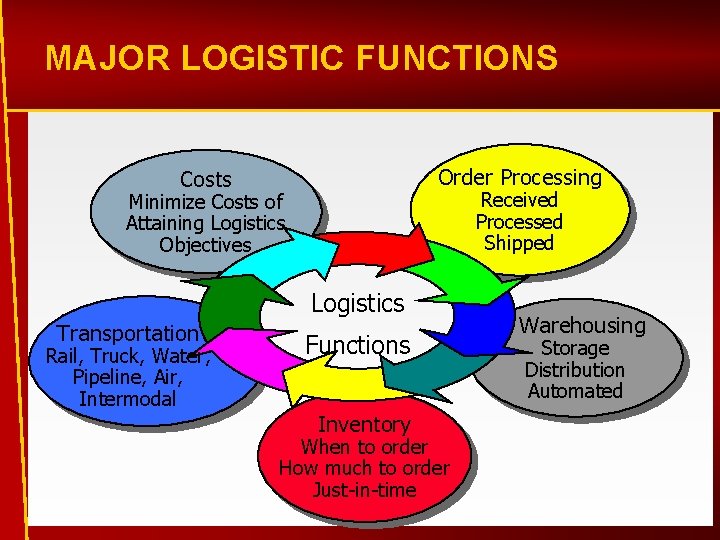
MAJOR LOGISTIC FUNCTIONS Order Processing Costs Received Processed Shipped Minimize Costs of Attaining Logistics Objectives Logistics Transportation Rail, Truck, Water, Pipeline, Air, Intermodal Functions Inventory When to order How much to order Just-in-time Warehousing Storage Distribution Automated
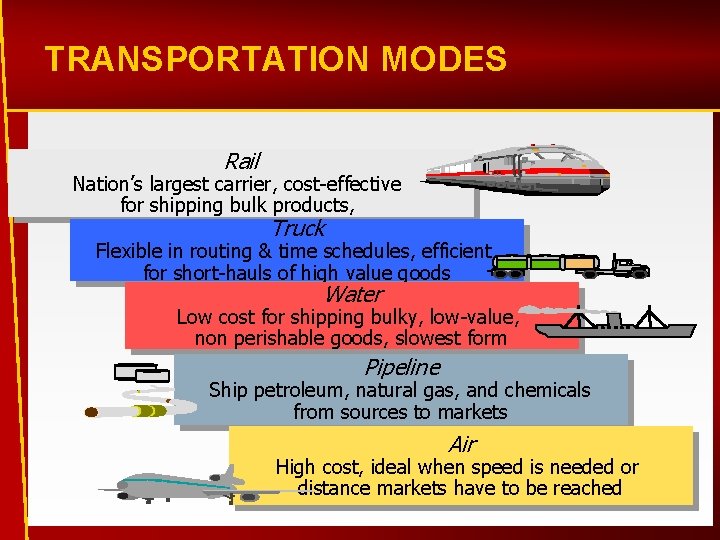
TRANSPORTATION MODES Rail Nation’s largest carrier, cost-effective for shipping bulk products, Truck Flexible in routing & time schedules, efficient for short-hauls of high value goods Water Low cost for shipping bulky, low-value, non perishable goods, slowest form Pipeline Ship petroleum, natural gas, and chemicals from sources to markets Air High cost, ideal when speed is needed or distance markets have to be reached
DISCUSSION QUESTIONS l Explain why companies use distribution channels and discuss the functions these channels perform. l Identify the major channel alternatives open to a company. l Discuss the nature and importance of physical distribution.
- Slides: 21