
Lecture 8 Legal Issues in Computing Some of










- Slides: 50
Lecture 8 Legal Issues in Computing
Some of the Dominant Legal Issues in Computing § Ownership § Intellectual Property Protection (IP) § Anti-Trust and Unfair Competition § File Sharing § Fraud § Privacy (Covered later in Databases)
Ownership § When you write a piece of software or design a unique webpage, who owns it? § Answer: You Do!! § Who gets to decide who can use it and for what purpose? § Answer: You Do!!
What are some of your options? § You can give unrestricted free usage of it, otherwise known as Freeware or Shareware § You can license it, for a fee, with restrictions on its use § You can sell it, lock stock and barrel and transfer ownership altogether
Most common ownership model is licensing model § Typical restrictions may include: § Copy restrictions § Limited to certain number of computers § Limited to certain number of users § Limited in Time and must be renewed § Limited Geography of use § Limited Functionality
How do you protect your IP? § Copyright registration § Trademark registration § Patents ( for unique invention) § Copy protection § On-line registration for every new installation § Protect the source code! § Audits
Copyrights § Protects the arrangement of your design including the text, the graphics, the industrial design § Sometimes hard to prove infringement in a lawsuit and often left up to “interpretation” and common sense
Trade. Mark § A form of copyright which protects your public brand image and associated design of things like Logos and advertising material § Mc. Donald’s Golden Arches is a classic example of this….
Patents § Reserved for protecting unique innovations and inventions that represent a “new” approach to solving a problem or creating a product or process § Takes a formal process of searches, filings and disclosures § Approximately 18 month process minimum and $5 -10 K in cost § Patents expire after 17 years in most cases
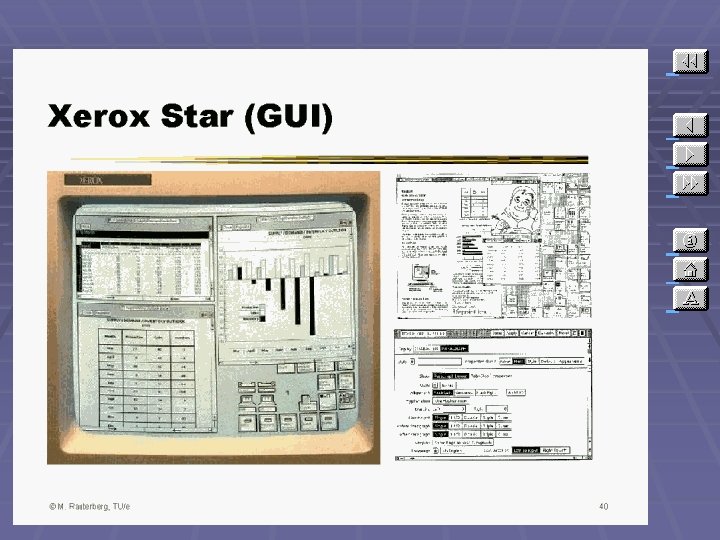
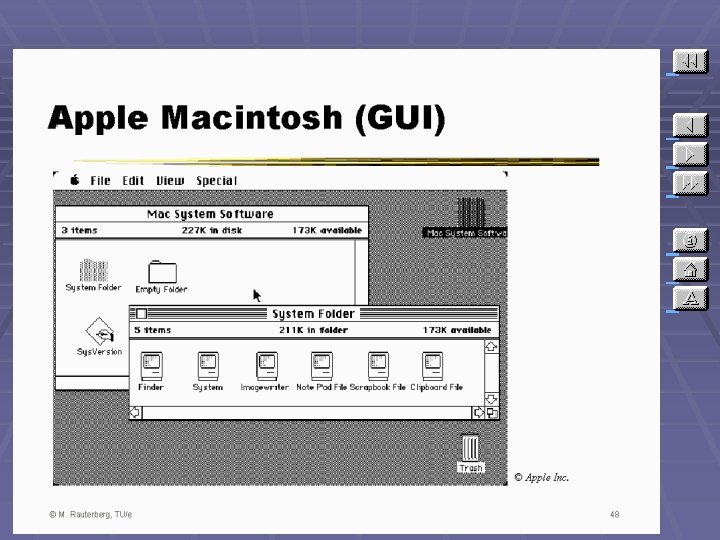
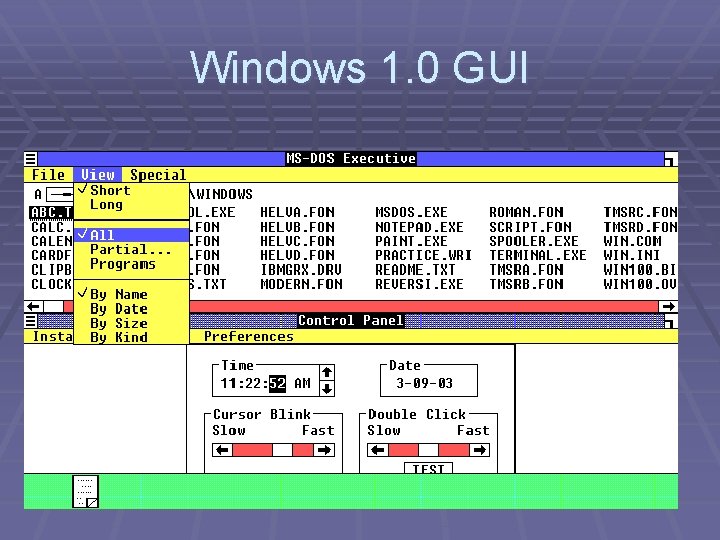
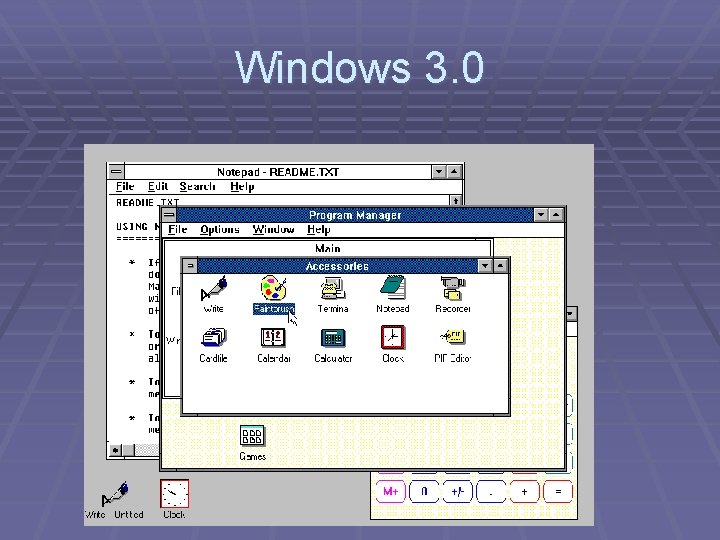
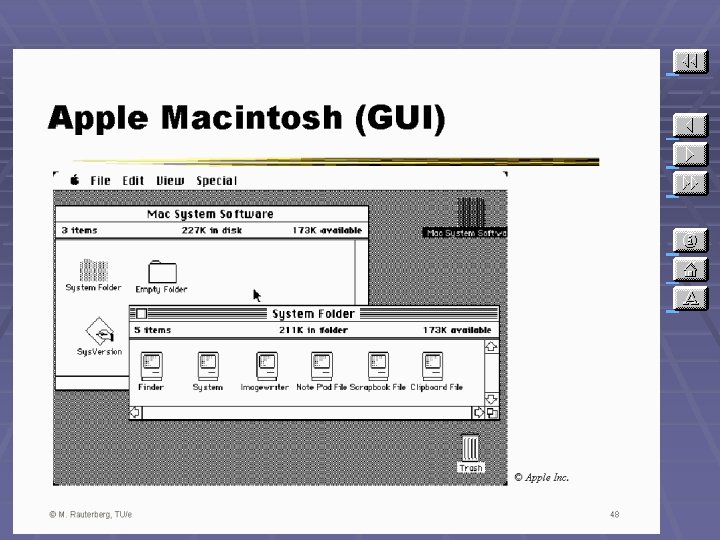
The Famous Apple vs. Microsoft lawsuit over Windows § Apple introduces the first commercial computer using a GUI, in 1983, based on pioneering work done by Xerox § Microsoft was set to introduce Windows 1. 0 in 1985 and entered into an agreement with Apple to license and sub-license certain aspects of the GUI interface § In return, Apple was granted use of certain Microsoft products for its computers
Windows 1. 0 GUI Desktop with applications in Windows 1. 01. The screenshot has an extra border (remove) and wrong aspect ratio (correct).
Windows 3. 0
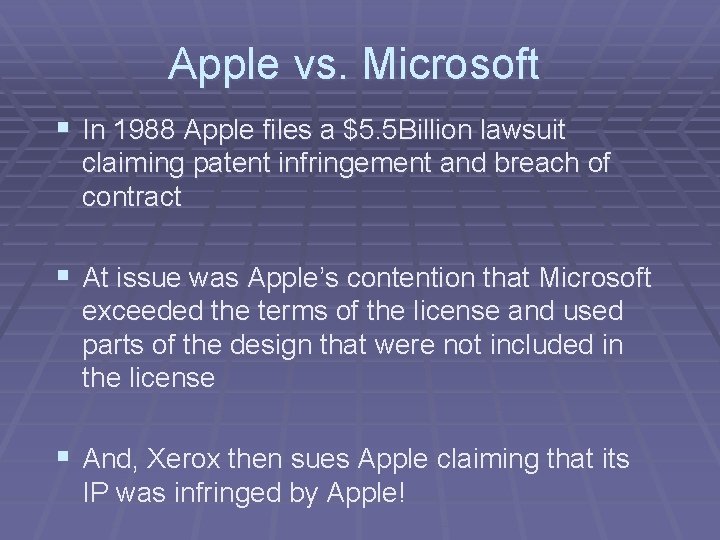
Apple vs. Microsoft § In 1988 Apple files a $5. 5 Billion lawsuit claiming patent infringement and breach of contract § At issue was Apple’s contention that Microsoft exceeded the terms of the license and used parts of the design that were not included in the license § And, Xerox then sues Apple claiming that its IP was infringed by Apple!
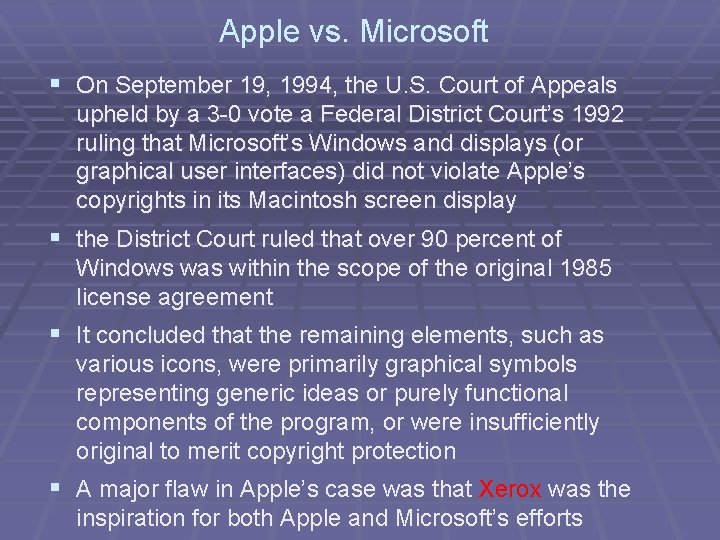
Apple vs. Microsoft § On September 19, 1994, the U. S. Court of Appeals upheld by a 3 -0 vote a Federal District Court’s 1992 ruling that Microsoft’s Windows and displays (or graphical user interfaces) did not violate Apple’s copyrights in its Macintosh screen display § the District Court ruled that over 90 percent of Windows was within the scope of the original 1985 license agreement § It concluded that the remaining elements, such as various icons, were primarily graphical symbols representing generic ideas or purely functional components of the program, or were insufficiently original to merit copyright protection § A major flaw in Apple’s case was that Xerox was the inspiration for both Apple and Microsoft’s efforts
The GUIs are the problem! § Copyright law essentially protects the original expression of ideas in tangible form, such as books, artwork, music and computer software, from unauthorized copying, distribution or modification. It does not apply to ideas. § While it is well-settled that copyright protections extend to computer software, the extent to which copyright law protects screen displays has been the subject of much litigation, with many courts reaching varied results
Anti-Trust
Sherman Anti-Trust Act of 1890 § Every contract, combination in the form of trust or otherwise, or conspiracy, in restraint of trade or commerce among the several States, or with foreign nations, is declared to be illegal. § Every person who shall monopolize, or attempt to monopolize, or combine or conspire with any other person or persons, to monopolize any part of the trade or commerce among the several States, or with foreign nations, shall be deemed guilty of a felony
Standard Oil § The Sherman Act was legislated in response to John D. Rockefeller’s attempts to monopolize the emerging oil industry through his company, Standard Oil § His son, John D. Rockefeller Jr. , was a Brown alumnus and major benefactor to the University
U. S. versus IBM § By the 1960’s IBM dominated the computer industry with a >60% market share § In January 1969, the government began a sweeping antitrust investigation into IBM's dominance and attempted to break it into smaller companies that would compete against one another
U. S versus IBM § During the six most critical years of the trial, from 1975 to 1980, the parties called 974 witnesses and read 104, 400 pages of transcripts § The 13 -year investigation, which required IBM to retain 200 attorneys at one point, fizzled in the early '80 s as the computing landscape shifted from mainframes to personal computers. The government abandoned the tainted effort entirely in 1982, as clones of the IBM PC eroded Big Blue's dominance
U. S. versus IBM § With IBM, the Justice Department was trying to hit a moving target, but the target had moved so much there was no point in shooting anymore--so they dropped the case § People who worked for IBM in the '80 s and early '90 s said the company routinely fell victim to "pricing death strategy"--a reluctance to lower prices below cost, even on products that weren't selling--to avoid what the government would call predatory pricing § Viewed today, the Government’s case against IBM appears ludicrous to many in retrospect
U. S versus Microsoft § In 1998 the Federal govt. filed a massive lawsuit against Microsoft which charged that it was in violation of antitrust laws by having engaged in § Predatory conduct § Bundling § Exclusionary Contracts As relates to the deployment of Microsoft Internet Explorer at the expense of Netscape, a competing product
U. S. vs. Microsoft § Predatory Conduct § The lawsuit claims that Microsoft, by giving away Internet Explorer for free, is exercising unfair advantage against Netscape, which sells its browser. By doing so, Microsoft is drying the revenue of Netscape, driving the company out of business
U. S. vs. Microsoft § Bundling § Microsoft not only gave Internet explorer for free; it also started closely linking Windows to Internet explorer. The lawsuit claims that, by closely bundling Internet Explorer with Windows operating system, Microsoft has significant advantage over its rivals
U. S. vs. Microsoft § Exclusionary Contracts § The lawsuit claims that, by forcing Internet service providers (ISPs) to distribute Internet Explorers with their products, instead of other browser, and in turn providing a link in Windows to these ISPs, Microsoft has used its monopoly to take unfair advantage against the competition. § By providing discounts and incentives to manufacturers and Internet service providers Microsoft takes advantage and uses that advantage to gain monopoly in the browser market
Blood in the Water! § Sensing blood in the water, many additional lawsuits were filed by Microsoft’s competitors, by State attorney generals and several foreign governments, including the EEU. § At this time (2003), Microsoft has avoided a breakup of the Company but has had to make considerable concessions as part of settling some of the suits. § If Microsoft was a French company, there would be a statue of Bill Gates on the Champs Elysee!
Politics and Anti-Trust § The use of Anti-Trust suits by the Government is very related to the politics of the administration in power at the time. § The Microsoft suit was brought during the Clinton administration § Microsoft has dodged a lot of very serious bullets and remedies since the Bush administration has been in office
Anti-Trust against Apple § Various lawsuits around the world have been filed against Apple for restriction of content associated with its i. Pod, i. Phone and i. Pad products when using the i. Tunes and i. Phone App Store. § Additionally there were cases pending against Apple and AT&T for restrictions on the purchase and operation of the i. Phone
File Sharing § The legal debate centers on the issue of whether you have the right to share copyrighted material with other parties as opposed to making copies for your own personal use.
File Sharing Lawsuits § The Recording Industry Association of America has filed many lawsuits against people trading unauthorized music online, including lawsuits against 69 people who allegedly used university networks to download music § Recent cases levied a fine of over $100 K against a woman that shared files over Kazaa.
Brown U. Response § Brown University issued a statement reacting to the lawsuits: "Brown University has not yet received notice of the lawsuits announced today by the RIAA. If the University is served with a subpoena that meets the requirements of the law, Brown will comply as fully as possible. Until the University is served, however, it does not know the extent of the RIAA action. Any Brown student found in violation of the law will also be subject to University disciplinary action. "
Debate rages on over swapping of music and videos § Despite the growth of legitimate, paid music-downloading services online, the legal, moral and economic debate over free music and video swapping shows no sign of being resolved soon.
IP Litigation involving Apple Inc. § A Very, Very long list in which Apple is both plaintiff and defendants at various times § It is fair to say that Apple has spent 100 s of millions of dollars on litigation around its products, intellectual property and trade practices § http: //en. wikipedia. org/wiki/Apple_Inc. _litig ation
Apple and Trademarks § Between just 2008 and 2010 Apple filed over 350 complaints over the improper use of its trademarks, i. Pod, i. Pad, i. Touch, i. Phone, Apple and Safari
Apple vs. Samsung In 2011 Apple alleged that Samsung used some of its IP in its Galaxy III cell phone § Apple was simultaneously suing Motorola for similar patent infringement § Known as the Mobile Patent Wars aimed at the incredible success of Android in the market, owned by Google
Apple vs. Samsung § Apple’s actions against Samsung eventually spread to 50 different lawsuits across more than a dozen countries § Samsung and Google countersued Apple in almost all cases § In August 2012 a U. S. Court held for Apple and assessed $1 B in damages against Samsung
Apple vs. Samsung § Apple requested that Samsung be forced to stop selling its Galaxy Android based phones in the U. S. while the appeals are pending. § Largest single damages award in recent history.
So who is winning? § As of early 2014, Apple has been largely successful against Samsung, with the bulk of rulings and court decisions going in Apple’s favor. Apple has also struck a blow against companies (like Motorola) using predatory licensing on standards-essential patents to seek bans on competing products, and can perhaps claim a moral victory with Samsung outright admitting some of its products copied Apple technology.
What have they actually won? § A settlement reached in 2018 appears to have been reached. § A jury awarded Apple $500 M in damages § “And if I had to characterize it, it didn’t really accomplish anything, ” said Brian J. Love, a Santa Clara University law professor who tracked the case. “Close to a decade of litigation, hundreds of millions of dollars spent on lawyers, and at the end of the day, NO products were removed from the market”
The Cost of Litigation § Who pays for these hundreds of lawsuits? § Ans: We Do! It’s built into the price of selling the product.
Read more here…. . § https: //www. nytimes. com/2018/06/27/tech nology/apple-samsung-smartphonepatent. html
Volkswagon Diesel. Gate !! 640 × 426
Volkswagen admits 11 million diesel cars have sneaky software installed !!!!
Possibly the most expensive Computer enabled fraud ever…so far § VW falsified emissions data for turbo diesel cars when they were being measured on the test station § Software changed the engine parameters and performance when car was actually being driven on the road and the car emissions increased substantially in real driving as opposed to testing § This deception was intentional and approved by senior managers at VW. § The fraud was initially discovered by student scientists at West Virginia U. who were comparing the performance of various turbo diesel cars as part of a research project.
Consequences of “Dieselgate” § Over 11 million cars worldwide and half a million § § § in the U. S. are implicated in the deception VW has pledged $30 B to rectify the problem and compensate owners! In addition they have agreed to a $2. 8 B fine imposed by the U. S. Govt. Criminal indictments have been handed down in Germany against senior leadership that is implicated in the scandal VW stock lost over 50% of its value Similar issues are under investigation against Audi, Volvo, Renault, Fiat and Hyundai diesels
§ You can read the whole story in excrutiating detail here: § https: //www. caranddriver. com/news/a 15339250/everything-youneed-to-know-about-the-vw-diesel-emissions-scandal/
Questions?