
Lecture 8 Knowledge Sharing Systems Md Mahbubul Alam
Lecture 8: Knowledge Sharing Systems Md. Mahbubul Alam, Ph. D Associate Professor Dept. of AEIS Sher-e-Bangla Agricultural University
Chapter Highlights • To explain how knowledge sharing systems help users share their knowledge, both tacit and explicit. • To present the different types of knowledge repositories. • To demonstrate how sharing systems serve to organize and distribute organizational and individual knowledge. 2
Corporate Memory • Corporate memory (known as organizational memory) is made up of the aggregate intellectual assets of an organization. • It is the combination of both explicit and tacit knowledge. • The loss of Corporate Memory often results from a lack of appropriate technologies for the organization and exchange of documents. 3
What are Knowledge Sharing Systems • Systems that enable members of an organization to acquire tacit and explicit knowledge from each other. • Knowledge markets that must attract a critical volume of knowledge seekers and knowledge owners in order to be effective. • Mostly KM systems are designed to share the explicit knowledge of individuals and organizations, what is referred to as knowledge repositories. • • Explicit knowledge sharing systems: Types – Lessons learned systems – Expertise locator systems • Tacit knowledge sharing systems: Type – Communities of practice. 4
Knowledge Sharing Systems: Types 1. Incident report database – Disseminate information related to incidents or malfunctions. – Typically describe the incident together with explanations of the incident BUT not suggest any recommendation. – Typically use in the context of safety and accident investigation. 2. Alert systems – Disseminate information about a negative experience that has occurred or is expected to occur. – Use to report problems experienced with a technology. – Applicable to a single organization or to a set of related organizations that share the same technology and suppliers. 3. Best practices databases – Describe successful efforts and are expected to represent business practices that are applicable to multiple organizations in the same sector, and often use as benchmark organizational processes. – It differs from lessons learned in that they capture only successful events, which may not be derived from experience. 4. Lessons-learned systems – To capture and provide lessons that can benefit employees who encounter situations that closely resemble a previous experience in a similar situation. 5. Expertise locator systems help locate intellectual capital, seeking for an expert. 5

Types of Knowledge Repositories 6
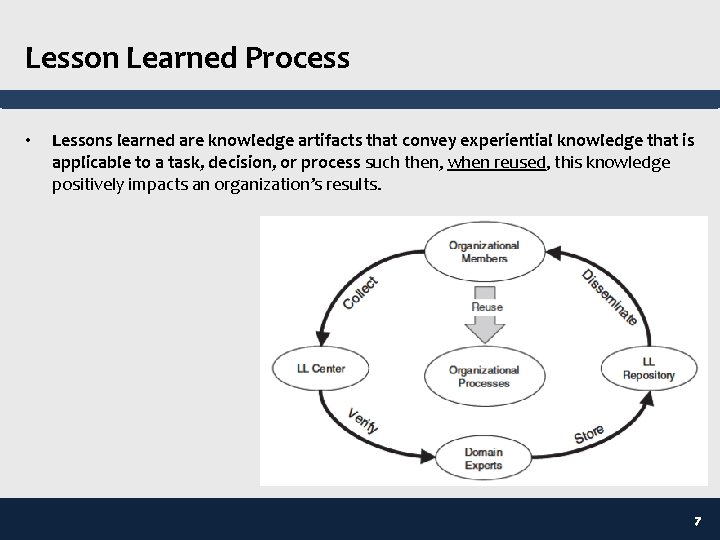
Lesson Learned Process • Lessons learned are knowledge artifacts that convey experiential knowledge that is applicable to a task, decision, or process such then, when reused, this knowledge positively impacts an organization’s results. 7
Purpose of Lessons Learned Systems (LLSs) • Collect the lessons – Passive reactive, after-action collection, proactive collection, interactive collection. • Verify the lessons • Store the lesson • Disseminate the lesson – Passive dissemination, active casting, broadcasting, active dissemination, proactive dissemination, reactive dissemination. • Apply the lesson – Browsable, executable, outcome reuse. 8
Expertise-Locator Systems (ELSs) • • Goal: to catalog knowledge competencies, including information not typically captured by human resources systems, in a way that could later be queried across the organization to help locate intellectual capital. Significant challenge in the development of ELS, knowledge repositories, and digital libraries, deals with the accurate development of knowledge taxonomies. Taxonomies, also called classification or categorization schemes, are considered to be knowledge organization systems that serve to group objects together based on a particular characteristics. Tools: e. g. , – Searchable Answer Generating Environment (SAGE) • The purpose is to create a searchable repository of university experts in a state. – Expert seekers • Organizational expertise locator KMS used to locate experts at NASA> 9
Tacit Knowledge Sharing • Communities of Practice – An organic and self-organized group of individuals who are dispersed geographically or organizationally but communicate regularly to discuss issues of mutual. – Purpose • To create a cultural environment that encourages the sharing of knowledge and thus to create a knowledge communities. 10

Question Please ?
- Slides: 11