
Lecture 8 Exploitative and Mutualistic Species Interactions Principles

- Slides: 53
Lecture 8 Exploitative and Mutualistic Species Interactions Principles of Ecology College of Forestry, Guangxi University Eben Goodale
The midterm • • Not fully graded, but clearly was difficult. Don’t worry too much … grades will be curved. Biggest problems the essay. Because writing may be difficult to you especially in a timed framework, I will reassign the essays for homework.
Midterm homework • On website, find two short answer and essay questions. Hand in your work next Saturday. • For essays, pick one essay topic that you did NOT do in class exam. • VERY IMPORTANT. This assignment is to be done by yourself and in your own words. If I find that your answers are similar to someone else’s or copied from some source, this is PLAGIARISM(抄 袭) and I will give you a 0. • Grades from this assignment will be combined with the midterm.
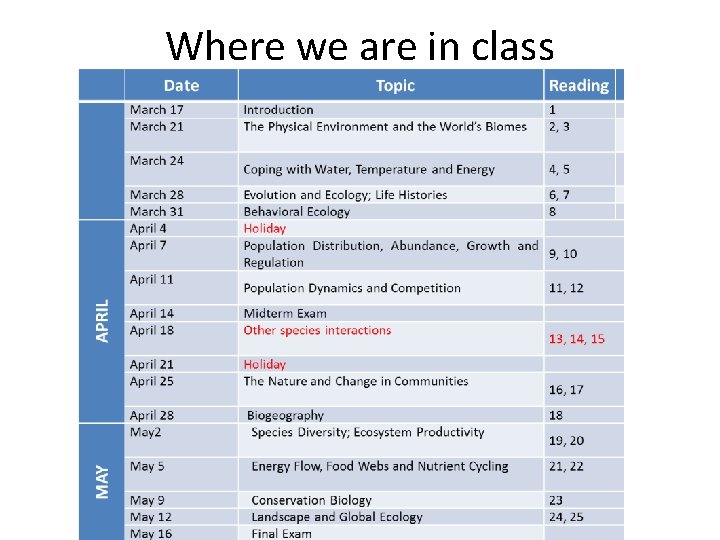
Where we are in class
Review • What levels of organization have we covered now? • Individuals form populations; populations form species; these species interact. • What is meant by competition being a - / interaction?
Today: more species interactions • Predator / Prey (+ / - ) • Parasites (+ / - ) • Mutualists ( + / +) or Commensalists (+ / 0)
Types of exploitive interactions 1) Predators: kill prey 2) Herbivores: usually don’t kill the plants 3) Parasites(寄生虫): don’t usually kill host § Pathogens(病原菌;病原体): induce disease § Parasitoids: insect predators that put eggs in insect host, then grow and kill host
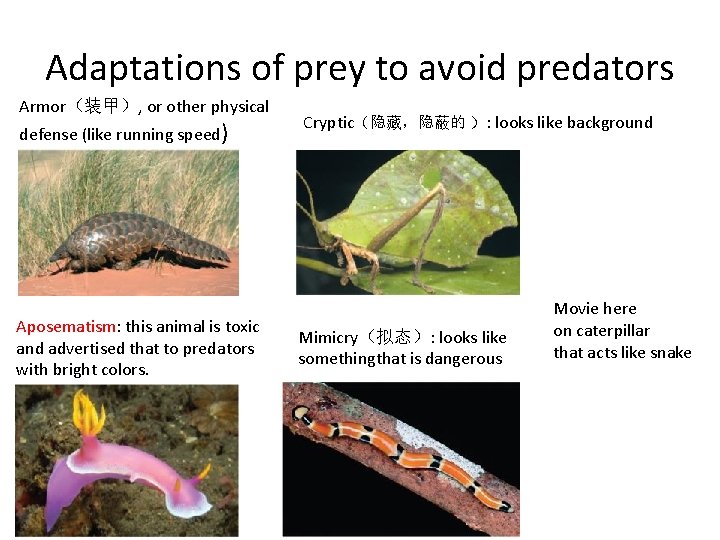
Adaptations of prey to avoid predators Armor(装甲), or other physical defense (like running speed) Aposematism: this animal is toxic and advertised that to predators with bright colors. Cryptic(隐藏,隐蔽的 ): looks like background Mimicry(拟态): looks like somethingthat is dangerous Movie here on caterpillar that acts like snake
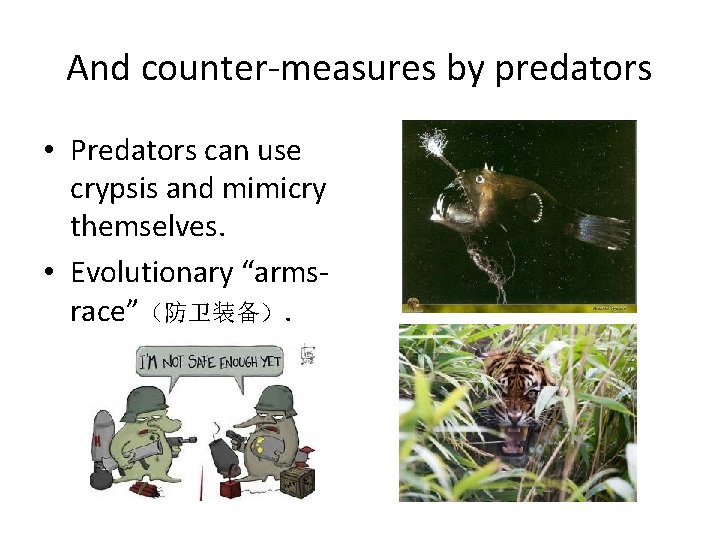
And counter-measures by predators • Predators can use crypsis and mimicry themselves. • Evolutionary “armsrace”(防卫装备).
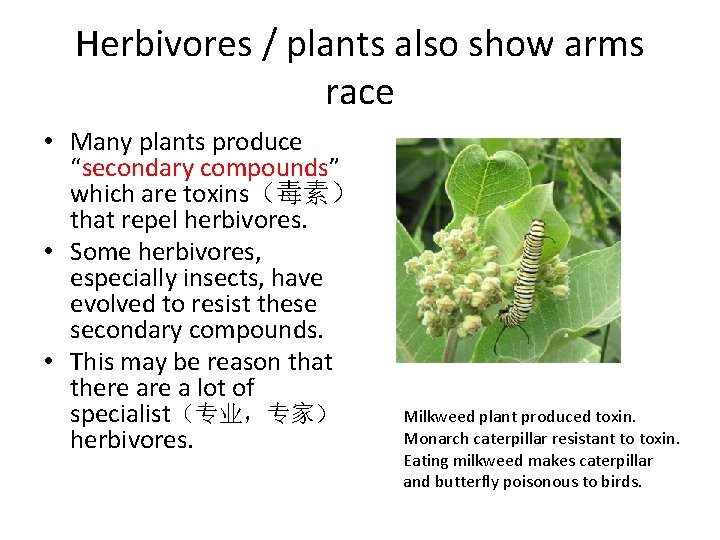
Herbivores / plants also show arms race • Many plants produce “secondary compounds” which are toxins(毒素) that repel herbivores. • Some herbivores, especially insects, have evolved to resist these secondary compounds. • This may be reason that there a lot of specialist(专业,专家) herbivores. Milkweed plant produced toxin. Monarch caterpillar resistant to toxin. Eating milkweed makes caterpillar and butterfly poisonous to birds.
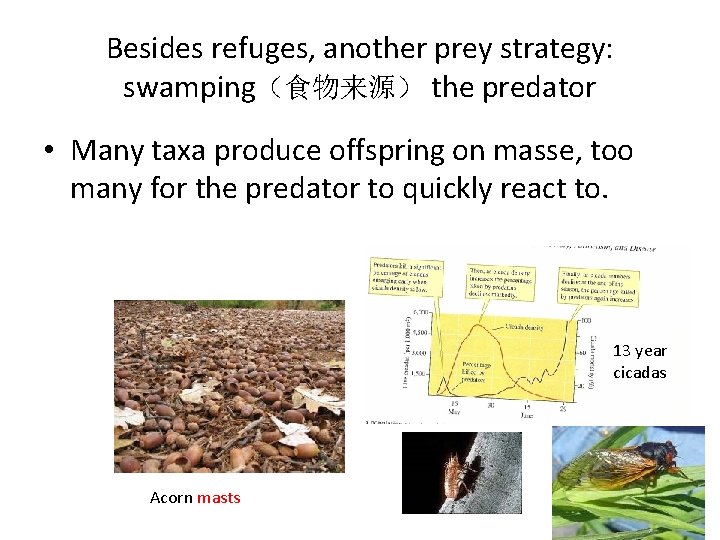
Besides refuges, another prey strategy: swamping(食物来源) the predator • Many taxa produce offspring on masse, too many for the predator to quickly react to. 13 year cicadas Acorn masts
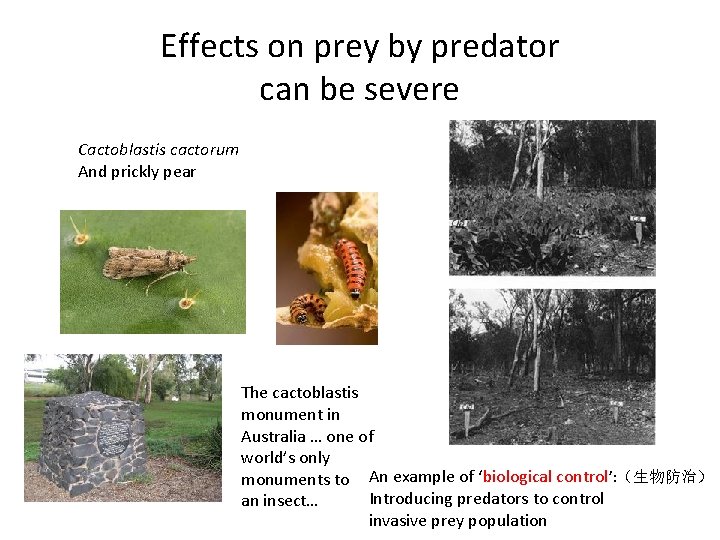
Effects on prey by predator can be severe Cactoblastis cactorum And prickly pear The cactoblastis monument in Australia … one of world’s only monuments to An example of ‘biological control’: (生物防治) Introducing predators to control an insect… invasive prey population
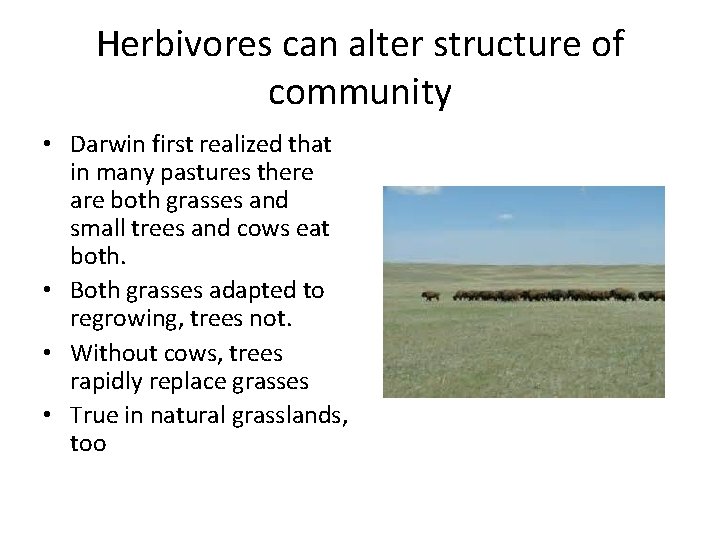
Herbivores can alter structure of community • Darwin first realized that in many pastures there are both grasses and small trees and cows eat both. • Both grasses adapted to regrowing, trees not. • Without cows, trees rapidly replace grasses • True in natural grasslands, too
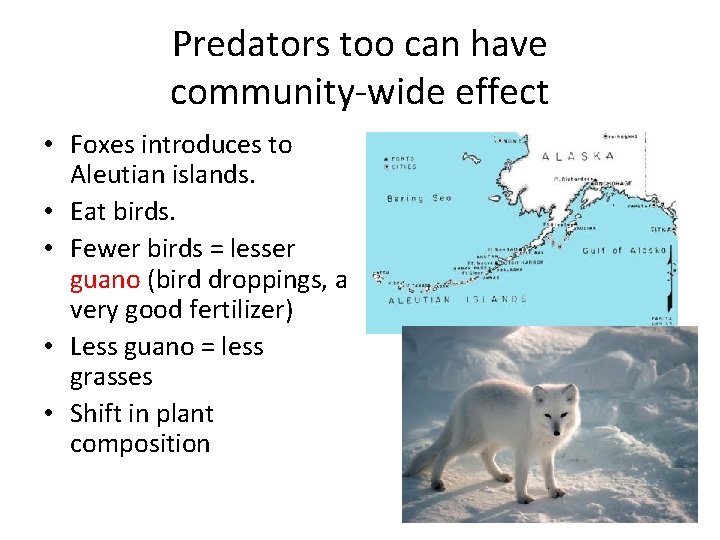
Predators too can have community-wide effect • Foxes introduces to Aleutian islands. • Eat birds. • Fewer birds = lesser guano (bird droppings, a very good fertilizer) • Less guano = less grasses • Shift in plant composition
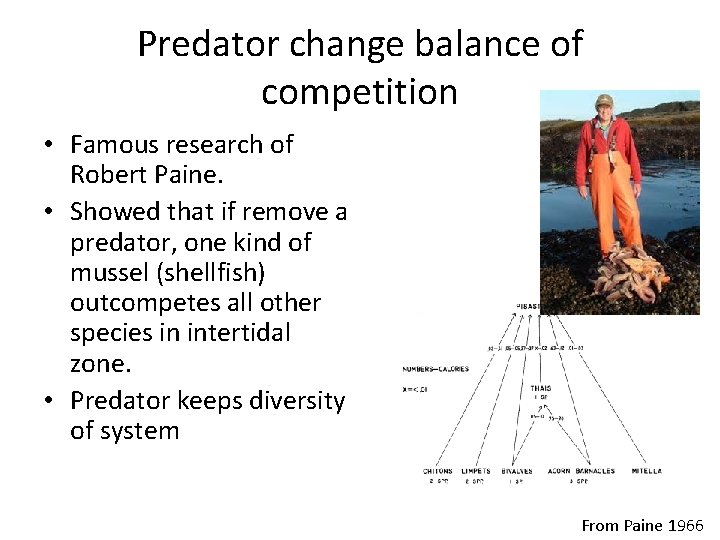
Predator change balance of competition • Famous research of Robert Paine. • Showed that if remove a predator, one kind of mussel (shellfish) outcompetes all other species in intertidal zone. • Predator keeps diversity of system From Paine 1966
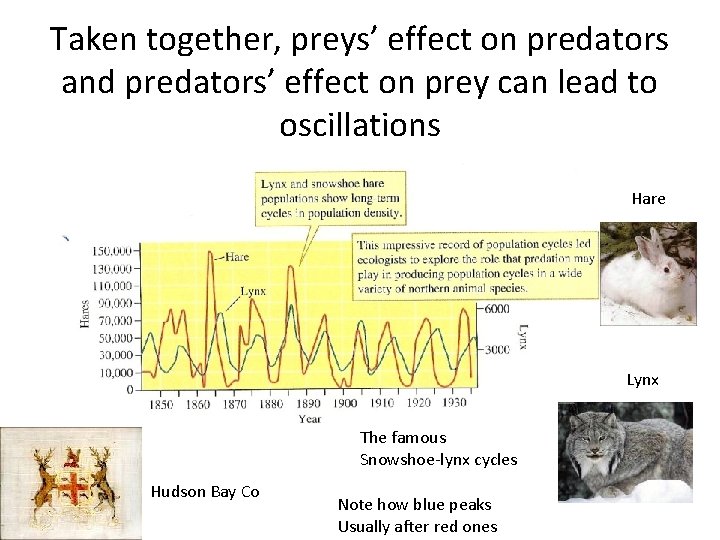
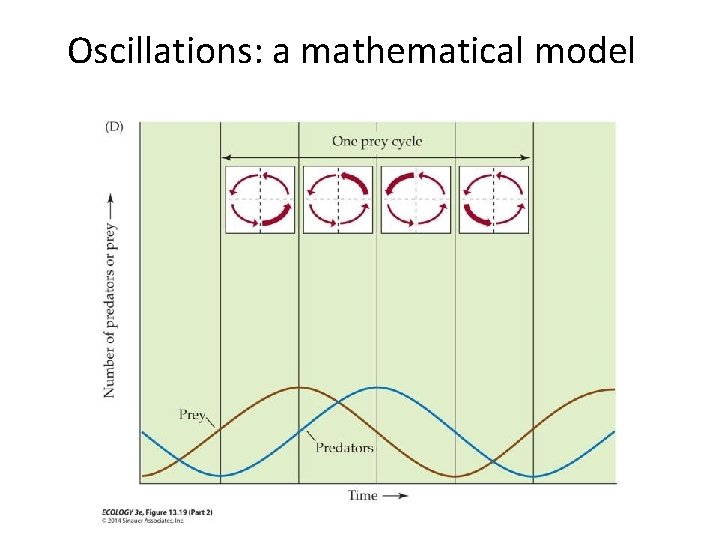
Taken together, preys’ effect on predators and predators’ effect on prey can lead to oscillations Hare Lynx The famous Snowshoe-lynx cycles Hudson Bay Co Note how blue peaks Usually after red ones
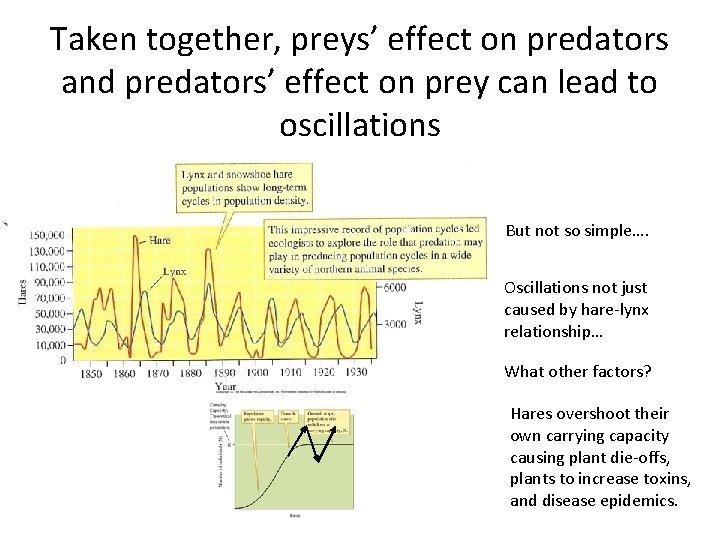
Taken together, preys’ effect on predators and predators’ effect on prey can lead to oscillations But not so simple…. Oscillations not just caused by hare-lynx relationship… What other factors? Hares overshoot their own carrying capacity causing plant die-offs, plants to increase toxins, and disease epidemics.
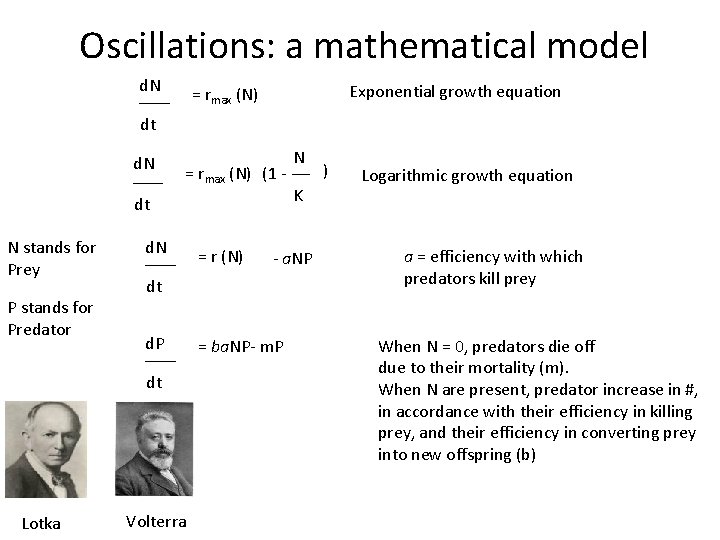
Oscillations: a mathematical model d. N Exponential growth equation = rmax (N) dt d. N = rmax (N) (1 - dt N stands for Prey P stands for Predator d. N d. P Volterra K - a. NP dt dt Lotka = r (N) N = ba. NP- m. P ) Logarithmic growth equation a = efficiency with which predators kill prey When N = 0, predators die off due to their mortality (m). When N are present, predator increase in #, in accordance with their efficiency in killing prey, and their efficiency in converting prey into new offspring (b)
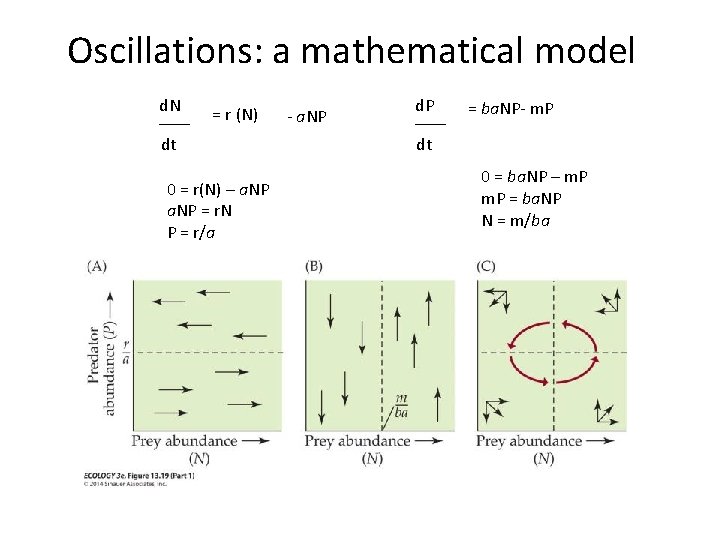
Oscillations: a mathematical model d. N = r (N) dt 0 = r(N) – a. NP = r. N P = r/a - a. NP d. P = ba. NP- m. P dt 0 = ba. NP – m. P = ba. NP N = m/ba
Oscillations: a mathematical model
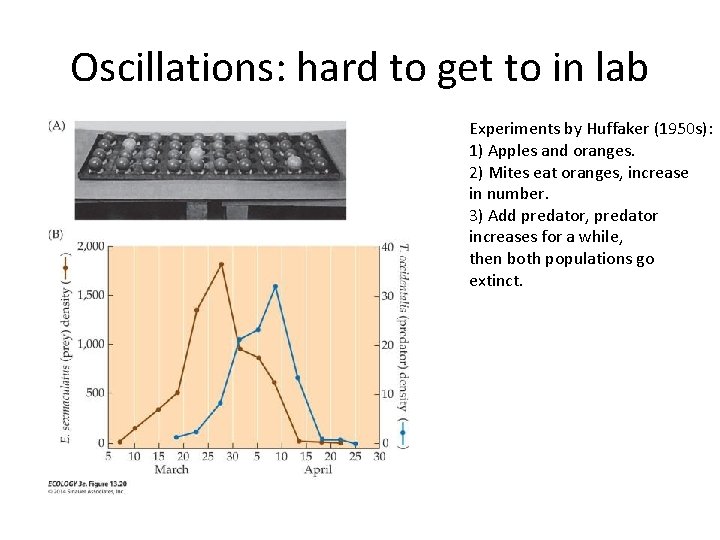
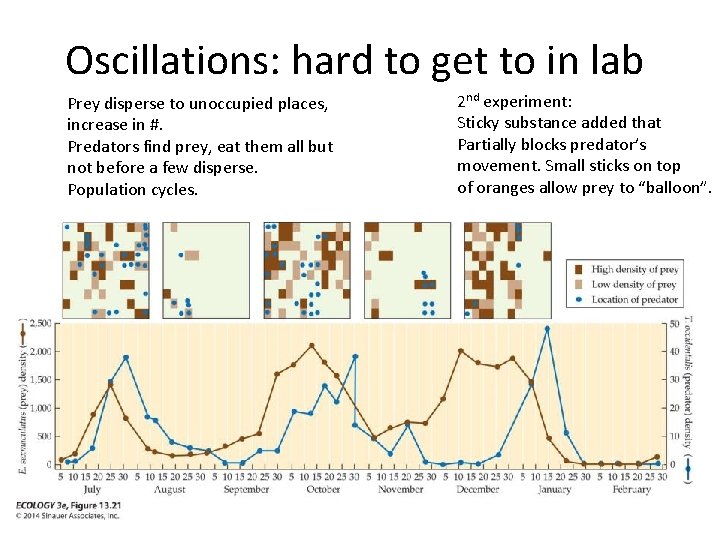
Oscillations: hard to get to in lab Experiments by Huffaker (1950 s): 1) Apples and oranges. 2) Mites eat oranges, increase in number. 3) Add predator, predator increases for a while, then both populations go extinct.
Oscillations: hard to get to in lab Prey disperse to unoccupied places, increase in #. Predators find prey, eat them all but not before a few disperse. Population cycles. 2 nd experiment: Sticky substance added that Partially blocks predator’s movement. Small sticks on top of oranges allow prey to “balloon”.
Today: more species interactions • Predator / Prey (+ / - ) • Parasites (+ / - ) • Mutualists ( + / +) or Commensalists (+ / 0)
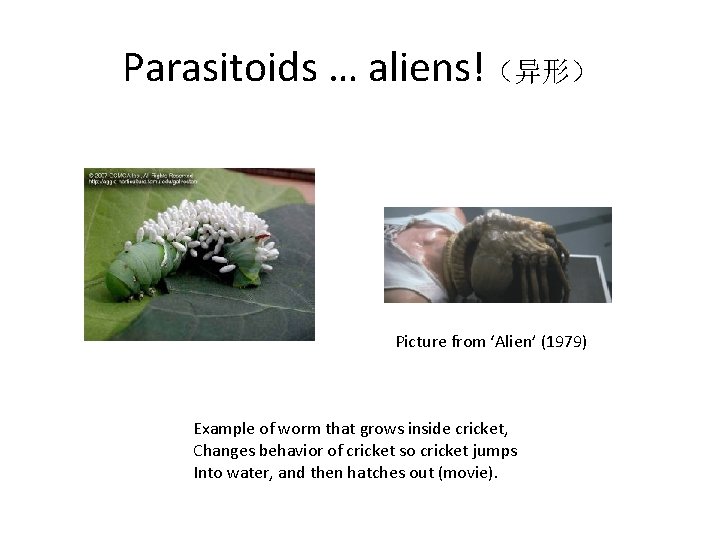
Parasitoids … aliens!(异形) Picture from ‘Alien’ (1979) Example of worm that grows inside cricket, Changes behavior of cricket so cricket jumps Into water, and then hatches out (movie).
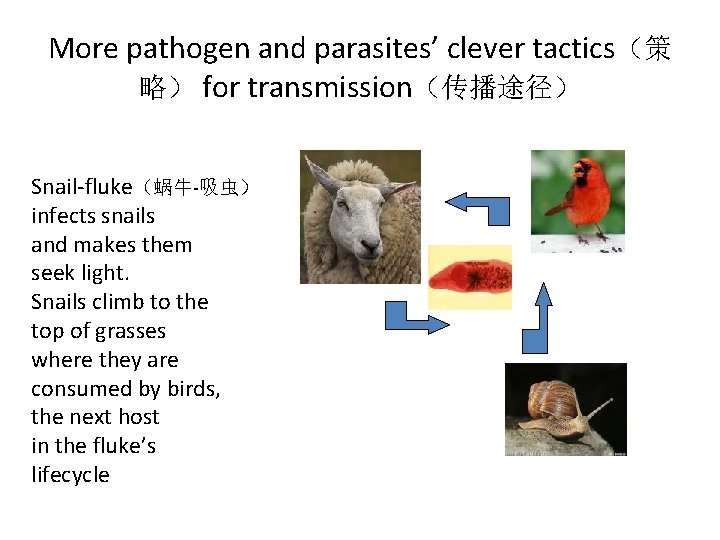
More pathogen and parasites’ clever tactics(策 略) for transmission(传播途径) Snail-fluke(蜗牛-吸虫) infects snails and makes them seek light. Snails climb to the top of grasses where they are consumed by birds, the next host in the fluke’s lifecycle
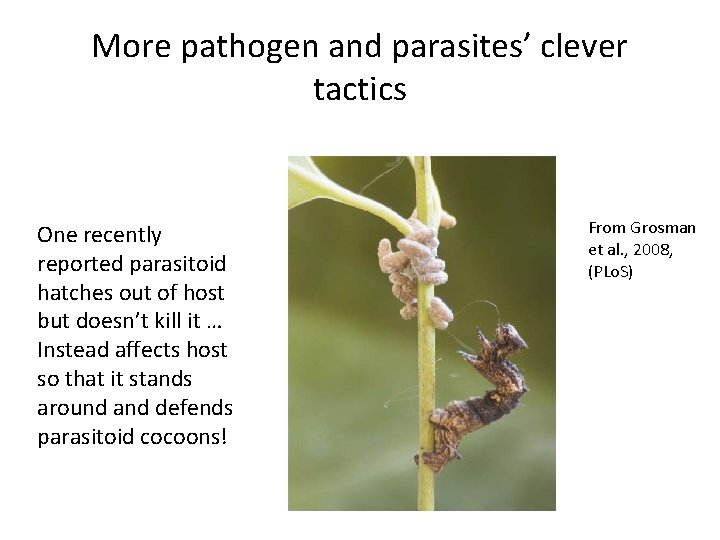
More pathogen and parasites’ clever tactics One recently reported parasitoid hatches out of host but doesn’t kill it … Instead affects host so that it stands around and defends parasitoid cocoons! From Grosman et al. , 2008, (PLo. S)
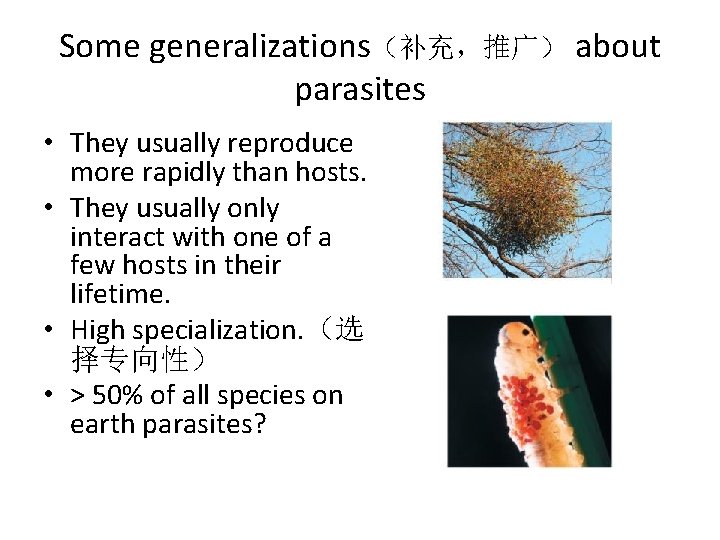
Some generalizations(补充,推广) about parasites • They usually reproduce more rapidly than hosts. • They usually only interact with one of a few hosts in their lifetime. • High specialization. (选 择专向性) • > 50% of all species on earth parasites?
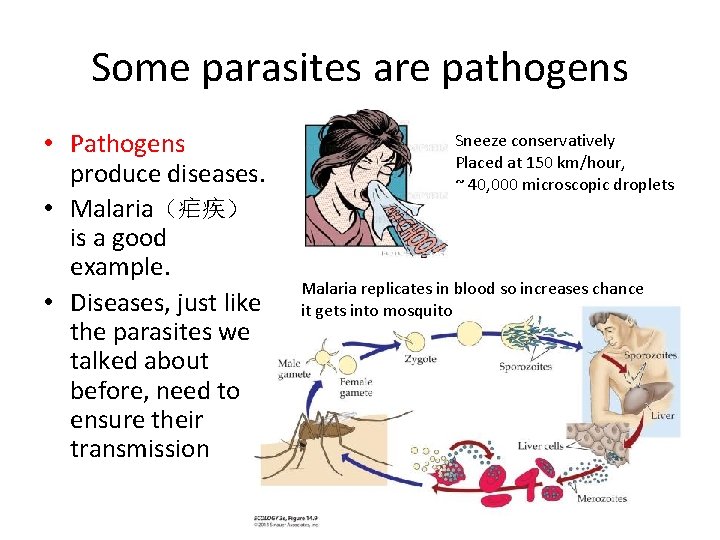
Some parasites are pathogens • Pathogens produce diseases. • Malaria(疟疾) is a good example. • Diseases, just like the parasites we talked about before, need to ensure their transmission Sneeze conservatively Placed at 150 km/hour, ~ 40, 000 microscopic droplets Malaria replicates in blood so increases chance it gets into mosquito
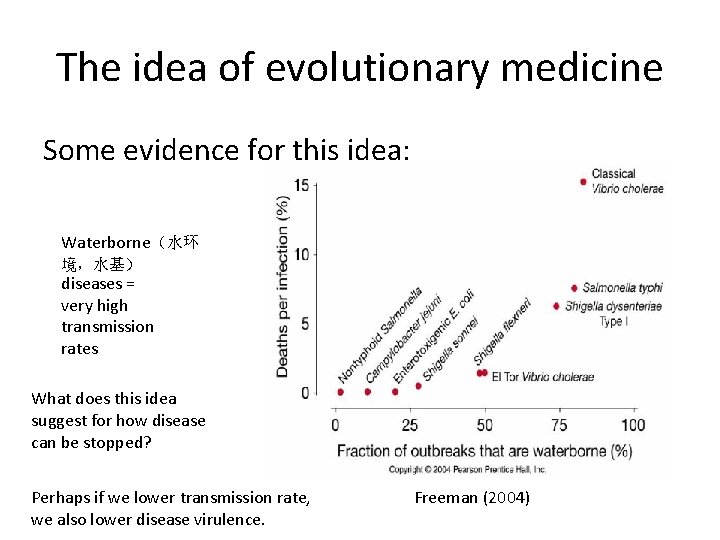
The idea of evolutionary medicine (医学发展) • A paradox(疑难问题): why would a pathogen want to kill its host? It will kill itself, too! • But if a pathogen is very good at transmission, then it can afford to kill host. • This idea predicts that very “virulent”(致死的) pathogens are ones that transmit to many hosts quickly.
The idea of evolutionary medicine Some evidence for this idea: Waterborne(水环 境,水基) diseases = very high transmission rates What does this idea suggest for how disease can be stopped? Perhaps if we lower transmission rate, we also lower disease virulence. Freeman (2004)
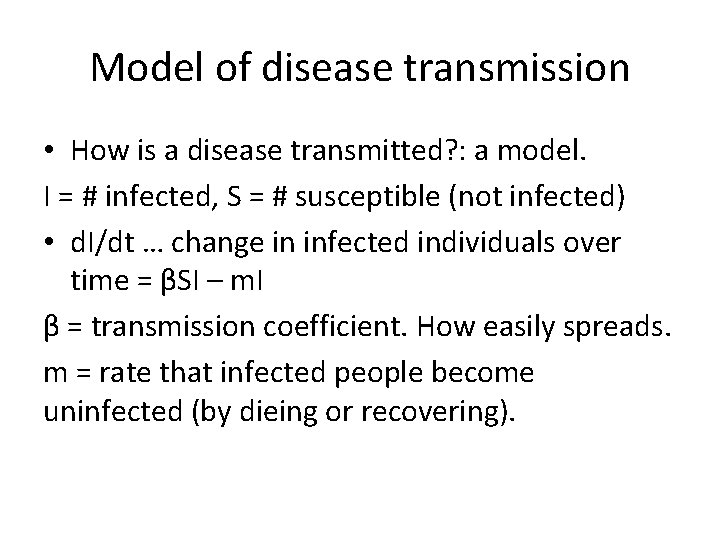
Model of disease transmission • How is a disease transmitted? : a model. I = # infected, S = # susceptible (not infected) • d. I/dt … change in infected individuals over time = βSI – m. I β = transmission coefficient. How easily spreads. m = rate that infected people become uninfected (by dieing or recovering).
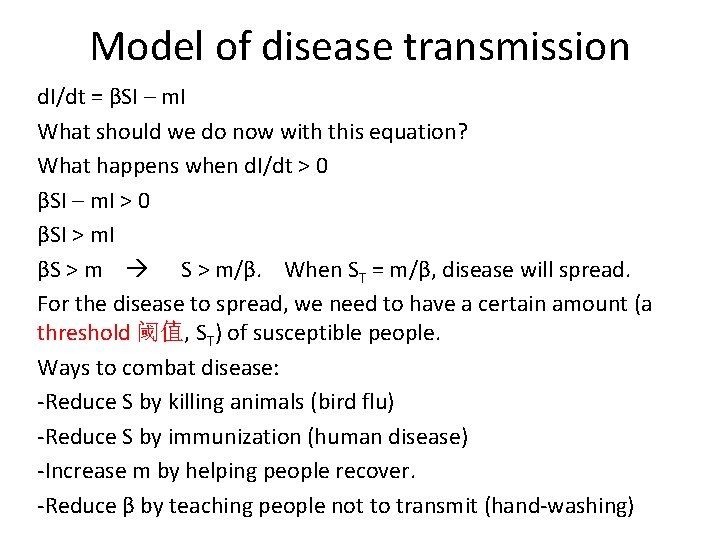
Model of disease transmission d. I/dt = βSI – m. I What should we do now with this equation? What happens when d. I/dt > 0 βSI – m. I > 0 βSI > m. I βS > m S > m/β. When ST = m/β, disease will spread. For the disease to spread, we need to have a certain amount (a threshold 阈值, ST) of susceptible people. Ways to combat disease: -Reduce S by killing animals (bird flu) -Reduce S by immunization (human disease) -Increase m by helping people recover. -Reduce β by teaching people not to transmit (hand-washing)
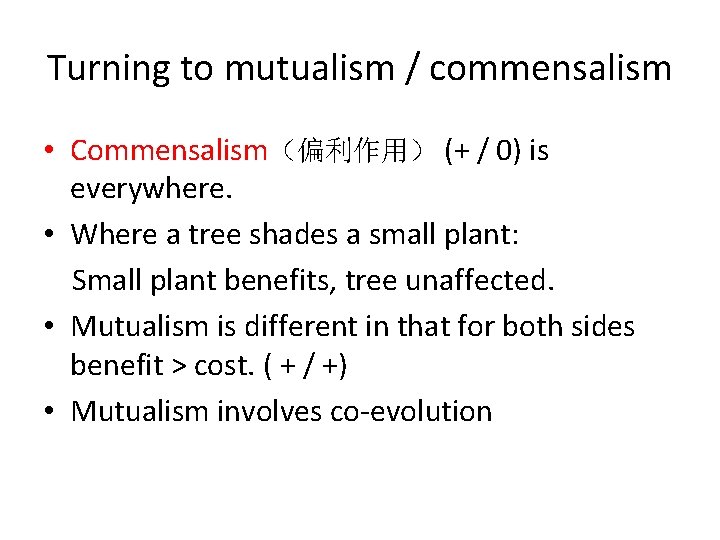
Turning to mutualism / commensalism • Commensalism(偏利作用) (+ / 0) is everywhere. • Where a tree shades a small plant: Small plant benefits, tree unaffected. • Mutualism is different in that for both sides benefit > cost. ( + / +) • Mutualism involves co-evolution
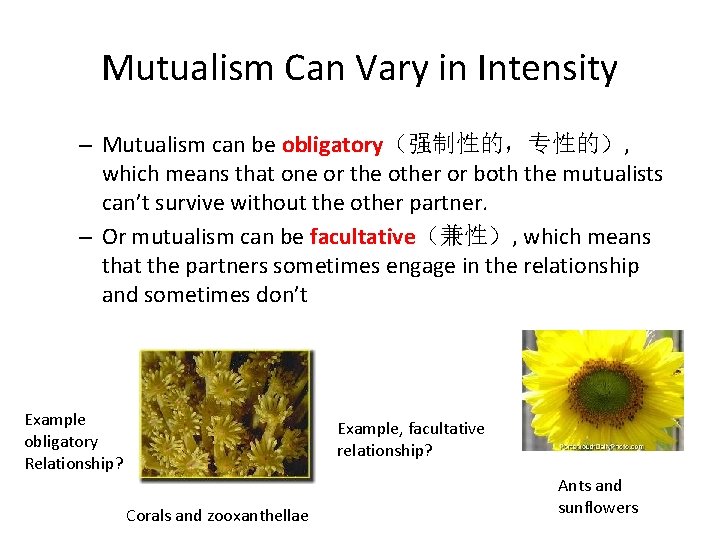
Mutualism Can Vary in Intensity – Mutualism can be obligatory(强制性的,专性的), which means that one or the other or both the mutualists can’t survive without the other partner. – Or mutualism can be facultative(兼性), which means that the partners sometimes engage in the relationship and sometimes don’t Example obligatory Relationship? Example, facultative relationship? Corals and zooxanthellae Ants and sunflowers
Very important mutualisms • Mycorrhizae and plants • Nitrogen fixing bacteria and plants (especially legumes) • Plants and pollinators • Plants and seed-dispersers • Plants and protectors like ants • Corals and zooxanthellae • Corals and protectors like crabs • Mixed groups of birds and mammals
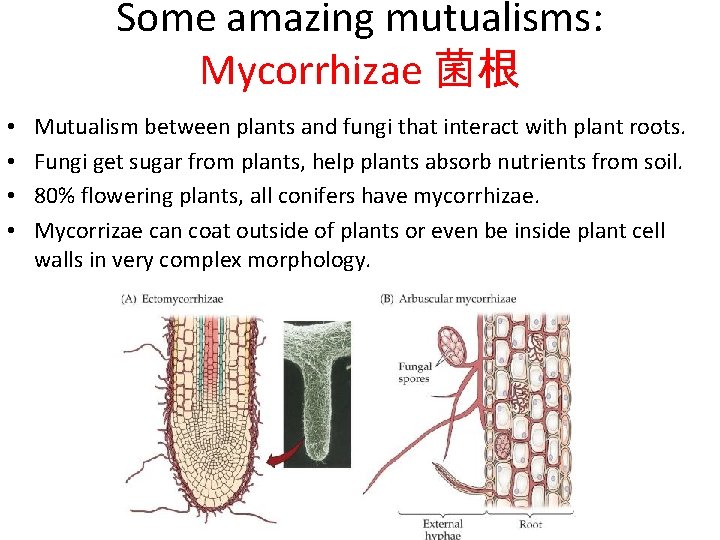
Some amazing mutualisms: Mycorrhizae 菌根 • • Mutualism between plants and fungi that interact with plant roots. Fungi get sugar from plants, help plants absorb nutrients from soil. 80% flowering plants, all conifers have mycorrhizae. Mycorrizae can coat outside of plants or even be inside plant cell walls in very complex morphology.
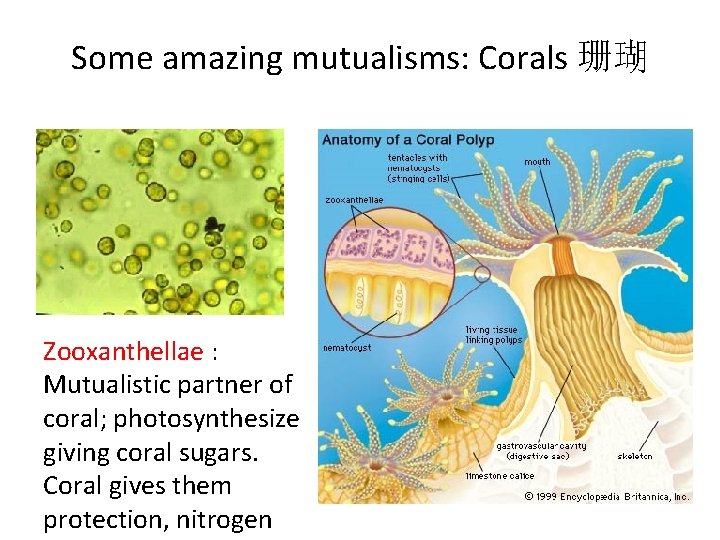
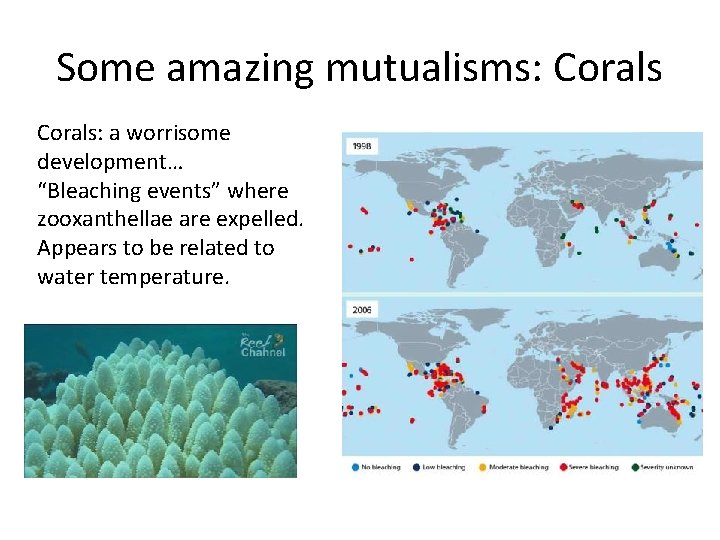
Some amazing mutualisms: Corals 珊瑚 Zooxanthellae : Mutualistic partner of coral; photosynthesize giving coral sugars. Coral gives them protection, nitrogen
Some amazing mutualisms: Corals: a worrisome development… “Bleaching events” where zooxanthellae are expelled. Appears to be related to water temperature.
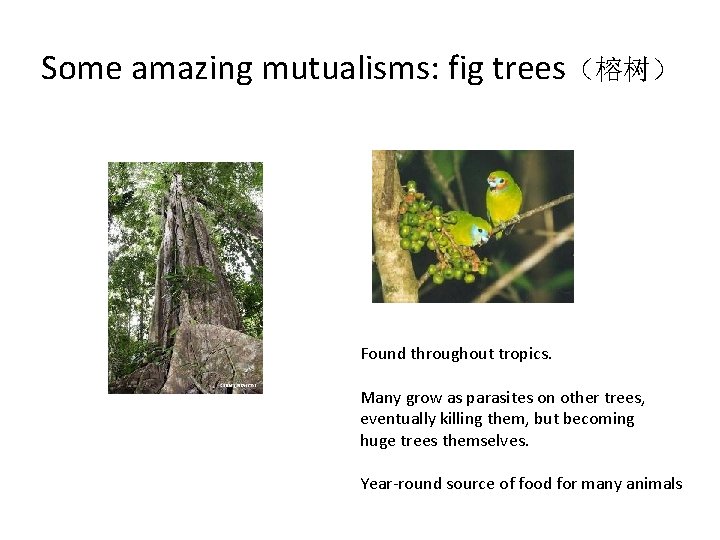
Some amazing mutualisms: fig trees(榕树) Found throughout tropics. Many grow as parasites on other trees, eventually killing them, but becoming huge trees themselves. Year-round source of food for many animals
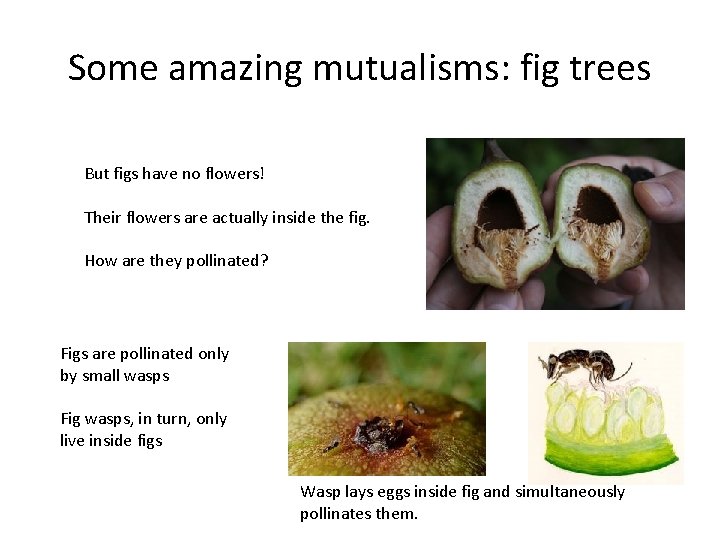
Some amazing mutualisms: fig trees But figs have no flowers! Their flowers are actually inside the fig. How are they pollinated? Figs are pollinated only by small wasps Fig wasps, in turn, only live inside figs Wasp lays eggs inside fig and simultaneously pollinates them.
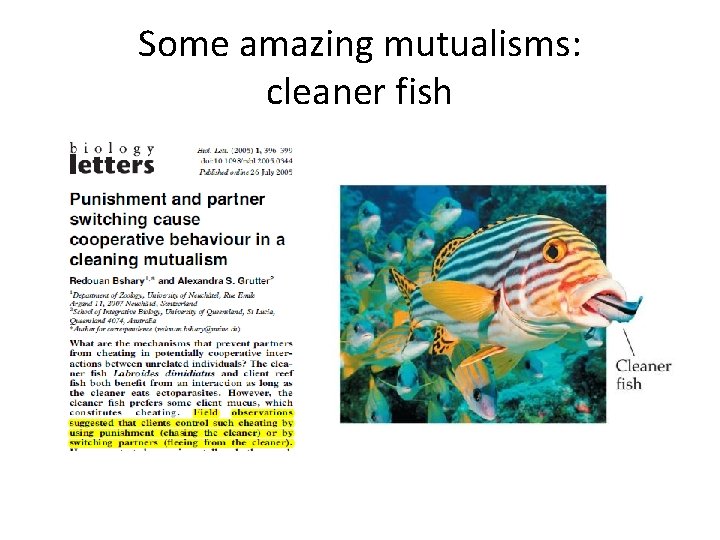
Some amazing mutualisms: cleaner fish
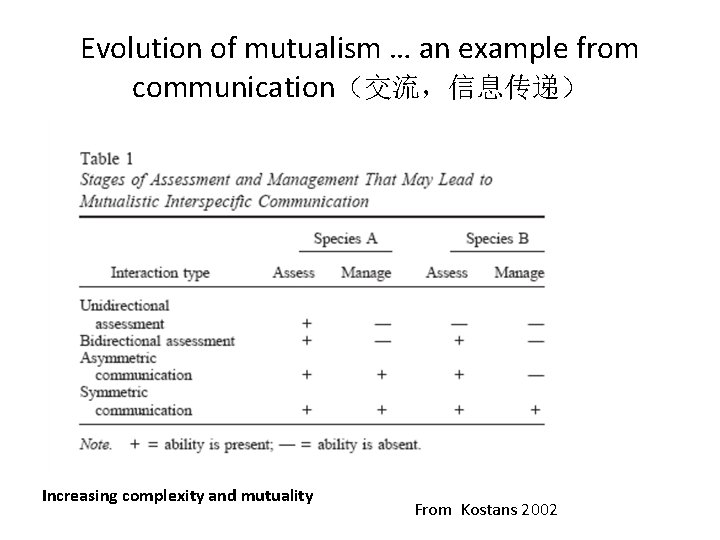
Evolution of mutualism … an example from communication(交流,信息传递) Increasing complexity and mutuality From Kostans 2002
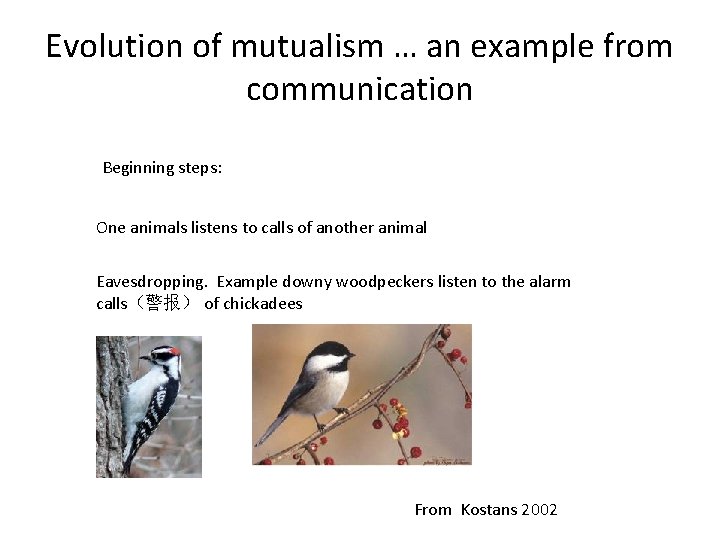
Evolution of mutualism … an example from communication Beginning steps: One animals listens to calls of another animal Eavesdropping. Example downy woodpeckers listen to the alarm calls(警报) of chickadees From Kostans 2002
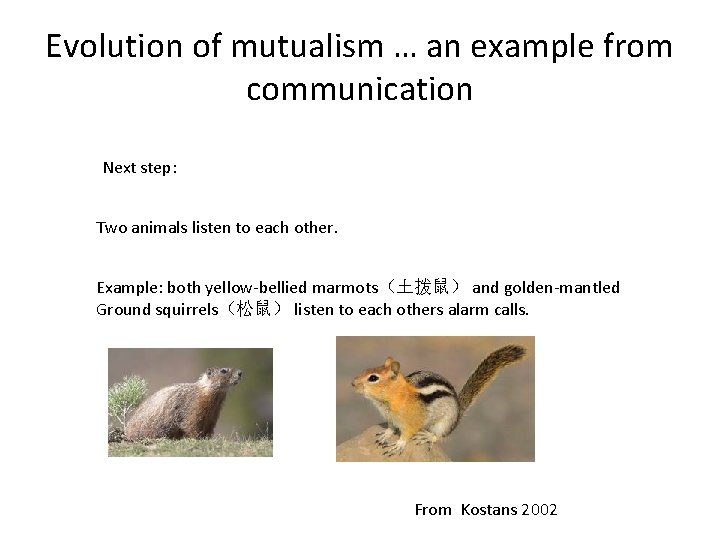
Evolution of mutualism … an example from communication Next step: Two animals listen to each other. Example: both yellow-bellied marmots(土拨鼠) and golden-mantled Ground squirrels(松鼠) listen to each others alarm calls. From Kostans 2002
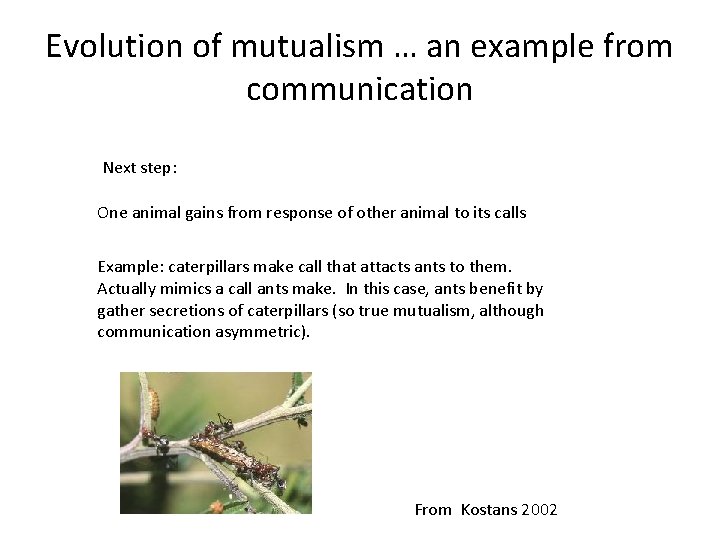
Evolution of mutualism … an example from communication Next step: One animal gains from response of other animal to its calls Example: caterpillars make call that attacts ants to them. Actually mimics a call ants make. In this case, ants benefit by gather secretions of caterpillars (so true mutualism, although communication asymmetric). From Kostans 2002
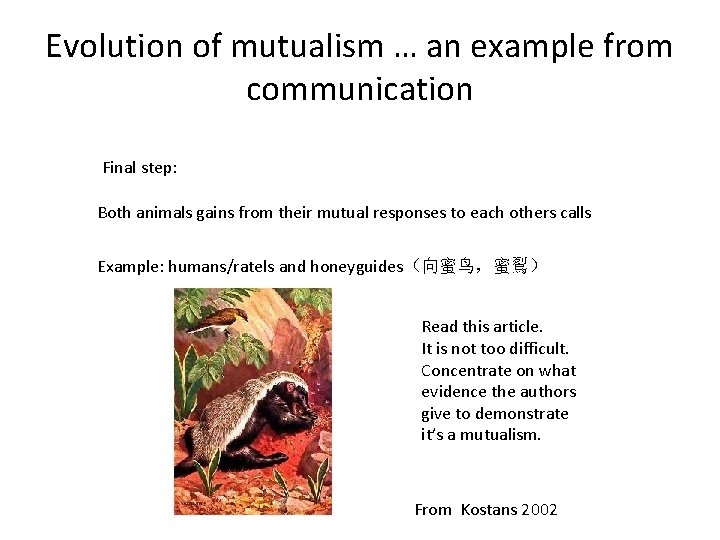
Evolution of mutualism … an example from communication Final step: Both animals gains from their mutual responses to each others calls Example: humans/ratels and honeyguides(向蜜鸟,蜜鴷) Read this article. It is not too difficult. Concentrate on what evidence the authors give to demonstrate it’s a mutualism. From Kostans 2002
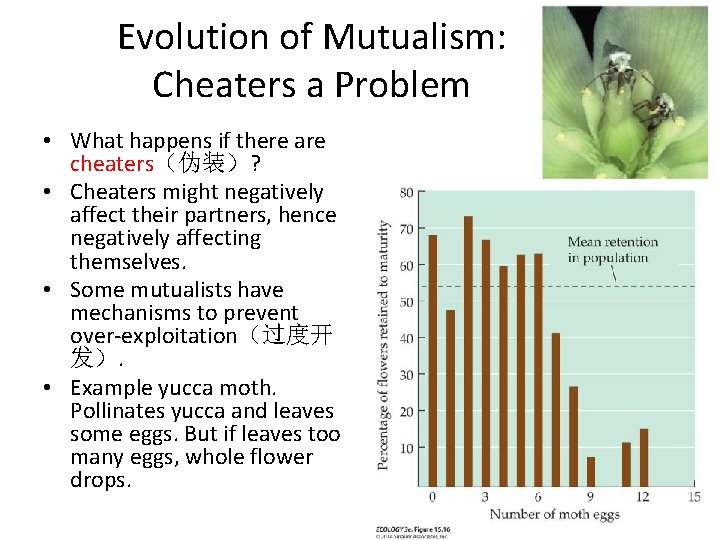
Evolution of Mutualism: Cheaters a Problem • What happens if there are cheaters(伪装)? • Cheaters might negatively affect their partners, hence negatively affecting themselves. • Some mutualists have mechanisms to prevent over-exploitation(过度开 发). • Example yucca moth. Pollinates yucca and leaves some eggs. But if leaves too many eggs, whole flower drops.
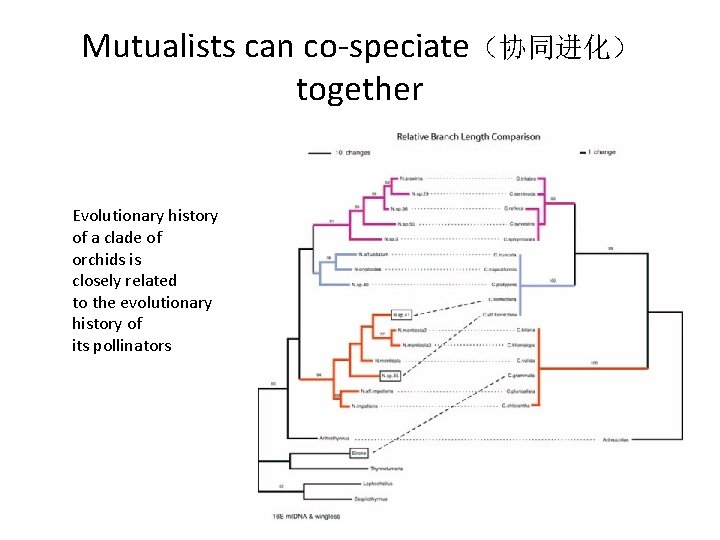
Mutualists can co-speciate(协同进化) together Evolutionary history of a clade of orchids is closely related to the evolutionary history of its pollinators
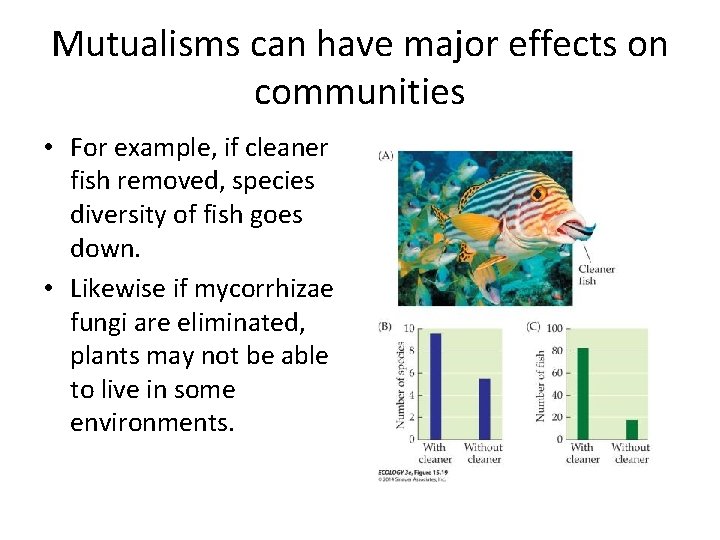
Mutualisms can have major effects on communities • For example, if cleaner fish removed, species diversity of fish goes down. • Likewise if mycorrhizae fungi are eliminated, plants may not be able to live in some environments.
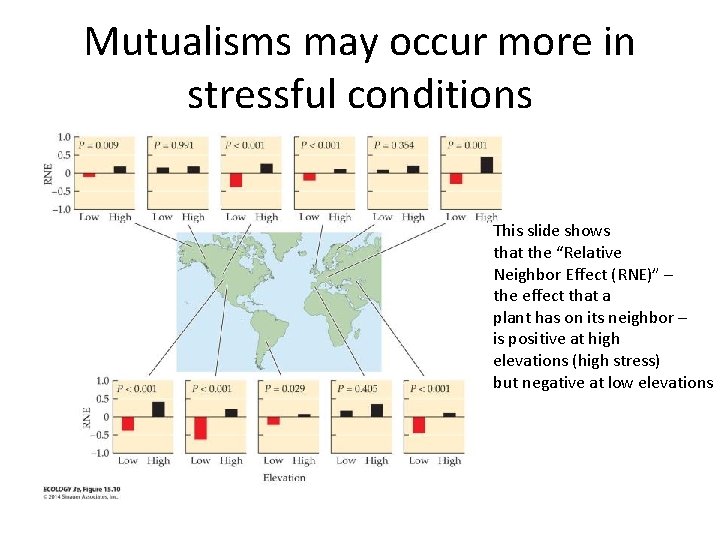
Mutualisms may occur more in stressful conditions This slide shows that the “Relative Neighbor Effect (RNE)” – the effect that a plant has on its neighbor – is positive at high elevations (high stress) but negative at low elevations
Homework • For next Saturday: Take-home portion of midterm. • Read summary of Chapters 16, 17 (I will e-mail you them). • Read Isack and Reyes (honey-guides). • I will look for primary reading for next Saturday.
Key concepts • Predator-prey interactions and herbivory / plant relationship involve coevolutionary arms-race. • Predation /herbivory has major effects on distribution/abundance of prey and even on communities. • Parasites are frequent in nature and adapted to transmission between hosts • Commensalism is when one species benefits and the other is unaffected and is also common. • Mutualism is when both partners benefit and involves coevolution. • Mutualisms vary in intensity; very intense ones are obligate, where partners cannot live without eachother.
Tips for listening, reading Listening: http: //www. artsci. utoront o. ca/current/advising/ell/ pdfs/ELL_Strengthening_L istening_Comprehension. pdf Reading to write: http: //www. artsci. utoront o. ca/current/advising/ell/ pdfs/Reading_to_Write_P reviewing. pdf