
Lecture 8 Distance Measuring Equipment DME Outlines Home


- Slides: 22
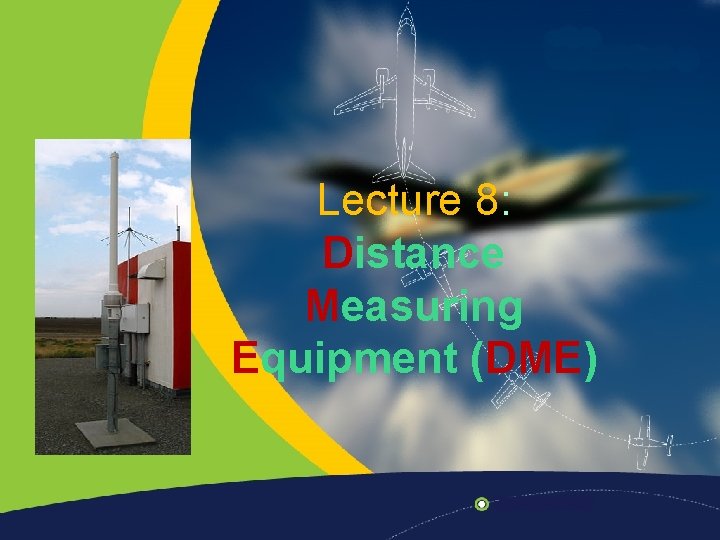
Lecture 8: Distance Measuring Equipment (DME)
Outlines Home Previous • Introduction • The uses of a DME Next • DME Equipment Help • How DME work? • Advantages of DME • Disadvantages of DME
Introduction Home Previous Next Help • Distance measuring equipment (DME) is a transponderbased radio navigation technology that measures slant range distance by timing the propagation delay of VHF or UHF radio signals. • Developed in Australia, it was invented by James Gerry Gerrand [1] under the supervision of. Edward George "Taffy" Bowen while employed as Chief of the Division of Radiophysics of the. Commonwealth Scientific and Industrial Research Organisation (CSIRO).
Home Previous Next Help • DME is similar to secondary radar, except in reverse. The system was a post-war development of the IFF (identification friend or foe) systems of World War II. To maintain compatibility, DME is functionally identical to the distance measuring component of TACAN.
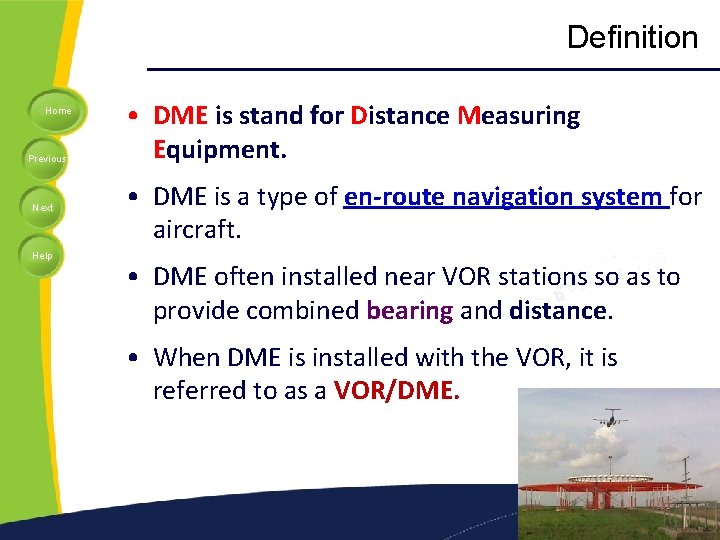
Definition Home Previous Next Help • DME is stand for Distance Measuring Equipment. • DME is a type of en-route navigation system for aircraft. • DME often installed near VOR stations so as to provide combined bearing and distance. • When DME is installed with the VOR, it is referred to as a VOR/DME.
Home Previous Next Help
The uses of DME Home Previous Next Help • DME provides the physical distance from the aircraft to the ground DME transponder expressed in Nautical Miles (NM). • DME also calculates ground speed and the time needed to reach the station if the aircraft is fitted with appropriate computer.
Home Previous Next Help
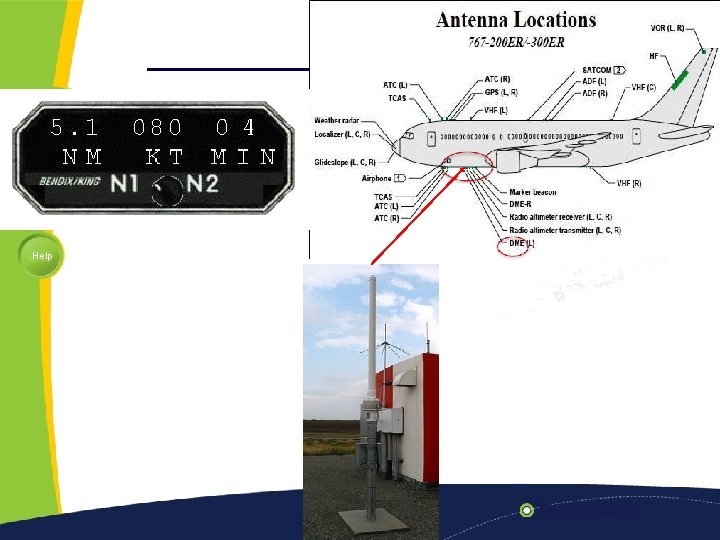
DME System Components: Home Previous The DME system consists of three basic components which are: Next Help • DME antenna on the aircraft body • DME navigation display unit in aircraft cockpit • DME transmitter/receiver in the ground
Home Previous Next Help DME INDICATOR IN THE COCKPIT
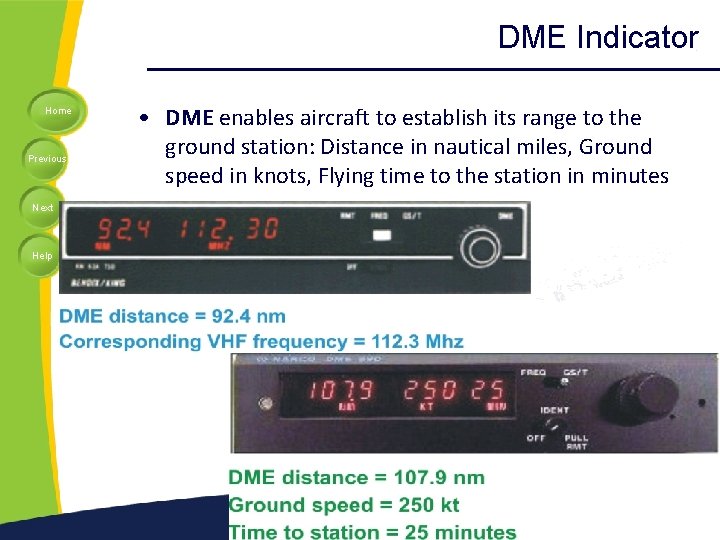
DME Indicator Home Previous Next Help • DME enables aircraft to establish its range to the ground station: Distance in nautical miles, Ground speed in knots, Flying time to the station in minutes
Home Previous Next Help DME PRINCIPLE
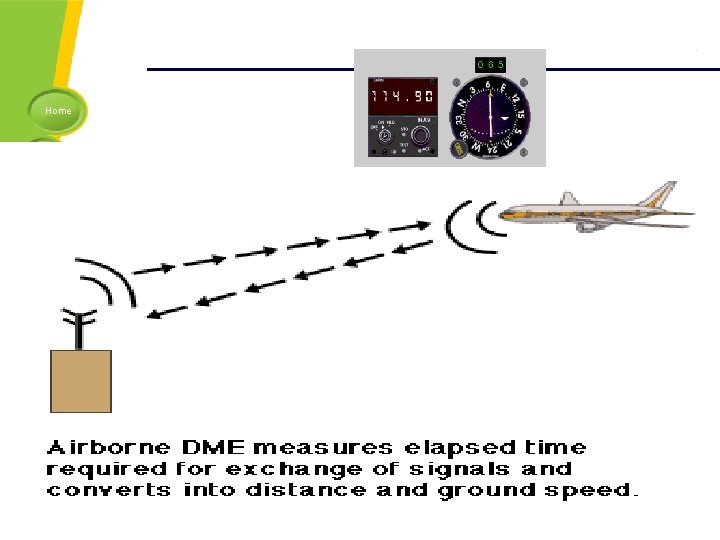
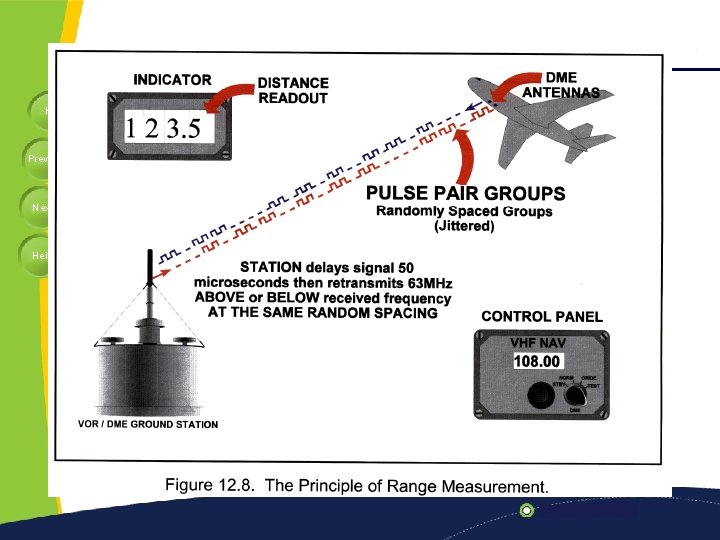
How DME works? Home Previous Next Help • DME provides distance (slant range) from the aircraft to the ground DME. • DME operates on Ultra High Frequency (UHF) which is between 962 to 1213 MHz. • DME works based on pulse techniques, where pulse means a single vibration of electric current. • The aircraft’s antenna sends out paired pulses at specific spacing. • The ground DME station receives the pulses and then responds with paired pulses at the same spacing but a different frequency.
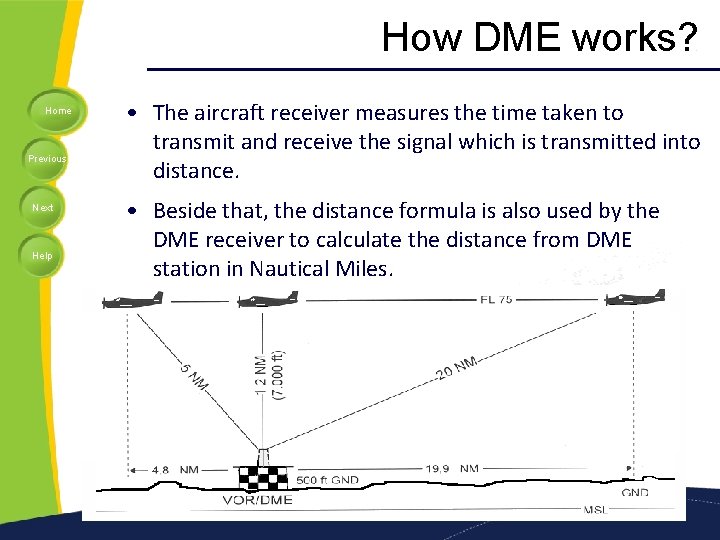
How DME works? Home Previous Next Help • The aircraft receiver measures the time taken to transmit and receive the signal which is transmitted into distance. • Beside that, the distance formula is also used by the DME receiver to calculate the distance from DME station in Nautical Miles.
Home Previous Next Help
Home Previous Next Help • A radio signal takes approximately 12. 36 microseconds to travel 1 nautical mile (1, 852 m) to the target and back—also referred to as a radar-mile. The time difference between interrogation and reply, minus the 50 microsecond ground transponder delay, is measured by the interrogator's timing circuitry and converted to a distance measurement (slant range), in nautical miles, then displayed on the cockpit DME display.
Home Previous Next Help • The distance formula, distance = rate * time, is used by the DME receiver to calculate its distance from the DME ground station. The rate in the calculation is the velocity of the radio pulse, which is the speed of light (roughly 300, 000 m/s or 186, 000 mi/s). The time in the calculation is (total time – 50µs)/2.
DME IDENTITY Home Previous Next Help • DME facilities identify themselves with a 1350 Hz morse code three letter identity. If collocated with a VOR or ILS, it will have the same identity code as the parent facility. Additionally, the DME will identify itself between those of the parent facility. The DME identity is 1350 Hz to differentiate itself from the 1020 Hz tone of the VOR or the ILS localizer.
Advantages of DME Home Previous Next Help • DME is extremely accurate: Provide continuous and accurate indication of the slant range distance (± 0. 1 nmi). • Aircraft Handling Capability: The transponder equipment should be capable of handling 100 to 200 aircrafts. • Large coverage: DME facility provides coverage up to 200 NM.
Disadvantages of DME Home Previous Next Help • As VOR the DME is also restricted to line-ofsight transmission. For example, the aircraft at altitude below 10’ 000 ft is unable to detect the DME signal.
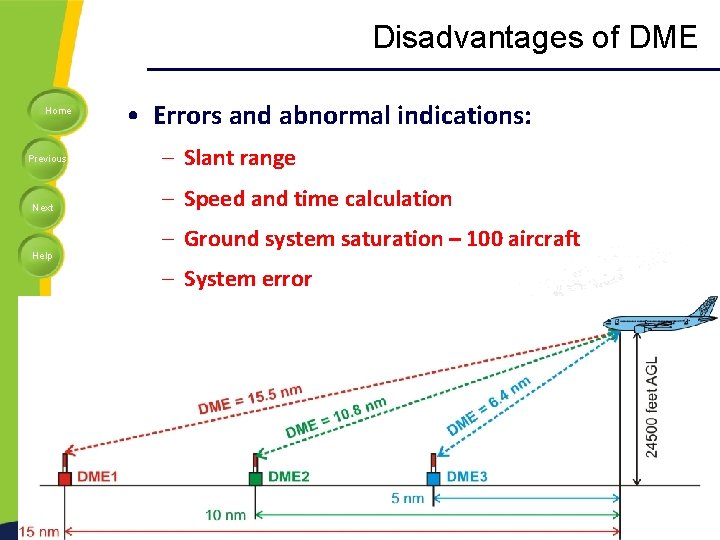
Disadvantages of DME Home Previous Next Help • Errors and abnormal indications: – Slant range – Speed and time calculation – Ground system saturation – 100 aircraft – System error
Exercise Home Previous • What is DME? Give two 2 uses of DME? (3 M) • How DME works? (10 M) Next • What the advantages of DME ( 2 M) Help • What are the disadvantages of DME (1 M) • What are 2 differences between VOR and DME? (2 M) • An aircraft flying at altitude about 3 N. M (18’ 000 ft). The ground distance is about 4 N. M. What is the distance (slant range) of the aircraft in N. M calculate by DME? (2 M)