
Lecture 8 Data Structures in Assembly CS 105
Lecture 8: Data Structures in Assembly CS 105 Fall 2020
![2 From Last Time… int proc(int *p); int example 1(int x) { int a[4];](http://slidetodoc.com/presentation_image_h2/0d7ffa81213c2cc0a67a9c199e71734b/image-2.jpg "2 From Last Time… int proc(int *p); int example 1(int x) { int a[4];")
2 From Last Time… int proc(int *p); int example 1(int x) { int a[4]; a[3] = 10; return proc(a); } example 1: subq $16, %rsp movl $10, 12(%rsp) movq %rsp, %rdi call 0 x 400546 <proc> addq $16, %rsp ret
![Array Allocation • Basic Principle T A[L]; • Array of data type T and](http://slidetodoc.com/presentation_image_h2/0d7ffa81213c2cc0a67a9c199e71734b/image-3.jpg "Array Allocation • Basic Principle T A[L]; • Array of data type T and")
Array Allocation • Basic Principle T A[L]; • Array of data type T and length L • Contiguously allocated region of L * sizeof(T) bytes in memory • Identifier A can be used as a pointer to array element 0: Type T* char string[12]; x x + 12 int val[5]; x x+4 x+8 x + 12 x + 16 x + 20 double a[3]; x x+8 x + 16 x + 24 char *p[3]; x + 16 x + 24
![Exercise 1: Array Access • Basic Principle T A[L]; • Array of data type](http://slidetodoc.com/presentation_image_h2/0d7ffa81213c2cc0a67a9c199e71734b/image-4.jpg "Exercise 1: Array Access • Basic Principle T A[L]; • Array of data type")
Exercise 1: Array Access • Basic Principle T A[L]; • Array of data type T and length L • Contiguously allocated region of L * sizeof(T) bytes in memory • Identifier A can be used as a pointer to array element 0: Type T* 1 int val[5]; x • Reference val[4] val+1 &val[2] val[5] *(val+1) val + i 5 x+4 2 x+8 Type Value int int 3 x x+4 x+8 ? ? 5 x+4 i * * 1 x + 12 3 x + 16 x + 20
![Exercise 1: Array Access • Basic Principle T A[L]; • Array of data type](http://slidetodoc.com/presentation_image_h2/0d7ffa81213c2cc0a67a9c199e71734b/image-5.jpg "Exercise 1: Array Access • Basic Principle T A[L]; • Array of data type")
Exercise 1: Array Access • Basic Principle T A[L]; • Array of data type T and length L • Contiguously allocated region of L * sizeof(T) bytes in memory • Identifier A can be used as a pointer to array element 0: Type T* 1 int val[5]; x • Reference val[4] val+1 &val[2] val[5] *(val+1) val + i 5 x+4 2 x+8 Type Value int int 3 x x+4 x+8 ? ? 5 x+4 i * * 1 x + 12 3 x + 16 x + 20
![Array Example #define ZLEN 5 typedef int zip_code[ZLEN]; zip_code pomona = { 9, 1,](http://slidetodoc.com/presentation_image_h2/0d7ffa81213c2cc0a67a9c199e71734b/image-6.jpg "Array Example #define ZLEN 5 typedef int zip_code[ZLEN]; zip_code pomona = { 9, 1,")
Array Example #define ZLEN 5 typedef int zip_code[ZLEN]; zip_code pomona = { 9, 1, 7, 1, 1 }; zip_code cornell = { 1, 4, 8, 5, 3 }; • Declaration “zip_code pomona” equivalent to “int pomona[5]” 9 zip_code pomona; 36 1 40 1 zip_code cornell; 16 7 44 4 20 1 48 8 24 1 52 5 28 56 3 32 36
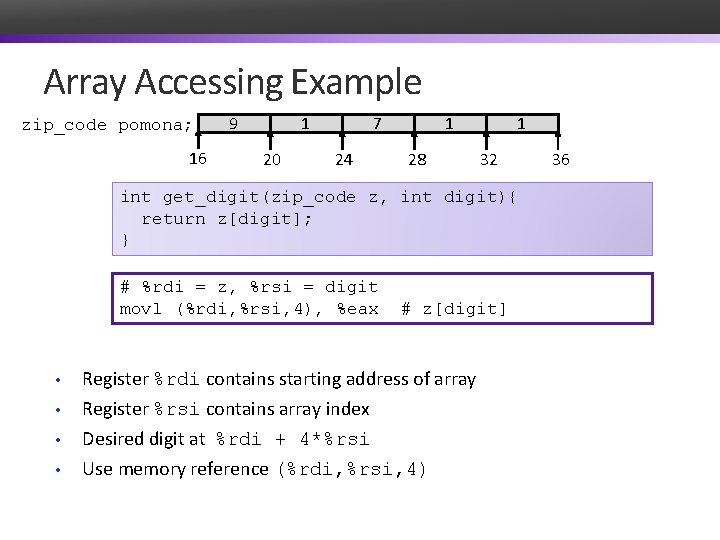
Array Accessing Example zip_code pomona; 16 9 1 20 7 24 1 28 1 32 int get_digit(zip_code z, int digit){ return z[digit]; } # %rdi = z, %rsi = digit movl (%rdi, %rsi, 4), %eax • • # z[digit] Register %rdi contains starting address of array Register %rsi contains array index Desired digit at %rdi + 4*%rsi Use memory reference (%rdi, %rsi, 4) 36
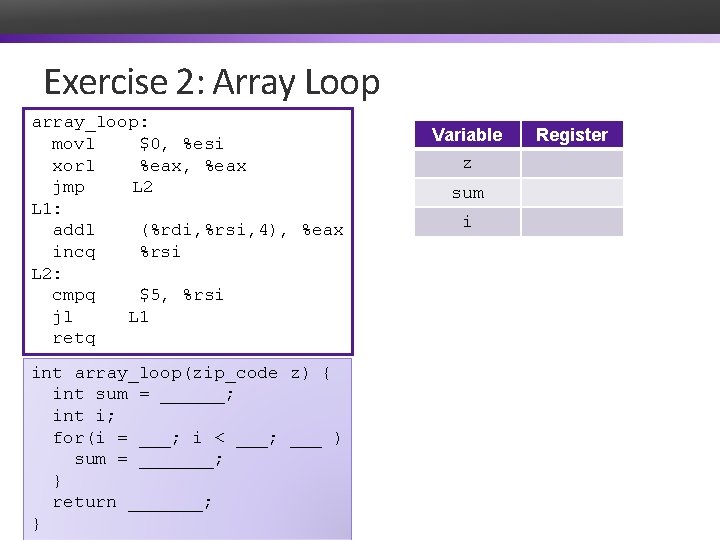
Exercise 2: Array Loop array_loop: movl $0, %esi xorl %eax, %eax jmp L 2 L 1: addl (%rdi, %rsi, 4), %eax incq %rsi L 2: cmpq $5, %rsi jl L 1 retq int array_loop(zip_code z) { int sum = ______; int i; for(i = ___; i < ___; ___ ) sum = _______; } return _______; } Variable z sum i Register
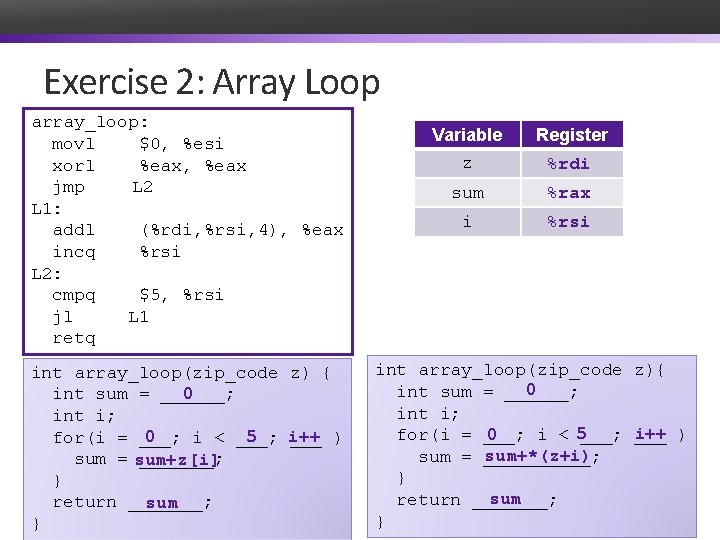
Exercise 2: Array Loop array_loop: movl $0, %esi xorl %eax, %eax jmp L 2 L 1: addl (%rdi, %rsi, 4), %eax incq %rsi L 2: cmpq $5, %rsi jl L 1 retq int array_loop(zip_code z) { 0 int sum = ______; int i; 0 5 i++ for(i = ___; i < ___; ___ ) sum = sum+z[i] _______; } return _______; sum } Variable Register z %rdi sum %rax i %rsi int array_loop(zip_code z){ 0 int sum = ______; int i; i++ ) 0 for(i = ___; i < 5___; ___ sum+*(z+i) sum = _____; } sum return _______; }
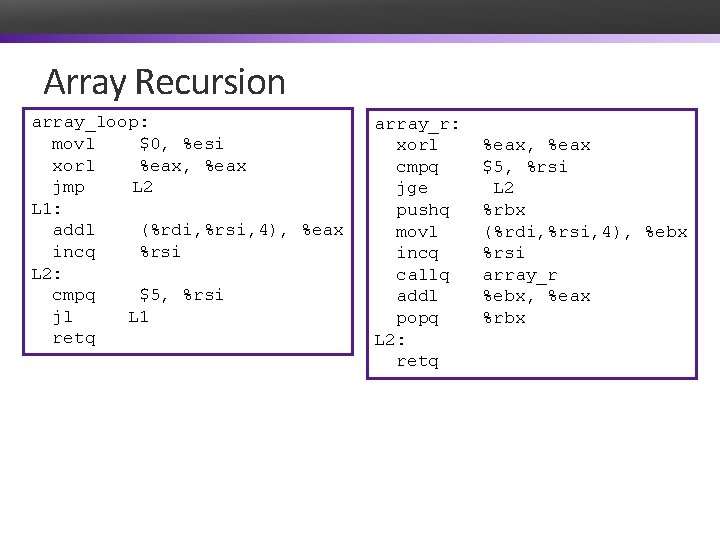
Array Recursion array_loop: movl $0, %esi xorl %eax, %eax jmp L 2 L 1: addl (%rdi, %rsi, 4), %eax incq %rsi L 2: cmpq $5, %rsi jl L 1 retq array_r: xorl cmpq jge pushq movl incq callq addl popq L 2: retq %eax, %eax $5, %rsi L 2 %rbx (%rdi, %rsi, 4), %ebx %rsi array_r %ebx, %eax %rbx
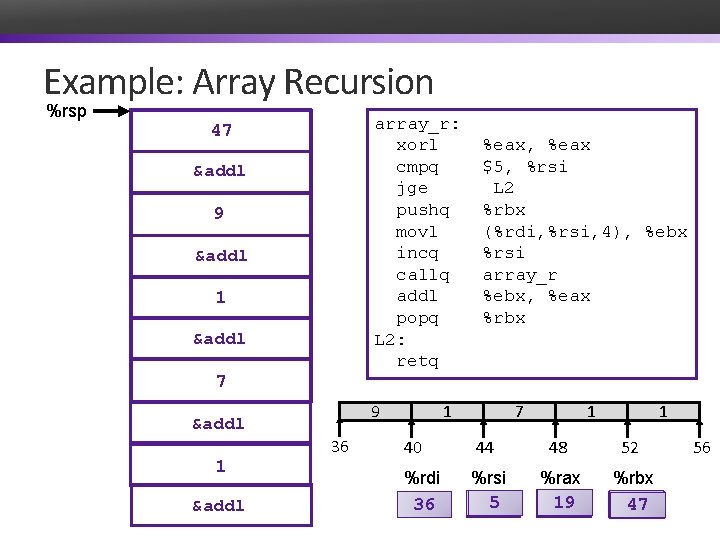
Example: Array Recursion %rsp array_r: xorl cmpq jge pushq movl incq callq addl popq L 2: retq 47 &addl 9 &addl 1 &addl %eax, %eax $5, %rsi L 2 %rbx (%rdi, %rsi, 4), %ebx %rsi array_r %ebx, %eax %rbx 7 9 &addl 1 &addl 36 1 40 %rdi 36 7 1 1 44 48 52 %rsi 4 5 3 0 1 2 %rax 19 9 10 2 0 47 1 %rbx 9 47 1 7 56
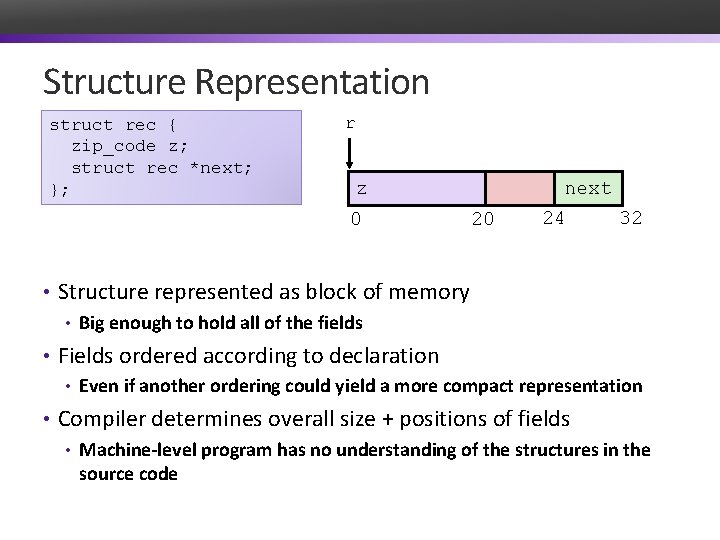
Structure Representation struct rec { zip_code z; struct rec *next; }; r z 0 20 next 24 32 • Structure represented as block of memory • Big enough to hold all of the fields • Fields ordered according to declaration • Even if another ordering could yield a more compact representation • Compiler determines overall size + positions of fields • Machine-level program has no understanding of the structures in the source code
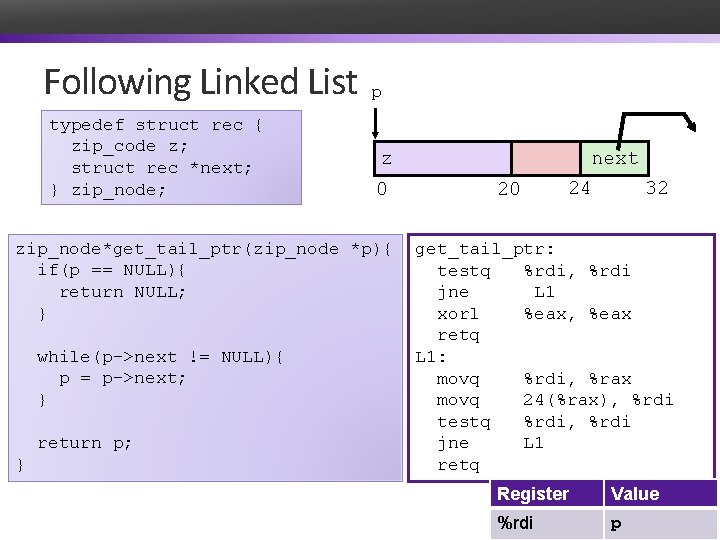
Following Linked List typedef struct rec { z; • Czip_code Code struct rec *next; } zip_node; p z 0 zip_node*get_tail_ptr(zip_node *p){ if(p == NULL){ return NULL; } while(p->next != NULL){ p = p->next; } return p; } 20 next 24 32 get_tail_ptr: testq %rdi, %rdi jne L 1 xorl %eax, %eax retq L 1: movq %rdi, %rax movq 24(%rax), %rdi testq %rdi, %rdi jne L 1 retq Register Value %rdi p
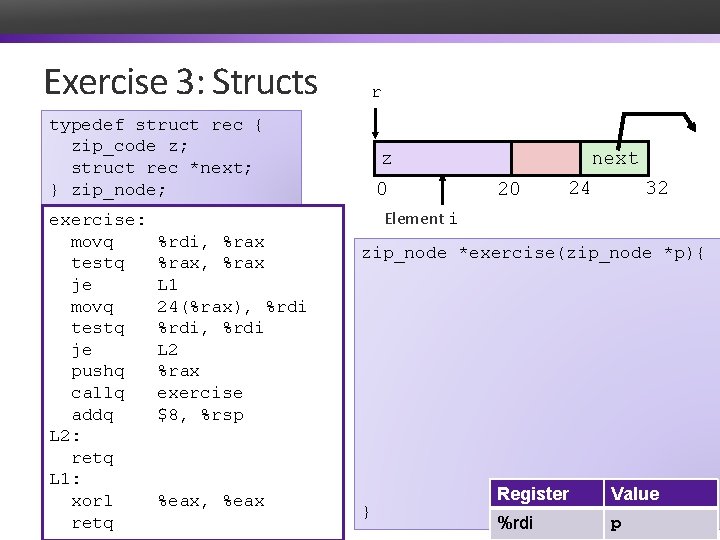
Exercise 3: Structs r typedef struct rec { z; • Czip_code Code struct rec *next; } zip_node; exercise: movq testq je pushq callq addq L 2: retq L 1: xorl retq z 0 20 next 24 32 Element i %rdi, %rax, %rax L 1 24(%rax), %rdi, %rdi L 2 %rax exercise $8, %rsp %eax, %eax zip_node *exercise(zip_node *p){ } Register Value %rdi p
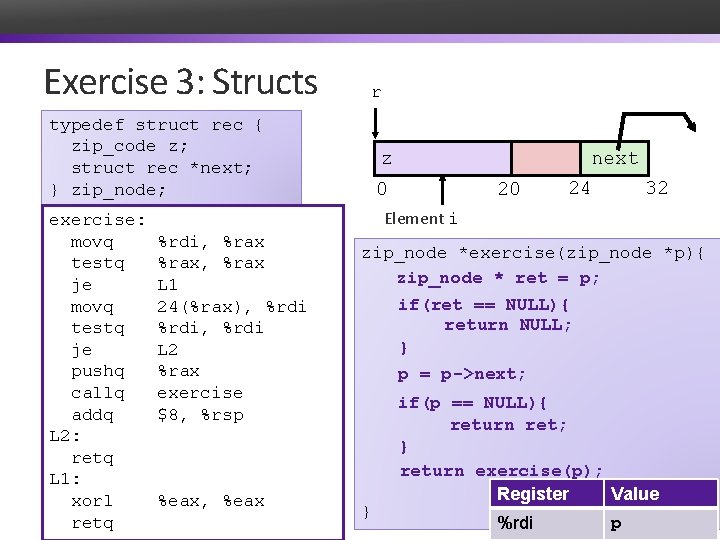
Exercise 3: Structs r typedef struct rec { z; • Czip_code Code struct rec *next; } zip_node; exercise: movq testq je pushq callq addq L 2: retq L 1: xorl retq z 20 0 next 24 32 Element i %rdi, %rax, %rax L 1 24(%rax), %rdi, %rdi L 2 %rax exercise $8, %rsp %eax, %eax zip_node *exercise(zip_node *p){ zip_node * ret = p; if(ret == NULL){ return NULL; } p = p->next; } if(p == NULL){ return ret; } return exercise(p); Register Value %rdi p
17 Exercise 4: Feedback 1. Rate how well you think this recorded lecture worked 1. Better than an in-person class 2. About as well as an in-person class 3. Less well than an in-person class, but you still learned something 4. Total waste of time, you didn't learn anything 2. How much time did you spend on this video lecture (including time spent on exercises)? 3. Do you have any questions that you would like me to address in this week's problem session? 4. Do you have any other comments or feedback?
- Slides: 16