
Lecture 8 Anthropometry for Children BY DR UMER

Lecture 8 Anthropometry for Children BY DR. UMER FAROOQ

Anthropometry for children Accurate measurement of height and weight is essential. The results can then be used to evaluate the physical growth of the child. For growth monitoring the data are plotted on growth charts over a period of time that is enough to calculate growth velocity, which can then be compared to international standards

Parameters of anthropometry Weight Head circumference Chest circumference Mid-arm circumference Skinfold thickness Ratios
Weight The measurement of weight is most reliable criteria of assessment of health and nutritional status of children. The weight can be recorded using a 1. Beam type weighing balance 2. Electronic weighing scales for infants and children 3. Bathroom type of mechanical scale 4. Salter spring machine
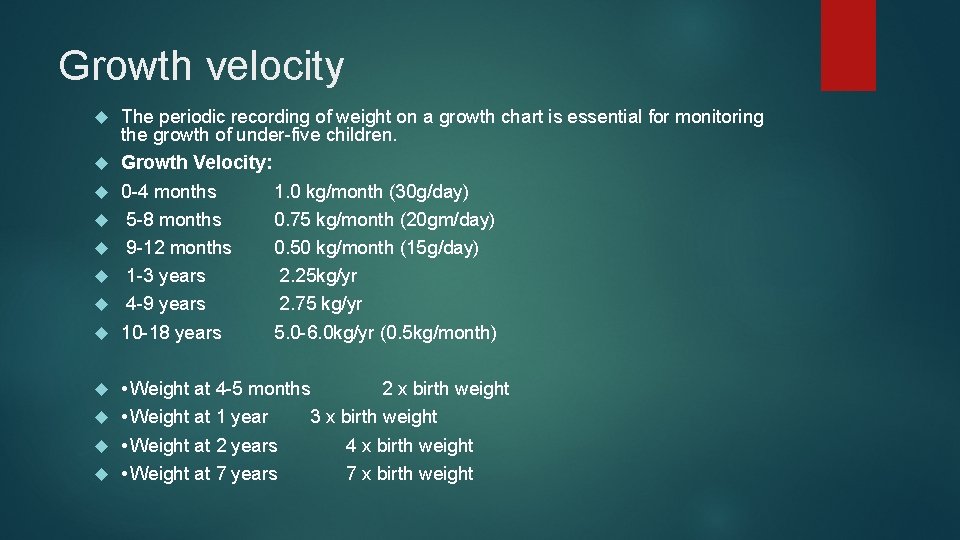
Growth velocity The periodic recording of weight on a growth chart is essential for monitoring the growth of under-five children. Growth Velocity: 0 -4 months 1. 0 kg/month (30 g/day) 5 -8 months 0. 75 kg/month (20 gm/day) 9 -12 months 0. 50 kg/month (15 g/day) 1 -3 years 2. 25 kg/yr 4 -9 years 2. 75 kg/yr 10 -18 years 5. 0 -6. 0 kg/yr (0. 5 kg/month) • Weight at 4 -5 months 2 x birth weight • Weight at 1 year 3 x birth weight • Weight at 2 years 4 x birth weight • Weight at 7 years 7 x birth weight

Length or Height Up to 2 years of age Recumbent Length is measured with the help of an Infant meter. In older children Standing Height or Stature is recorded. It is convenient to use an Inbuilt Stadiometer affixed on the wall which provides a direct read out of height with an accuracy of +/- 0. 1 cm. Nutritional deprivation over a period of time affects the stature or linear growth of the child. Technique of length measurement : The infant is placed supine on the infantometer. Assistant or mother is asked to keep the vertex or top of the head snugly touching the fixed vertical plank.
The leg are fully extended by pressing over the knee, and feet are kept vertical at 90, the movable pedal plank of infantometer is snuggly apposed against soles and length is read from scale. Technique for height measurement : In older children who can stand, height can be measured by the rod attached to the lever type machine or by stadiometer. Child should stand with bare feet on the flat floor against a wall with heels buttocks, shoulders and occiput touching the wall. Head should be kept in Frankfurt plane. With the help of a wooden spatula or plastic ruler. The topmost point of the vertex is identified on the wall.
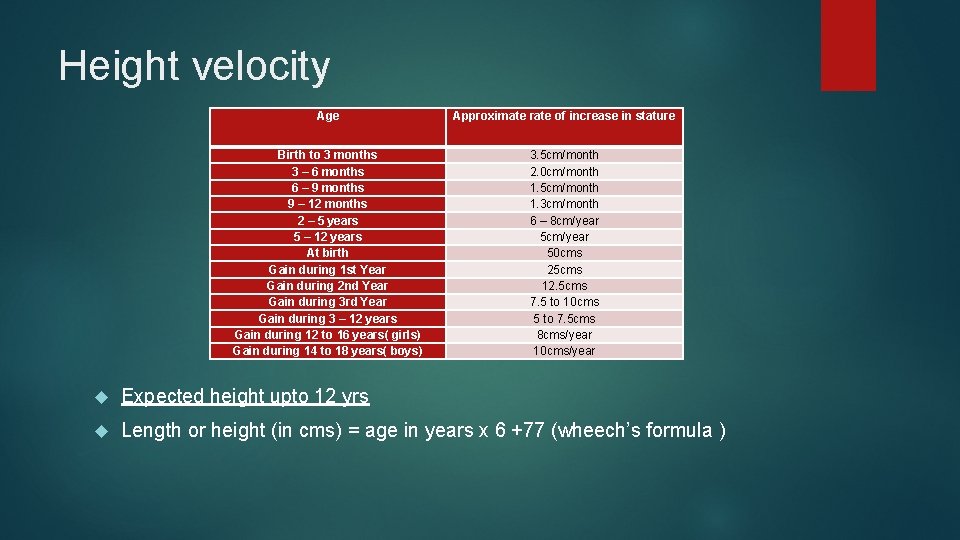
Height velocity Age Approximate rate of increase in stature Birth to 3 months 3 – 6 months 6 – 9 months 9 – 12 months 2 – 5 years 5 – 12 years At birth Gain during 1 st Year Gain during 2 nd Year Gain during 3 rd Year Gain during 3 – 12 years Gain during 12 to 16 years( girls) Gain during 14 to 18 years( boys) 3. 5 cm/month 2. 0 cm/month 1. 5 cm/month 1. 3 cm/month 6 – 8 cm/year 50 cms 25 cms 12. 5 cms 7. 5 to 10 cms 5 to 7. 5 cms 8 cms/year 10 cms/year Expected height upto 12 yrs Length or height (in cms) = age in years x 6 +77 (wheech’s formula )
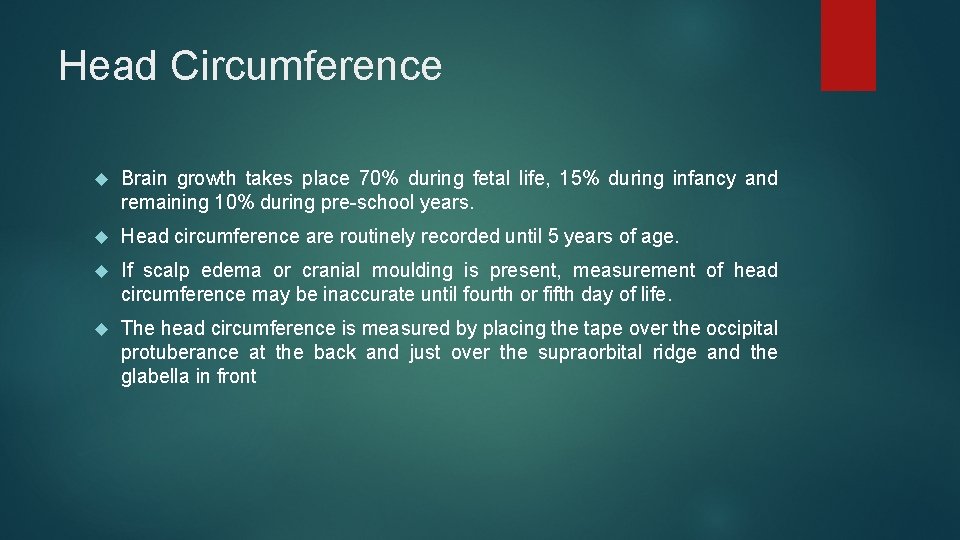
Head Circumference Brain growth takes place 70% during fetal life, 15% during infancy and remaining 10% during pre-school years. Head circumference are routinely recorded until 5 years of age. If scalp edema or cranial moulding is present, measurement of head circumference may be inaccurate until fourth or fifth day of life. The head circumference is measured by placing the tape over the occipital protuberance at the back and just over the supraorbital ridge and the glabella in front
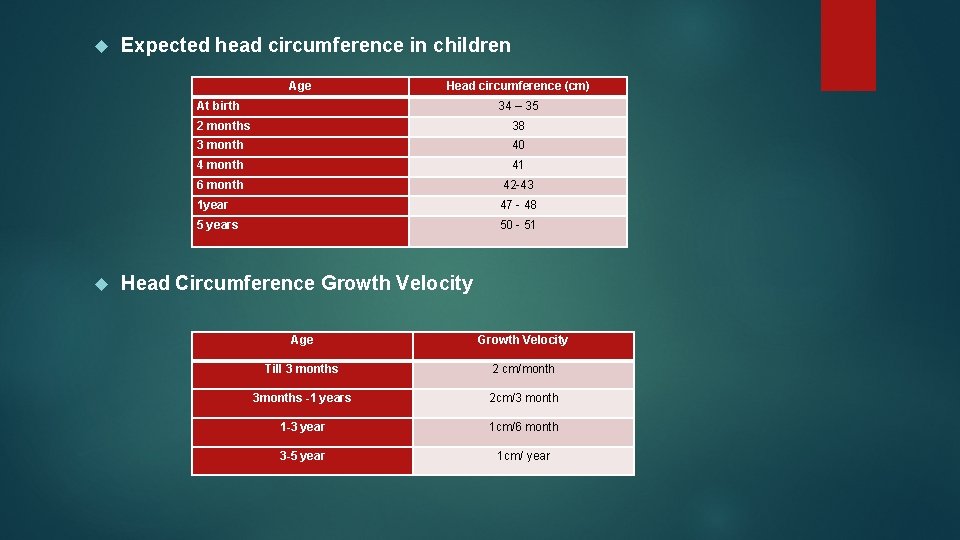
Expected head circumference in children Age Head circumference (cm) At birth 34 – 35 2 months 38 3 month 40 4 month 41 6 month 42 -43 1 year 47 - 48 5 years 50 - 51 Head Circumference Growth Velocity Age Growth Velocity Till 3 months 2 cm/month 3 months -1 years 2 cm/3 month 1 -3 year 1 cm/6 month 3 -5 year 1 cm/ year
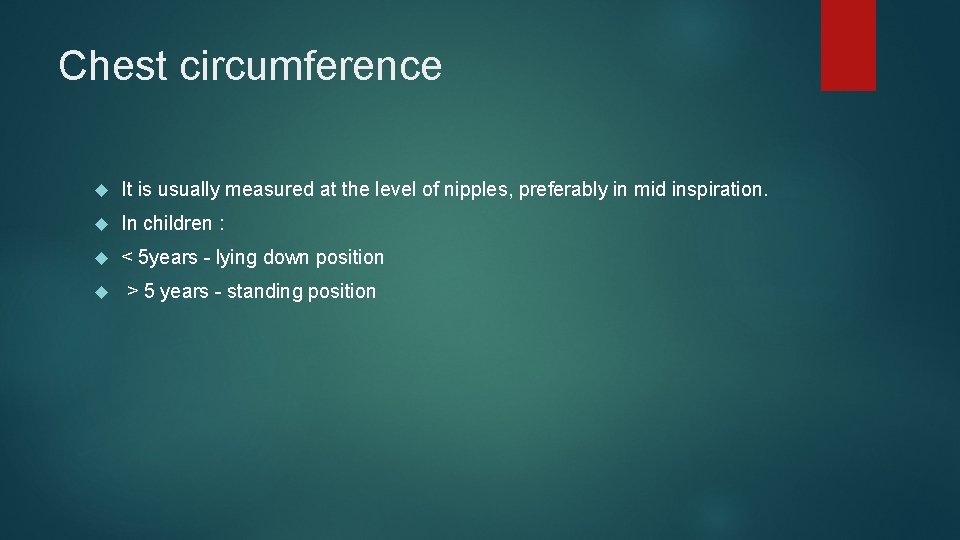
Chest circumference It is usually measured at the level of nipples, preferably in mid inspiration. In children : < 5 years - lying down position > 5 years - standing position
Relationship between head size with Chest Circumference At birth: head circumference > chest circumference by upto 3 cms. At around 9 months to 1 year of age: head circumference = chest circumference There after chest grows more rapidly compared to the brain. The head circumference is greater than chest circumference by more than 3 cms in : a) preterms b) small-for-date , c) hydrocephalic infants In malnourished children, chest size may be significantly smaller than head circumference because growth of brain is less affected by undernutrition. Therefore there will be considerable delay before chest circumference overtakes head circumference.
Mid-upper arm circumference During 1 -5 Years of age it remains reasonably static between 15 -17 cms among healthy children. It is conventionally measured over the left upper arm, at a point marked midway between acromion (shoulder) and olecranon (elbow) with arm bent at right angle. The child is asked to stand or sit with the arm hanging loose at the side. It is measured with a fiber glass or steel tape. If it is less than 12. 5 cm it is suggestive of severe malnutrition. If it is between 12. 5 -13. 5 cm it is indicative of moderate malnutrition.
Bangle test It is a quick assessment of arm circumference. A fiber glass ring of internal diameter of 4 cm is slipped up the arm, if it passes above the elbow, it suggests that upper arm is less than 12. 5 cm and child is malnourished. Shakir tape It is a fiber-glass tape with red – less than 12. 5 cm yellow – 12. 5 - 13. 5 cm green – greater than 13. 5 cm shading so that paramedical workers can assess nutritional status without having to remember the normal limits of mid arm circumference.
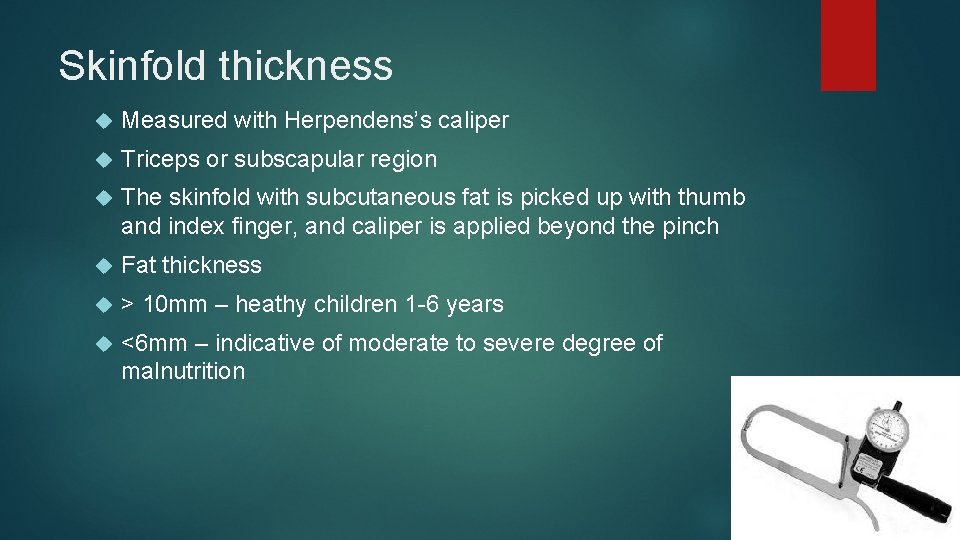
Skinfold thickness Measured with Herpendens’s caliper Triceps or subscapular region The skinfold with subcutaneous fat is picked up with thumb and index finger, and caliper is applied beyond the pinch Fat thickness > 10 mm – heathy children 1 -6 years <6 mm – indicative of moderate to severe degree of malnutrition
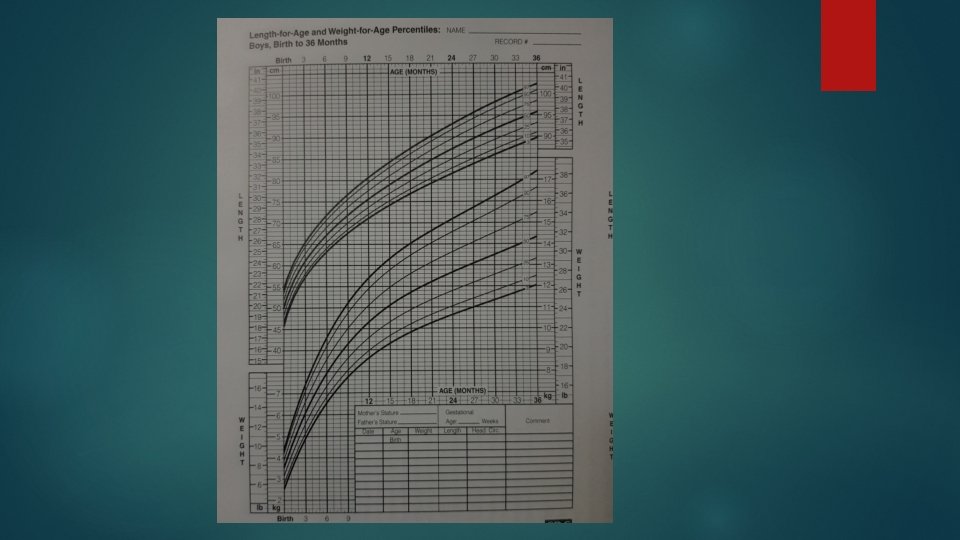
Assessment To evaluate growth patterns, periodic measurements of height (or length), weight, and head circumference are plotted on growth charts The most commonly used growth charts compare height (or length) to age, weight to age, head circumference to age, weight to length, and BMI to age Although individual growth patterns vary, a child’s growth will generally stay at about the same percentile throughout childhood; a sharp drop in a previously steady growth pattern suggests malnutrition
Growth patterns that fall below the 5 th percentile may also be cause for concern, although genetic influences must be considered when interpreting low values Growth charts with BMI-for-age percentiles can be used to assess risk of underweight and overweight in children over two years of age: the 10 th and 85 th percentiles are used as cutoffs to identify children who may be malnourished or over « weight, respectively

Thank You
- Slides: 20