
Lecture 7 Web Search Engine Architecture 1 Overview
Lecture 7 Web Search Engine Architecture 1
Overview of components • We introduce in this subject the architecture of a search engine. It consists of its software components, the interfaces provided by them, and the relationships between any two of them. (An extra level of detail could include the data structures supported. ) In this subject, we use the example of an early centralized architecture as reflected by the Altavista search engine of the mid 90 s to provide a high-level description of the major components of such a system. We then (Subject 3) give an example of the Google search engine architecture as it was originally developed and used back in 1997 and 1998. There are more components involved in the Google architecture, but a highlevel abstraction of that architecture (minus the ranking engine perhaps) is not much different from Altavista’s. 2
Overview of components The first search engines such as Excite (1994), Info. Seek (1994), Altavista(1995) employed primarily Information Retrieval principles and techniques and were search engines that were evaluating the similarity of a query q relative to the web document dj of a corpus of web-documents retrieved from the Web. The query was being treated as a “small document” consisting of the index-terms input by a customer/user and the similarity s(q, dj ) was established based on IR principles/measures. This determined a “rank” of d j for query q. However Yahoo! (1995), Google (1998), Teoma (2000), Bing (2006) differ from those early approaches in the sense that link information (e. g. the Web structure and link information of Web-based documents) is used to determine the rank of a web document r(dj) in addition to other monetary criteria (say, for the case of Google, advertising revenue by paying customers). Thus the R(q, dj) the overall rank of a document dj relative to a query q becomes a weighed sum of s(q, dj) and r(dj) plus other additional factors. Somewhere in between these two groups of search engines we have Lycos (1994) a search engine that only used content and structure information for ranking results. 3
Overview of components Criteria. Any search engine architecture must satisfy two major criteria. • Effectiveness (Quality) that will satisfy the relevance criterion. • Efficiency (Speed) that will satisfy response times and throughput requirements i. e. process as many queries as quickly as possible. Related to it is the notion of scalability. Other criteria or goals can also be satisfied that relate to critical features of a search engine such as those described in the previous subject. 4
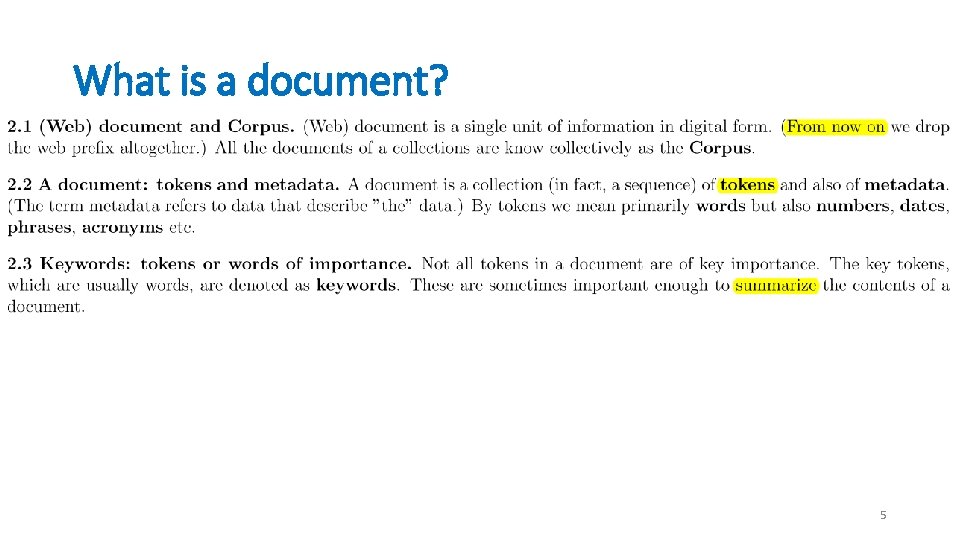
What is a document? 5
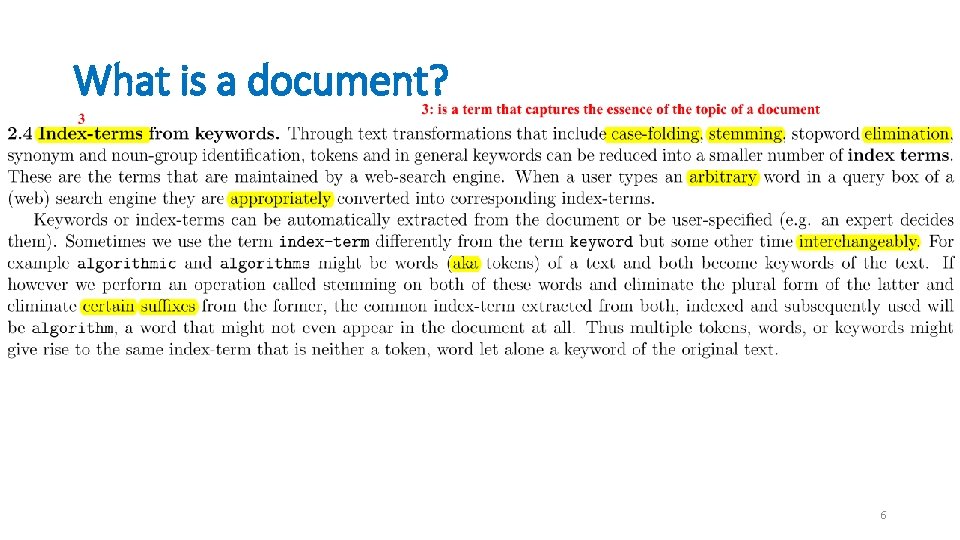
What is a document? 6
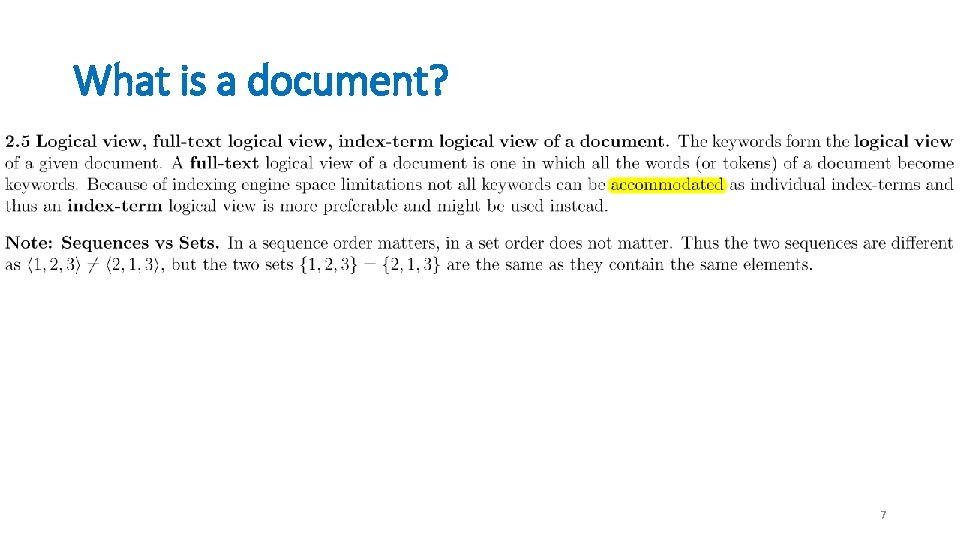
What is a document? 7
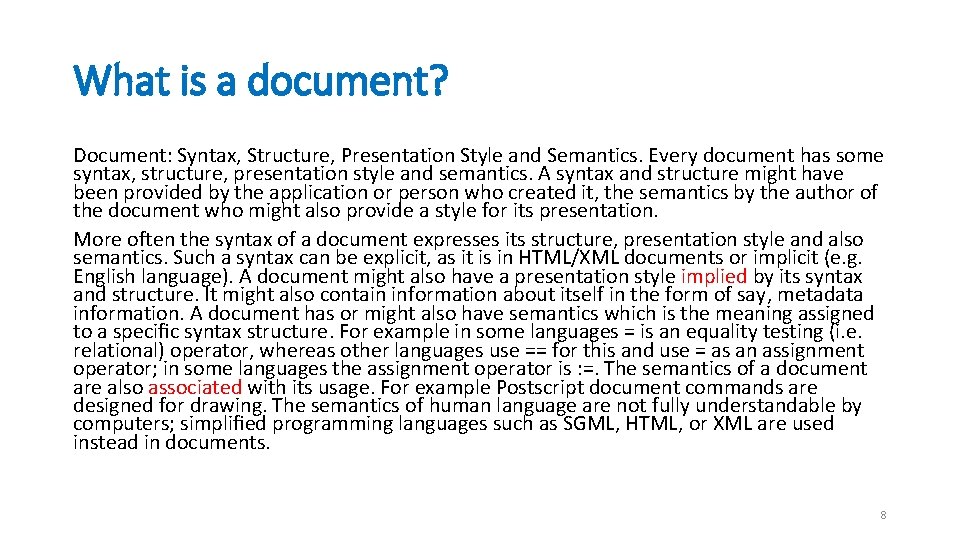
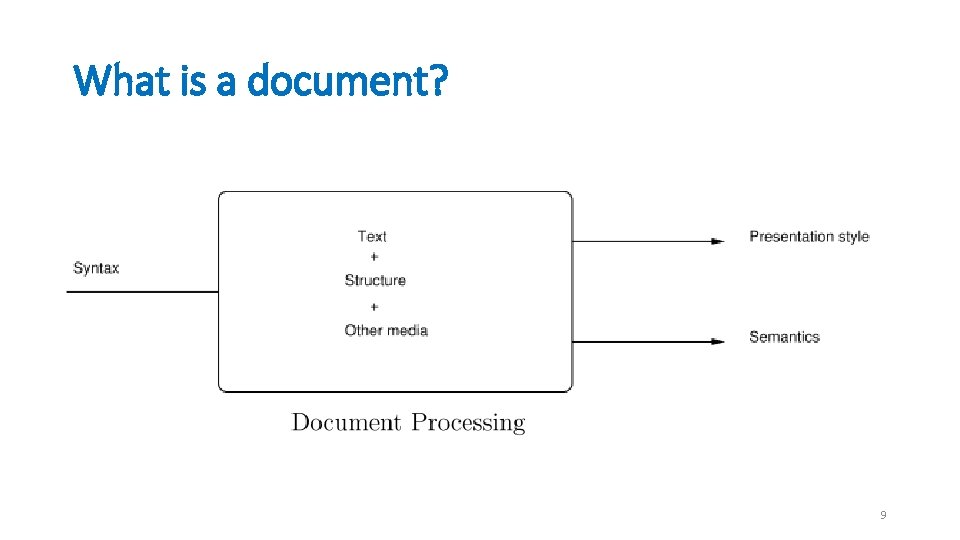
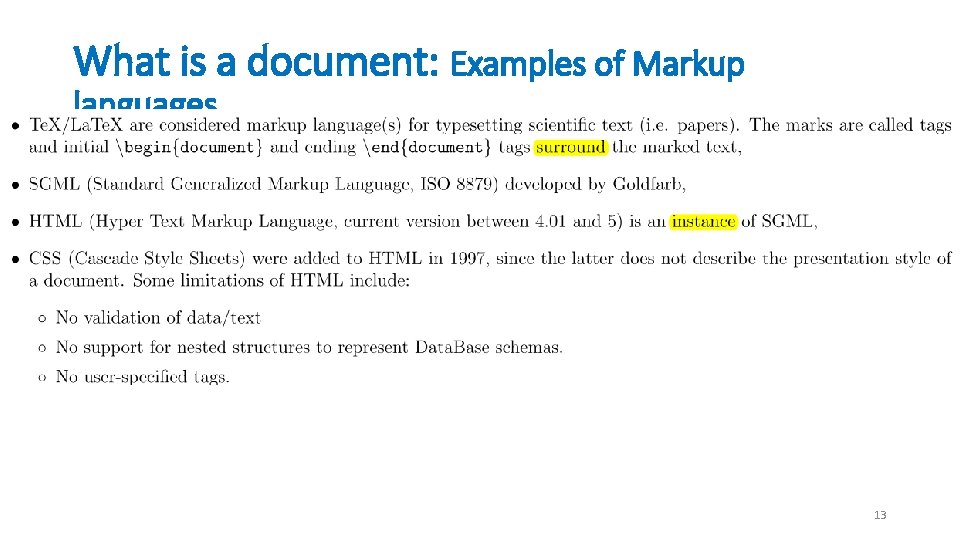
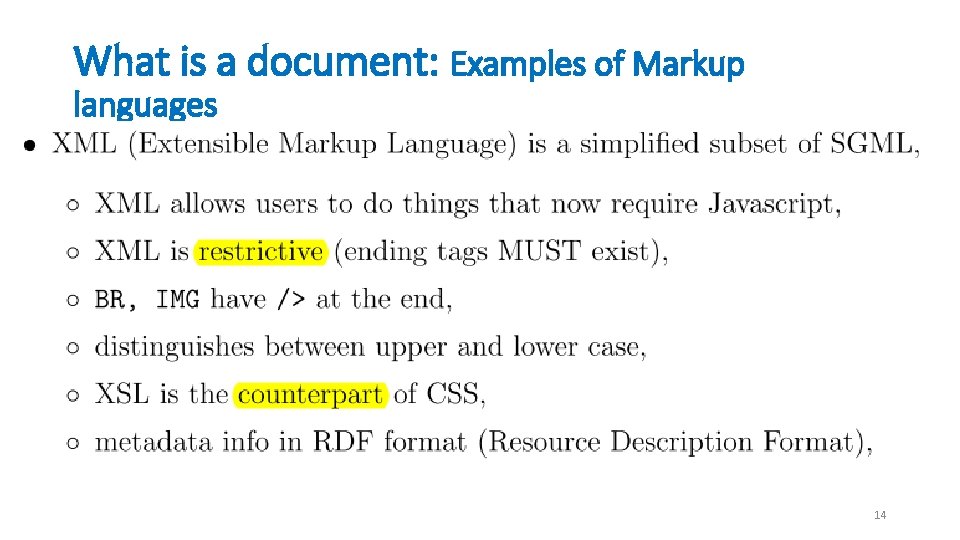
What is a document? Document: Syntax, Structure, Presentation Style and Semantics. Every document has some syntax, structure, presentation style and semantics. A syntax and structure might have been provided by the application or person who created it, the semantics by the author of the document who might also provide a style for its presentation. More often the syntax of a document expresses its structure, presentation style and also semantics. Such a syntax can be explicit, as it is in HTML/XML documents or implicit (e. g. English language). A document might also have a presentation style implied by its syntax and structure. It might also contain information about itself in the form of say, metadata information. A document has or might also have semantics which is the meaning assigned to a specific syntax structure. For example in some languages = is an equality testing (i. e. relational) operator, whereas other languages use == for this and use = as an assignment operator; in some languages the assignment operator is : =. The semantics of a document are also associated with its usage. For example Postscript document commands are designed for drawing. The semantics of human language are not fully understandable by computers; simplified programming languages such as SGML, HTML, or XML are used instead in documents. 8
What is a document? 9
What is a document? Documents come in a variety of formats that might be classified as follows: (a) text-based documents (e. g. plain text ASCII or UNICODE, HTML, XML, Te. X, La. Te. X, RTF, etc), (b) encoded documents (e. g. MIMEencoded which is an acronym for Multipurpose Internet Mail Exchange), (c) proprietary word-processing formatted documents such as Microsoft Word, Framemaker, etc, (d) documents intended for displaying or printing such as Adobe Acrobat PDF, and Adobe Postscript, (e) documents intended for other purposes that also store text (e. g. Microsoft Excel and Powerpoint), and (f) compressed proprietary document formats. 10
What is a document: Markup Languages 11
What is a document: Markup Languages 12
What is a document: Examples of Markup languages 13
What is a document: Examples of Markup languages 14
What is a document: Examples of Markup languages 15
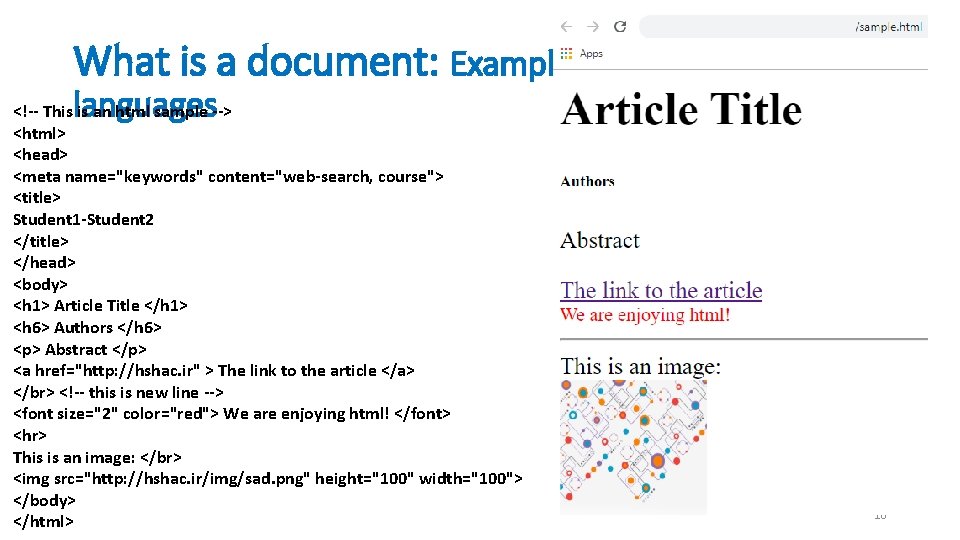
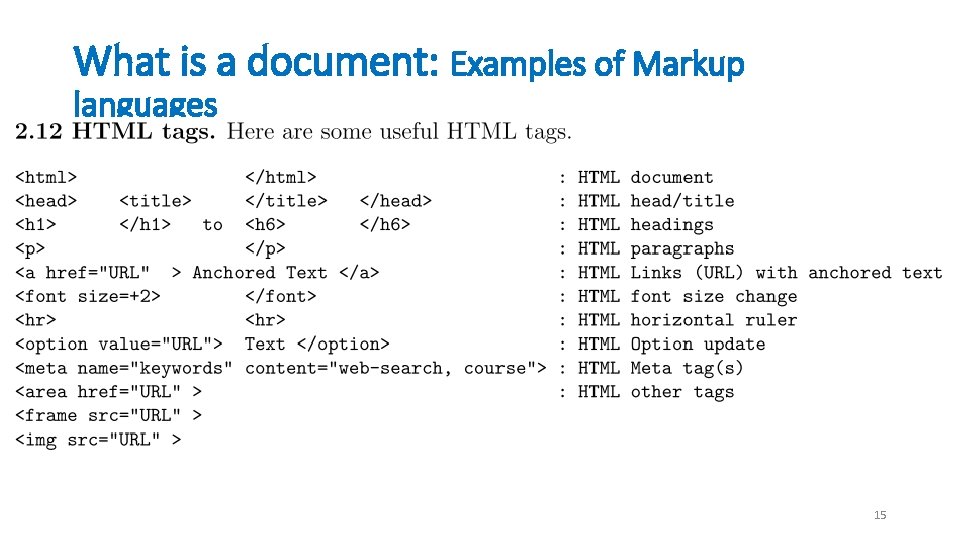
What is a document: Examples of Markup languages <!-- This is an html sample --> <html> <head> <meta name="keywords" content="web-search, course"> <title> Student 1 -Student 2 </title> </head> <body> <h 1> Article Title </h 1> <h 6> Authors </h 6> <p> Abstract </p> <a href="http: //hshac. ir" > The link to the article </a> </br> <!-- this is new line --> <font size="2" color="red"> We are enjoying html! </font> <hr> This is an image: </br> <img src="http: //hshac. ir/img/sad. png" height="100" width="100"> </body> </html> 16
- Slides: 16