
Lecture 7 Vector cont Principles of Information Retrieval






- Slides: 45
Lecture 7: Vector (cont. ) Principles of Information Retrieval Prof. Ray Larson University of California, Berkeley School of Information IS 240 – Spring 2009. 02. 11 - SLIDE 1
Review • IR Models • Vector Space Introduction IS 240 – Spring 2009. 02. 11 - SLIDE 2
IR Models • Set Theoretic Models – Boolean – Fuzzy – Extended Boolean • Vector Models (Algebraic) • Probabilistic Models (probabilistic) IS 240 – Spring 2009. 02. 11 - SLIDE 3
Vector Space Model • Documents are represented as vectors in term space – Terms are usually stems – Documents represented by binary or weighted vectors of terms • Queries represented the same as documents • Query and Document weights are based on length and direction of their vector • A vector distance measure between the query and documents is used to rank retrieved documents IS 240 – Spring 2009. 02. 11 - SLIDE 4
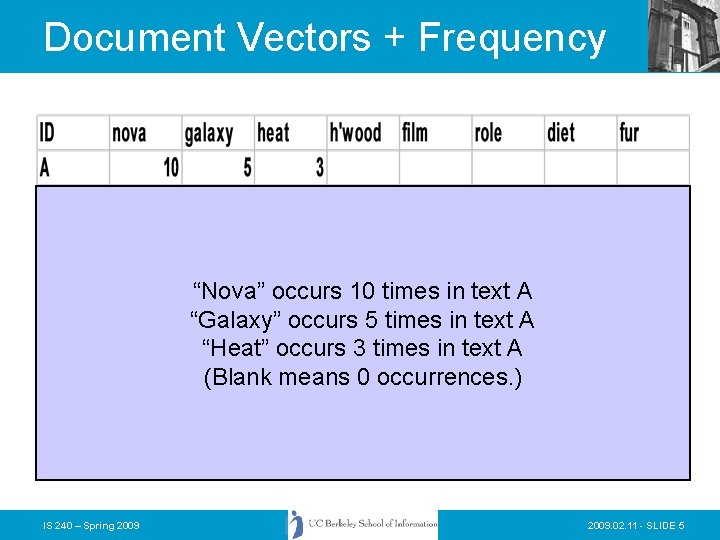
Document Vectors + Frequency “Nova” occurs 10 times in text A “Galaxy” occurs 5 times in text A “Heat” occurs 3 times in text A (Blank means 0 occurrences. ) IS 240 – Spring 2009. 02. 11 - SLIDE 5
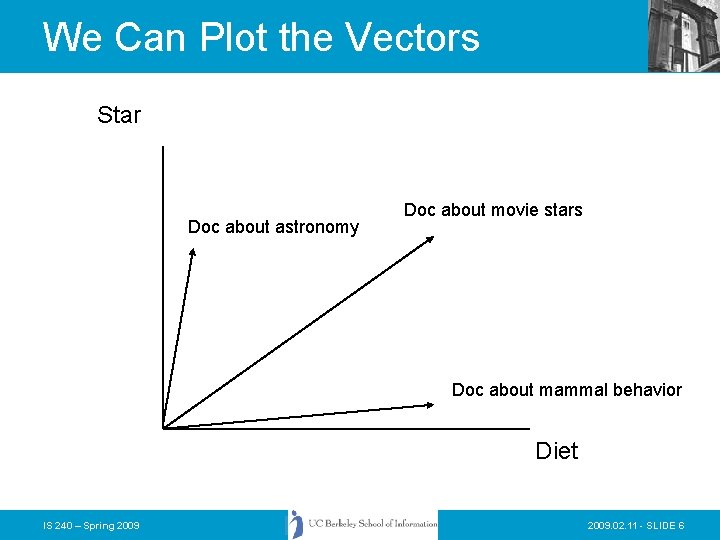
We Can Plot the Vectors Star Doc about astronomy Doc about movie stars Doc about mammal behavior Diet IS 240 – Spring 2009. 02. 11 - SLIDE 6
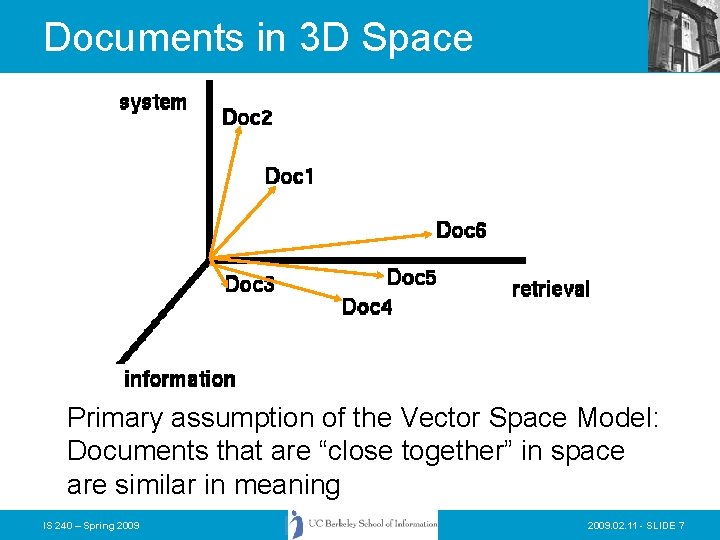
Documents in 3 D Space Primary assumption of the Vector Space Model: Documents that are “close together” in space are similar in meaning IS 240 – Spring 2009. 02. 11 - SLIDE 7
Document Space has High Dimensionality • What happens beyond 2 or 3 dimensions? • Similarity still has to do with how many tokens are shared in common. • More terms -> harder to understand which subsets of words are shared among similar documents. • We will look in detail at ranking methods • Approaches to handling high dimensionality: Clustering and LSI (later) IS 240 – Spring 2009. 02. 11 - SLIDE 8
Assigning Weights to Terms • Binary Weights • Raw term frequency • tf*idf – Recall the Zipf distribution – Want to weight terms highly if they are • Frequent in relevant documents … BUT • Infrequent in the collection as a whole • Automatically derived thesaurus terms IS 240 – Spring 2009. 02. 11 - SLIDE 9
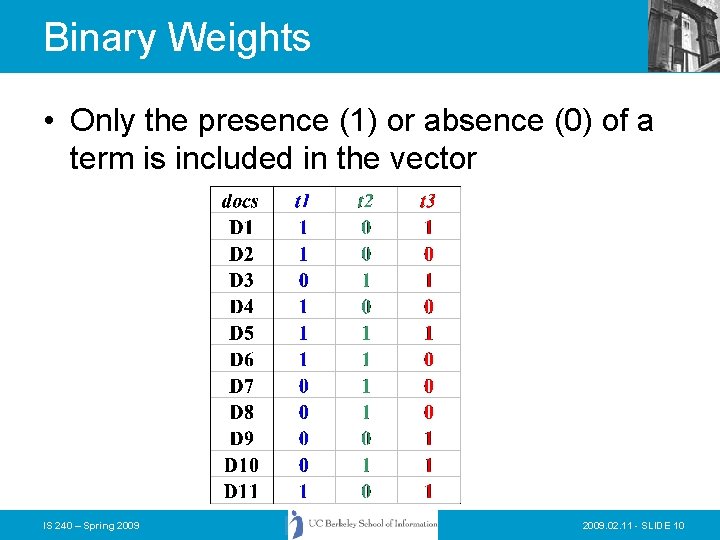
Binary Weights • Only the presence (1) or absence (0) of a term is included in the vector IS 240 – Spring 2009. 02. 11 - SLIDE 10
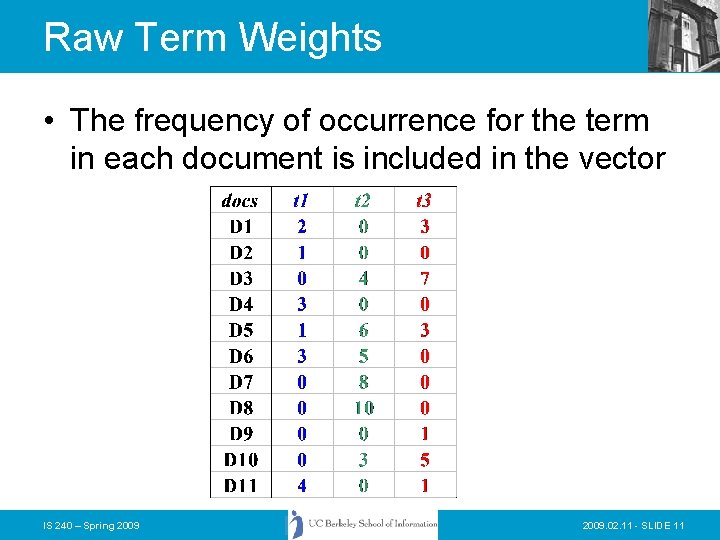
Raw Term Weights • The frequency of occurrence for the term in each document is included in the vector IS 240 – Spring 2009. 02. 11 - SLIDE 11
Assigning Weights • tf*idf measure: – Term frequency (tf) – Inverse document frequency (idf) • A way to deal with some of the problems of the Zipf distribution • Goal: Assign a tf*idf weight to each term in each document IS 240 – Spring 2009. 02. 11 - SLIDE 12
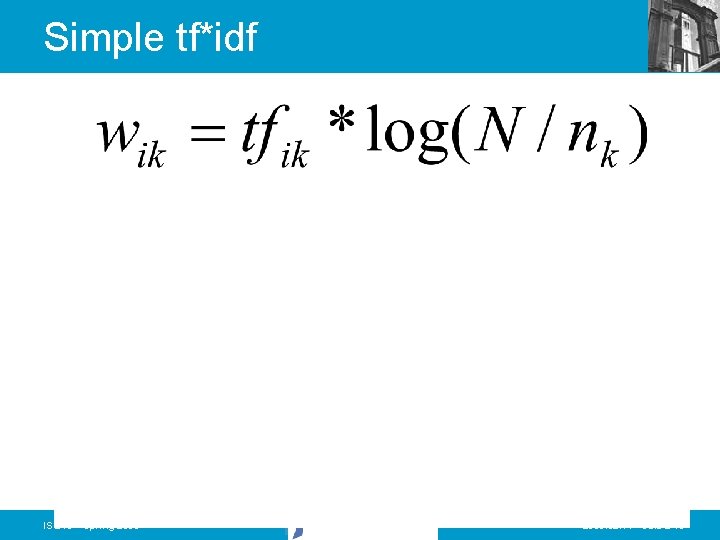
Simple tf*idf IS 240 – Spring 2009. 02. 11 - SLIDE 13
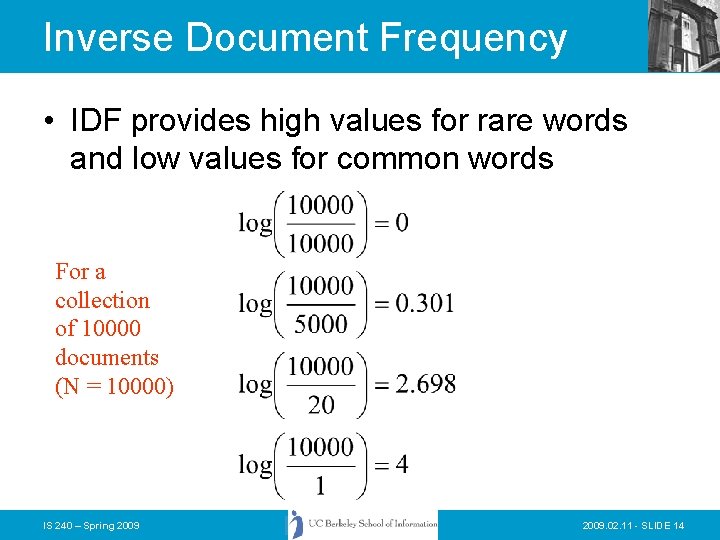
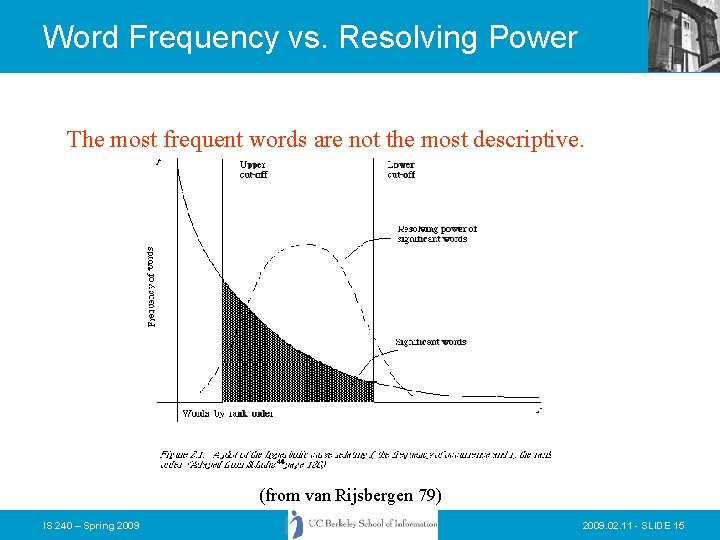
Inverse Document Frequency • IDF provides high values for rare words and low values for common words For a collection of 10000 documents (N = 10000) IS 240 – Spring 2009. 02. 11 - SLIDE 14
Word Frequency vs. Resolving Power The most frequent words are not the most descriptive. (from van Rijsbergen 79) IS 240 – Spring 2009. 02. 11 - SLIDE 15
Non-Boolean IR • Need to measure some similarity between the query and the document • The basic notion is that documents that are somehow similar to a query, are likely to be relevant responses for that query • We will revisit this notion again and see how the Language Modelling approach to IR has taken it to a new level IS 240 – Spring 2009. 02. 11 - SLIDE 16
Non-Boolean? • To measure similarity we… – Need to consider the characteristics of the document and the query – Make the assumption that similarity of language use between the query and the document implies similarity of topic and hence, potential relevance. IS 240 – Spring 2009. 02. 11 - SLIDE 17
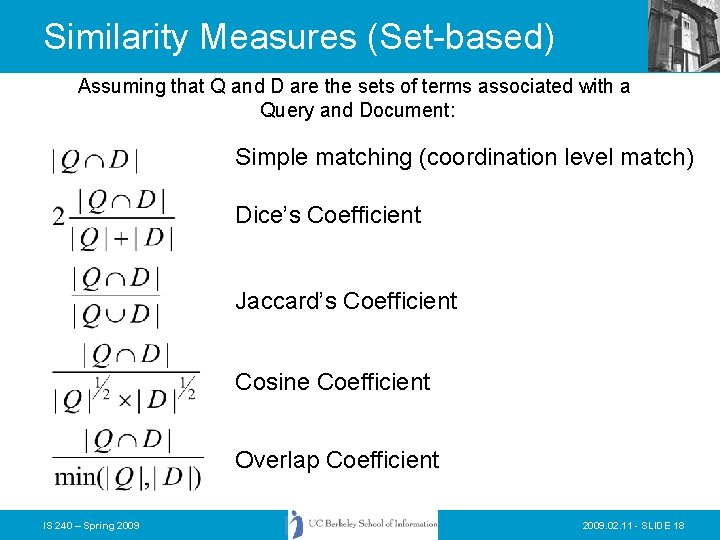
Similarity Measures (Set-based) Assuming that Q and D are the sets of terms associated with a Query and Document: Simple matching (coordination level match) Dice’s Coefficient Jaccard’s Coefficient Cosine Coefficient Overlap Coefficient IS 240 – Spring 2009. 02. 11 - SLIDE 18
Today • • • Vector Matching SMART Matching options Calculating cosine similarity ranks Calculating TF-IDF weights How to Process a query in a vector system? • Extensions to basic vector space and pivoted vector space IS 240 – Spring 2009. 02. 11 - SLIDE 19
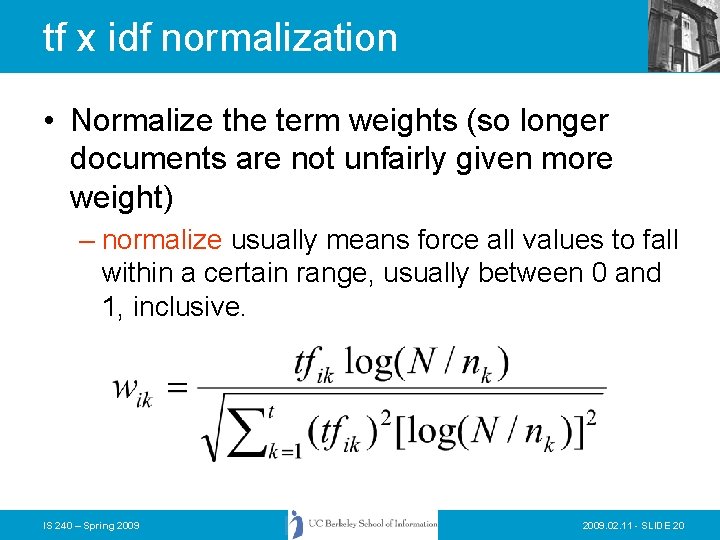
tf x idf normalization • Normalize the term weights (so longer documents are not unfairly given more weight) – normalize usually means force all values to fall within a certain range, usually between 0 and 1, inclusive. IS 240 – Spring 2009. 02. 11 - SLIDE 20
Vector space similarity • Use the weights to compare the documents IS 240 – Spring 2009. 02. 11 - SLIDE 21
Vector Space Similarity Measure • combine tf x idf into a measure IS 240 – Spring 2009. 02. 11 - SLIDE 22
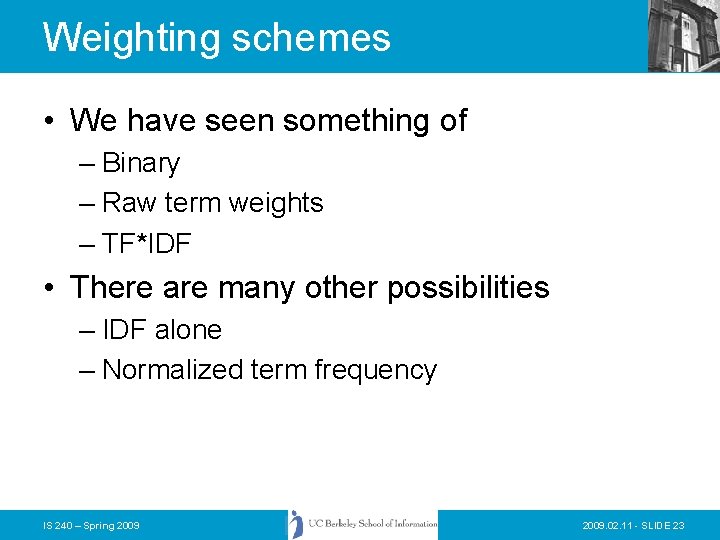
Weighting schemes • We have seen something of – Binary – Raw term weights – TF*IDF • There are many other possibilities – IDF alone – Normalized term frequency IS 240 – Spring 2009. 02. 11 - SLIDE 23
Term Weights in SMART • SMART is an experimental IR system developed by Gerard Salton (and continued by Chris Buckley) at Cornell. • Designed for laboratory experiments in IR – Easy to mix and match different weighting methods – Really terrible user interface – Intended for use by code hackers IS 240 – Spring 2009. 02. 11 - SLIDE 24
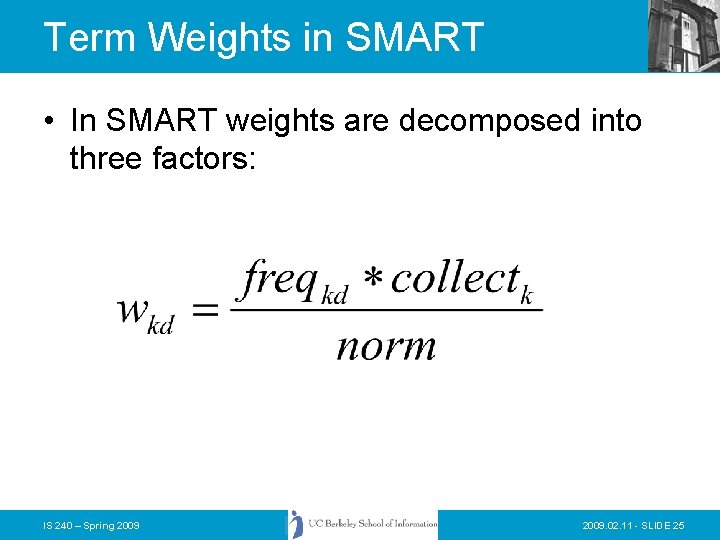
Term Weights in SMART • In SMART weights are decomposed into three factors: IS 240 – Spring 2009. 02. 11 - SLIDE 25
SMART Freq Components Binary maxnorm augmented log IS 240 – Spring 2009. 02. 11 - SLIDE 26
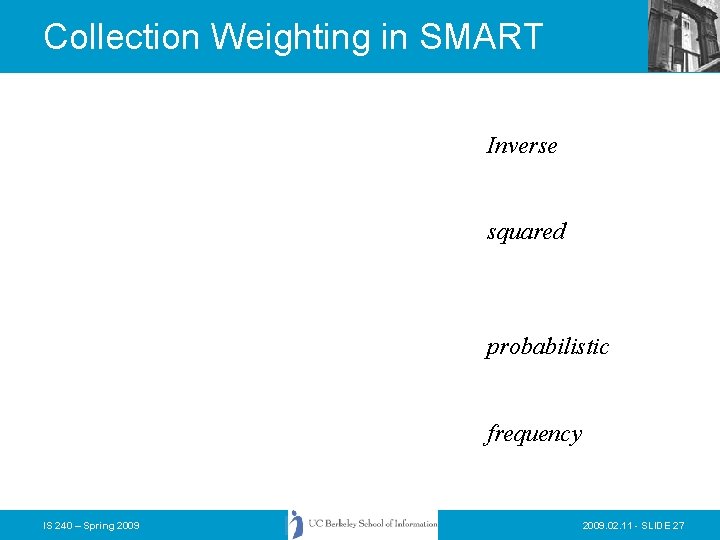
Collection Weighting in SMART Inverse squared probabilistic frequency IS 240 – Spring 2009. 02. 11 - SLIDE 27
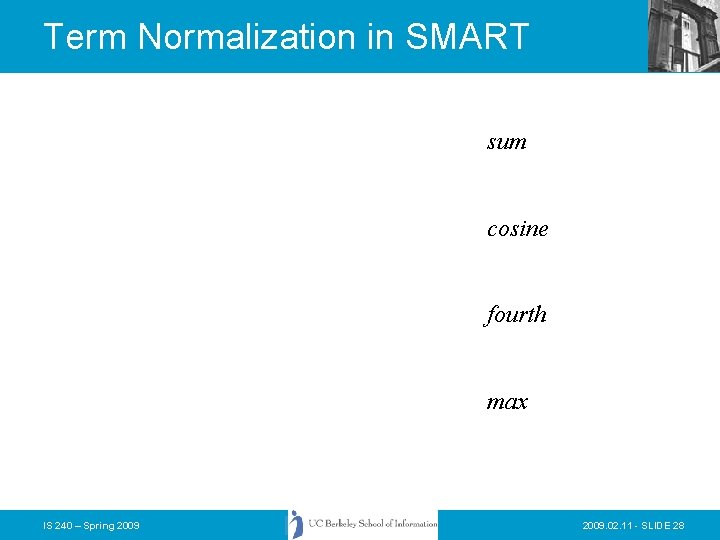
Term Normalization in SMART sum cosine fourth max IS 240 – Spring 2009. 02. 11 - SLIDE 28
How To Process a Vector Query • Assume that the database contains an inverted file like the one we discussed earlier… – Why an inverted file? – Why not a REAL vector file? • What information should be stored about each document/term pair? – As we have seen SMART gives you choices about this… IS 240 – Spring 2009. 02. 11 - SLIDE 29
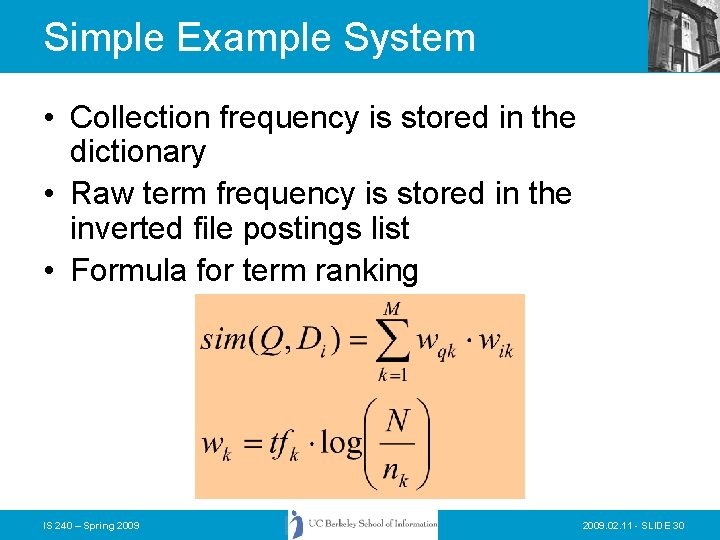
Simple Example System • Collection frequency is stored in the dictionary • Raw term frequency is stored in the inverted file postings list • Formula for term ranking IS 240 – Spring 2009. 02. 11 - SLIDE 30
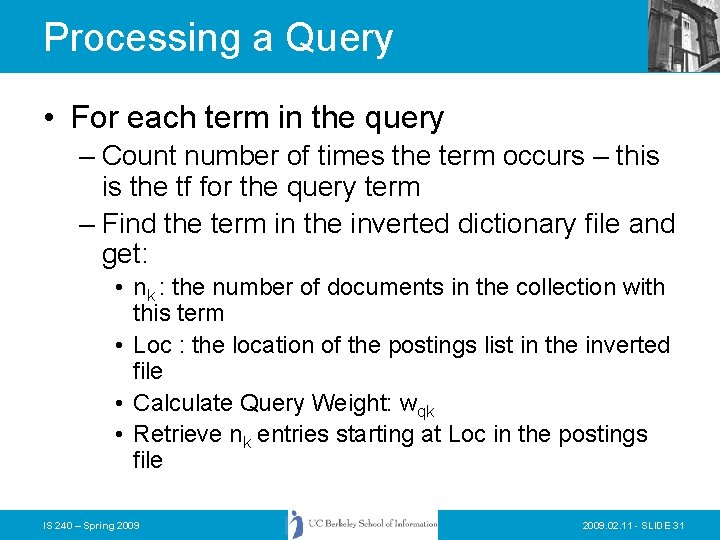
Processing a Query • For each term in the query – Count number of times the term occurs – this is the tf for the query term – Find the term in the inverted dictionary file and get: • nk : the number of documents in the collection with this term • Loc : the location of the postings list in the inverted file • Calculate Query Weight: wqk • Retrieve nk entries starting at Loc in the postings file IS 240 – Spring 2009. 02. 11 - SLIDE 31
Processing a Query • Alternative strategies… – First retrieve all of the dictionary entries before getting any postings information • Why? – Just process each term in sequence • How can we tell how many results there will be? – It is possible to put a limitation on the number of items returned • How might this be done? IS 240 – Spring 2009. 02. 11 - SLIDE 32
Processing a Query • Like Hashed Boolean OR: – Put each document ID from each postings list into hash table • If match increment counter (optional) – If first doc, set a Weight. SUM variable to 0 • Calculate Document weight wik for the current term • Multiply Query weight and Document weight and add it to Weight. SUM • Scan hash table contents and add to new list – including document ID and Weight. SUM • Sort by Weight. SUM and present in sorted order IS 240 – Spring 2009. 02. 11 - SLIDE 33
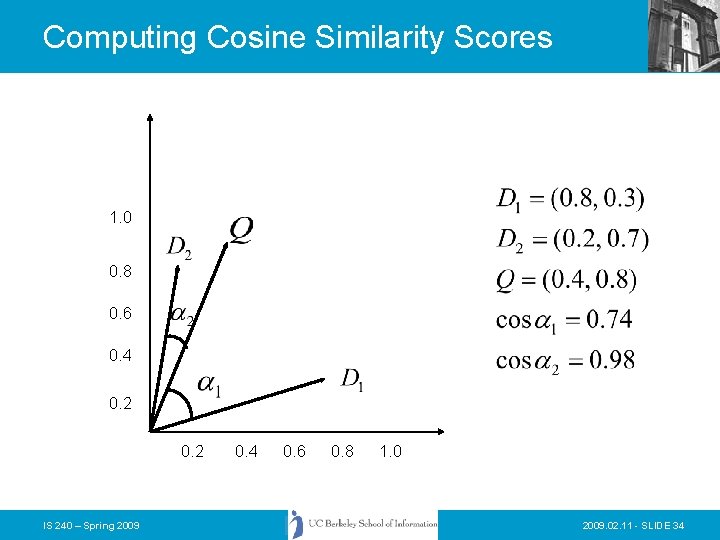
Computing Cosine Similarity Scores 1. 0 0. 8 0. 6 0. 4 0. 2 IS 240 – Spring 2009 0. 4 0. 6 0. 8 1. 0 2009. 02. 11 - SLIDE 34
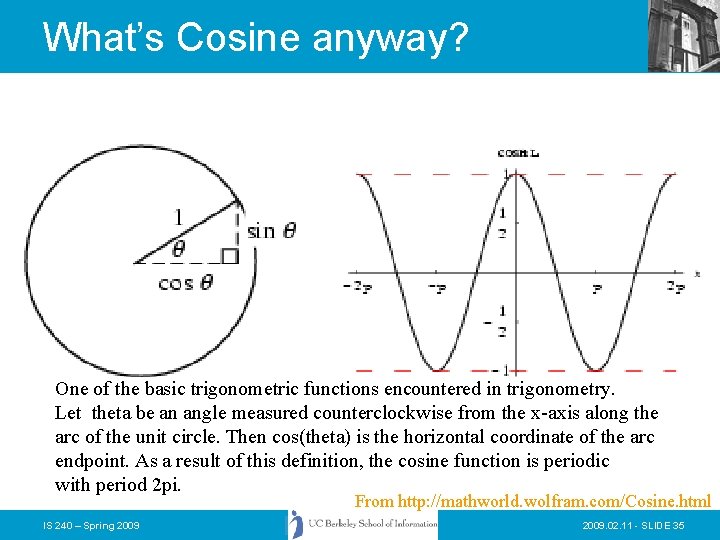
What’s Cosine anyway? One of the basic trigonometric functions encountered in trigonometry. Let theta be an angle measured counterclockwise from the x-axis along the arc of the unit circle. Then cos(theta) is the horizontal coordinate of the arc endpoint. As a result of this definition, the cosine function is periodic with period 2 pi. From http: //mathworld. wolfram. com/Cosine. html IS 240 – Spring 2009. 02. 11 - SLIDE 35
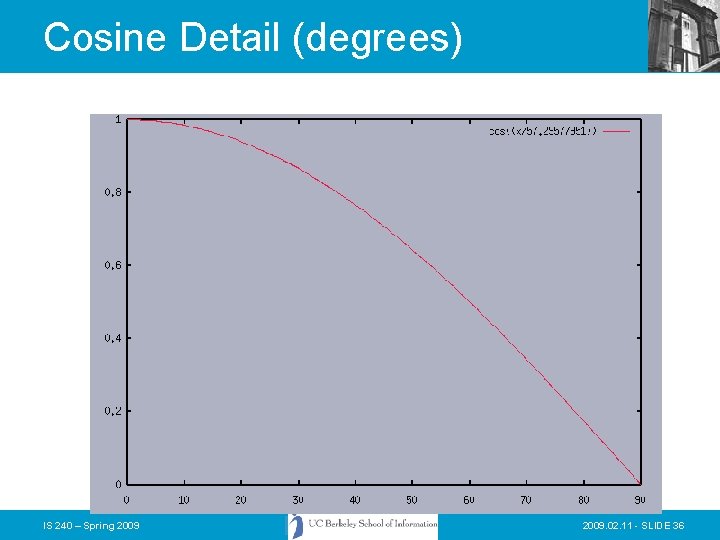
Cosine Detail (degrees) IS 240 – Spring 2009. 02. 11 - SLIDE 36
Computing a similarity score IS 240 – Spring 2009. 02. 11 - SLIDE 37
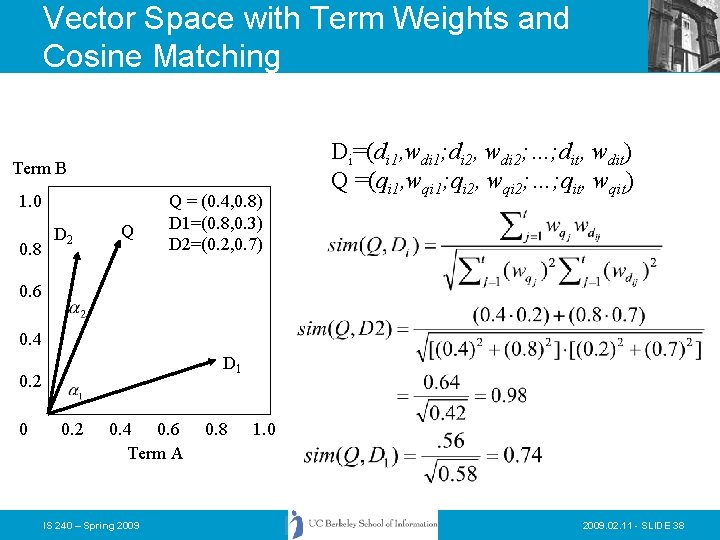
Vector Space with Term Weights and Cosine Matching Term B 1. 0 0. 8 D 2 Q Q = (0. 4, 0. 8) D 1=(0. 8, 0. 3) D 2=(0. 2, 0. 7) Di=(di 1, wdi 1; di 2, wdi 2; …; dit, wdit) Q =(qi 1, wqi 1; qi 2, wqi 2; …; qit, wqit) 0. 6 0. 4 D 1 0. 2 0. 4 0. 6 Term A IS 240 – Spring 2009 0. 8 1. 0 2009. 02. 11 - SLIDE 38
Problems with Vector Space • There is no real theoretical basis for the assumption of a term space – it is more for visualization that having any real basis – most similarity measures work about the same regardless of model • Terms are not really orthogonal dimensions – Terms are not independent of all other terms IS 240 – Spring 2009. 02. 11 - SLIDE 39
Vector Space Refinements • As we saw earlier, the SMART system included a variety of weighting methods that could be combined into a single vector model algorithm • Vector space has proven very effective in most IR evaluations • Salton in a short article in SIGIR Forum (Fall 1981) outlined a “Blueprint” for automatic indexing and retrieval using vector space that has been, to a large extent, followed by everyone doing vector IR IS 240 – Spring 2009. 02. 11 - SLIDE 40
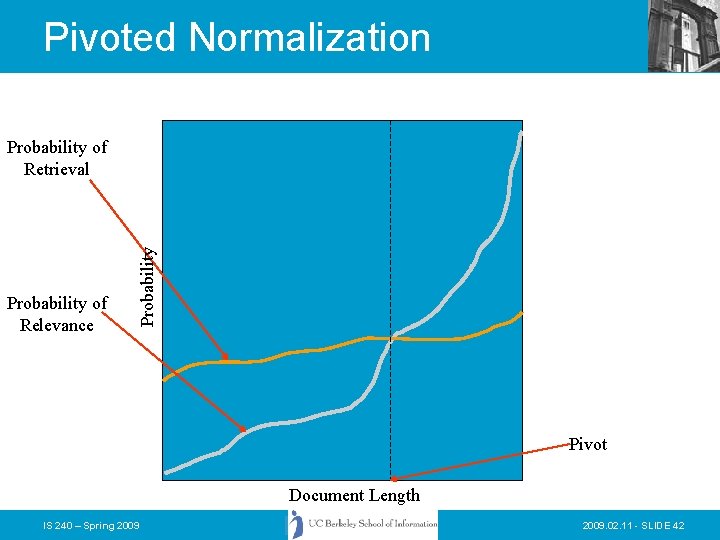
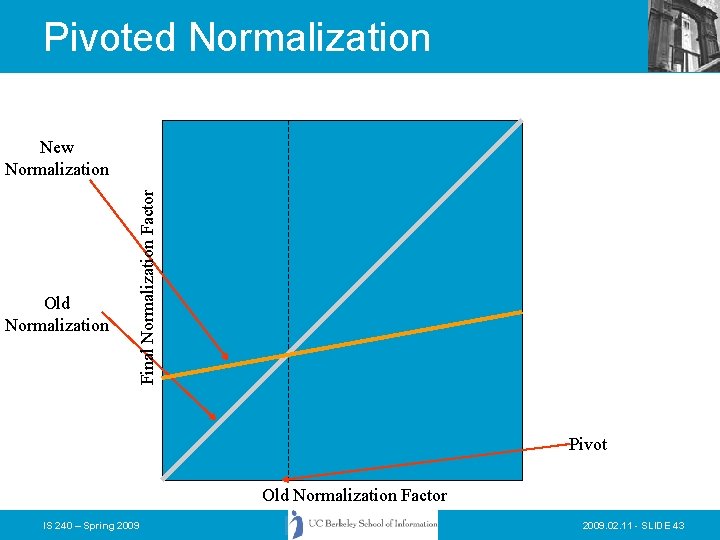
Vector Space Refinements • Singhal (one of Salton’s students) found that the normalization of document length usually performed in the “standard tfidf” tended to overemphasize short documents • He and Chris Buckley came up with the idea of adjusting the normalization document length to better correspond to observed relevance patterns • The “Pivoted Document Length Normalization” provided a valuable enhancement to the performance of vector space systems IS 240 – Spring 2009. 02. 11 - SLIDE 41
Pivoted Normalization Probability of Relevance Probability of Retrieval Pivot Document Length IS 240 – Spring 2009. 02. 11 - SLIDE 42
Pivoted Normalization Old Normalization Final Normalization Factor New Normalization Pivot Old Normalization Factor IS 240 – Spring 2009. 02. 11 - SLIDE 43
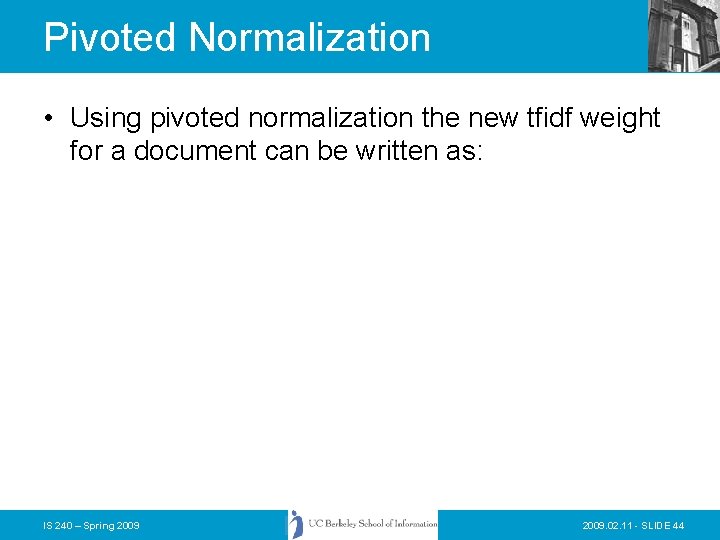
Pivoted Normalization • Using pivoted normalization the new tfidf weight for a document can be written as: IS 240 – Spring 2009. 02. 11 - SLIDE 44
Pivoted Normalization • Training from past relevance data, and assuming that the slope is going to be consistent with new results, we can adjust to better fit the relevance curve for document size normalization IS 240 – Spring 2009. 02. 11 - SLIDE 45