
Lecture 7 Stable Isotopes of Elements Types of
Lecture 7 Stable Isotopes of Elements Types of Isotopes Chart of the Nuclides Measurements Delta Notation Isotope Fractionation Equilibrium Kinetic Raleigh See E & H Chpt. 5
Key questions: What are isotopes? What are the types of isotopes? How do we measure isotopes? How do we express measurements of isotopes? What is isotope fractionation and how do we express it? What is equilibrium isotope fractionation? What is kinetic isotope fractionation? What is Raleigh distillation? What are some applications of stable isotopes?
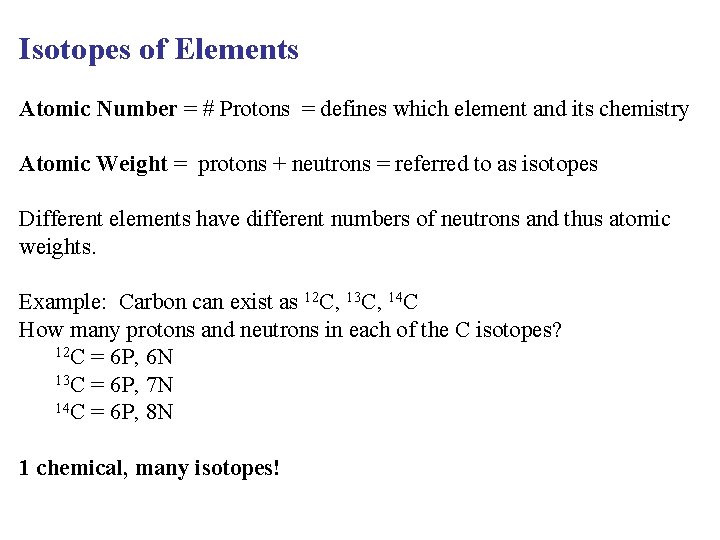
Isotopes of Elements Atomic Number = # Protons = defines which element and its chemistry Atomic Weight = protons + neutrons = referred to as isotopes Different elements have different numbers of neutrons and thus atomic weights. Example: Carbon can exist as 12 C, 13 C, 14 C How many protons and neutrons in each of the C isotopes? 12 C = 6 P, 6 N 13 C = 6 P, 7 N 14 C = 6 P, 8 N 1 chemical, many isotopes!
Where do Isotopes come from? In the beginning (Big Bang), light elements of H and He were formed (and a little bit of Li) Nuclear reactions (ie: fusion) in stars created the remaining elements (and are still creating), some of which have since decayed to more stable elements There are 92 naturally occurring elements – some are stable, some are not
Types of Isotopes can be categorized into 2 categories: Stable isotopes – Isotopes that do not decay over the timescale of earth history (4. 5 billion years) Radioactive isotopes – Isotopes that spontaneously convert into other nuclei at a discernable rate
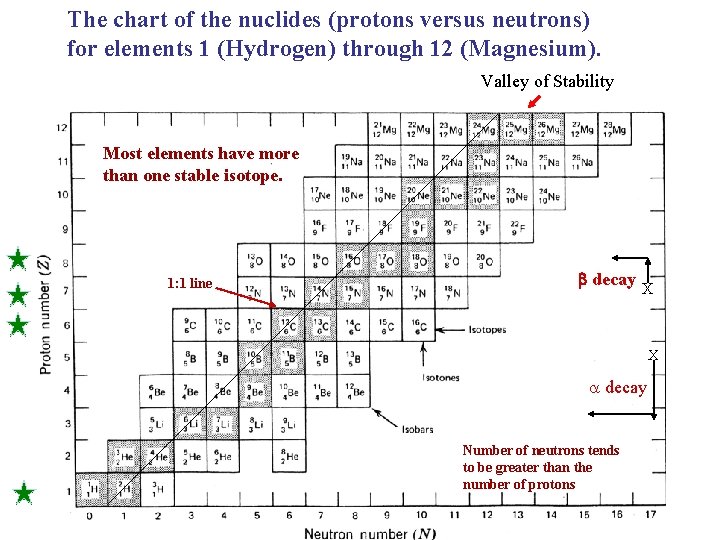
The chart of the nuclides (protons versus neutrons) for elements 1 (Hydrogen) through 12 (Magnesium). Valley of Stability Most elements have more than one stable isotope. 1: 1 line b decay X X decay Number of neutrons tends to be greater than the number of protons
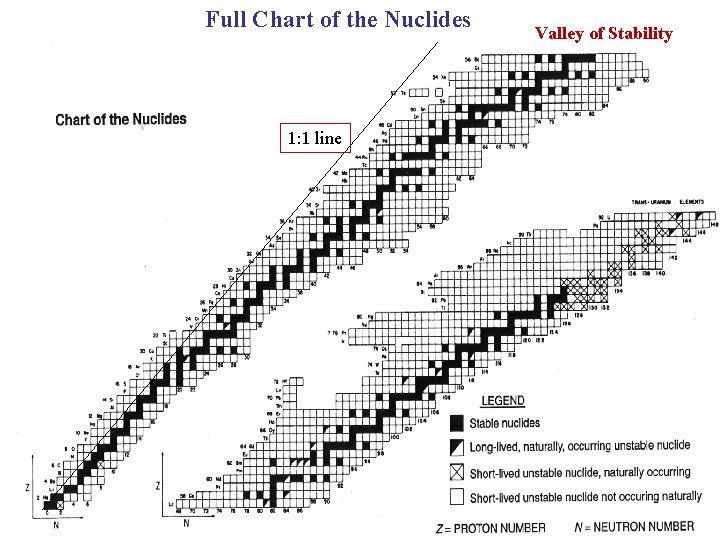
Full Chart of the Nuclides 1: 1 line Valley of Stability
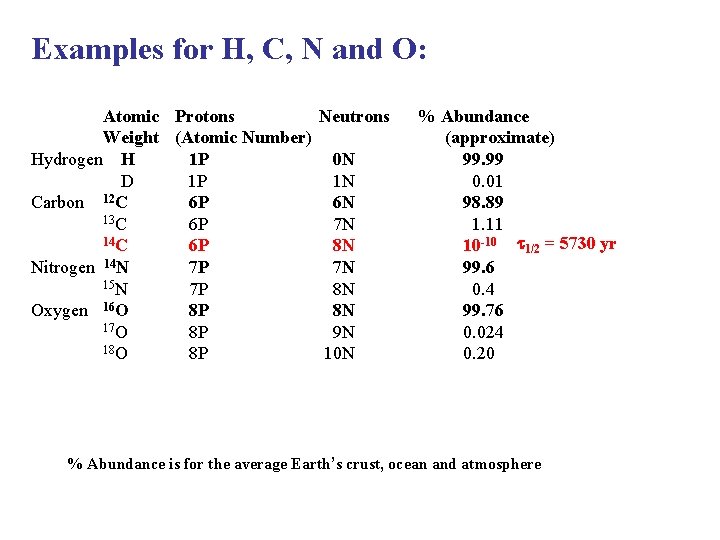
Examples for H, C, N and O: Atomic Protons Neutrons Weight (Atomic Number) Hydrogen H 1 P 0 N D 1 P 1 N Carbon 12 C 6 P 6 N 13 C 6 P 7 N 14 C 6 P 8 N Nitrogen 14 N 7 P 7 N 15 N 7 P 8 N Oxygen 16 O 8 P 8 N 17 O 8 P 9 N 18 O 8 P 10 N % Abundance (approximate) 99. 99 0. 01 98. 89 1. 11 10 -10 1/2 = 5730 yr 99. 6 0. 4 99. 76 0. 024 0. 20 % Abundance is for the average Earth’s crust, ocean and atmosphere
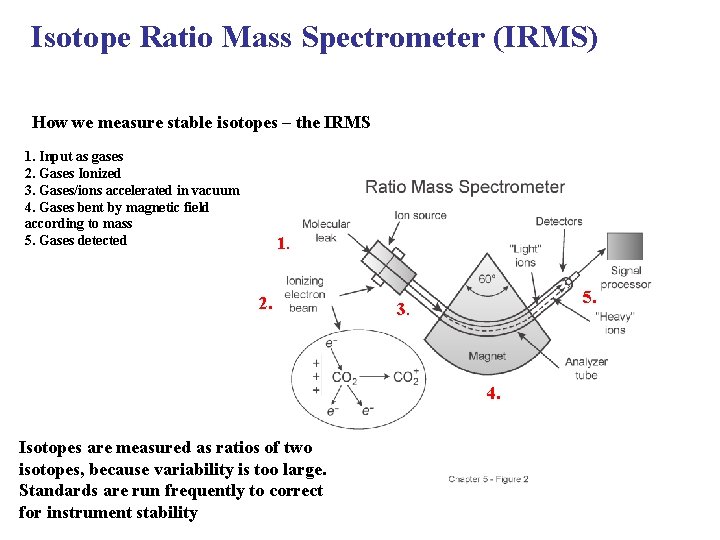
Isotope Ratio Mass Spectrometer (IRMS) How we measure stable isotopes – the IRMS 1. Input as gases 2. Gases Ionized 3. Gases/ions accelerated in vacuum 4. Gases bent by magnetic field according to mass 5. Gases detected 1. 2. 5. 3. 4. Isotopes are measured as ratios of two isotopes, because variability is too large. Standards are run frequently to correct for instrument stability
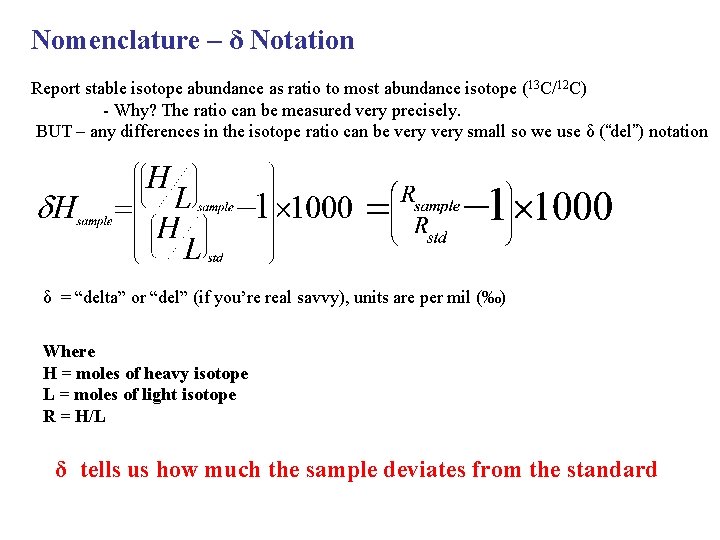
Nomenclature – δ Notation Report stable isotope abundance as ratio to most abundance isotope (13 C/12 C) - Why? The ratio can be measured very precisely. BUT – any differences in the isotope ratio can be very small so we use δ (“del”) notation δ = “delta” or “del” (if you’re real savvy), units are per mil (‰) Where H = moles of heavy isotope L = moles of light isotope R = H/L δ tells us how much the sample deviates from the standard
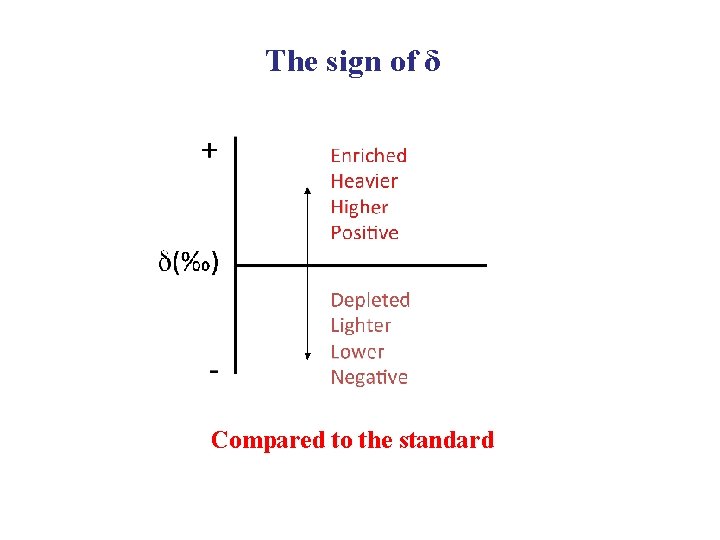
The sign of δ Compared to the standard
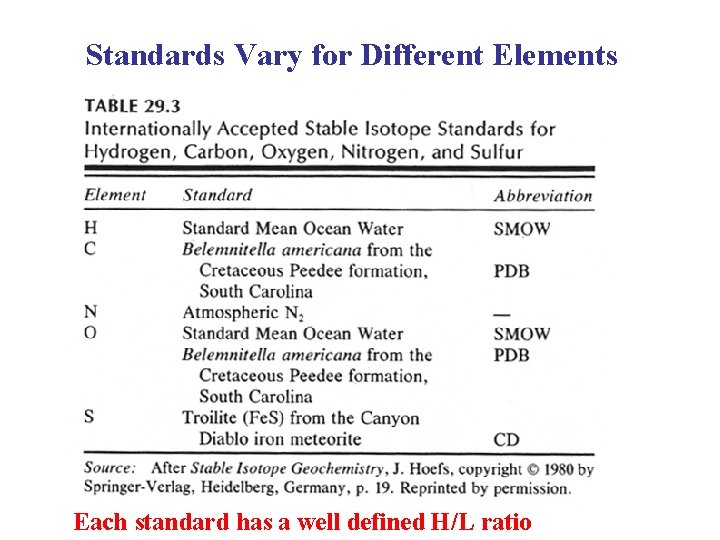
Standards Vary for Different Elements Each standard has a well defined H/L ratio
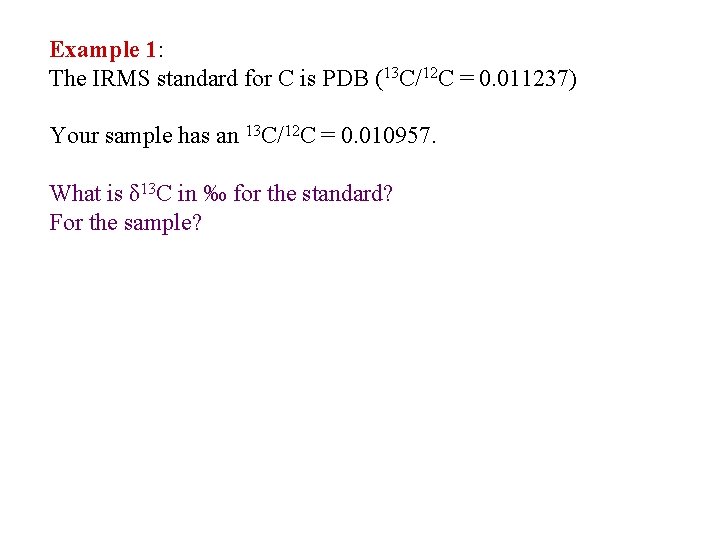
Example 1: The IRMS standard for C is PDB (13 C/12 C = 0. 011237) Your sample has an 13 C/12 C = 0. 010957. What is δ 13 C in ‰ for the standard? For the sample?
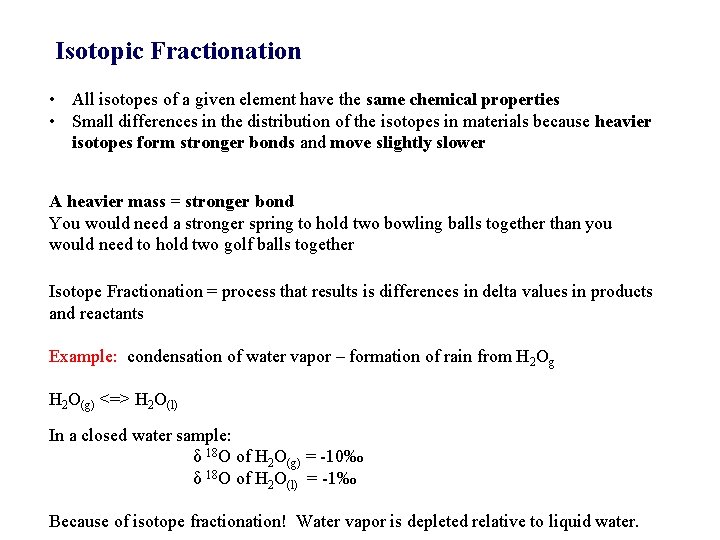
Isotopic Fractionation • All isotopes of a given element have the same chemical properties • Small differences in the distribution of the isotopes in materials because heavier isotopes form stronger bonds and move slightly slower A heavier mass = stronger bond You would need a stronger spring to hold two bowling balls together than you would need to hold two golf balls together Isotope Fractionation = process that results is differences in delta values in products and reactants Example: condensation of water vapor – formation of rain from H 2 Og H 2 O(g) <=> H 2 O(l) In a closed water sample: δ 18 O of H 2 O(g) = -10‰ δ 18 O of H 2 O(l) = -1‰ Because of isotope fractionation! Water vapor is depleted relative to liquid water.
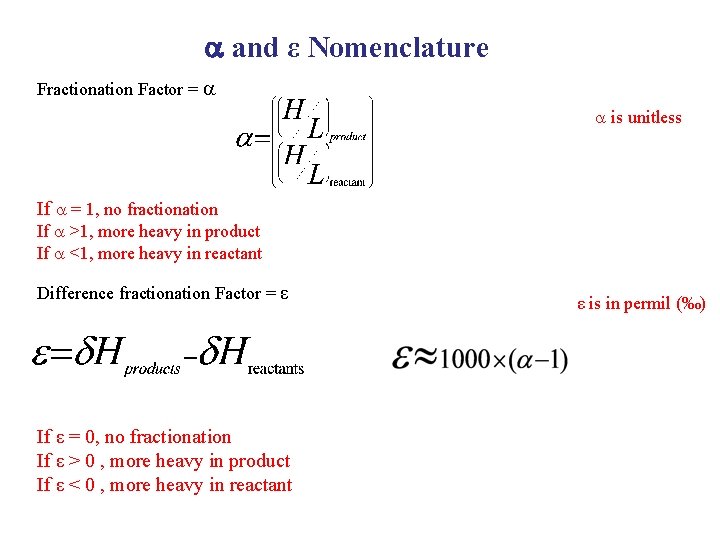
and ε Nomenclature Fractionation Factor = is unitless If = 1, no fractionation If >1, more heavy in product If <1, more heavy in reactant Difference fractionation Factor = ε If ε = 0, no fractionation If ε > 0 , more heavy in product If ε < 0 , more heavy in reactant ε is in permil (‰)
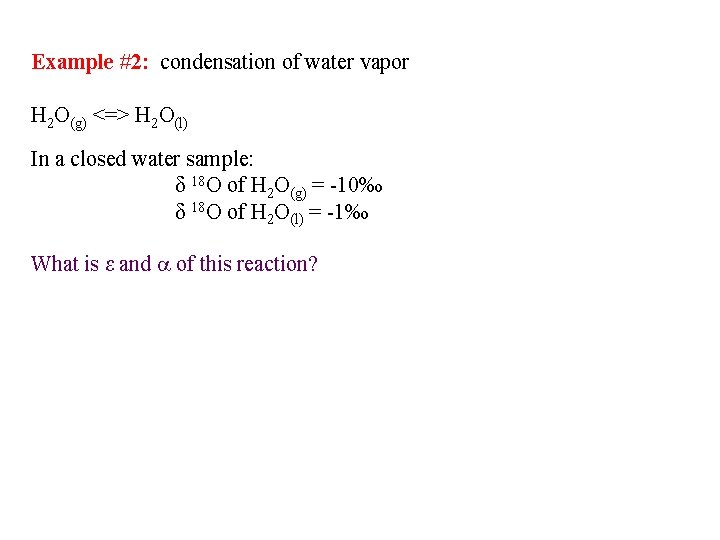
Example #2: condensation of water vapor H 2 O(g) <=> H 2 O(l) In a closed water sample: δ 18 O of H 2 O(g) = -10‰ δ 18 O of H 2 O(l) = -1‰ What is ε and of this reaction?
Two kinds of Isotope Fractionation Processes 1. Equilibrium Isotope effects Occurs in equilibrium reactions (reactions can go both ways) if the system is in equilibrium Chemical equilibrium Phase changes (closed system) Distributes isotopes in a system so that the total energy of the system is minimized Heavier isotope equilibrates into the compound or phase in which it is most stably bound Within a molecule (CO 2 vs HCO 3 -) Between molecules (CO 2(g) vs CO 2(aq) ) Usually applies to inorganic species. Usually not in organic compounds Due to slightly different free energies for atoms of different atomic weight Usually temperature dependent! Differences in vibrational energy is the source of the fractionation. Heavier isotopes wind up in the compound where it is bound more strongly
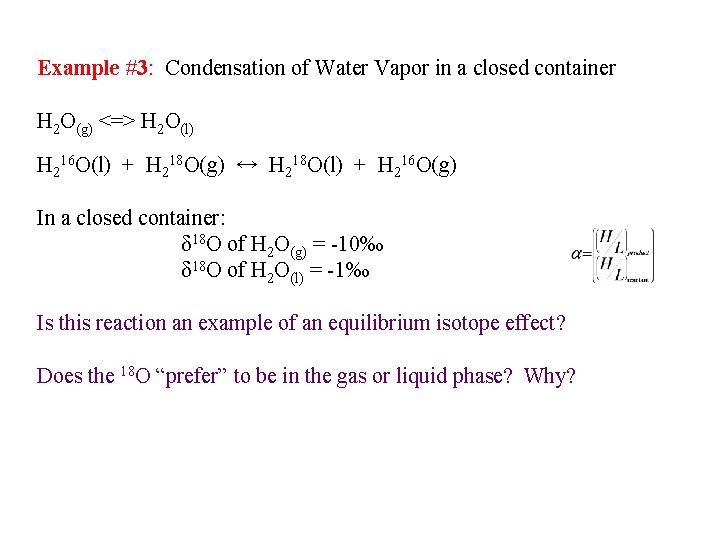
Example #3: Condensation of Water Vapor in a closed container H 2 O(g) <=> H 2 O(l) H 216 O(l) + H 218 O(g) ↔ H 218 O(l) + H 216 O(g) In a closed container: δ 18 O of H 2 O(g) = -10‰ δ 18 O of H 2 O(l) = -1‰ Is this reaction an example of an equilibrium isotope effect? Does the 18 O “prefer” to be in the gas or liquid phase? Why?
Example #4: Bicarbonate system The carbonate buffer system involving gaseous CO 2(g), aqueous CO 2(aq), aqueous bicarbonate HCO 3 - and carbonate CO 32 -. One step of that reaction: CO 2(aq) + H 2 O ↔ HCO 3 - + H+ δ 13 C of CO 2(aq) = 1‰ = 1. 0092 at 0ºC and 1. 0068 at 30ºC (The IRMS standard for C is PDB (13 C/12 C = 0. 011237)) Is this reaction an example of an equilibrium isotope effect? How can you tell? What is the final δ 13 C of HCO 3 - at 0ºC at 30ºC? Is 13 C more stable as CO 2(aq) or HCO 3 -? Is there more or less fractionation at higher temperatures?
2. Kinetic Fractionation Occurs in unidirectional (irreversible) reactions reversible reactions that are not yet at equilibrium diffusion or differential bond breaking Heavier isotopes move more slowly (KE = ½ mv 2) Therefore react more slowly Reaction products are depleted in the heavy isotope relative to the reactants All isotopes effects involving organic matter are kinetic Why do heavier isotopes move more slowly? Same kinetic energy, despite isotope E = ½ mv 2 If E is the same and mass increases, the v must decrease
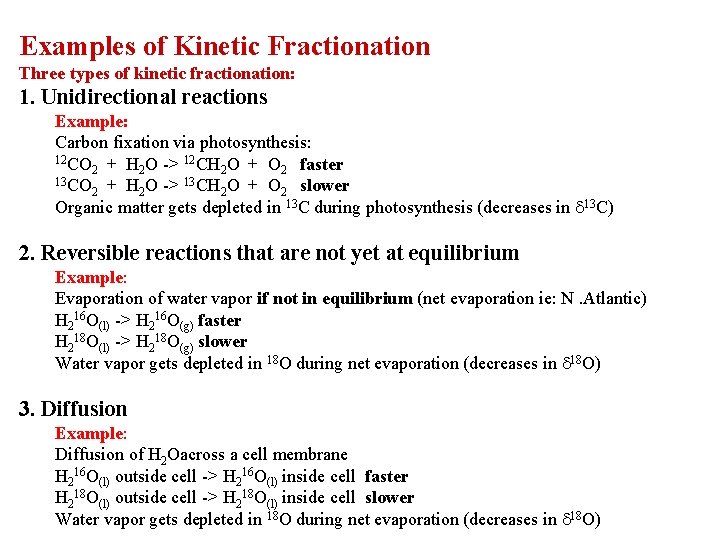
Examples of Kinetic Fractionation Three types of kinetic fractionation: 1. Unidirectional reactions Example: Carbon fixation via photosynthesis: 12 CO + H O -> 12 CH O + O 2 2 faster 13 CO + H O -> 13 CH O + O 2 2 slower Organic matter gets depleted in 13 C during photosynthesis (decreases in 13 C) 2. Reversible reactions that are not yet at equilibrium Example: Evaporation of water vapor if not in equilibrium (net evaporation ie: N. Atlantic) H 216 O(l) -> H 216 O(g) faster H 218 O(l) -> H 218 O(g) slower Water vapor gets depleted in 18 O during net evaporation (decreases in 18 O) 3. Diffusion Example: Diffusion of H 2 Oacross a cell membrane H 216 O(l) outside cell -> H 216 O(l) inside cell faster H 218 O(l) outside cell -> H 218 O(l) inside cell slower Water vapor gets depleted in 18 O during net evaporation (decreases in 18 O)
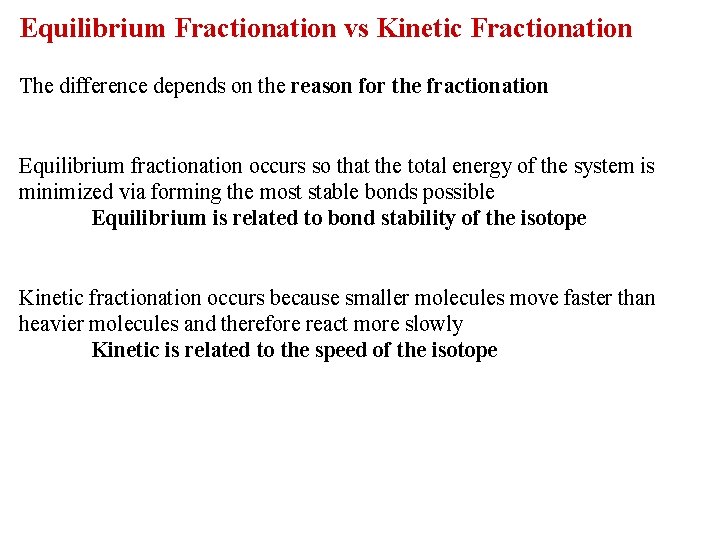
Equilibrium Fractionation vs Kinetic Fractionation The difference depends on the reason for the fractionation Equilibrium fractionation occurs so that the total energy of the system is minimized via forming the most stable bonds possible Equilibrium is related to bond stability of the isotope Kinetic fractionation occurs because smaller molecules move faster than heavier molecules and therefore react more slowly Kinetic is related to the speed of the isotope
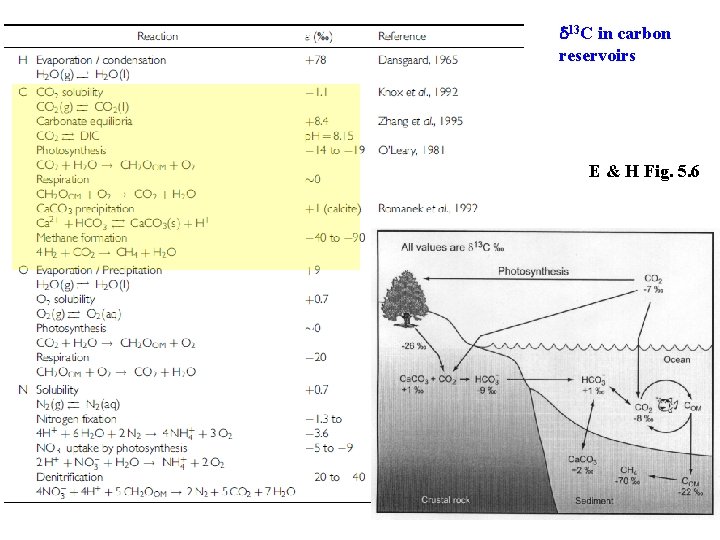
d 13 C in carbon reservoirs E & H Fig. 5. 6
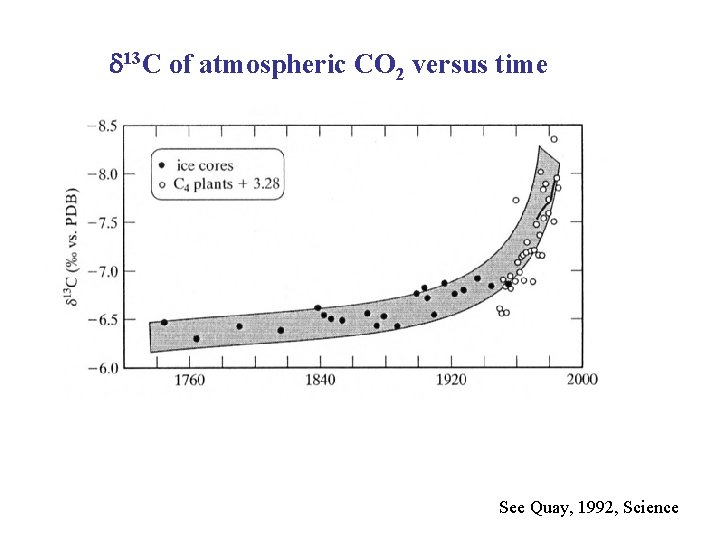
d 13 C of atmospheric CO 2 versus time See Quay, 1992, Science
Raleigh Fractionation A combination of kinetic and equilibrium isotope effects • Kinetic when water molecules evaporate from sea surface (net evaporation b/c system is not in equilibrium) • Equilibrium effect when water molecules condense from vapor to liquid form A isotope fractionation reaction where products are isolated immediately from the reactants will show a characteristic trend in isotopic composition.
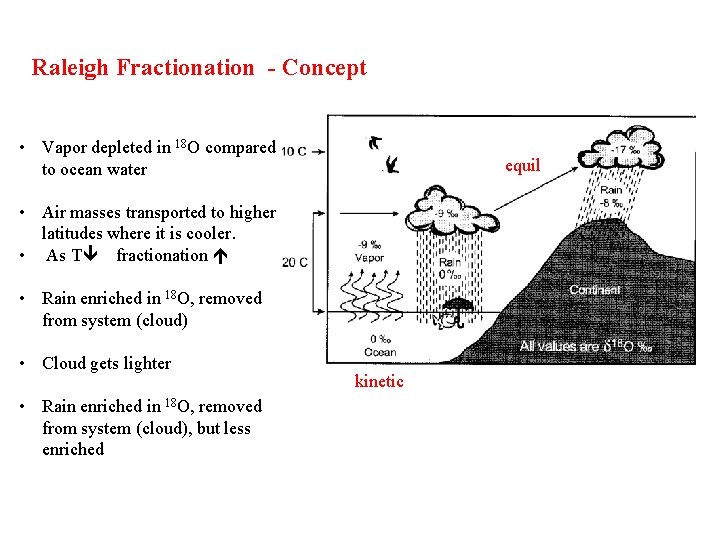
Raleigh Fractionation - Concept • Vapor depleted in 18 O compared to ocean water equil • Air masses transported to higher latitudes where it is cooler. • As T fractionation • Rain enriched in 18 O, removed from system (cloud) • Cloud gets lighter • Rain enriched in 18 O, removed from system (cloud), but less enriched kinetic
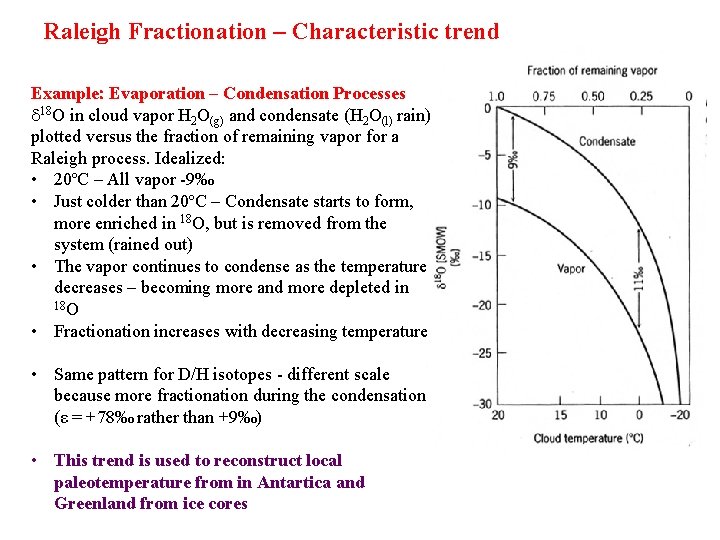
Raleigh Fractionation – Characteristic trend Example: Evaporation – Condensation Processes 18 O in cloud vapor H 2 O(g) and condensate (H 2 O(l) rain) plotted versus the fraction of remaining vapor for a Raleigh process. Idealized: • 20ºC – All vapor -9‰ • Just colder than 20ºC – Condensate starts to form, more enriched in 18 O, but is removed from the system (rained out) • The vapor continues to condense as the temperature decreases – becoming more and more depleted in 18 O • Fractionation increases with decreasing temperature • Same pattern for D/H isotopes - different scale because more fractionation during the condensation (ε = +78‰ rather than +9‰) • This trend is used to reconstruct local paleotemperature from in Antartica and Greenland from ice cores
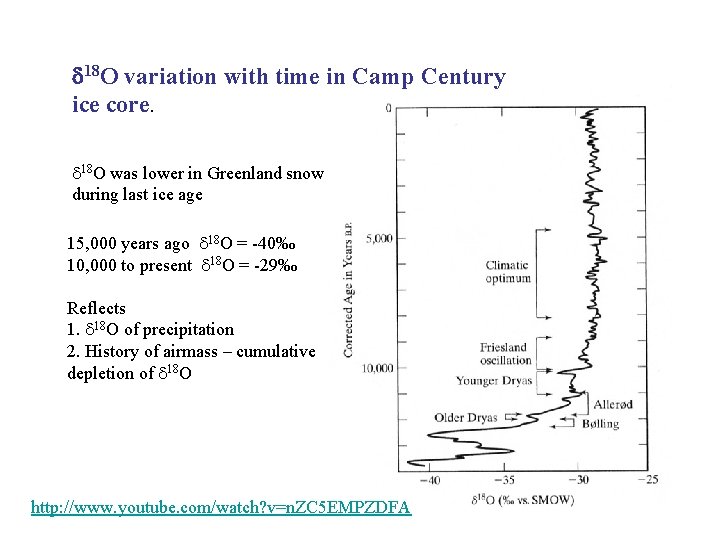
d 18 O variation with time in Camp Century ice core. 18 O was lower in Greenland snow during last ice age 15, 000 years ago 18 O = -40‰ 10, 000 to present 18 O = -29‰ Reflects 1. 18 O of precipitation 2. History of airmass – cumulative depletion of 18 O http: //www. youtube. com/watch? v=n. ZC 5 EMPZDFA
Applications of Stable Isotopes There are many applications of stable isotopes – especially in the study of past conditions on earth Three case studies in oceanography: 1. 2. 3. Paleothermometer from foraminifera shells Origin of organic matter Estimate primary production in marine systems
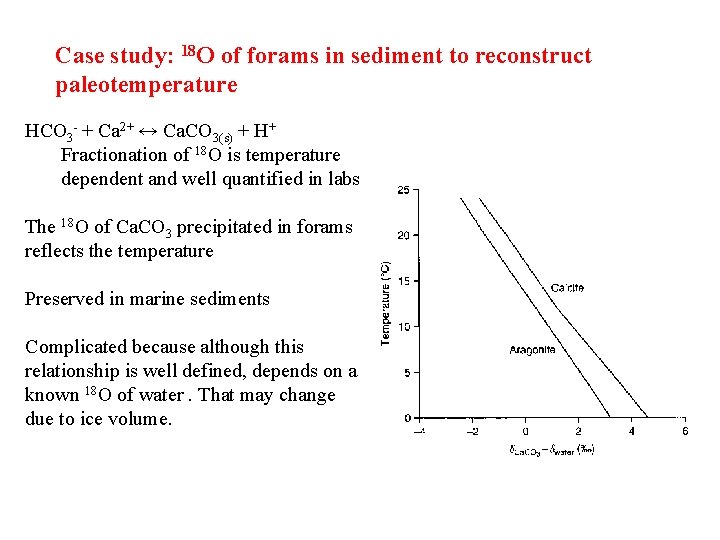
Case study: 18 O of forams in sediment to reconstruct paleotemperature HCO 3 - + Ca 2+ ↔ Ca. CO 3(s) + H+ Fractionation of 18 O is temperature dependent and well quantified in labs The 18 O of Ca. CO 3 precipitated in forams reflects the temperature Preserved in marine sediments Complicated because although this relationship is well defined, depends on a known 18 O of water. That may change due to ice volume.
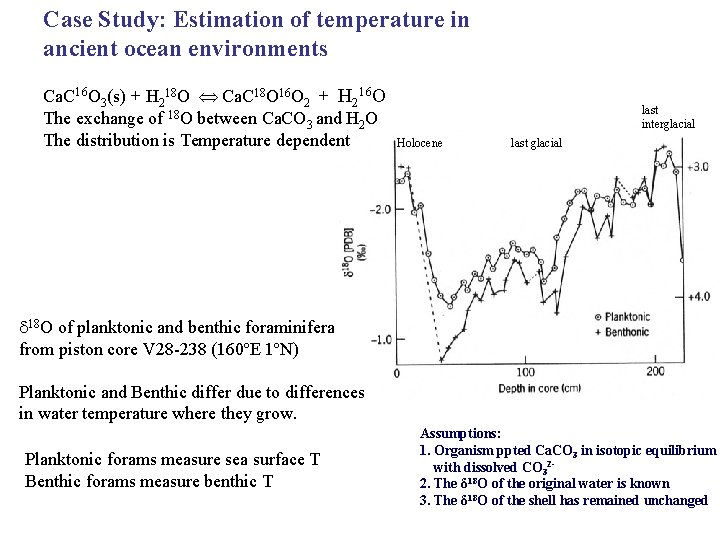
Case Study: Estimation of temperature in ancient ocean environments Ca. C 16 O 3(s) + H 218 O Ca. C 18 O 16 O 2 + H 216 O The exchange of 18 O between Ca. CO 3 and H 2 O The distribution is Temperature dependent last interglacial Holocene last glacial 18 O of planktonic and benthic foraminifera from piston core V 28 -238 (160ºE 1ºN) Planktonic and Benthic differ due to differences in water temperature where they grow. Planktonic forams measure sea surface T Benthic forams measure benthic T Assumptions: 1. Organism ppted Ca. CO 3 in isotopic equilibrium with dissolved CO 322. The δ 18 O of the original water is known 3. The δ 18 O of the shell has remained unchanged
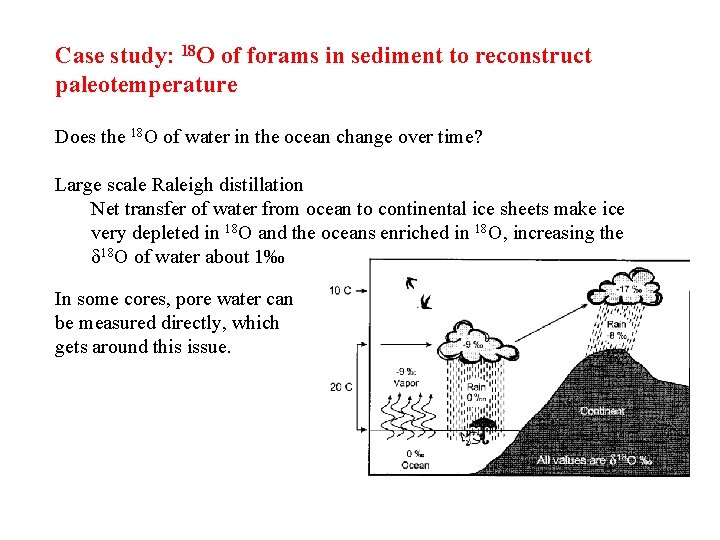
Case study: 18 O of forams in sediment to reconstruct paleotemperature Does the 18 O of water in the ocean change over time? Large scale Raleigh distillation Net transfer of water from ocean to continental ice sheets make ice very depleted in 18 O and the oceans enriched in 18 O, increasing the 18 O of water about 1‰ In some cores, pore water can be measured directly, which gets around this issue.
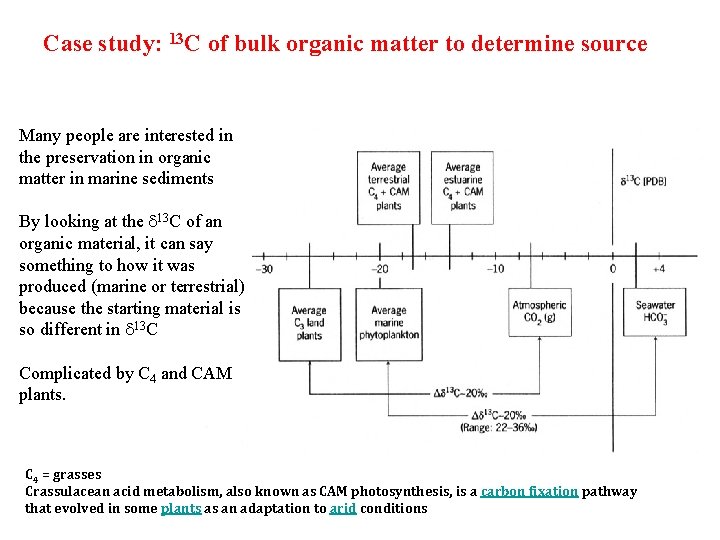
Case study: 13 C of bulk organic matter to determine source Many people are interested in the preservation in organic matter in marine sediments By looking at the 13 C of an organic material, it can say something to how it was produced (marine or terrestrial) because the starting material is so different in 13 C Complicated by C 4 and CAM plants. C 4 = grasses Crassulacean acid metabolism, also known as CAM photosynthesis, is a carbon fixation pathway that evolved in some plants as an adaptation to arid conditions
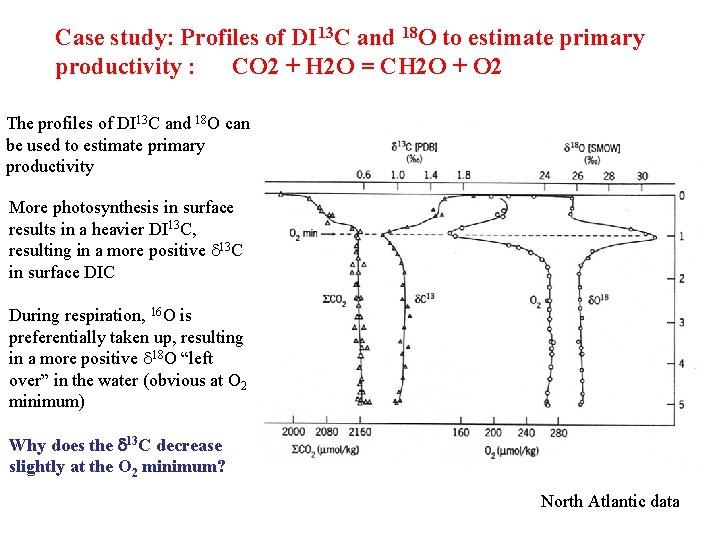
Case study: Profiles of DI 13 C and 18 O to estimate primary productivity : CO 2 + H 2 O = CH 2 O + O 2 The profiles of DI 13 C and 18 O can be used to estimate primary productivity More photosynthesis in surface results in a heavier DI 13 C, resulting in a more positive 13 C in surface DIC During respiration, 16 O is preferentially taken up, resulting in a more positive 18 O “left over” in the water (obvious at O 2 minimum) Why does the d 13 C decrease slightly at the O 2 minimum? North Atlantic data
- Slides: 34