
Lecture 7 Speculative Execution and Recovery Branch prediction

Lecture 7: Speculative Execution and Recovery Branch prediction and speculative execution, precise interrupt, reorder buffer 1
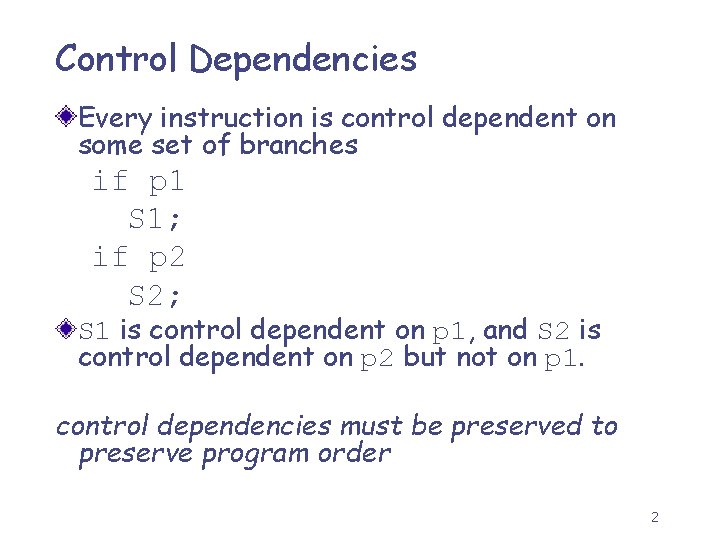
Control Dependencies Every instruction is control dependent on some set of branches if p 1 S 1; if p 2 S 2; S 1 is control dependent on p 1, and S 2 is control dependent on p 2 but not on p 1. control dependencies must be preserved to preserve program order 2
Control Dependence Ignored If CPU stalls on branches, how much would CPI increase? Control dependence need not be preserved in the whole execution n willing to execute instructions that should not have been executed, thereby violating the control dependences, if can do so without affecting correctness of the program Two properties critical to program correctness are data flow and exception behavior 3
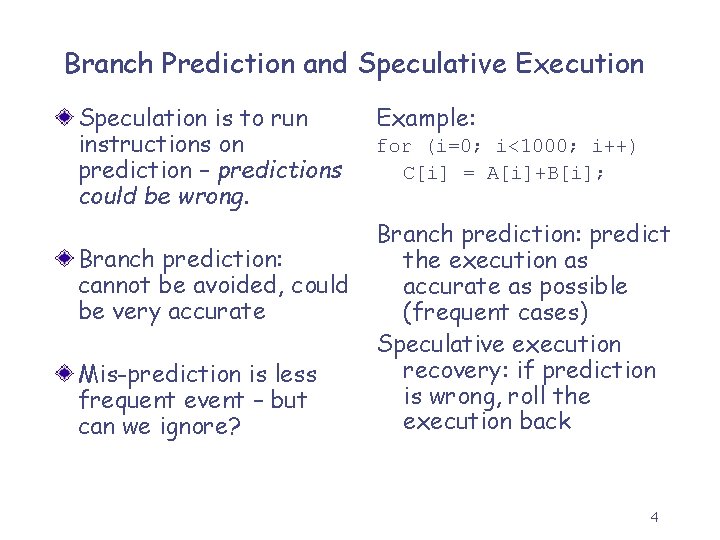
Branch Prediction and Speculative Execution Speculation is to run instructions on prediction – predictions could be wrong. Branch prediction: cannot be avoided, could be very accurate Mis-prediction is less frequent event – but can we ignore? Example: for (i=0; i<1000; i++) C[i] = A[i]+B[i]; Branch prediction: predict the execution as accurate as possible (frequent cases) Speculative execution recovery: if prediction is wrong, roll the execution back 4
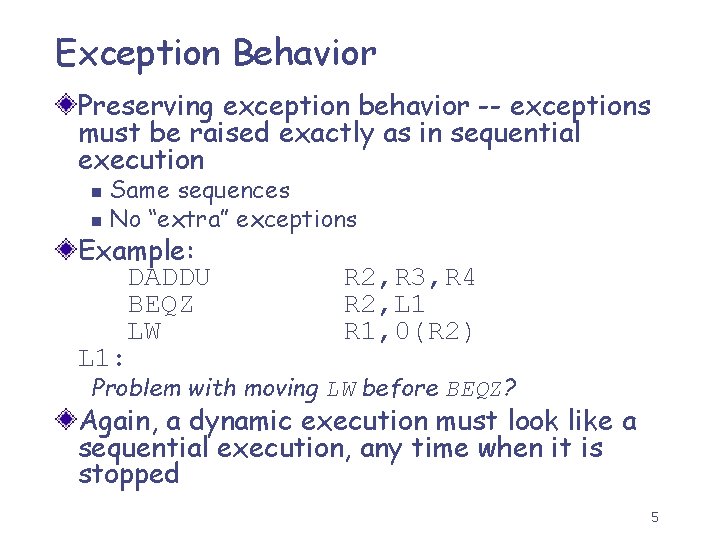
Exception Behavior Preserving exception behavior -- exceptions must be raised exactly as in sequential execution Same sequences n No “extra” exceptions n Example: DADDU BEQZ LW L 1: R 2, R 3, R 4 R 2, L 1 R 1, 0(R 2) Problem with moving LW before BEQZ? Again, a dynamic execution must look like a sequential execution, any time when it is stopped 5
Precise Interrupts Tomasulo had: In-order issue, out-of-order execution, and out-of-order completion Need to “fix” the out-of-order completion aspect so that we can find precise breakpoint in instruction stream. 6

Branch Prediction vs. Precise Interrupt Mis-prediction is “exception” on the branch inst Same technique for handling both issue: in-order completion or commit: change register/memory only in program Execution “branches order (sequential) out” on exceptions n Every instruction is “predicted” not to take the “branch” to interrupt handler How does it ensure the correctness? 7
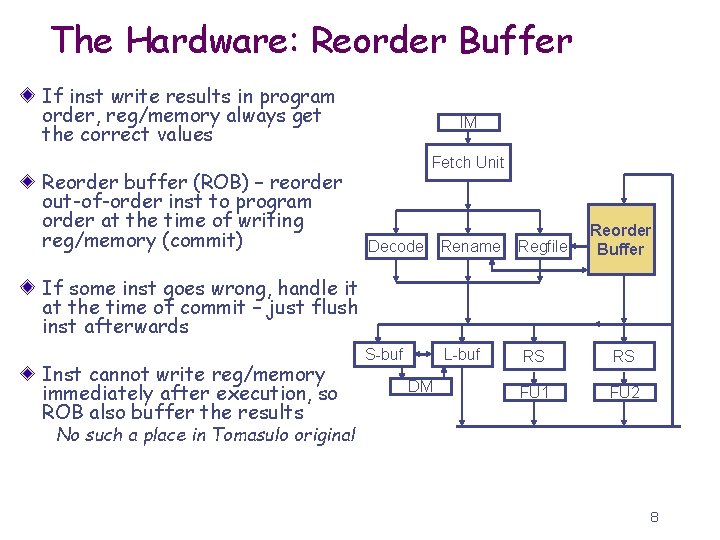
The Hardware: Reorder Buffer If inst write results in program order, reg/memory always get the correct values Reorder buffer (ROB) – reorder out-of-order inst to program order at the time of writing reg/memory (commit) IM Fetch Unit Reorder Buffer Decode Rename Regfile S-buf L-buf RS RS FU 1 FU 2 If some inst goes wrong, handle it at the time of commit – just flush inst afterwards Inst cannot write reg/memory immediately after execution, so ROB also buffer the results DM No such a place in Tomasulo original 8
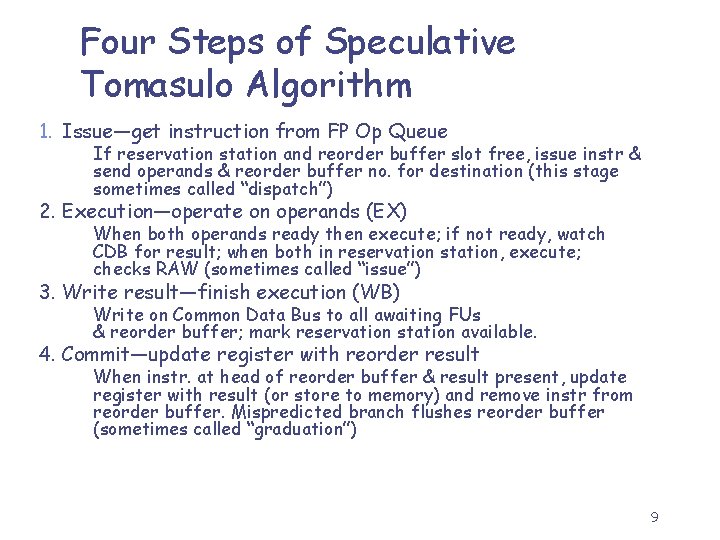
Four Steps of Speculative Tomasulo Algorithm 1. Issue—get instruction from FP Op Queue If reservation station and reorder buffer slot free, issue instr & send operands & reorder buffer no. for destination (this stage sometimes called “dispatch”) 2. Execution—operate on operands (EX) When both operands ready then execute; if not ready, watch CDB for result; when both in reservation station, execute; checks RAW (sometimes called “issue”) 3. Write result—finish execution (WB) Write on Common Data Bus to all awaiting FUs & reorder buffer; mark reservation station available. 4. Commit—update register with reorder result When instr. at head of reorder buffer & result present, update register with result (or store to memory) and remove instr from reorder buffer. Mispredicted branch flushes reorder buffer (sometimes called “graduation”) 9
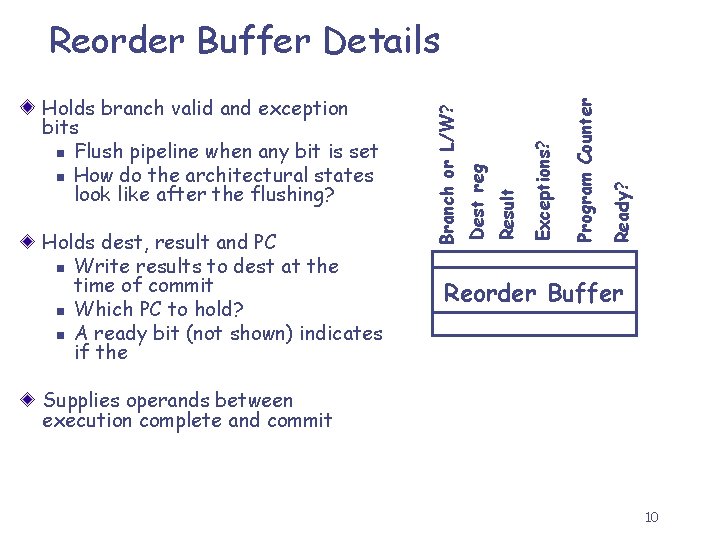
Ready? Program Counter Exceptions? Result Holds dest, result and PC n Write results to dest at the time of commit n Which PC to hold? n A ready bit (not shown) indicates if the Dest reg Holds branch valid and exception bits n Flush pipeline when any bit is set n How do the architectural states look like after the flushing? Branch or L/W? Reorder Buffer Details Reorder Buffer Supplies operands between execution complete and commit 10
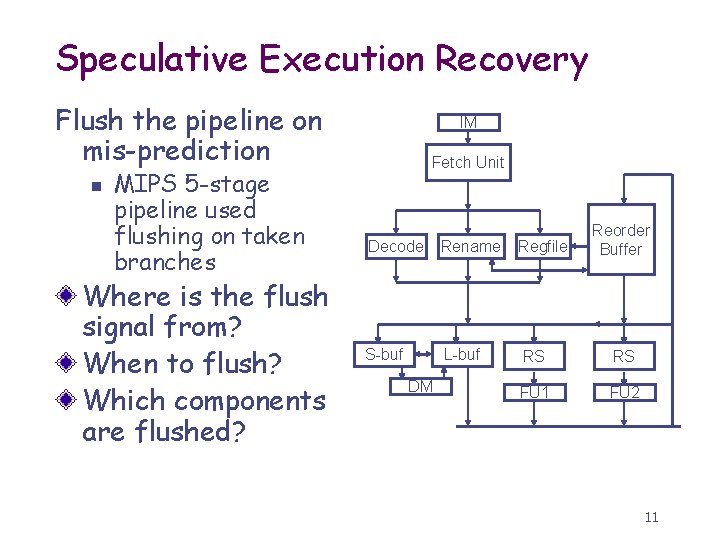
Speculative Execution Recovery Flush the pipeline on mis-prediction n MIPS 5 -stage pipeline used flushing on taken branches Where is the flush signal from? When to flush? Which components are flushed? IM Fetch Unit Reorder Buffer Decode Rename Regfile S-buf L-buf RS RS FU 1 FU 2 DM 11
Changes to Other Components Use ROB index as tag n Why not RS index any more? n Why is ROB index a valid choice? Renaming table maps architecture registers to ROB index if the register is renamed Reservation stations now use ROB index for tracking dependence and for wakeup Again tag (now ROB index) and data are broadcast on CDB at writeback Inst may receive values from reg/mem, data broadcasting, or ROB 12
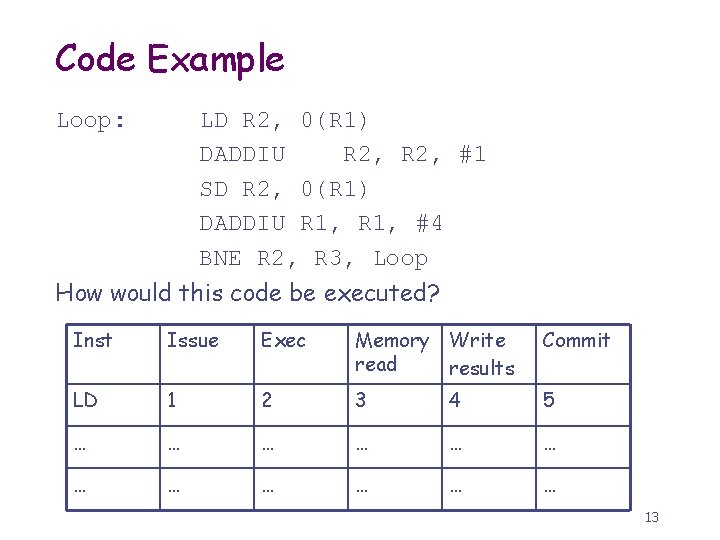
Code Example Loop: LD R 2, 0(R 1) DADDIU R 2, #1 SD R 2, 0(R 1) DADDIU R 1, #4 BNE R 2, R 3, Loop How would this code be executed? Inst Issue Exec Memory Write read results Commit LD 1 2 3 4 5 … … … 13
Summary Reservations stations: implicit register renaming to larger set of registers + buffering source operands n Prevents registers as bottleneck n Avoids WAR, WAW hazards of Scoreboard Not limited to basic blocks when compared to static scheduling (integer units gets ahead, beyond branches) Today, helps cache misses as well n n Don’t stall for L 1 Data cache miss (insufficient ILP for L 2 miss? ) Can support memory-level parallelism Lasting Contributions n n n Dynamic scheduling Register renaming Load/store disambiguation (discuss later) 360/91 descendants are Pentium III; Power. PC 604; MIPS R 10000; HP-PA 8000; Alpha 21264 14
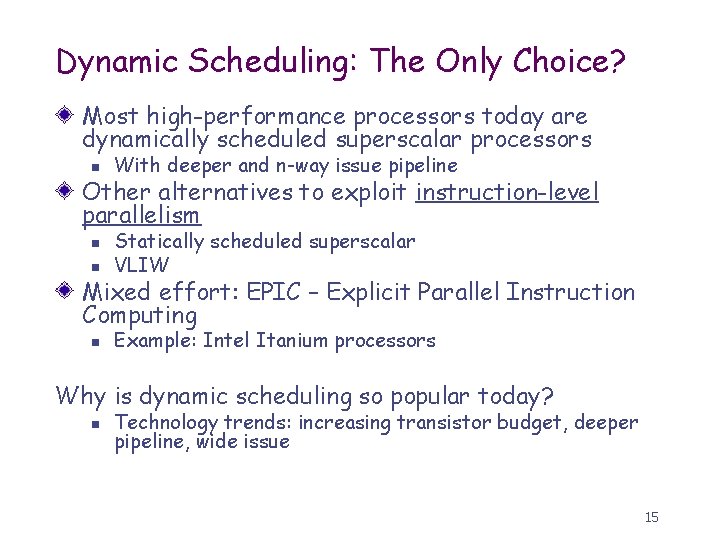
Dynamic Scheduling: The Only Choice? Most high-performance processors today are dynamically scheduled superscalar processors n With deeper and n-way issue pipeline Other alternatives to exploit instruction-level parallelism n Statically scheduled superscalar VLIW n Example: Intel Itanium processors n Mixed effort: EPIC – Explicit Parallel Instruction Computing Why is dynamic scheduling so popular today? n Technology trends: increasing transistor budget, deeper pipeline, wide issue 15
- Slides: 15