
Lecture 7 Price competition Bertrands Model of Oligopoly

Lecture 7 Price competition
Bertrand’s Model of Oligopoly • Strategic variable price rather than output. • Single good produced by n firms • Cost to firm i of producing qi units: Ci(qi), where Ci is nonnegative and increasing • If price is p, demand is D(p) • Consumers buy from firm with lowest price • Firms produce what is demanded
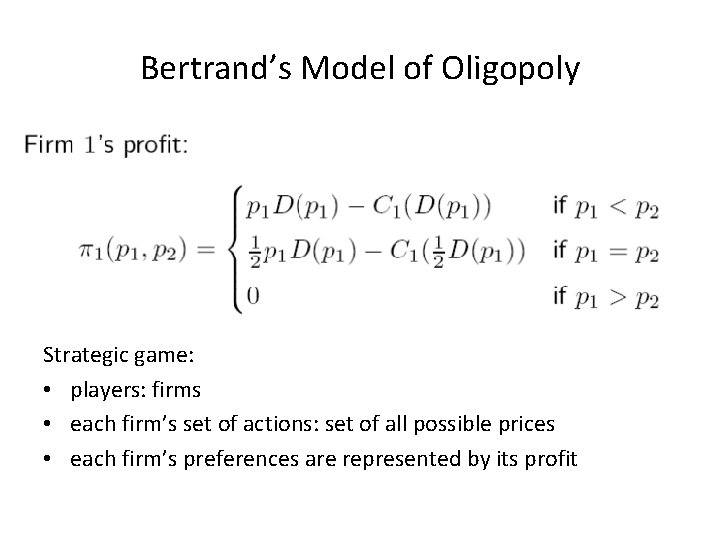
Bertrand’s Model of Oligopoly Strategic game: • players: firms • each firm’s set of actions: set of all possible prices • each firm’s preferences are represented by its profit
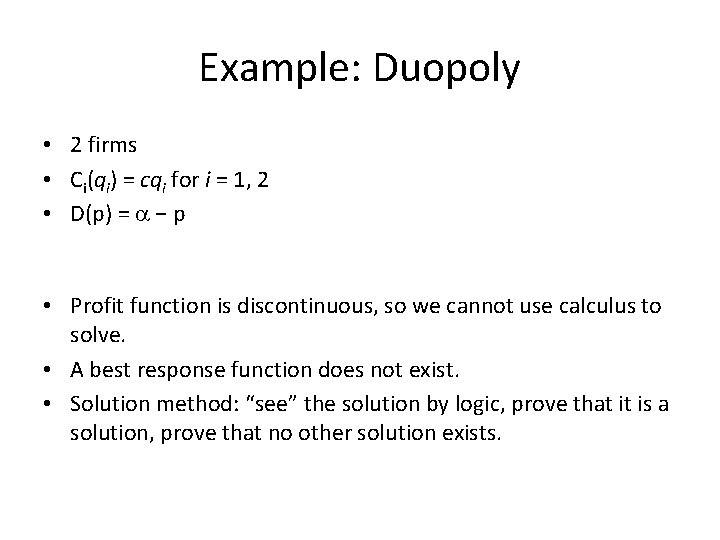
Example: Duopoly • 2 firms • Ci(qi) = cqi for i = 1, 2 • D(p) = a − p • Profit function is discontinuous, so we cannot use calculus to solve. • A best response function does not exist. • Solution method: “see” the solution by logic, prove that it is a solution, prove that no other solution exists.
Example: Duopoly Nash Equilibrium (p 1, p 2) = (c, c) If each firm charges a price of c then the other firm can do no better than charge a price of c also (if it raises its price it sells no output, while if it lowers its price it makes a loss), so (c, c) is a Nash equilibrium.
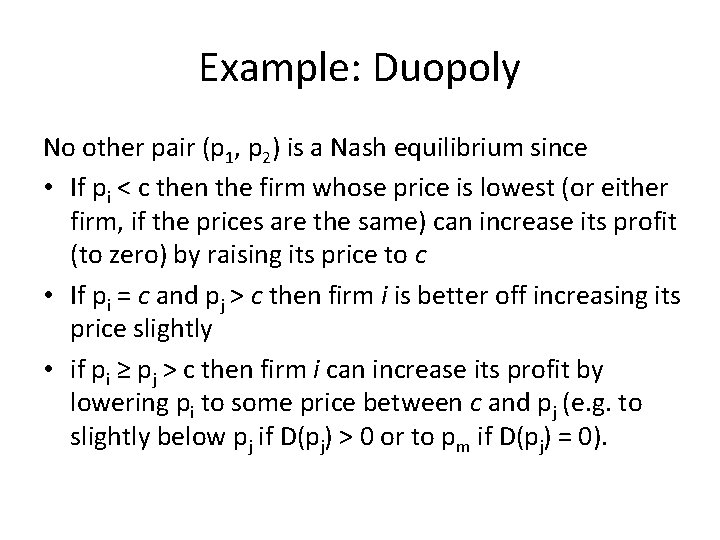
Example: Duopoly No other pair (p 1, p 2) is a Nash equilibrium since • If pi < c then the firm whose price is lowest (or either firm, if the prices are the same) can increase its profit (to zero) by raising its price to c • If pi = c and pj > c then firm i is better off increasing its price slightly • if pi ≥ pj > c then firm i can increase its profit by lowering pi to some price between c and pj (e. g. to slightly below pj if D(pj) > 0 or to pm if D(pj) = 0).
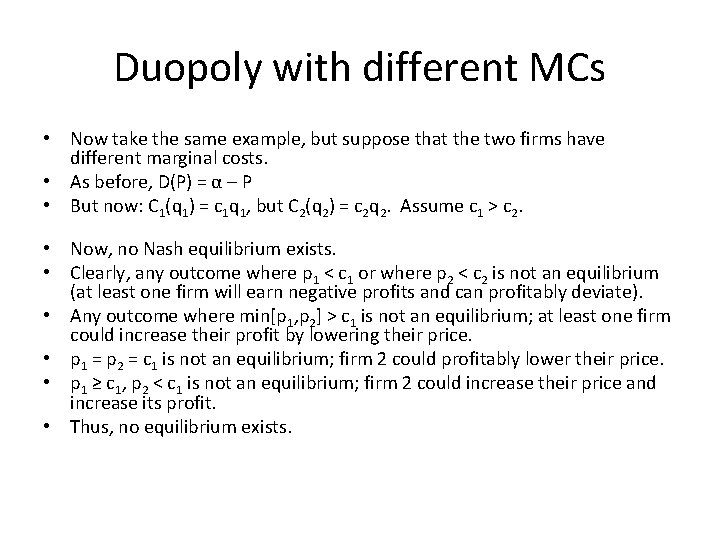
Duopoly with different MCs • Now take the same example, but suppose that the two firms have different marginal costs. • As before, D(P) = α – P • But now: C 1(q 1) = c 1 q 1, but C 2(q 2) = c 2 q 2. Assume c 1 > c 2. • Now, no Nash equilibrium exists. • Clearly, any outcome where p 1 < c 1 or where p 2 < c 2 is not an equilibrium (at least one firm will earn negative profits and can profitably deviate). • Any outcome where min[p 1, p 2] > c 1 is not an equilibrium; at least one firm could increase their profit by lowering their price. • p 1 = p 2 = c 1 is not an equilibrium; firm 2 could profitably lower their price. • p 1 ≥ c 1, p 2 < c 1 is not an equilibrium; firm 2 could increase their price and increase its profit. • Thus, no equilibrium exists.
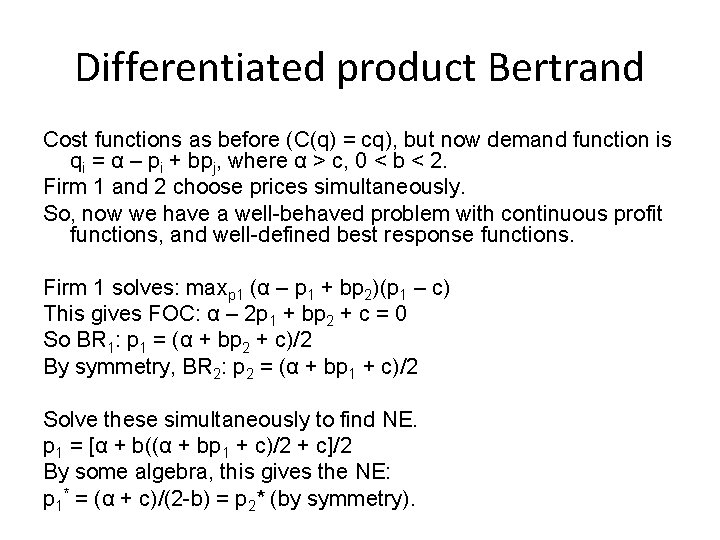
Differentiated product Bertrand Cost functions as before (C(q) = cq), but now demand function is qi = α – pi + bpj, where α > c, 0 < b < 2. Firm 1 and 2 choose prices simultaneously. So, now we have a well-behaved problem with continuous profit functions, and well-defined best response functions. Firm 1 solves: maxp 1 (α – p 1 + bp 2)(p 1 – c) This gives FOC: α – 2 p 1 + bp 2 + c = 0 So BR 1: p 1 = (α + bp 2 + c)/2 By symmetry, BR 2: p 2 = (α + bp 1 + c)/2 Solve these simultaneously to find NE. p 1 = [α + b((α + bp 1 + c)/2 + c]/2 By some algebra, this gives the NE: p 1* = (α + c)/(2 -b) = p 2* (by symmetry).
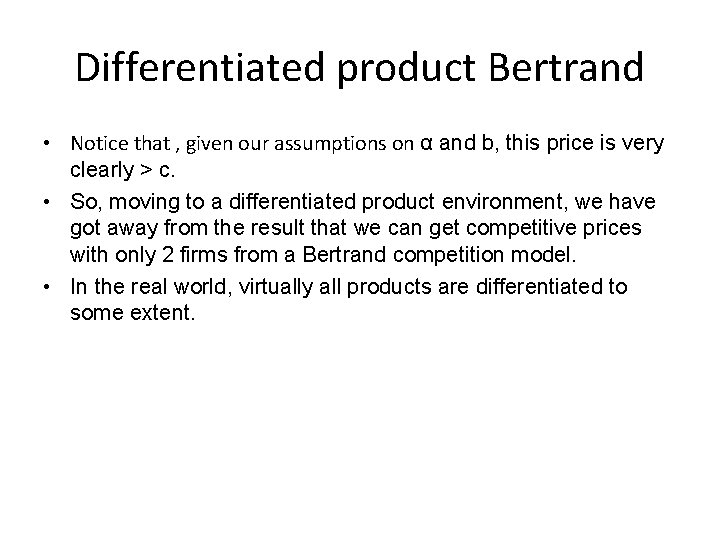
Differentiated product Bertrand • Notice that , given our assumptions on α and b, this price is very clearly > c. • So, moving to a differentiated product environment, we have got away from the result that we can get competitive prices with only 2 firms from a Bertrand competition model. • In the real world, virtually all products are differentiated to some extent.
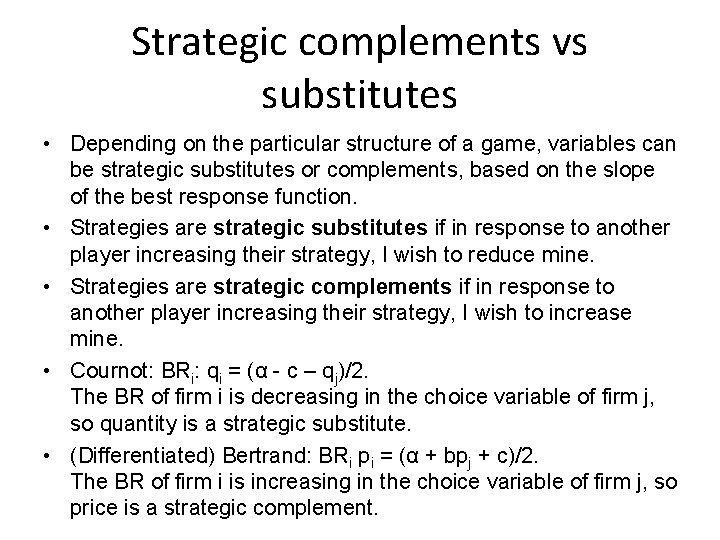
Strategic complements vs substitutes • Depending on the particular structure of a game, variables can be strategic substitutes or complements, based on the slope of the best response function. • Strategies are strategic substitutes if in response to another player increasing their strategy, I wish to reduce mine. • Strategies are strategic complements if in response to another player increasing their strategy, I wish to increase mine. • Cournot: BRi: qi = (α - c – qj)/2. The BR of firm i is decreasing in the choice variable of firm j, so quantity is a strategic substitute. • (Differentiated) Bertrand: BRi pi = (α + bpj + c)/2. The BR of firm i is increasing in the choice variable of firm j, so price is a strategic complement.
- Slides: 10