
Lecture 7 Power Outline q Power and Energy
- Slides: 29
Lecture 7: Power
Outline q Power and Energy q Dynamic Power q Static Power 7: Power CMOS VLSI Design 4 th Ed. 2
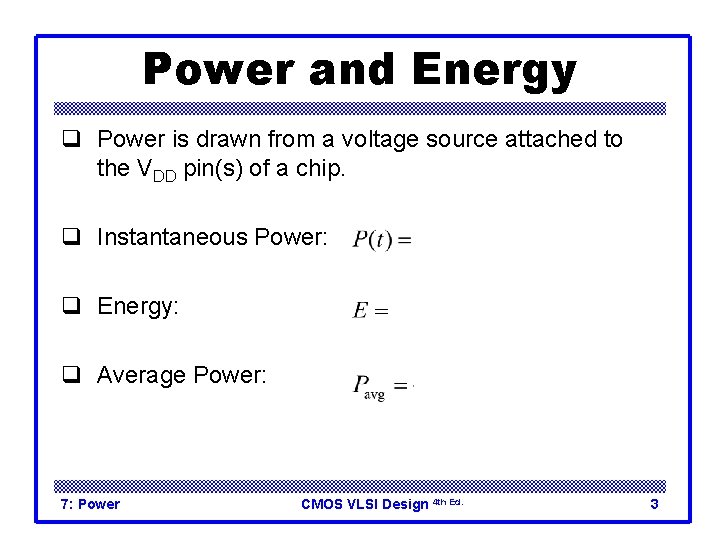
Power and Energy q Power is drawn from a voltage source attached to the VDD pin(s) of a chip. q Instantaneous Power: q Energy: q Average Power: 7: Power CMOS VLSI Design 4 th Ed. 3
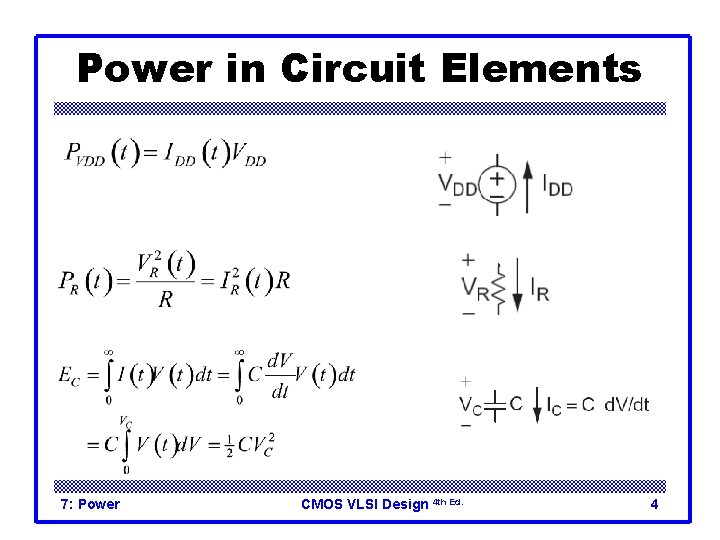
Power in Circuit Elements 7: Power CMOS VLSI Design 4 th Ed. 4
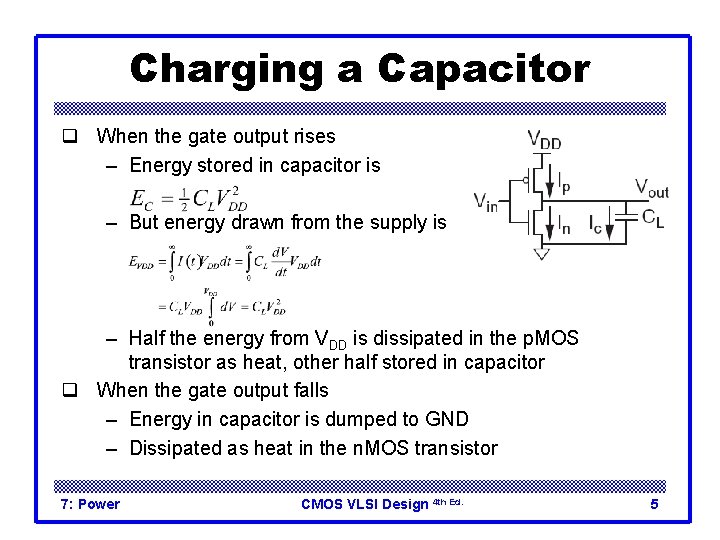
Charging a Capacitor q When the gate output rises – Energy stored in capacitor is – But energy drawn from the supply is – Half the energy from VDD is dissipated in the p. MOS transistor as heat, other half stored in capacitor q When the gate output falls – Energy in capacitor is dumped to GND – Dissipated as heat in the n. MOS transistor 7: Power CMOS VLSI Design 4 th Ed. 5
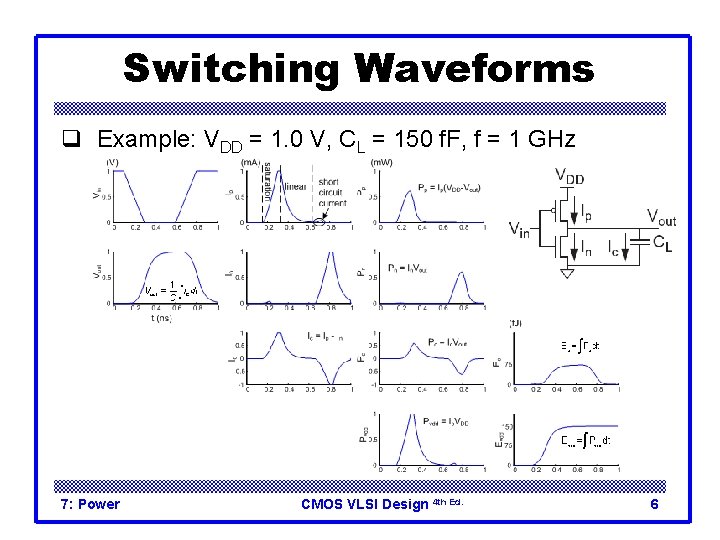
Switching Waveforms q Example: VDD = 1. 0 V, CL = 150 f. F, f = 1 GHz 7: Power CMOS VLSI Design 4 th Ed. 6
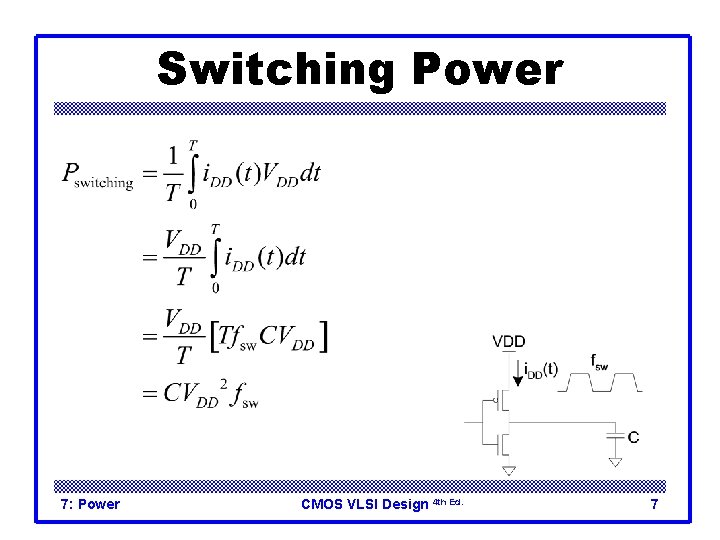
Switching Power 7: Power CMOS VLSI Design 4 th Ed. 7
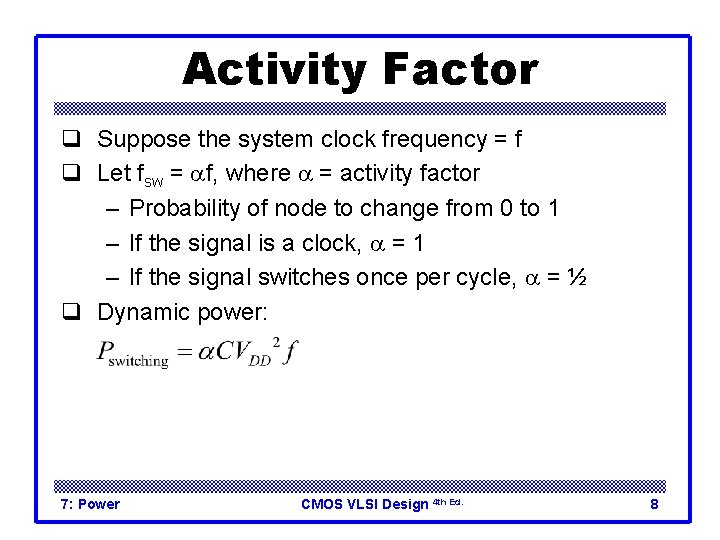
Activity Factor q Suppose the system clock frequency = f q Let fsw = af, where a = activity factor – Probability of node to change from 0 to 1 – If the signal is a clock, a = 1 – If the signal switches once per cycle, a = ½ q Dynamic power: 7: Power CMOS VLSI Design 4 th Ed. 8
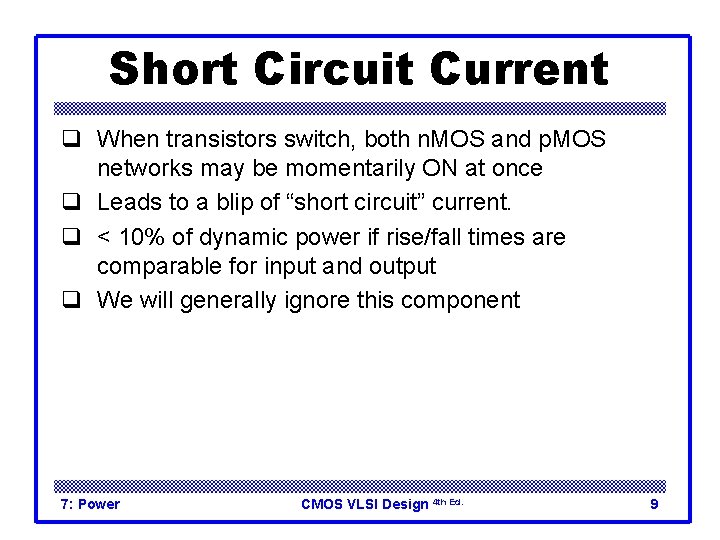
Short Circuit Current q When transistors switch, both n. MOS and p. MOS networks may be momentarily ON at once q Leads to a blip of “short circuit” current. q < 10% of dynamic power if rise/fall times are comparable for input and output q We will generally ignore this component 7: Power CMOS VLSI Design 4 th Ed. 9
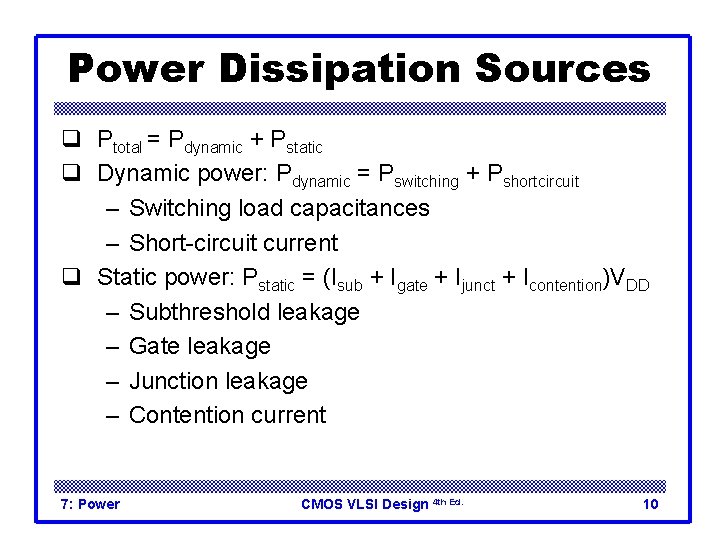
Power Dissipation Sources q Ptotal = Pdynamic + Pstatic q Dynamic power: Pdynamic = Pswitching + Pshortcircuit – Switching load capacitances – Short-circuit current q Static power: Pstatic = (Isub + Igate + Ijunct + Icontention)VDD – Subthreshold leakage – Gate leakage – Junction leakage – Contention current 7: Power CMOS VLSI Design 4 th Ed. 10
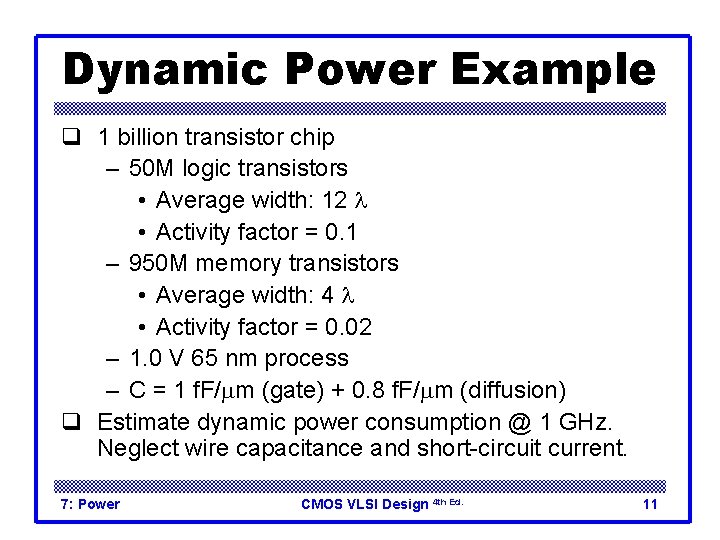
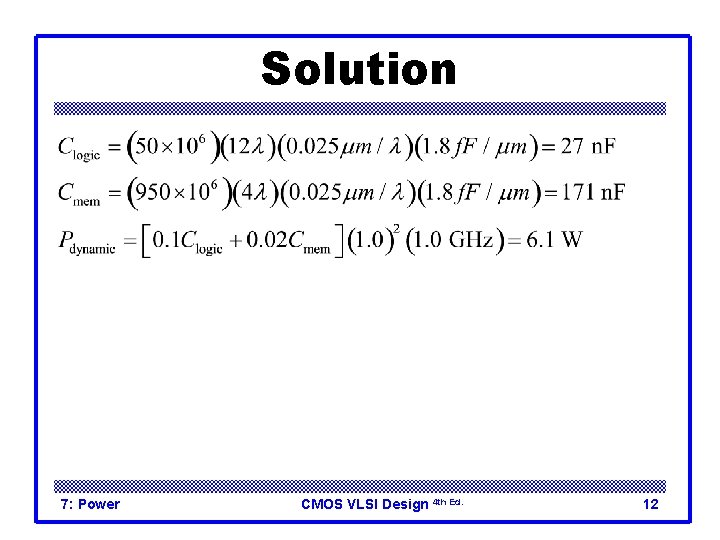
Dynamic Power Example q 1 billion transistor chip – 50 M logic transistors • Average width: 12 l • Activity factor = 0. 1 – 950 M memory transistors • Average width: 4 l • Activity factor = 0. 02 – 1. 0 V 65 nm process – C = 1 f. F/mm (gate) + 0. 8 f. F/mm (diffusion) q Estimate dynamic power consumption @ 1 GHz. Neglect wire capacitance and short-circuit current. 7: Power CMOS VLSI Design 4 th Ed. 11
Solution 7: Power CMOS VLSI Design 4 th Ed. 12
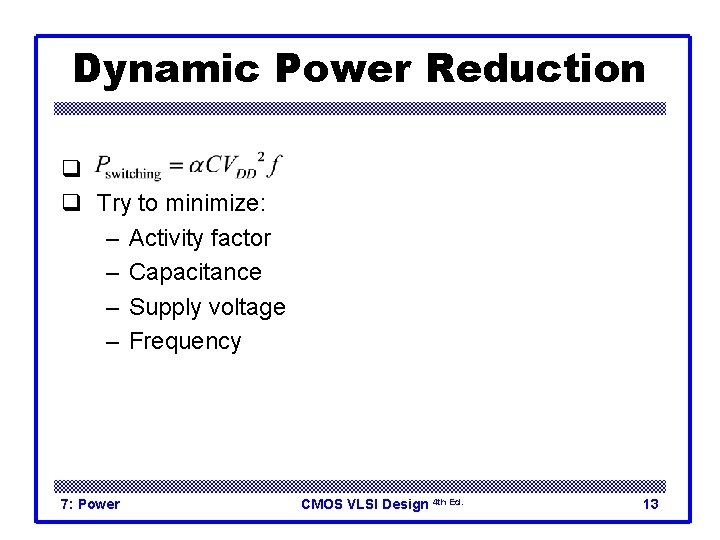
Dynamic Power Reduction q q Try to minimize: – Activity factor – Capacitance – Supply voltage – Frequency 7: Power CMOS VLSI Design 4 th Ed. 13
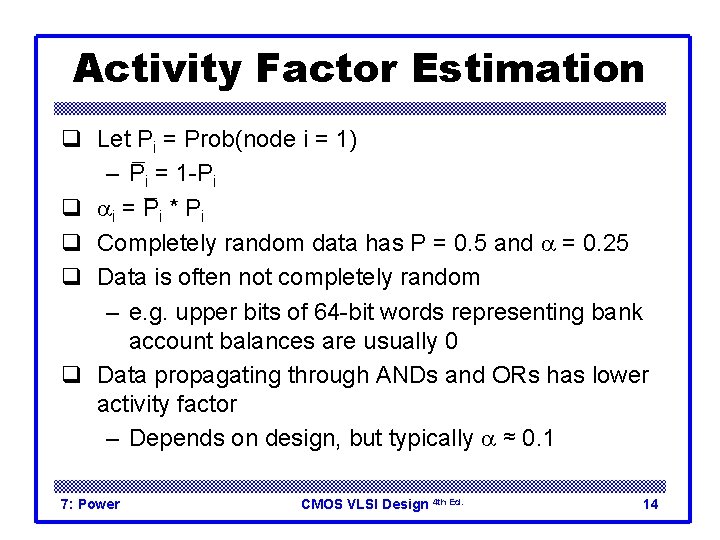
Activity Factor Estimation q Let Pi = Prob(node i = 1) – Pi = 1 -Pi q ai = P i * P i q Completely random data has P = 0. 5 and a = 0. 25 q Data is often not completely random – e. g. upper bits of 64 -bit words representing bank account balances are usually 0 q Data propagating through ANDs and ORs has lower activity factor – Depends on design, but typically a ≈ 0. 1 7: Power CMOS VLSI Design 4 th Ed. 14
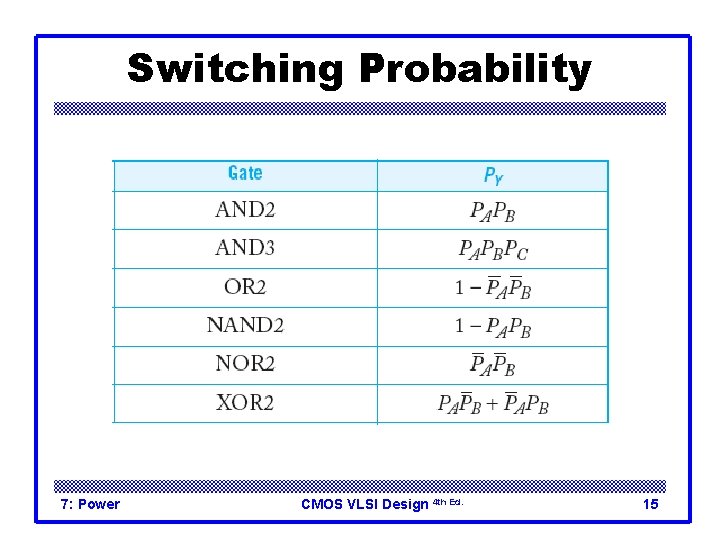
Switching Probability 7: Power CMOS VLSI Design 4 th Ed. 15
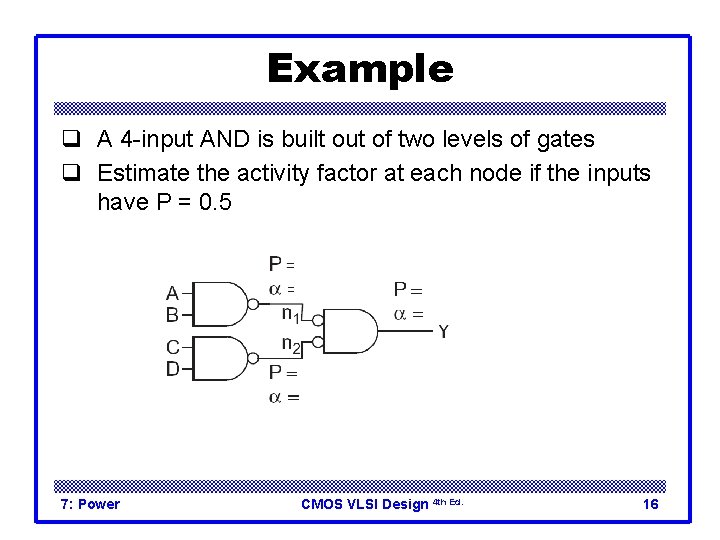
Example q A 4 -input AND is built out of two levels of gates q Estimate the activity factor at each node if the inputs have P = 0. 5 7: Power CMOS VLSI Design 4 th Ed. 16
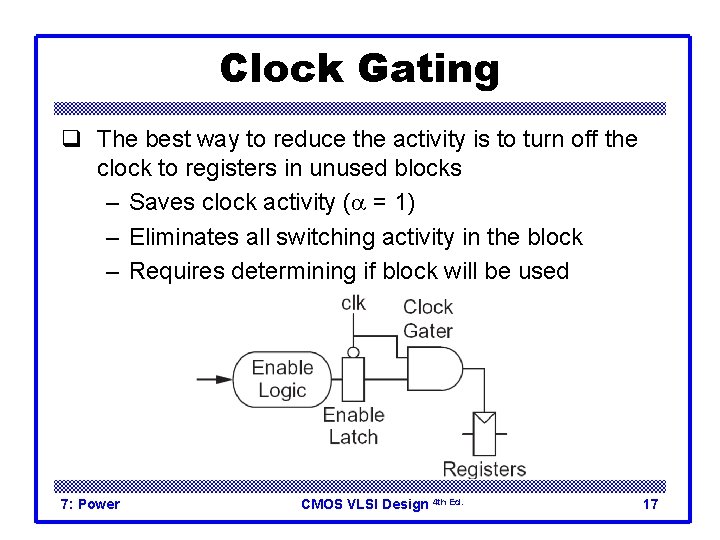
Clock Gating q The best way to reduce the activity is to turn off the clock to registers in unused blocks – Saves clock activity (a = 1) – Eliminates all switching activity in the block – Requires determining if block will be used 7: Power CMOS VLSI Design 4 th Ed. 17
Capacitance q Gate capacitance – Fewer stages of logic – Small gate sizes q Wire capacitance – Good floorplanning to keep communicating blocks close to each other – Drive long wires with inverters or buffers rather than complex gates 7: Power CMOS VLSI Design 4 th Ed. 18
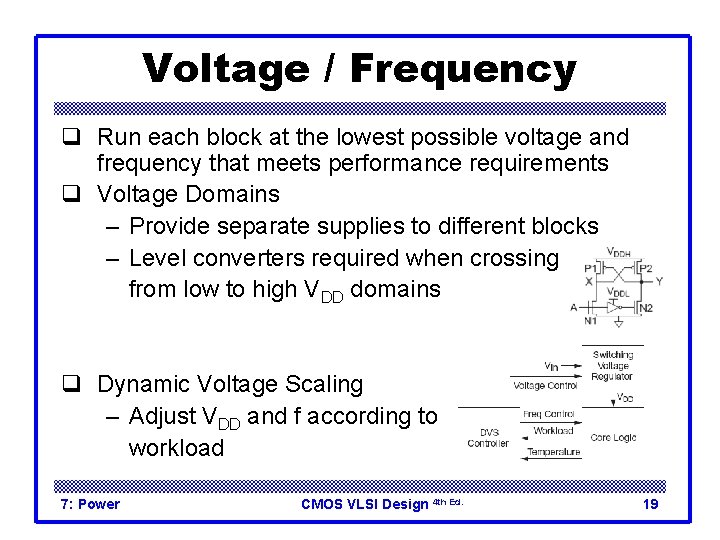
Voltage / Frequency q Run each block at the lowest possible voltage and frequency that meets performance requirements q Voltage Domains – Provide separate supplies to different blocks – Level converters required when crossing from low to high VDD domains q Dynamic Voltage Scaling – Adjust VDD and f according to workload 7: Power CMOS VLSI Design 4 th Ed. 19
Static Power q Static power is consumed even when chip is quiescent. – Leakage draws power from nominally OFF devices – Ratioed circuits burn power in fight between ON transistors 7: Power CMOS VLSI Design 4 th Ed. 20
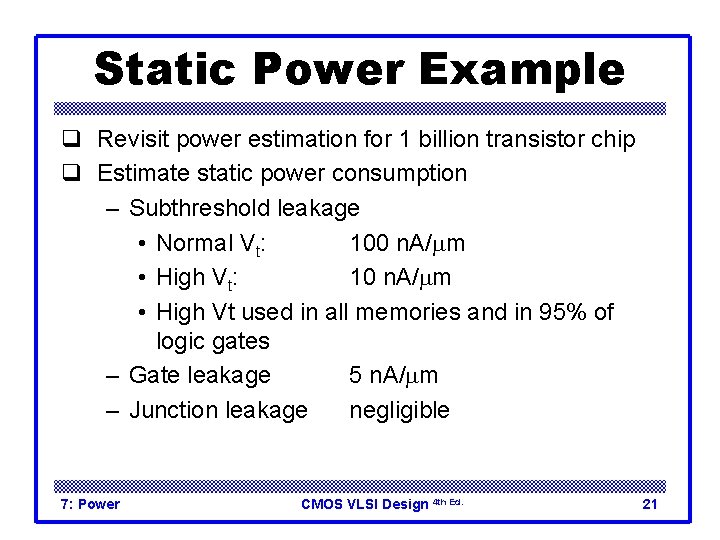
Static Power Example q Revisit power estimation for 1 billion transistor chip q Estimate static power consumption – Subthreshold leakage • Normal Vt: 100 n. A/mm • High Vt: 10 n. A/mm • High Vt used in all memories and in 95% of logic gates – Gate leakage 5 n. A/mm – Junction leakage negligible 7: Power CMOS VLSI Design 4 th Ed. 21
Solution 7: Power CMOS VLSI Design 4 th Ed. 22
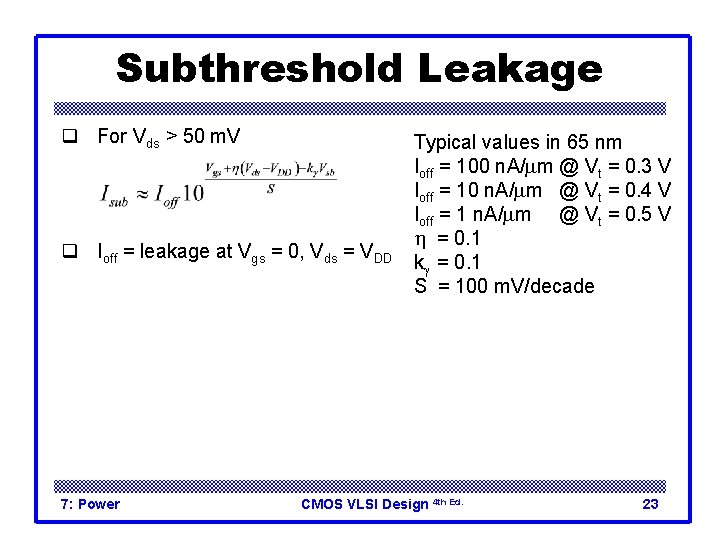
Subthreshold Leakage q For Vds > 50 m. V q Ioff = leakage at Vgs = 0, Vds = VDD 7: Power Typical values in 65 nm Ioff = 100 n. A/mm @ Vt = 0. 3 V Ioff = 10 n. A/mm @ Vt = 0. 4 V Ioff = 1 n. A/mm @ Vt = 0. 5 V h = 0. 1 kg = 0. 1 S = 100 m. V/decade CMOS VLSI Design 4 th Ed. 23
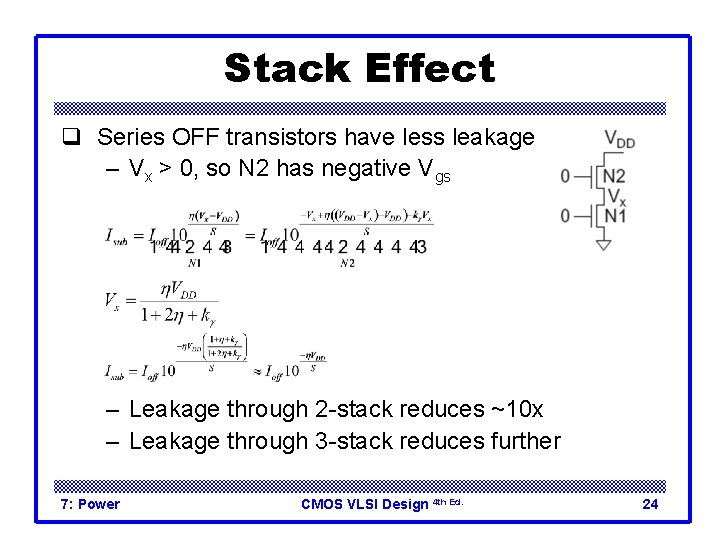
Stack Effect q Series OFF transistors have less leakage – Vx > 0, so N 2 has negative Vgs – Leakage through 2 -stack reduces ~10 x – Leakage through 3 -stack reduces further 7: Power CMOS VLSI Design 4 th Ed. 24
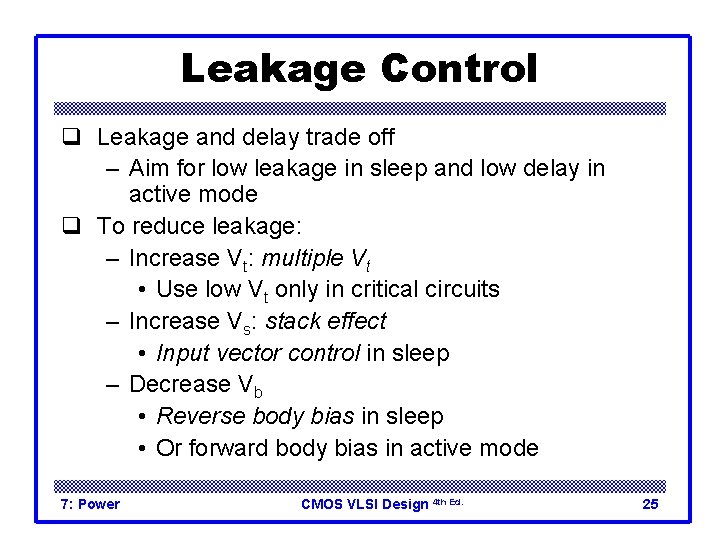
Leakage Control q Leakage and delay trade off – Aim for low leakage in sleep and low delay in active mode q To reduce leakage: – Increase Vt: multiple Vt • Use low Vt only in critical circuits – Increase Vs: stack effect • Input vector control in sleep – Decrease Vb • Reverse body bias in sleep • Or forward body bias in active mode 7: Power CMOS VLSI Design 4 th Ed. 25
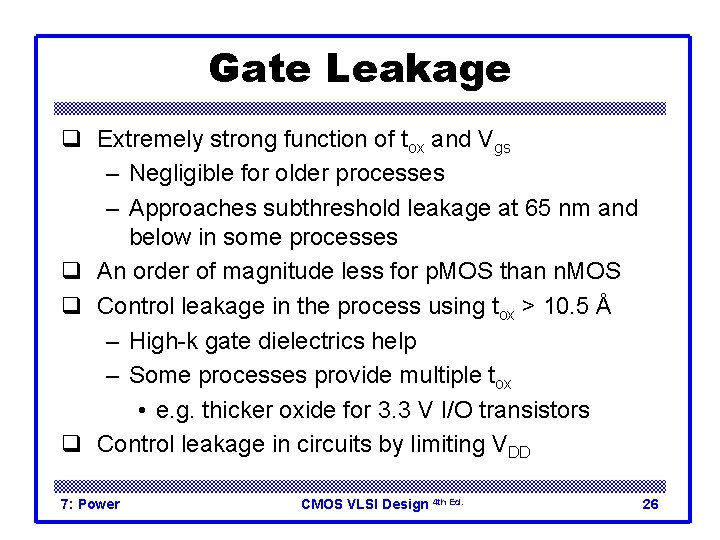
Gate Leakage q Extremely strong function of tox and Vgs – Negligible for older processes – Approaches subthreshold leakage at 65 nm and below in some processes q An order of magnitude less for p. MOS than n. MOS q Control leakage in the process using tox > 10. 5 Å – High-k gate dielectrics help – Some processes provide multiple tox • e. g. thicker oxide for 3. 3 V I/O transistors q Control leakage in circuits by limiting VDD 7: Power CMOS VLSI Design 4 th Ed. 26
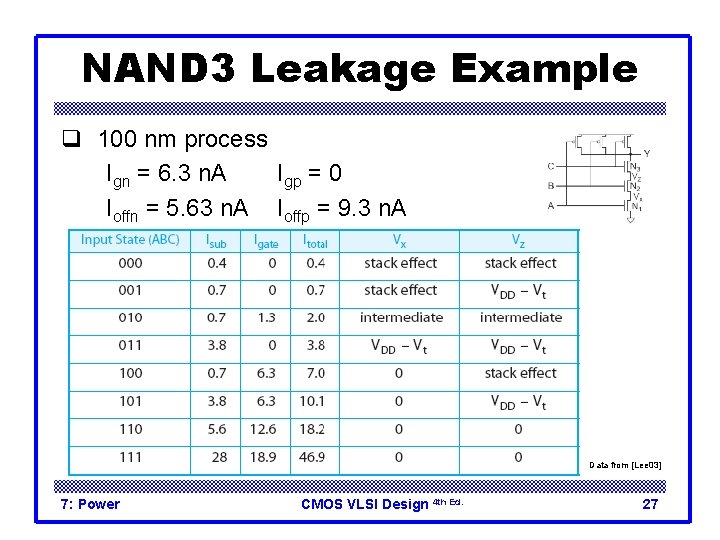
NAND 3 Leakage Example q 100 nm process Ign = 6. 3 n. A Igp = 0 Ioffn = 5. 63 n. A Ioffp = 9. 3 n. A Data from [Lee 03] 7: Power CMOS VLSI Design 4 th Ed. 27
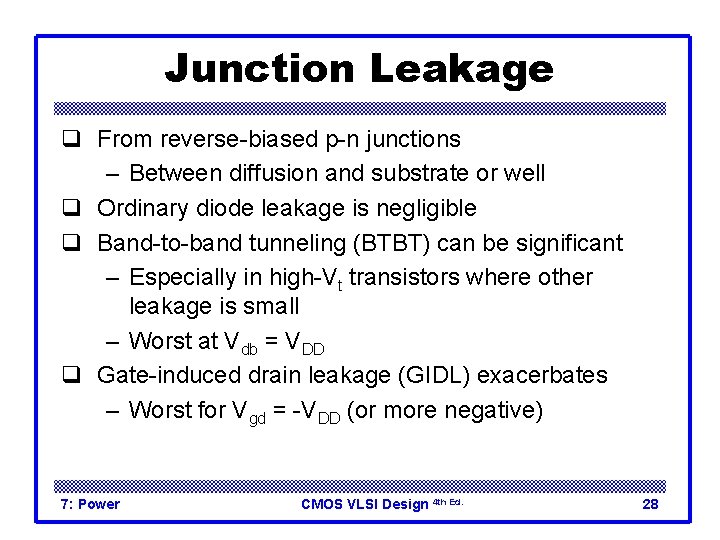
Junction Leakage q From reverse-biased p-n junctions – Between diffusion and substrate or well q Ordinary diode leakage is negligible q Band-to-band tunneling (BTBT) can be significant – Especially in high-Vt transistors where other leakage is small – Worst at Vdb = VDD q Gate-induced drain leakage (GIDL) exacerbates – Worst for Vgd = -VDD (or more negative) 7: Power CMOS VLSI Design 4 th Ed. 28
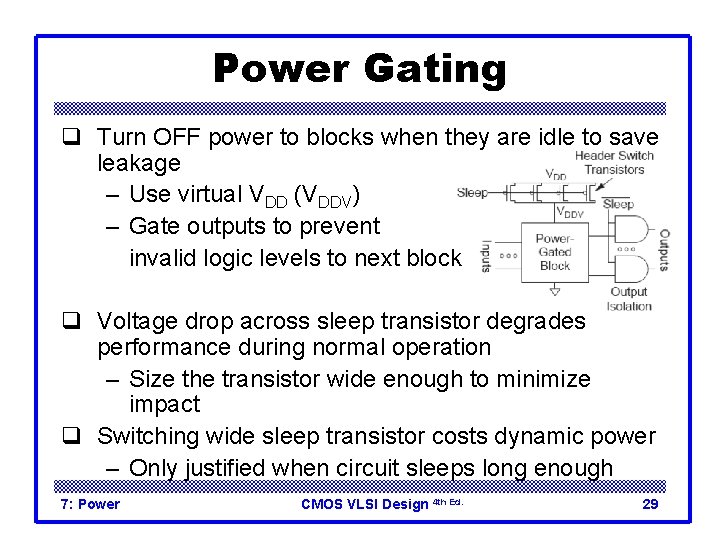
Power Gating q Turn OFF power to blocks when they are idle to save leakage – Use virtual VDD (VDDV) – Gate outputs to prevent invalid logic levels to next block q Voltage drop across sleep transistor degrades performance during normal operation – Size the transistor wide enough to minimize impact q Switching wide sleep transistor costs dynamic power – Only justified when circuit sleeps long enough 7: Power CMOS VLSI Design 4 th Ed. 29