
Lecture 7 PLANNING DESIGN OF OPEN SPACES Planning
- Slides: 6
Lecture 7 PLANNING & DESIGN OF OPEN SPACES Planning Of New Town
1) IMPORTANCE OF OPEN SPACES Establish a desirable living environment for new town residents. One can maintain contact with nature. Careful use of such spaces can avoid the inequality between private and public open spaces. Careful planning of open spaces can avoid mixing of industrial and residential land uses and could increase and strengthen the identity of territorial neighbourhoods and new towns Siddiqa Amin 2
2) TYPES OF RECREATION PARKS Provide relief to the inhabitants from air and noise pollution and to satisfy the needs of fresh air. Furnish the passive type of recreation to the town. PLAYGROUNDS Necessary for physical development of body by actively engaging in various games. Siddiqa Amin 3
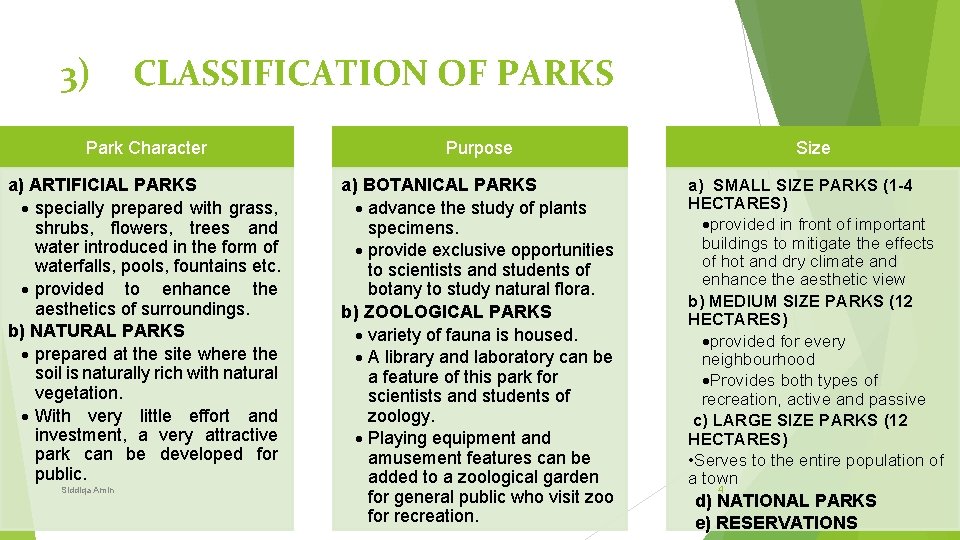
3) CLASSIFICATION OF PARKS Park Character Purpose Size a) ARTIFICIAL PARKS specially prepared with grass, shrubs, flowers, trees and water introduced in the form of waterfalls, pools, fountains etc. provided to enhance the aesthetics of surroundings. b) NATURAL PARKS prepared at the site where the soil is naturally rich with natural vegetation. With very little effort and investment, a very attractive park can be developed for public. a) BOTANICAL PARKS advance the study of plants specimens. provide exclusive opportunities to scientists and students of botany to study natural flora. b) ZOOLOGICAL PARKS variety of fauna is housed. A library and laboratory can be a feature of this park for scientists and students of zoology. Playing equipment and amusement features can be added to a zoological garden for general public who visit zoo for recreation. a) SMALL SIZE PARKS (1 -4 HECTARES) provided in front of important buildings to mitigate the effects of hot and dry climate and enhance the aesthetic view b) MEDIUM SIZE PARKS (12 HECTARES) provided for every neighbourhood Provides both types of recreation, active and passive c) LARGE SIZE PARKS (12 HECTARES) • Serves to the entire population of a town 4 d) NATIONAL PARKS e) RESERVATIONS Siddiqa Amin
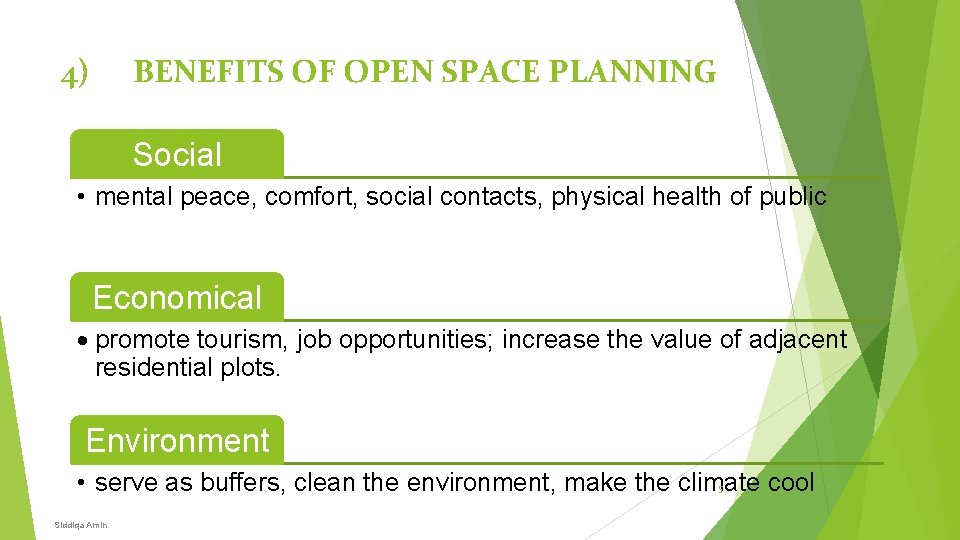
4) BENEFITS OF OPEN SPACE PLANNING Social • mental peace, comfort, social contacts, physical health of public Economical promote tourism, job opportunities; increase the value of adjacent residential plots. Environment • serve as buffers, clean the environment, make the climate cool 5 Siddiqa Amin
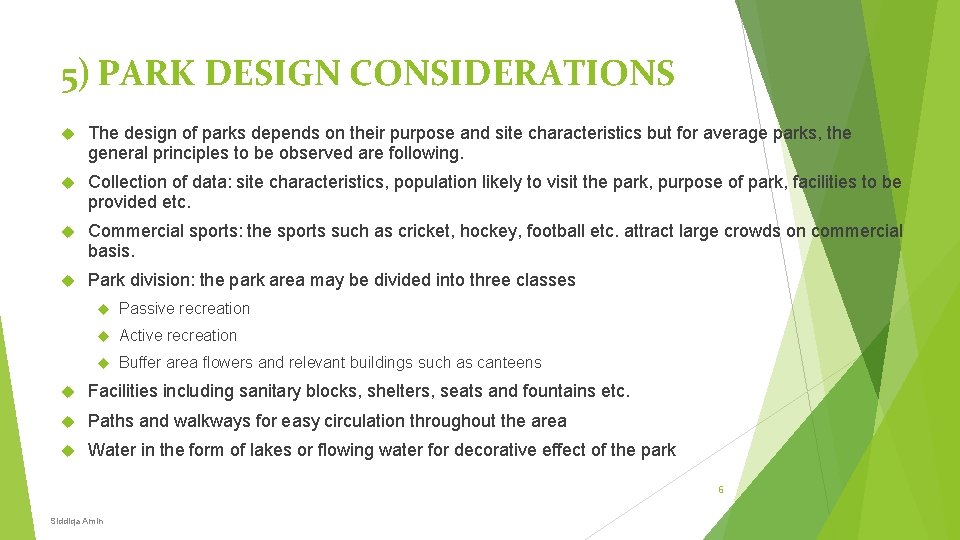
5) PARK DESIGN CONSIDERATIONS The design of parks depends on their purpose and site characteristics but for average parks, the general principles to be observed are following. Collection of data: site characteristics, population likely to visit the park, purpose of park, facilities to be provided etc. Commercial sports: the sports such as cricket, hockey, football etc. attract large crowds on commercial basis. Park division: the park area may be divided into three classes Passive recreation Active recreation Buffer area flowers and relevant buildings such as canteens Facilities including sanitary blocks, shelters, seats and fountains etc. Paths and walkways for easy circulation throughout the area Water in the form of lakes or flowing water for decorative effect of the park 6 Siddiqa Amin