
Lecture 7 Models of the Foreign Policy Making
- Slides: 29
Lecture #7 Models of the Foreign Policy Making Process
Introduction to Models of Foreign-Making Process
Introduction to Decision-Making • Why understanding decision-making is difficult… • No single decision-making process exists • Decisions are seldom final and tend to lack concrete beginning and ending points • There is an imperfect link between the policy process and the policy outcome • Thus any decision-making model is likely to oversimplify the problem • Still models offer analytical tools which can be combined to provide useful insights
Introduction to Decision-Making • Different models of how foreign policy is made have been proposed • Graham Allison famously applied 3 models to the Cuban Missile Crisis in the classic work Essence of Decision
Introduction to Decision-Making • Each model brings certain elements into focus and obscures others (like a set of lenses) • Subsequent work has elaborated and critiqued these 3 models, but they are a good starting point for understanding foreign policy making
Rational Actor Model
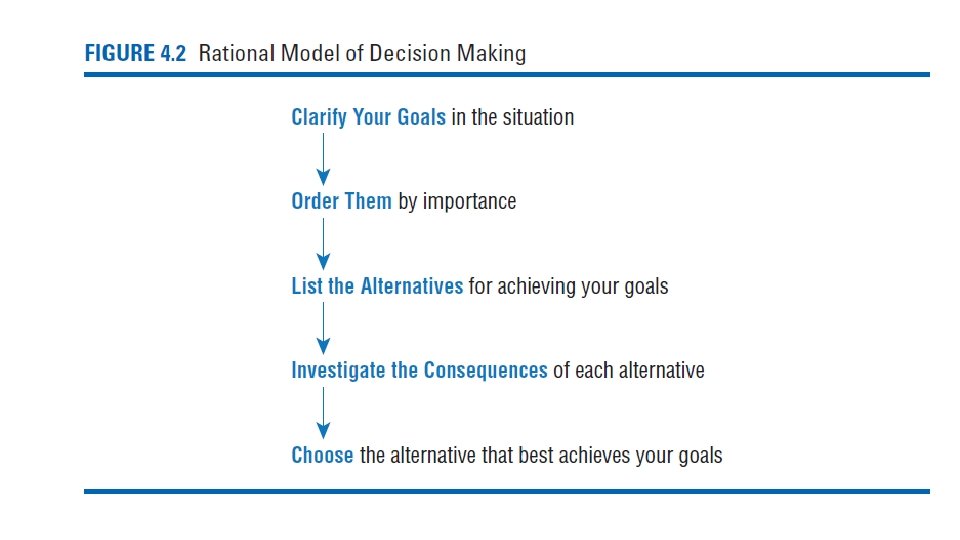
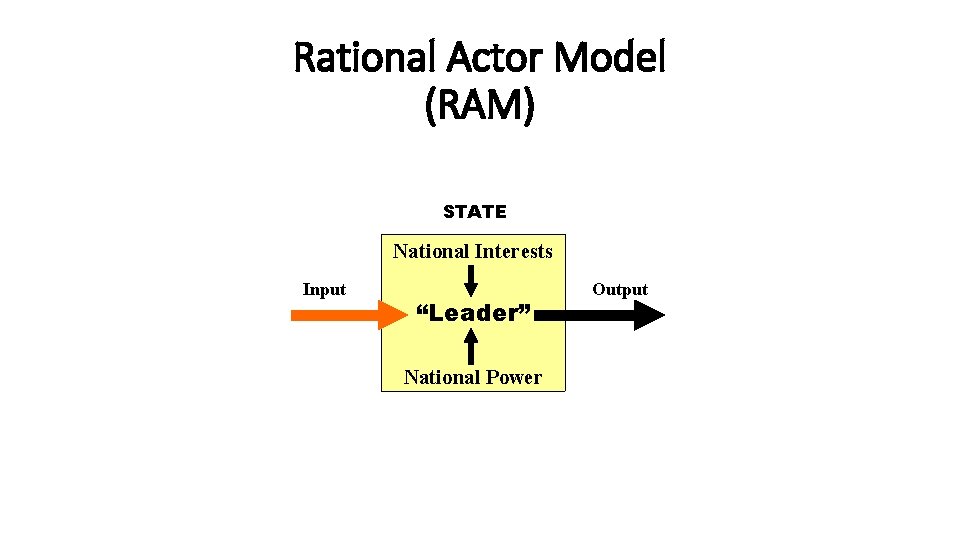
Rational Actor Model • Rational Model • Decision makers set goals • Evaluate their relative importance • Calculate the costs and benefits of each possible course of action • And then choose the one with the highest benefits and lowest costs. • Role of uncertainty • Accepting of risk versus averse to risk • A very useful tool during the Cold War
Rational Actor Model • Foreign policy is viewed as a calculated response to the actions of another actor • That causes a calculated response from the first actor which leads to reevaluation and readjustment by the second actor • Throughout this process, the state is seen as unitary and rational • Domestic politics, governmental organization, and personalities are discounted • Seen in Realist Theory
Rational Actor Model • Most widely used method among media/public for explaining countries’ actions • Oversimplification? • Critics: yes, empirically flawed and can be very misleading • Proponents: “As if” model with predictive accuracy
Group-Share • For the following questions that are asked under the Rational Actors Model, what aspects are not addressed or overlooked that you think are important to developing foreign policy? Why?
Rational Actors Model Questions • What is the problem • What are the alternatives • What are the strategic costs and benefits of each alternative • What is the observed pattern of national values • What are the pressures in the international strategic marketplace
Rational Actor Model (RAM) STATE National Interests Input “Leader” National Power Output
Organizational Process Model
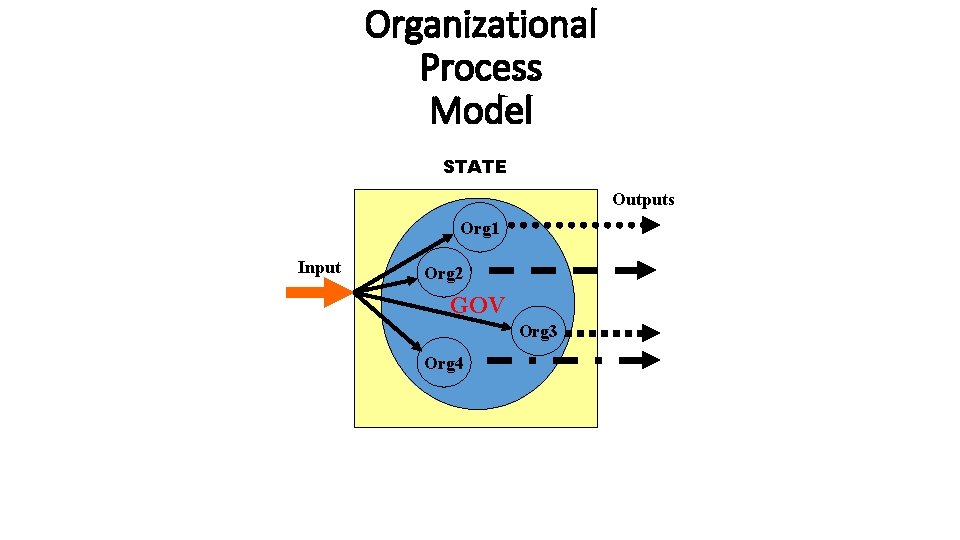
Organizational Process Model • Because time is short to do a lot of bargaining, many decisions are based on existing organizational standard operating procedures (SOPs) • Governments are complex entities consisting of large organizations among which responsibilities for particular areas are divided
Organizational Process Model • To control large numbers of people, organizations need standard operating procedures (SOPs) • SOPs can promote efficient and effective responses • SOPs can be unduly rigid and inappropriate for the situation • Example: nuclear SOPs nearly resulting in nuclear accidents/war (Sagan)
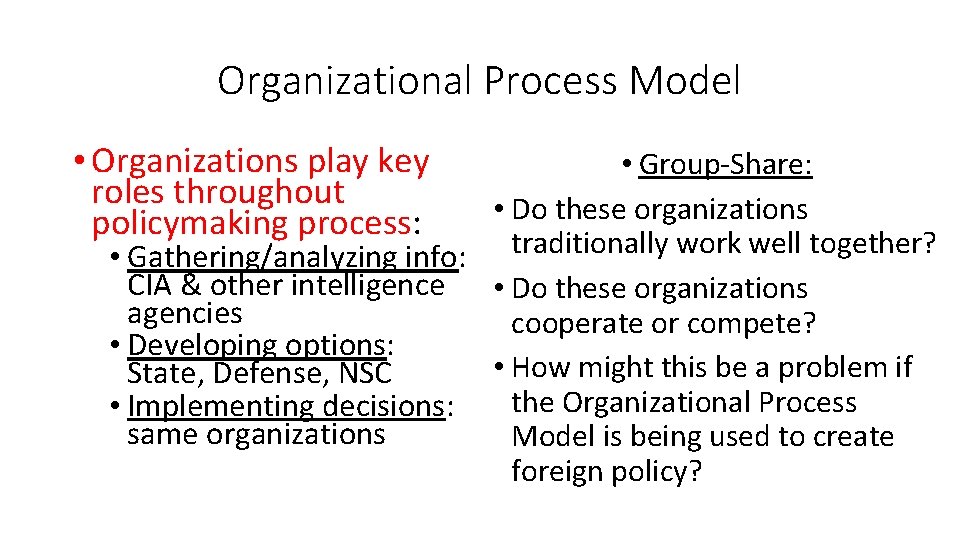
Organizational Process Model • Organizations play key roles throughout policymaking process: • Group-Share: • Do these organizations • Gathering/analyzing info: traditionally work well together? CIA & other intelligence • Do these organizations agencies cooperate or compete? • Developing options: • How might this be a problem if State, Defense, NSC the Organizational Process • Implementing decisions: same organizations Model is being used to create foreign policy?
Organizational Process Model • Therefore decisions within the organization are largely determined by routines established by SOPs before the particular instance or problem even occurs • To ensure predictable performance, the “standards” are often limited, unduly formalized, and sluggish • They may also be inappropriate
Organizational Process Model • Organizations’ SOPs and routines can undermine rationality at the state level and diverge from national interest • Orgs aren’t following coherent, integrated national strategy but are “mindlessly” executing routines • Contradicts Rational Actor Model • Example: Soviet rocket forces and infantry had SOPs that revealed their presence on Cuba when Khruschev wanted their activities kept secret
Organizational Model Questions • Of which organizations does the gov. consist? • Which organizations traditionally act on a problem of this sort? • What programs, repertoires do these organizations have for making information available? • What are the programs available in these organizations for implementing decisions?
Organizational Process Model STATE Outputs Org 1 Input Org 2 GOV Org 3 Org 4
Bureaucratic Politics Model
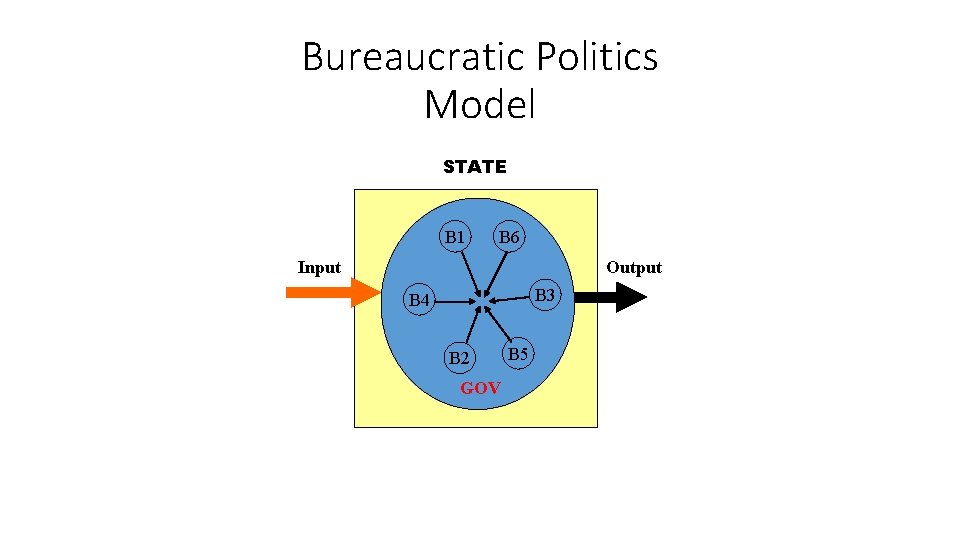
Bureaucratic Politics Model • Bureaucratic politics is the “process by which people inside government bargain with one another on complex public policy questions” • This model sees decisions as being the product of conflict-resolution rather than problem solving • Class: What do you think of that premise? Why?
Bureaucratic Politics Model • Foreign policy actions result from a “political game” played by actors who differ in: • Goals/interests • Power • Presidential power is the power to persuade (Neustadt) • Presidents can’t just command; they must cajole, bargain, etc.
Bureaucratic Politics Model • Power is shared • The individuals who share power disagree on what should be done because they are located at different places in the government and see different aspects of the problem • Example: • The Secretary of State may view a problem primarily from the diplomatic perspective • While the Secretary of Defense has a different view because his troops may be used • While the President must also concern himself with domestic fallout
Bureaucratic Politics Model • Krasner’s Critique: • Group-Share: • Empirical flaws: • Can you think of any President is more like a examples from American King than “first among History where this equals” happened? • Practical danger: • What do you think? Should absolves the Presidents be held of responsibility for accountable for their foreign actions (e. g. , Vietnam) policy decisions? Why or why not?
Bureaucratic Politics Model • Weaknesses: • Rarely do problems enter or leave the policy process in a clearly definable manner • They get entangled with other issues • Not everyone participates in every problem • Competition / Rivalry of various agencies • Inability / Unwillingness to share across bureaucratic boundaries • Standard Operating Procedures
Bureaucratic Model Questions • What are the existing channels for producing action? • Which players in what positions are centrally involved? • How do pressures of job, past and personality affect central players? • What are the deadlines? • Where are the follow-ups?
Bureaucratic Politics Model STATE B 1 B 6 Input Output B 3 B 4 B 2 GOV B 5