
Lecture 7 Lasers and their applications II Requirements
- Slides: 9
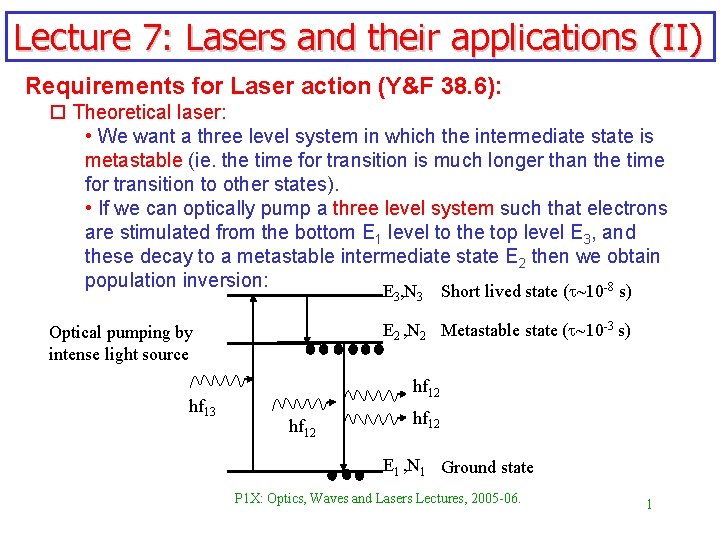
Lecture 7: Lasers and their applications (II) Requirements for Laser action (Y&F 38. 6): o Theoretical laser: • We want a three level system in which the intermediate state is metastable (ie. the time for transition is much longer than the time for transition to other states). • If we can optically pump a three level system such that electrons are stimulated from the bottom E 1 level to the top level E 3, and these decay to a metastable intermediate state E 2 then we obtain population inversion: E , N Short lived state (t~10 -8 s) 3 E 2 , N 2 Metastable state (t~10 -3 s) Optical pumping by intense light source hf 13 3 hf 12 E 1 , N 1 Ground state P 1 X: Optics, Waves and Lasers Lectures, 2005 -06. 1
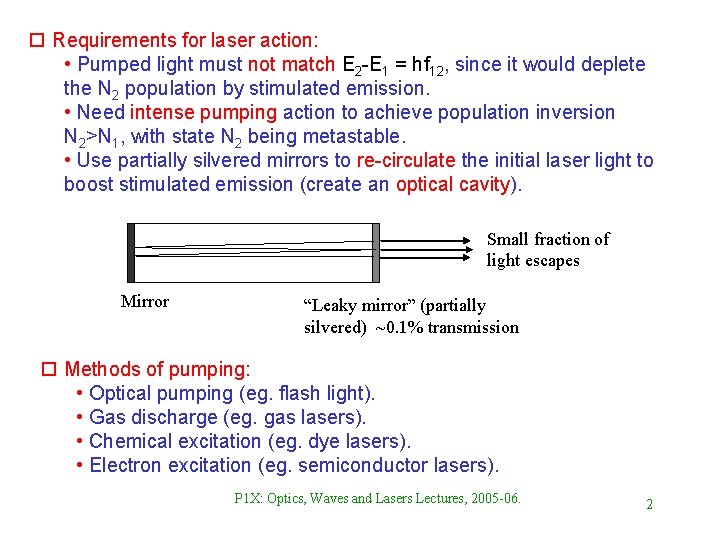
o Requirements for laser action: • Pumped light must not match E 2 -E 1 = hf 12, since it would deplete the N 2 population by stimulated emission. • Need intense pumping action to achieve population inversion N 2>N 1, with state N 2 being metastable. • Use partially silvered mirrors to re-circulate the initial laser light to boost stimulated emission (create an optical cavity). Small fraction of light escapes Mirror “Leaky mirror” (partially silvered) ~0. 1% transmission o Methods of pumping: • Optical pumping (eg. flash light). • Gas discharge (eg. gas lasers). • Chemical excitation (eg. dye lasers). • Electron excitation (eg. semiconductor lasers). P 1 X: Optics, Waves and Lasers Lectures, 2005 -06. 2
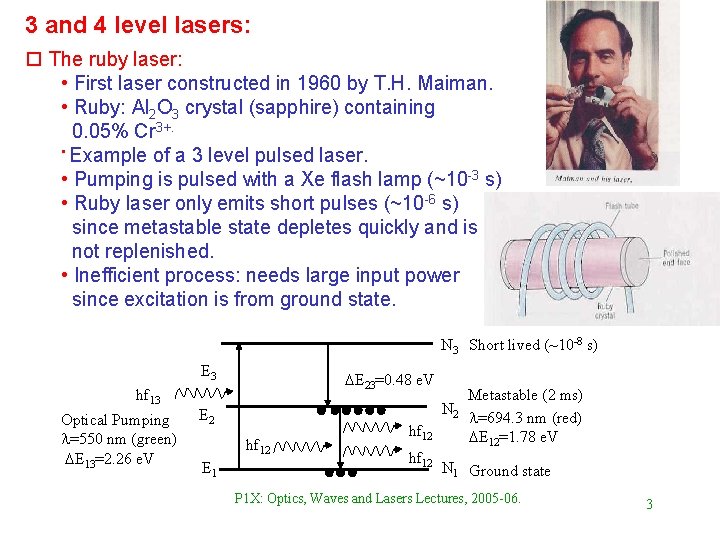
3 and 4 level lasers: o The ruby laser: • First laser constructed in 1960 by T. H. Maiman. • Ruby: Al 2 O 3 crystal (sapphire) containing 0. 05% Cr 3+. • Example of a 3 level pulsed laser. • Pumping is pulsed with a Xe flash lamp (~10 -3 s) • Ruby laser only emits short pulses (~10 -6 s) since metastable state depletes quickly and is not replenished. • Inefficient process: needs large input power since excitation is from ground state. N 3 Short lived (~10 -8 s) E 3 DE 23=0. 48 e. V hf 13 Optical Pumping l=550 nm (green) DE 13=2. 26 e. V E 2 hf 12 E 1 hf 12 Metastable (2 ms) N 2 l=694. 3 nm (red) DE 12=1. 78 e. V N 1 Ground state P 1 X: Optics, Waves and Lasers Lectures, 2005 -06. 3
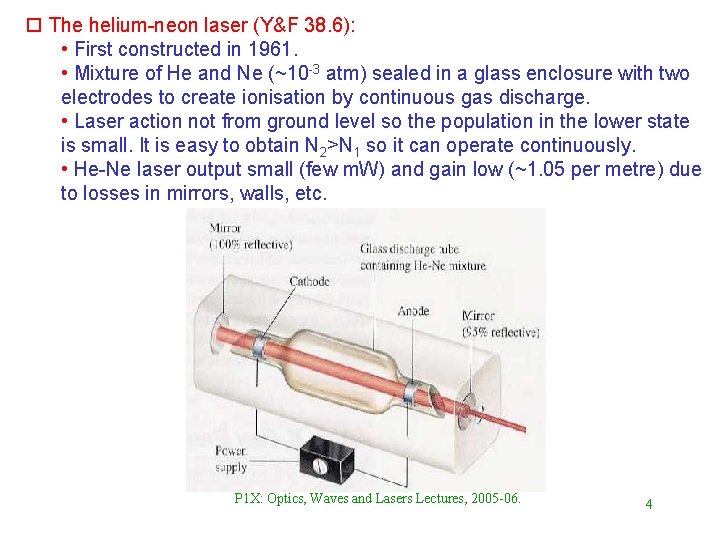
o The helium-neon laser (Y&F 38. 6): • First constructed in 1961. • Mixture of He and Ne (~10 -3 atm) sealed in a glass enclosure with two electrodes to create ionisation by continuous gas discharge. • Laser action not from ground level so the population in the lower state is small. It is easy to obtain N 2>N 1 so it can operate continuously. • He-Ne laser output small (few m. W) and gain low (~1. 05 per metre) due to losses in mirrors, walls, etc. P 1 X: Optics, Waves and Lasers Lectures, 2005 -06. 4
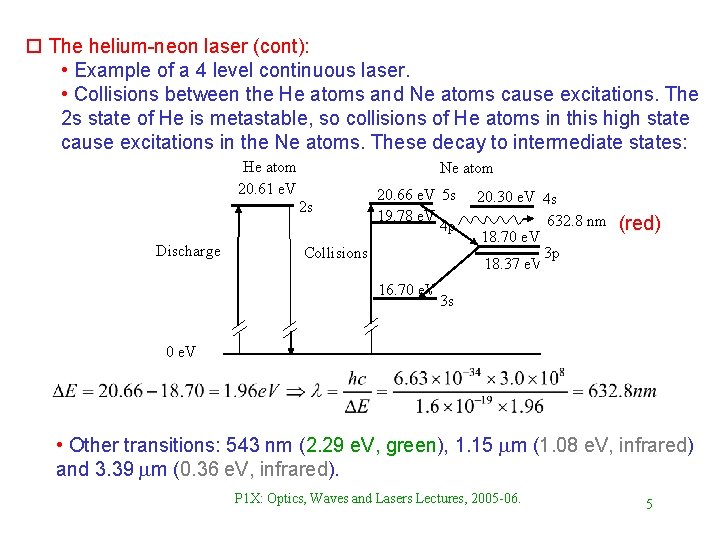
o The helium-neon laser (cont): • Example of a 4 level continuous laser. • Collisions between the He atoms and Ne atoms cause excitations. The 2 s state of He is metastable, so collisions of He atoms in this high state cause excitations in the Ne atoms. These decay to intermediate states: He atom 20. 61 e. V Discharge Ne atom 2 s 20. 66 e. V 5 s 19. 78 e. V 4 p Collisions 16. 70 e. V 20. 30 e. V 4 s 632. 8 nm 18. 70 e. V 3 p 18. 37 e. V (red) 3 s 0 e. V • Other transitions: 543 nm (2. 29 e. V, green), 1. 15 mm (1. 08 e. V, infrared) and 3. 39 mm (0. 36 e. V, infrared). P 1 X: Optics, Waves and Lasers Lectures, 2005 -06. 5
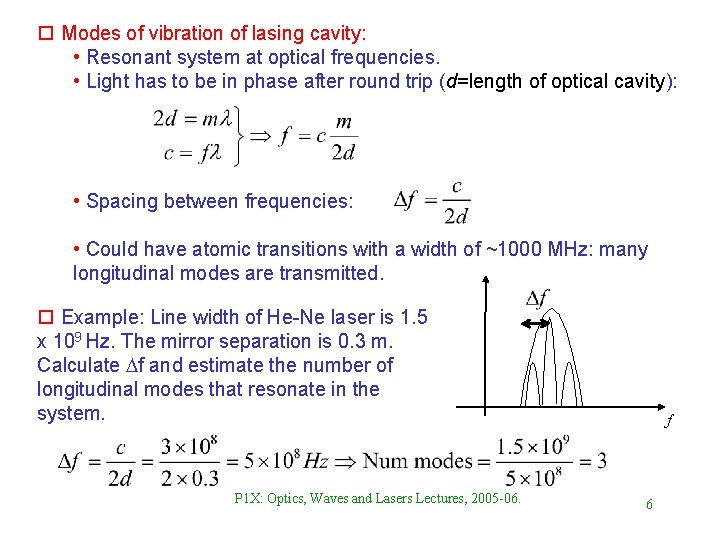
o Modes of vibration of lasing cavity: • Resonant system at optical frequencies. • Light has to be in phase after round trip (d=length of optical cavity): • Spacing between frequencies: • Could have atomic transitions with a width of ~1000 MHz: many longitudinal modes are transmitted. o Example: Line width of He-Ne laser is 1. 5 x 10⁹ Hz. The mirror separation is 0. 3 m. Calculate Df and estimate the number of longitudinal modes that resonate in the system. P 1 X: Optics, Waves and Lasers Lectures, 2005 -06. f 6
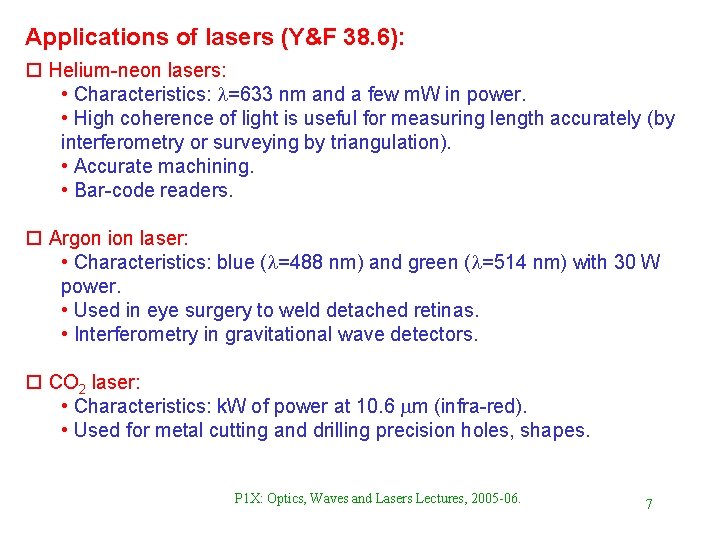
Applications of lasers (Y&F 38. 6): o Helium-neon lasers: • Characteristics: l=633 nm and a few m. W in power. • High coherence of light is useful for measuring length accurately (by interferometry or surveying by triangulation). • Accurate machining. • Bar-code readers. o Argon ion laser: • Characteristics: blue (l=488 nm) and green (l=514 nm) with 30 W power. • Used in eye surgery to weld detached retinas. • Interferometry in gravitational wave detectors. o CO 2 laser: • Characteristics: k. W of power at 10. 6 mm (infra-red). • Used for metal cutting and drilling precision holes, shapes. P 1 X: Optics, Waves and Lasers Lectures, 2005 -06. 7
o Nd-YAG (neodynium doped ytrium-aluminium-garnet) laser: • Characteristics: pulsed laser at 1. 06 mm (infra-red). • Used in medicine to clear blocked arteries and to destroy tissue • (e. g. tumors). • Nd-glass laser used in induced fusion experiments. o Semi-conductor laser (e. g. gallium arsenide): • Characteristics: mainly at 800 nm but also at 680 nm. • Used for optical communications through optic fibres. • CD players. • Supermarket checkouts. • Pump for Nd-YAG laser. • Laser pointers. P 1 X: Optics, Waves and Lasers Lectures, 2005 -06. 8
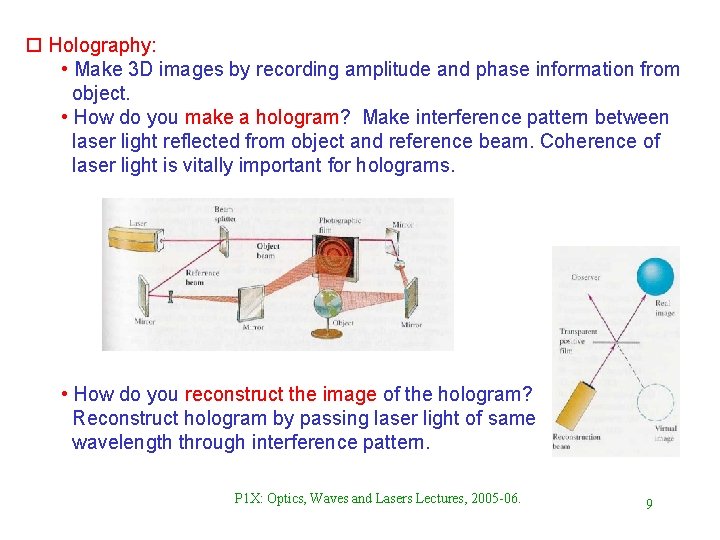
o Holography: • Make 3 D images by recording amplitude and phase information from object. • How do you make a hologram? Make interference pattern between laser light reflected from object and reference beam. Coherence of laser light is vitally important for holograms. • How do you reconstruct the image of the hologram? Reconstruct hologram by passing laser light of same wavelength through interference pattern. P 1 X: Optics, Waves and Lasers Lectures, 2005 -06. 9