
Lecture 7 Formation of the Solar System Dust

- Slides: 72
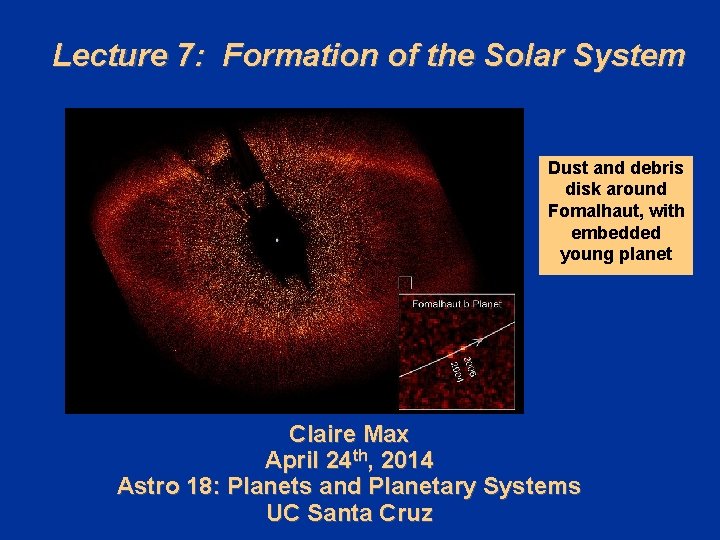
Lecture 7: Formation of the Solar System Dust and debris disk around Fomalhaut, with embedded young planet Claire Max April 24 th, 2014 Astro 18: Planets and Planetary Systems UC Santa Cruz
Solar System Origins: Outline • How can we make a theory of something that happened > 4 billion years ago? • What are the patterns we are trying to explain? • How do stars form? • Processes of planet formation • The young Solar System: bombardment, collisions, captures • The age of the Solar System Please remind me to take a break at 12: 45 pm! Slide 2
The Main Points • We didn’t observe the origin of the Solar System, so we have to develop theories that match “circumstantial evidence” - what the Solar System is like today • Observed data (today) are most consistent with theory that all the planets formed out of the same cloud of gas at the same time • Some of the wide variety seen within the existing planets may be due to chance events like collisions • Discovery of planet-forming disks and actual planets around other stars implies that planet-forming processes are common in our Galaxy Slide 3
Today’s best hypothesis: Planet formation in a nutshell • Earth, Sun, and rest of Solar System formed from cloud of gas and dust ~ 4. 6 billion years ago • Properties of individual planets reflect their proximity to the hot proto-sun • Some planets have experienced major perturbations and/or collisions • Comets and asteroids are debris left over from Solar System formation Slide 4
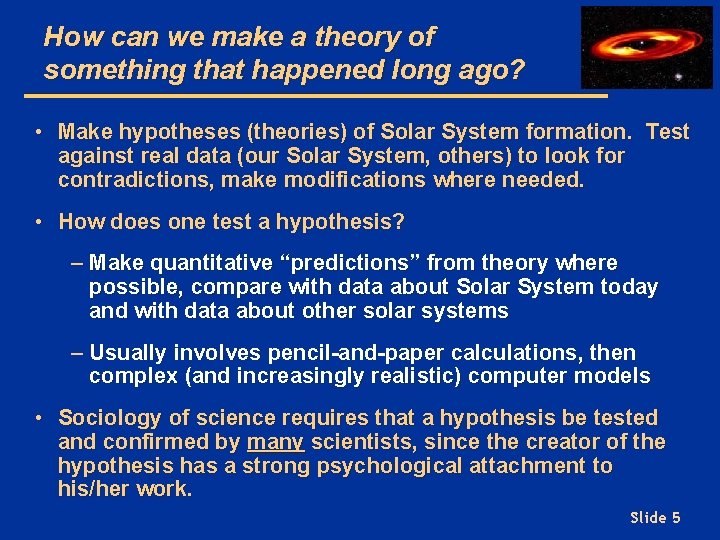
How can we make a theory of something that happened long ago? • Make hypotheses (theories) of Solar System formation. Test against real data (our Solar System, others) to look for contradictions, make modifications where needed. • How does one test a hypothesis? – Make quantitative “predictions” from theory where possible, compare with data about Solar System today and with data about other solar systems – Usually involves pencil-and-paper calculations, then complex (and increasingly realistic) computer models • Sociology of science requires that a hypothesis be tested and confirmed by many scientists, since the creator of the hypothesis has a strong psychological attachment to his/her work. Slide 5
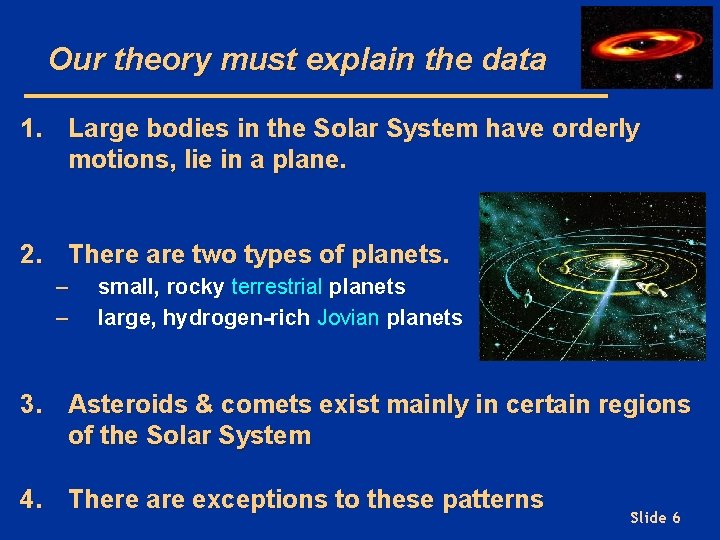
Our theory must explain the data 1. Large bodies in the Solar System have orderly motions, lie in a plane. 2. There are two types of planets. – – small, rocky terrestrial planets large, hydrogen-rich Jovian planets 3. Asteroids & comets exist mainly in certain regions of the Solar System 4. There are exceptions to these patterns Slide 6
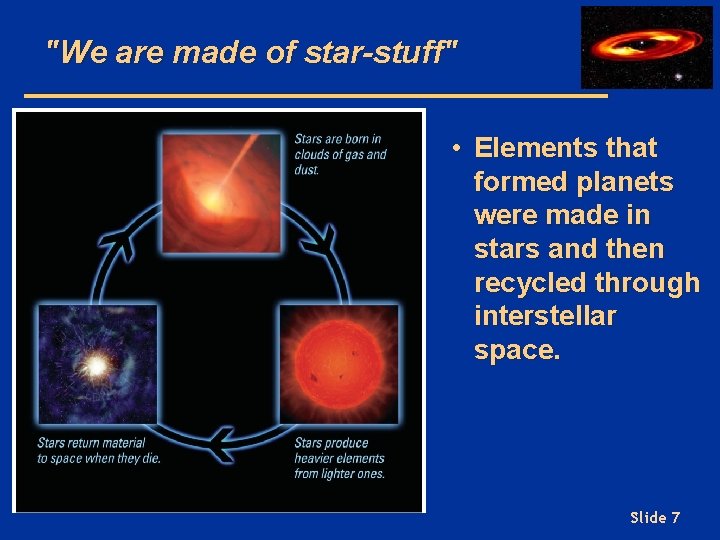
"We are made of star-stuff" • Elements that formed planets were made in stars and then recycled through interstellar space. Slide 7
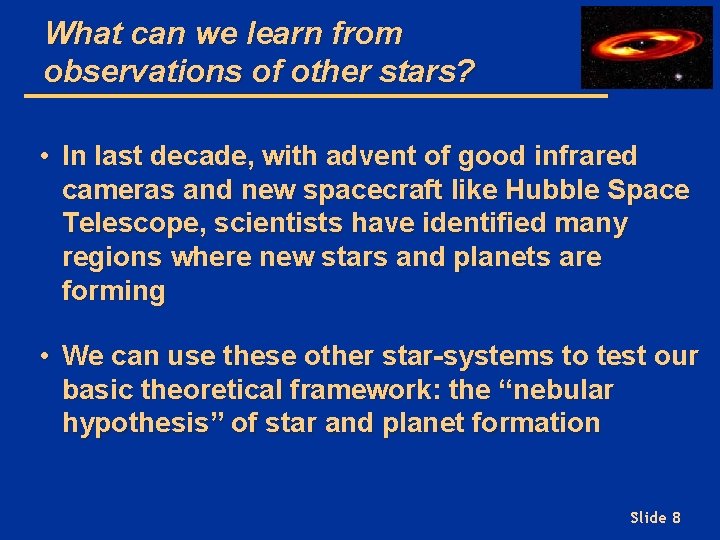
What can we learn from observations of other stars? • In last decade, with advent of good infrared cameras and new spacecraft like Hubble Space Telescope, scientists have identified many regions where new stars and planets are forming • We can use these other star-systems to test our basic theoretical framework: the “nebular hypothesis” of star and planet formation Slide 8
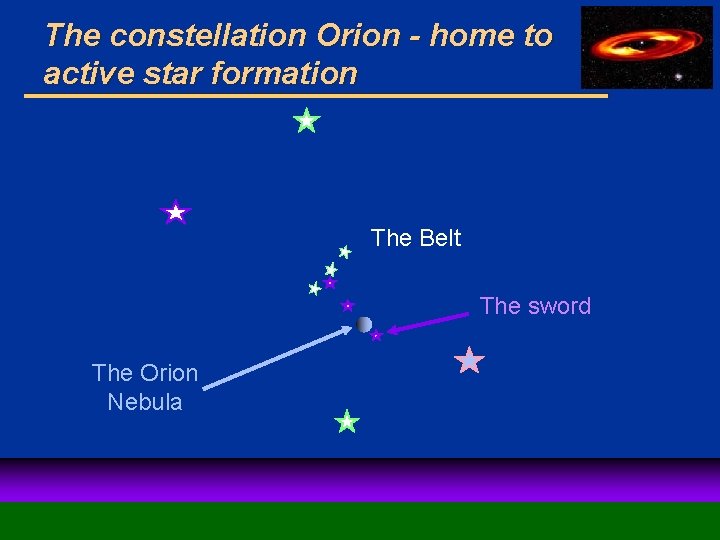
The constellation Orion - home to active star formation The Belt The sword The Orion Nebula Slide 9 Page
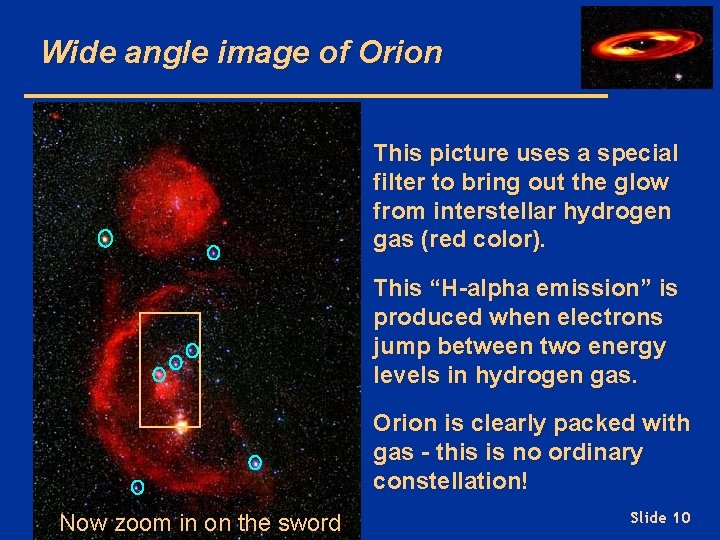
Wide angle image of Orion This picture uses a special filter to bring out the glow from interstellar hydrogen gas (red color). This “H-alpha emission” is produced when electrons jump between two energy levels in hydrogen gas. Orion is clearly packed with gas - this is no ordinary constellation! Now zoom in on the sword Slide 10
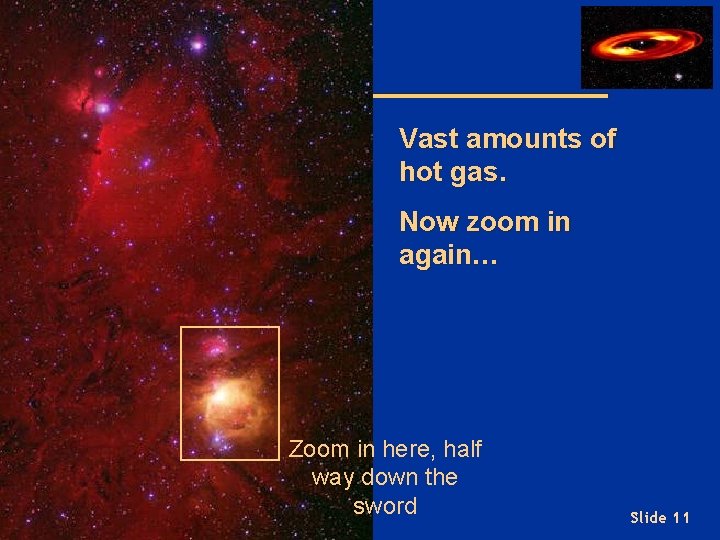
Vast amounts of hot gas. Now zoom in again… Zoom in here, half way down the sword Slide 11
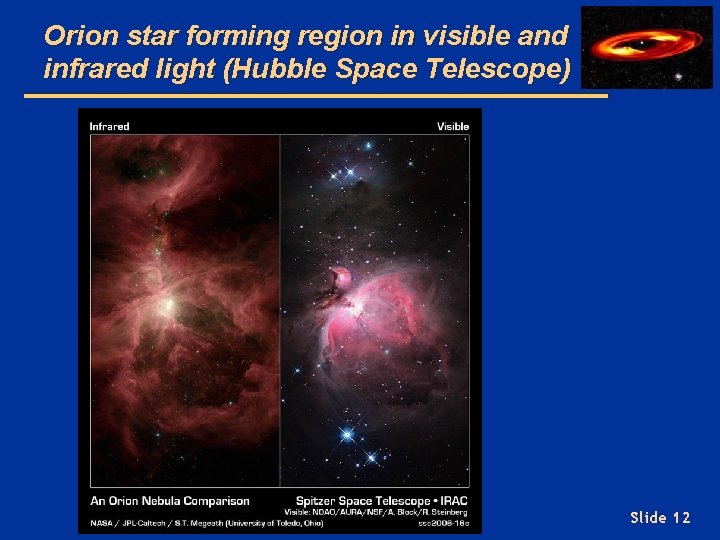
Orion star forming region in visible and infrared light (Hubble Space Telescope) Slide 12
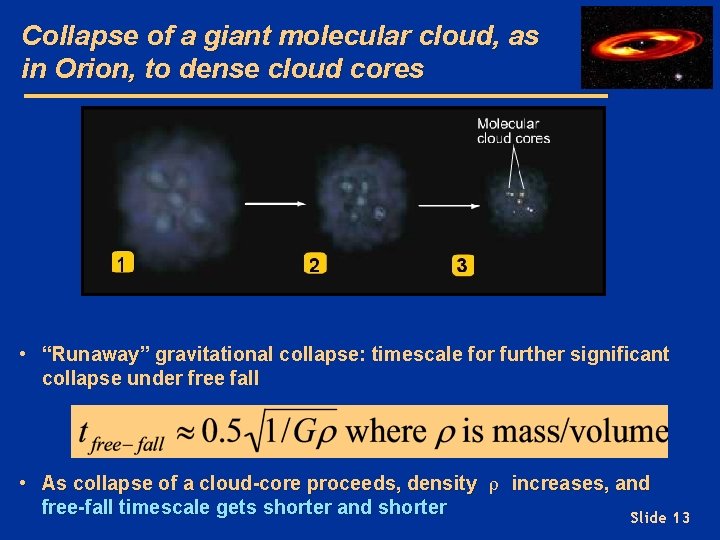
Collapse of a giant molecular cloud, as in Orion, to dense cloud cores • “Runaway” gravitational collapse: timescale for further significant collapse under free fall • As collapse of a cloud-core proceeds, density ρ increases, and free-fall timescale gets shorter and shorter Slide 13
Computer simulation: Collapse of a dense gas cloud to form star cluster • Credit: Matthew Bate, Univ. of Exeter, England • http: //www. astro. ex. ac. uk/people/mbate/Cluster/Animations/Cluste r. XT 1810 Z_H 264 B_s. mov Slide 14
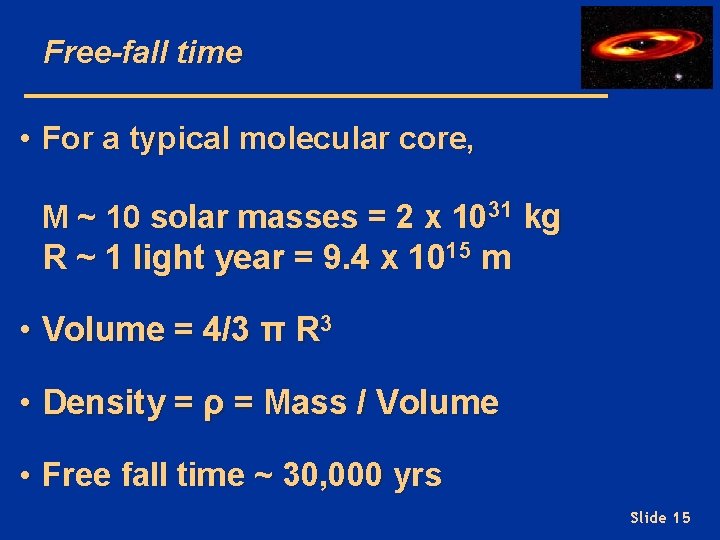
Free-fall time • For a typical molecular core, M ~ 10 solar masses = 2 x 1031 kg R ~ 1 light year = 9. 4 x 10¹⁵ m • Volume = 4/3 π R 3 • Density = ρ = Mass / Volume • Free fall time ~ 30, 000 yrs Slide 15
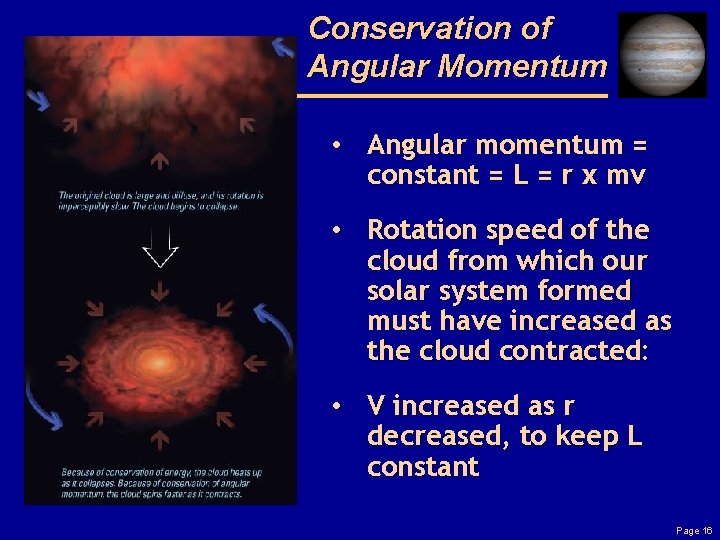
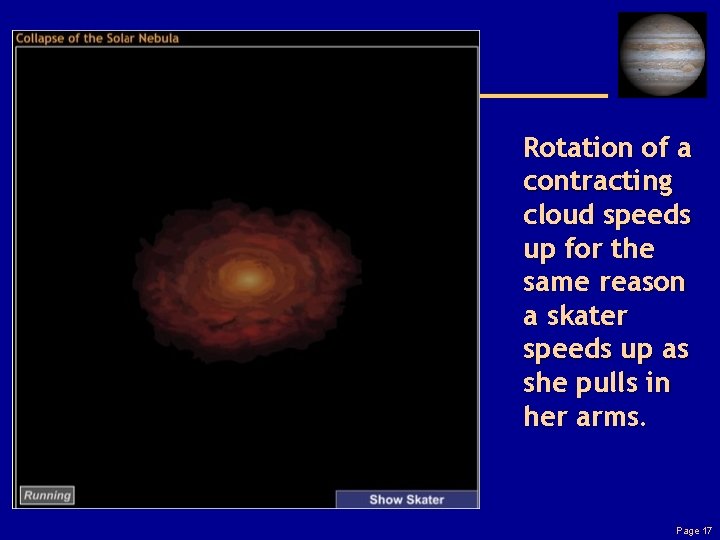
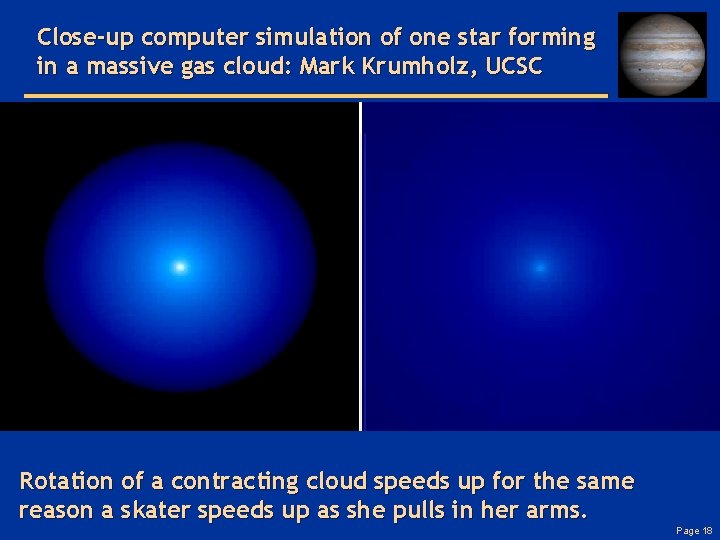
Conservation of Angular Momentum • Angular momentum = constant = L = r x mv • Rotation speed of the cloud from which our solar system formed must have increased as the cloud contracted: • V increased as r decreased, to keep L constant Page 16
Rotation of a contracting cloud speeds up for the same reason a skater speeds up as she pulls in her arms. Page 17
Close-up computer simulation of one star forming in a massive gas cloud: Mark Krumholz, UCSC Rotation of a contracting cloud speeds up for the same reason a skater speeds up as she pulls in her arms. Page 18
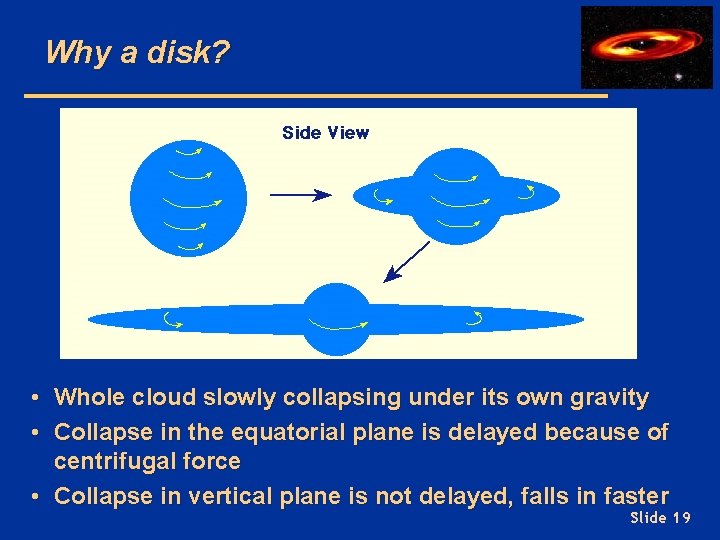
Why a disk? • Whole cloud slowly collapsing under its own gravity • Collapse in the equatorial plane is delayed because of centrifugal force • Collapse in vertical plane is not delayed, falls in faster Slide 19
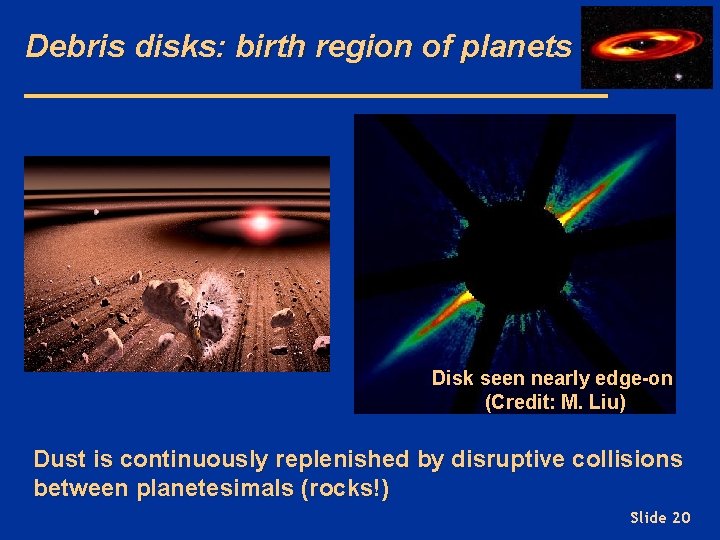
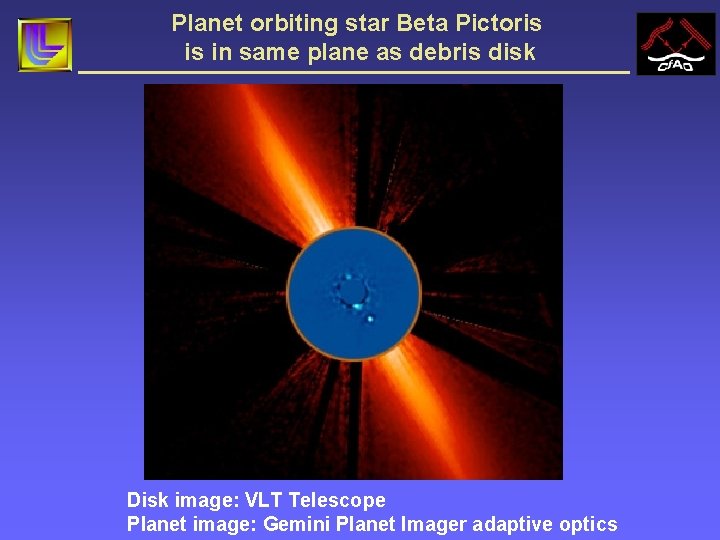
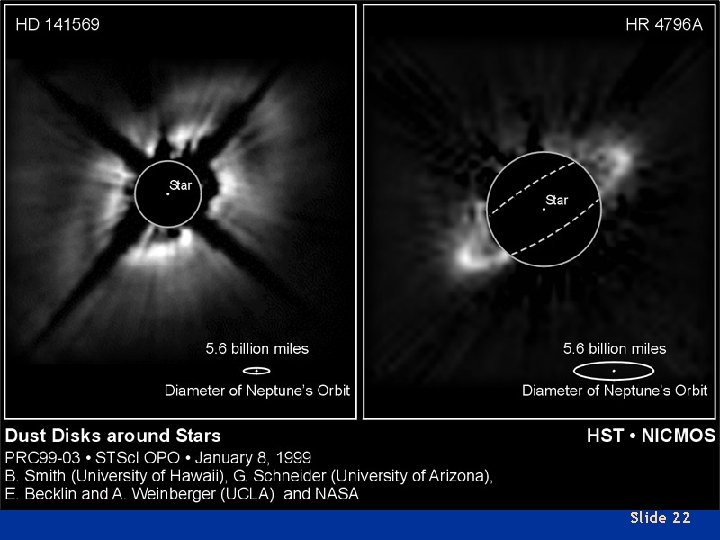
Debris disks: birth region of planets Disk seen nearly edge-on (Credit: M. Liu) Dust is continuously replenished by disruptive collisions between planetesimals (rocks!) Slide 20
Planet orbiting star Beta Pictoris is in same plane as debris disk Disk image: VLT Telescope Planet image: Gemini Planet Imager adaptive optics
Slide 22
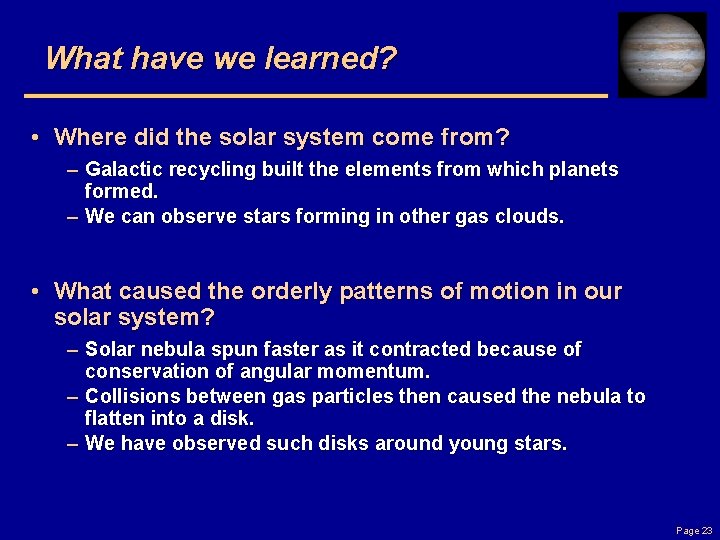
What have we learned? • Where did the solar system come from? – Galactic recycling built the elements from which planets formed. – We can observe stars forming in other gas clouds. • What caused the orderly patterns of motion in our solar system? – Solar nebula spun faster as it contracted because of conservation of angular momentum. – Collisions between gas particles then caused the nebula to flatten into a disk. – We have observed such disks around young stars. Page 23
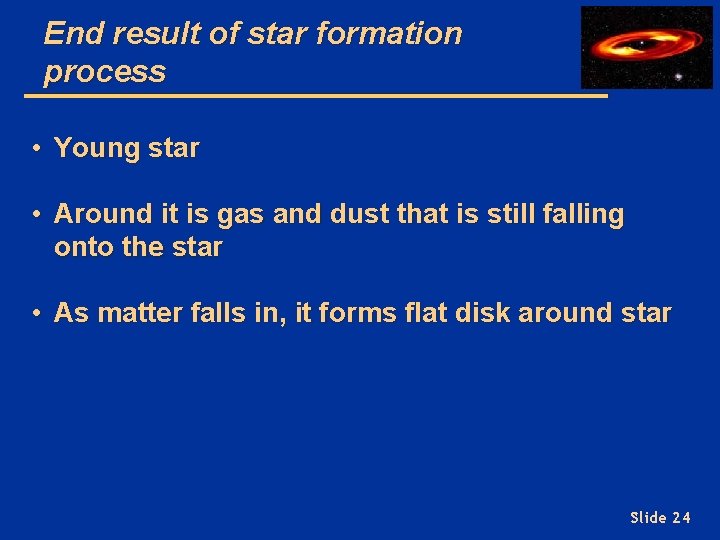
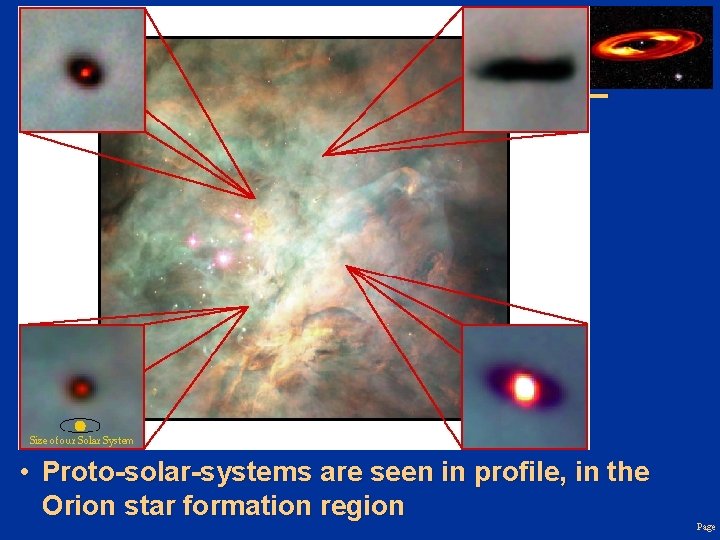
End result of star formation process • Young star • Around it is gas and dust that is still falling onto the star • As matter falls in, it forms flat disk around star Slide 24
• Proto-solar-systems are seen in profile, in the Orion star formation region Page
What Triggers a Collapse? • Consider the air in this room: temperature resists the effects of gravity. So too in interstellar space. • Need to cool or compress the gas. (How? ) Slide 26
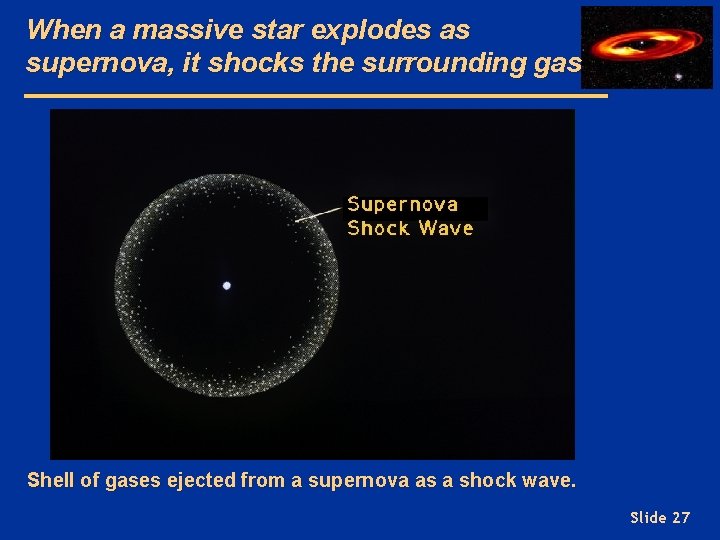
When a massive star explodes as supernova, it shocks the surrounding gas Shell of gases ejected from a supernova as a shock wave. Slide 27
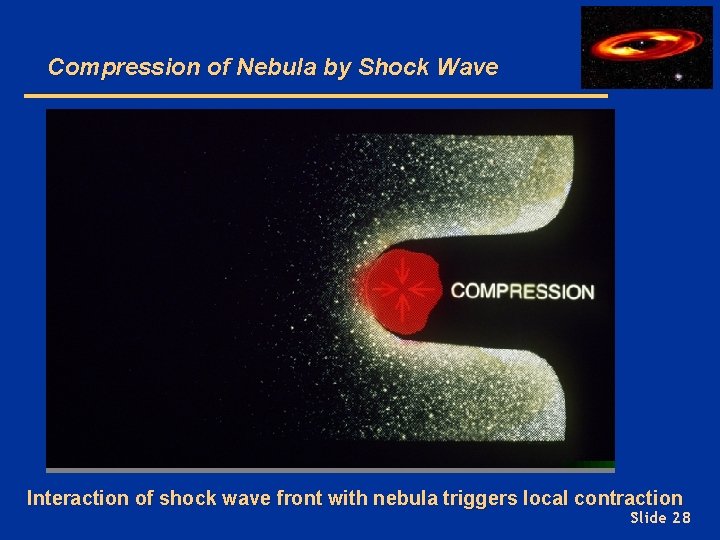
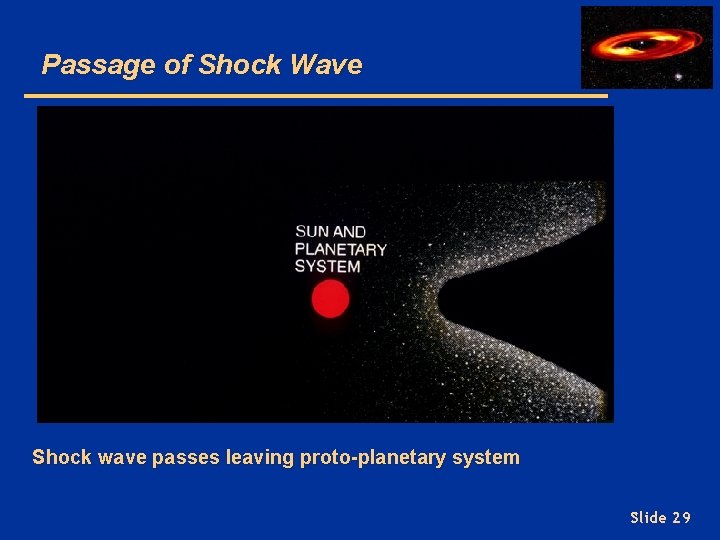
Compression of Nebula by Shock Wave Interaction of shock wave front with nebula triggers local contraction Slide 28
Passage of Shock Wave Shock wave passes leaving proto-planetary system Slide 29
Orderly Motions in the Solar System • The Sun formed in the center of the nebula. – temperature & density were high enough for nuclear fusion reactions to begin • The planets formed in the rest of the disk. • This would explain the following: – – – all planets lie along one plane (in the disk) all planets orbit in one direction (the spin direction of the disk) the Sun rotates in the same direction the planets would tend to rotate in this same direction most moons orbit in this direction most planetary orbits are near circular (collisions in the disk) Slide 30
Concept Question • The material that makes up the Sun was once part of – the Big Bang – another star – a molecular cloud – a protostar – all of the above Slide 31
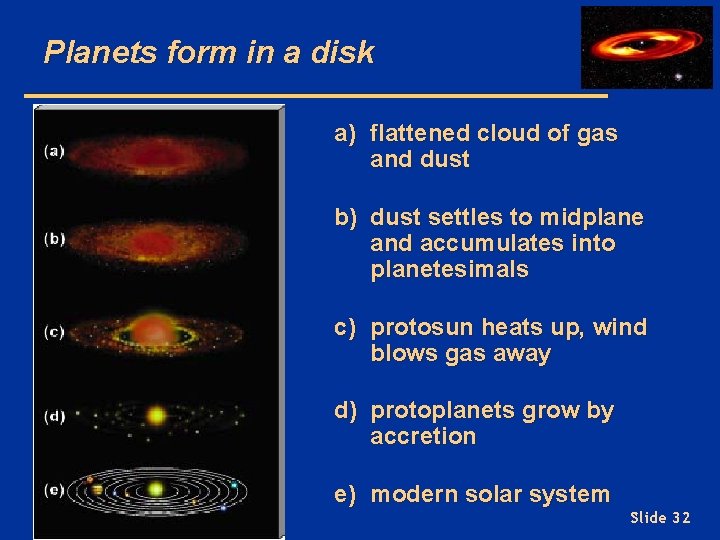
Planets form in a disk a) flattened cloud of gas and dust b) dust settles to midplane and accumulates into planetesimals c) protosun heats up, wind blows gas away d) protoplanets grow by accretion e) modern solar system Slide 32
Processes of planet formation • Condensation – Transition directly from gas (vapor) to solid phase – Example on Earth: formation of snowflakes • Solar Nebula slowly cooled down, so condensation could begin • Regions nearest Sun were warmer than those far away • Pattern of condensation was determined by local temperature Slide 33
Different formation histories for inner, outer planets • Inner Solar System: little gas left (too hot, blown away by solar wind? ) • Outer Solar System: rocky cores accrete gas, dust material from remaining gaseous disk – Jupiter as “mini solar system” with moons rings etc – All four gas giant planets have many moons, rings • Allows outer planets to build up to big masses Slide 34
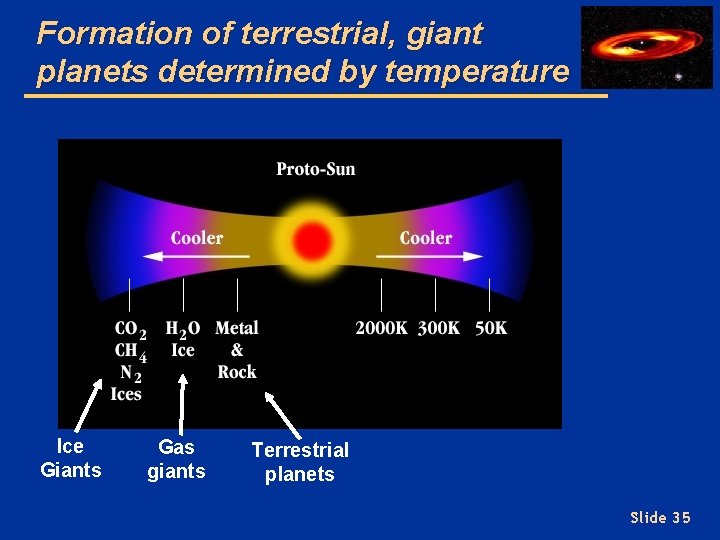
Formation of terrestrial, giant planets determined by temperature Ice Giants Gas giants Terrestrial planets Slide 35
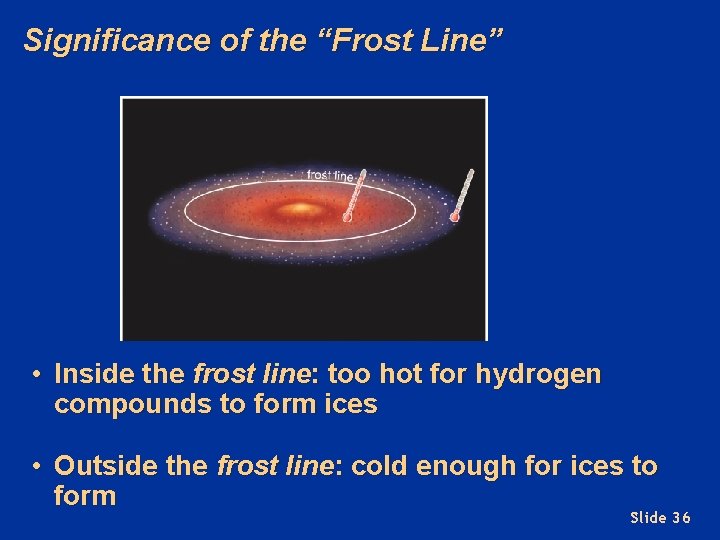
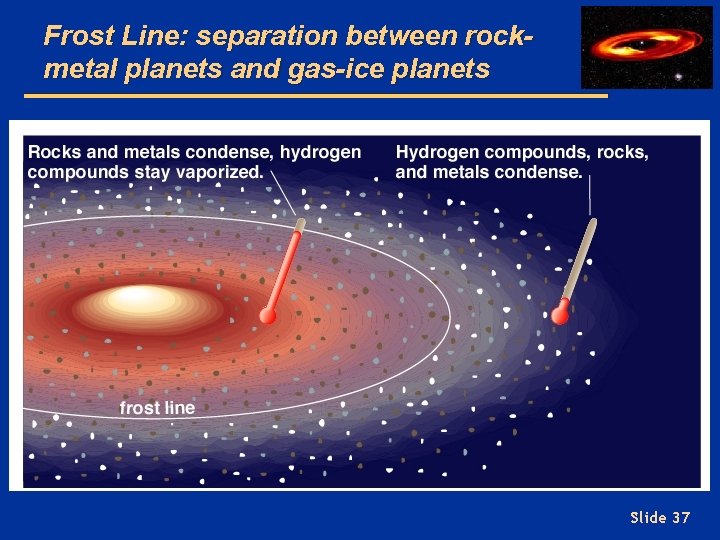
Significance of the “Frost Line” • Inside the frost line: too hot for hydrogen compounds to form ices • Outside the frost line: cold enough for ices to form Slide 36
Frost Line: separation between rockmetal planets and gas-ice planets Slide 37
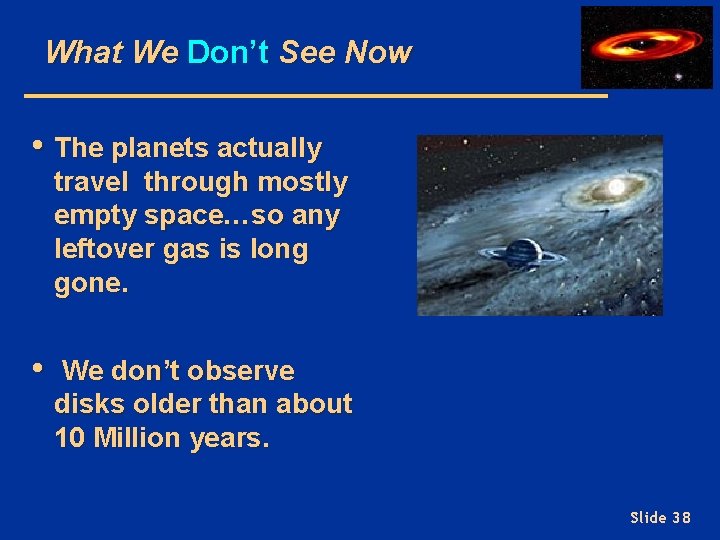
What We Don’t See Now • The planets actually travel through mostly empty space…so any leftover gas is long gone. • We don’t observe disks older than about 10 Million years. Slide 38
Evidence of Gas Sweeping • Other young stars (strong ‘stellar winds’) • Earth’s atmosphere -- which is in fact secondary. The original atmosphere was probably completely swept away! Slide 39
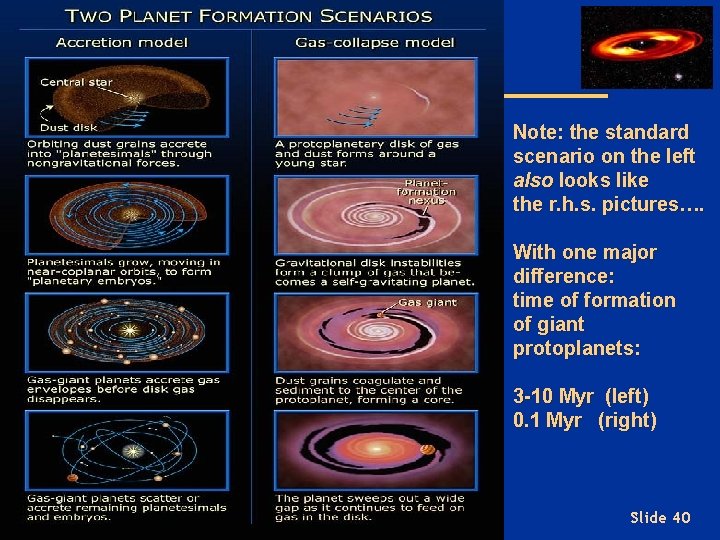
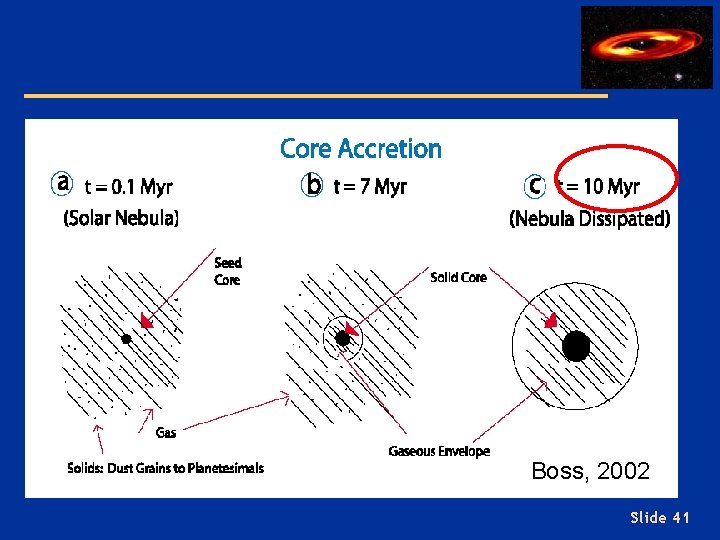
Note: the standard scenario on the left also looks like the r. h. s. pictures…. With one major difference: time of formation of giant protoplanets: 3 -10 Myr (left) 0. 1 Myr (right) Slide 40
Boss, 2002 Slide 41
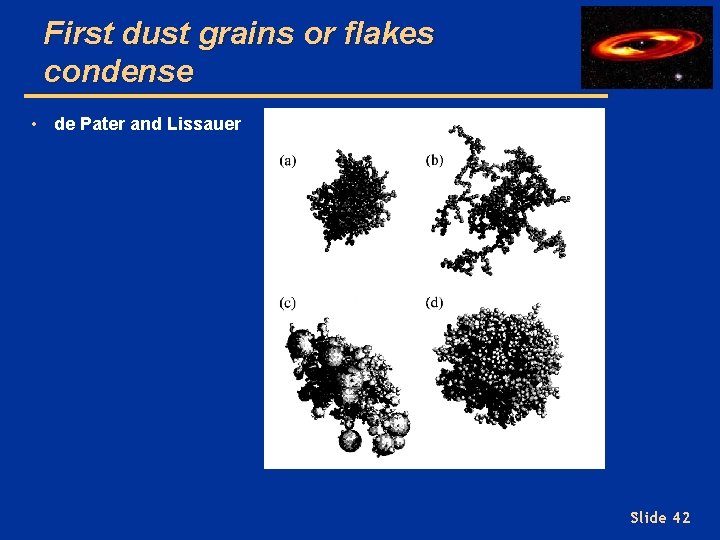
First dust grains or flakes condense • de Pater and Lissauer Slide 42
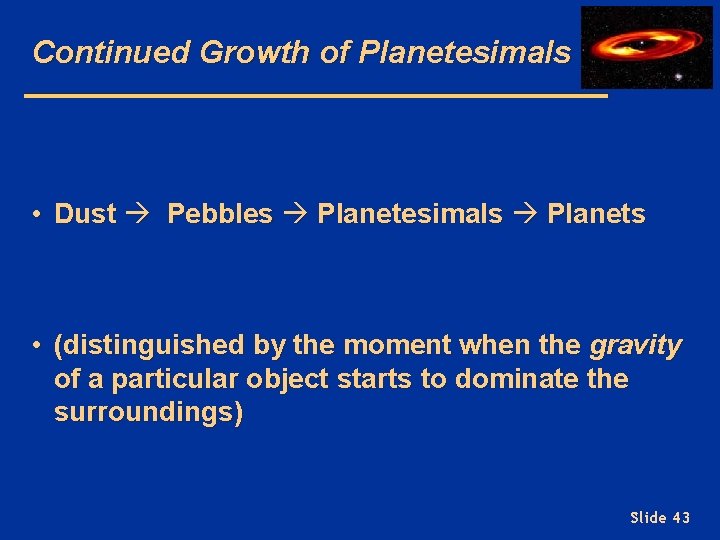
Continued Growth of Planetesimals • Dust Pebbles Planetesimals Planets • (distinguished by the moment when the gravity of a particular object starts to dominate the surroundings) Slide 43
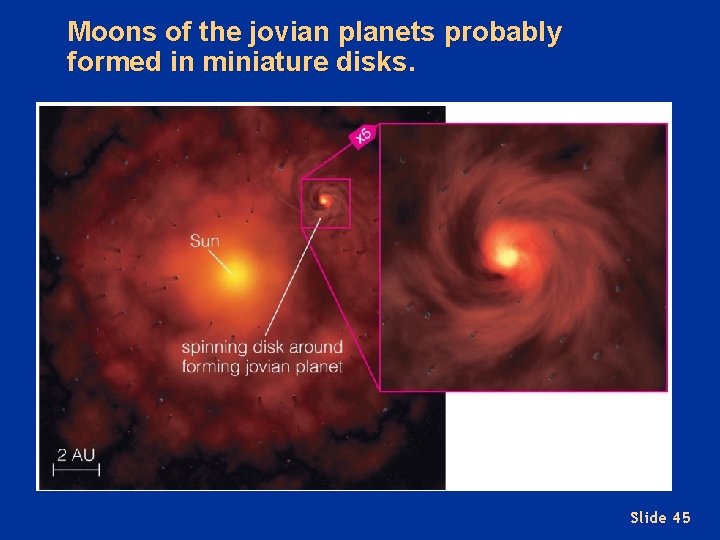
How did the jovian planets form? • Ice could also form small particles outside the frost line. • Larger planetesimals and planets were able to form. • Gravity of these larger planets was able to draw in surrounding H and He gases. Slide 44
Moons of the jovian planets probably formed in miniature disks. Slide 45
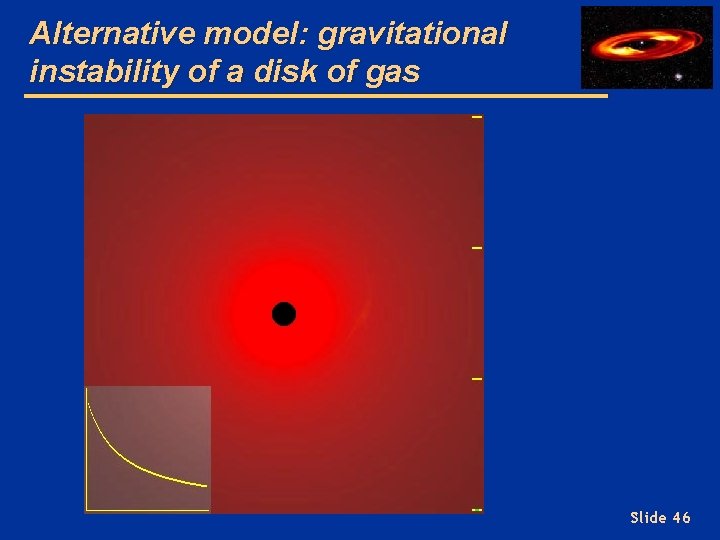
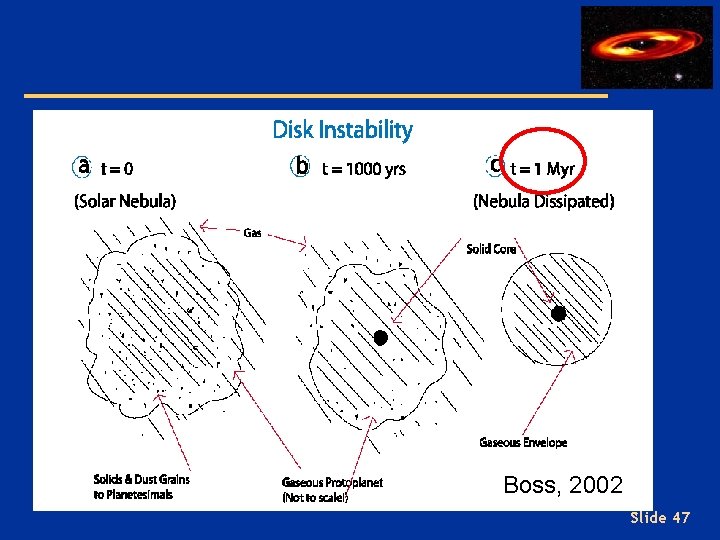
Alternative model: gravitational instability of a disk of gas Slide 46
Boss, 2002 Slide 47
Gravitational instability model: pros and cons • Pros: – Under some circumstances it may be natural to form gravitationally unstable disks – Happens very fast • Cons: – Much of the time the disk won’t be unstable – Doesn’t explain difference between earth-like planets, gas giants, ice giants • This hypothesis is considerably less mature than the agglomeration or core accretion models. • Hints that some extrasolar planetary systems may have been formed by disk instability Slide 48
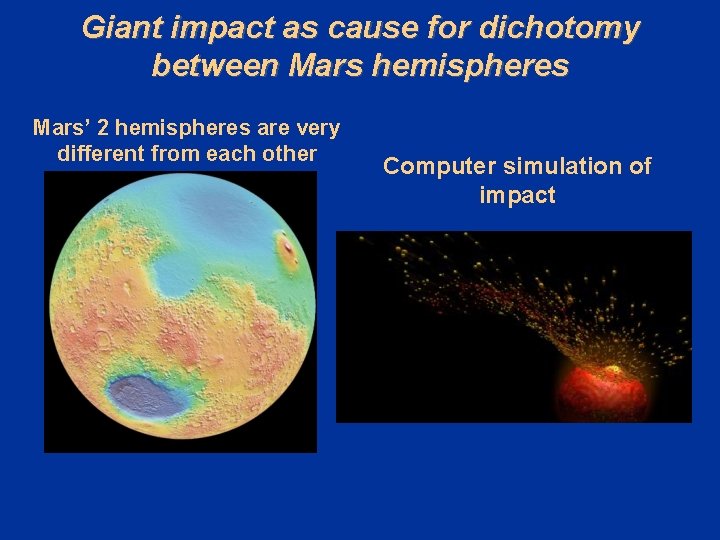
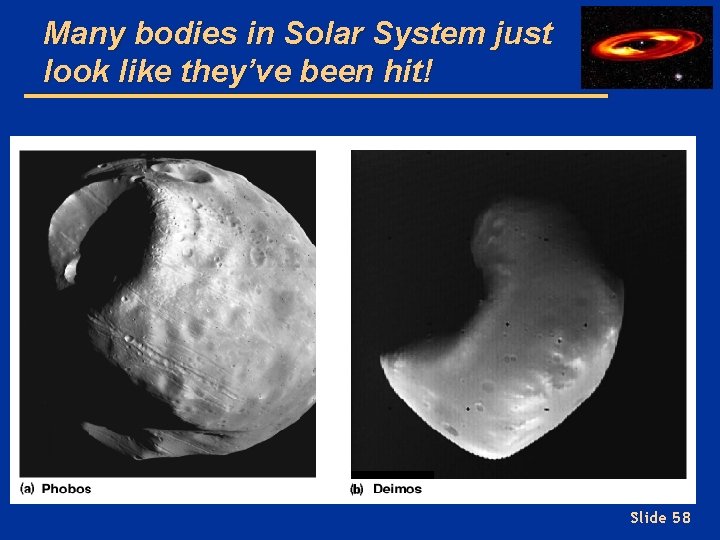
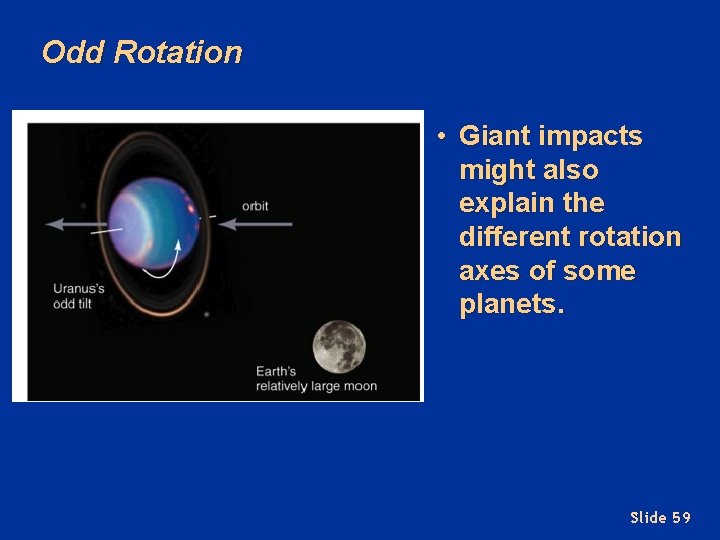
Dramatic impact events in the young Solar System • Evidence for intense early bombardment by rocky (and icy? ) bodies – Mercury lost most of its rocky mantle – Moon: made from collision with Earth that removed big chunk of Earth’s mantle – Odd rotation of Venus, orientation of Uranus – Evidence for a huge impact on Mars – Studies of craters on the terrestrial planets Slide 49
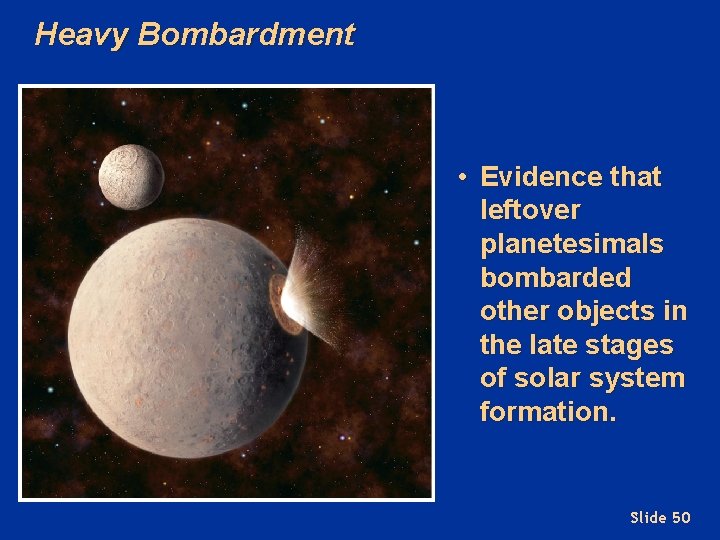
Heavy Bombardment • Evidence that leftover planetesimals bombarded other objects in the late stages of solar system formation. Slide 50
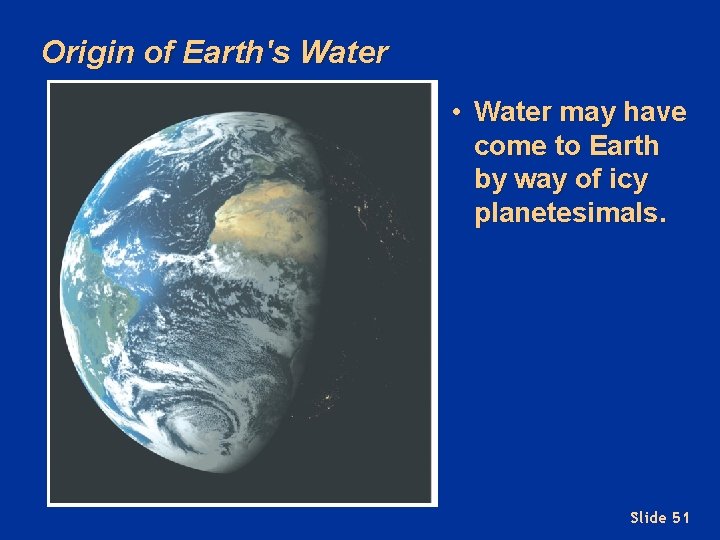
Origin of Earth's Water • Water may have come to Earth by way of icy planetesimals. Slide 51
Giant impact as cause for dichotomy between Mars hemispheres Mars’ 2 hemispheres are very different from each other Computer simulation of impact
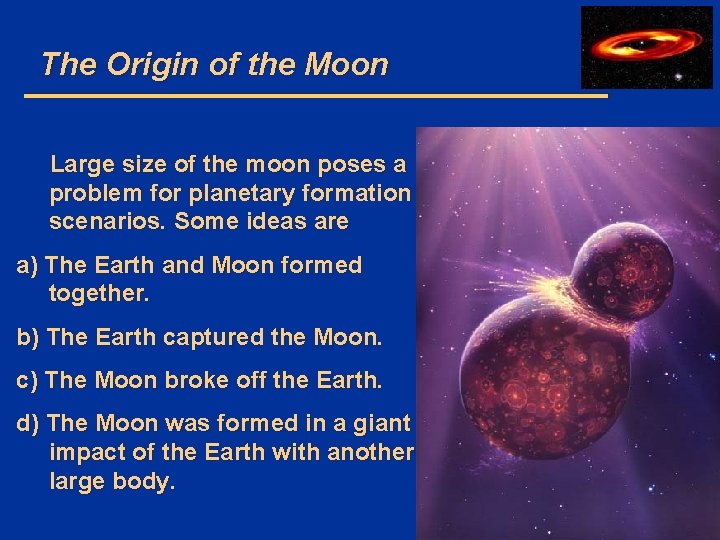
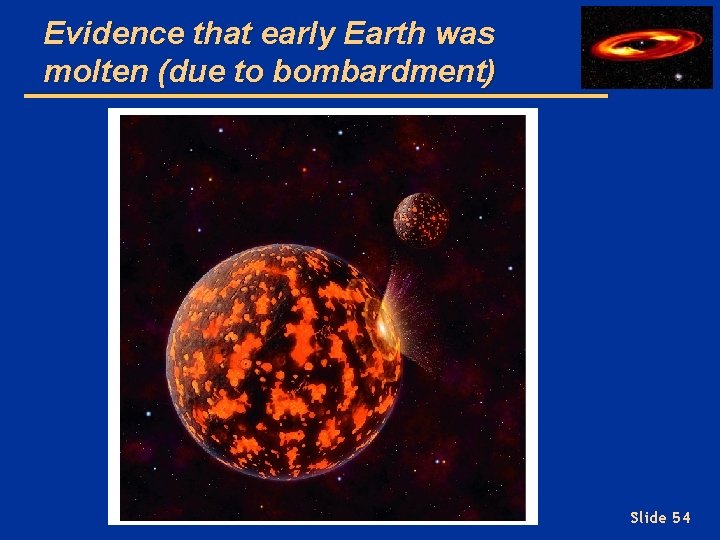
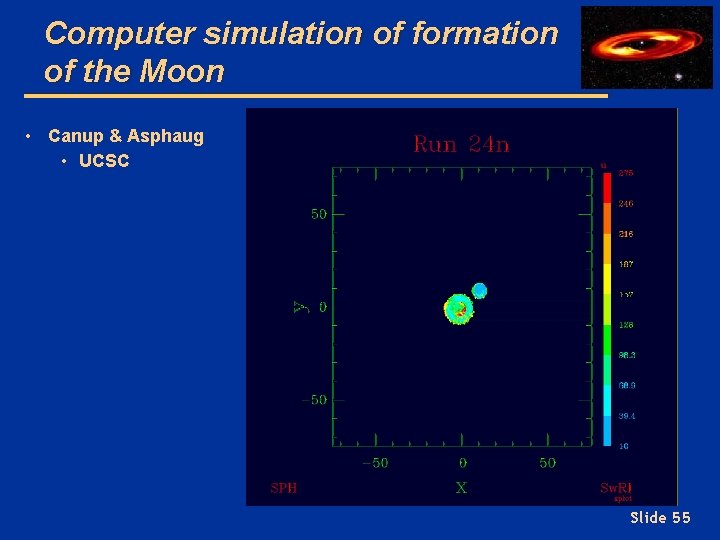
The Origin of the Moon Large size of the moon poses a problem for planetary formation scenarios. Some ideas are a) The Earth and Moon formed together. b) The Earth captured the Moon. c) The Moon broke off the Earth. d) The Moon was formed in a giant impact of the Earth with another large body. Slide 53 Page
Evidence that early Earth was molten (due to bombardment) Slide 54
Computer simulation of formation of the Moon • Canup & Asphaug • UCSC Slide 55
Artist’s conception of moon formation by giant impact • http: //www. history. com/shows/the-universe/videos/creation-of-the-moon Slide 56
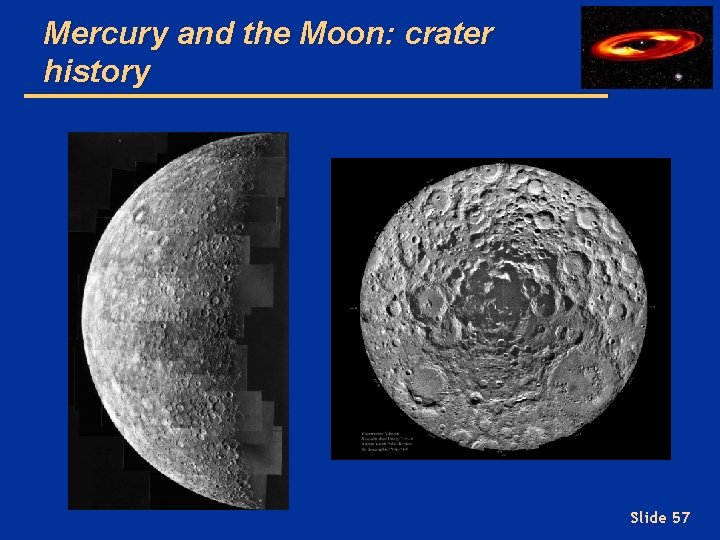
Mercury and the Moon: crater history Slide 57
Many bodies in Solar System just look like they’ve been hit! Slide 58
Odd Rotation • Giant impacts might also explain the different rotation axes of some planets. Slide 59
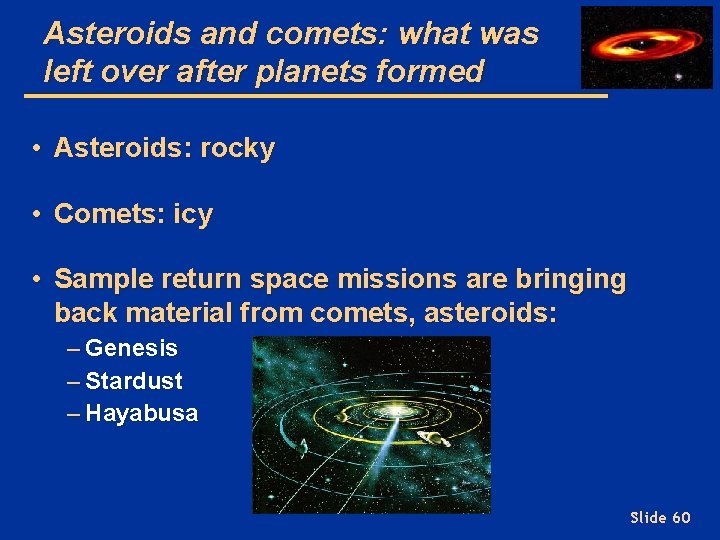
Asteroids and comets: what was left over after planets formed • Asteroids: rocky • Comets: icy • Sample return space missions are bringing back material from comets, asteroids: – Genesis – Stardust – Hayabusa Slide 60
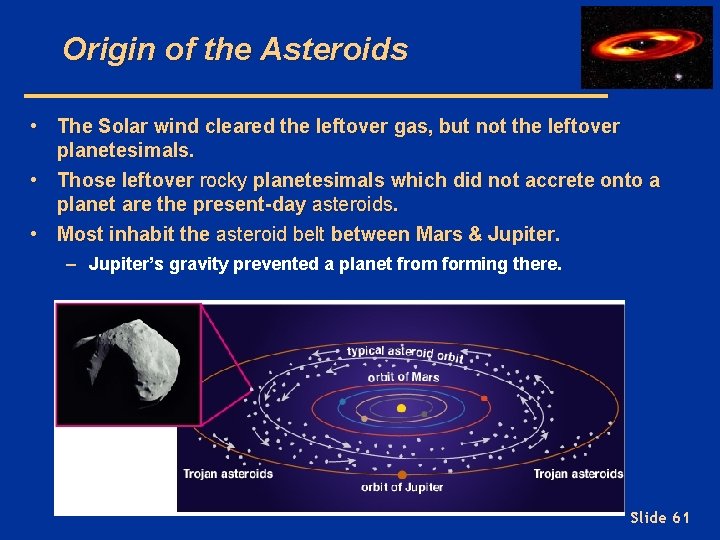
Origin of the Asteroids • The Solar wind cleared the leftover gas, but not the leftover planetesimals. • Those leftover rocky planetesimals which did not accrete onto a planet are the present-day asteroids. • Most inhabit the asteroid belt between Mars & Jupiter. – Jupiter’s gravity prevented a planet from forming there. Slide 61
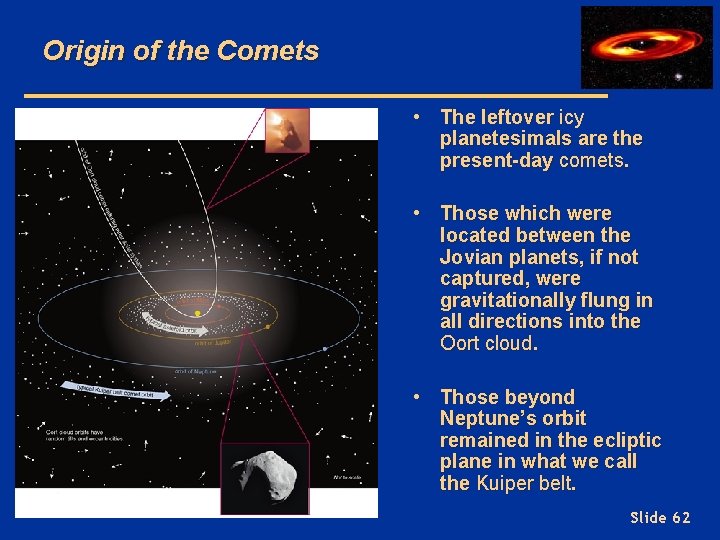
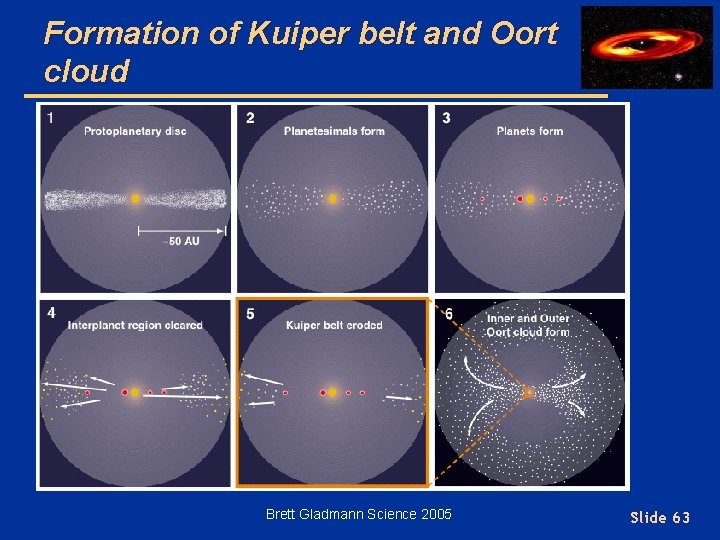
Origin of the Comets • The leftover icy planetesimals are the present-day comets. • Those which were located between the Jovian planets, if not captured, were gravitationally flung in all directions into the Oort cloud. • Those beyond Neptune’s orbit remained in the ecliptic plane in what we call the Kuiper belt. Slide 62
Formation of Kuiper belt and Oort cloud Brett Gladmann Science 2005 Slide 63
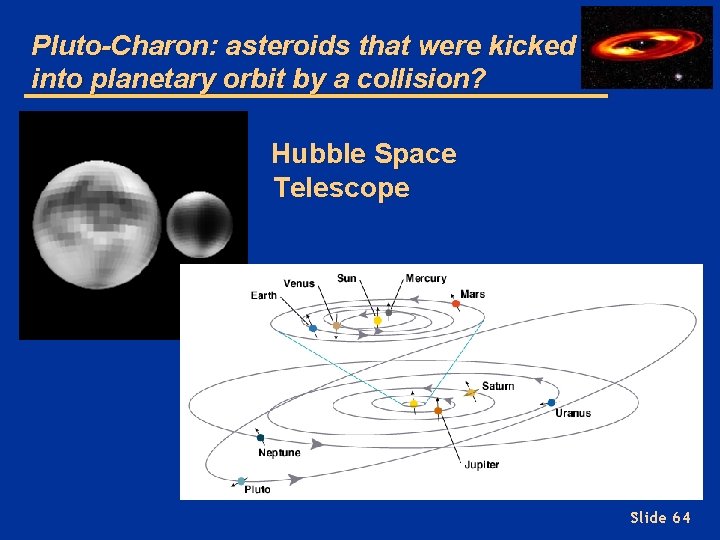
Pluto-Charon: asteroids that were kicked into planetary orbit by a collision? Hubble Space Telescope Slide 64
What have we learned? • What caused the orderly patterns of motion in our solar system? – Solar nebula spun faster as it contracted because of conservation of angular momentum. – Collisions between gas particles then caused the nebula to flatten into a disk. • Why are there two major types of planets? – Only rock and metals condensed inside the frost line. – Rock, metals, and ices condensed outside the frost line. – Larger planetesimals outside the frost line drew in H and He gas. Slide 65
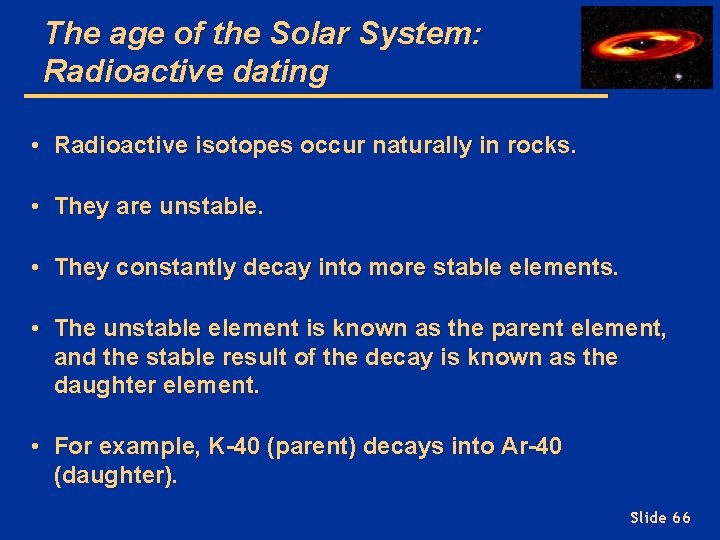
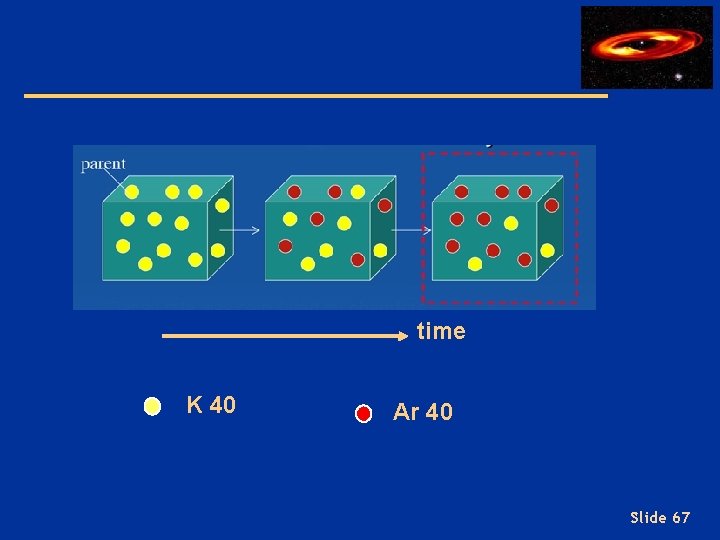
The age of the Solar System: Radioactive dating • Radioactive isotopes occur naturally in rocks. • They are unstable. • They constantly decay into more stable elements. • The unstable element is known as the parent element, and the stable result of the decay is known as the daughter element. • For example, K-40 (parent) decays into Ar-40 (daughter). Slide 66
time K 40 Ar 40 Slide 67
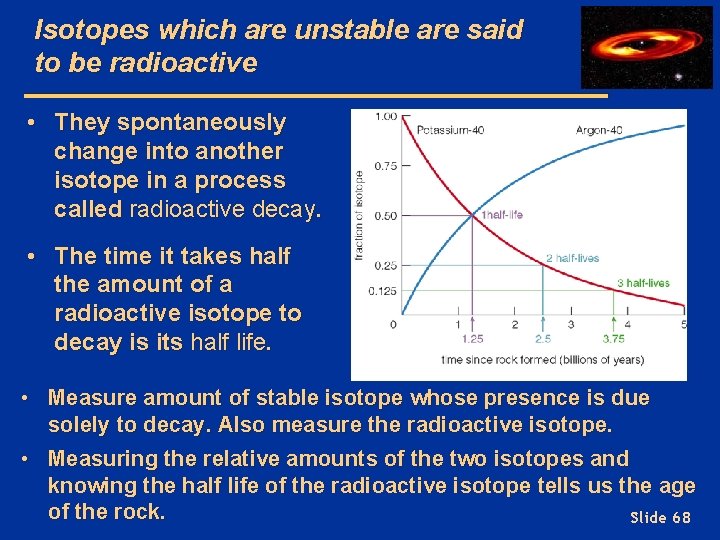
Isotopes which are unstable are said to be radioactive • They spontaneously change into another isotope in a process called radioactive decay. • The time it takes half the amount of a radioactive isotope to decay is its half life. • Measure amount of stable isotope whose presence is due solely to decay. Also measure the radioactive isotope. • Measuring the relative amounts of the two isotopes and knowing the half life of the radioactive isotope tells us the age of the rock. Slide 68
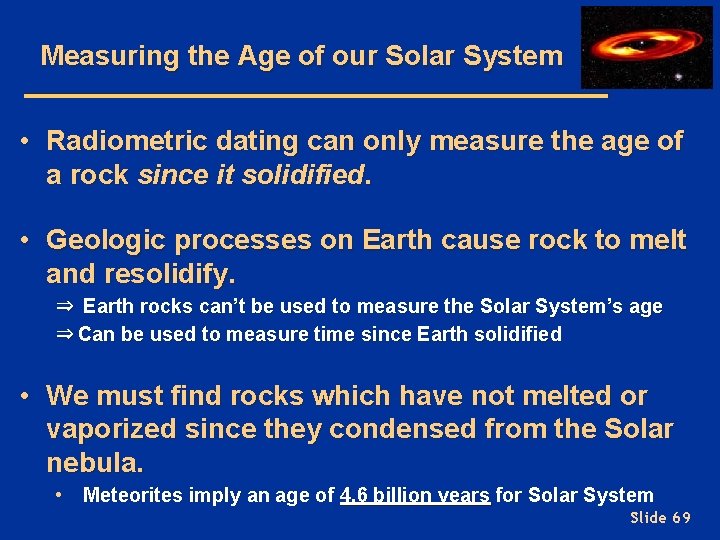
Measuring the Age of our Solar System • Radiometric dating can only measure the age of a rock since it solidified. • Geologic processes on Earth cause rock to melt and resolidify. ⇒ Earth rocks can’t be used to measure the Solar System’s age ⇒ Can be used to measure time since Earth solidified • We must find rocks which have not melted or vaporized since they condensed from the Solar nebula. • Meteorites imply an age of 4. 6 billion years for Solar System Slide 69
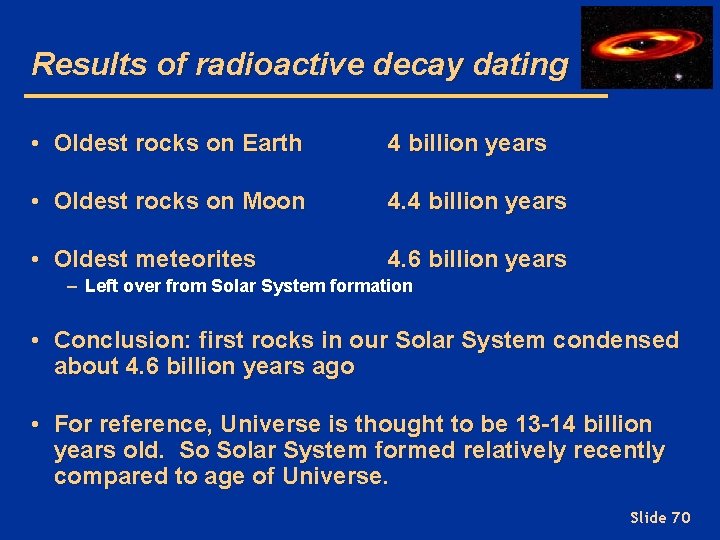
Results of radioactive decay dating • Oldest rocks on Earth 4 billion years • Oldest rocks on Moon 4. 4 billion years • Oldest meteorites 4. 6 billion years – Left over from Solar System formation • Conclusion: first rocks in our Solar System condensed about 4. 6 billion years ago • For reference, Universe is thought to be 13 -14 billion years old. So Solar System formed relatively recently compared to age of Universe. Slide 70
Review of Solar System formation, part 1 • A star forms when an interstellar gas cloud collapses under its own weight • The forming star is surrounded by a flat rotating disk - the raw material for planets • Dust grains in the disk stick together to form larger and larger solid objects • Temperature differences within the disk determine the kinds of materials from which solid objects form Slide 71
Review of Solar System formation, part 2 • Giant planets form when solid planet-sized bodies capture extra gas from the surrounding disk • Atmospheres of terrestrial planets are gases released by volcanoes and volatile materials that arrive onboard comets and impacts • Some other solar systems may have formed from large-scale disk instability rather than core accretion (as in our Solar System) Slide 72