
Lecture 7 Evolutionary Algorithms Vikas Ashok Department of
- Slides: 19
Lecture 7 Evolutionary Algorithms Vikas Ashok Department of Computer Science ODU Reading for Next Class: Chapter 3, Russell and Norvig Artificial Intelligence
Review • Last Class – Heuristic Search – Local Search • Hill-Climbing • This Class – Evolutionary Computing – Introduction to Genetic Algorithm • Next Class – More on Genetic Algorithm Artificial Intelligence
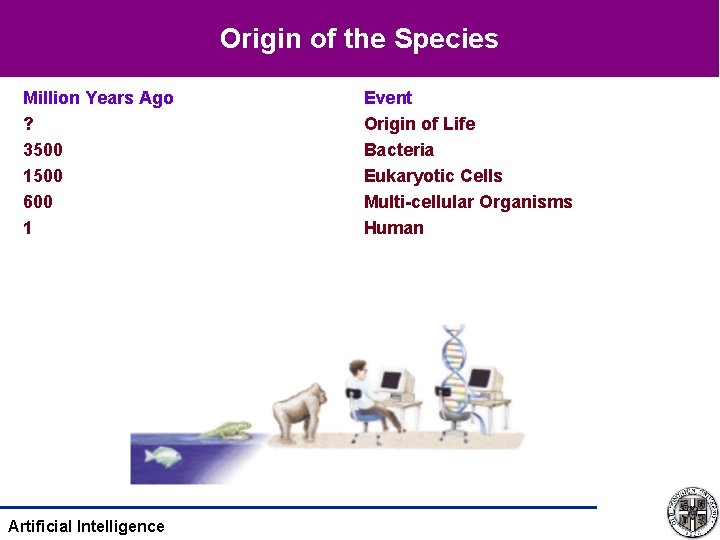
Origin of the Species Million Years Ago ? 3500 1500 600 1 Artificial Intelligence Event Origin of Life Bacteria Eukaryotic Cells Multi-cellular Organisms Human
Darwinian Evolution • Survival of the Fittest – All environments have finite resources • Can only support a limited number of individuals – Life forms have basic instinct/life cycles geared towards reproduction – Therefore some kind of selection is inevitable • Those individuals that compete for the resources most effectively have increased chance of reproduction Artificial Intelligence
Darwinian Evolution • Diversity Drives Change – Phenotypic traits • Behavior/physical differences that affect response to environment • Partly determined by inheritance, partly by factors during development • Unique to each individual, partly as a result of random changes – If phenotypic traits • Lead to a higher chances of reproduction • Can be inherited then they will tend to increase in subsequent generations – Leading to new combinations of traits… Artificial Intelligence
Darwinian Evolution: Summary • • Population consists of diverse set of individuals Combinations of traits that are better adapted tend to increase representation in population – Individuals are “units of selection” • Variations occur through random changes yielding constant source of diversity, coupled with selection means that: – Population is the “unit of evolution” • Note: the absence of “guiding force” Artificial Intelligence
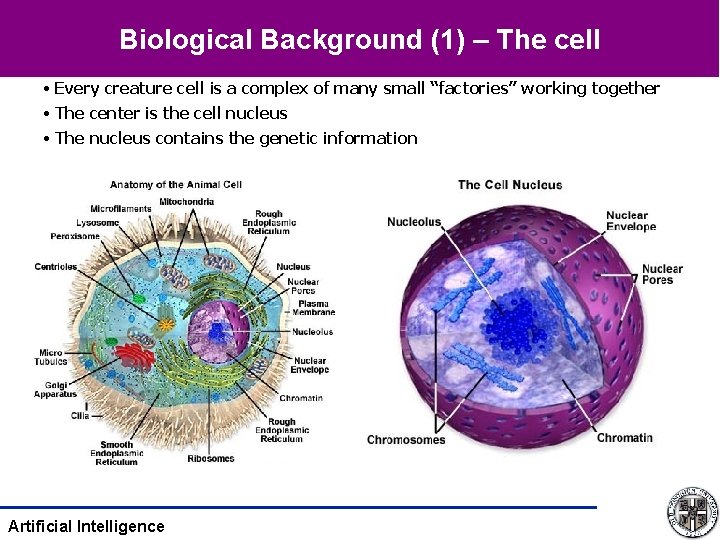
Biological Background (1) – The cell • Every creature cell is a complex of many small “factories” working together • The center is the cell nucleus • The nucleus contains the genetic information Artificial Intelligence
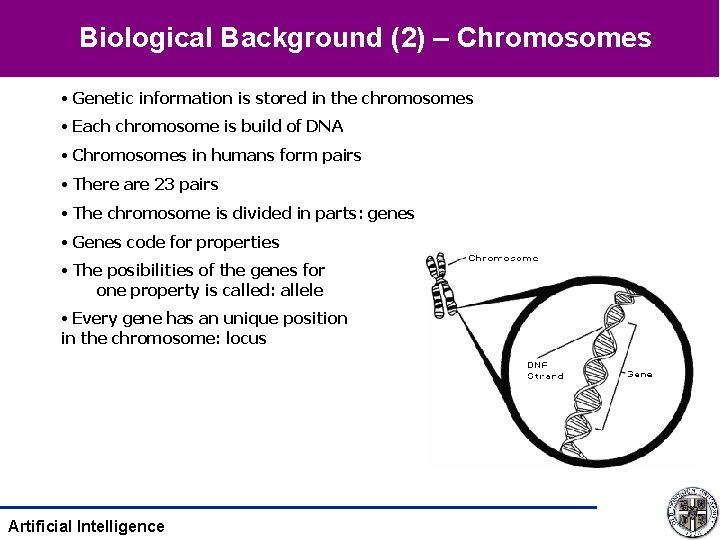
Biological Background (2) – Chromosomes • Genetic information is stored in the chromosomes • Each chromosome is build of DNA • Chromosomes in humans form pairs • There are 23 pairs • The chromosome is divided in parts: genes • Genes code for properties • The posibilities of the genes for one property is called: allele • Every gene has an unique position in the chromosome: locus Artificial Intelligence on
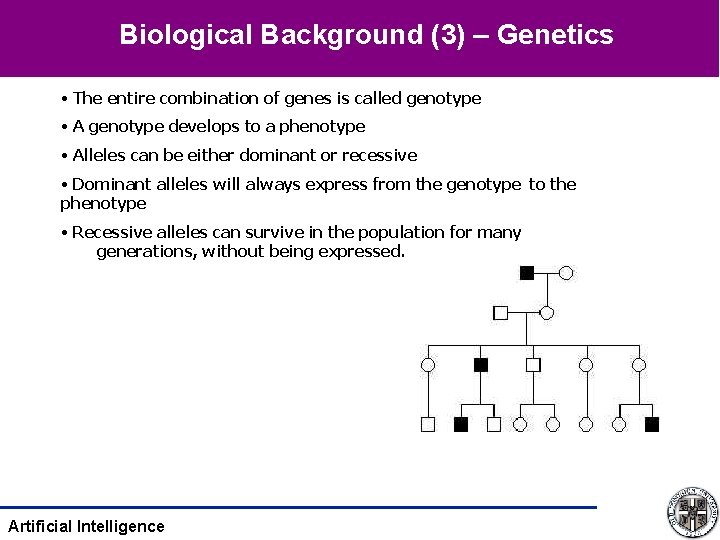
Biological Background (3) – Genetics • The entire combination of genes is called genotype • A genotype develops to a phenotype • Alleles can be either dominant or recessive • Dominant alleles will always express from the genotype to the phenotype • Recessive alleles can survive in the population for many generations, without being expressed. Artificial Intelligence
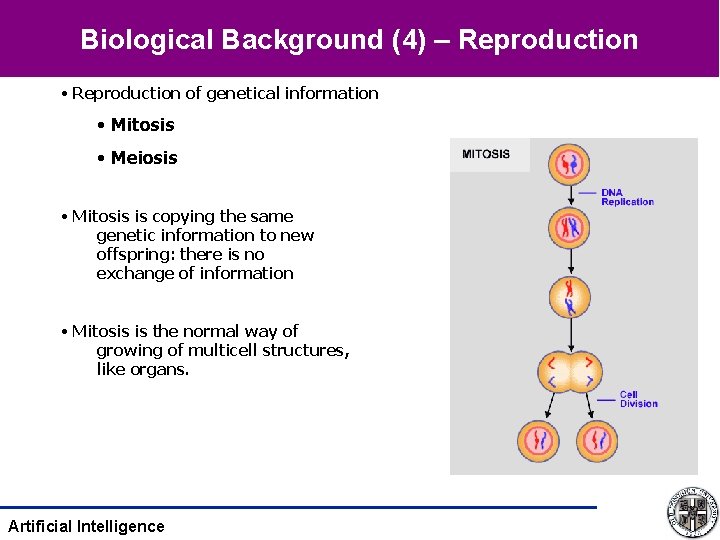
Biological Background (4) – Reproduction • Reproduction of genetical information • Mitosis • Meiosis • Mitosis is copying the same genetic information to new offspring: there is no exchange of information • Mitosis is the normal way of growing of multicell structures, like organs. Artificial Intelligence
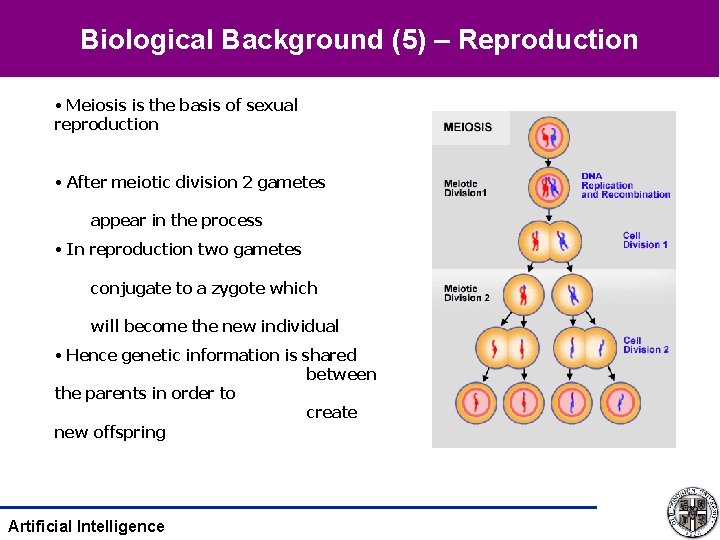
Biological Background (5) – Reproduction • Meiosis is the basis of sexual reproduction • After meiotic division 2 gametes appear in the process • In reproduction two gametes conjugate to a zygote which will become the new individual • Hence genetic information is shared between the parents in order to create new offspring Artificial Intelligence
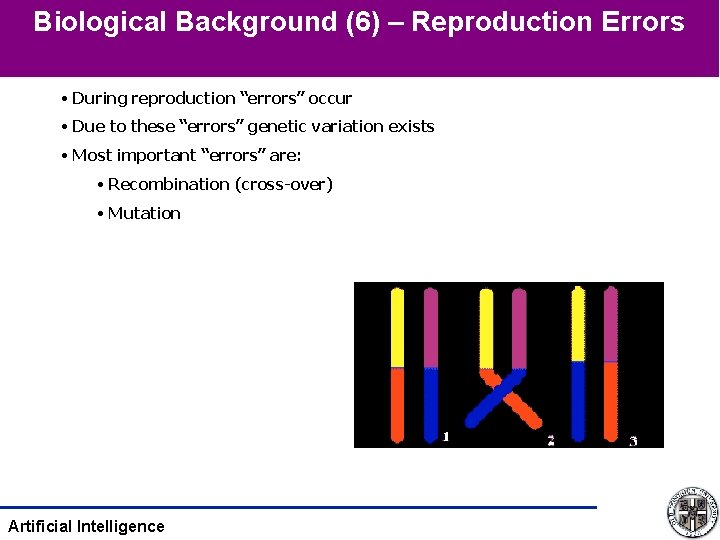
Biological Background (6) – Reproduction Errors • During reproduction “errors” occur • Due to these “errors” genetic variation exists • Most important “errors” are: • Recombination (cross-over) • Mutation Artificial Intelligence
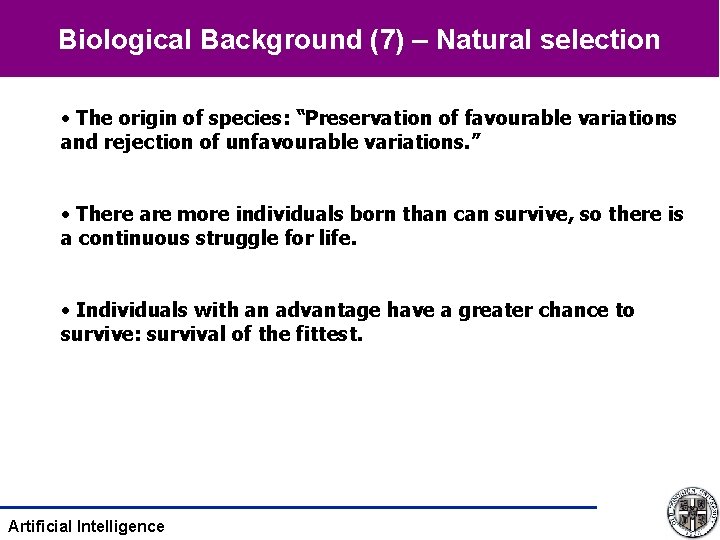
Biological Background (7) – Natural selection • The origin of species: “Preservation of favourable variations and rejection of unfavourable variations. ” • There are more individuals born than can survive, so there is a continuous struggle for life. • Individuals with an advantage have a greater chance to survive: survival of the fittest. Artificial Intelligence
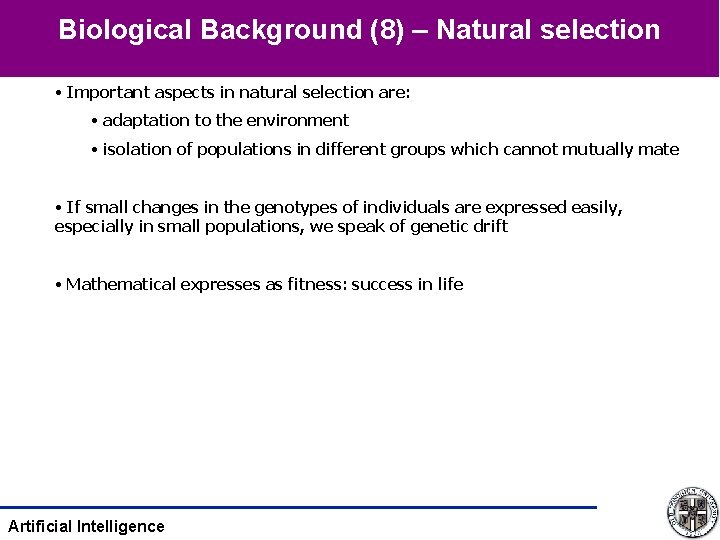
Biological Background (8) – Natural selection • Important aspects in natural selection are: • adaptation to the environment • isolation of populations in different groups which cannot mutually mate • If small changes in the genotypes of individuals are expressed easily, especially in small populations, we speak of genetic drift • Mathematical expresses as fitness: success in life Artificial Intelligence
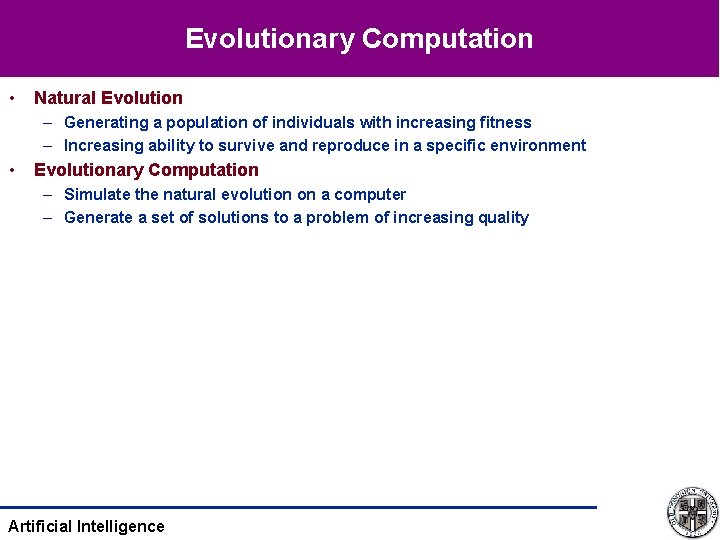
Evolutionary Computation • Natural Evolution – Generating a population of individuals with increasing fitness – Increasing ability to survive and reproduce in a specific environment • Evolutionary Computation – Simulate the natural evolution on a computer – Generate a set of solutions to a problem of increasing quality Artificial Intelligence
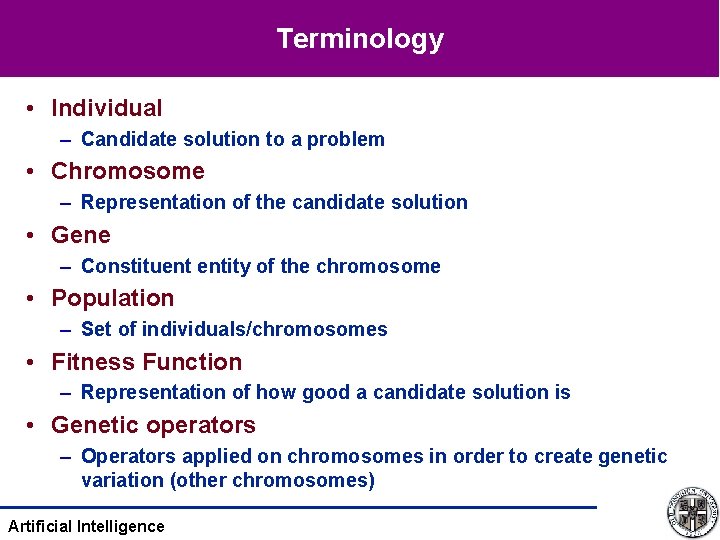
Terminology • Individual – Candidate solution to a problem • Chromosome – Representation of the candidate solution • Gene – Constituent entity of the chromosome • Population – Set of individuals/chromosomes • Fitness Function – Representation of how good a candidate solution is • Genetic operators – Operators applied on chromosomes in order to create genetic variation (other chromosomes) Artificial Intelligence
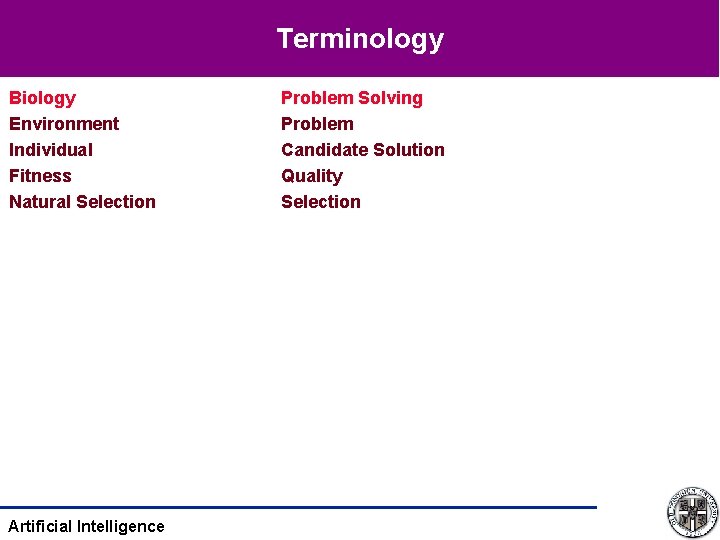
Terminology Biology Environment Individual Fitness Natural Selection Artificial Intelligence Problem Solving Problem Candidate Solution Quality Selection
Summary • • • Darwinian Evolution Biological Background Evolutionary Computation Artificial Intelligence
What I want you to do • • Review Chapter 3 Work on your assignment Artificial Intelligence