
Lecture 7 Data Structures in Assembly CS 105
Lecture 7: Data Structures in Assembly CS 105 February 13, 2019
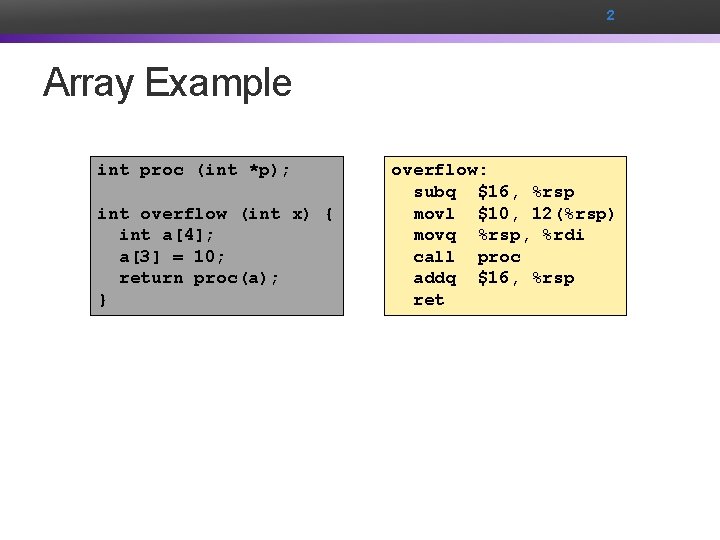
2 Array Example int proc (int *p); int overflow (int x) { int a[4]; a[3] = 10; return proc(a); } overflow: subq $16, %rsp movl $10, 12(%rsp) movq %rsp, %rdi call proc addq $16, %rsp ret
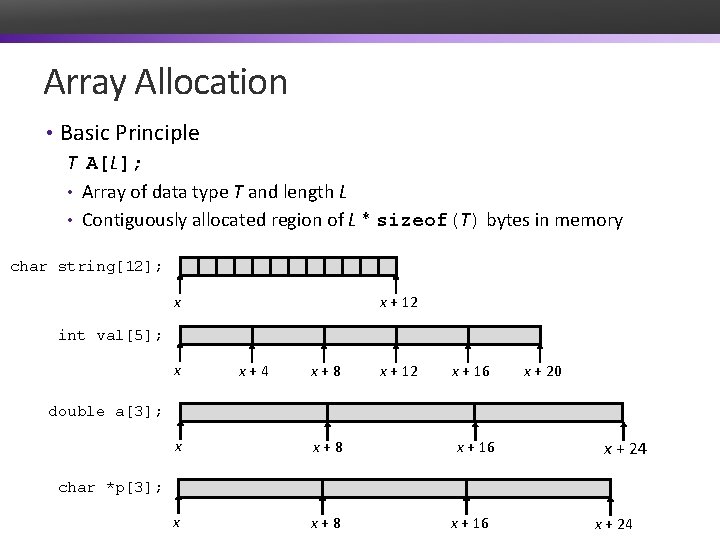
Array Allocation • Basic Principle T A[L]; • Array of data type T and length L • Contiguously allocated region of L * sizeof(T) bytes in memory char string[12]; x x + 12 int val[5]; x x + 4 x + 8 x + 12 x + 16 x + 20 double a[3]; x x + 8 x + 16 x + 24 char *p[3]; x + 16 x + 24
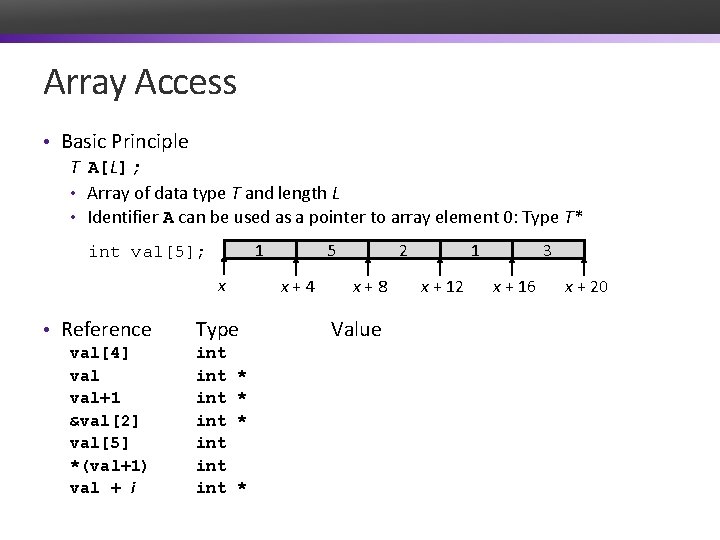
Array Access • Basic Principle T A[L]; • Array of data type T and length L • Identifier A can be used as a pointer to array element 0: Type T* 1 int val[5]; x • Reference val[4] val+1 &val[2] val[5] *(val+1) val + i 5 x + 4 2 x + 8 Type Value int * int int * 3 x x + 4 x + 8 ? ? 5 x + 4 i 1 x + 12 3 x + 16 x + 20
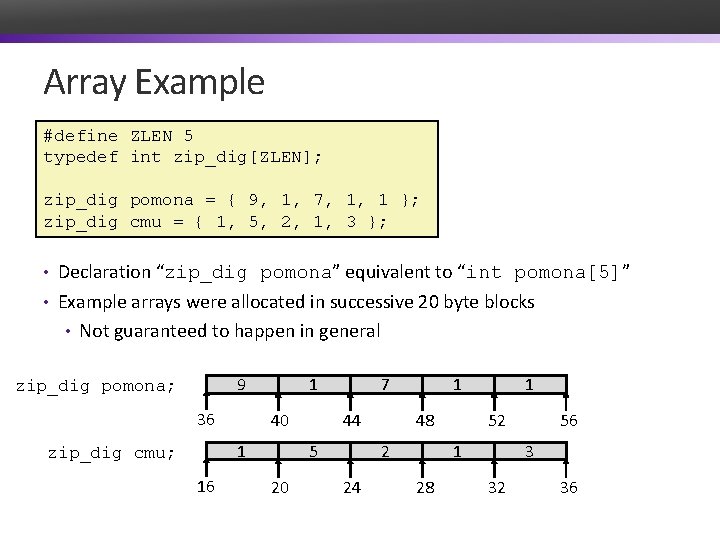
Array Example #define ZLEN 5 typedef int zip_dig[ZLEN]; zip_dig pomona = { 9, 1, 7, 1, 1 }; zip_dig cmu = { 1, 5, 2, 1, 3 }; • Declaration “zip_dig pomona” equivalent to “int pomona[5]” • Example arrays were allocated in successive 20 byte blocks • Not guaranteed to happen in general 9 zip_dig pomona; 36 1 40 1 zip_dig cmu; 16 7 44 5 20 1 48 2 24 1 52 1 28 56 3 32 36
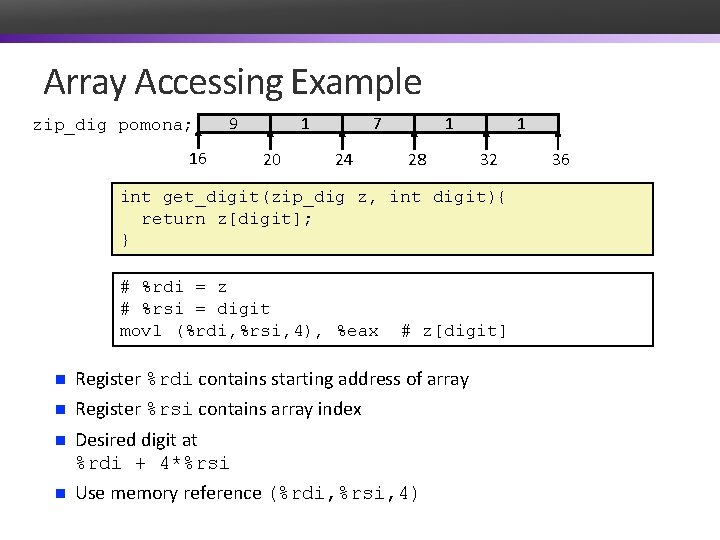
Array Accessing Example zip_dig pomona; 9 16 1 20 7 24 1 28 1 32 int get_digit(zip_dig z, int digit){ return z[digit]; } # %rdi = z # %rsi = digit movl (%rdi, %rsi, 4), %eax # z[digit] n n Register %rdi contains starting address of array Register %rsi contains array index n Desired digit at %rdi + 4*%rsi n Use memory reference (%rdi, %rsi, 4) 36
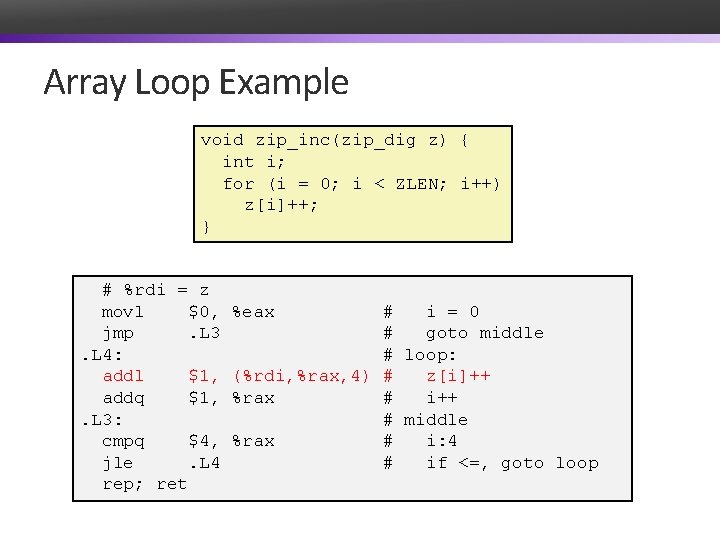
Array Loop Example void zip_inc(zip_dig z) { int i; for (i = 0; i < ZLEN; i++) z[i]++; } # %rdi = z movl $0, %eax # i = 0 jmp . L 3 # goto middle. L 4: # loop: addl $1, (%rdi, %rax, 4) # z[i]++ addq $1, %rax # i++. L 3: # middle cmpq $4, %rax # i: 4 jle . L 4 # if <=, goto loop rep; ret
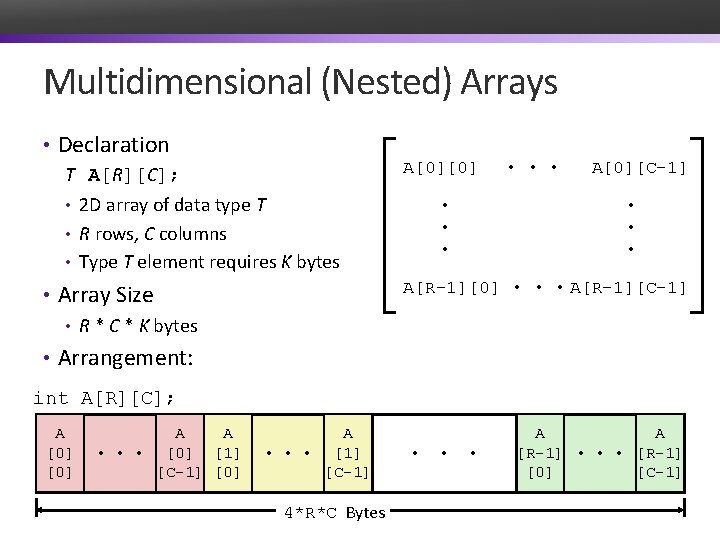
Multidimensional (Nested) Arrays • Declaration T A[R][C]; • 2 D array of data type T • R rows, C columns • Type T element requires K bytes A[0][0] • • • A[0][C-1] • • • A[R-1][0] • • • A[R-1][C-1] • Array Size • R * C * K bytes • Arrangement: int A[R][C]; A [0] A A • • • [0] [1] [C-1] [0] A • • • [1] [C-1] 4*R*C Bytes • • • A A [R-1] • • • [R-1] [0] [C-1]
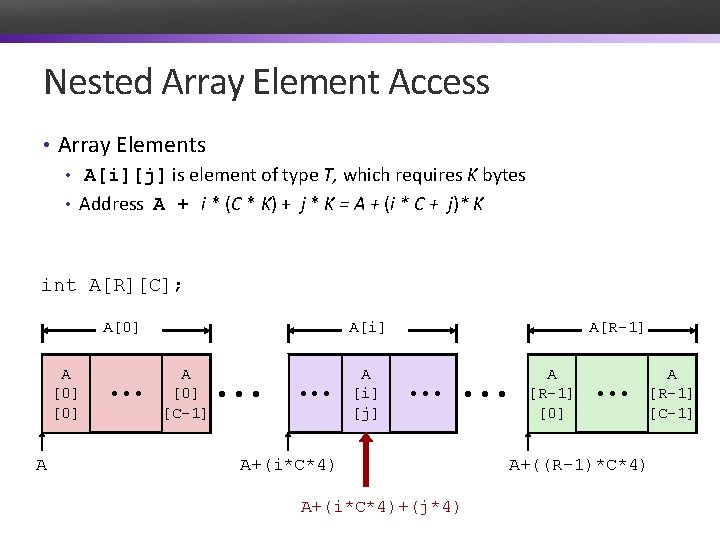
Nested Array Element Access • Array Elements • A[i][j] is element of type T, which requires K bytes • Address A + i * (C * K) + j * K = A + (i * C + j)* K int A[R][C]; A[0] A • • • A[i] A [0] • • • [C-1] A [i] • • [j] A+(i*C*4)+(j*4) A[R-1] • • • A [R-1] [0] • • • A [R-1] [C-1] A+((R-1)*C*4)
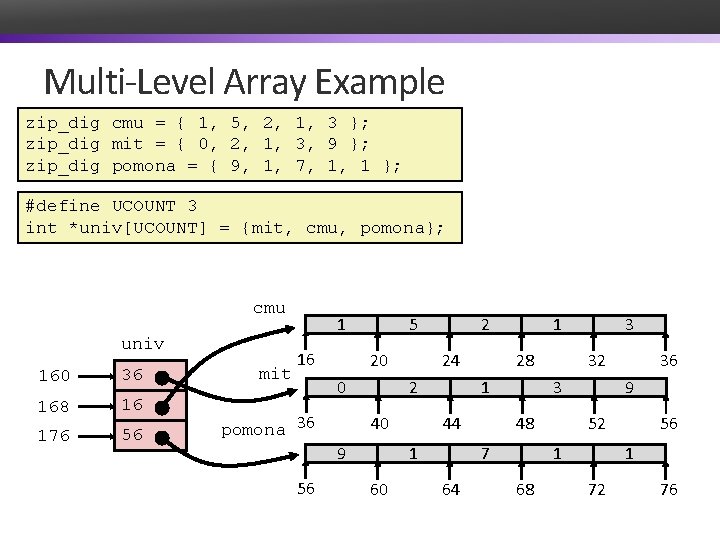
Multi-Level Array Example zip_dig cmu = { 1, 5, 2, 1, 3 }; • Variable univ denotes array of 3 elements zip_dig mit = { 0, 2, 1, 3, 9 }; zip_dig pomona = { 9, 1, 7, 1, 1 }; • Each element is a pointer • 8 bytes #define UCOUNT 3 int *univ[UCOUNT] = {mit, cmu, pomona}; • Each pointer points to array of int’s cmu univ 160 36 168 16 176 56 mit 1 16 5 20 0 pomona 36 24 2 40 9 56 2 28 1 44 1 60 1 32 3 48 7 64 3 9 52 1 68 36 56 1 72 76
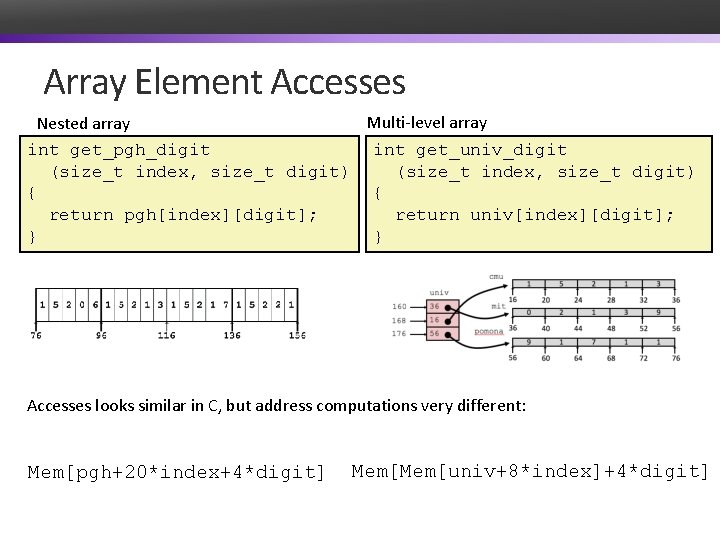
Array Element Accesses Multi-level array Nested array int get_pgh_digit int get_univ_digit (size_t index, size_t digit) { { return pgh[index][digit]; return univ[index][digit]; } } Accesses looks similar in C, but address computations very different: Mem[pgh+20*index+4*digit] Mem[univ+8*index]+4*digit]
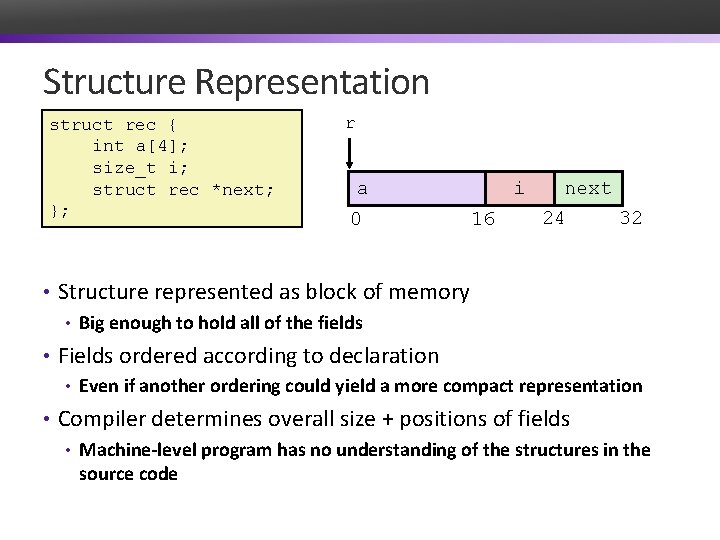
Structure Representation struct rec { int a[4]; size_t i; struct rec *next; }; r a 0 i 16 next 24 32 • Structure represented as block of memory • Big enough to hold all of the fields • Fields ordered according to declaration • Even if another ordering could yield a more compact representation • Compiler determines overall size + positions of fields • Machine-level program has no understanding of the structures in the source code
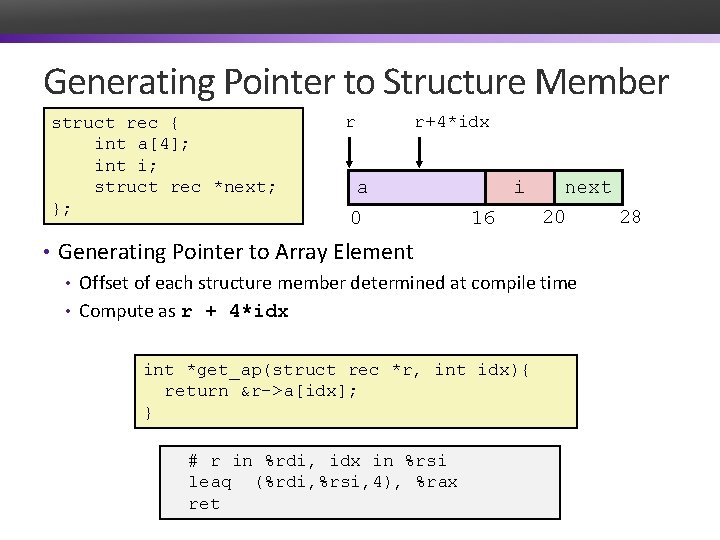
Generating Pointer to Structure Member struct rec { int a[4]; int i; struct rec *next; }; r r+4*idx a 0 i 16 next 20 28 • Generating Pointer to Array Element • Offset of each structure member determined at compile time • Compute as r + 4*idx int *get_ap(struct rec *r, int idx){ return &r->a[idx]; } # r in %rdi, idx in %rsi leaq (%rdi, %rsi, 4), %rax ret
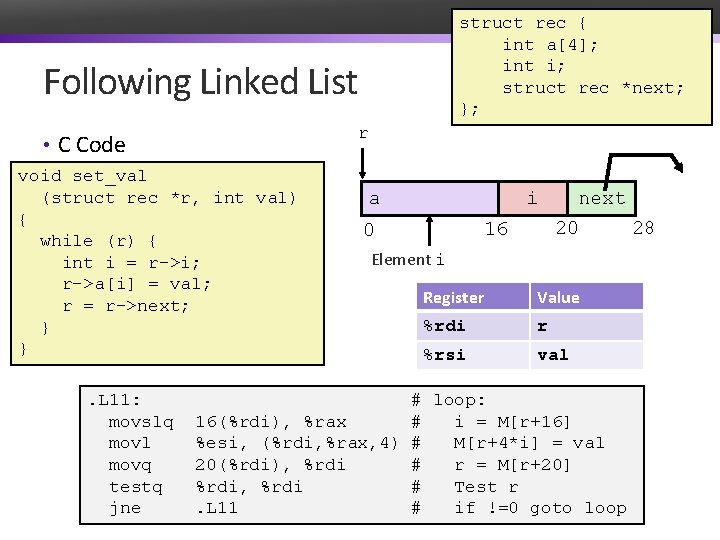
struct rec { int a[4]; int i; struct rec *next; }; Following Linked List • C Code void set_val (struct rec *r, int val) { while (r) { int i = r->i; r->a[i] = val; r = r->next; } } r a i 16 0 next 20 28 Element i Register Value %rdi r %rsi val . L 11: # loop: movslq 16(%rdi), %rax # i = M[r+16] movl %esi, (%rdi, %rax, 4) # M[r+4*i] = val movq 20(%rdi), %rdi # r = M[r+20] testq %rdi, %rdi # Test r jne . L 11 # if !=0 goto loop
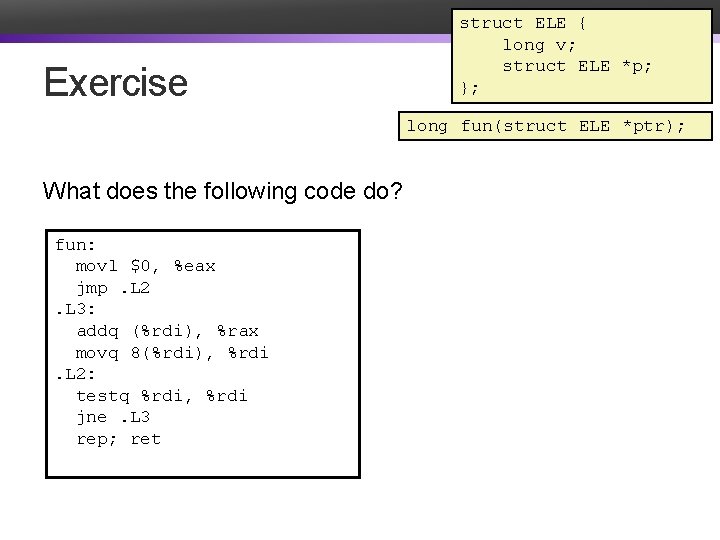
Exercise struct ELE { long v; struct ELE *p; }; long fun(struct ELE *ptr); What does the following code do? fun: movl $0, %eax jmp. L 2. L 3: addq (%rdi), %rax movq 8(%rdi), %rdi. L 2: testq %rdi, %rdi jne. L 3 rep; ret
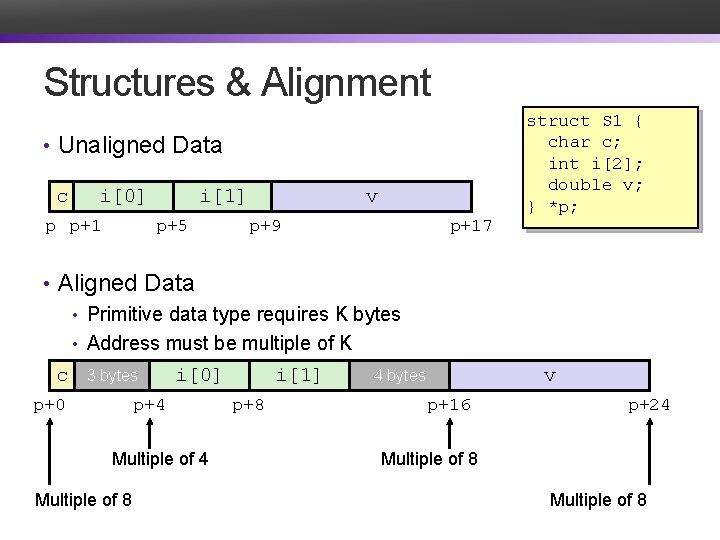
Structures & Alignment • Unaligned Data c i[0] p p+1 i[1] p+5 v p+9 p+17 • Aligned Data • Primitive data type requires K bytes • Address must be multiple of K c 3 bytes i[0] i[1] 4 bytes p+0 p+4 Multiple of 8 p+8 struct S 1 { char c; int i[2]; double v; } *p; v p+16 p+24 Multiple of 8
Alignment Principles • Aligned Data • Primitive data type requires K bytes • Address must be multiple of K • Required on some machines; advised on x 86 -64 • Motivation for Aligning Data • Memory accessed by (aligned) chunks of 4 or 8 bytes (system dependent) • Inefficient to load or store datum that spans quad word boundaries • Virtual memory trickier when datum spans 2 pages • Compiler • Inserts gaps in structure to ensure correct alignment of fields
Specific Cases of Alignment (x 86 -64) • 1 byte: char, … • no restrictions on address • 2 bytes: short, … • lowest 1 bit of address must be 02 • 4 bytes: int, float, … • lowest 2 bits of address must be 002 • 8 bytes: double, long, char *, … • lowest 3 bits of address must be 0002 • 16 bytes: long double (GCC on Linux) • lowest 4 bits of address must be 00002
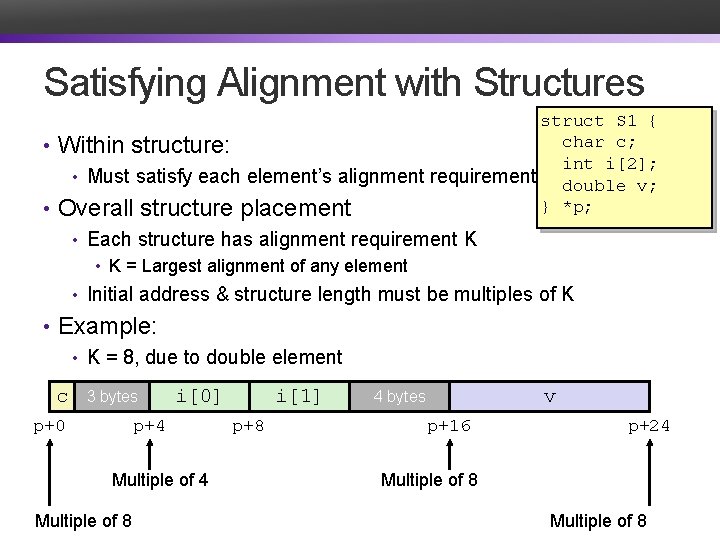
Satisfying Alignment with Structures struct S 1 { char c; • Within structure: int i[2]; • Must satisfy each element’s alignment requirement double v; } *p; • Overall structure placement • Each structure has alignment requirement K • K = Largest alignment of any element • Initial address & structure length must be multiples of K • Example: • K = 8, due to double element c 3 bytes p+0 i[0] p+4 Multiple of 8 i[1] p+8 v 4 bytes p+16 p+24 Multiple of 8
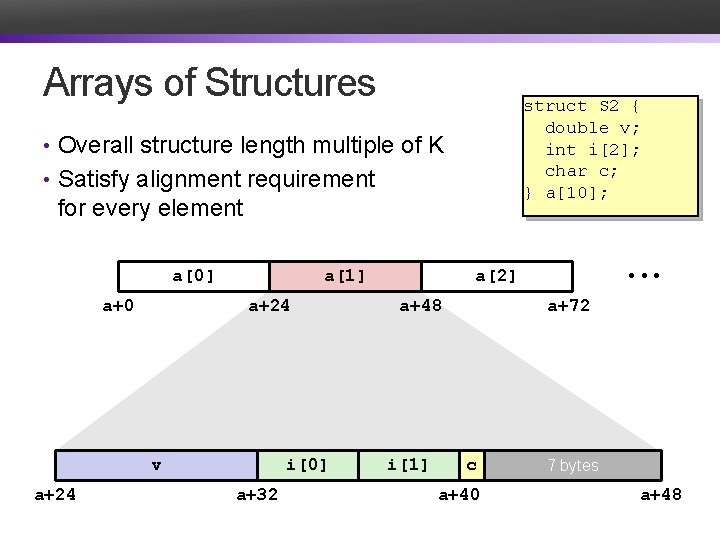
Arrays of Structures struct S 2 { double v; int i[2]; char c; } a[10]; • Overall structure length multiple of K • Satisfy alignment requirement for every element a[0] a+0 a[1] a+24 v a+24 i[0] a+32 • • • a[2] a+48 i[1] a+72 c a+40 7 bytes a+48
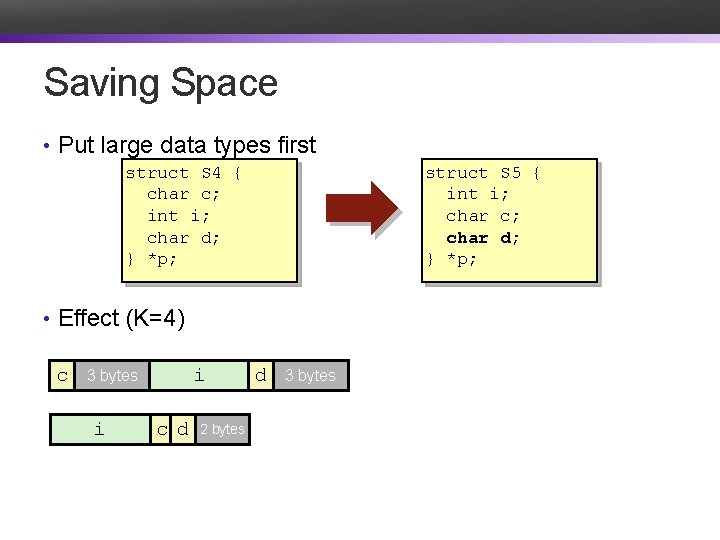
Saving Space • Put large data types first struct S 5 { int i; char c; char d; } *p; struct S 4 { char c; int i; char d; } *p; • Effect (K=4) c i 3 bytes i c d 2 bytes d 3 bytes
- Slides: 21