
Lecture 7 Class Reptilia repto to creep Part

- Slides: 24
Lecture 7: Class Reptilia repto ‘to creep’ Part 1: Reptile Overview & Turtles Ch. 26 pp. 567 -589
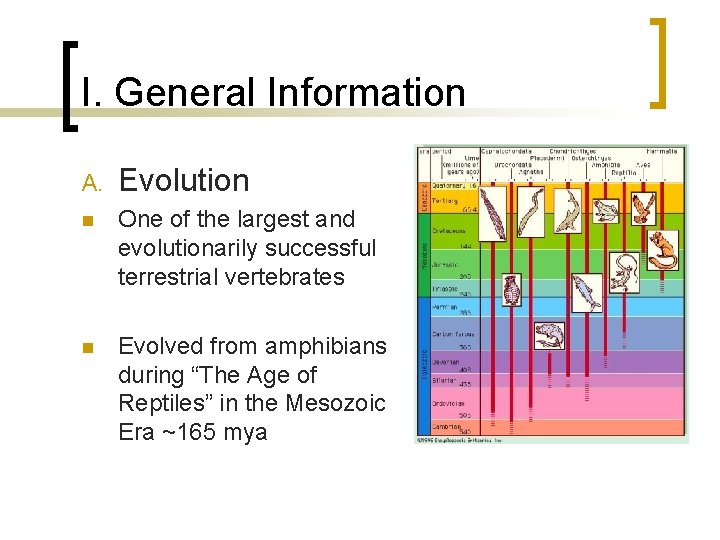
I. General Information A. Evolution n One of the largest and evolutionarily successful terrestrial vertebrates n Evolved from amphibians during “The Age of Reptiles” in the Mesozoic Era ~165 mya
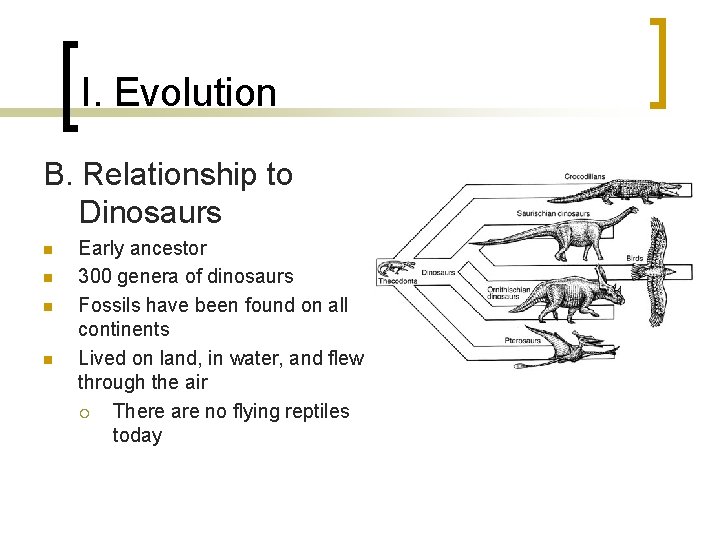
I. Evolution B. Relationship to Dinosaurs n n Early ancestor 300 genera of dinosaurs Fossils have been found on all continents Lived on land, in water, and flew through the air ¡ There are no flying reptiles today
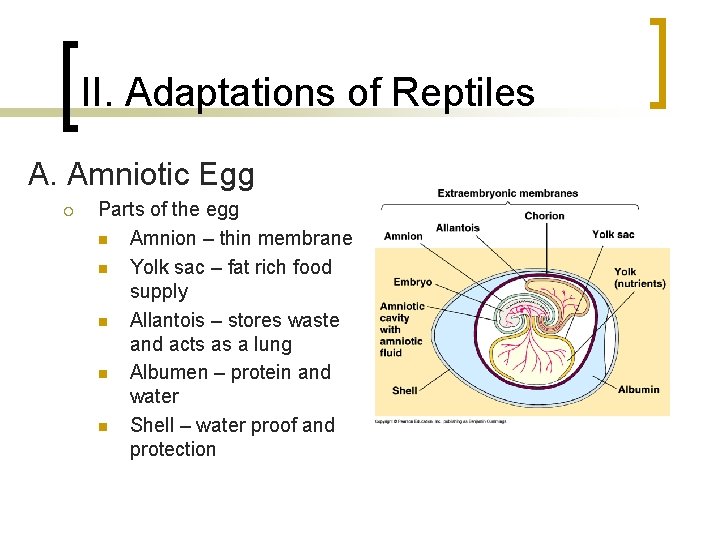
II. Adaptations of Reptiles A. Amniotic Egg ¡ Parts of the egg n Amnion – thin membrane n Yolk sac – fat rich food supply n Allantois – stores waste and acts as a lung n Albumen – protein and water n Shell – water proof and protection
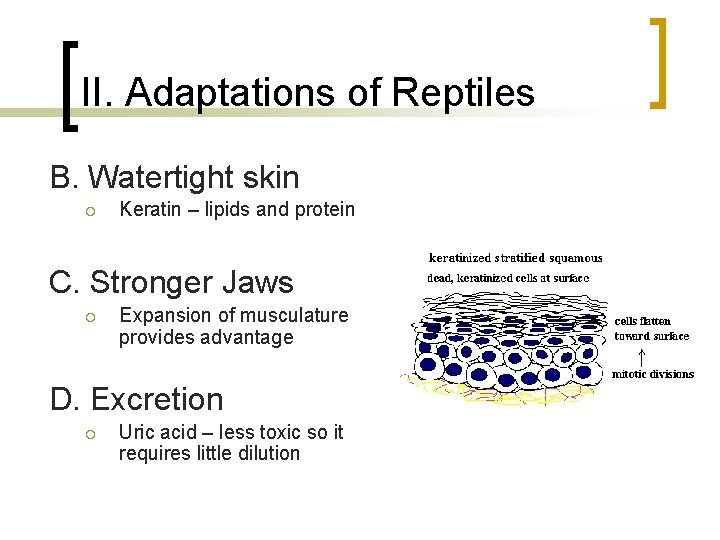
II. Adaptations of Reptiles B. Watertight skin ¡ Keratin – lipids and protein C. Stronger Jaws ¡ Expansion of musculature provides advantage D. Excretion ¡ Uric acid – less toxic so it requires little dilution
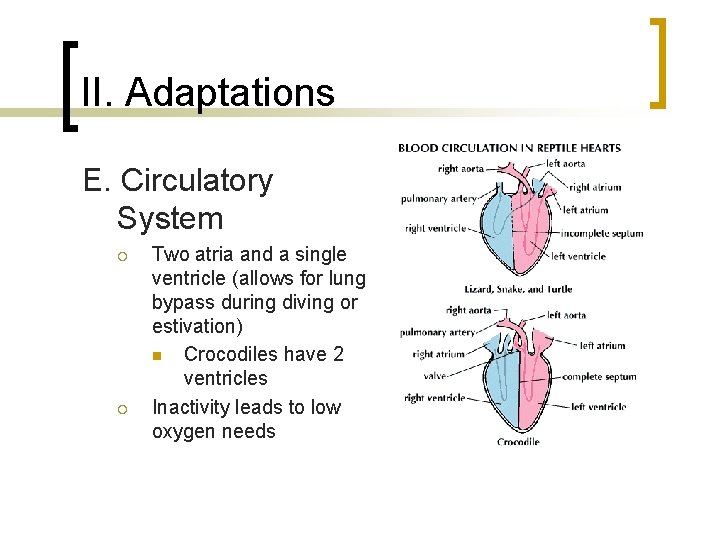
II. Adaptations E. Circulatory System ¡ ¡ Two atria and a single ventricle (allows for lung bypass during diving or estivation) n Crocodiles have 2 ventricles Inactivity leads to low oxygen needs
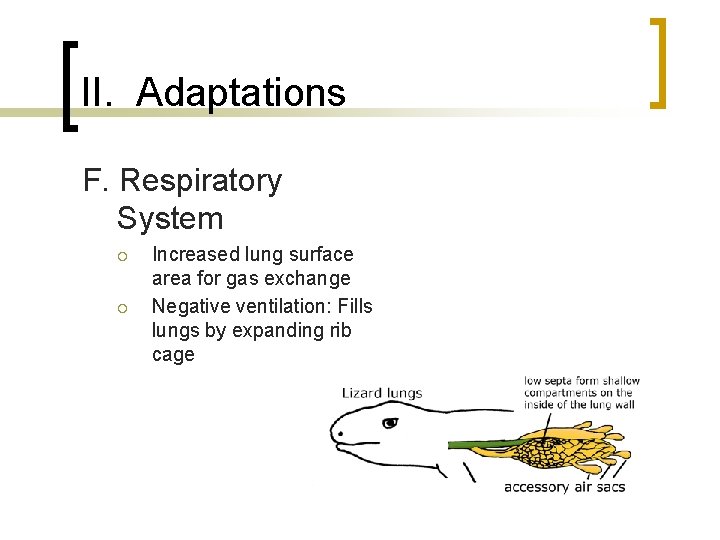
II. Adaptations F. Respiratory System ¡ ¡ Increased lung surface area for gas exchange Negative ventilation: Fills lungs by expanding rib cage
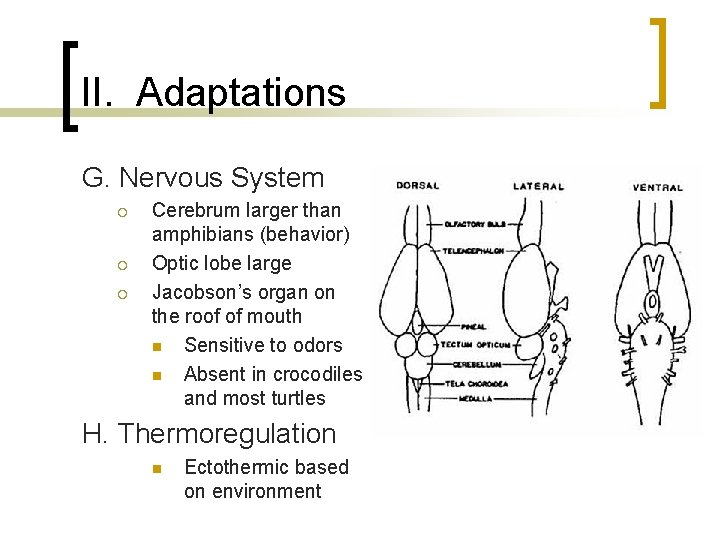
II. Adaptations G. Nervous System ¡ ¡ ¡ Cerebrum larger than amphibians (behavior) Optic lobe large Jacobson’s organ on the roof of mouth n Sensitive to odors n Absent in crocodiles and most turtles H. Thermoregulation n Ectothermic based on environment
II. Adaptations I. Reproduction ¡ Types n n n ¡ Oviparity – females lays shelled eggs Ovoviviparity – eggs laid just before they are hatched Viviparity – no shell, live birth Care of young n n n Most provide no care Some warm eggs Crocs provide care for up to a year
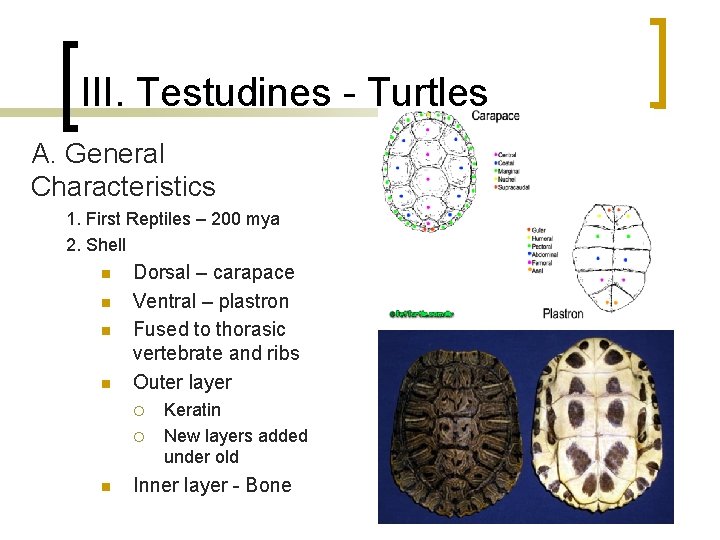
III. Testudines - Turtles A. General Characteristics 1. First Reptiles – 200 mya 2. Shell n n Dorsal – carapace Ventral – plastron Fused to thorasic vertebrate and ribs Outer layer ¡ ¡ n Keratin New layers added under old Inner layer - Bone
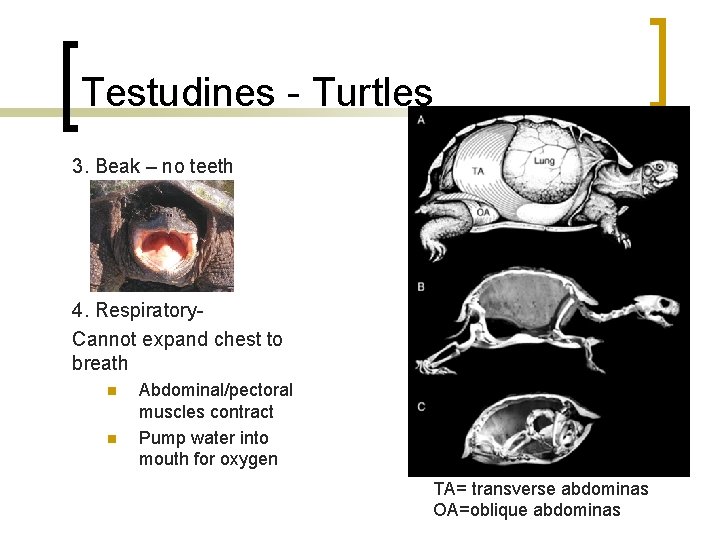
Testudines - Turtles 3. Beak – no teeth 4. Respiratory. Cannot expand chest to breath n n Abdominal/pectoral muscles contract Pump water into mouth for oxygen TA= transverse abdominas OA=oblique abdominas
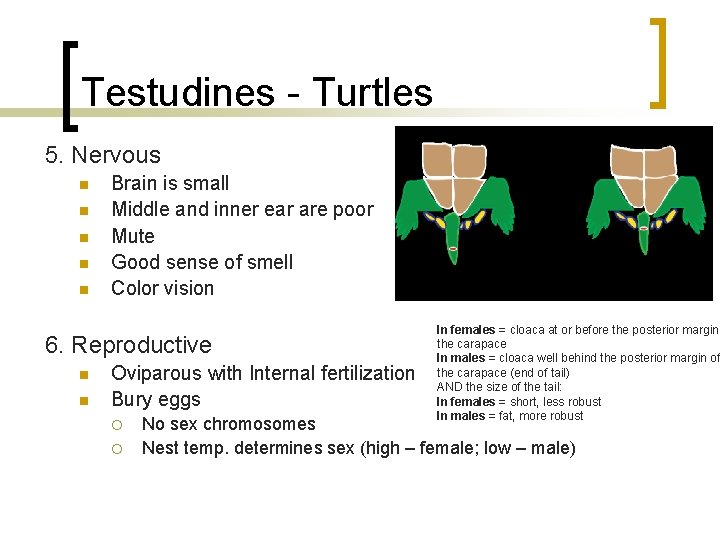
Testudines - Turtles 5. Nervous n n n Brain is small Middle and inner ear are poor Mute Good sense of smell Color vision 6. Reproductive n n Oviparous with Internal fertilization Bury eggs ¡ ¡ In females = cloaca at or before the posterior margin the carapace In males = cloaca well behind the posterior margin of the carapace (end of tail) AND the size of the tail: In females = short, less robust In males = fat, more robust No sex chromosomes Nest temp. determines sex (high – female; low – male)
Lecture 7: Class Reptilia repto ‘to creep’ Part 2: Snakes, Alligators/Crocodiles, Lizards & Tuataras Ch. 26 pp. 567 -589
IV. Types of Reptiles n Testudines – Turtles ¡ n n Squamata/Serpentines - Snakes Crocodilia - Crocodiles/Alligators ¡ ¡ ¡ n Introduced to Florida Valve in throat closes during feeding Lays eggs, cares for young Squamata/Sauria - Lizards ¡ ¡ n Previously discussed Autotomy – drop tail, grow new one Some are venomous Sphenodonta - Tuataras ¡ Only two living species are found in New Zealand
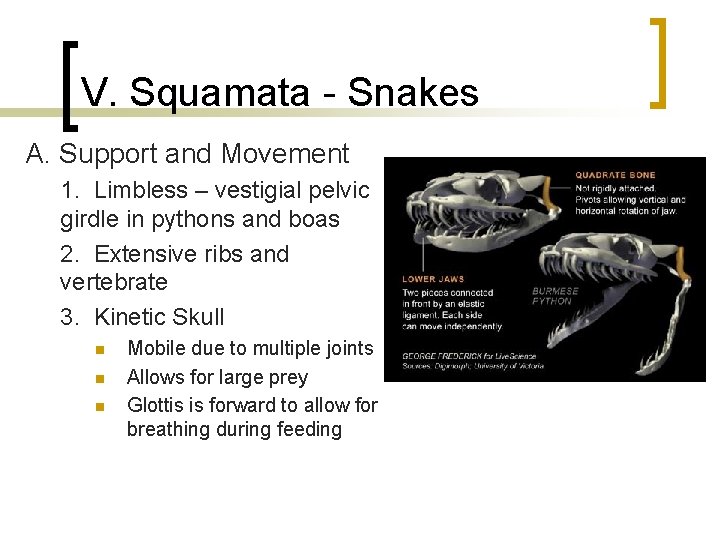
V. Squamata - Snakes A. Support and Movement 1. Limbless – vestigial pelvic girdle in pythons and boas 2. Extensive ribs and vertebrate 3. Kinetic Skull n n n Mobile due to multiple joints Allows for large prey Glottis is forward to allow for breathing during feeding
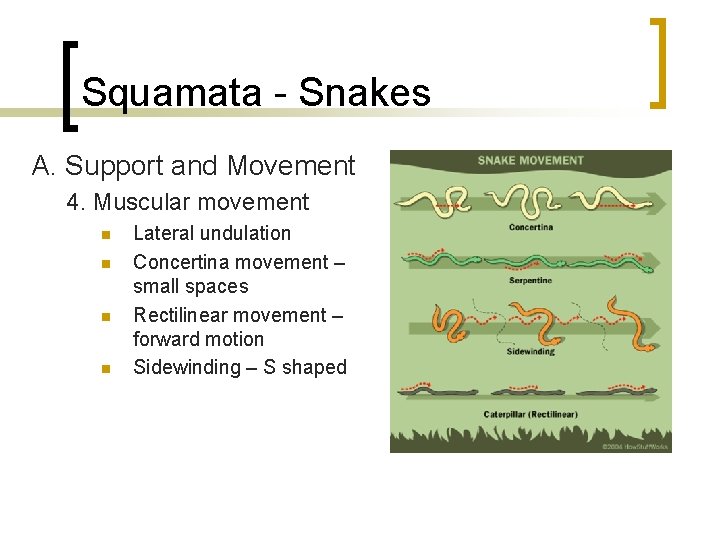
Squamata - Snakes A. Support and Movement 4. Muscular movement n n Lateral undulation Concertina movement – small spaces Rectilinear movement – forward motion Sidewinding – S shaped
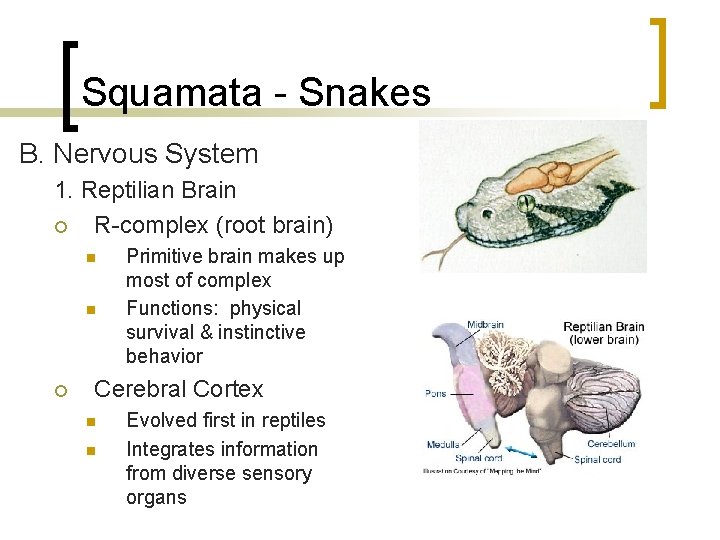
Squamata - Snakes B. Nervous System 1. Reptilian Brain ¡ R-complex (root brain) n n ¡ Primitive brain makes up most of complex Functions: physical survival & instinctive behavior Cerebral Cortex n n Evolved first in reptiles Integrates information from diverse sensory organs
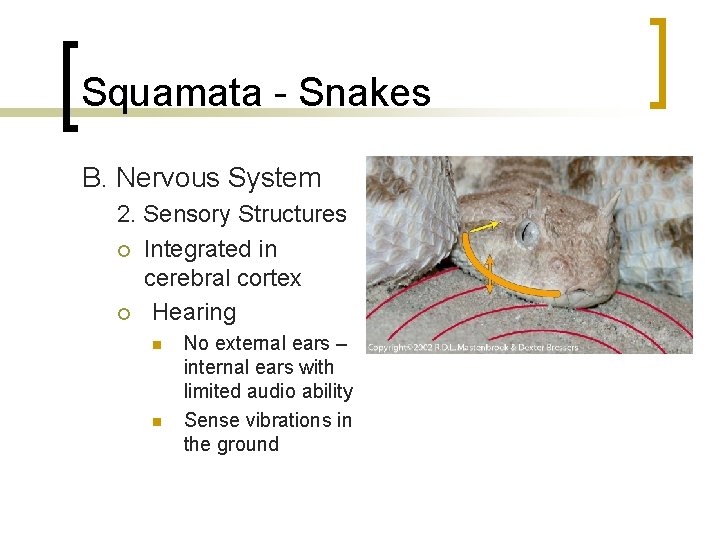
Squamata - Snakes B. Nervous System 2. Sensory Structures ¡ Integrated in cerebral cortex ¡ Hearing n n No external ears – internal ears with limited audio ability Sense vibrations in the ground
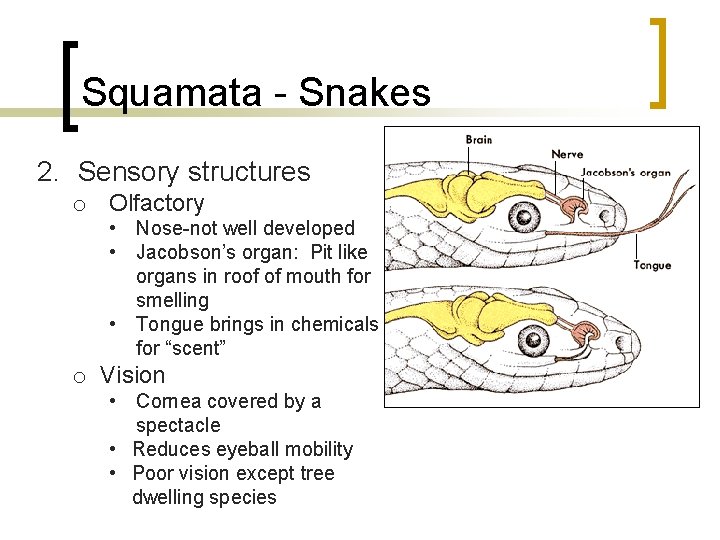
Squamata - Snakes 2. Sensory structures o Olfactory • Nose-not well developed • Jacobson’s organ: Pit like organs in roof of mouth for smelling • Tongue brings in chemicals for “scent” o Vision • Cornea covered by a spectacle • Reduces eyeball mobility • Poor vision except tree dwelling species
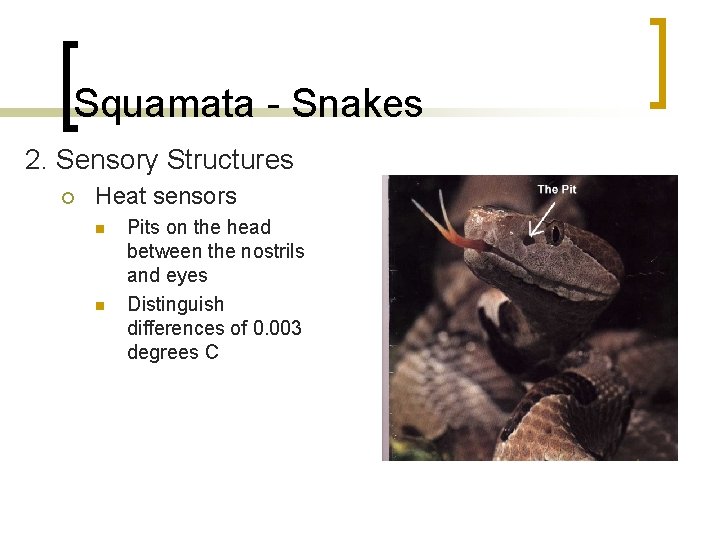
Squamata - Snakes 2. Sensory Structures ¡ Heat sensors n n Pits on the head between the nostrils and eyes Distinguish differences of 0. 003 degrees C
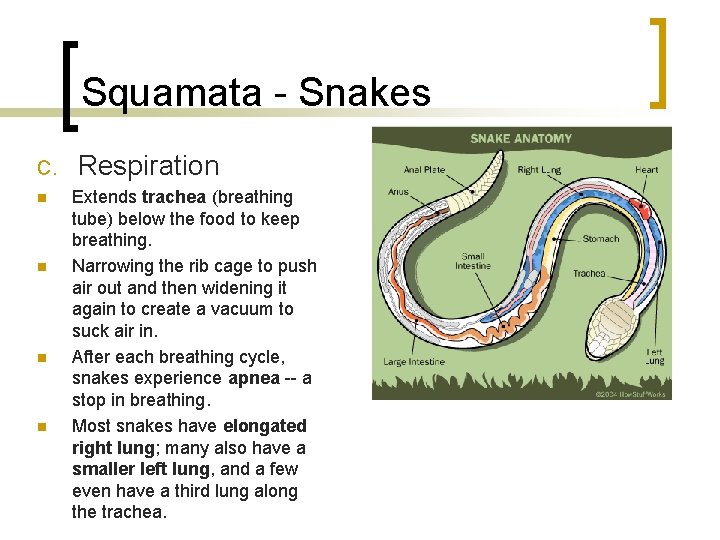
Squamata - Snakes C. n n Respiration Extends trachea (breathing tube) below the food to keep breathing. Narrowing the rib cage to push air out and then widening it again to create a vacuum to suck air in. After each breathing cycle, snakes experience apnea -- a stop in breathing. Most snakes have elongated right lung; many also have a smaller left lung, and a few even have a third lung along the trachea.
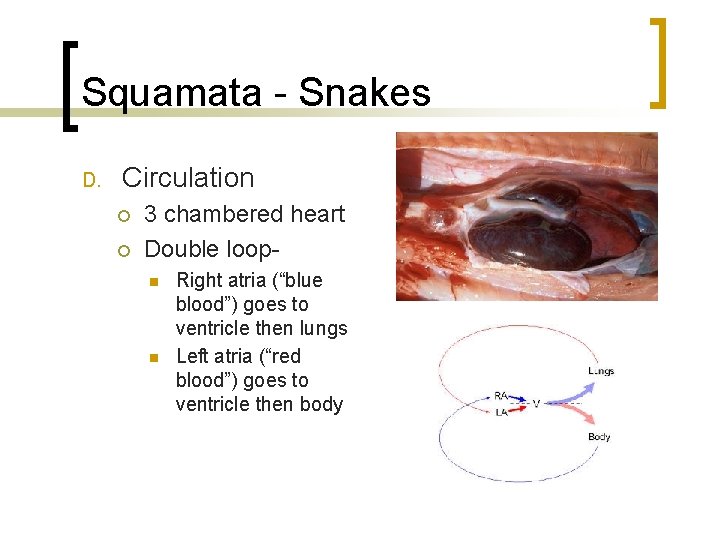
Squamata - Snakes D. Circulation ¡ ¡ 3 chambered heart Double loopn n Right atria (“blue blood”) goes to ventricle then lungs Left atria (“red blood”) goes to ventricle then body
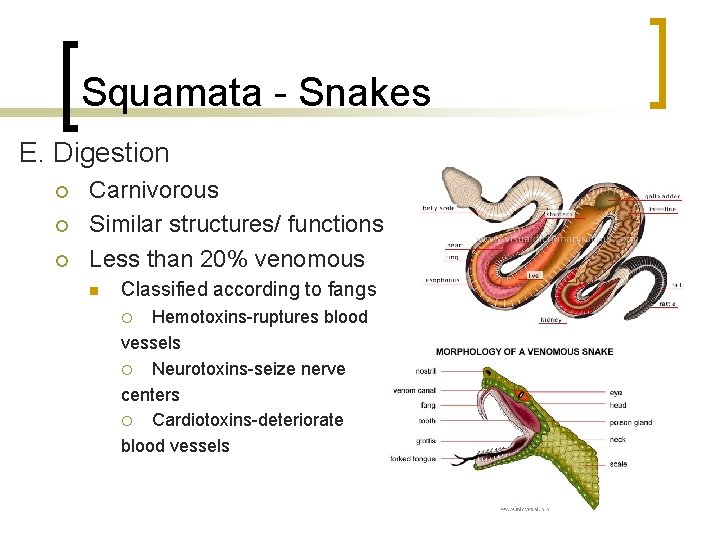
Squamata - Snakes E. Digestion ¡ ¡ ¡ Carnivorous Similar structures/ functions Less than 20% venomous n Classified according to fangs Hemotoxins-ruptures blood vessels ¡ Neurotoxins-seize nerve centers ¡ Cardiotoxins-deteriorate blood vessels ¡
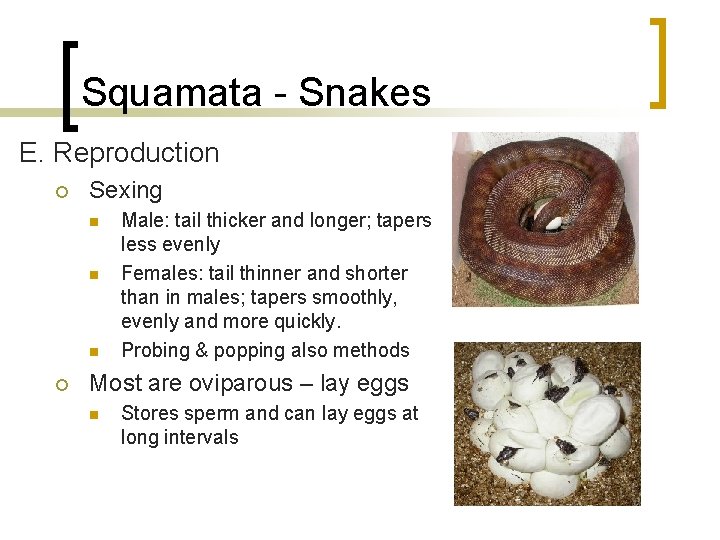
Squamata - Snakes E. Reproduction ¡ Sexing n n n ¡ Male: tail thicker and longer; tapers less evenly Females: tail thinner and shorter than in males; tapers smoothly, evenly and more quickly. Probing & popping also methods Most are oviparous – lay eggs n Stores sperm and can lay eggs at long intervals