
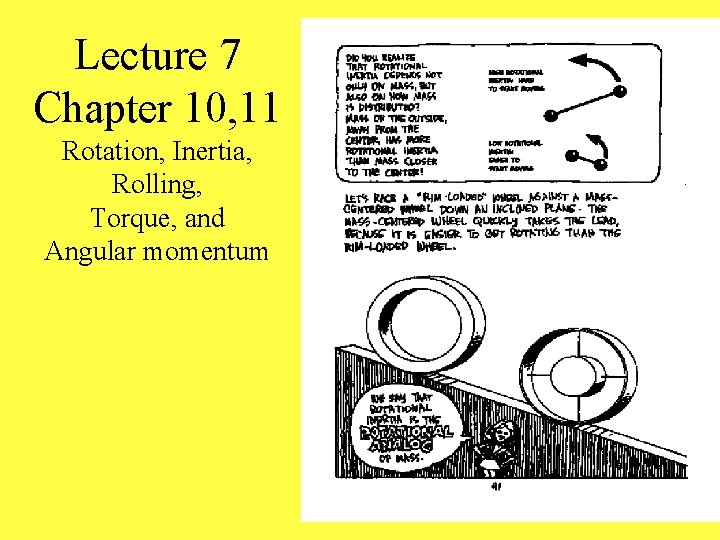
Lecture 7 Chapter 10 11 Rotation Inertia Rolling






- Slides: 64
Lecture 7 Chapter 10, 11 Rotation, Inertia, Rolling, Torque, and Angular momentum Demo
Demos A pulley with string wrapped around it and a weight. Atwoods machine with a large pulley. Screw driver with different size handles
Summary of Concepts to Cover from chapter 10 Rotation • Rotating cylinder with string wrapped around it: example • Kinematic variables analogous to linear motion for constant acceleration • Kinetic energy of rotation • Rotational inertia • Moment of Inertia • Parallel axis theorem
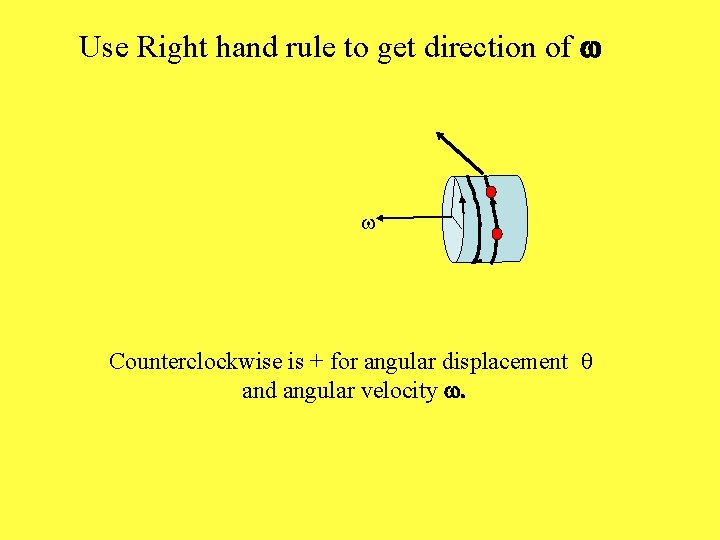
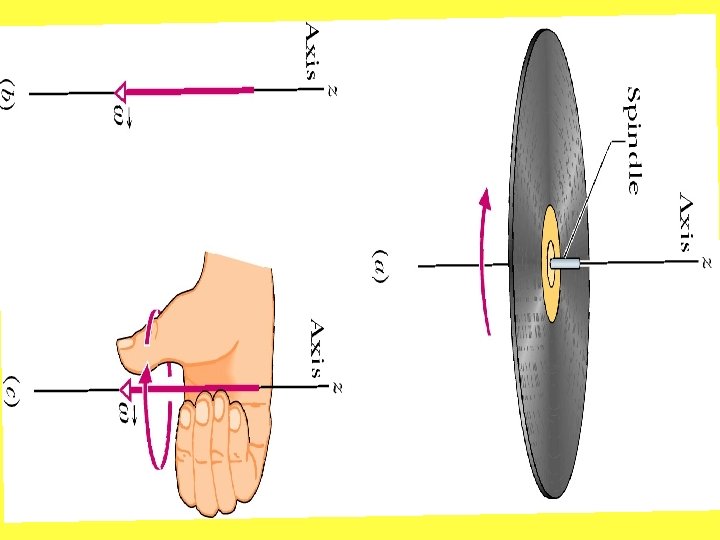
ROTATION ABOUT A FIXED AXIS • Spin an rigid object and define rotation axis. • Define angular displacement, angular velocity and angular acceleration. • Show angle is measured positive (counterclockwise). • Interpret signs of angular velocity and acceleration. • Point out analogy to 1 D motion for the variables. • Point out that omega and alpha are vectors that lie along the axis of rotation for a fixed axis of rotation Angular displacements are not vectors. Show the figure with two angular displacements of a book.
ROTATION WITH CONSTANT ANGULAR ACCELERATION • Restrict discussion to a fixed axis of rotation but also applies if the axis is in translation as well. • Write down or point out the analogy of the angular kinematic equations with linear motion. See Table 11. 1 in text • Same strategies are used to solve rotational problems as linear ones.
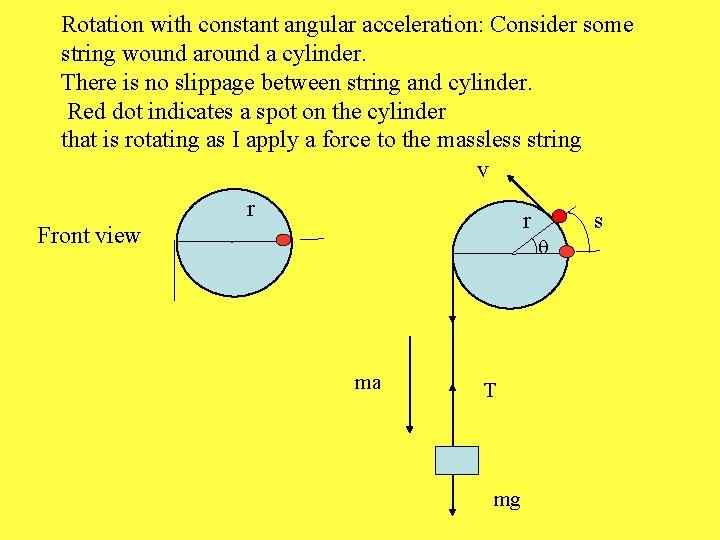
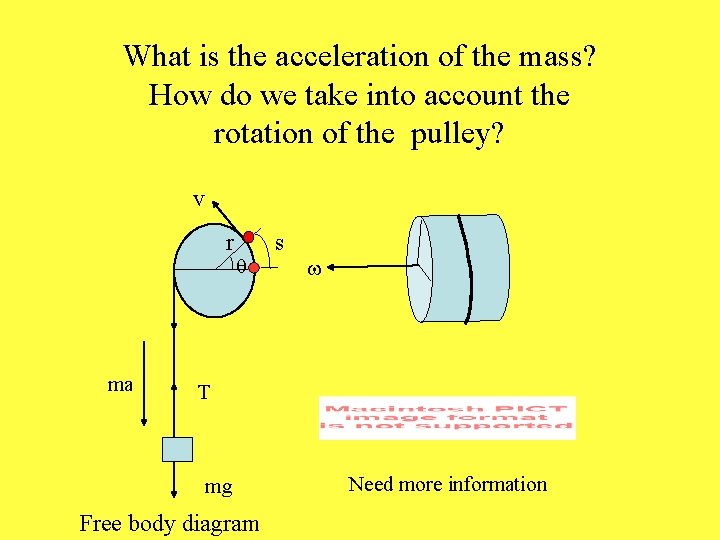
Rotation with constant angular acceleration: Consider some string wound around a cylinder. There is no slippage between string and cylinder. Red dot indicates a spot on the cylinder that is rotating as I apply a force to the massless string v r Front view r . s q ma T mg
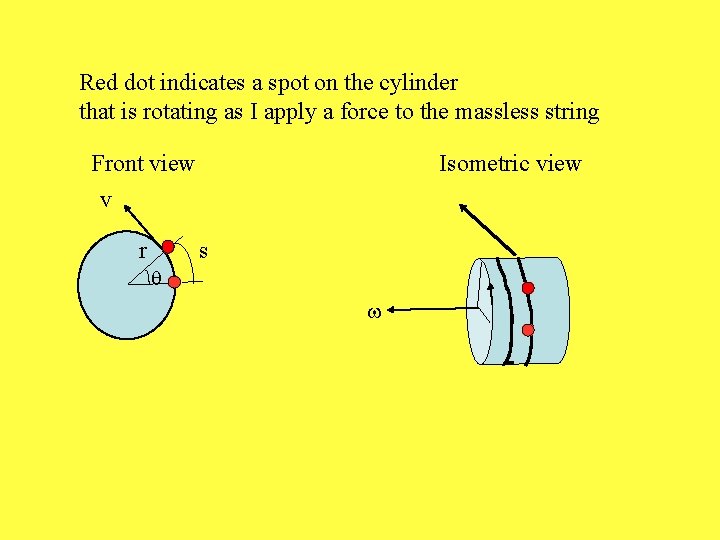
Red dot indicates a spot on the cylinder that is rotating as I apply a force to the massless string Front view Isometric view v r s q w
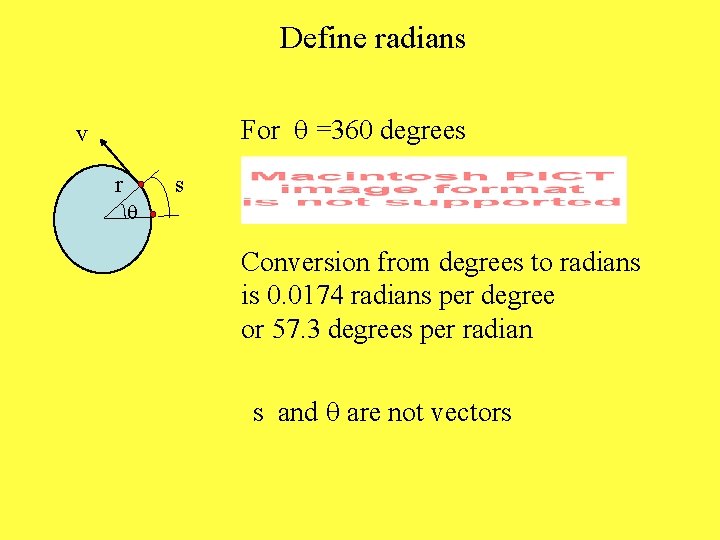
Define radians For q =360 degrees v r s q Conversion from degrees to radians is 0. 0174 radians per degree or 57. 3 degrees per radian s and q are not vectors
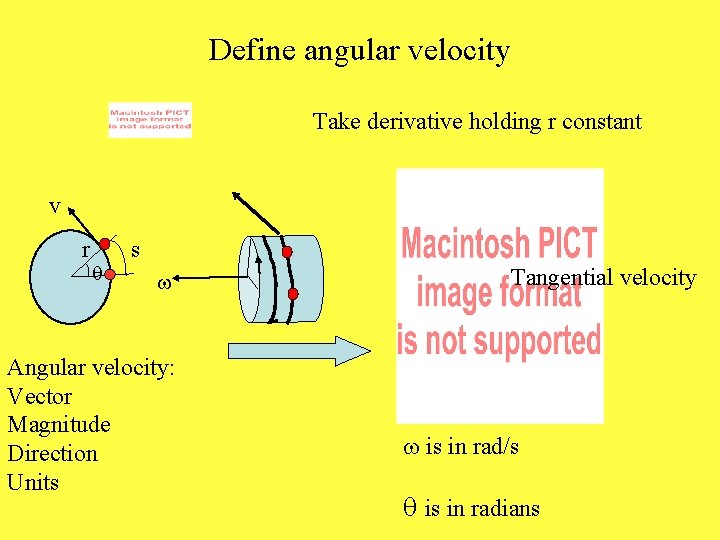
Define angular velocity Take derivative holding r constant v r q s w Angular velocity: Vector Magnitude Direction Units Tangential velocity w is in rad/s q is in radians
Use Right hand rule to get direction of w Counterclockwise is + for angular displacement q and angular velocity .
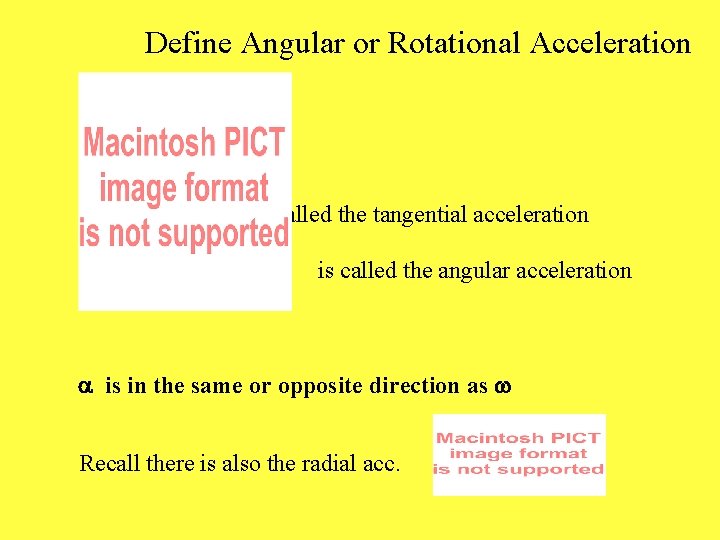
Define Angular or Rotational Acceleration Also called the tangential acceleration is called the angular acceleration is in the same or opposite direction as Recall there is also the radial acc.
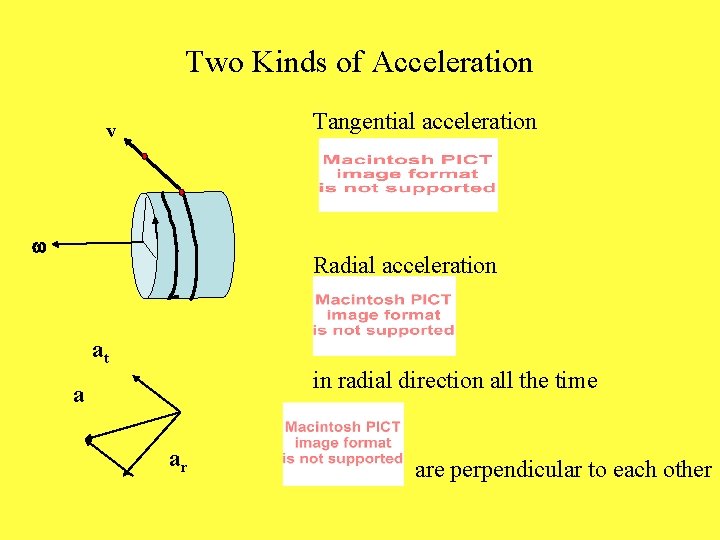
Two Kinds of Acceleration Tangential acceleration v Radial acceleration at in radial direction all the time a ar are perpendicular to each other
For constant acceleration We have an analogous set of formulas for angular variables
What is the acceleration of the mass? How do we take into account the rotation of the pulley? v r ma q s w T mg Free body diagram Need more information
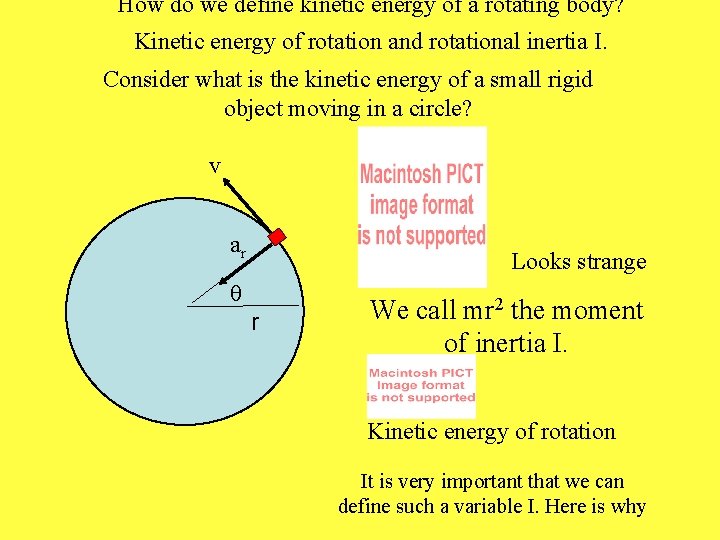
How do we define kinetic energy of a rotating body? Kinetic energy of rotation and rotational inertia I. Consider what is the kinetic energy of a small rigid object moving in a circle? v ar Looks strange q r We call mr 2 the moment of inertia I. Kinetic energy of rotation It is very important that we can define such a variable I. Here is why
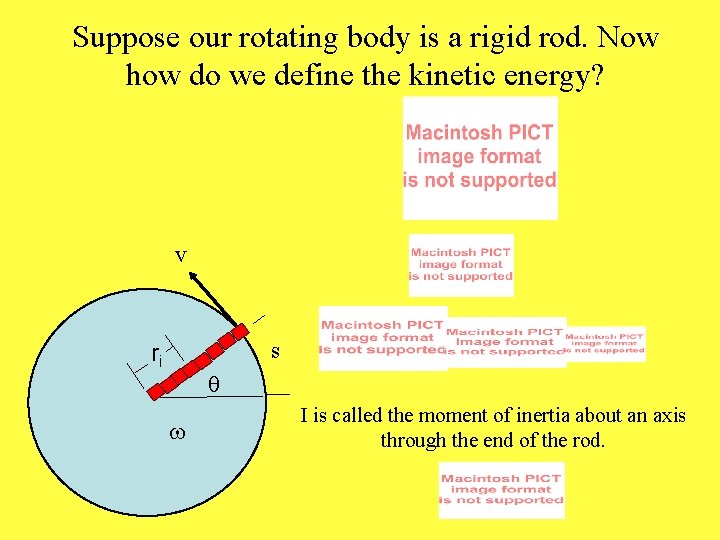
Suppose our rotating body is a rigid rod. Now how do we define the kinetic energy? v s ri q w I is called the moment of inertia about an axis through the end of the rod.
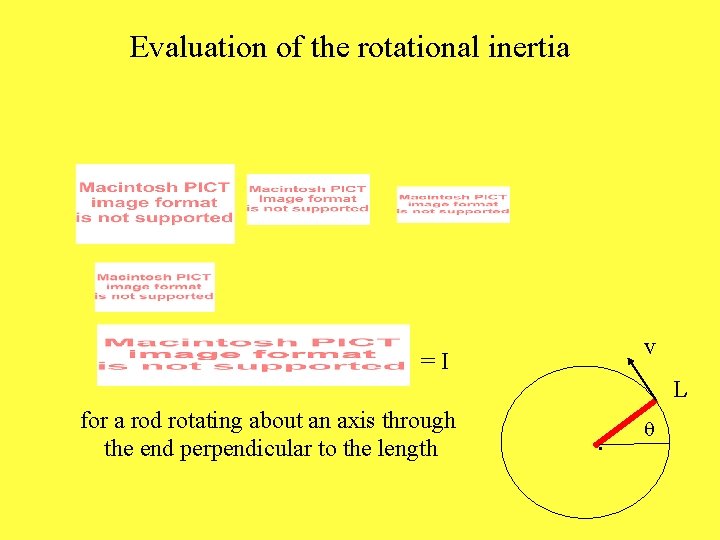
Evaluation of the rotational inertia v =I L for a rod rotating about an axis through the end perpendicular to the length . q
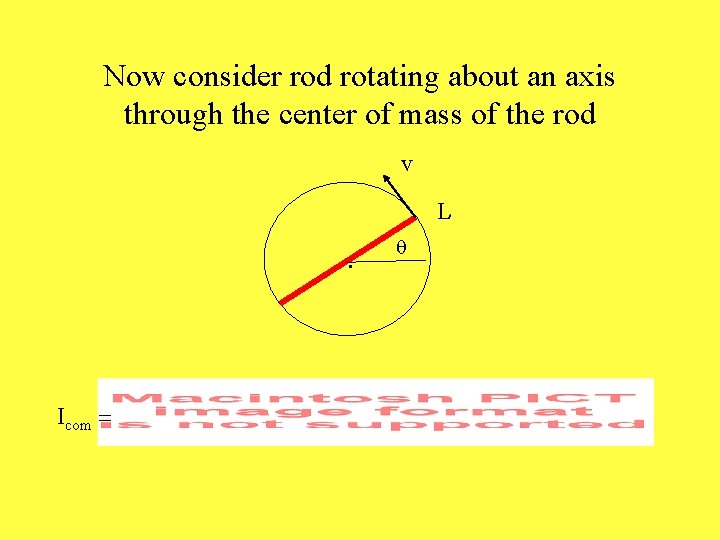
Now consider rod rotating about an axis through the center of mass of the rod v L . Icom = q
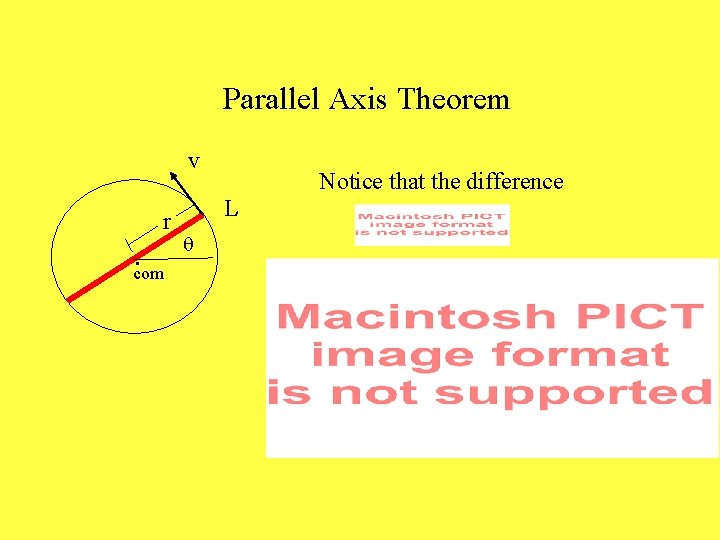
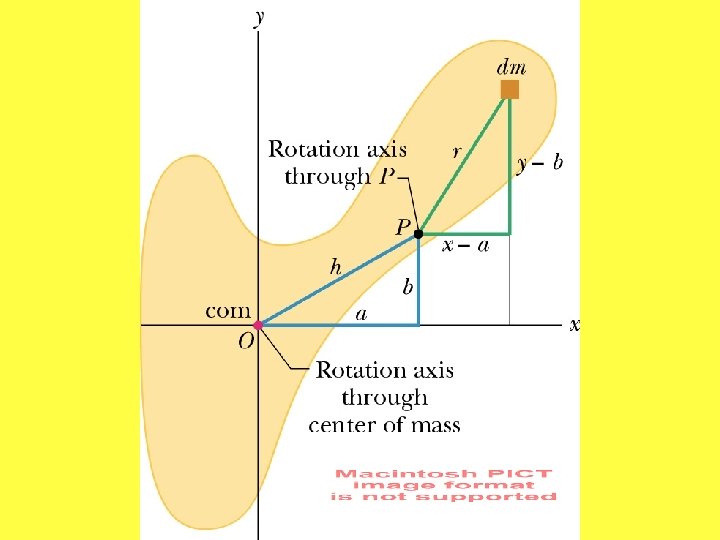
Parallel Axis Theorem v . r Notice that the difference L q com General relation
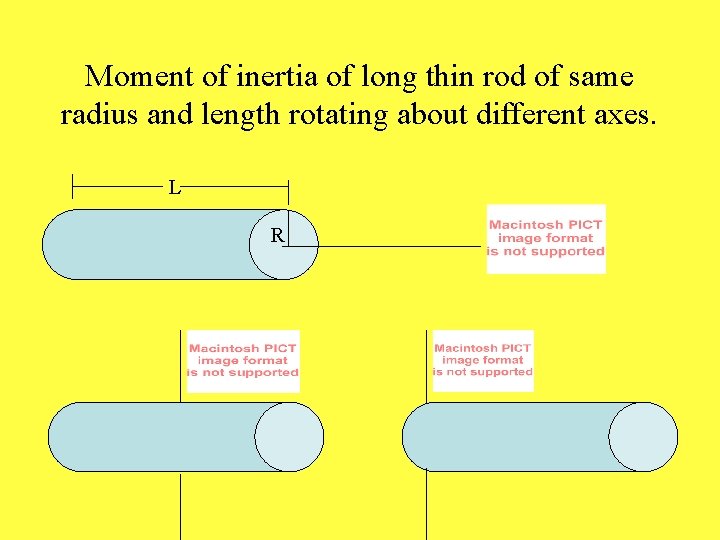
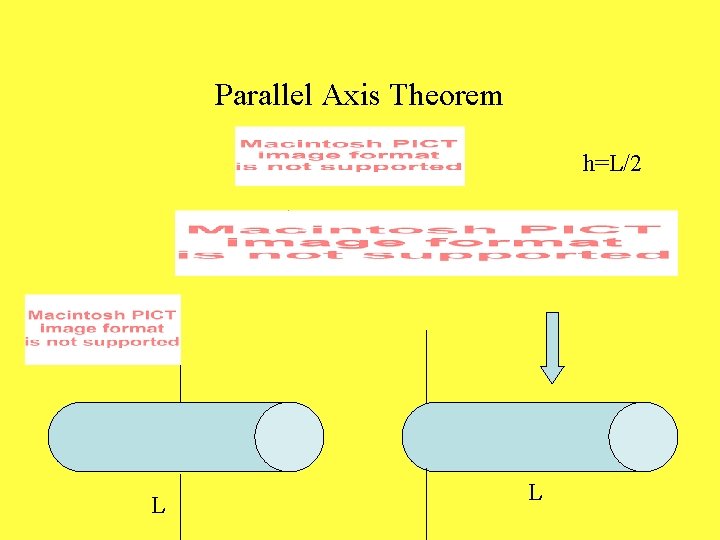
Moment of inertia of long thin rod of same radius and length rotating about different axes. L R
Parallel Axis Theorem h=L/2 L L
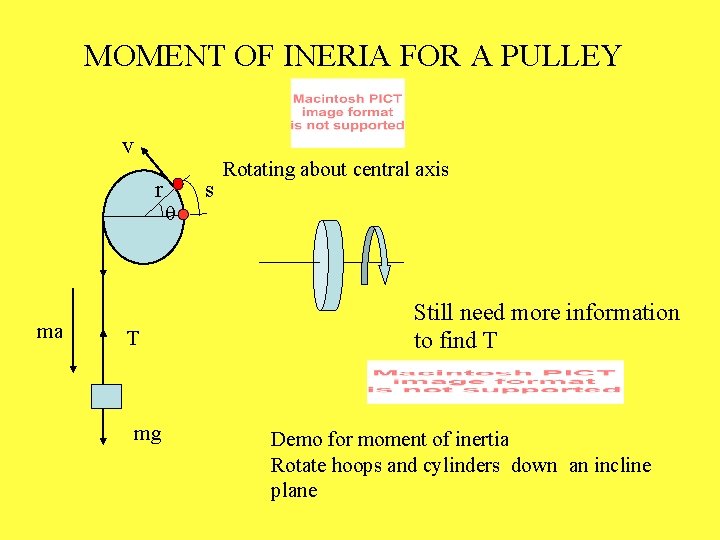
MOMENT OF INERIA FOR A PULLEY v r ma T mg q s Rotating about central axis Still need more information to find T Demo for moment of inertia Rotate hoops and cylinders down an incline plane
Concepts in Chapter 11 Rolling, Torque, and Angular Momentum • • • Torque Newton’s Law for rotations Work Energy theorem for rotations Atwood machine with mass of pulley More on rolling without sliding Center of percussion: baseball bat and hammer Sphere rolling down an inclined plane Yo -yo Angular momentum Conservation of angular momentum Breaking a stick balanced on a wine glass
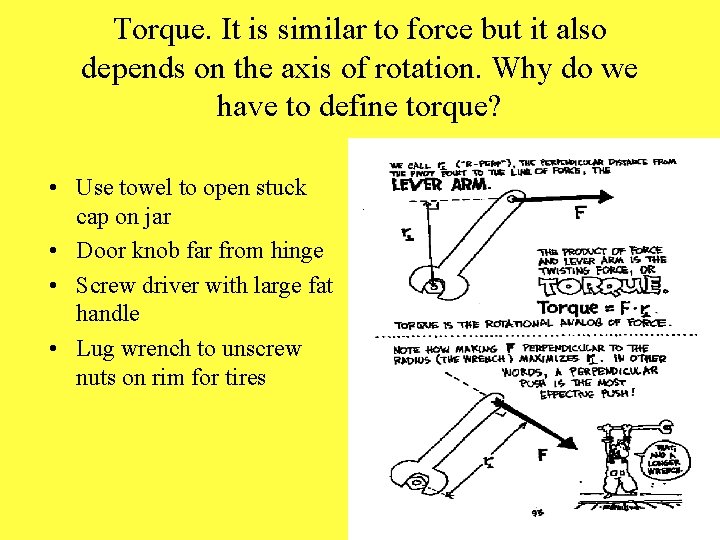
Torque. It is similar to force but it also depends on the axis of rotation. Why do we have to define torque? • Use towel to open stuck cap on jar • Door knob far from hinge • Screw driver with large fat handle • Lug wrench to unscrew nuts on rim for tires
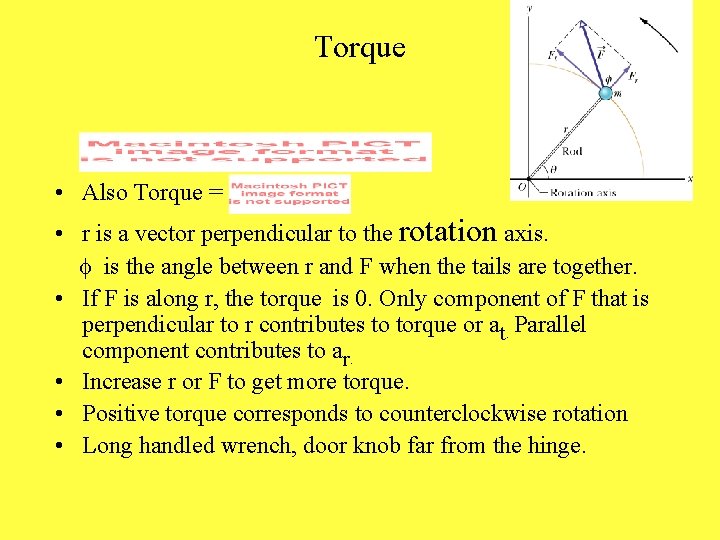
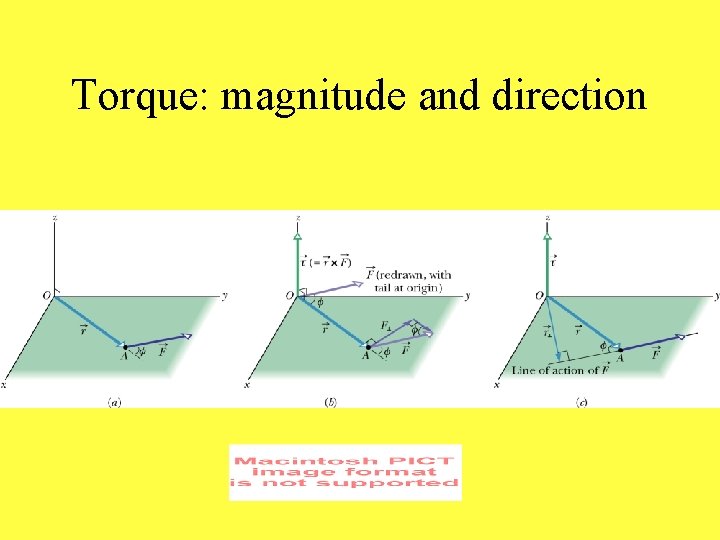
Torque • Also Torque = • r is a vector perpendicular to the rotation axis. f is the angle between r and F when the tails are together. • If F is along r, the torque is 0. Only component of F that is perpendicular to r contributes to torque or at. Parallel component contributes to ar. • Increase r or F to get more torque. • Positive torque corresponds to counterclockwise rotation • Long handled wrench, door knob far from the hinge.
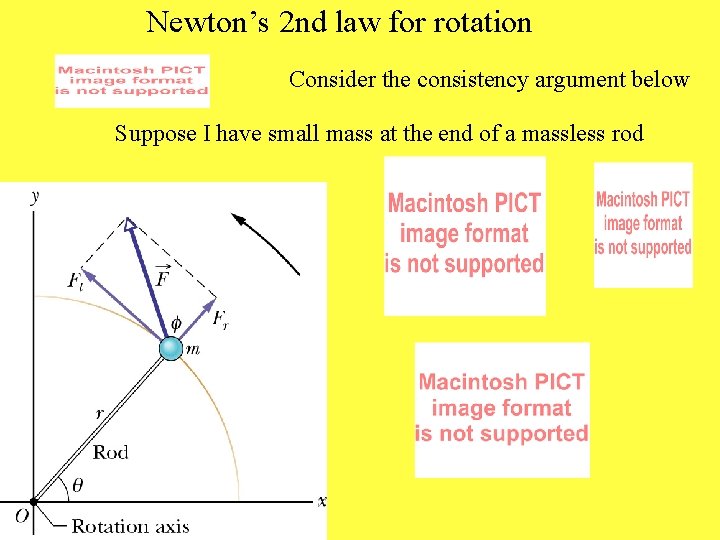
Newton’s 2 nd law for rotation Consider the consistency argument below Suppose I have small mass at the end of a massless rod
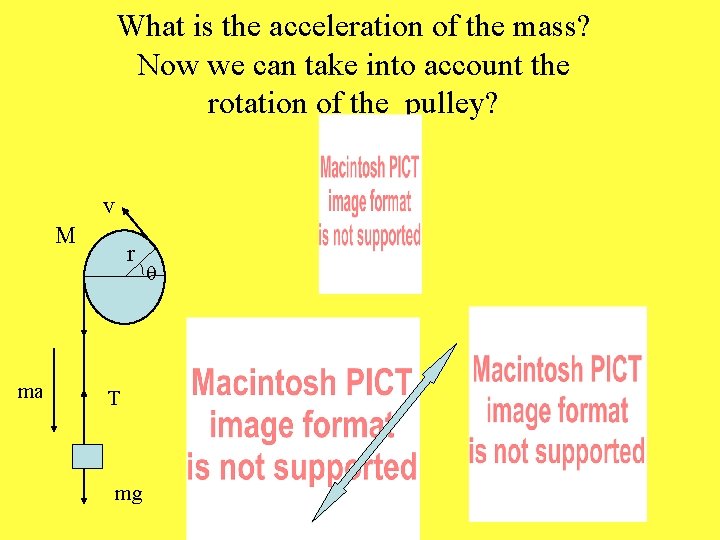
What is the acceleration of the mass? Now we can take into account the rotation of the pulley? v M ma r T mg q
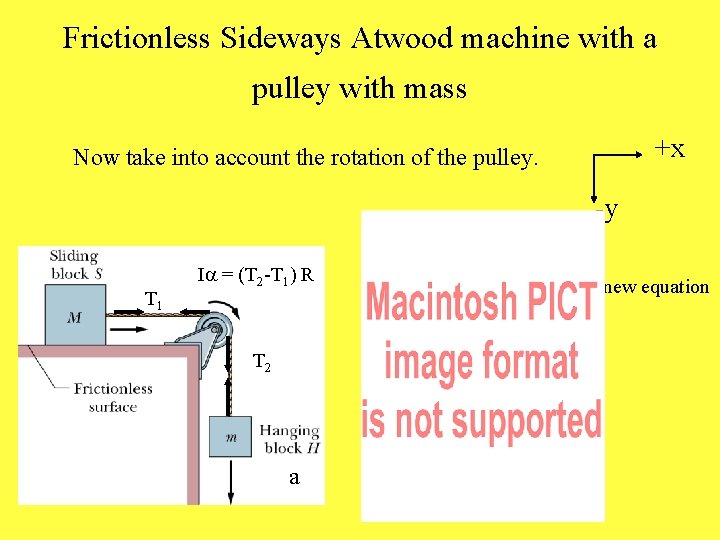
Frictionless Sideways Atwood machine with a pulley with mass +x Now take into account the rotation of the pulley. -y T 1 Ia = (T 2 -T 1) R T 2 a new equation
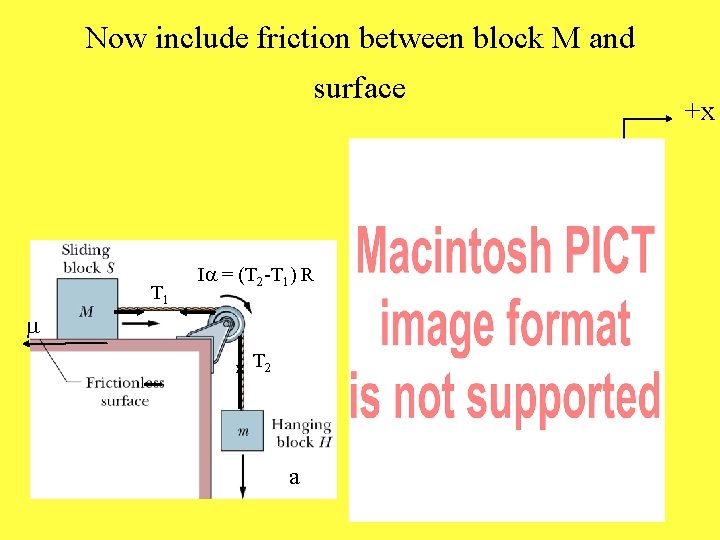
Now include friction between block M and surface +x -y new equation T 1 Ia = (T 2 -T 1) R m T 2 a
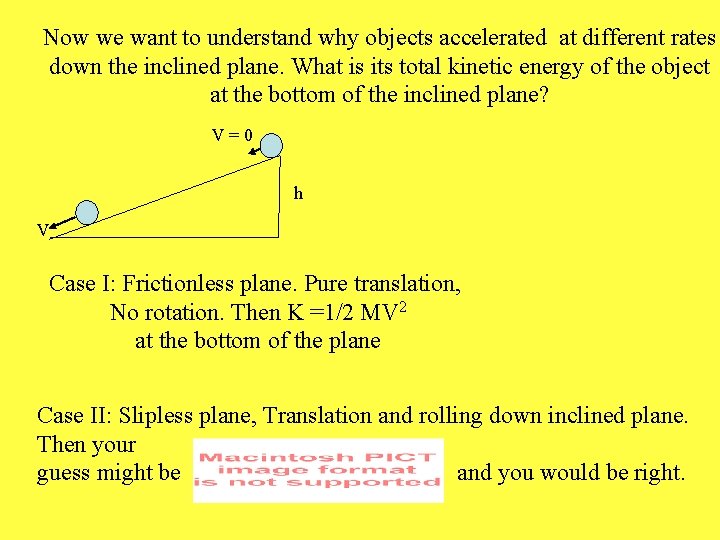
Now we want to understand why objects accelerated at different rates down the inclined plane. What is its total kinetic energy of the object at the bottom of the inclined plane? V=0 h V Case I: Frictionless plane. Pure translation, No rotation. Then K =1/2 MV 2 at the bottom of the plane Case II: Slipless plane, Translation and rolling down inclined plane. Then your guess might be and you would be right.
Which objects will get the bottom of the inclined planes fastest
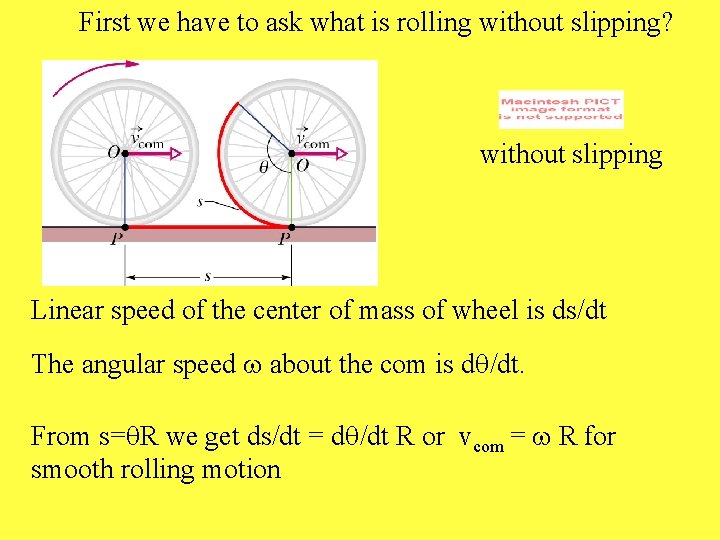
First we have to ask what is rolling without slipping? without slipping Linear speed of the center of mass of wheel is ds/dt The angular speed w about the com is dq/dt. From s=q. R we get ds/dt = dq/dt R or vcom = w R for smooth rolling motion
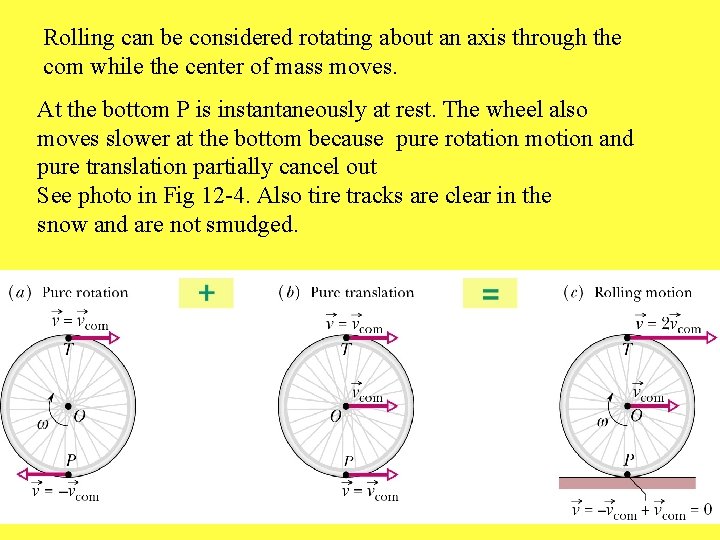
Rolling can be considered rotating about an axis through the com while the center of mass moves. At the bottom P is instantaneously at rest. The wheel also moves slower at the bottom because pure rotation motion and pure translation partially cancel out See photo in Fig 12 -4. Also tire tracks are clear in the snow and are not smudged.
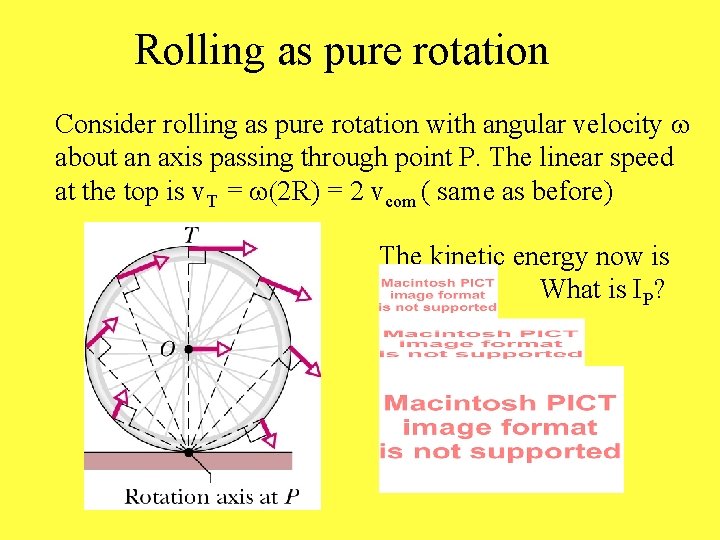
Rolling as pure rotation Consider rolling as pure rotation with angular velocity w about an axis passing through point P. The linear speed at the top is v. T = w(2 R) = 2 vcom ( same as before) The kinetic energy now is What is IP?
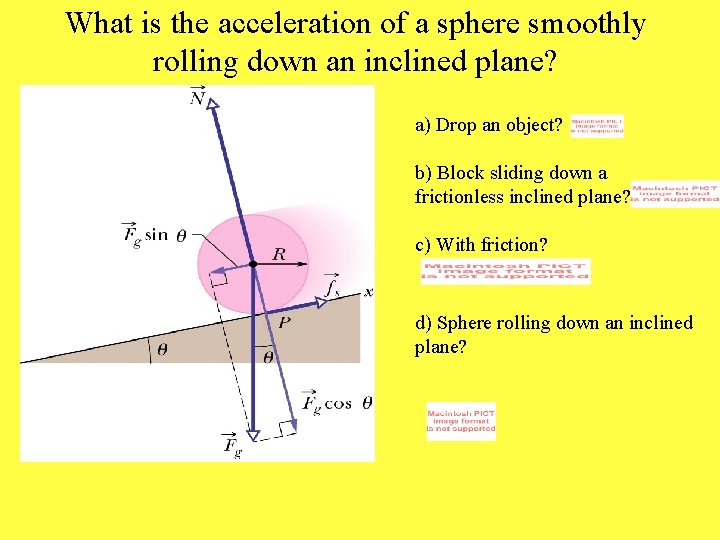
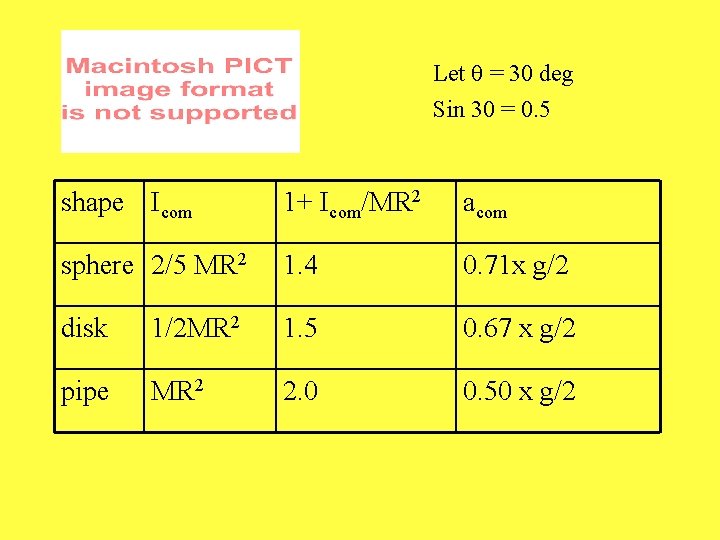
What is the acceleration of a sphere smoothly rolling down an inclined plane? a) Drop an object? b) Block sliding down a frictionless inclined plane? c) With friction? d) Sphere rolling down an inclined plane?
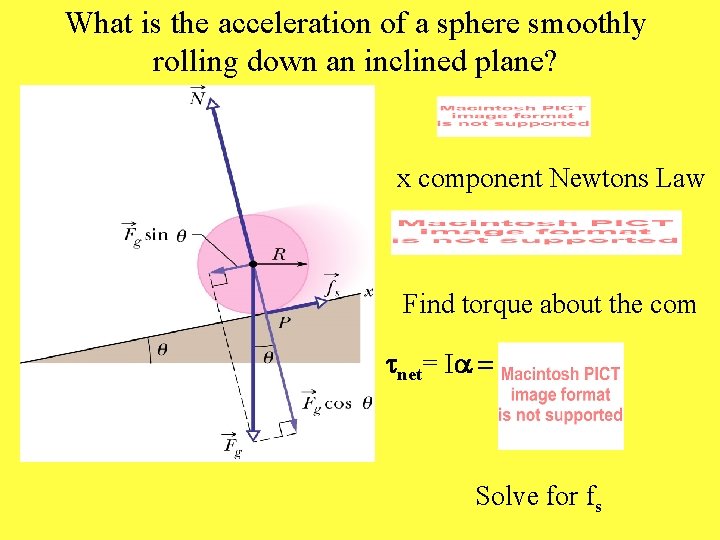
What is the acceleration of a sphere smoothly rolling down an inclined plane? x component Newtons Law Find torque about the com tnet= I Solve for fs
Solve for This will predict which objects will roll down the inclined faster.
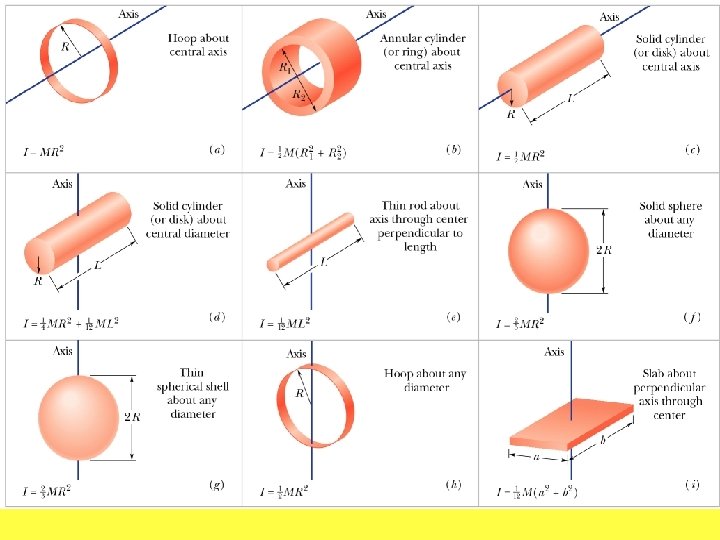
Let q = 30 deg Sin 30 = 0. 5 shape Icom 1+ Icom/MR 2 acom sphere 2/5 MR 2 1. 4 0. 71 x g/2 disk 1/2 MR 2 1. 5 0. 67 x g/2 pipe MR 2 2. 0 0. 50 x g/2
Can objects fall with a greater acceleration than gravity?
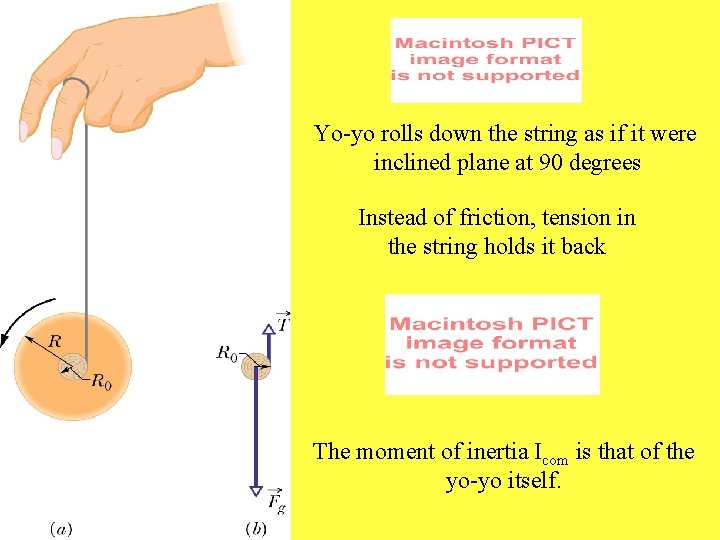
Yo-yo rolls down the string as if it were inclined plane at 90 degrees Instead of friction, tension in the string holds it back The moment of inertia Icom is that of the yo-yo itself.
Things to consider • Yo-yo • Angular momentum of a rigid body • Conservation of angular momentum
Torque: magnitude and direction
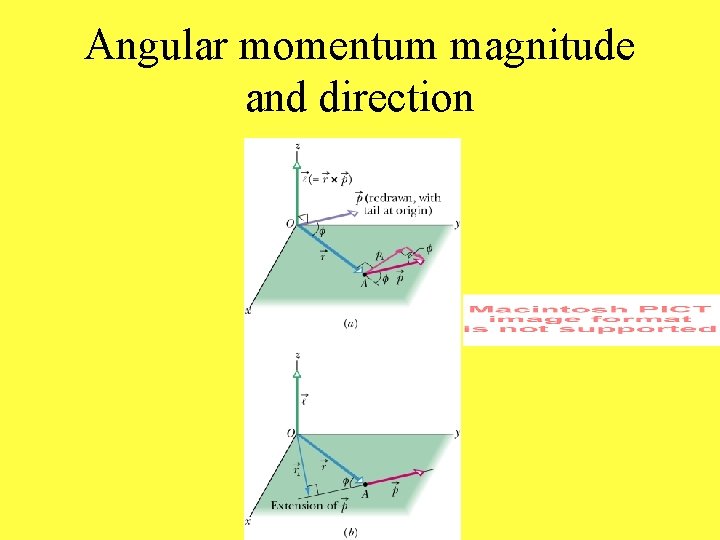
Angular momentum magnitude and direction
Work-energy theorem for rotations
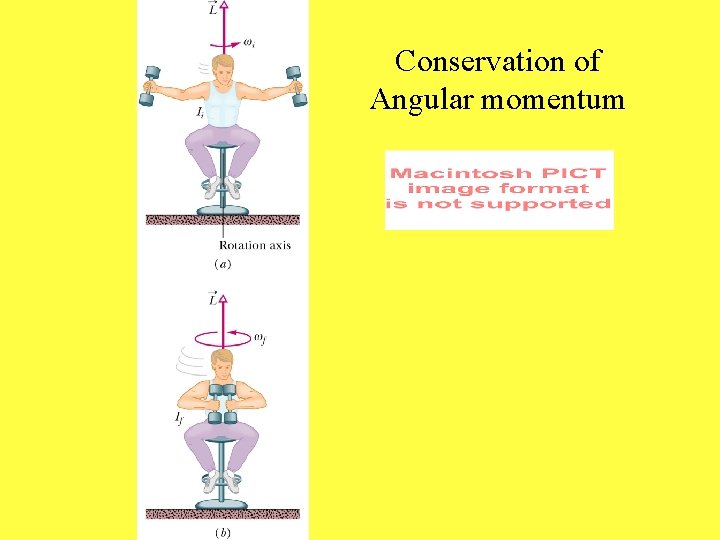
Conservation of Angular momentum
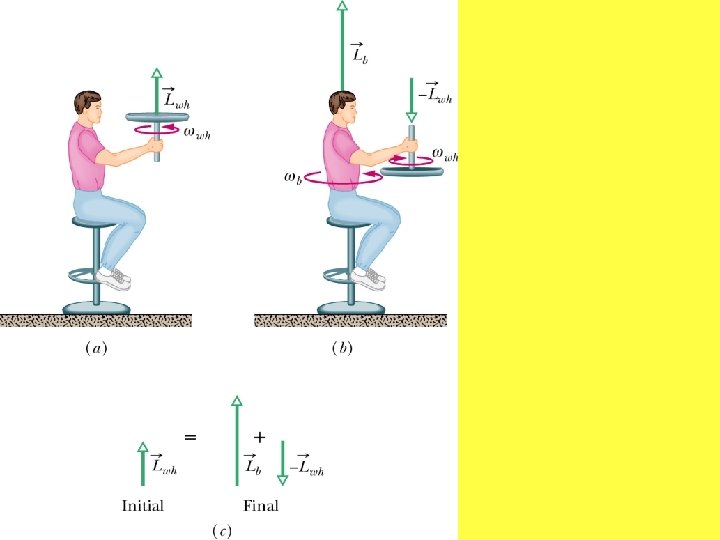
Conservation of angular momentum and it’s vector nature Sit on stool with dumbells held straight out 180 degrees apart. Slowly rotate the stool then bringarms in towards body. Angular velocity will increase drastically. Spin up bicycle wheel on buffer and hold its axis vertical while sitting on the stool. Slowly rotate the wheel axis 180 degrees and the stool will rotate in accordance with the law of conservation of angular momentum.
Precession of a Bicycle Wheel Gyroscope Under Gravitational Force In each of the lecture halls there is a string which hangs from the ceiling and has a hook attached to its free end. Spin the bicycle wheel up with the buffer wheel and attach the axle of the wheel to the hook on the string. With the axis of the bicycle wheel held horizontal, it is released. The axis remains horizontal while the wheel precesses around a vertical axis.
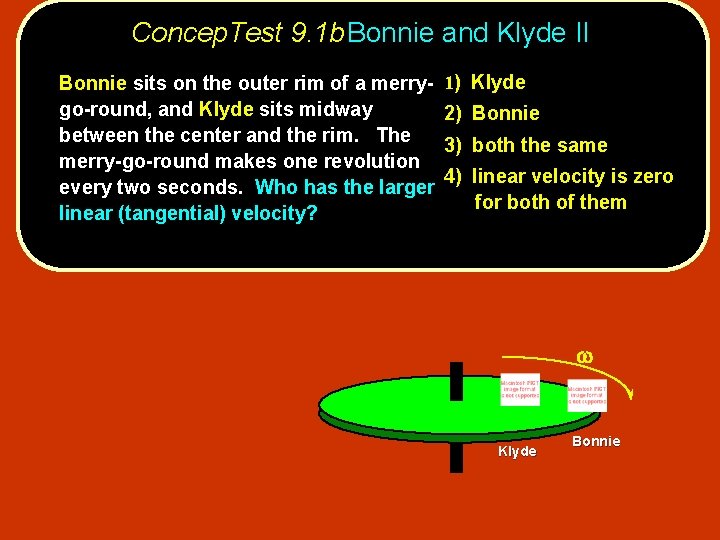
Concep. Test 9. 1 b. Bonnie and Klyde II Bonnie sits on the outer rim of a merrygo-round, and Klyde sits midway between the center and the rim. The merry-go-round makes one revolution every two seconds. Who has the larger linear (tangential) velocity? 1) Klyde 2) Bonnie 3) both the same 4) linear velocity is zero for both of them Klyde Bonnie
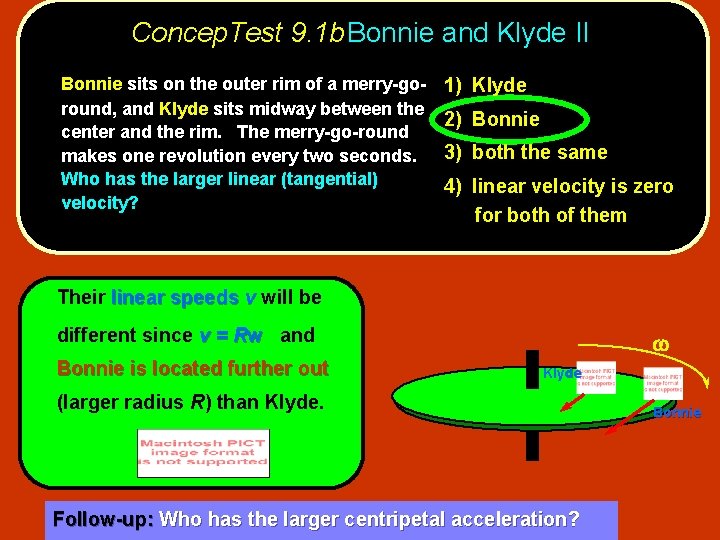
Concep. Test 9. 1 b. Bonnie and Klyde II Bonnie sits on the outer rim of a merry-goround, and Klyde sits midway between the center and the rim. The merry-go-round makes one revolution every two seconds. Who has the larger linear (tangential) velocity? 1) Klyde 2) Bonnie 3) both the same 4) linear velocity is zero for both of them Their linear speeds v will be different since v = Rw and Bonnie is located further out Klyde (larger radius R) than Klyde. Follow-up: Who has the larger centripetal acceleration? Bonnie
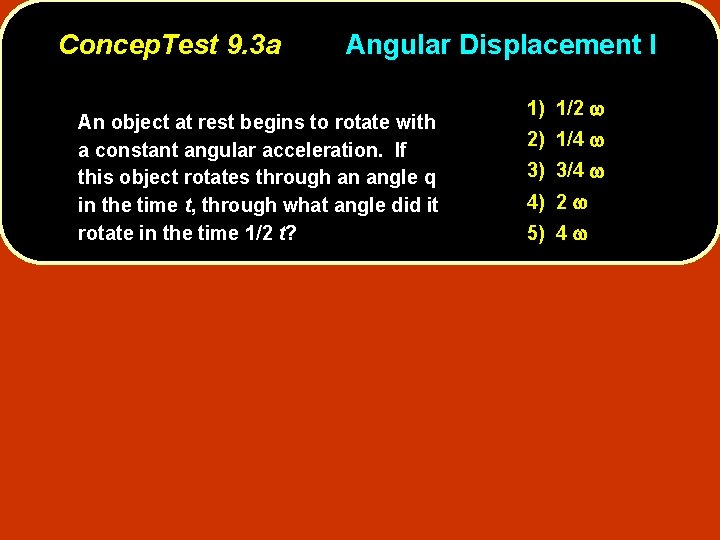
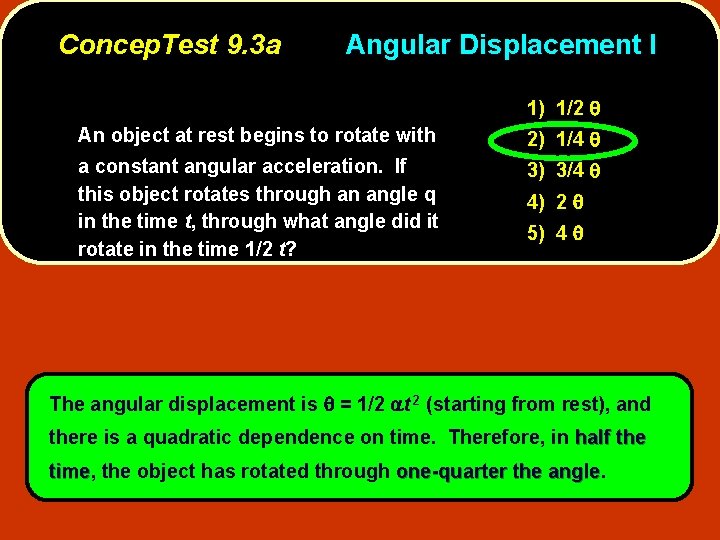
Concep. Test 9. 3 a Angular Displacement I An object at rest begins to rotate with a constant angular acceleration. If this object rotates through an angle q in the time t, through what angle did it rotate in the time 1/2 t? 1) 1/2 2) 1/4 3) 3/4 4) 2 5) 4
Concep. Test 9. 3 a Angular Displacement I 1) 1/2 An object at rest begins to rotate with 2) 1/4 a constant angular acceleration. If this object rotates through an angle q in the time t, through what angle did it rotate in the time 1/2 t? 3) 3/4 4) 2 5) 4 The angular displacement is = 1/2 t 2 (starting from rest), and there is a quadratic dependence on time. Therefore, in half the time, time the object has rotated through one-quarter the angle
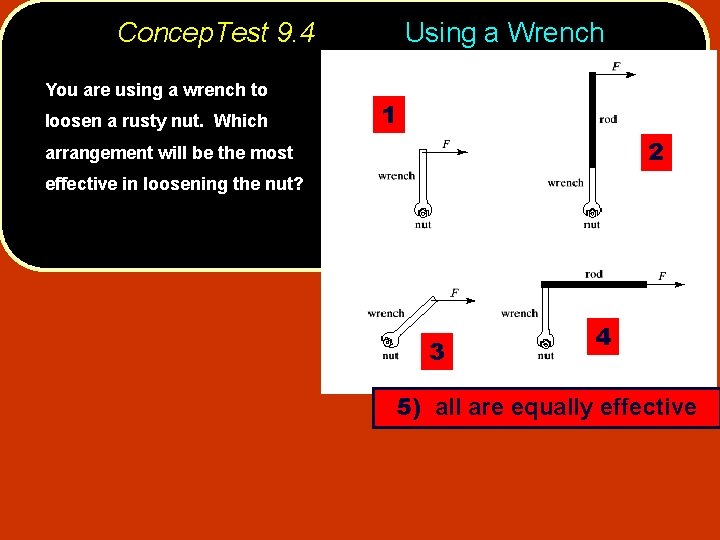
Concep. Test 9. 4 You are using a wrench to loosen a rusty nut. Which Using a Wrench 1 2 arrangement will be the most effective in loosening the nut? 3 4 5) all are equally effective
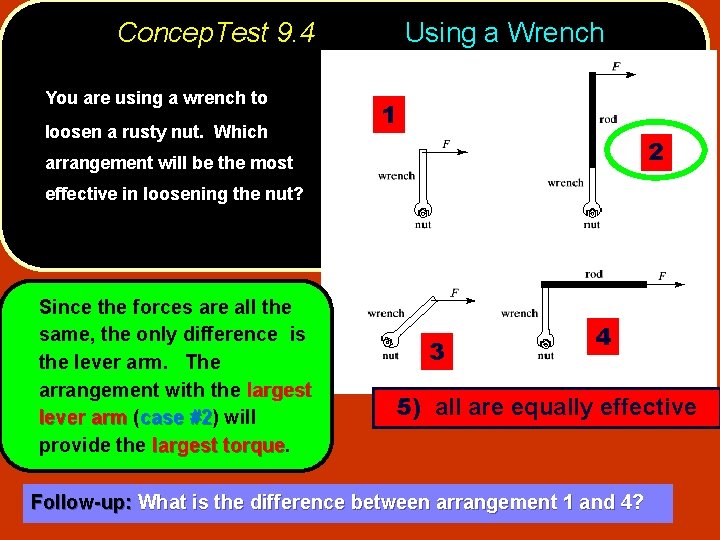
Concep. Test 9. 4 You are using a wrench to loosen a rusty nut. Which Using a Wrench 1 2 arrangement will be the most effective in loosening the nut? Since the forces are all the same, the only difference is the lever arm. The arrangement with the largest lever arm (case #2) #2 will provide the largest torque 3 4 5) all are equally effective Follow-up: What is the difference between arrangement 1 and 4?
Concep. Test 9. 7 When a tape is played on a cassette deck, there is a tension in the tape that applies a torque to the supply reel. Assuming the tension remains constant during playback, how does this applied torque vary as the supply reel becomes empty? Cassette Player 1) torque increases 2) torque decreases 3) torque remains constant
Concep. Test 9. 7 Cassette Player When a tape is played on a cassette deck, there is a tension in the tape that applies a torque to the supply reel. Assuming the tension remains constant during playback, how does this applied torque vary as the supply reel becomes empty? 1) torque increases 2) torque decreases 3) torque remains constant As the supply reel empties, the lever arm decreases because the radius of the reel (with tape on it) is decreasing. Thus, as the playback continues, the applied torque diminishes.
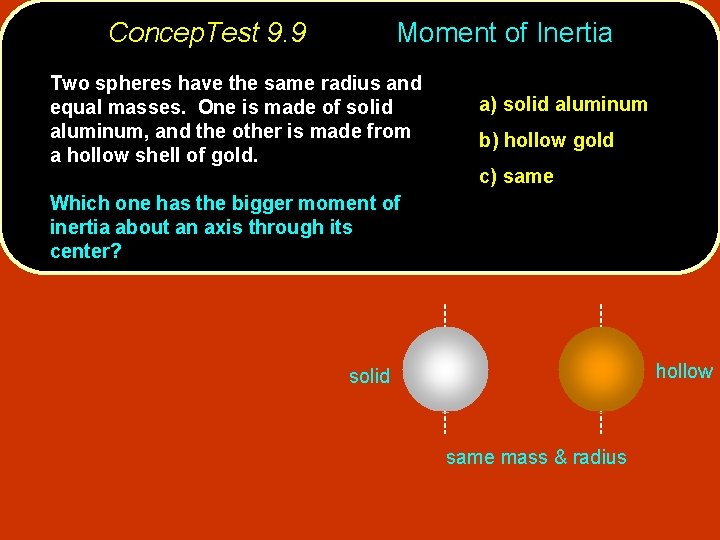
Concep. Test 9. 9 Moment of Inertia Two spheres have the same radius and equal masses. One is made of solid aluminum, and the other is made from a hollow shell of gold. a) solid aluminum b) hollow gold c) same Which one has the bigger moment of inertia about an axis through its center? hollow solid same mass & radius
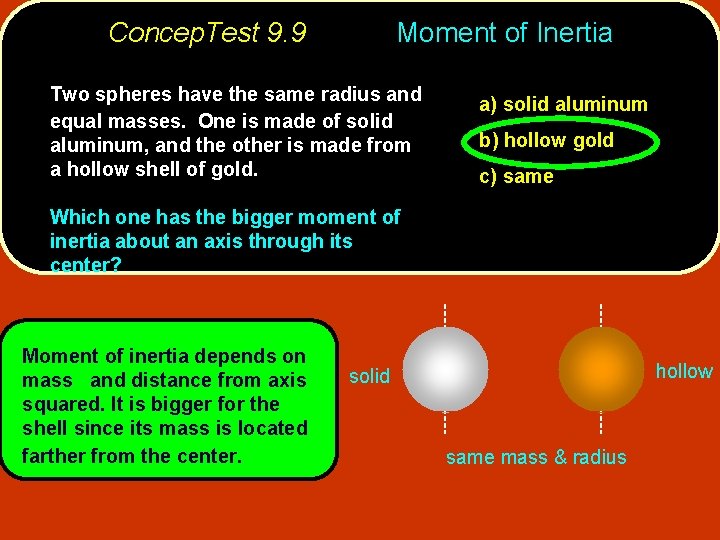
Concep. Test 9. 9 Moment of Inertia Two spheres have the same radius and equal masses. One is made of solid aluminum, and the other is made from a hollow shell of gold. a) solid aluminum b) hollow gold c) same Which one has the bigger moment of inertia about an axis through its center? Moment of inertia depends on mass and distance from axis squared. It is bigger for the shell since its mass is located farther from the center. hollow solid same mass & radius
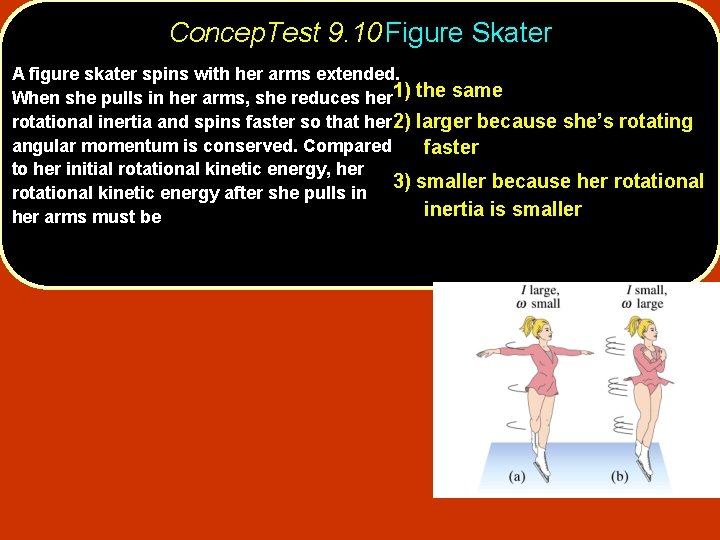
Concep. Test 9. 10 Figure Skater A figure skater spins with her arms extended. When she pulls in her arms, she reduces her 1) the same rotational inertia and spins faster so that her 2) larger because she’s rotating angular momentum is conserved. Compared faster to her initial rotational kinetic energy, her 3) smaller because her rotational kinetic energy after she pulls in inertia is smaller her arms must be
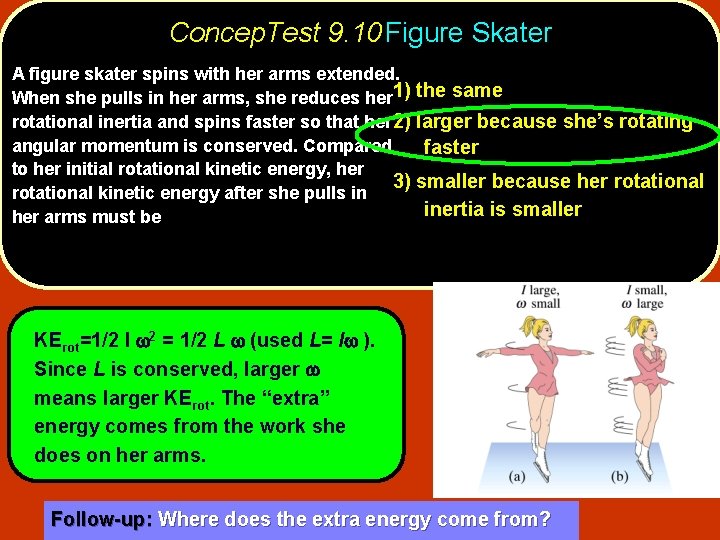
Concep. Test 9. 10 Figure Skater A figure skater spins with her arms extended. When she pulls in her arms, she reduces her 1) the same rotational inertia and spins faster so that her 2) larger because she’s rotating angular momentum is conserved. Compared faster to her initial rotational kinetic energy, her 3) smaller because her rotational kinetic energy after she pulls in inertia is smaller her arms must be KErot=1/2 I 2 = 1/2 L (used L= I ). Since L is conserved, larger means larger KErot. The “extra” energy comes from the work she does on her arms. Follow-up: Where does the extra energy come from?