
Lecture 7 B PART 3 Higher order functions

Lecture 7 B: PART 3 Higher order functions COMP 1100

Acknowledgement of Country ü I wish to acknowledge the traditional custodians of the land we are meeting on, the Ngunnawal people. I wish to acknowledge and respect their continuing culture and the contribution they make to the life of this city and this region. I would also like to acknowledge and welcome any other Aboriginal and Torres Strait Islander people who are enrolled in our courses. 2
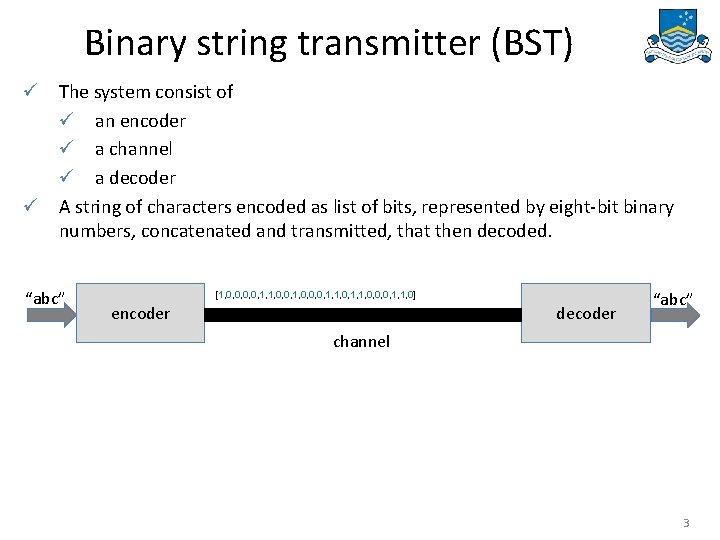
Binary string transmitter (BST) ü The system consist of ü an encoder ü a channel ü a decoder ü A string of characters encoded as list of bits, represented by eight-bit binary numbers, concatenated and transmitted, that then decoded. “abc” [1, 0, 0, 1, 1, 0, 0, 0, 1, 1, 0] encoder decoder “abc” channel 3
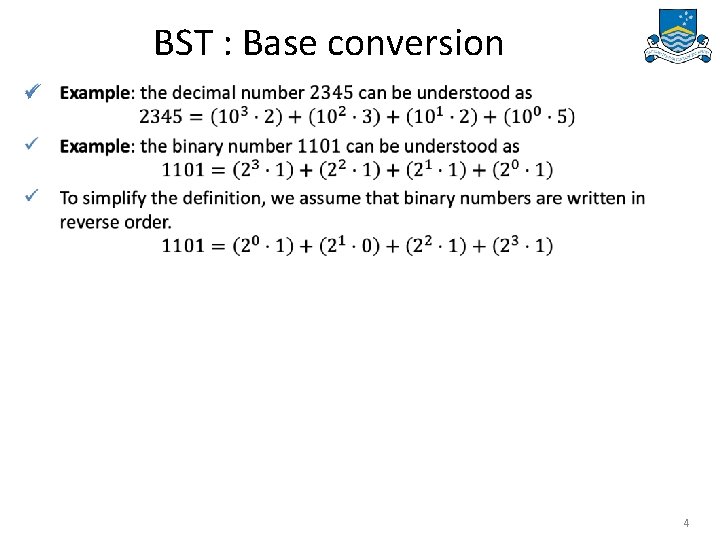
BST : Base conversion ü 4
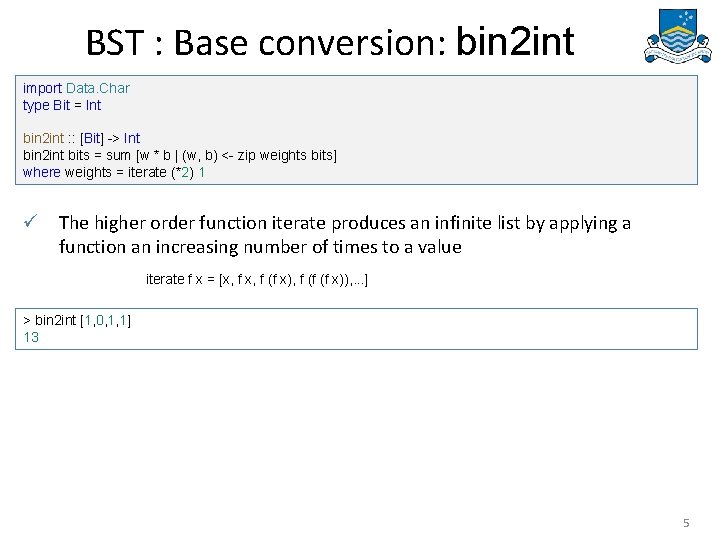
BST : Base conversion: bin 2 int import Data. Char type Bit = Int bin 2 int : : [Bit] -> Int bin 2 int bits = sum [w * b | (w, b) <- zip weights bits] where weights = iterate (*2) 1 ü The higher order function iterate produces an infinite list by applying a function an increasing number of times to a value iterate f x = [x, f (f x), f (f (f x)), . . . ] > bin 2 int [1, 0, 1, 1] 13 5
BST : Base conversion: bin 2 int ü 6
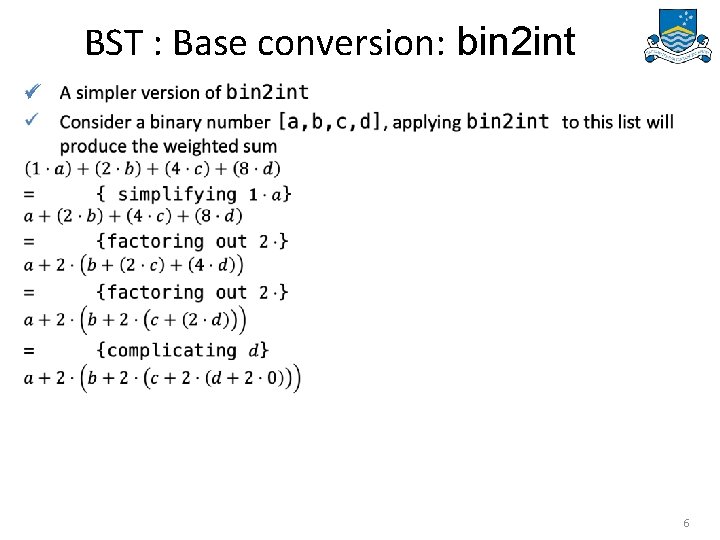
![BST : Base conversion: bin 2 int ü bin 2 int : : [Bit]](http://slidetodoc.com/presentation_image_h2/4871b0ef33605e98c22e9743da69ab81/image-7.jpg "BST : Base conversion: bin 2 int ü bin 2 int : : [Bit]")
BST : Base conversion: bin 2 int ü bin 2 int : : [Bit] -> Int bin 2 int = foldl (x y -> x + 2*y) 0 7
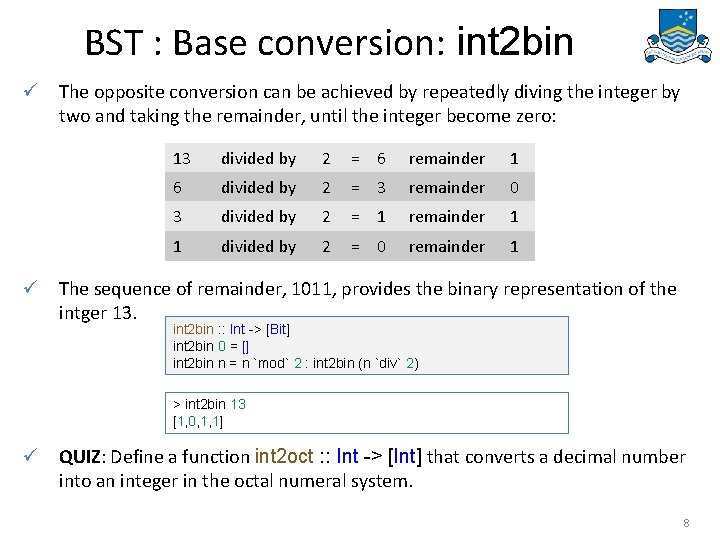
BST : Base conversion: int 2 bin ü The opposite conversion can be achieved by repeatedly diving the integer by two and taking the remainder, until the integer become zero: 13 divided by 2 = 6 remainder 1 6 divided by 2 = 3 remainder 0 3 divided by 2 = 1 remainder 1 1 divided by 2 = 0 remainder 1 ü The sequence of remainder, 1011, provides the binary representation of the intger 13. int 2 bin : : Int -> [Bit] int 2 bin 0 = [] int 2 bin n = n `mod` 2 : int 2 bin (n `div` 2) > int 2 bin 13 [1, 0, 1, 1] ü QUIZ: Define a function int 2 oct : : Int -> [Int] that converts a decimal number into an integer in the octal numeral system. 8
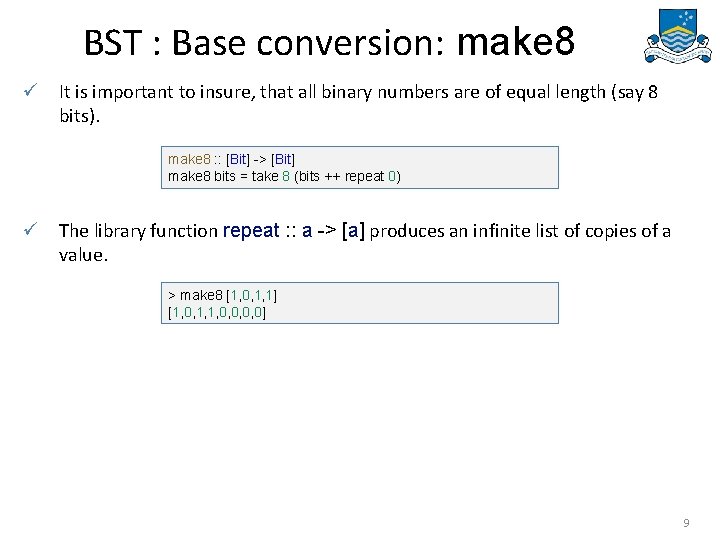
BST : Base conversion: make 8 ü It is important to insure, that all binary numbers are of equal length (say 8 bits). make 8 : : [Bit] -> [Bit] make 8 bits = take 8 (bits ++ repeat 0) ü The library function repeat : : a -> [a] produces an infinite list of copies of a value. > make 8 [1, 0, 1, 1] [1, 0, 1, 1, 0, 0] 9
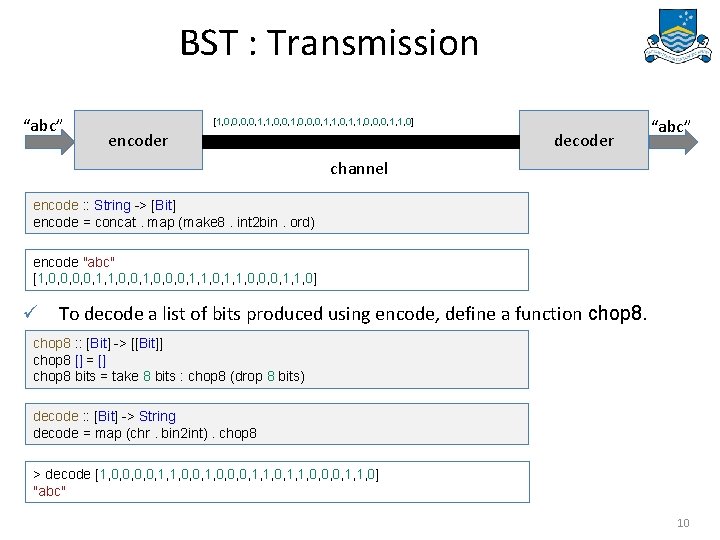
BST : Transmission “abc” [1, 0, 0, 1, 1, 0, 0, 0, 1, 1, 0] encoder decoder “abc” channel encode : : String -> [Bit] encode = concat. map (make 8. int 2 bin. ord) encode "abc" [1, 0, 0, 1, 1, 0, 0, 0, 1, 1, 0] ü To decode a list of bits produced using encode, define a function chop 8 : : [Bit] -> [[Bit]] chop 8 [] = [] chop 8 bits = take 8 bits : chop 8 (drop 8 bits) decode : : [Bit] -> String decode = map (chr. bin 2 int). chop 8 > decode [1, 0, 0, 1, 1, 0, 0, 0, 1, 1, 0] "abc" 10
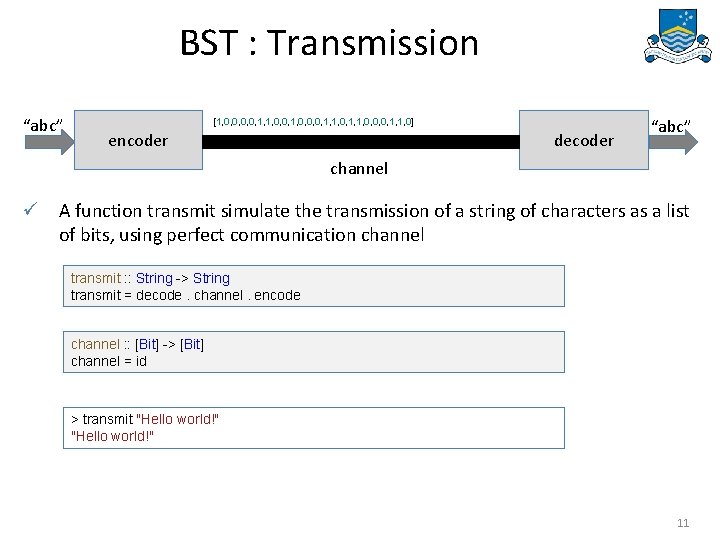
BST : Transmission “abc” [1, 0, 0, 1, 1, 0, 0, 0, 1, 1, 0] encoder decoder “abc” channel ü A function transmit simulate the transmission of a string of characters as a list of bits, using perfect communication channel transmit : : String -> String transmit = decode. channel. encode channel : : [Bit] -> [Bit] channel = id > transmit "Hello world!" 11
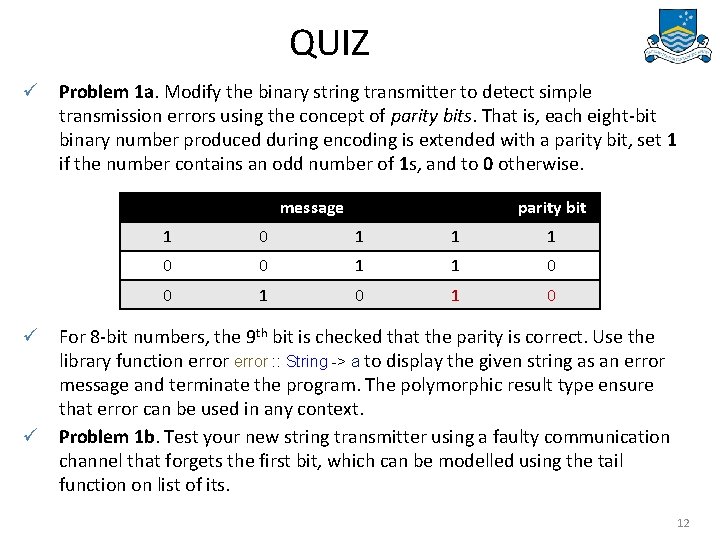
QUIZ ü Problem 1 a. Modify the binary string transmitter to detect simple transmission errors using the concept of parity bits. That is, each eight-bit binary number produced during encoding is extended with a parity bit, set 1 if the number contains an odd number of 1 s, and to 0 otherwise. message parity bit 1 0 1 1 1 0 0 1 0 ü For 8 -bit numbers, the 9 th bit is checked that the parity is correct. Use the library function error : : String -> a to display the given string as an error message and terminate the program. The polymorphic result type ensure that error can be used in any context. ü Problem 1 b. Test your new string transmitter using a faulty communication channel that forgets the first bit, which can be modelled using the tail function on list of its. 12
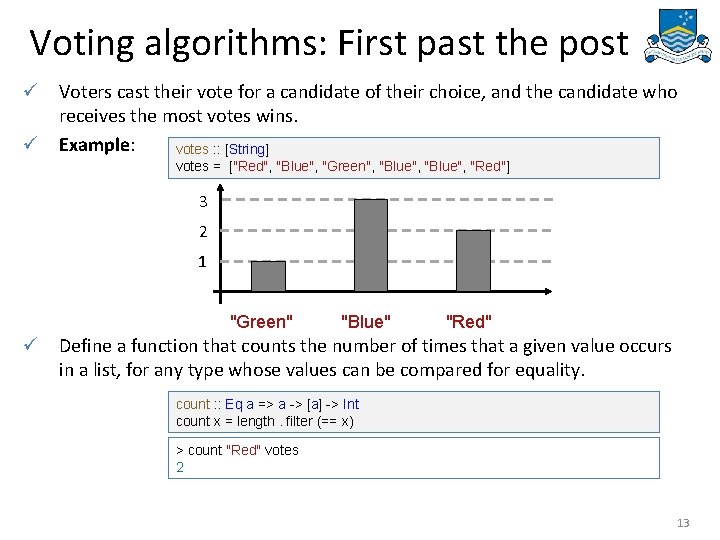
Voting algorithms: First past the post ü Voters cast their vote for a candidate of their choice, and the candidate who receives the most votes wins. ü Example: votes : : [String] votes = ["Red", "Blue", "Green", "Blue", "Red"] 3 2 1 "Green" "Blue" "Red" ü Define a function that counts the number of times that a given value occurs in a list, for any type whose values can be compared for equality. count : : Eq a => a -> [a] -> Int count x = length. filter (== x) > count "Red" votes 2 13
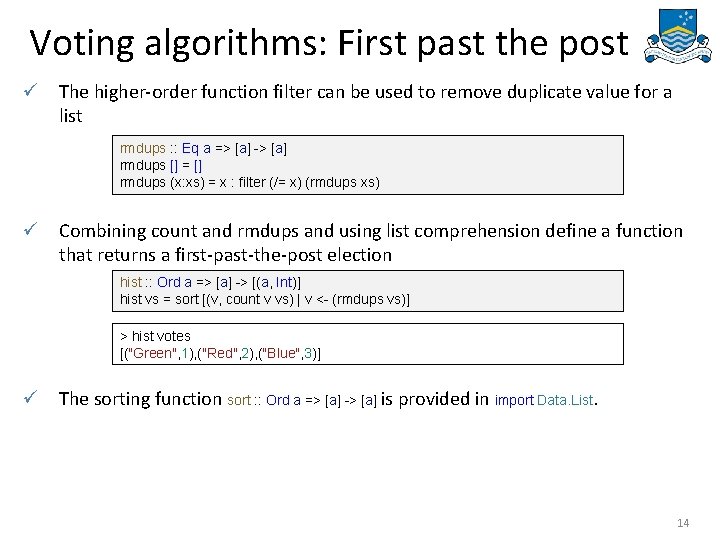
Voting algorithms: First past the post ü The higher-order function filter can be used to remove duplicate value for a list rmdups : : Eq a => [a] -> [a] rmdups [] = [] rmdups (x: xs) = x : filter (/= x) (rmdups xs) ü Combining count and rmdups and using list comprehension define a function that returns a first-past-the-post election hist : : Ord a => [a] -> [(a, Int)] hist vs = sort [(v, count v vs) | v <- (rmdups vs)] > hist votes [("Green", 1), ("Red", 2), ("Blue", 3)] ü The sorting function sort : : Ord a => [a] -> [a] is provided in import Data. List. 14
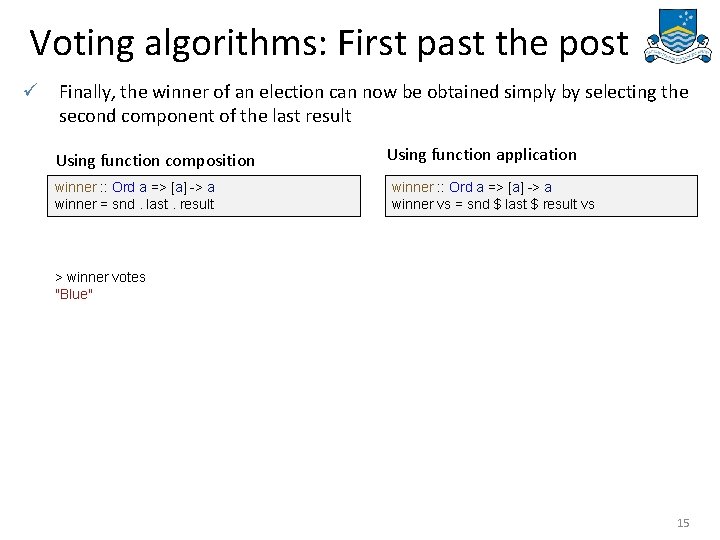
Voting algorithms: First past the post ü Finally, the winner of an election can now be obtained simply by selecting the second component of the last result Using function composition winner : : Ord a => [a] -> a winner = snd. last. result Using function application winner : : Ord a => [a] -> a winner vs = snd $ last $ result vs > winner votes "Blue" 15
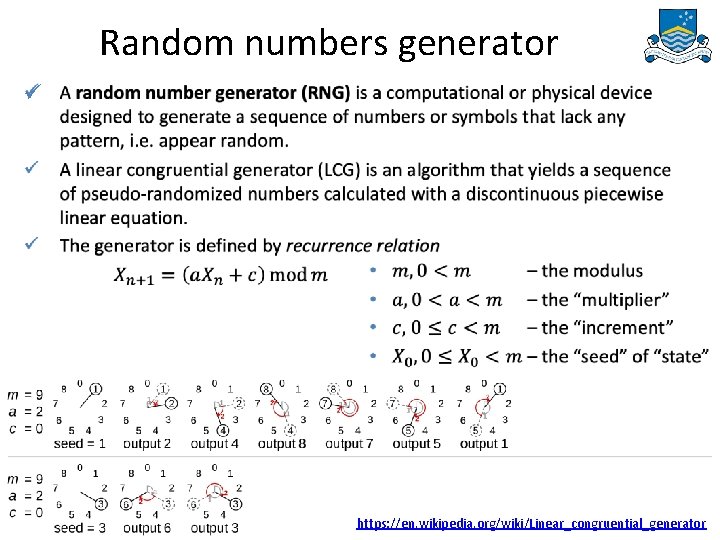
Random numbers generator ü 16 https: //en. wikipedia. org/wiki/Linear_congruential_generator
![Random numbers generator ü rand : : Integer -> [Integer] rand n x_prev =](http://slidetodoc.com/presentation_image_h2/4871b0ef33605e98c22e9743da69ab81/image-17.jpg "Random numbers generator ü rand : : Integer -> [Integer] rand n x_prev =")
Random numbers generator ü rand : : Integer -> [Integer] rand n x_prev = case n of 0 -> [a * x_prev + c] _ -> ((a * head x_next + c) `mod` m): x_next where x_next = rand (n - 1) x_prev a = 25214903917: : Integer c = 11: : Integer m = (2^48): : Integer > rand 5 0 [25707281917278, 102626409374399, 49720483695876, 11718085204285, 277363943098, 11] > map (x -> x `mod` 2) (rand 10 2) [1, 0, 1, 0, 1] 17
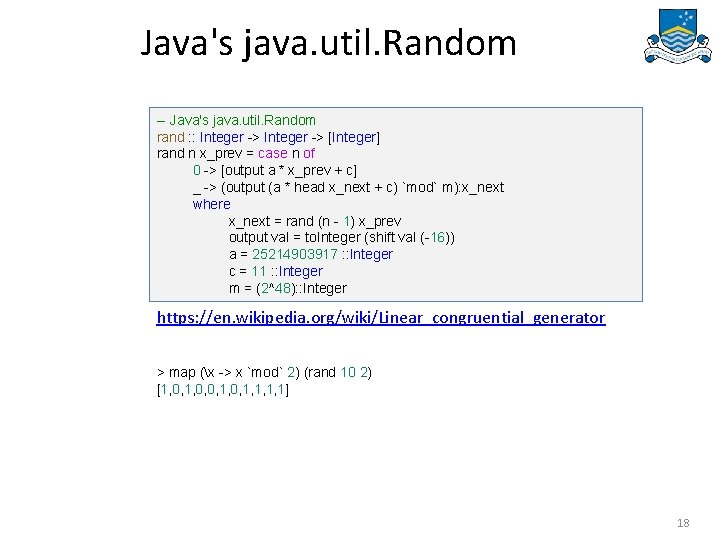
Java's java. util. Random -- Java's java. util. Random rand : : Integer -> [Integer] rand n x_prev = case n of 0 -> [output a * x_prev + c] _ -> (output (a * head x_next + c) `mod` m): x_next where x_next = rand (n - 1) x_prev output val = to. Integer (shift val (-16)) a = 25214903917 : : Integer c = 11 : : Integer m = (2^48): : Integer https: //en. wikipedia. org/wiki/Linear_congruential_generator > map (x -> x `mod` 2) (rand 10 2) [1, 0, 0, 1, 1, 1, 1] 18
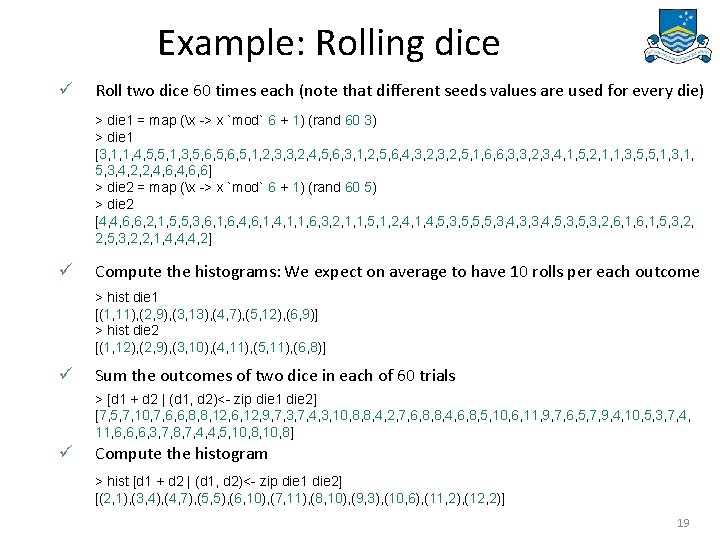
Example: Rolling dice ü Roll two dice 60 times each (note that different seeds values are used for every die) > die 1 = map (x -> x `mod` 6 + 1) (rand 60 3) > die 1 [3, 1, 1, 4, 5, 5, 1, 3, 5, 6, 5, 1, 2, 3, 3, 2, 4, 5, 6, 3, 1, 2, 5, 6, 4, 3, 2, 5, 1, 6, 6, 3, 3, 2, 3, 4, 1, 5, 2, 1, 1, 3, 5, 5, 1, 3, 1, 5, 3, 4, 2, 2, 4, 6, 6] > die 2 = map (x -> x `mod` 6 + 1) (rand 60 5) > die 2 [4, 4, 6, 6, 2, 1, 5, 5, 3, 6, 1, 6, 4, 6, 1, 4, 1, 1, 6, 3, 2, 1, 1, 5, 1, 2, 4, 1, 4, 5, 3, 5, 5, 5, 3, 4, 3, 3, 4, 5, 3, 2, 6, 1, 5, 3, 2, 2, 1, 4, 4, 4, 2] ü Compute the histograms: We expect on average to have 10 rolls per each outcome > hist die 1 [(1, 11), (2, 9), (3, 13), (4, 7), (5, 12), (6, 9)] > hist die 2 [(1, 12), (2, 9), (3, 10), (4, 11), (5, 11), (6, 8)] ü Sum the outcomes of two dice in each of 60 trials > [d 1 + d 2 | (d 1, d 2)<- zip die 1 die 2] [7, 5, 7, 10, 7, 6, 6, 8, 8, 12, 6, 12, 9, 7, 3, 7, 4, 3, 10, 8, 8, 4, 2, 7, 6, 8, 8, 4, 6, 8, 5, 10, 6, 11, 9, 7, 6, 5, 7, 9, 4, 10, 5, 3, 7, 4, 11, 6, 6, 6, 3, 7, 8, 7, 4, 4, 5, 10, 8] ü Compute the histogram > hist [d 1 + d 2 | (d 1, d 2)<- zip die 1 die 2] [(2, 1), (3, 4), (4, 7), (5, 5), (6, 10), (7, 11), (8, 10), (9, 3), (10, 6), (11, 2), (12, 2)] 19
QUIZ ü Problem 1. Without looking at the definitions from the standard prelude, define the higher-order library function curry that convers a function on pairs into a curried function, and, conversely, the function uncurry that convers a curried function with two arguments into a function on pairs. HINT: first write down the types of the two functions. 20
- Slides: 20