
Lecture 7 b EPR spectroscopy Introduction I Electron
Lecture 7 b EPR spectroscopy
Introduction I �Electron Paramagnetic Resonance (EPR), also commonly called Electron Spin Resonance (ESR), was reported by Zavoisky in 1945 �EPR is a versatile and non-destructive spectroscopic method of analysis, which can be applied to inorganic, and biological materials containing one or more unpaired electrons �The technique depends on the resonant absorption of electromagnetic radiation in a magnetic field by magnetic dipoles arising from electrons with net spin (i. e. , an unpaired electron)
Introduction II �Application � Kinetics of radical reactions � Spin trapping � Catalysis � Oxidation and reduction processes � Defects in crystals � Defects in optical fibers � Alanine radiation dosimetry � Archaeological dating � Radiation effects of biological compounds

Physics I �EPR is in many way similar to NMR spectroscopy � The electronic Zeeman effect arises from an unpaired electron, which possesses a magnetic moment that assumes one of two orientations in an external magnetic field � The energy separation between these two states, is given as DE = hn = gb. H where h, g, and b are Planck's constant, the Lande spectroscopic splitting factor, and the Bohr magneton � The Bohr magneton is eh/4 pmc with e and m as the charge and mass of the electron and c as the speed of light � The g-factor is a proportionality constant approximately equal to a value of two for most organic radicals but may vary as high as six for some transition metals such as iron in heme proteins
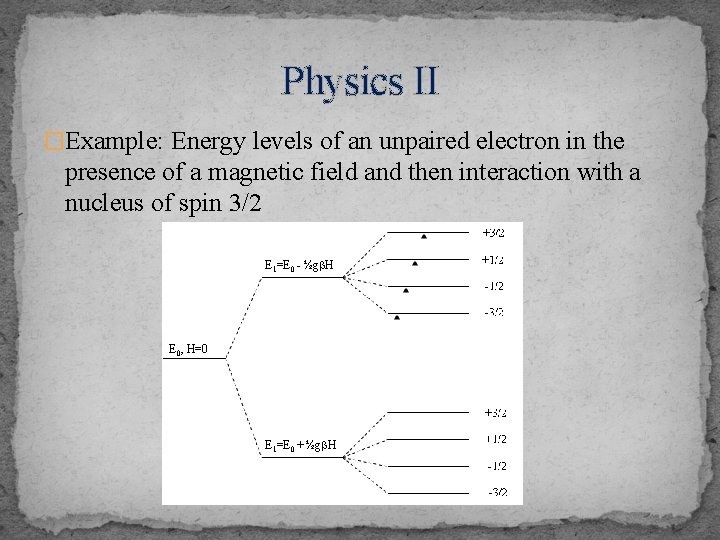
Physics II �Example: Energy levels of an unpaired electron in the presence of a magnetic field and then interaction with a nucleus of spin 3/2 E 1=E 0 - ½gb. H E 0, H=0 E 1=E 0 + ½gb. H
Physics III �A nuclear spin of I, when interacting with the electronic spin, perturbs the energy of the system in such a way that each electronic state is further split into 2 I+1 sublevels, as further shown above �For n nuclei, there can be 2 n. I+1 resonances (lines) �Since the magneton is inversely related to the mass of the particle, the nuclear magneton is about 1000 times smaller than the Bohr magneton for the electron �Therefore, the energy separations between these sublevels are small. The required energies fall in the radiofrequency range

Example I � Copper(II) acetylacetonate (Cu(acac)2) � Copper has two nuclear magnetically active isotopes. Both isotopes have a nuclear spin of 3/2, but they vary in their natural abundance. � The 63 Cu isotope has a natural abundance of 69% while the 65 Cu isotope has a natural abundance of 31%. � Since the nuclear magnetogyric ratios are quite similar with 7. 09 for 63 Cu and 7. 60 for 65 Cu, the hyperfine coupling to each isotope is nearly identical. � As a result, the ESR spectrum shows four resonances as it couples to the one nuclear spin 3/2 in each molecule.
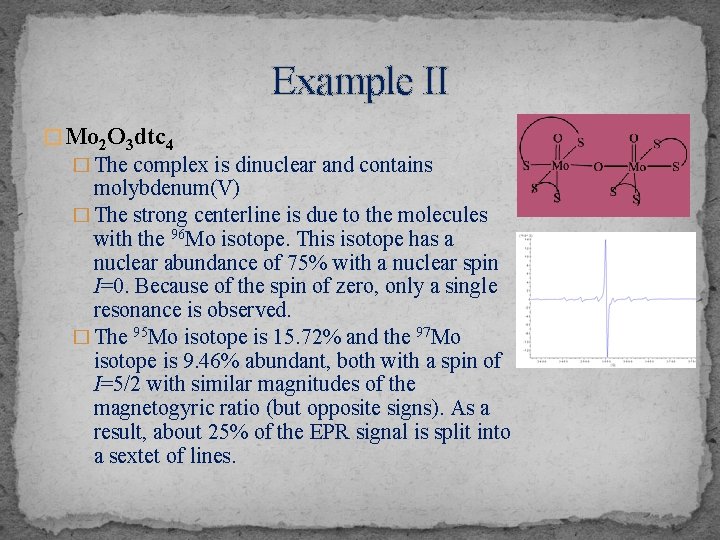
Example II � Mo 2 O 3 dtc 4 � The complex is dinuclear and contains molybdenum(V) � The strong centerline is due to the molecules with the 96 Mo isotope. This isotope has a nuclear abundance of 75% with a nuclear spin I=0. Because of the spin of zero, only a single resonance is observed. � The 95 Mo isotope is 15. 72% and the 97 Mo isotope is 9. 46% abundant, both with a spin of I=5/2 with similar magnitudes of the magnetogyric ratio (but opposite signs). As a result, about 25% of the EPR signal is split into a sextet of lines.
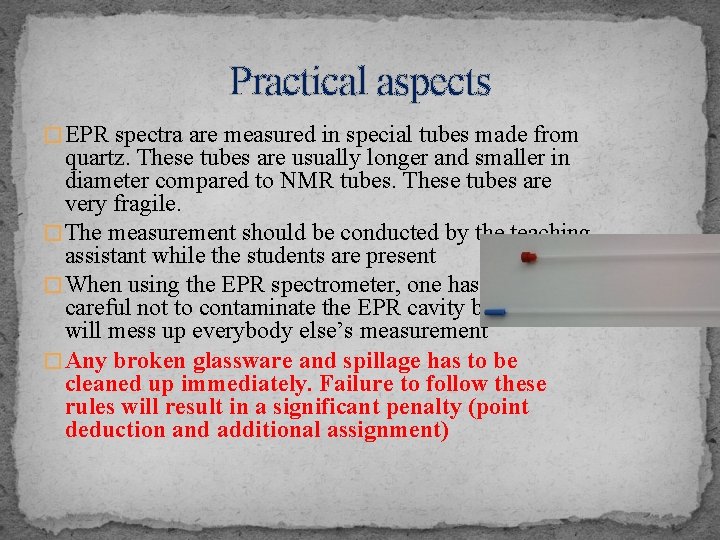
Practical aspects � EPR spectra are measured in special tubes made from quartz. These tubes are usually longer and smaller in diameter compared to NMR tubes. These tubes are very fragile. � The measurement should be conducted by the teaching assistant while the students are present � When using the EPR spectrometer, one has to be careful not to contaminate the EPR cavity because this will mess up everybody else’s measurement � Any broken glassware and spillage has to be cleaned up immediately. Failure to follow these rules will result in a significant penalty (point deduction and additional assignment)
- Slides: 9