
Lecture 7 Arrays Dynamic Arrays Copy Constructors Absolute
Lecture 7 Arrays, Dynamic Arrays & Copy Constructors “Absolute C++” Sections 5. 1 - 5. 3, 10. 2
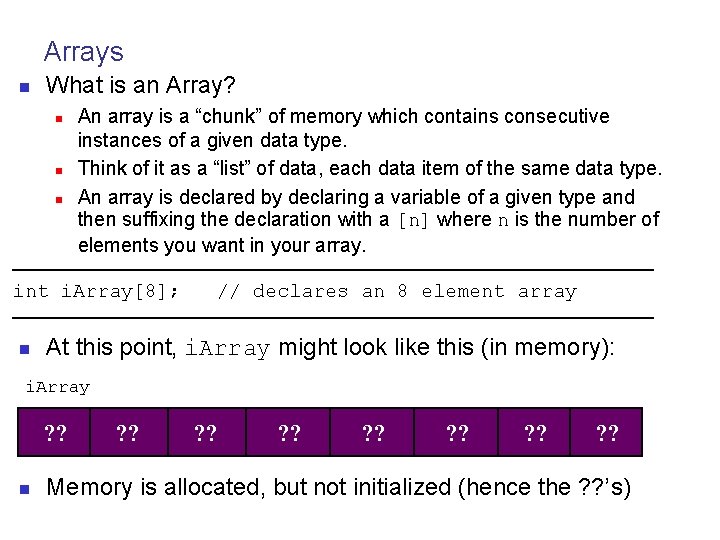
Arrays n What is an Array? n n n An array is a “chunk” of memory which contains consecutive instances of a given data type. Think of it as a “list” of data, each data item of the same data type. An array is declared by declaring a variable of a given type and then suffixing the declaration with a [n] where n is the number of elements you want in your array. int i. Array[8]; n // declares an 8 element array At this point, i. Array might look like this (in memory): i. Array ? ? n ? ? ? ? Memory is allocated, but not initialized (hence the ? ? ’s)
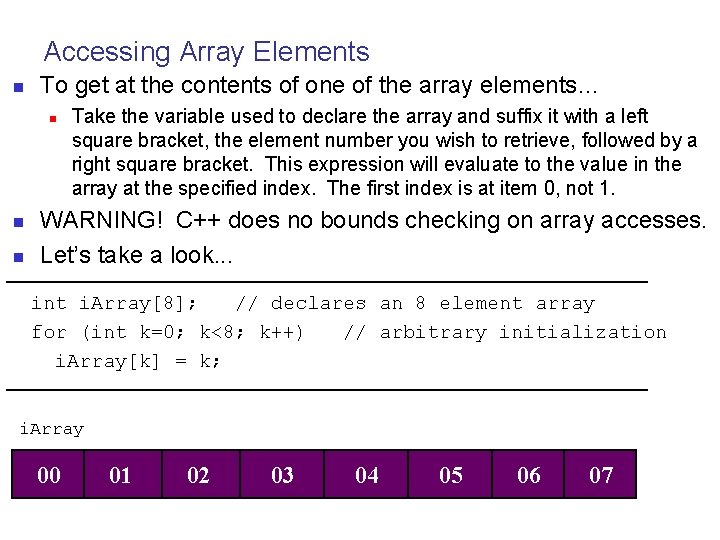
Accessing Array Elements n To get at the contents of one of the array elements… n n n Take the variable used to declare the array and suffix it with a left square bracket, the element number you wish to retrieve, followed by a right square bracket. This expression will evaluate to the value in the array at the specified index. The first index is at item 0, not 1. WARNING! C++ does no bounds checking on array accesses. Let’s take a look. . . int i. Array[8]; // declares an 8 element array for (int k=0; k<8; k++) // arbitrary initialization i. Array[k] = k; i. Array 00 01 02 03 04 05 06 07
![Pointers in Array Declarations n What’s the difference between. . . int *j[4]; int](http://slidetodoc.com/presentation_image_h2/12b8daf6aeda48f3f3897e6e86b1431b/image-4.jpg "Pointers in Array Declarations n What’s the difference between. . . int *j[4]; int")
Pointers in Array Declarations n What’s the difference between. . . int *j[4]; int (*p)[4]; n The first declaration is an array of 4 pointers to int j int n int The second is a pointer to an array of 4 integers p int int
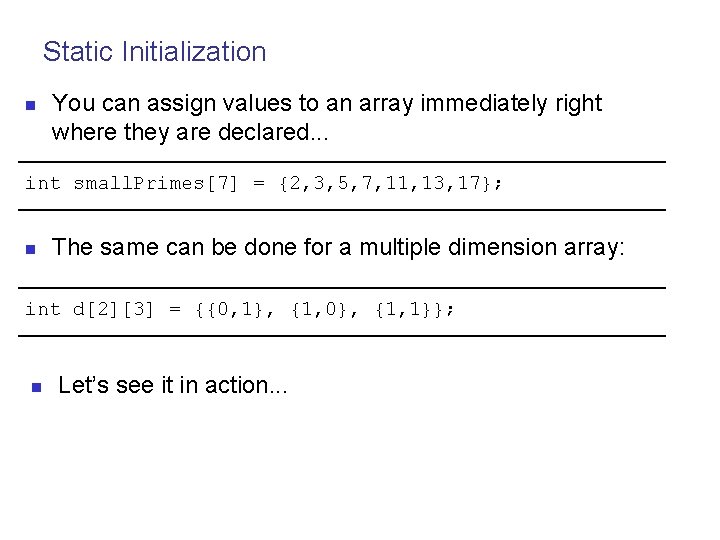
Static Initialization n You can assign values to an array immediately right where they are declared. . . int small. Primes[7] = {2, 3, 5, 7, 11, 13, 17}; n The same can be done for a multiple dimension array: int d[2][3] = {{0, 1}, {1, 0}, {1, 1}}; n Let’s see it in action. . .
Demonstration #1 Basic Arrays
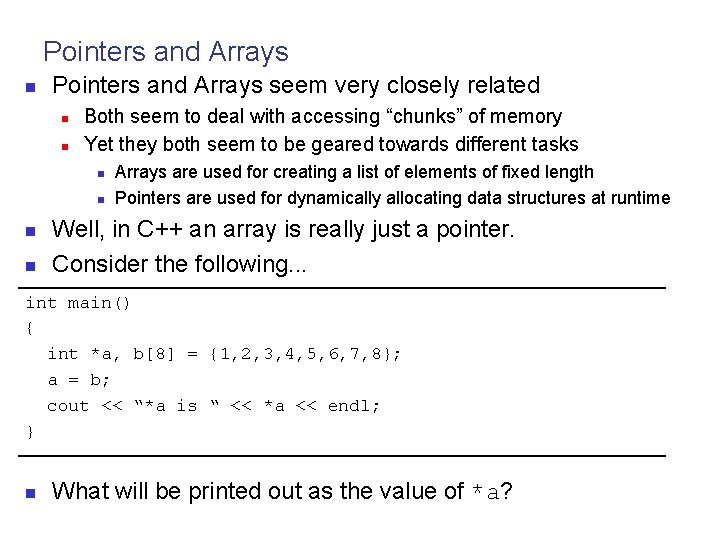
Pointers and Arrays n Pointers and Arrays seem very closely related n n Both seem to deal with accessing “chunks” of memory Yet they both seem to be geared towards different tasks n n Arrays are used for creating a list of elements of fixed length Pointers are used for dynamically allocating data structures at runtime Well, in C++ an array is really just a pointer. Consider the following. . . int main() { int *a, b[8] = {1, 2, 3, 4, 5, 6, 7, 8}; a = b; cout << “*a is “ << *a << endl; } n What will be printed out as the value of *a?
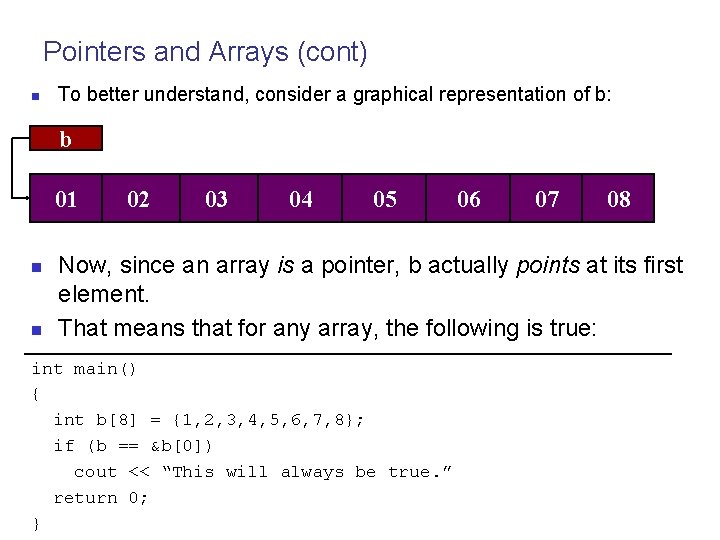
Pointers and Arrays (cont) n To better understand, consider a graphical representation of b: b 01 n n 02 03 04 05 06 07 08 Now, since an array is a pointer, b actually points at its first element. That means that for any array, the following is true: int main() { int b[8] = {1, 2, 3, 4, 5, 6, 7, 8}; if (b == &b[0]) cout << “This will always be true. ” return 0; }
Demonstration #2 Sanity Check (Arrays as Pointers)
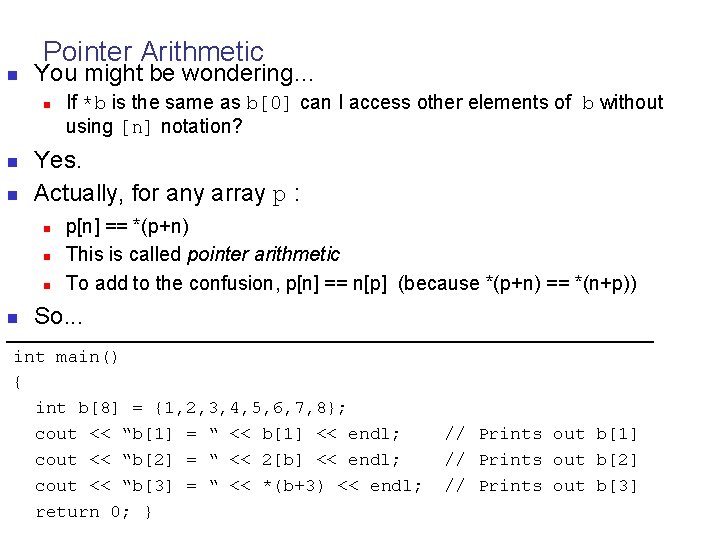
Pointer Arithmetic n You might be wondering… n n n Yes. Actually, for any array p : n n If *b is the same as b[0] can I access other elements of b without using [n] notation? p[n] == *(p+n) This is called pointer arithmetic To add to the confusion, p[n] == n[p] (because *(p+n) == *(n+p)) So. . . int main() { int b[8] = {1, 2, 3, 4, 5, 6, 7, 8}; cout << “b[1] = “ << b[1] << endl; cout << “b[2] = “ << 2[b] << endl; cout << “b[3] = “ << *(b+3) << endl; return 0; } // Prints out b[1] // Prints out b[2] // Prints out b[3]
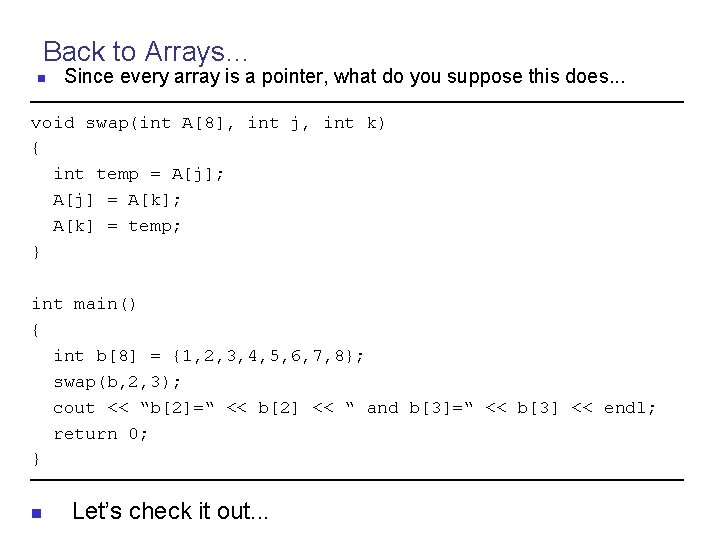
Back to Arrays… n Since every array is a pointer, what do you suppose this does. . . void swap(int A[8], int j, int k) { int temp = A[j]; A[j] = A[k]; A[k] = temp; } int main() { int b[8] = {1, 2, 3, 4, 5, 6, 7, 8}; swap(b, 2, 3); cout << “b[2]=“ << b[2] << “ and b[3]=“ << b[3] << endl; return 0; } n Let’s check it out. . .
Demonstration #3 Pointers as Parameters
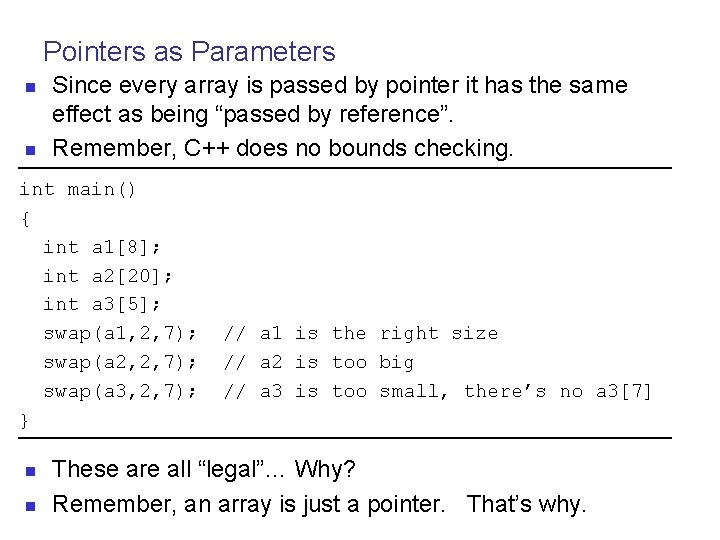
Pointers as Parameters n n Since every array is passed by pointer it has the same effect as being “passed by reference”. Remember, C++ does no bounds checking. int main() { int a 1[8]; int a 2[20]; int a 3[5]; swap(a 1, 2, 7); swap(a 2, 2, 7); swap(a 3, 2, 7); } n n // a 1 is the right size // a 2 is too big // a 3 is too small, there’s no a 3[7] These are all “legal”… Why? Remember, an array is just a pointer. That’s why.
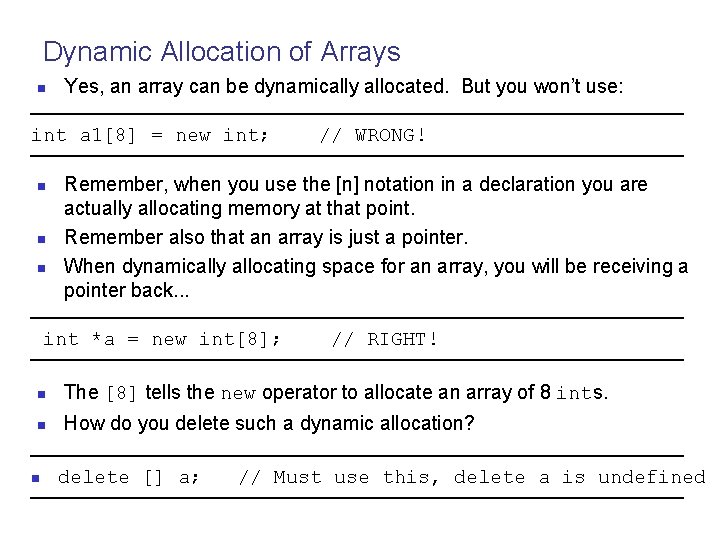
Dynamic Allocation of Arrays n Yes, an array can be dynamically allocated. But you won’t use: int a 1[8] = new int; n n n // WRONG! Remember, when you use the [n] notation in a declaration you are actually allocating memory at that point. Remember also that an array is just a pointer. When dynamically allocating space for an array, you will be receiving a pointer back. . . int *a = new int[8]; // RIGHT! n The [8] tells the new operator to allocate an array of 8 ints. n How do you delete such a dynamic allocation? n delete [] a; // Must use this, delete a is undefined
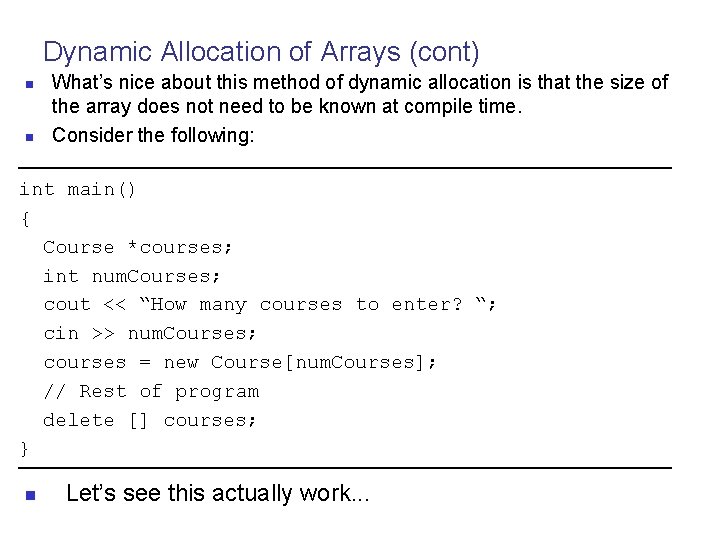
Dynamic Allocation of Arrays (cont) n n What’s nice about this method of dynamic allocation is that the size of the array does not need to be known at compile time. Consider the following: int main() { Course *courses; int num. Courses; cout << “How many courses to enter? “; cin >> num. Courses; courses = new Course[num. Courses]; // Rest of program delete [] courses; } n Let’s see this actually work. . .
Demonstration #4 Dynamic Allocation of Arrays
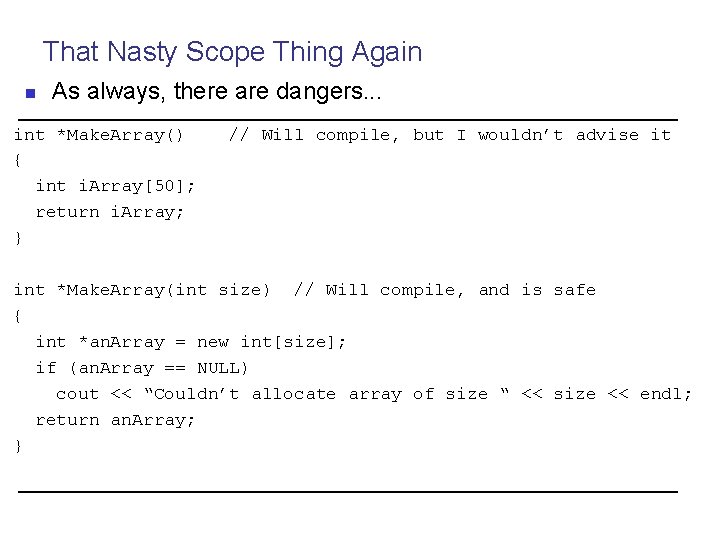
That Nasty Scope Thing Again n As always, there are dangers. . . int *Make. Array() { int i. Array[50]; return i. Array; } // Will compile, but I wouldn’t advise it int *Make. Array(int size) // Will compile, and is safe { int *an. Array = new int[size]; if (an. Array == NULL) cout << “Couldn’t allocate array of size “ << size << endl; return an. Array; }
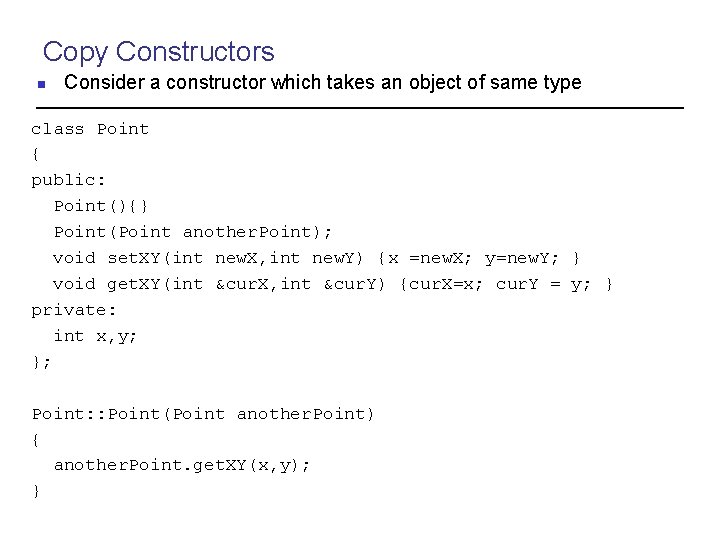
Copy Constructors n Consider a constructor which takes an object of same type class Point { public: Point(){} Point(Point another. Point); void set. XY(int new. X, int new. Y) {x =new. X; y=new. Y; } void get. XY(int &cur. X, int &cur. Y) {cur. X=x; cur. Y = y; } private: int x, y; }; Point: : Point(Point another. Point) { another. Point. get. XY(x, y); }
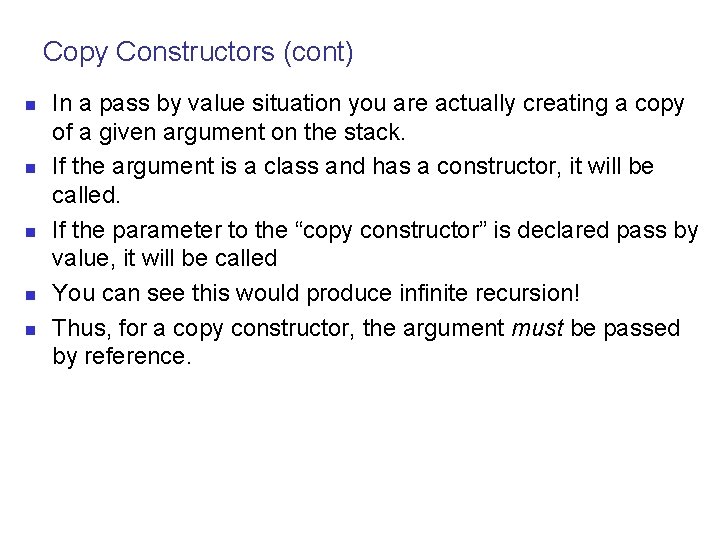
Copy Constructors (cont) n n n In a pass by value situation you are actually creating a copy of a given argument on the stack. If the argument is a class and has a constructor, it will be called. If the parameter to the “copy constructor” is declared pass by value, it will be called You can see this would produce infinite recursion! Thus, for a copy constructor, the argument must be passed by reference.
Lecture 7 Final Thoughts
- Slides: 20