
Lecture 6 WAN Data Link Layer Protocols 1




- Slides: 43
Lecture 6: WAN Data Link Layer Protocols 1 nd semester 1438 -1439 By: Adal ALashban 1
WANs - As we have learned, all WAN connections consist of three basic elements: 1 - The physical transmission media. 2 - Electrical signaling specifications for generating, transmitting, and receiving signals through various transmission media. 3 - Data link layer protocols. 2
WAN Data Link Layer Protocols - In addition to Physical layer devices, WANs require Data Link layer protocols to provide communication between two devices across the communication line. - Because there are many different ways to connect devices, there are many different data link protocols. - Data link protocols may provide any of the following services: Framing. Session setup and termination. Error detection. Addressing on a multipoint medium. 3
WAN Data Link Layer Protocols - The Data Link protocols may span only the local loop, span across regions, or even go intercontinental. - This is unlike the physical layer transmission technologies that are only concerned with moving electrical signals from customer location to the central office for processing. 4
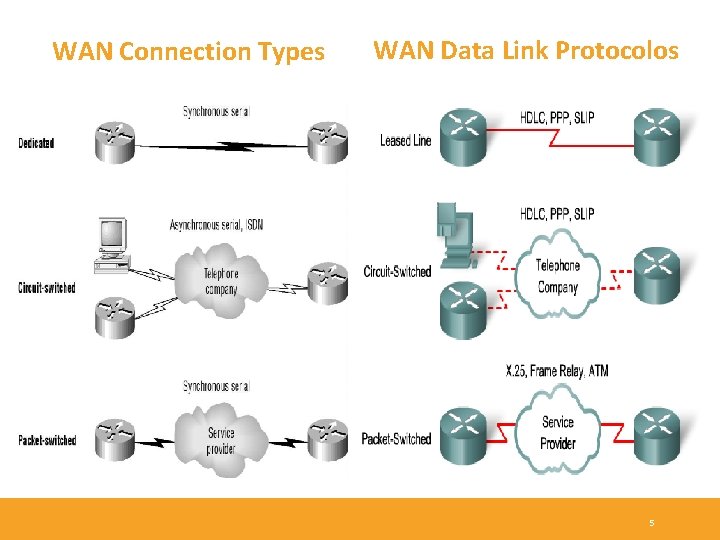
WAN Connection Types WAN Data Link Protocolos 5
WAN Data Link Layer Protocols - Each WAN connection type uses a Data Link layer protocol to encapsulate a packet while it is crossing the WAN link. - The choice of encapsulation protocols depends on the WAN technology and the equipment. - In the previous slide, a figure displays the more common WAN protocols and where they are used. 6
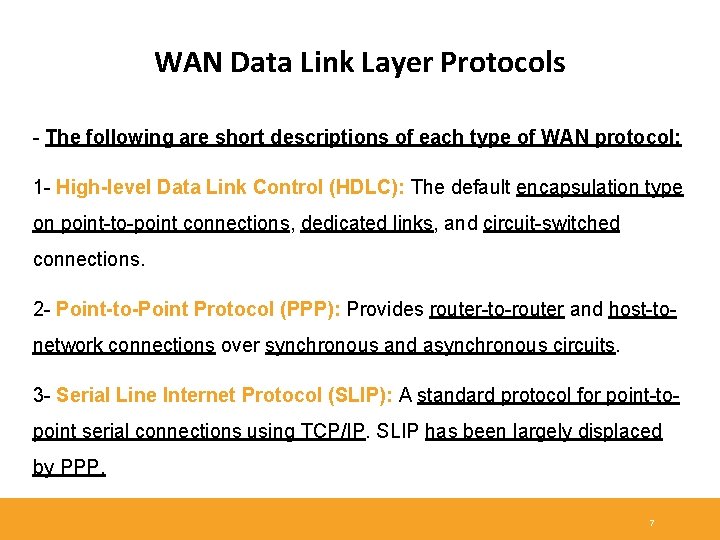
WAN Data Link Layer Protocols - The following are short descriptions of each type of WAN protocol: 1 - High-level Data Link Control (HDLC): The default encapsulation type on point-to-point connections, dedicated links, and circuit-switched connections. 2 - Point-to-Point Protocol (PPP): Provides router-to-router and host-tonetwork connections over synchronous and asynchronous circuits. 3 - Serial Line Internet Protocol (SLIP): A standard protocol for point-topoint serial connections using TCP/IP. SLIP has been largely displaced by PPP. 7
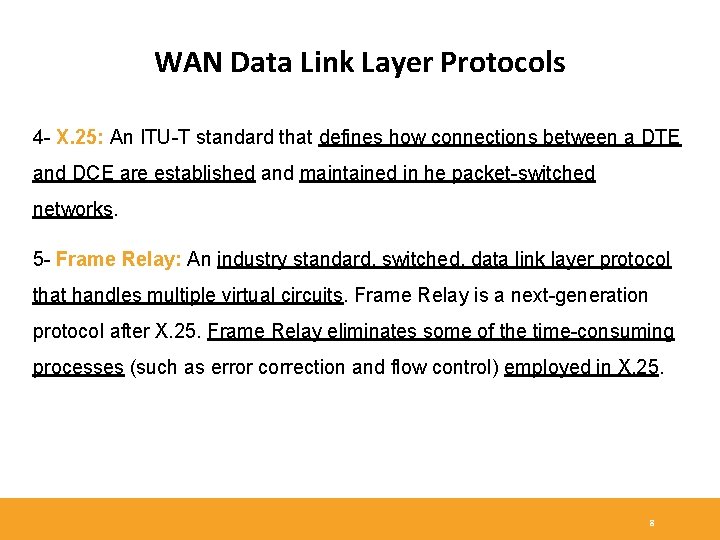
WAN Data Link Layer Protocols 4 - X. 25: An ITU-T standard that defines how connections between a DTE and DCE are established and maintained in he packet-switched networks. 5 - Frame Relay: An industry standard, switched, data link layer protocol that handles multiple virtual circuits. Frame Relay is a next-generation protocol after X. 25. Frame Relay eliminates some of the time-consuming processes (such as error correction and flow control) employed in X. 25. 8
WAN Data Link Layer Protocols 6 - Asynchronous Transfer Mode (ATM): The international standard for cell relay in which devices send multiple service types, such as voice, video, or data, in fixed-length (53 -byte) cells. Fixed-length cells allow processing to occur in hardware; thereby, reducing transit delays. ATM takes advantage of high-speed transmission media such as E 3, SONET, and T 3. 9
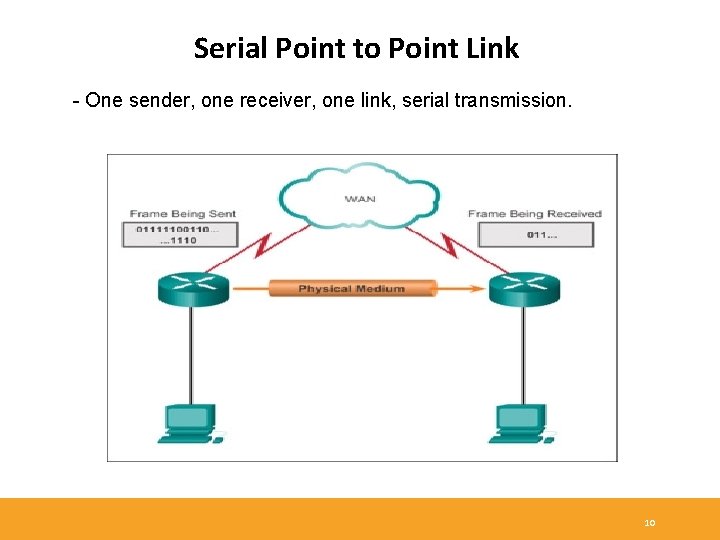
Serial Point to Point Link - One sender, one receiver, one link, serial transmission. 10
Serial Link - WAN technologies are based on serial transmission at the physical layer. - There are many different serial communication standards, each one using a different signaling method. - There are three important serial communication standards affecting LAN-to-WAN connections: V. 35, RS-232, and HSSI - The standard usually defines signal levels, maximum bandwidth, connector pin-out, and electrical characteristics of the serial lines. 11
Transmission Synchronization - Asynchronous Transmission: - Transmitting & Receiving devices maintain their own internal clocks. - They do not synchronize their clocks before communicating. - Data is transmitted in well-defined frames. - The frame includes both information (e. g. , data) and overhead (e. g. control bits). - Each frame begins with a start bit & ends with a stop bit. 12
Transmission Synchronization - Asynchronous transmission advantages: 1. Simple, doesn’t require synchronization of both communication sides. 2. Cheap, timing is not as critical as for synchronous transmission, therefore hardware can be made cheaper. - Asynchronous transmission disadvantages: 1. Large relative overhead, a high proportion of the transmitted bits are uniquely for control purposes and thus carry no useful information. 13
Transmission Synchronization - Synchronous Transmission: - Transmitting device provides clocking. - May use separate channel that is dedicated to the clock. - The clock signal acts a control line that tells the receiver when to read from the data line. - What this means is that the transmitter and receiver must synchronize their access to the data line in order to successfully transmit data. 14
Transmission Synchronization - Synchronous transmission advantages: 1. Lower overhead and thus, greater throughput. - Synchronous transmission disadvantages: 1. Slightly more complex. 2. Hardware is more expensive. 15
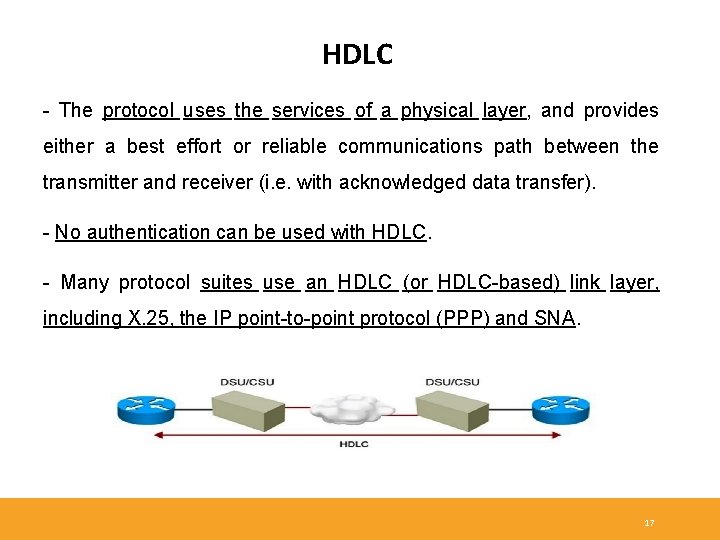
HDLC - High-level Data Link Control (HDLC): is one of the oldest data link layer protocols for the WAN developed by the ISO. - HDLC is a bit-oriented protocol for communication over point-to-point and multipoint links. - Although HDLC can be used for point-to-multipoint connections, the most common usage of HDLC is for point-to-point serial communications. - It supports full-duplex communication. 16
HDLC - The protocol uses the services of a physical layer, and provides either a best effort or reliable communications path between the transmitter and receiver (i. e. with acknowledged data transfer). - No authentication can be used with HDLC. - Many protocol suites use an HDLC (or HDLC-based) link layer, including X. 25, the IP point-to-point protocol (PPP) and SNA. 17
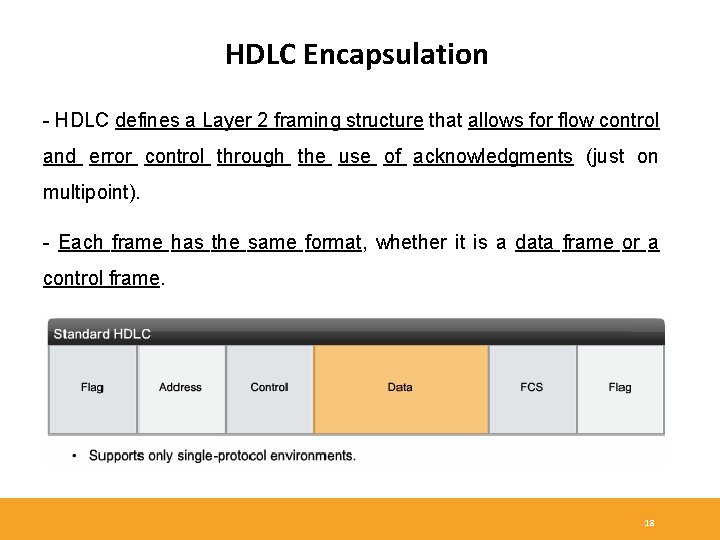
HDLC Encapsulation - HDLC defines a Layer 2 framing structure that allows for flow control and error control through the use of acknowledgments (just on multipoint). - Each frame has the same format, whether it is a data frame or a control frame. 18
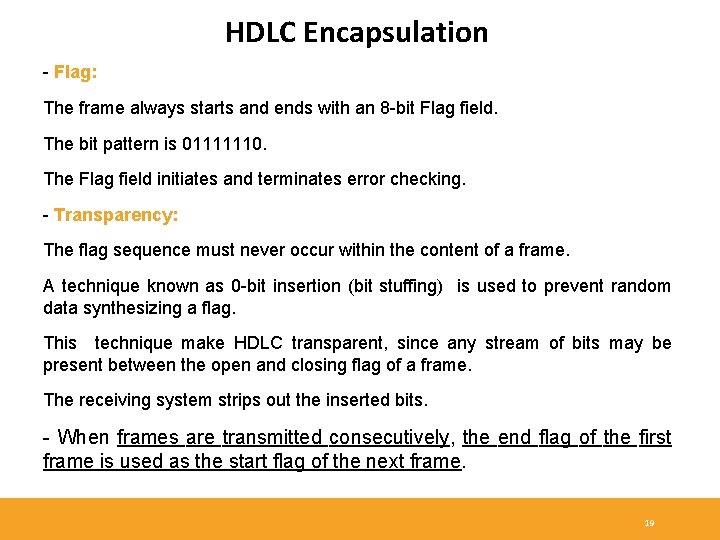
HDLC Encapsulation - Flag: The frame always starts and ends with an 8 -bit Flag field. The bit pattern is 01111110. The Flag field initiates and terminates error checking. - Transparency: The flag sequence must never occur within the content of a frame. A technique known as 0 -bit insertion (bit stuffing) is used to prevent random data synthesizing a flag. This technique make HDLC transparent, since any stream of bits may be present between the open and closing flag of a frame. The receiving system strips out the inserted bits. - When frames are transmitted consecutively, the end flag of the first frame is used as the start flag of the next frame. 19
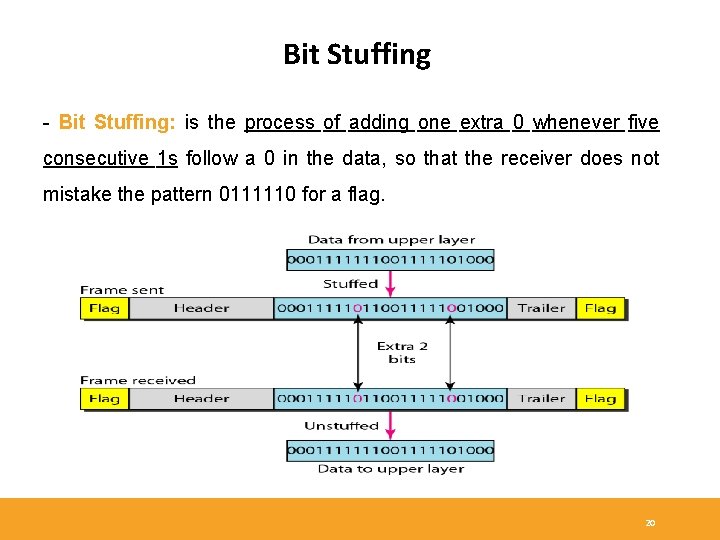
Bit Stuffing - Bit Stuffing: is the process of adding one extra 0 whenever five consecutive 1 s follow a 0 in the data, so that the receiver does not mistake the pattern 0111110 for a flag. 20
HDLC Encapsulation - Address: The address field identifies the secondary station that transmitted or is to receive the frame. This field is not needed for point-to-point links, but is always included for the sake of uniformity. - Control Field: It defines the three types of frames I, U and S Frame for HDLC. - Frame Check Sequence (FCS): Is usually a cyclic redundancy check (CRC) calculation remainder. The CRC calculation is redone in the receiver. If the result differs from the value in the original frame, an error is assumed. 21
HDLC Encapsulation - Control Field - Information (I) frame: I-frames carry upper layer information and some control information. - Supervisory (S) frame: S-frames provide control information. - Unnumbered (U) frame: U-frames support control purposes and are not sequenced. 22
HDLC Encapsulation - HDLC was not intended to encapsulate multiple Network layer protocols across the same link. - The HDLC header carries no identification of the type of protocol being carried inside the HDLC encapsulation. - Because of this, each vendor that uses HDLC has their own way of identifying the Network layer protocol, which means that each vendor’s HDLC is proprietary for their equipment 23
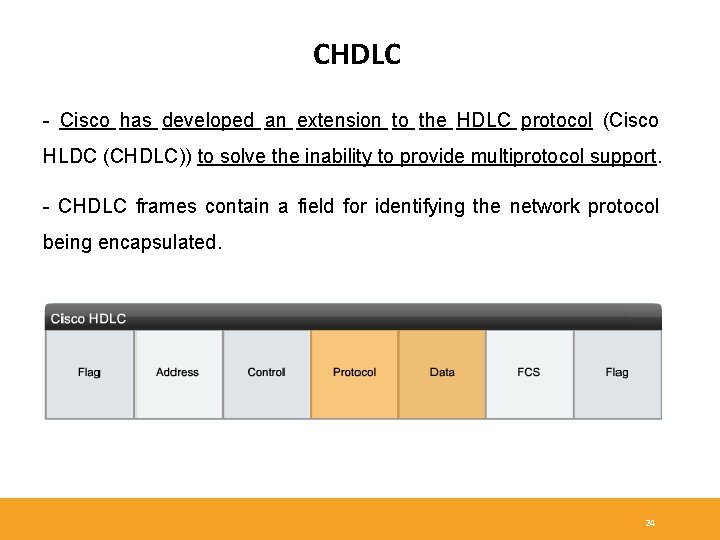
CHDLC - Cisco has developed an extension to the HDLC protocol (Cisco HLDC (CHDLC)) to solve the inability to provide multiprotocol support. - CHDLC frames contain a field for identifying the network protocol being encapsulated. 24
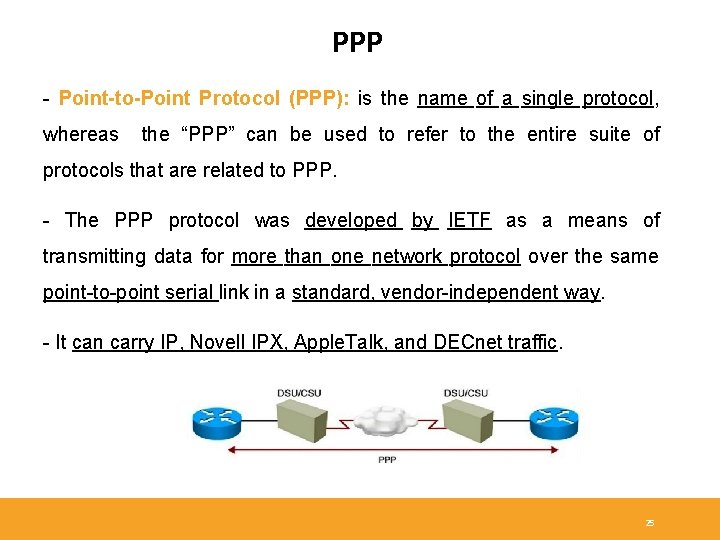
PPP - Point-to-Point Protocol (PPP): is the name of a single protocol, whereas the “PPP” can be used to refer to the entire suite of protocols that are related to PPP. - The PPP protocol was developed by IETF as a means of transmitting data for more than one network protocol over the same point-to-point serial link in a standard, vendor-independent way. - It can carry IP, Novell IPX, Apple. Talk, and DECnet traffic. 25
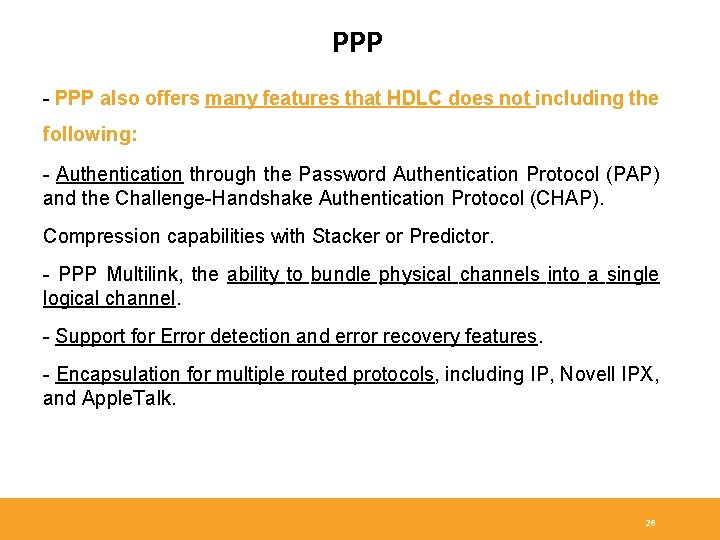
PPP - PPP also offers many features that HDLC does not including the following: - Authentication through the Password Authentication Protocol (PAP) and the Challenge-Handshake Authentication Protocol (CHAP). Compression capabilities with Stacker or Predictor. - PPP Multilink, the ability to bundle physical channels into a single logical channel. - Support for Error detection and error recovery features. - Encapsulation for multiple routed protocols, including IP, Novell IPX, and Apple. Talk. 26
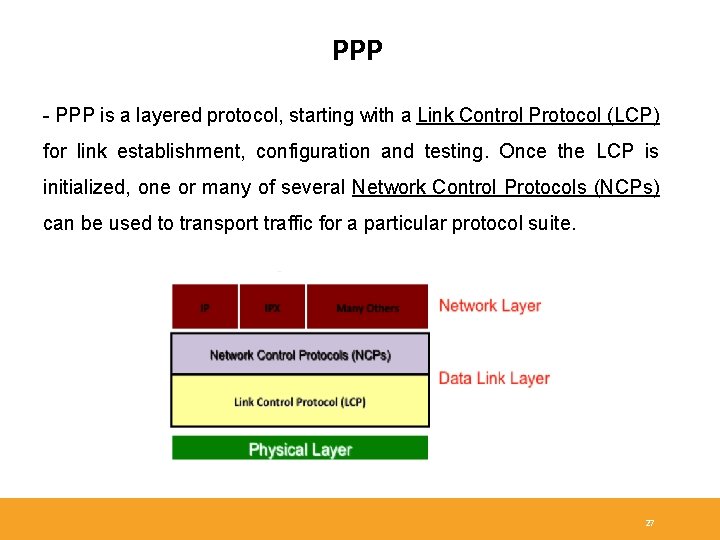
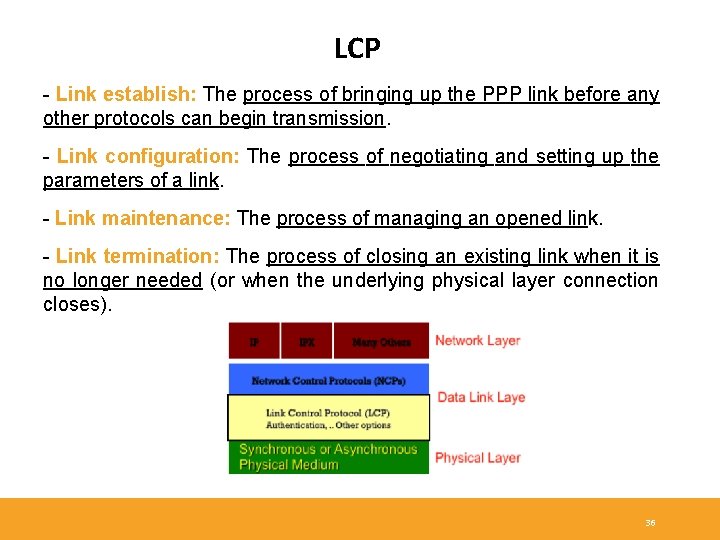
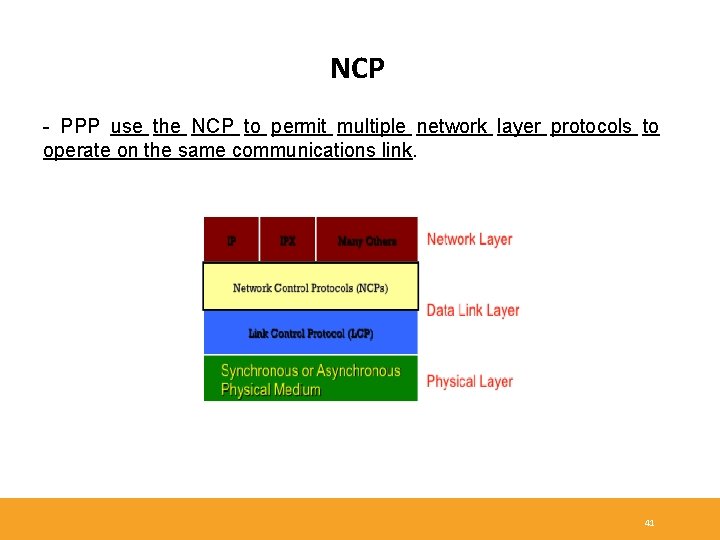
PPP - PPP is a layered protocol, starting with a Link Control Protocol (LCP) for link establishment, configuration and testing. Once the LCP is initialized, one or many of several Network Control Protocols (NCPs) can be used to transport traffic for a particular protocol suite. 27
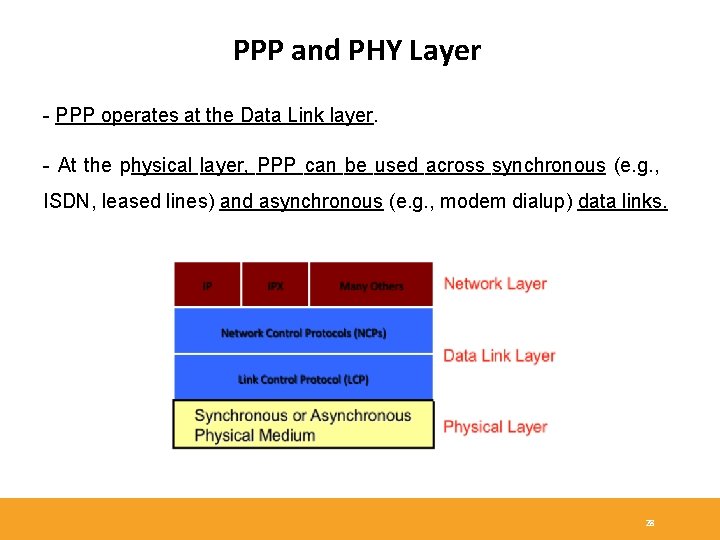
PPP and PHY Layer - PPP operates at the Data Link layer. - At the physical layer, PPP can be used across synchronous (e. g. , ISDN, leased lines) and asynchronous (e. g. , modem dialup) data links. 28
How PPP Work - The mechanism that PPP uses to carry network traffic is to open a link with a short exchange of packets. - Once the link is open, network traffic is carried with very little overhead. Frames are sent as unnumbered information frames, meaning that no data link acknowledgement is required and no retransmissions are carried out. - So once the link is established, PPP acts as a straight data pipe for protocols. 29
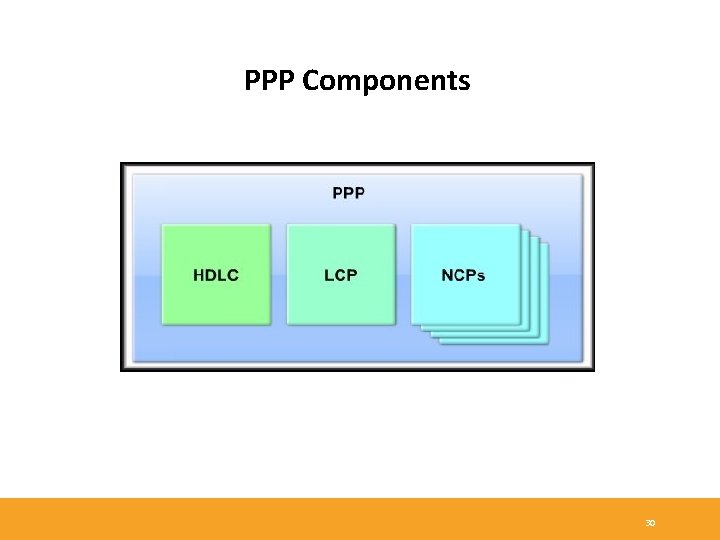
PPP Components 30
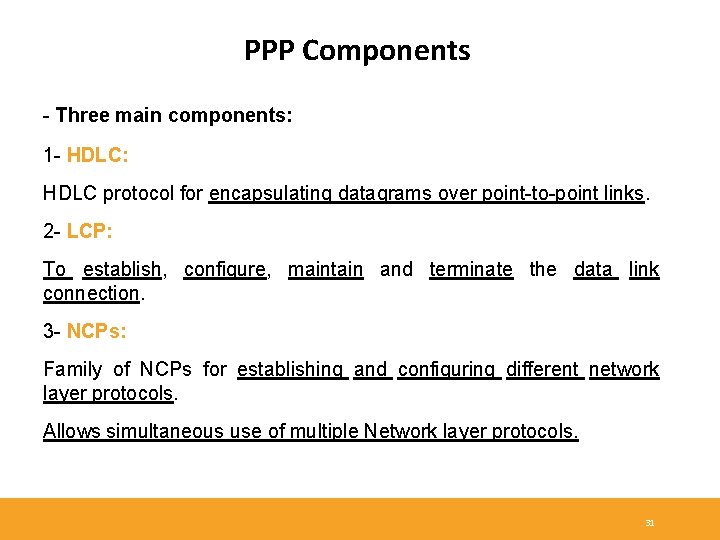
PPP Components - Three main components: 1 - HDLC: HDLC protocol for encapsulating datagrams over point-to-point links. 2 - LCP: To establish, configure, maintain and terminate the data link connection. 3 - NCPs: Family of NCPs for establishing and configuring different network layer protocols. Allows simultaneous use of multiple Network layer protocols. 31
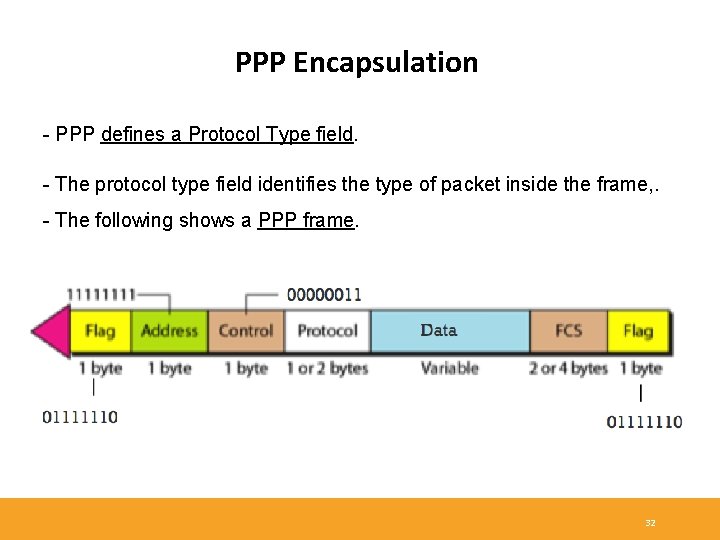
PPP Encapsulation - PPP defines a Protocol Type field. - The protocol type field identifies the type of packet inside the frame, . - The following shows a PPP frame. 32
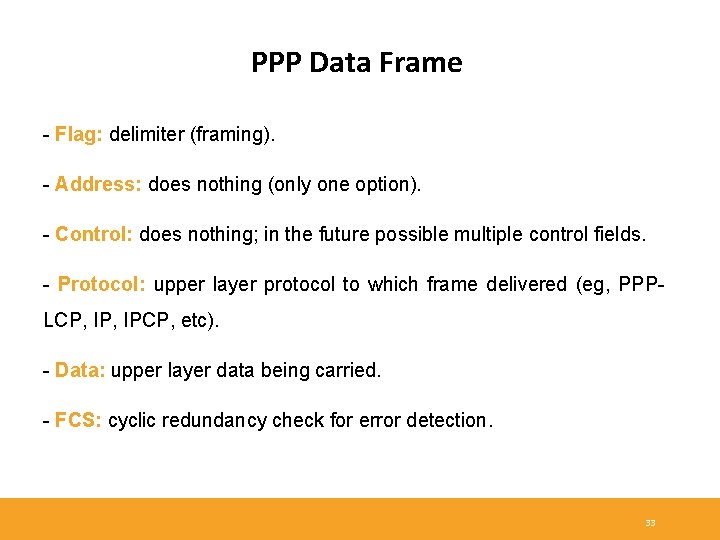
PPP Data Frame - Flag: delimiter (framing). - Address: does nothing (only one option). - Control: does nothing; in the future possible multiple control fields. - Protocol: upper layer protocol to which frame delivered (eg, PPPLCP, IPCP, etc). - Data: upper layer data being carried. - FCS: cyclic redundancy check for error detection. 33
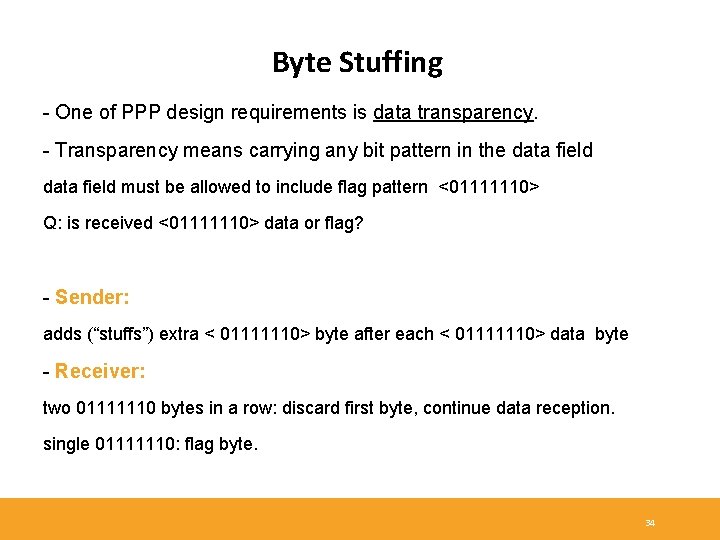
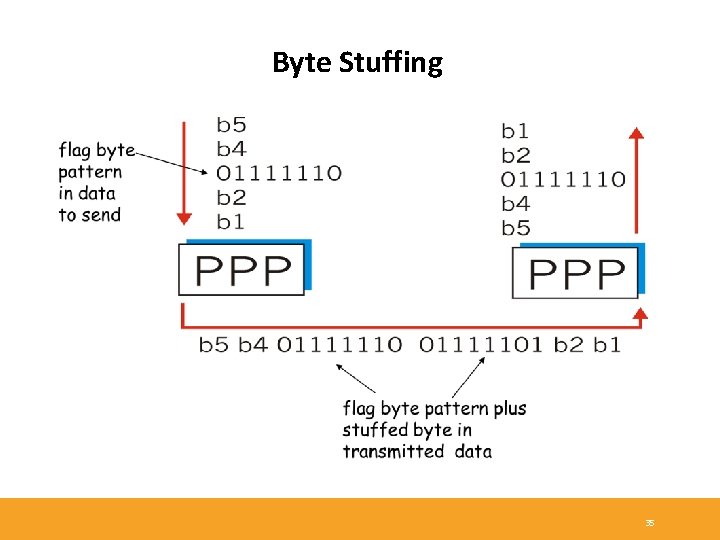
Byte Stuffing - One of PPP design requirements is data transparency. - Transparency means carrying any bit pattern in the data field must be allowed to include flag pattern <01111110> Q: is received <01111110> data or flag? - Sender: adds (“stuffs”) extra < 01111110> byte after each < 01111110> data byte - Receiver: two 01111110 bytes in a row: discard first byte, continue data reception. single 01111110: flag byte. 34
Byte Stuffing 35
LCP - Link establish: The process of bringing up the PPP link before any other protocols can begin transmission. - Link configuration: The process of negotiating and setting up the parameters of a link. - Link maintenance: The process of managing an opened link. - Link termination: The process of closing an existing link when it is no longer needed (or when the underlying physical layer connection closes). 36
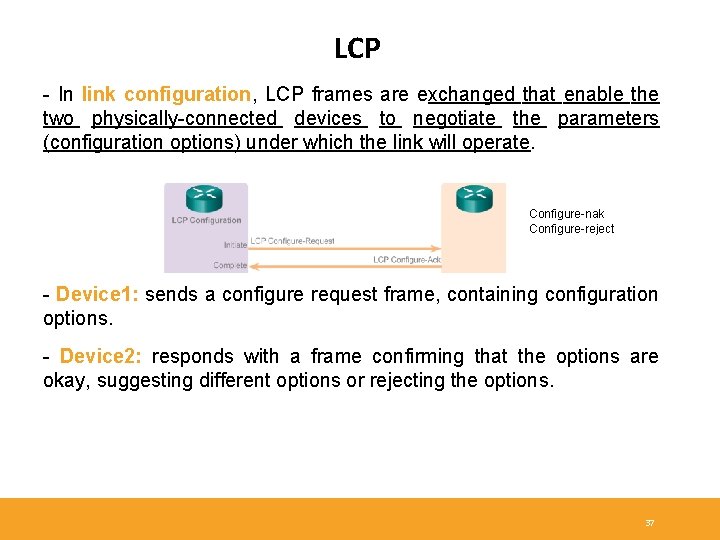
LCP - In link configuration, LCP frames are exchanged that enable the two physically-connected devices to negotiate the parameters (configuration options) under which the link will operate. Configure-nak Configure-reject - Device 1: sends a configure request frame, containing configuration options. - Device 2: responds with a frame confirming that the options are okay, suggesting different options or rejecting the options. 37
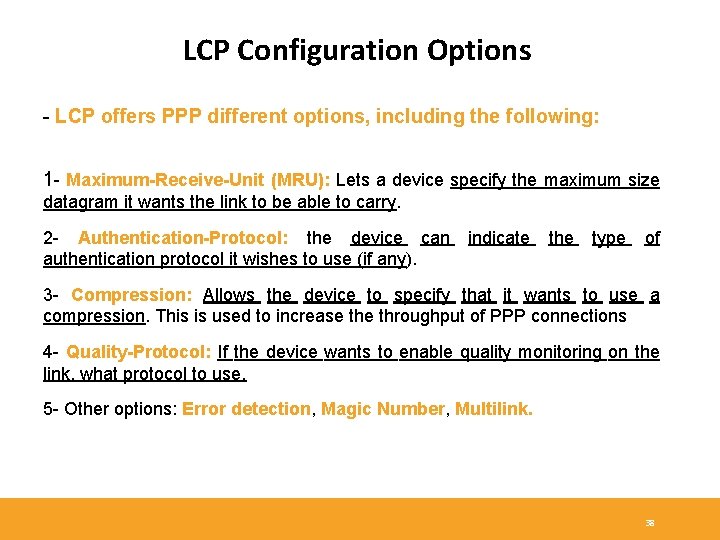
LCP Configuration Options - LCP offers PPP different options, including the following: 1 - Maximum-Receive-Unit (MRU): Lets a device specify the maximum size datagram it wants the link to be able to carry. 2 - Authentication-Protocol: the device can authentication protocol it wishes to use (if any). indicate the type of 3 - Compression: Allows the device to specify that it wants to use a compression. This is used to increase throughput of PPP connections 4 - Quality-Protocol: If the device wants to enable quality monitoring on the link, what protocol to use. 5 - Other options: Error detection, Magic Number, Multilink. 38
LCP - During link maintenance, LCP can use messages to provide feedback and test the link. - Echo-Request, Echo-Reply, and Discard-Request - These frames can be used for testing the link. - Code-Reject and Protocol-Reject - These frame types provide feedback when one device receives an invalid frame due to either an unrecognized LCP code (LCP frame type) or a bad protocol identifier. 39
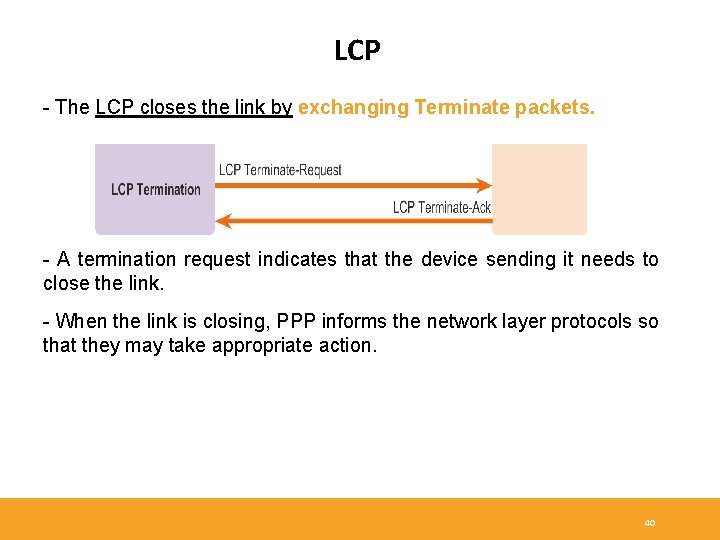
LCP - The LCP closes the link by exchanging Terminate packets. - A termination request indicates that the device sending it needs to close the link. - When the link is closing, PPP informs the network layer protocols so that they may take appropriate action. 40
NCP - PPP use the NCP to permit multiple network layer protocols to operate on the same communications link. 41
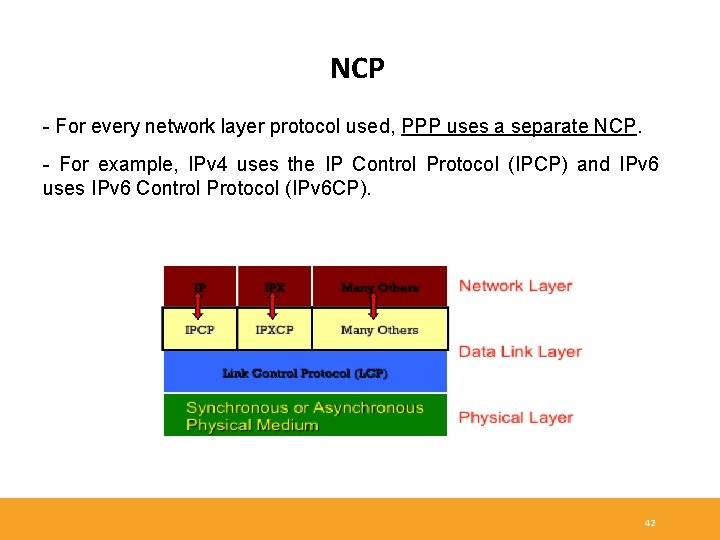
NCP - For every network layer protocol used, PPP uses a separate NCP. - For example, IPv 4 uses the IP Control Protocol (IPCP) and IPv 6 uses IPv 6 Control Protocol (IPv 6 CP). 42
Thank You 43