
Lecture 6 User Requirements The voyage of discovery
- Slides: 34
Lecture 6 User Requirements The voyage of discovery is not in seeking new landscapes but in having new eyes. (Proust, 1923) Notes from Heim Chapter 4 DARPA
Learning Objectives To describe when user requirements are gathered To develop a set of skills for systematic analysis of a problem domain to discover HCI issues and requirements To understand perspectives on data collection including types of stakeholders To be able to collect data by interviews, focus groups and questionnaires To be able to create user profiles 2
User Requirements What users require from the system Objective and testable Ranked: Mandatory Desirable Optional Future enhancement 3
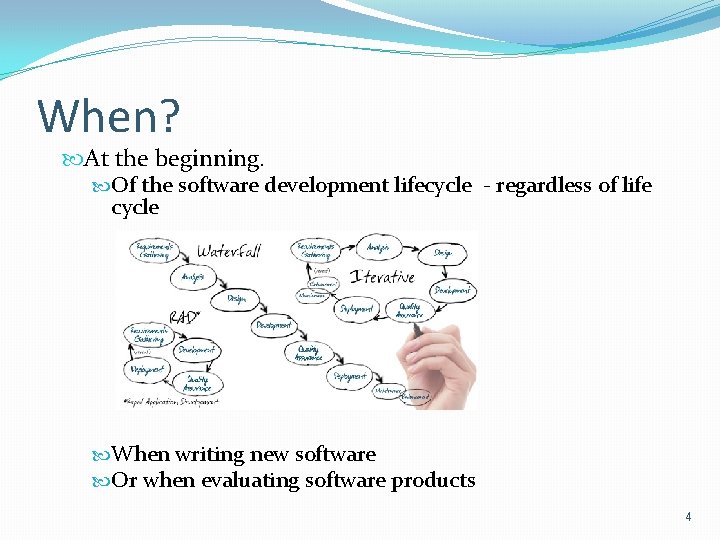
When? At the beginning. Of the software development lifecycle - regardless of life cycle When writing new software Or when evaluating software products 4
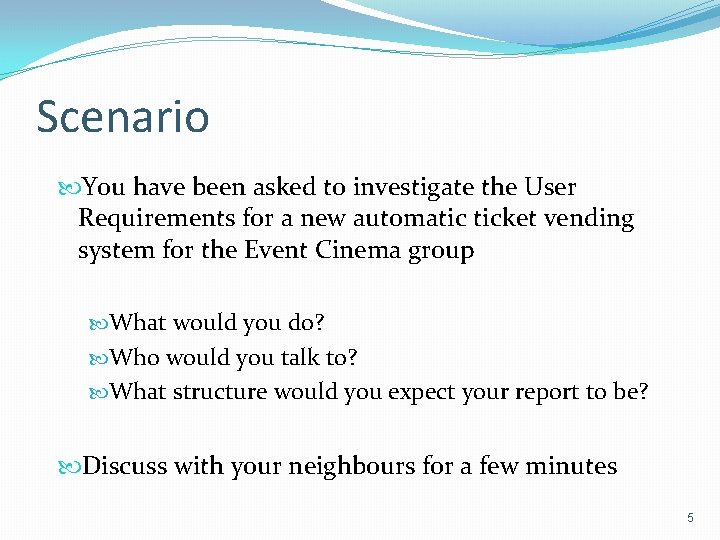
Scenario You have been asked to investigate the User Requirements for a new automatic ticket vending system for the Event Cinema group What would you do? Who would you talk to? What structure would you expect your report to be? Discuss with your neighbours for a few minutes 5
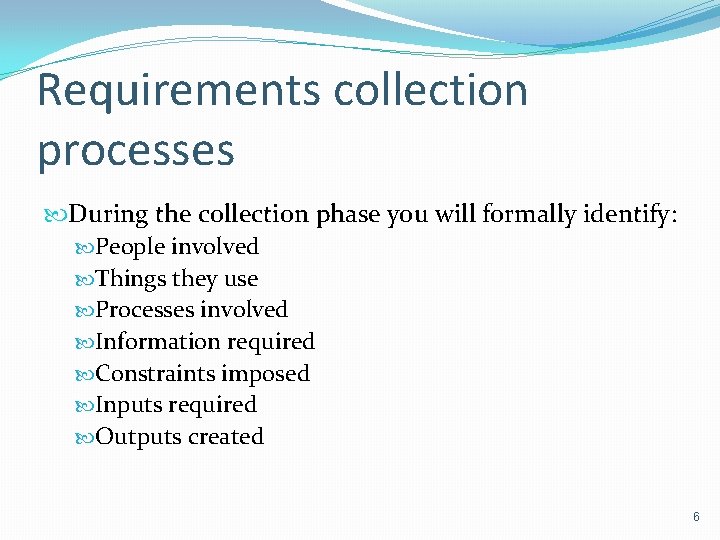
Requirements collection processes During the collection phase you will formally identify: People involved Things they use Processes involved Information required Constraints imposed Inputs required Outputs created 6
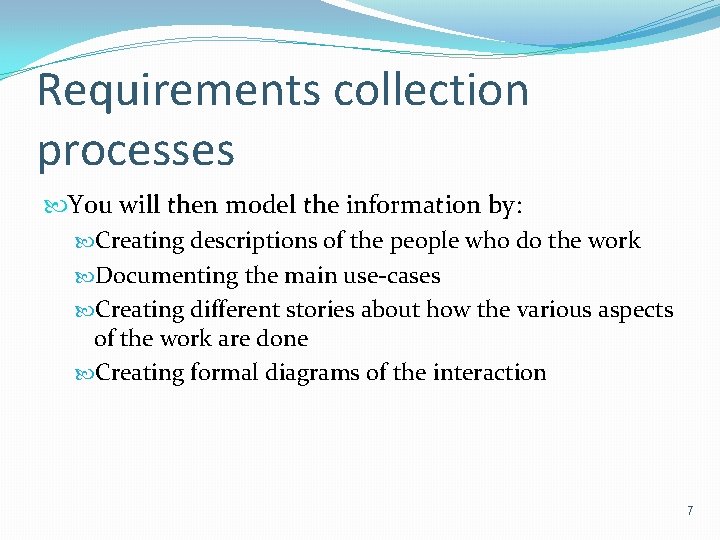
Requirements collection processes You will then model the information by: Creating descriptions of the people who do the work Documenting the main use-cases Creating different stories about how the various aspects of the work are done Creating formal diagrams of the interaction 7
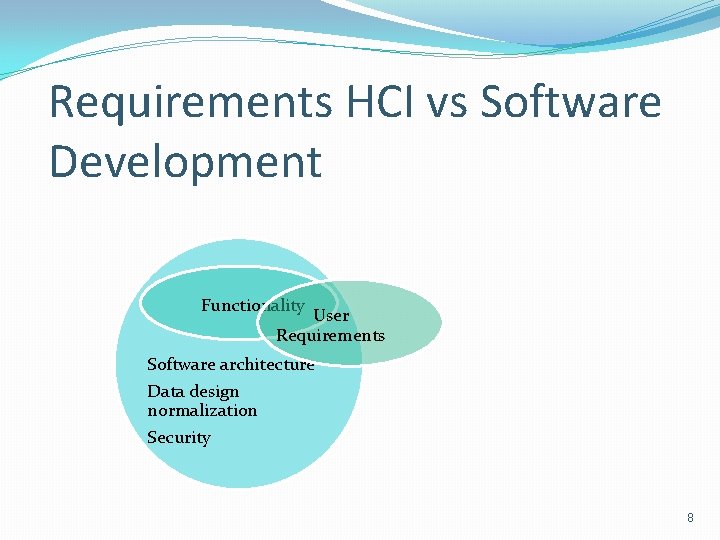
Requirements HCI vs Software Development Functionality User Requirements Software architecture Data design normalization Security 8
Discovery Phase Looking with new eyes The frame of reference must come from the observation and not be imposed on it Finding out about the work that people do Defined methodology to gather and interpret 9
Exploring the Domain Identify all stakeholders There are four types of stakeholders: Primary—A person who uses the design directly Secondary—A person who either supplies input or receives output from the design Facilitator—A person who maintains or develops the design Indirect—A person who is affected by the use of the design but has no contact with it, such as the user’s superior or coworkers and the client who is paying for the project (the client may or may also be the primary stakeholder) 10
Exploring the Domain The primary stakeholders should have the most impact on the eventual design. All stakeholders should be considered during the design A new system that is not designed to be integrated with the work practices of people in the organization may cause needless disruptions 11
Exploring the Domain Understand the competition Learn from other design solutions Assess both the positive and negative aspects Respect copyrighted material and intellectual property Often times the goal is not to build a new system but to buy a system that best fits 12
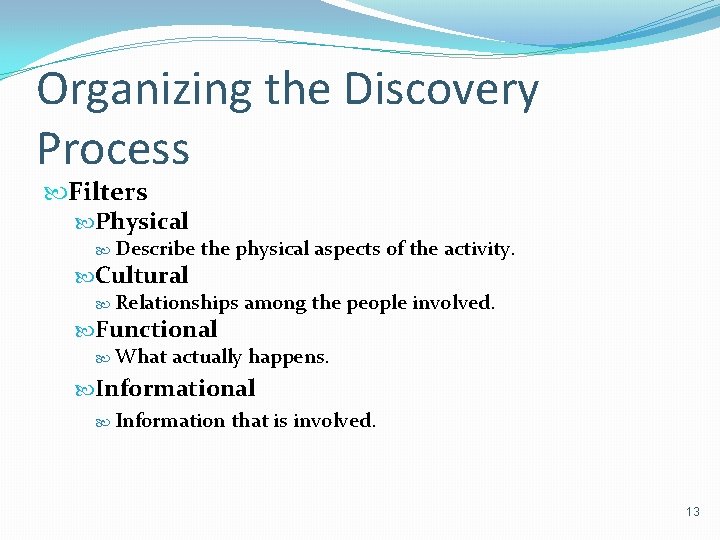
Organizing the Discovery Process Filters Physical Describe the physical aspects of the activity. Cultural Relationships among the people involved. Functional What actually happens. Informational Information that is involved. 13
Organizing the Discovery Process Interpretation means going from data to design requirements The data must be collected AND organized to transform it into information The methodologies we will explore (next lecture) include the following: Stakeholder profiles Task analysis Storyboarding Use cases 14
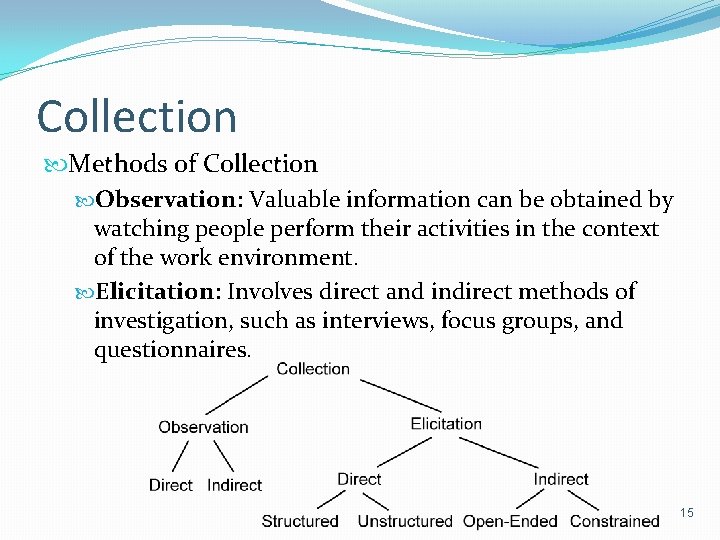
Collection Methods of Collection Observation: Valuable information can be obtained by watching people perform their activities in the context of the work environment. Elicitation: Involves direct and indirect methods of investigation, such as interviews, focus groups, and questionnaires. 15
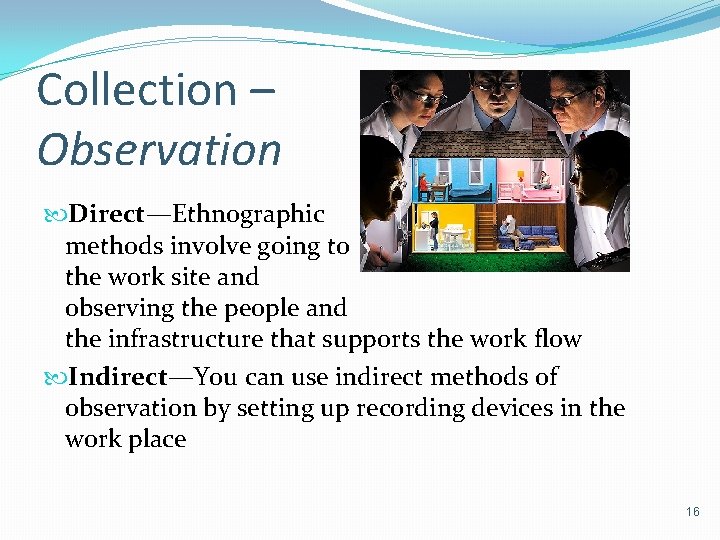
Collection – Observation Direct—Ethnographic methods involve going to the work site and observing the people and the infrastructure that supports the work flow Indirect—You can use indirect methods of observation by setting up recording devices in the work place 16
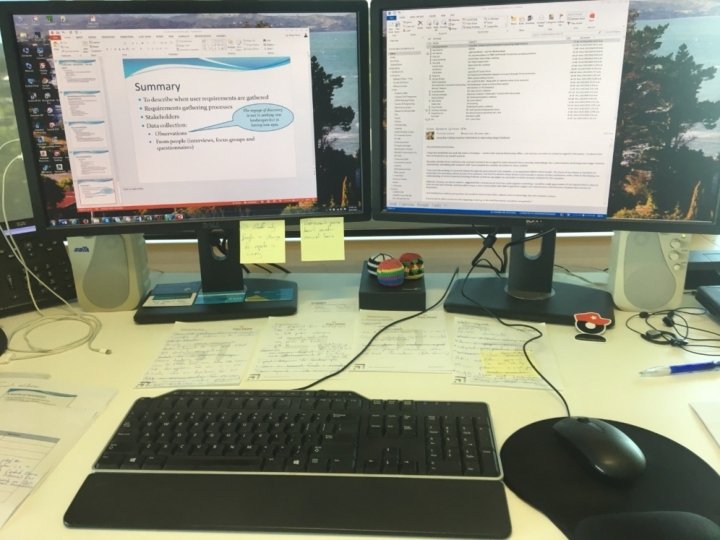
Collection - Observation Concerns about Ethnographic Observations Your presence will affect the people you observe ‘Hawthorne effect’ Your presence can become annoying It can raise questions with the ‘consumer’ E. g. in health care – who’s that person in the corner? Distributed Cognition - the tendency to off-load cognitive tasks to objects in the environment (e. g. post-its, calendar, whiteboard) or to distribute them among team members or coworkers 17
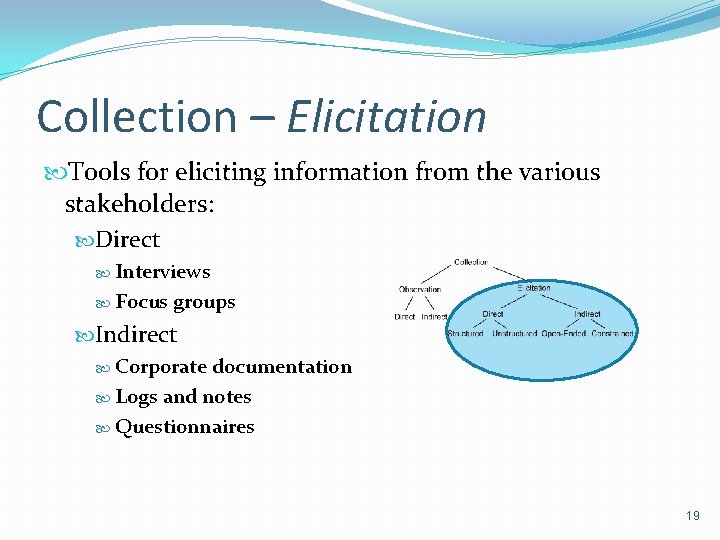
Collection – Elicitation Tools for eliciting information from the various stakeholders: Direct Interviews Focus groups Indirect Corporate documentation Logs and notes Questionnaires 19
Collection - Elicitation – Direct – Interviews Be polite and courteous during interviews (people will judge the eventual software product by how you treat them at this stage! And people can be quite threatened that automation will take their job!) Interviews On-site interviews: may help people remember aspects of the job Away from job site interviews: not interrupted by normal work related events 20
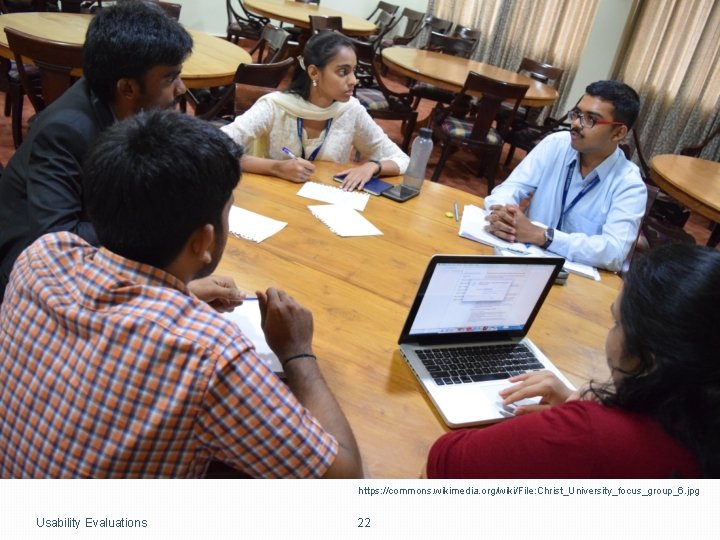
Collection - Elicitation – Direct – Focus Groups Require a moderator/facilitator to keep discussion on track Maintain spontaneity Have clearly defined outcomes Provide participants with a context for the project Work best if the participants have a ‘peer’ relationship If line workers won’t speak freely in front of line supervisors, then put them in two separate focus groups
https: //commons. wikimedia. org/wiki/File: Christ_University_focus_group_6. jpg Usability Evaluations 22
Collection - Elicitation – Direct – Focus Groups The advantages of focus groups: They are relatively inexpensive and easy to set up. They can be used early in the design process to help to identify and prioritize features. They help you to gain insight into people’s attitudes and motivations. They make it clear an opinion is an ‘outlier’ Can help sell a new solution The disadvantages of focus groups: They only represent the views of one particular group. A strong voice can capture the group They are not statistically significant. They do not provide information about usability.
Collection - Elicitation – Indirect Corporate Documentation Policies and procedures. Logs and Notes Ask people to keep a log of specific activities Collect (or photograph) the notes people make to remind them of procedures and policies sticky notes tacked onto a computer reminders stuck on a corkboard Examining electronic logs
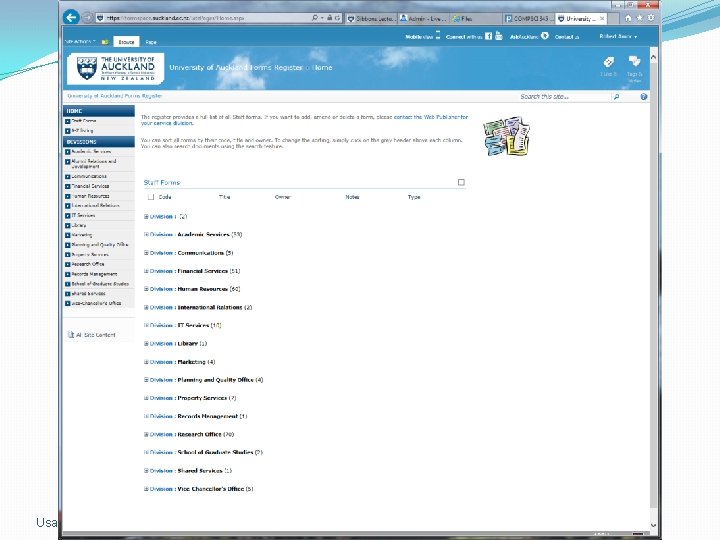
Usability Evaluations 25
Collection - Elicitation – Indirect – Questionnaires are familiar Questionnaires can contain open and closed questions Questionnaires can include the following: Mutually exclusive choices (radio buttons) Non–mutually exclusive choices (checkboxes) Ranges (overlapping, open-ended) Scales (Likert scales, semantic differential scales) Short-answer fill-ins Comments
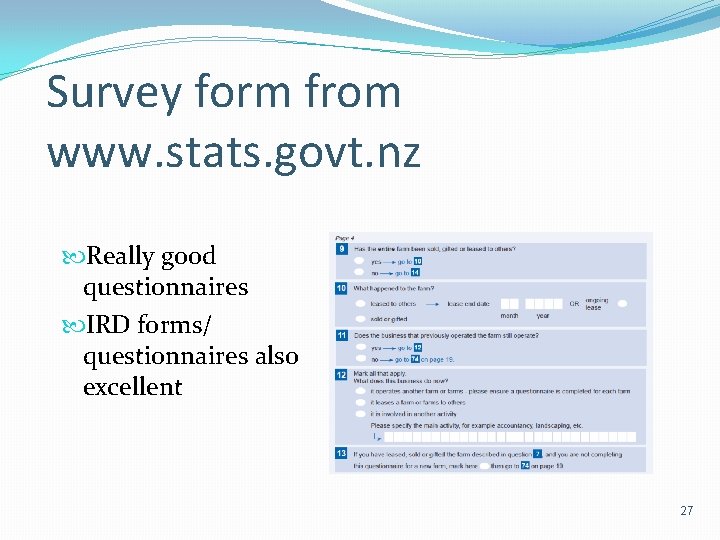
Survey form from www. stats. govt. nz Really good questionnaires IRD forms/ questionnaires also excellent 27
Collection - Elicitation – Indirect – Questionnaires Advantages of questionnaires: They do not involve face-to-face contact and can be administered remotely. They can be used to supply information for primary stakeholder profiles. They can be used to ascertain whether proposed solutions will meet with acceptance as well as to elicit new ideas. They can also be used to double-check the feedback obtained from one-on-one interviews. They can reach a large audience with relatively little expense. 28
Collection - Elicitation – Indirect – Questionnaires Disadvantages of questionnaires: Vague questions will return ambiguous responses that will serve no useful purpose or the design. People do not like to fill out long questionnaires. Closed-ended questions can restrict responses. Open-ended questions can be hard to quantify. Total Survey Error – you can introduce errors into your survey very easily 29
Collection - Elicitation - Survey tools Survey. Monkey Popular solution to let you design and distribute questionnaires Runs ‘in the cloud’ Lime. Survey A free online tool that can be installed directly onto the researcher’s system, thus avoiding storage of data in the cloud (better control of confidential data) 30
Modelling and Documenting Requirements. Collating all the data and intermediate documents from the Discovery Phase Working documents include Human centred System centred Collate into Mission statement Requirements document Project management document Usability requirements
Documentation Mission Statement Project goals: What is the value proposition? What needs will the new system address? How will it address these needs? Project scope What does the proposed design include or exclude? What are the external constraints such as time and finances? How will you decide when it satisfies the design proposal?
Documentation Requirements Users Who are the users of the system? What are they like? What tasks will they perform? Requirements Functional – what features must be present? Information – what information is needed to carry out the functions? And what outputs are required by the stakeholders? Input/output mediums – desktop, mobile, special environments? Constraints – physical, financial, time, data storage, networking, etc.
Summary To describe when user requirements are gathered Requirements gathering processes The voyage of discovery is not in seeking new Stakeholders landscapes but in Data collection: having new eyes. Observations From people (interviews, focus groups and questionnaires)