
Lecture 6 Symmetric Cryptography CS 5430 February 21
Lecture 6: Symmetric Cryptography CS 5430 February 21, 2018
The Big Picture Thus Far… Attacks are perpetrated by threats that inflict harm by exploiting vulnerabilities which are controlled by countermeasures.
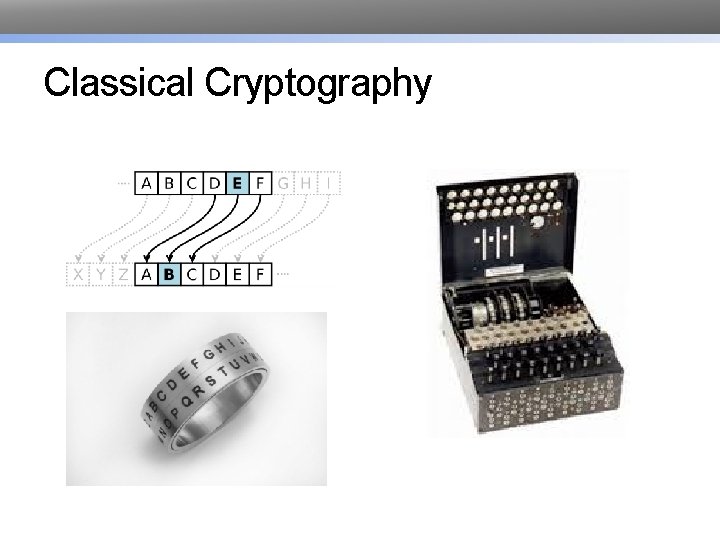
Classical Cryptography
Tenants of modern cryptography When inventing a cryptographic algorithm/protocol: • Formulate a precise definition of security • Provide a rigorous mathematical proof that the cryptographic algorithm/protocol satisfies the definition of security • State any required assumptions in the proof, keeping them as minimal as possible
Cryptography cf. CS 4830/6830 cf. CS 6832
Purpose of Encryption • Threat: attacker who controls the network • can read, modify, delete messages • in essence, the attacker is the network • Dolev-Yao model [1983]
Purpose of encryption • Threat: attacker who controls the network • can read, modify, delete messages • in essence, the attacker is the network • Dolev-Yao model [1983] • Harm: messages containing secret information disclosed to attacker (violating confidentiality) • Vulnerability: communication channel between sender and receiver can be read by other principals • Countermeasure: encryption
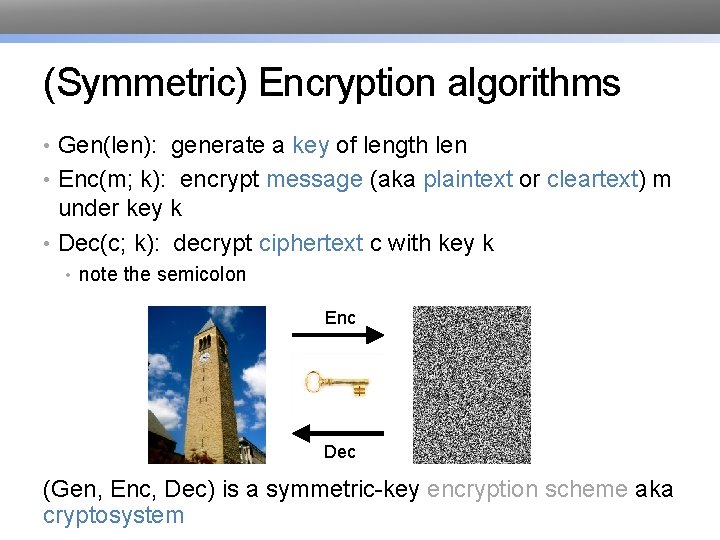
(Symmetric) Encryption algorithms • Gen(len): generate a key of length len • Enc(m; k): encrypt message (aka plaintext or cleartext) m under key k • Dec(c; k): decrypt ciphertext c with key k • note the semicolon Enc Dec (Gen, Enc, Dec) is a symmetric-key encryption scheme aka cryptosystem
Key lengths
The obvious idea. . . • Divide long message into short chunks, each the size of a block • Encrypt each block with the block cipher m
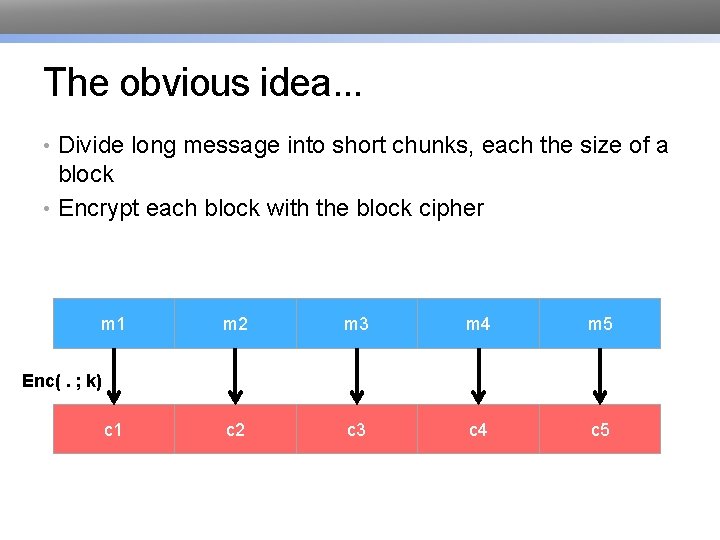
The obvious idea. . . • Divide long message into short chunks, each the size of a block • Encrypt each block with the block cipher m 1 m 2 m 3 m 4 m 5 c 2 c 3 c 4 c 5 Enc(. ; k) c 1
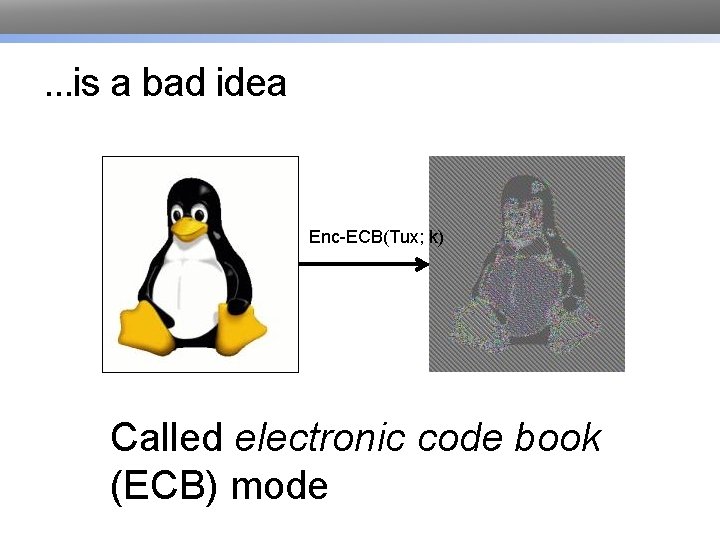
. . . is a bad idea Enc-ECB(Tux; k) Called electronic code book (ECB) mode
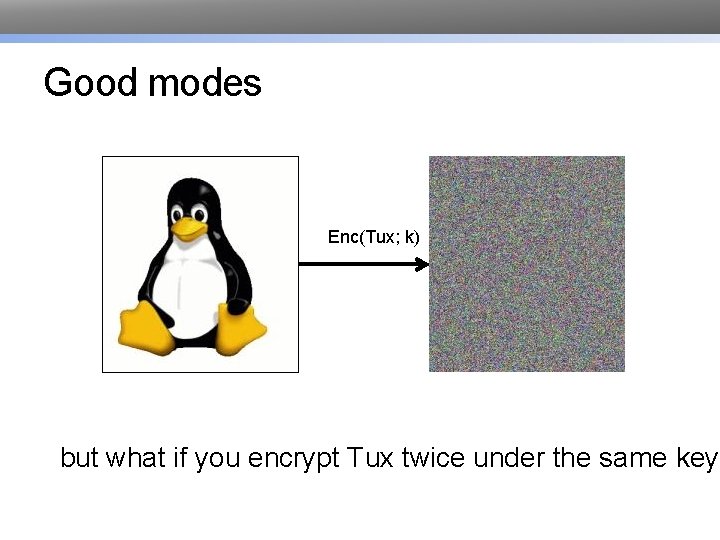
Good modes Enc(Tux; k) but what if you encrypt Tux twice under the same key?
Nonces A nonce is a number used once Must be • unique: never used before in lifetime of system and/or (depending on intended usage) • unpredictable: attacker can't guess next nonce given all previous nonces in lifetime of system
Nonce sources • counter • requires state • easy to implement • can overflow • highly predictable • clock: just a counter • random number generator • might not be unique, unless drawn from large space • might or might not be unpredictable • generating randomness: • standard library generators often are not cryptographically strong, i. e. , unpredictable by attackers • cryptographically strong randomness is a black art
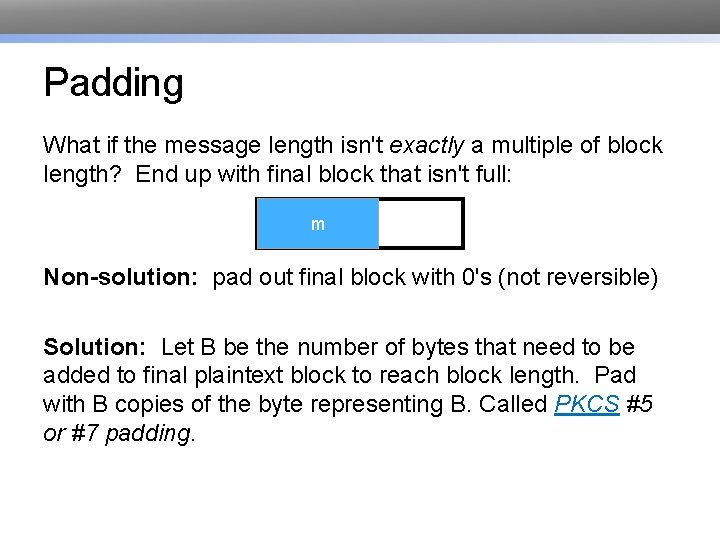
Padding What if the message length isn't exactly a multiple of block length? End up with final block that isn't full: m Non-solution: pad out final block with 0's (not reversible) Solution: Let B be the number of bytes that need to be added to final plaintext block to reach block length. Pad with B copies of the byte representing B. Called PKCS #5 or #7 padding.
Protection of integrity • Threat: attacker who controls the network • Dolev-Yao model: attacker can read, modify, delete messages • Harm: information contained in messages can be changed by attacker (violating integrity) • Vulnerability: communication channel between sender and receiver can be controlled by other principals • Countermeasure: message authentication codes (MACs) • beware: not the same "MAC" as mandatory access control
Encryption and integrity
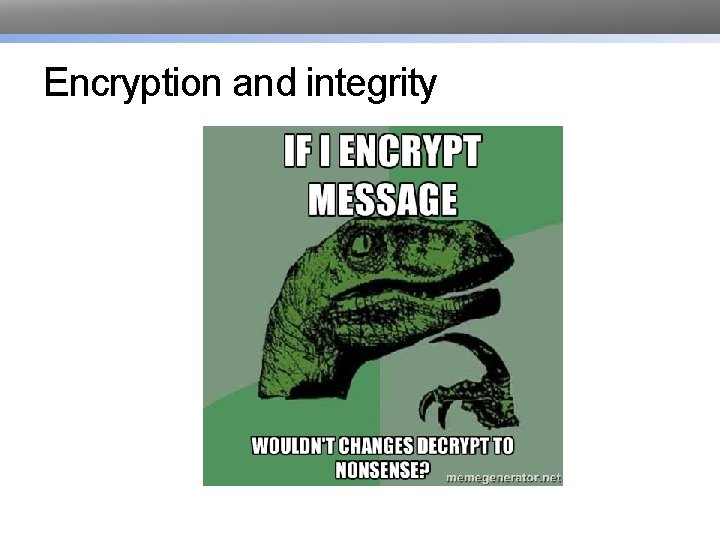
Encryption and integrity NO! • Plaintext block might be random number, and recipient has no way to detect change in random number • Attacker might substitute ciphertext from another execution of same protocol • In some block modes (e. g. , CTR), it's easy to flip individual bits • change "admin=0" to "admin=1" • In some block modes (e. g. , CBC), it's easy to truncate blocks from beginning of message • . . . So you can't get integrity solely from encryption
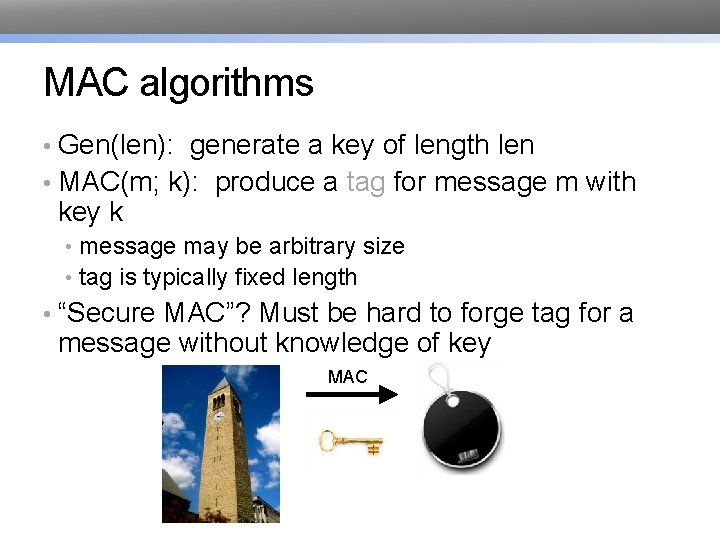
MAC algorithms • Gen(len): generate a key of length len • MAC(m; k): produce a tag for message m with key k • message may be arbitrary size • tag is typically fixed length • “Secure MAC”? Must be hard to forge tag for a message without knowledge of key MAC
Real-world MACs • CBC-MAC • Parameterized on a block cipher • Core idea: encrypt message with block cipher in CBC mode, use very last ciphertext block as the tag • HMAC • Parameterized on a hash function • Core idea: hash message together with key • Your everyday hash function isn't good enough. . .
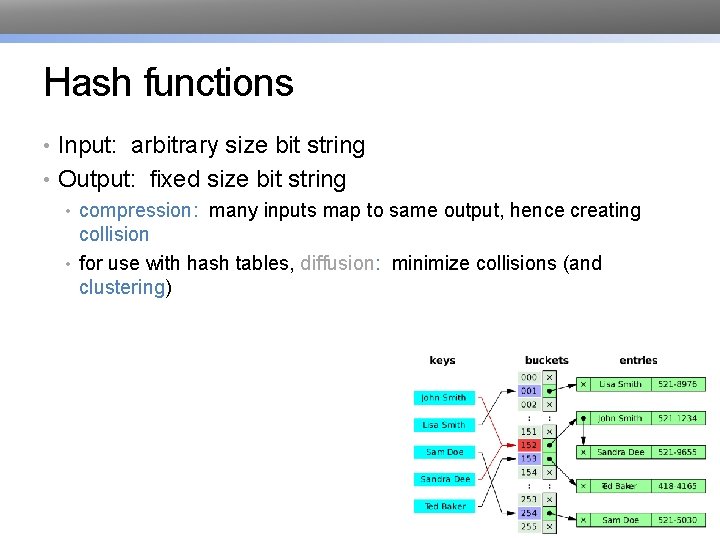
Hash functions • Input: arbitrary size bit string • Output: fixed size bit string • compression: many inputs map to same output, hence creating collision • for use with hash tables, diffusion: minimize collisions (and clustering)
Cryptographic hash functions • Aka message digest • Stronger requirements than (plain old) hash functions • Goal: hash is compact representation of original like a fingerprint • Hard to find 2 people with same fingerprint • Whether you get to pick pairs of people, or whether you start with one person and find another. . . collision-resistant • Given person easy to get fingerprint • Given fingerprint hard to find person. . . one-way
Real-world hash functions • MD 5: Ron Rivest (1991) • 128 bit output • Collision resistance broken 2004 -8 • Can now find collisions in seconds • Don't use it • SHA-1: NSA (1995) • 160 bit output • Theoretical attacks that reduce strength to less than 80 bits • As of 2017, “practical attack” on PDFs: https: //shattered. io/ • Industry has been deprecating SHA-1 over the couple years
Real world hash functions • SHA-2: NSA (2001) • Family of algorithms with output sizes {224, 256, 385, 512} • In principle, could one day be vulnerable to similar attacks as SHA 1 • SHA-3: public competition (won in 2012, standardized by NIST in 2015) • Same output sizes as SHA-2 • Plus a variable-length output called SHAKE
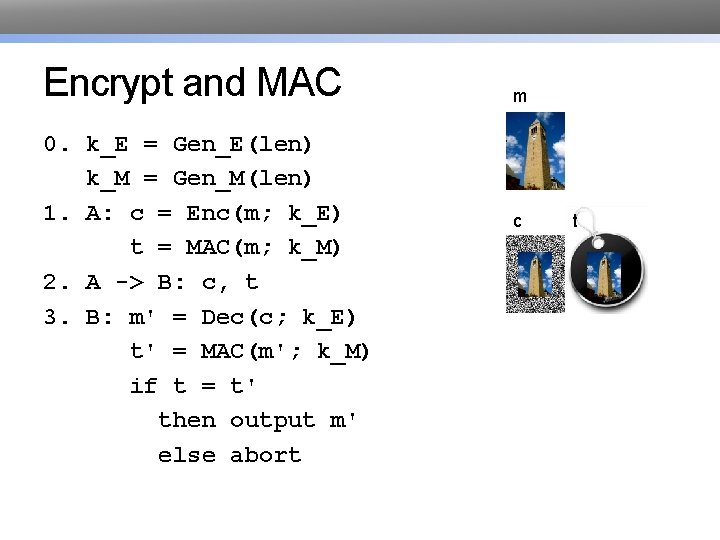
Encrypt and MAC 0. k_E = Gen_E(len) k_M = Gen_M(len) 1. A: c = Enc(m; k_E) t = MAC(m; k_M) 2. A -> B: c, t 3. B: m' = Dec(c; k_E) t' = MAC(m'; k_M) if t = t' then output m' else abort m c t
Encrypt and MAC • Pro: can compute Enc and MAC in parallel • Con: MAC must protect confidentiality • Example: ssh (Secure Shell) protocol • recommends AES-128 -CBC for encryption • recommends HMAC with SHA-2 for MAC
Aside: Key reuse • Never use same key for both encryption and MAC schemes • Principle: every key in system should have unique purpose
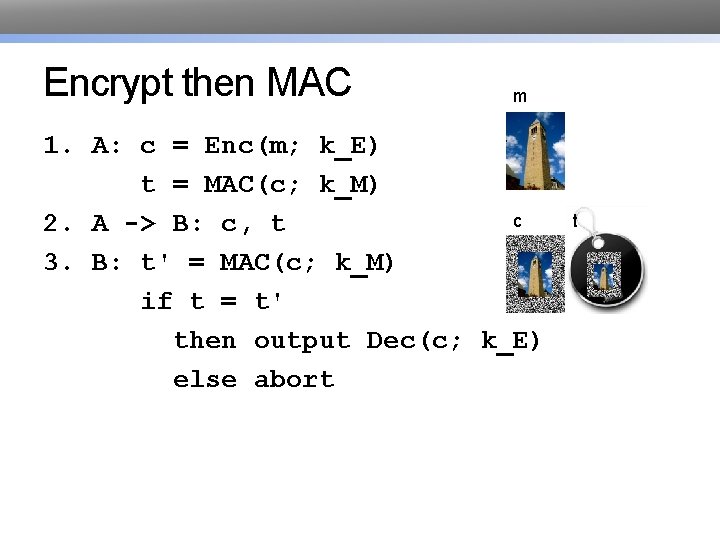
Encrypt then MAC m 1. A: c = Enc(m; k_E) t = MAC(c; k_M) c 2. A -> B: c, t 3. B: t' = MAC(c; k_M) if t = t' then output Dec(c; k_E) else abort t
Encrypt then MAC • Pro: provably most secure of three options [Bellare & Namprepre 2001] • Pro: don't have to decrypt if MAC fails • resist Do. S • Example: IPsec (Internet Protocol Security) • recommends AES-CBC for encryption and HMAC-SHA 1 for MAC, among others • or AES-GCM
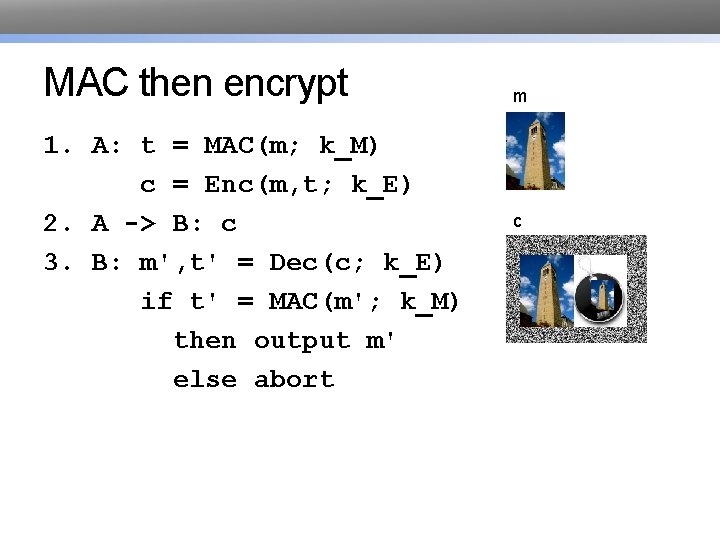
MAC then encrypt 1. A: t = MAC(m; k_M) c = Enc(m, t; k_E) 2. A -> B: c 3. B: m', t' = Dec(c; k_E) if t' = MAC(m'; k_M) then output m' else abort m c
MAC then encrypt • Pro: provably next most secure • and just as secure as Encrypt-then-MAC for strong enough MAC schemes • HMAC and CBC-MAC are strong enough • Example: SSL (Secure Sockets Layer) • Many options for encryption, e. g. AES-128 -CBC • For MAC, standard is HMAC with many options for hash, e. g. SHA 256
Authenticated encryption • Three combinations: • Enc and MAC • Enc then MAC • MAC then Enc • Let's unify all with a pair of algorithms: • Auth. Enc(m; ke; km): produce an authenticated ciphertext x of message m under encryption key ke and MAC key km • Auth. Dec(x; ke; km): recover the plaintext message m from authenticated ciphertext x, and verify that the MAC is valid, using ke and km • Abort if MAC is invalid
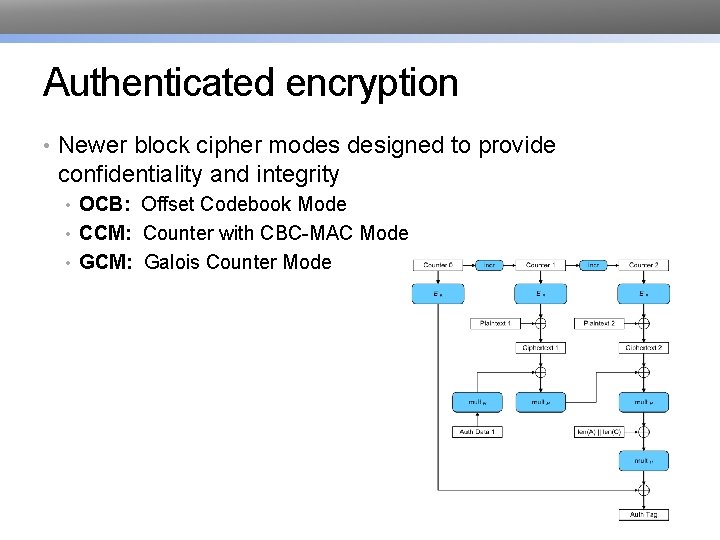
Authenticated encryption • Newer block cipher modes designed to provide confidentiality and integrity • OCB: Offset Codebook Mode • CCM: Counter with CBC-MAC Mode • GCM: Galois Counter Mode
- Slides: 34