
Lecture 6 Structure of the FX Market FX
- Slides: 26
Lecture 6 Structure of the FX Market & FX Derivatives Part 1 Dr Alper Kara
Learning Objectives for Part I • To describe the organisation of the FX Market • To explain how forward contracts can be used to reduce currency risk • To explain what currency futures are and to describe the organisation of the market • To distinguish between currency futures and currency forwards • To describe the advantages and disadvantages of currency futures relative to forward contracts 2 3 February 2015
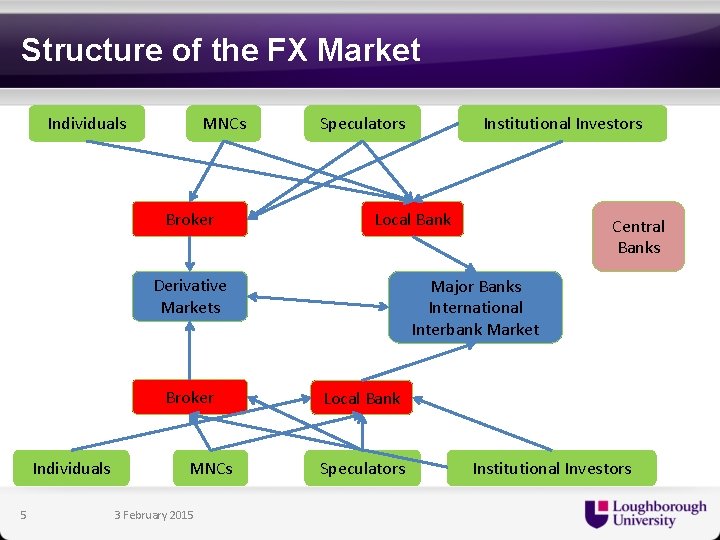
Structure of the FX Market 3 3 February 2015
Structure of the FX Market • The Currency Market: a place where money denominated in one currency is bought and sold with money denominated in another currency. • Ability to transfer ………………. power between countries • …………. . (OTC) type market (via phone, Reuters, Bloomberg etc. ) 4 3 February 2015
Structure of the FX Market Individuals MNCs Broker Speculators Local Bank Derivative Markets Broker Individuals 5 MNCs 3 February 2015 Institutional Investors Central Banks Major Banks International Interbank Market Local Bank Speculators Institutional Investors
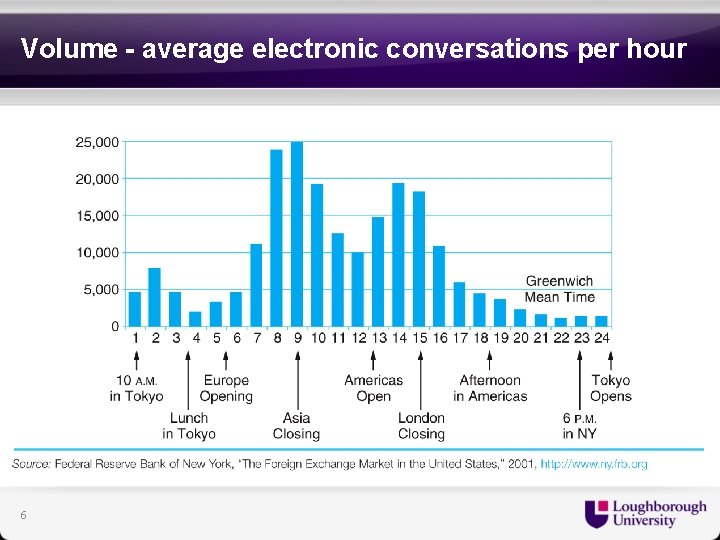
Volume - average electronic conversations per hour • The volume of currency transactions and flows across the globe as the major currency trading centers open and close throughout the day (average electronic conversations per hour) 6
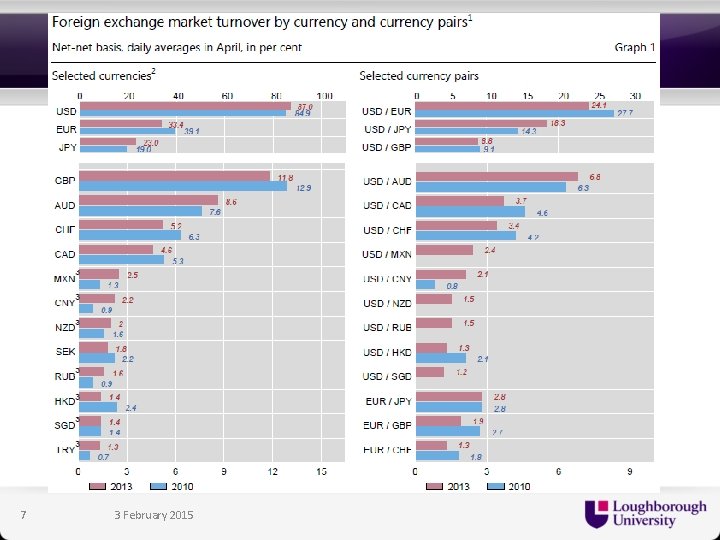
7 3 February 2015
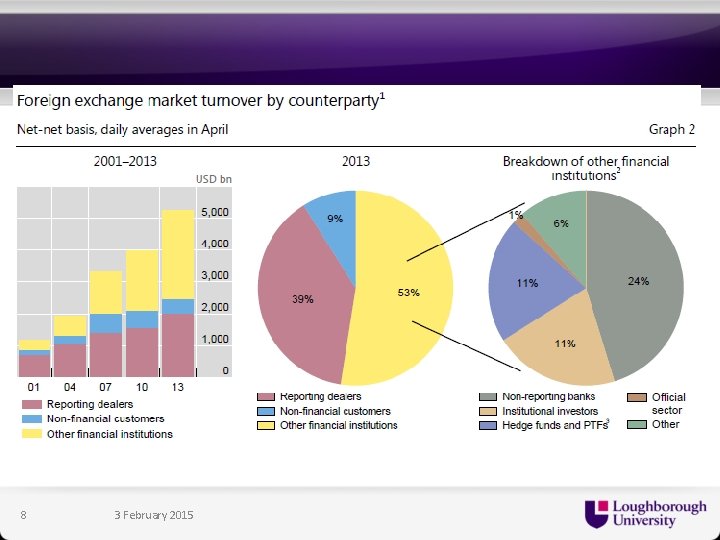
8 3 February 2015
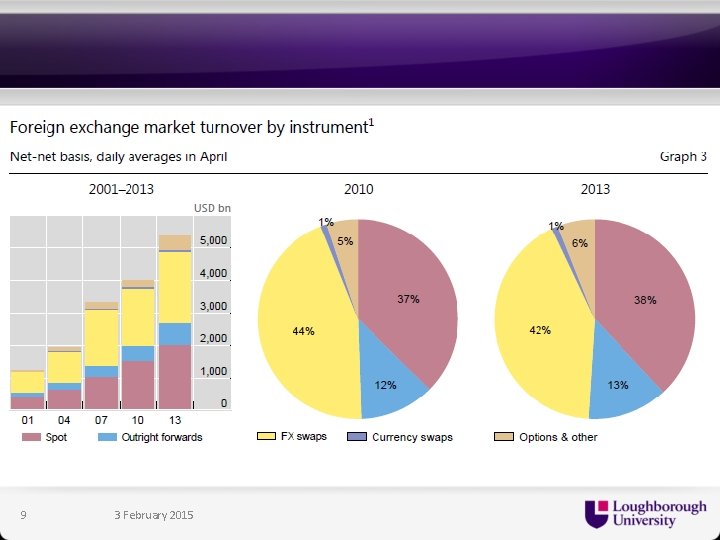
9 3 February 2015
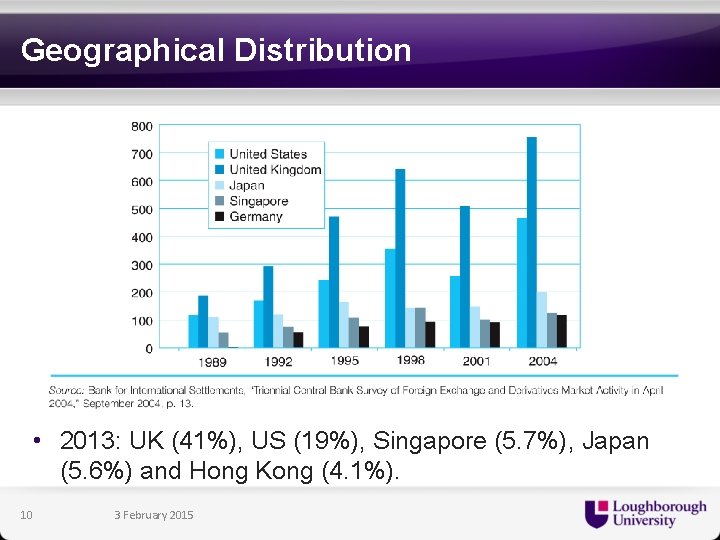
Geographical Distribution • 2013: UK (41%), US (19%), Singapore (5. 7%), Japan (5. 6%) and Hong Kong (4. 1%). 10 3 February 2015
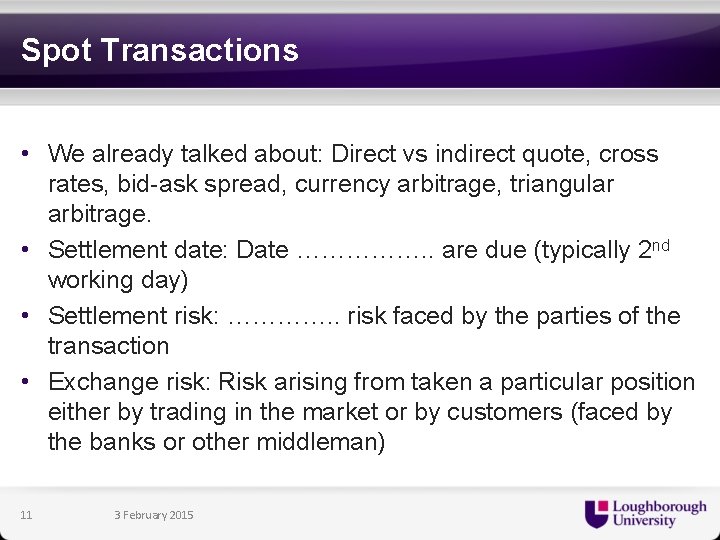
Spot Transactions • We already talked about: Direct vs indirect quote, cross rates, bid-ask spread, currency arbitrage, triangular arbitrage. • Settlement date: Date ……………. . are due (typically 2 nd working day) • Settlement risk: …………. . risk faced by the parties of the transaction • Exchange risk: Risk arising from taken a particular position either by trading in the market or by customers (faced by the banks or other middleman) 11 3 February 2015
Forward Contracts 12 3 February 2015
Forward Contracts • Foreign exchange contracts offered by market maker banks. • Market maker banks will quote exchange rates today at which they will carry out forward agreements. • They will sell and buy foreign currency forward • Forward contracts allow the global firm to lock in a home currency equivalent of some “fixed” contractual foreign currency cash flow. • These contracts are used to offset the foreign exchange exposure resulting from an initial commercial or financial transaction. 13 3 February 2015
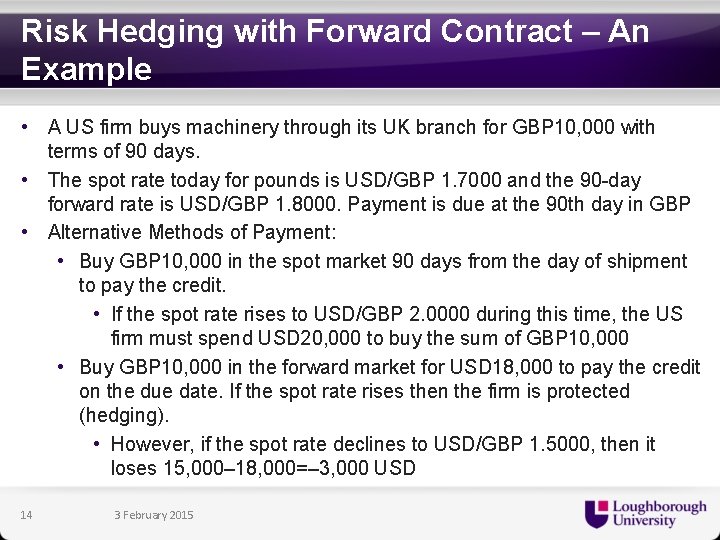
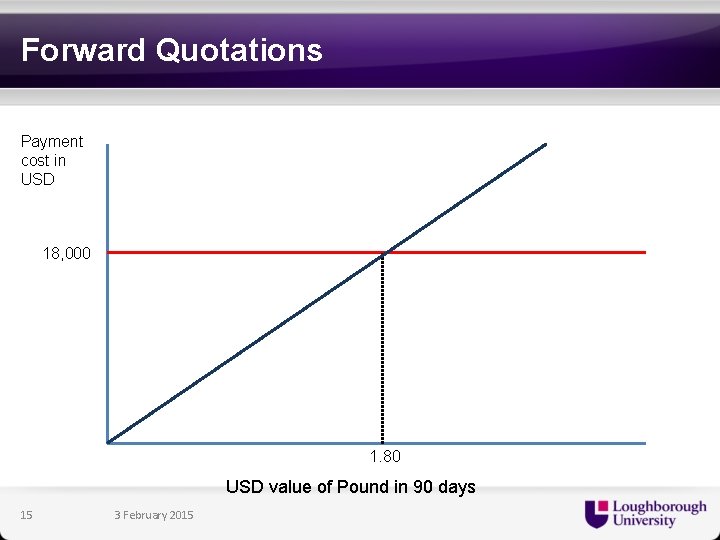
Risk Hedging with Forward Contract – An Example • A US firm buys machinery through its UK branch for GBP 10, 000 with terms of 90 days. • The spot rate today for pounds is USD/GBP 1. 7000 and the 90 -day forward rate is USD/GBP 1. 8000. Payment is due at the 90 th day in GBP • Alternative Methods of Payment: • Buy GBP 10, 000 in the spot market 90 days from the day of shipment to pay the credit. • If the spot rate rises to USD/GBP 2. 0000 during this time, the US firm must spend USD 20, 000 to buy the sum of GBP 10, 000 • Buy GBP 10, 000 in the forward market for USD 18, 000 to pay the credit on the due date. If the spot rate rises then the firm is protected (hedging). • However, if the spot rate declines to USD/GBP 1. 5000, then it loses 15, 000– 18, 000=– 3, 000 USD 14 3 February 2015
Forward Quotations Payment cost in USD 18, 000 1. 80 USD value of Pound in 90 days 15 3 February 2015
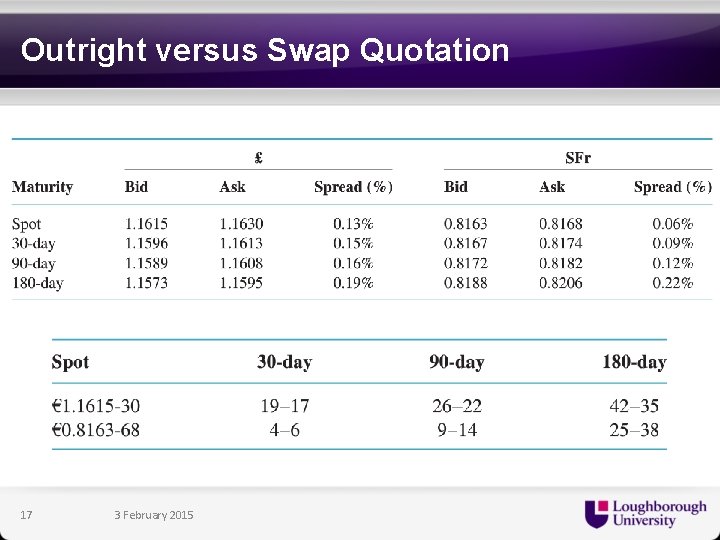
Forward Terminology • We already talked about: Forward discount and forward premium • Outright rate: Fully quoted actual price • …………. rate: Only forward rate differential are quoted (discount or premium) • Being in a: • Short position: Owing the currency • Long position: Owning the currency 16 3 February 2015
Outright versus Swap Quotation 17 3 February 2015
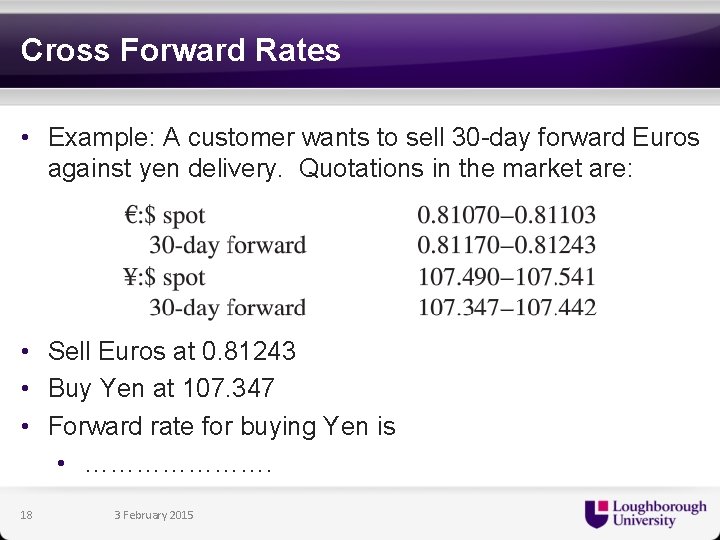
Cross Forward Rates • Example: A customer wants to sell 30 -day forward Euros against yen delivery. Quotations in the market are: • Sell Euros at 0. 81243 • Buy Yen at 107. 347 • Forward rate for buying Yen is • …………………. 18 3 February 2015
Futures Contracts 19 3 February 2015
Definitions • Future contracts: …………………. contracts that trade on organised futures markets for specific delivery dates only. • The first futures exchange market was the Dōjima Rice Exchange in Japan in the 1730 s, to meet the needs of samurai who—being paid in rice, and after a series of bad harvests—needed a stable conversion to coin • A financial derivative product – contracts that drive their value from an underlying asset 20 3 February 2015
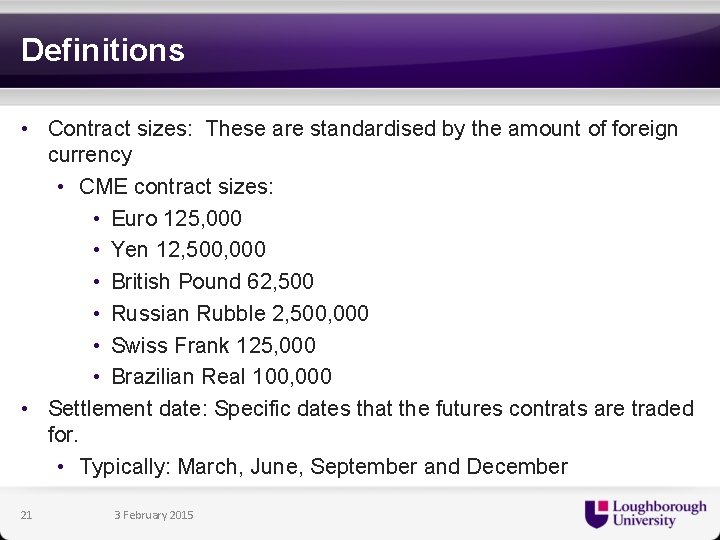
Definitions • Contract sizes: These are standardised by the amount of foreign currency • CME contract sizes: • Euro 125, 000 • Yen 12, 500, 000 • British Pound 62, 500 • Russian Rubble 2, 500, 000 • Swiss Frank 125, 000 • Brazilian Real 100, 000 • Settlement date: Specific dates that the futures contrats are traded for. • Typically: March, June, September and December 21 3 February 2015
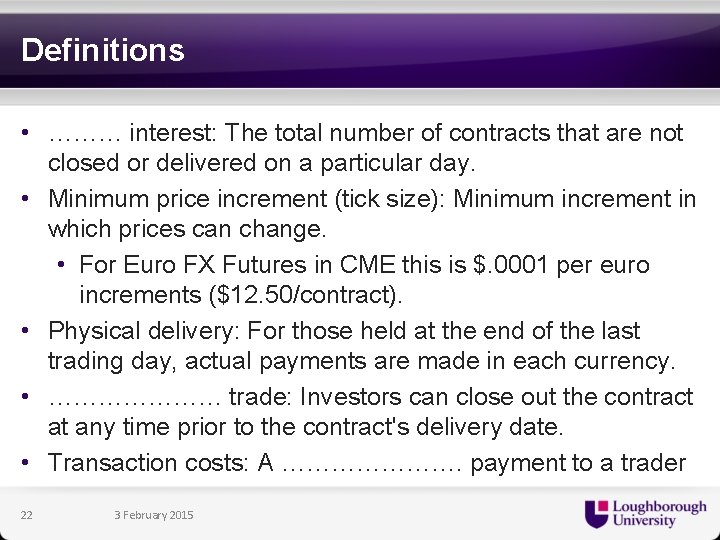
Definitions • ……… interest: The total number of contracts that are not closed or delivered on a particular day. • Minimum price increment (tick size): Minimum increment in which prices can change. • For Euro FX Futures in CME this is $. 0001 per euro increments ($12. 50/contract). • Physical delivery: For those held at the end of the last trading day, actual payments are made in each currency. • ………………… trade: Investors can close out the contract at any time prior to the contract's delivery date. • Transaction costs: A …………………. payment to a trader 22 3 February 2015
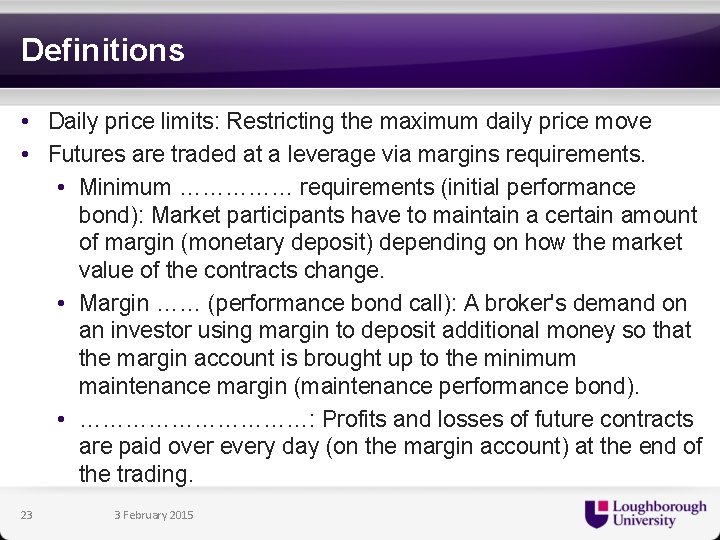
Definitions • Daily price limits: Restricting the maximum daily price move • Futures are traded at a leverage via margins requirements. • Minimum …………… requirements (initial performance bond): Market participants have to maintain a certain amount of margin (monetary deposit) depending on how the market value of the contracts change. • Margin …… (performance bond call): A broker's demand on an investor using margin to deposit additional money so that the margin account is brought up to the minimum maintenance margin (maintenance performance bond). • ……………: Profits and losses of future contracts are paid over every day (on the margin account) at the end of the trading. 23 3 February 2015
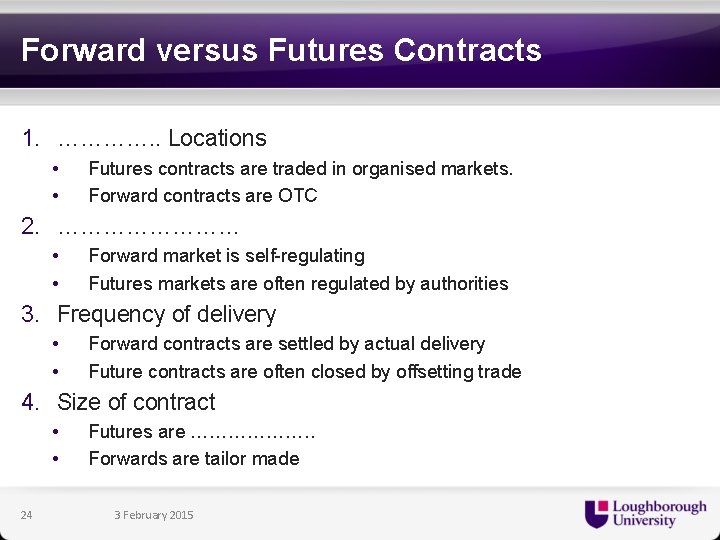
Forward versus Futures Contracts 1. …………. . Locations • • Futures contracts are traded in organised markets. Forward contracts are OTC 2. ………… • • Forward market is self-regulating Futures markets are often regulated by authorities 3. Frequency of delivery • • Forward contracts are settled by actual delivery Future contracts are often closed by offsetting trade 4. Size of contract • • 24 Futures are ………………. . Forwards are tailor made 3 February 2015
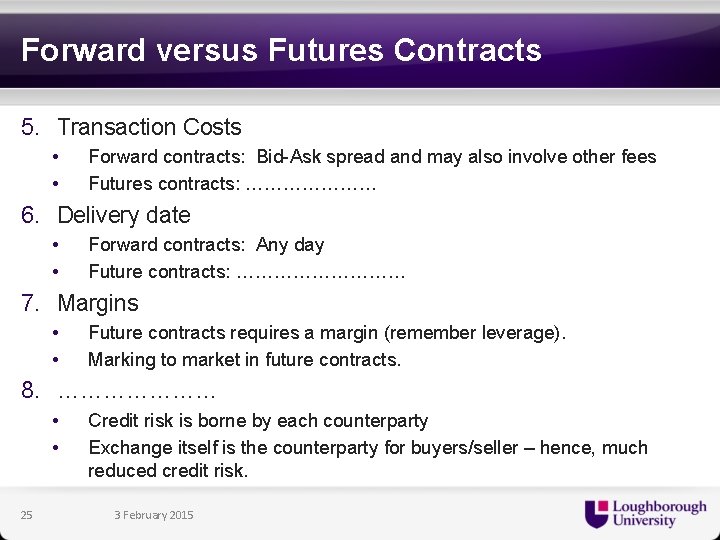
Forward versus Futures Contracts 5. Transaction Costs • • Forward contracts: Bid-Ask spread and may also involve other fees Futures contracts: ………………… 6. Delivery date • • Forward contracts: Any day Future contracts: …………… 7. Margins • • Future contracts requires a margin (remember leverage). Marking to market in future contracts. 8. ………………… • • 25 Credit risk is borne by each counterparty Exchange itself is the counterparty for buyers/seller – hence, much reduced credit risk. 3 February 2015
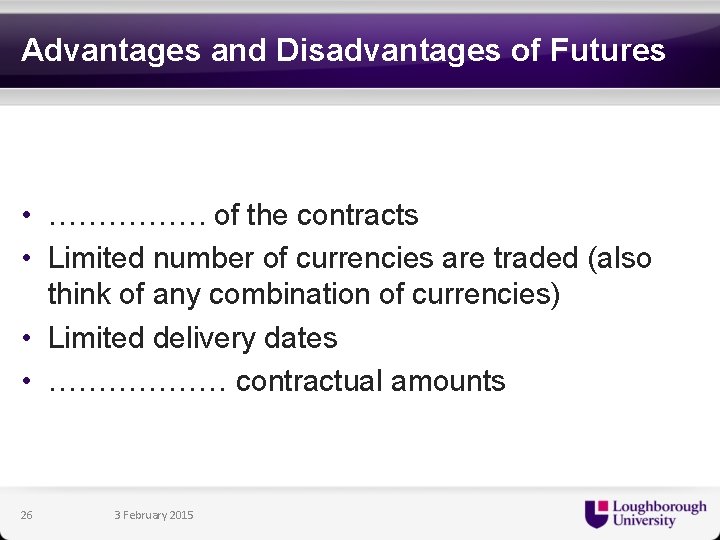
Advantages and Disadvantages of Futures • ……………. of the contracts • Limited number of currencies are traded (also think of any combination of currencies) • Limited delivery dates • ……………… contractual amounts 26 3 February 2015