
Lecture 6 Risk Management CSCI 3350 Software Engineering








- Slides: 65
Lecture 6 Risk Management CSCI – 3350 Software Engineering II Fall 2014 Bill Pine
Lecture Overview • • Sources of risk in software development Consequences of unmanaged risk Risk mitigation / Risk management Barry Boehm Top 10 Risk List CSCI 3350 Lecture 6 - 2
Introduction • By taking steps to manage risk, we acknowledge: – Software development is inherently risky, and – Therefore prone to failure • All the efforts expended in project management are of little value if – Project development time is lengthening, uncontrollably, in response to unmanaged risk • The purpose of risk management – Keep the project risks firmly in view – Address those risks CSCI 3350 Lecture 6 - 3
Introduction (continued) • What constitutes a risk? – Anything that adversely affects the three goals of a successful project • The project manager must therefore take steps to mitigate risks – The first step is to identify the risks CSCI 3350 Lecture 6 - 4
Sources of Risk • Sources of risk can be divided into two categories: – Technical factors – Human factors CSCI 3350 Lecture 6 - 5
Technical Risk • Technical risks take many forms and depend on the specific details of the project • Some examples of important categories of technical risks – – – – Project complexity Project size Project innovation Security Information attainability – how quickly can you get it Production quality data may not be available for testing High quality graphics CSCI 3350 Lecture 6 - 6
Project Complexity • There are problems in computer science that are intractable – Intractable the time for solution increases exponentially (or faster) with increased problem size • The traveling salesman problem • The knapsack problem • The best next move in a game of strategy – Chess, Checkers, Othello CSCI 3350 Lecture 6 - 7
Project Complexity (continued) • If our problem is intractable – Must rely on heuristics to find near optimal solutions • The Risk? – Formulating an effective heuristic approach to finding a “good” solution in a reasonable amount of time, i. e. next move in chess CSCI 3350 Lecture 6 - 8
Project Size • When beginning a very large project, – Project is not understood in sufficient detail – Unanticipated stumbling blocks are numerous – May need to add a large number of tasks, • As project becomes better understood – Implications – failed project • • Project late Project over budget Project quality poor Or (more likely) a combination of the above CSCI 3350 Lecture 6 - 9
Project Innovation • Some projects need state-of-the-art technology – Development team will experience risk in the form of significant delay in • • Learning the new technology Adapting the way the team functions Converting existing code to the new technology Dealing with a potentially “buggy” technology – There is a potential upside • The expenditure of effort in learning the new technology may pay big dividends on future projects • But in the words of Jimmy Driftwood – “That ain’t a-doin us no good now” CSCI 3350 Soldier’s Joy Lecture 6 - 10
Security • To mention but a few – Network vulnerability • Must build in safeguards to prevent “thugs” from – Viewing data – Destroying or modifying data or programs – Disgruntled employees • Similar damage as above, carried out by “insiders” – Either development team members or client employees – Involved end-users – Time bombs – White collar crime • Money handling systems need a system of checks and balances to prevent theft of money or information CSCI 3350 Lecture 6 - 11
Information Attainability • The domain experts (remember these guys? ) may see the new system as a threat to their livelihood – Refuse to co-operate – Provide incomplete information – Provide misleading information – Result: • System is built upon incomplete or erroneous domain knowledge CSCI 3350 Lecture 6 - 12
Production Quality Data Not Available • Client cannot or will not provide “real” data – Can’t interrupt current operations – Highly sensitive data • Any data that is generated to simulate the “real” data, may not accurately reflect the “real” data – Too small – Missing key stressors CSCI 3350 Lecture 6 - 13
High Quality Graphics • Many systems require high quality artwork to be effective • The risk: – The artwork produced may be of a low enough quality to compromise the system effectiveness CSCI 3350 Lecture 6 - 14
Sources of Human Factors Risk • The sources of risk from people involvement can be assigned to 3 categories – Client / Users – Management – Developers • Humans are very difficult to predict / categorize • In spite of an aggressive Risk Management Program, people will occasionally do something that is: – So erratic and unpredictable that no reasonable risk manager could have anticipated it CSCI 3350 Lecture 6 - 15
End-User Risks • End-users add risk to a project in a number of ways – End-users may feel that the new software system will put their jobs at risk • May withhold information about their job procedures from the analysts • May give incorrect or misleading information about their job procedures – End-user may not be very technology aware • • Don’t know what to ask for in terms of capabilities Developers tend to give the users that for which they asked End users don’t get the maximum functionality from the system This is a large risk, and one that must be clearly addressed in any system CSCI 3350 Lecture 6 - 16
End-User Risks (continued) – There may be a wide range of technology savvy among the end-users • The resulting conflict in system envisioned by the various users makes the job of the analyst difficult • The analyst must resolve the different visions, but since he is not a part of the client organization this can be very hard to do – The end-user may be reluctant to adopt the new system (or any new system) • This is an inertia issue • This attitude was institutionalized in the Loudon County, VA motto - “We bide our time” – The motto perfectly represented the underlying attitude of county government employees toward change in any form CSCI 3350 Lecture 6 - 17
Management Risks • Management control introduces the following risks – Budgetary constraints – Project priority shifts – Unrealistic expectations CSCI 3350 Lecture 6 - 18
Budgetary Constraint • If management is inexperienced in software development, they may – Impose arbitrary time and cost constraints on the project • Without reducing the scope of the project • Thereby unintentionally sabotaging the project – If management has a history of doing this • Software project managers compensate in a variety of ways – Over-estimate the time and cost of project – Withhold information from management CSCI 3350 Lecture 6 - 19
Project Priority Shifts • For no good (translate → technical) reason, – Management support for the project can shift • • Corporate earnings Shareholder pressure Internal politics A whim CSCI 3350 Lecture 6 - 20
Unrealistic Expectations • Not understanding the need for the early phases of software development – Requirements elicitation, analysis, preliminary design, . . . • Feel that this is a “good place to cut the fat” • Allocate unrealistic time and cost constraints to the “unproductive stuff” CSCI 3350 Lecture 6 - 21
Developer Risks • An unfortunate fact: – “Members of the development team are human” • This “humanness” leads to the following risks that can be categorized into several areas – – – Individual productivity is extremely variable Individual experience is also quite variable Individual knowledge is also variable Individual motivation is perhaps the most variable of all Individual random influences are unknowable CSCI 3350 Lecture 6 - 22
Individual Productivity • From one individual to another • For a given individual – From one day to the next – From one season to the next • Difficult to estimate task completion time – Especially when using an individual for the first time – Even when you have worked with the individual before CSCI 3350 Lecture 6 - 23
Individual Experience • All members on the team bring with them a different set of experiences • This can be a strength by providing a broad base of real world experiences • Can be a weakness, if you assume some minimal level of experience – “Everyone knows the Fruggle-hopf methodology” CSCI 3350 Lecture 6 - 24
Individual Knowledge • The issue of knowledge is somewhat easier to assess • Even that assessment won’t be perfect • Again a variety of experience on the team can be either a strength or weakness CSCI 3350 Lecture 6 - 25
Individual Motivation • Strongly affects productivity • Everyone is motivated by something – But may not be to turn out a great product – Some motivators • • Money Recognition Promotion / power To effect positive change – A key managerial skill • Discover what motivates an individual • Mold that to apply to the project CSCI 3350 Lecture 6 - 26
Individual Random Influences • Any factor that can affect an individual’s availability, productivity, motivation, … – Illness – Family pressures – Issues in his personal life – Financial pressures – Emotional issues CSCI 3350 Lecture 6 - 27
The Consequences of Risk • Since risk is defined in terms of project goals, – It should be no surprise that consequences of unmanaged risk directly impact those goals • Or maybe complete failure if any of the above are so bad as to – Render the project irrelevant CSCI 3350 Lecture 6 - 28
Risk Management / Risk Mitigation • An unfortunate fact: – Most projects spend little or nothing in the way of risk mitigation or risk management • This is most regrettable since as was mentioned earlier, “Software development is an activity that is inherently risky” • This means that most projects accept unnecessarily high risk exposure • The really sad fact: – Directing a small portion ( 5% ) of a projects resources to risk management, can have a h u g e payoff CSCI 3350 Lecture 6 - 29
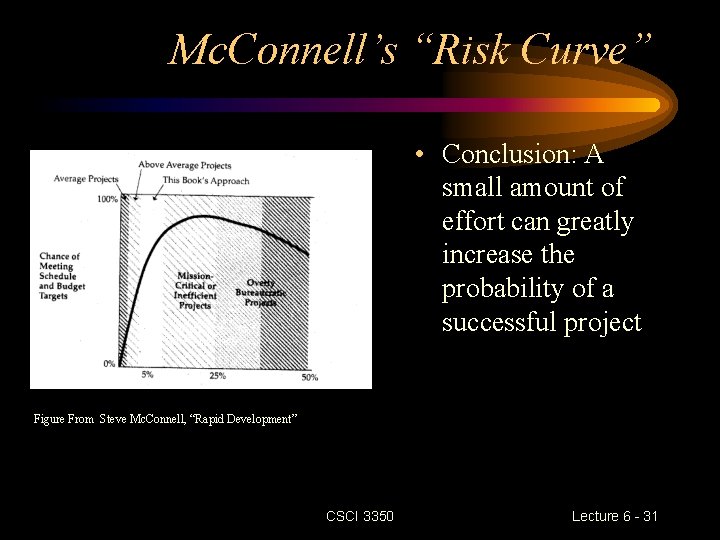
Risk Management (continued) • A good organization will actively seek out ways to trade a small number of $’s for a large reduction in risk exposure • How sensitive is this relation? – Steve Mc. Connell provides a sketch of Probability of Meeting Schedule and Budget as a function of portion of the budget expended on risk management CSCI 3350 Lecture 6 - 30
Mc. Connell’s “Risk Curve” • Conclusion: A small amount of effort can greatly increase the probability of a successful project Figure From Steve Mc. Connell, “Rapid Development” CSCI 3350 Lecture 6 - 31
“Risk Curve” (continued) • Mc. Connell estimates that the risk management technique that follows – Will consume approximately 5% of the total development – Will result in a probability of. 5 -. 7 for a successful project • Projects that need to further reduce risk, will be forced into the area of diminishing returns • It is not possible to achieve a probability approaching 1 for any project of significance CSCI 3350 Lecture 6 - 32
“Risk Curve” (continued) • To achieve the desired risk reduction, corporate management must commit to risk management • Aside: Does the previous graph remind you of one from economics? – Art Laffer and the Laffer Curve CSCI 3350 Lecture 6 - 33
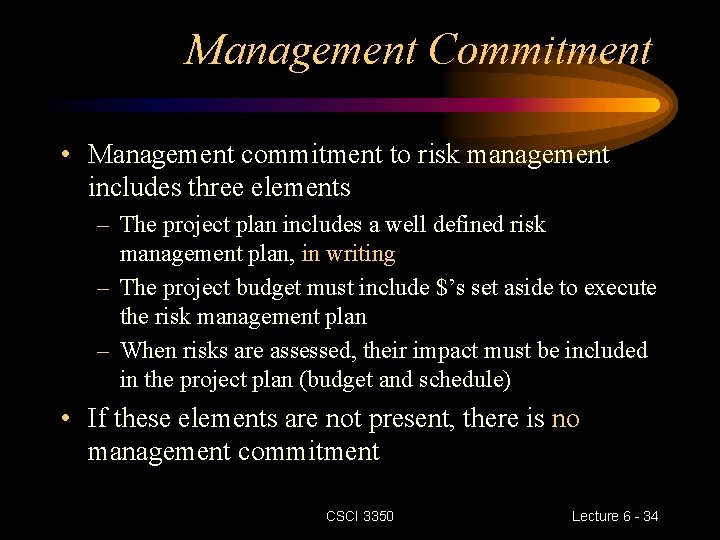
Management Commitment • Management commitment to risk management includes three elements – The project plan includes a well defined risk management plan, in writing – The project budget must include $’s set aside to execute the risk management plan – When risks are assessed, their impact must be included in the project plan (budget and schedule) • If these elements are not present, there is no management commitment CSCI 3350 Lecture 6 - 34
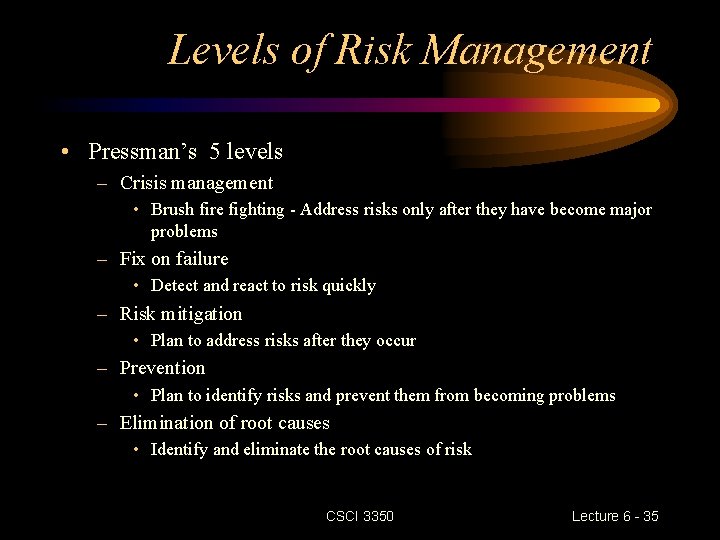
Levels of Risk Management • Pressman’s 5 levels – Crisis management • Brush fire fighting - Address risks only after they have become major problems – Fix on failure • Detect and react to risk quickly – Risk mitigation • Plan to address risks after they occur – Prevention • Plan to identify risks and prevent them from becoming problems – Elimination of root causes • Identify and eliminate the root causes of risk CSCI 3350 Lecture 6 - 35
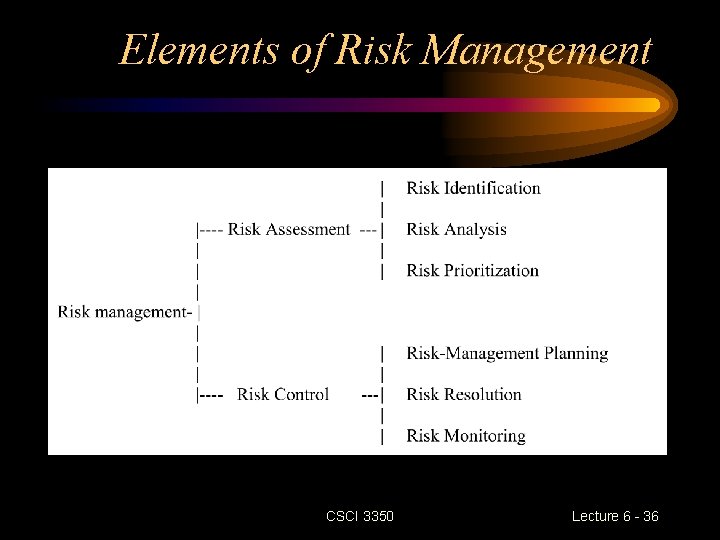
Elements of Risk Management CSCI 3350 Lecture 6 - 36
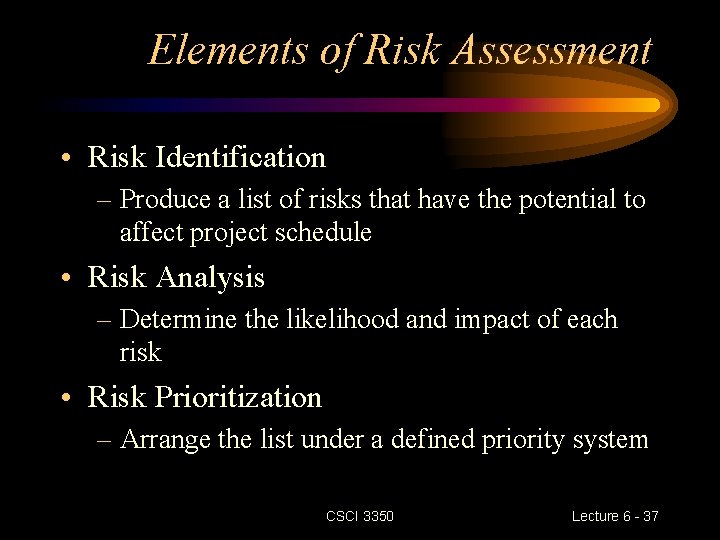
Elements of Risk Assessment • Risk Identification – Produce a list of risks that have the potential to affect project schedule • Risk Analysis – Determine the likelihood and impact of each risk • Risk Prioritization – Arrange the list under a defined priority system CSCI 3350 Lecture 6 - 37
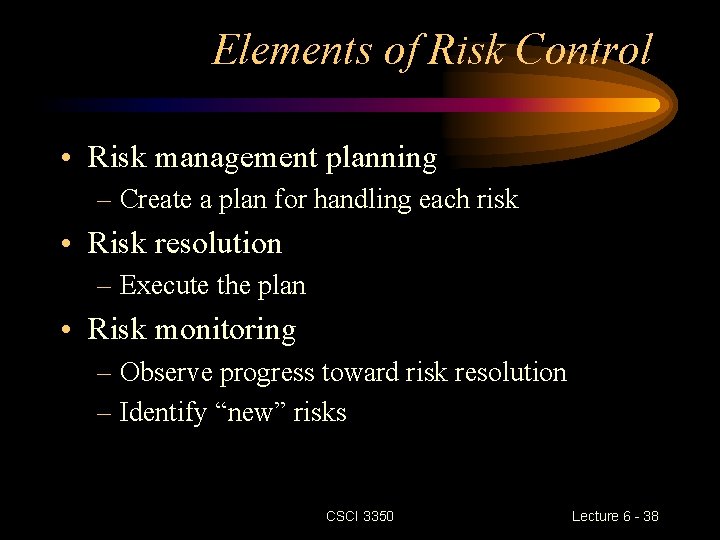
Elements of Risk Control • Risk management planning – Create a plan for handling each risk • Risk resolution – Execute the plan • Risk monitoring – Observe progress toward risk resolution – Identify “new” risks CSCI 3350 Lecture 6 - 38
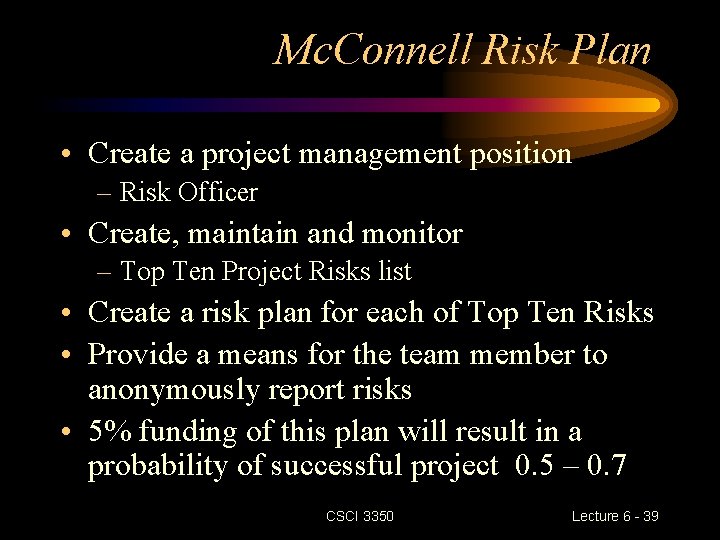
Mc. Connell Risk Plan • Create a project management position – Risk Officer • Create, maintain and monitor – Top Ten Project Risks list • Create a risk plan for each of Top Ten Risks • Provide a means for the team member to anonymously report risks • 5% funding of this plan will result in a probability of successful project 0. 5 – 0. 7 CSCI 3350 Lecture 6 - 39
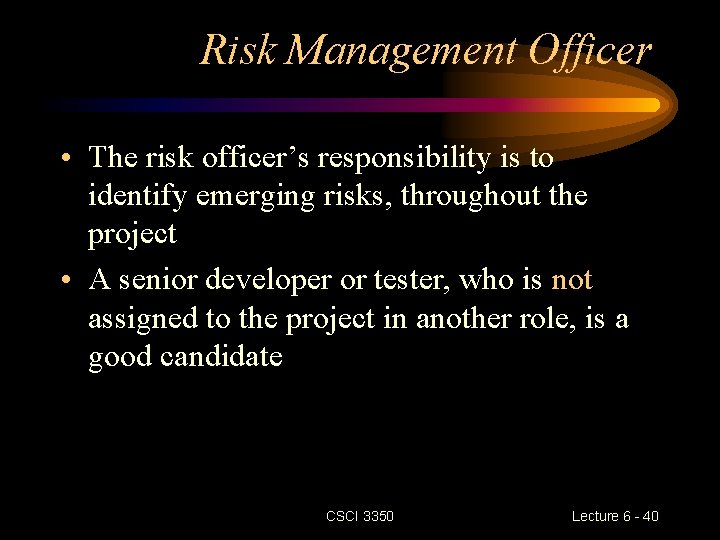
Risk Management Officer • The risk officer’s responsibility is to identify emerging risks, throughout the project • A senior developer or tester, who is not assigned to the project in another role, is a good candidate CSCI 3350 Lecture 6 - 40
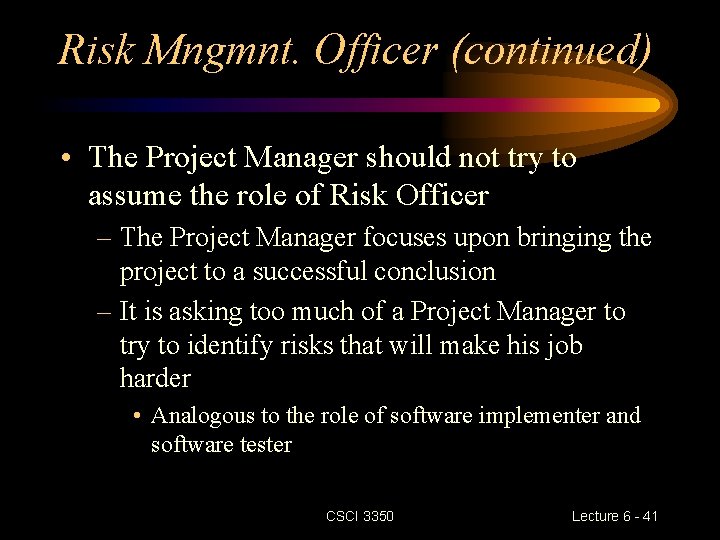
Risk Mngmnt. Officer (continued) • The Project Manager should not try to assume the role of Risk Officer – The Project Manager focuses upon bringing the project to a successful conclusion – It is asking too much of a Project Manager to try to identify risks that will make his job harder • Analogous to the role of software implementer and software tester CSCI 3350 Lecture 6 - 41
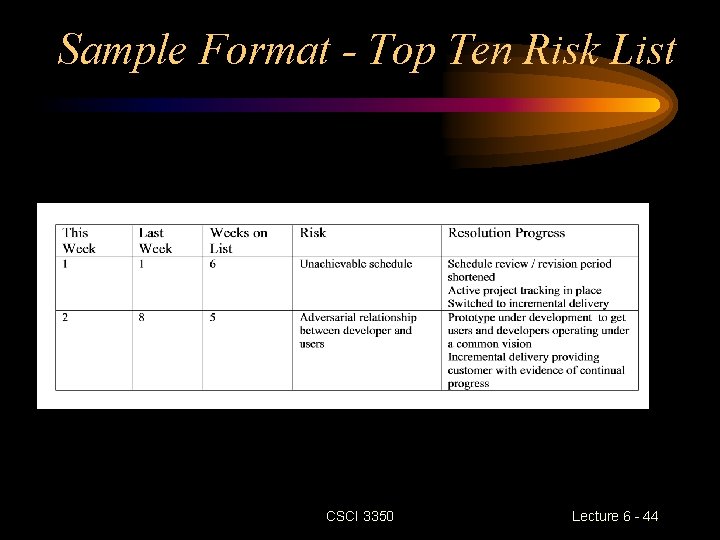
Top Ten Risk List • This is the risk management tool • Create early in the project, – Prior to or during requirements elicitation • Must be reviewed on a frequent periodic basis – – No less frequently than every two weeks Update the list with additional risks Adjust the priority Update the progress on the previously identified risks CSCI 3350 Lecture 6 - 42
Top Ten Risk List (continued) • Should be available to anyone working on the project, and to upper-level corporate management • All team members should be encouraged to contribute risks to the list CSCI 3350 Lecture 6 - 43
Sample Format - Top Ten Risk List CSCI 3350 Lecture 6 - 44
Individual Risk Plan • Each item on the Top 10 Risks list must have a written risk plan – Not an elaborate document ~ 1 page • Should answer the following questions – Why is this issue a risk? • Describe the risk’s probability of occurrence, severity and consequences – How will the risk be resolved? • Describe the general approach to resolving the risk • List or describe all options that were considered CSCI 3350 Lecture 6 - 45
Individual Risk Plan (continued) – What specific steps will be taken to resolve the risk? • List the steps and deliverables that will be generated in resolving the risk • Describe the conditions under which the risks will be upgraded - calendar date, or other trigger – Who is responsible? • Indicate who is responsible for each step in the risk resolution CSCI 3350 Lecture 6 - 46
Individual Risk Plan (continued) – When will each step be completed? • Provide a date when the step will be completed – How much of the budget is allocated to the resolution? • List the cost of each step in the risk resolution CSCI 3350 Lecture 6 - 47
Anonymous Risk Reporting • Provide a means for team members to anonymously report risks – Suggestion box (low tech) – Web site (higher tech) CSCI 3350 Lecture 6 - 48
Addition Human Factors Issue • The Project Manager is held accountable for – Meeting the delivery date – Staying within budget – Delivering a quality product • Often a large loss to a company is the mass departure of good technical people during or after the end of a project • This represents a loss of skills, experience, and corporate memory • Should not this be loss be also charged to the Project Manager? CSCI 3350 Lecture 6 - 49
Staffing Considerations • Ideally, how should a project be staffed? – Hire senior technical people during the requirements elicitation phase • You need experienced people to – “Ferret out” the requirements – Provide insight into the overall project vision – Provide guidelines for the project scope CSCI 3350 Lecture 6 - 50
Staffing (continued) • Hire additional staff during preliminary design and detailed design phase – Would like to have 2 -3 man teams – Hiring additional people doesn’t increase project productivity – Can lead to excessive “wrangling” about minor issues • Major staffing occurs during late detailed design and implementation phases – You can profitably make use of more people, as the tasks become better defined – Try not to add people very late in the implementation phase can actually dilute productivity CSCI 3350 Lecture 6 - 51
Staffing (continued) • For small projects – The flat model, with a level staffing works fine • Whatever you do, – Hire the best people available, even if you have to wait for them to become available – Statistics indicate that the ratio of productivity for the best developers to the worst developers is 10: 1 – You can afford to wait for a 10; you don’t need a 1 CSCI 3350 Lecture 6 - 52
Staffing (continued) – Poor developers can have a negative effect on productivity • Number of defects introduced • Lowers team morale • In especially egregious cases, represent a net drain on the effort and not a net contribution CSCI 3350 Lecture 6 - 53
Managing the Team • The above having been said, research by Lakhanpal, indicates that – The team’s cohesion is the single most important factor in determining team productivity – Individual developers capabilities run a close second to cohesion • This is important because – Most hiring decisions are based solely on technical skills considerations – You should give equal importance to how well an individual will mesh with the rest of the team CSCI 3350 Lecture 6 - 54
Managing the Team (continued) – More important in staffing further on in the project, when the teams have coalesced – A great manager will keep a smoothly working team together at the completion of the current project • Corollary: – An individual disruptive to the team must not be tolerated • The single biggest complaint against management – Failure to remove individuals who were not contributing to the team – The technical people could identify the trouble makers, but management was too slow to act CSCI 3350 Lecture 6 - 55
Barry Boehm’s Top Ten List • A list compiled over a history of more than 40 projects • Risk 1: Personnel shortfalls – Not enough people available with the needed skills • Appropriate Risk Mitigation Techniques – – – Staffing with top quality people Job matching Team building Key personnel agreements Cross training CSCI 3350 Lecture 6 - 56
Boehm’s Top Ten (continued) • Risk 2: Unrealistic schedules or budgets – Either intentional or unintentional • Appropriate Risk Mitigation Techniques – Detailed multi-source cost and schedule estimates – Design to cost – Incremental development – Software reuse – Requirements scrubbing CSCI 3350 Lecture 6 - 57
Boehm’s Top Ten (continued) • Risk 3: Developing wrong functionality – Getting the requirements wrong – Not adhering to the requirements • Appropriate Risk Mitigation Techniques – – – Customer mission analysis User survey User participation Prototyping Early user manuals Quality factor analysis CSCI 3350 Lecture 6 - 58
Boehm’s Top Ten (continued) • Risk 4: Developing wrong user interface – Not correctly identifying the users skill level – A wide variety of user skill levels • Appropriate Risk Mitigation Techniques – Prototyping – Scenarios – Task analysis – User participation CSCI 3350 Lecture 6 - 59
Boehm’s Top Ten (continued) • Risk 5: Gold Plating – Adding nonessential features • Appropriate Risk Mitigation Techniques – Requirements scrubbing – Prototyping – Cost-benefit analysis – Designing to cost CSCI 3350 Lecture 6 - 60
Boehm’s Top Ten (continued) • Risk 6: Requirements Changes – Failing to accommodate change – Failing to limit change • Appropriate Risk Mitigation Techniques – Set high threshold for change acceptance – Incremental development (defer change to next version) CSCI 3350 Lecture 6 - 61
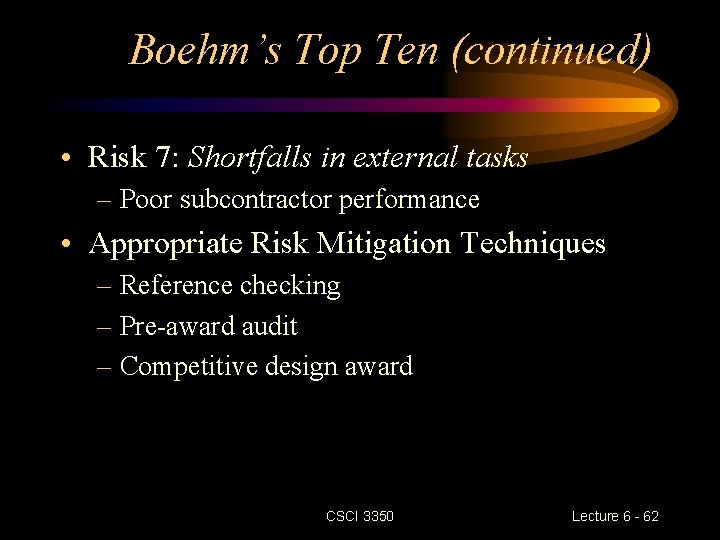
Boehm’s Top Ten (continued) • Risk 7: Shortfalls in external tasks – Poor subcontractor performance • Appropriate Risk Mitigation Techniques – Reference checking – Pre-award audit – Competitive design award CSCI 3350 Lecture 6 - 62
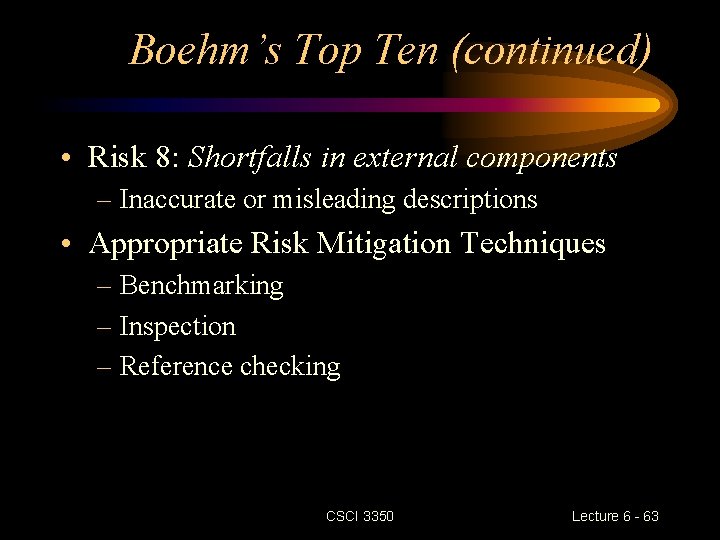
Boehm’s Top Ten (continued) • Risk 8: Shortfalls in external components – Inaccurate or misleading descriptions • Appropriate Risk Mitigation Techniques – Benchmarking – Inspection – Reference checking CSCI 3350 Lecture 6 - 63
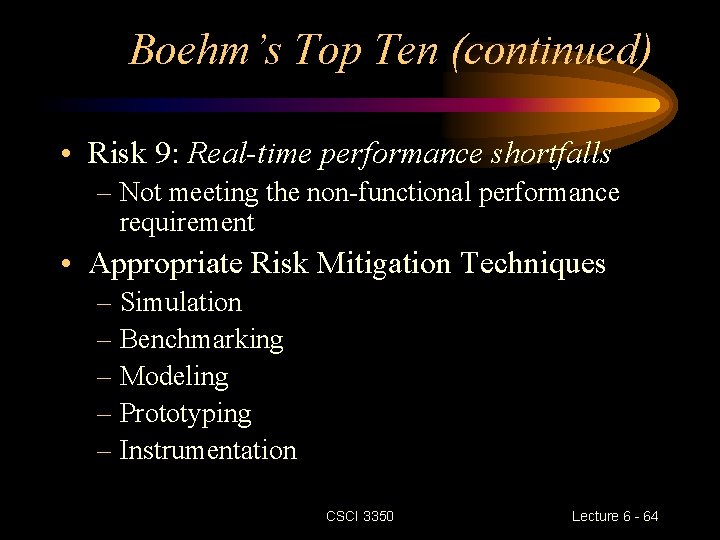
Boehm’s Top Ten (continued) • Risk 9: Real-time performance shortfalls – Not meeting the non-functional performance requirement • Appropriate Risk Mitigation Techniques – Simulation – Benchmarking – Modeling – Prototyping – Instrumentation CSCI 3350 Lecture 6 - 64
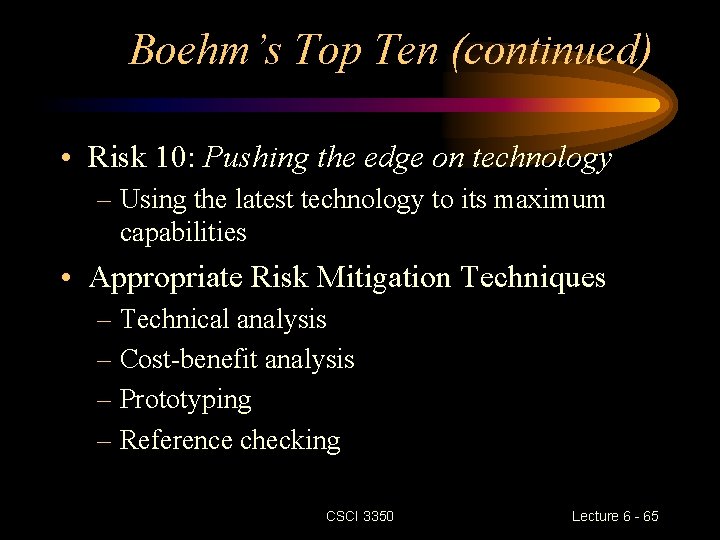
Boehm’s Top Ten (continued) • Risk 10: Pushing the edge on technology – Using the latest technology to its maximum capabilities • Appropriate Risk Mitigation Techniques – Technical analysis – Cost-benefit analysis – Prototyping – Reference checking CSCI 3350 Lecture 6 - 65