
Lecture 6 Radioactive Isotopes Definitions and types of



- Slides: 26
Lecture 6 Radioactive Isotopes Definitions and types of decay Derivation of decay equations Half lives and mean lives Secular Equilibrium Useful radiotracers in oceanography E & H Chpt 5
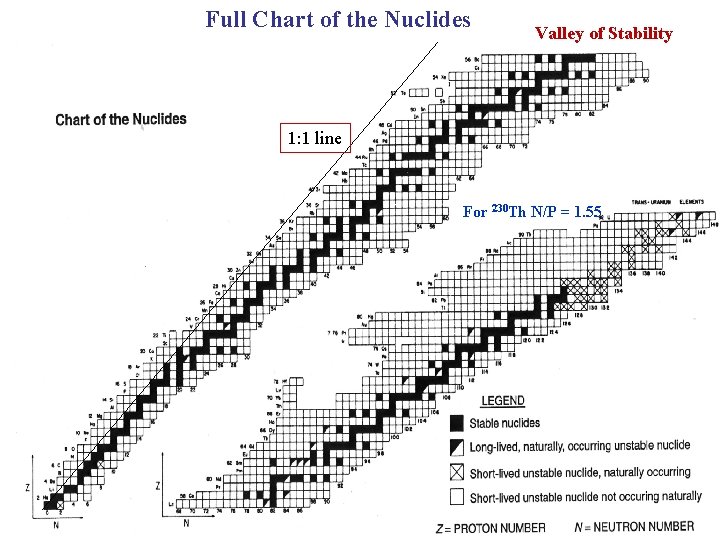
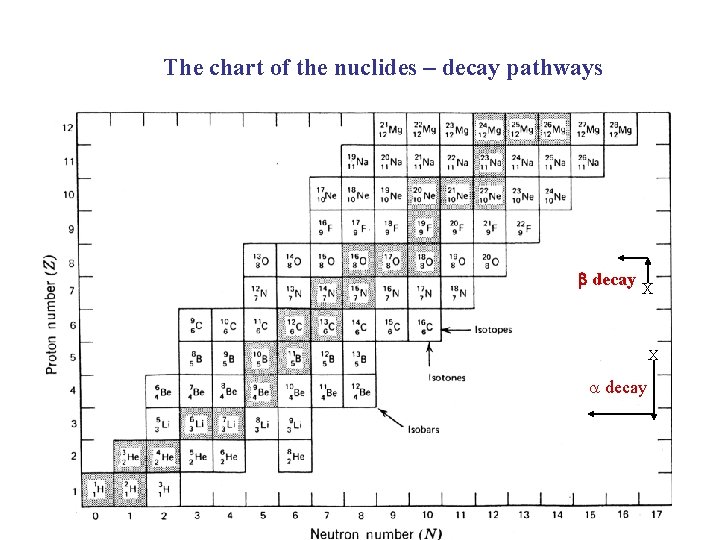
The chart of the nuclides - decay Q. 230 Th 90 How many protons / neutrons?
Full Chart of the Nuclides Valley of Stability 1: 1 line For 230 Th N/P = 1. 55
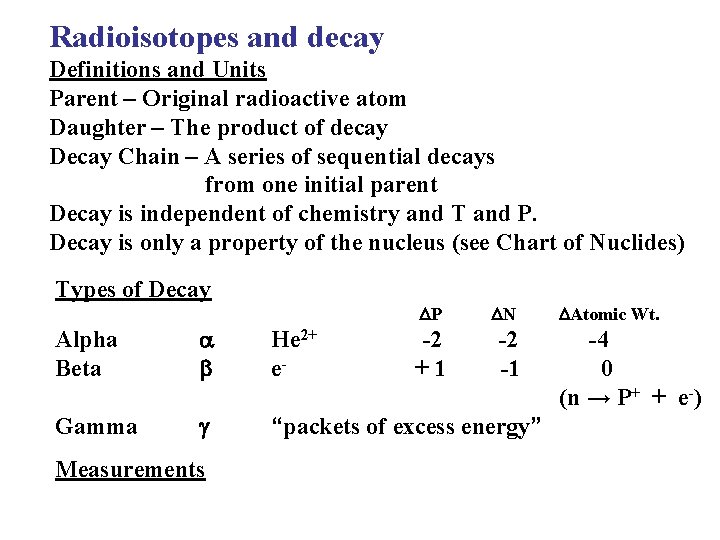
Radioisotopes and decay Definitions and Units Parent – Original radioactive atom Daughter – The product of decay Decay Chain – A series of sequential decays from one initial parent Decay is independent of chemistry and T and P. Decay is only a property of the nucleus (see Chart of Nuclides) Types of Decay DP DN -2 +1 -2 -1 Alpha Beta a b He 2+ e- Gamma g “packets of excess energy” Measurements DAtomic Wt. -4 0 (n → P+ + e-)
The chart of the nuclides – decay pathways b decay X X a decay
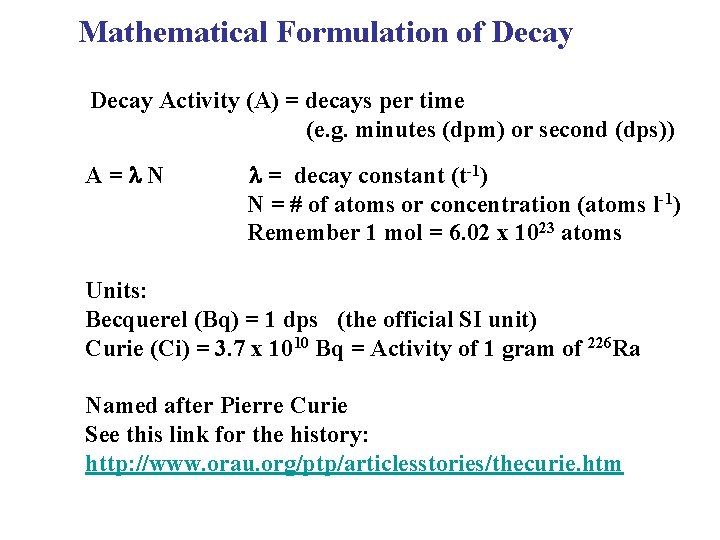
Mathematical Formulation of Decay Activity (A) = decays per time (e. g. minutes (dpm) or second (dps)) A= N = decay constant (t-1) N = # of atoms or concentration (atoms l-1) Remember 1 mol = 6. 02 x 1023 atoms Units: Becquerel (Bq) = 1 dps (the official SI unit) Curie (Ci) = 3. 7 x 10¹⁰ Bq = Activity of 1 gram of 226 Ra Named after Pierre Curie See this link for the history: http: //www. orau. org/ptp/articlesstories/thecurie. htm
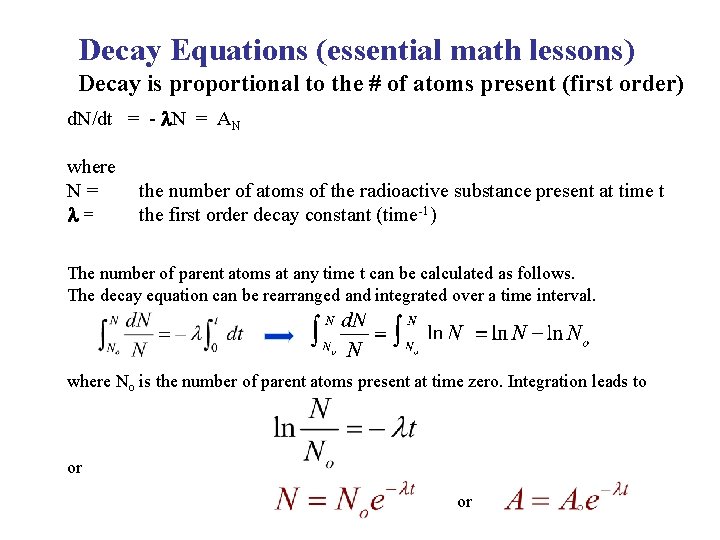
Decay Equations (essential math lessons) Decay is proportional to the # of atoms present (first order) d. N/dt = - N = AN where N= = the number of atoms of the radioactive substance present at time t the first order decay constant (time-1) The number of parent atoms at any time t can be calculated as follows. The decay equation can be rearranged and integrated over a time interval. where No is the number of parent atoms present at time zero. Integration leads to or or
Decay Curve Both N and A decrease exponentially
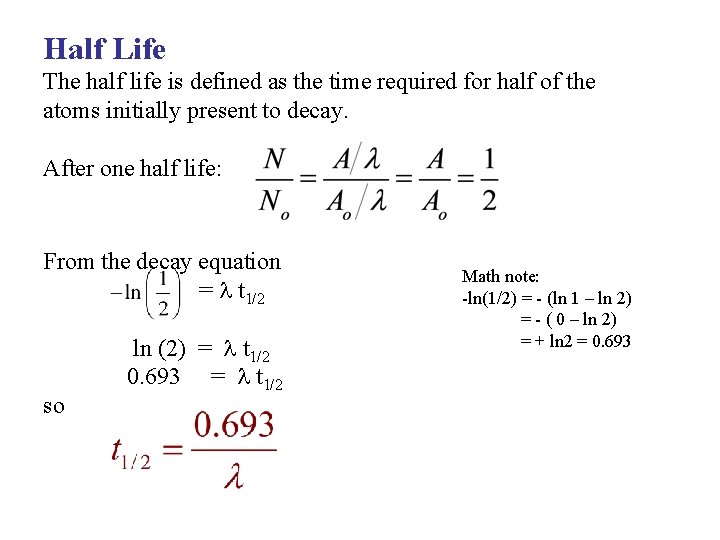
Half Life The half life is defined as the time required for half of the atoms initially present to decay. After one half life: From the decay equation = t 1/2 so ln (2) = t 1/2 0. 693 = t 1/2 Math note: -ln(1/2) = - (ln 1 – ln 2) = - ( 0 – ln 2) = + ln 2 = 0. 693
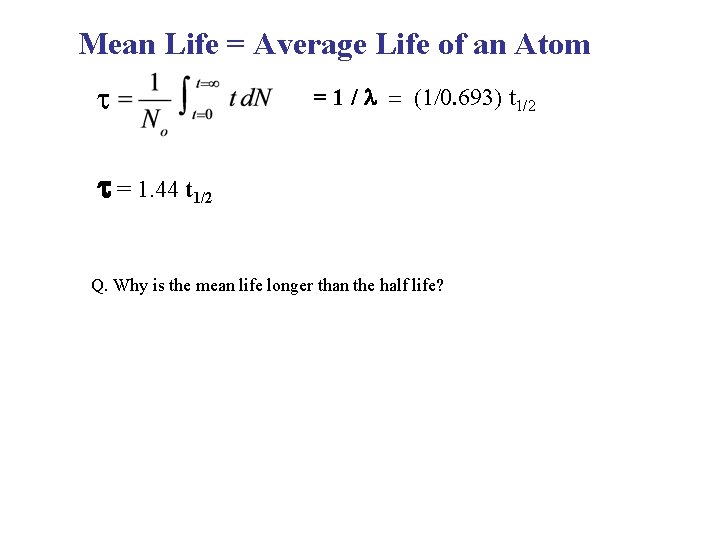
Mean Life = Average Life of an Atom t = 1 / = (1/0. 693) t 1/2 t = 1. 44 t 1/2 Q. Why is the mean life longer than the half life?
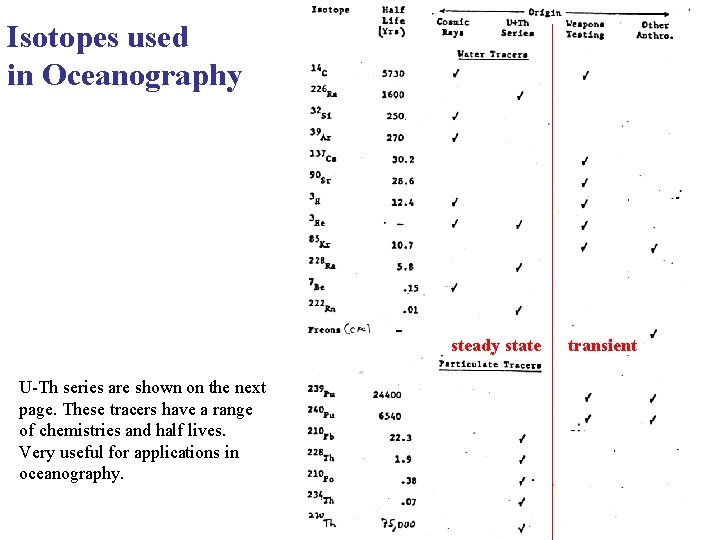
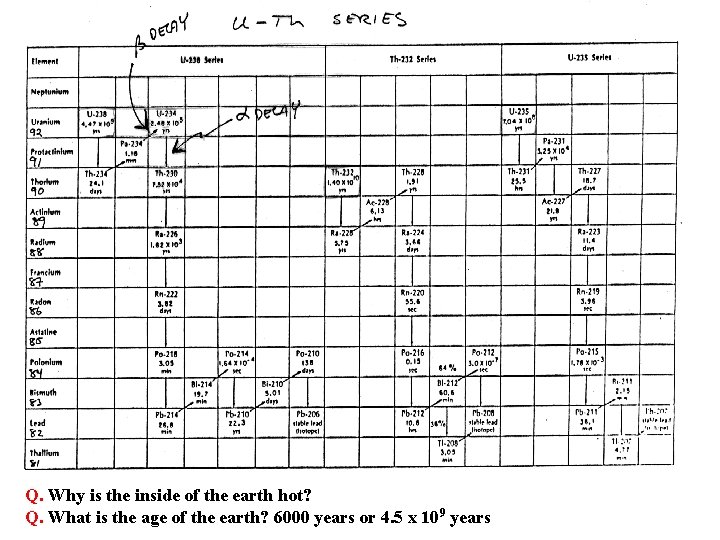
Isotopes used in Oceanography steady state U-Th series are shown on the next page. These tracers have a range of chemistries and half lives. Very useful for applications in oceanography. transient
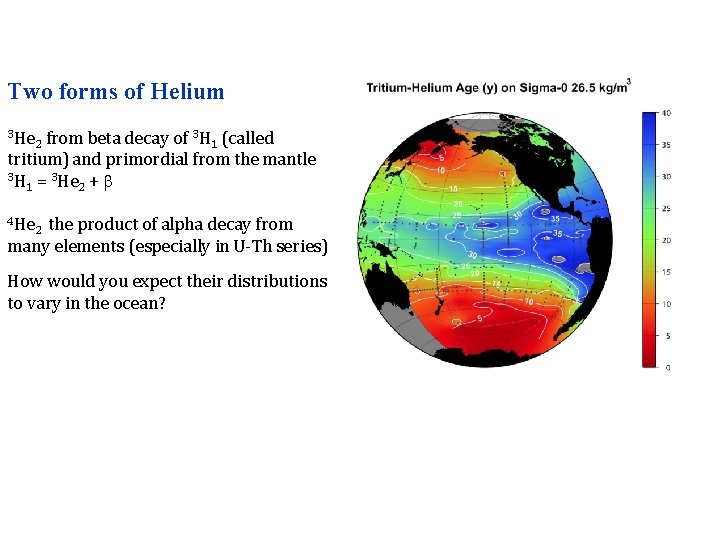
Two forms of Helium 3 He 2 from beta decay of 3 H 1 (called tritium) and primordial from the mantle 3 H = 3 He + b 1 2 4 He 2 the product of alpha decay from many elements (especially in U-Th series) How would you expect their distributions to vary in the ocean?
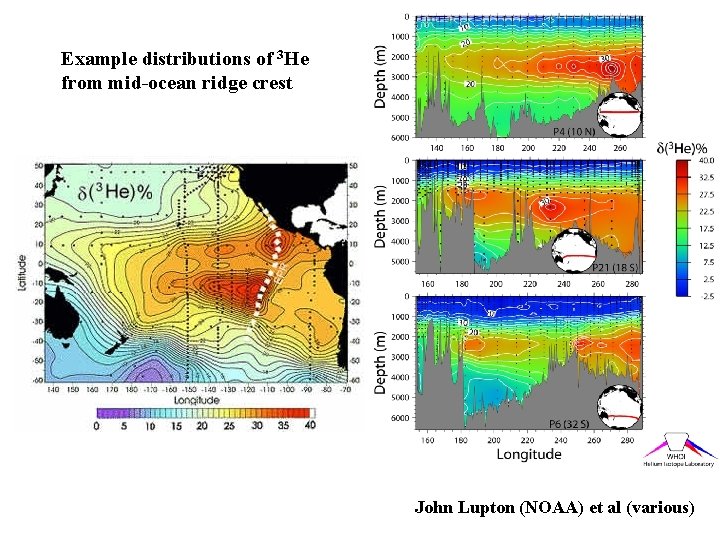
Example distributions of 3 He from mid-ocean ridge crest John Lupton (NOAA) et al (various)
Q. Why is the inside of the earth hot? Q. What is the age of the earth? 6000 years or 4. 5 x 10⁹ years
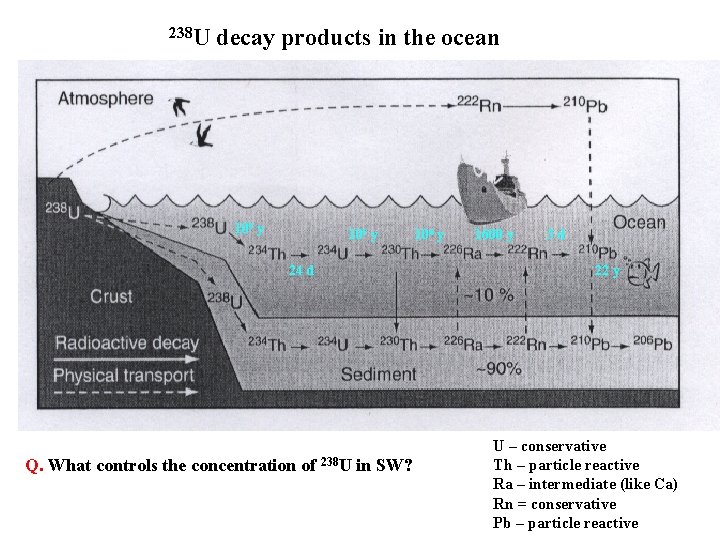
238 U decay products in the ocean 109 y 105 y 24 d Q. What controls the concentration of 238 U in SW? 104 y 1600 y 3 d 22 y U – conservative Th – particle reactive Ra – intermediate (like Ca) Rn = conservative Pb – particle reactive
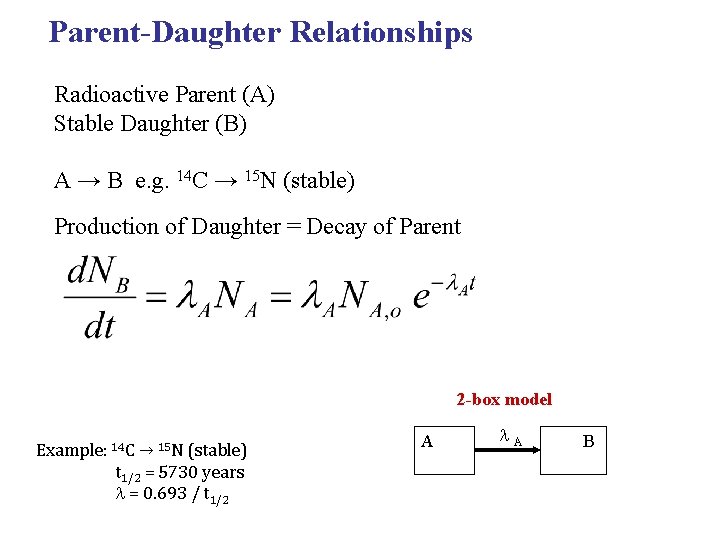
Parent-Daughter Relationships Radioactive Parent (A) Stable Daughter (B) A → B e. g. 14 C → 15 N (stable) Production of Daughter = Decay of Parent 2 -box model Example: 14 C 15 N → (stable) t 1/2 = 5730 years = 0. 693 / t 1/2 A A B
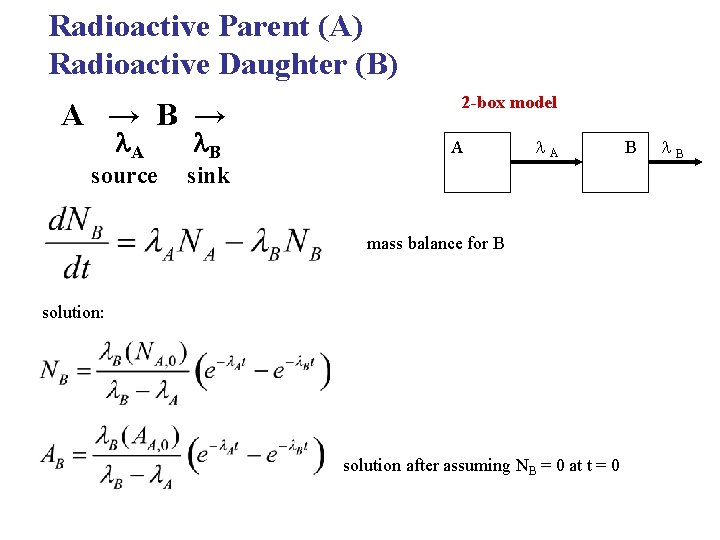
Radioactive Parent (A) Radioactive Daughter (B) A → B → A source B 2 -box model A A sink mass balance for B solution: solution after assuming NB = 0 at t = 0 B B
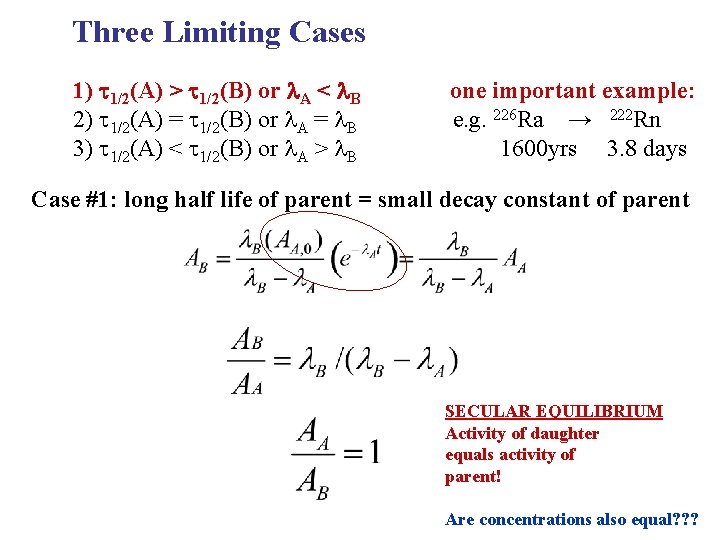
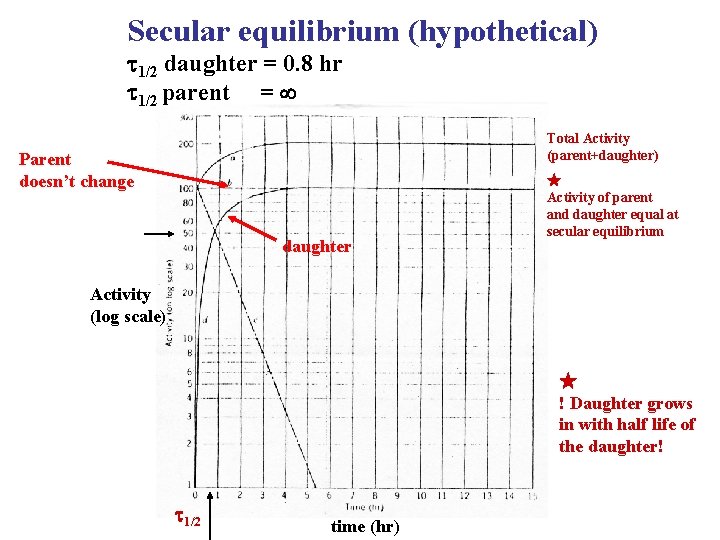
Three Limiting Cases 1) t 1/2(A) > t 1/2(B) or A < B 2) t 1/2(A) = t 1/2(B) or A = B 3) t 1/2(A) < t 1/2(B) or A > B one important example: e. g. 226 Ra → 222 Rn 1600 yrs 3. 8 days Case #1: long half life of parent = small decay constant of parent SECULAR EQUILIBRIUM Activity of daughter equals activity of parent! Are concentrations also equal? ? ?
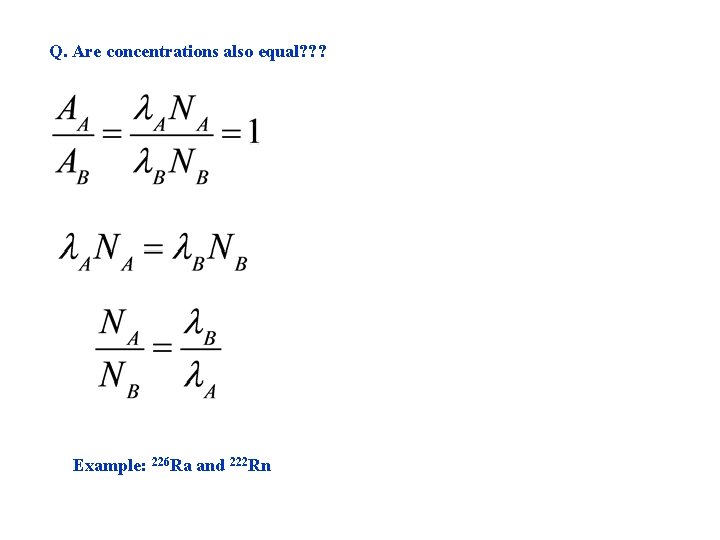
Q. Are concentrations also equal? ? ? Example: 226 Ra and 222 Rn
Secular equilibrium (hypothetical) t 1/2 daughter = 0. 8 hr t 1/2 parent = Total Activity (parent+daughter) Parent doesn’t change daughter ★ Activity of parent and daughter equal at secular equilibrium Activity (log scale) ★ ! Daughter grows in with half life of the daughter! t 1/2 time (hr)
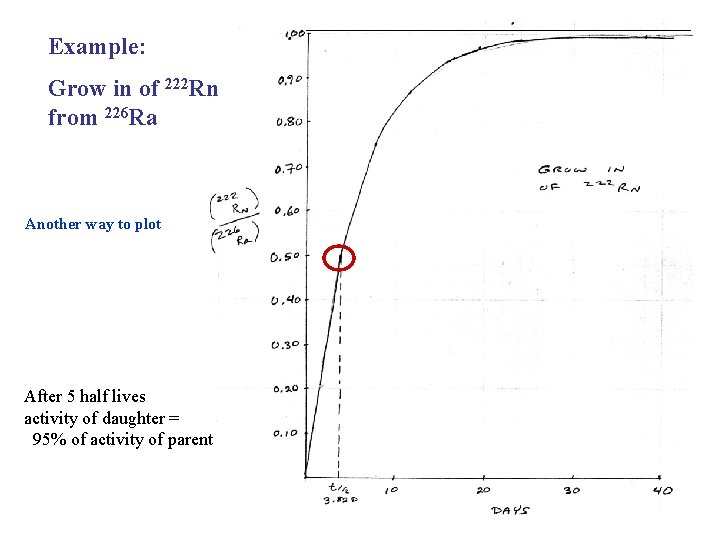
Example: Grow in of 222 Rn from 226 Ra Another way to plot After 5 half lives activity of daughter = 95% of activity of parent
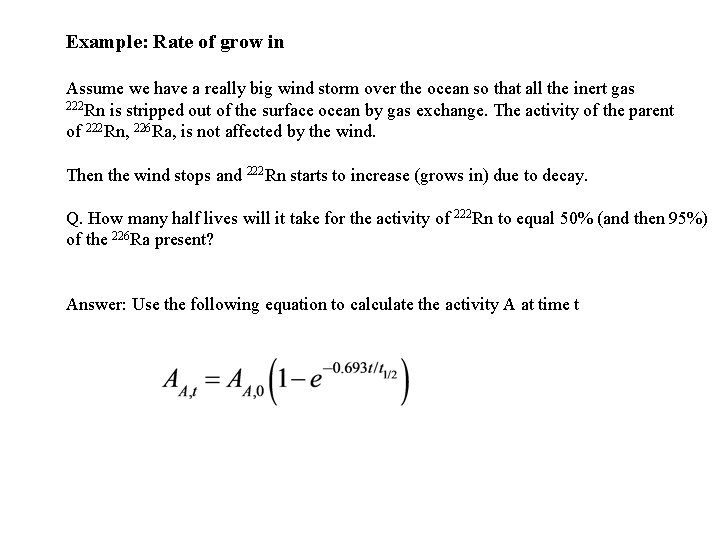
Example: Rate of grow in Assume we have a really big wind storm over the ocean so that all the inert gas 222 Rn is stripped out of the surface ocean by gas exchange. The activity of the parent of 222 Rn, 226 Ra, is not affected by the wind. Then the wind stops and 222 Rn starts to increase (grows in) due to decay. Q. How many half lives will it take for the activity of 222 Rn to equal 50% (and then 95%) of the 226 Ra present? Answer: Use the following equation to calculate the activity A at time t
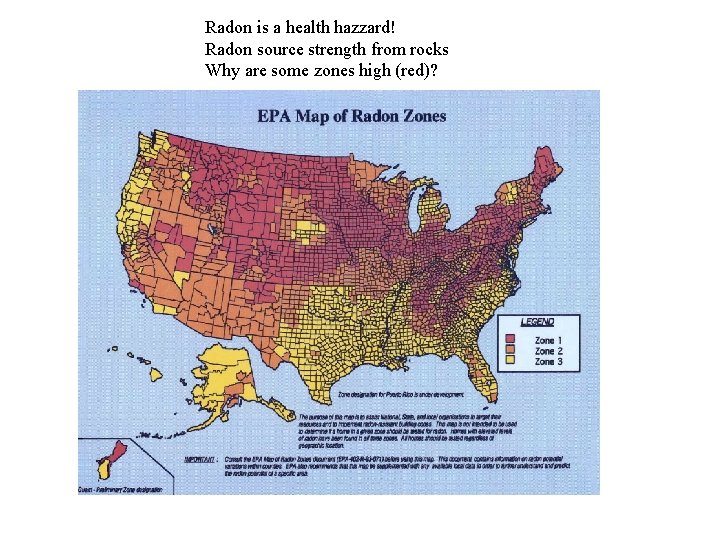
Radon is a health hazzard! Radon source strength from rocks Why are some zones high (red)?
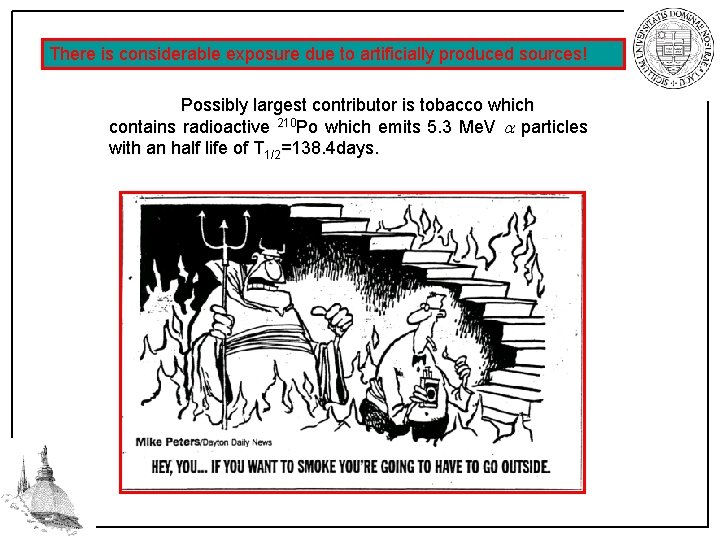
There is considerable exposure due to artificially produced sources! Possibly largest contributor is tobacco which contains radioactive 210 Po which emits 5. 3 Me. V a particles with an half life of T 1/2=138. 4 days.
Was Litvinenko (a former Russian spy) killed by 210 Po? ? A case study of 210 Po Toxicity of Polonium 210 Weight-for-weight, polonium's toxicity is around 106 times greater than hydrogen cyanide (50 ng for Po-210 vs 50 mg for hydrogen cyanide). The main hazard is its intense radioactivity (as an alpha emitter), which makes it very difficult to handle safely - one gram of Po will self-heat to a temperature of around 500°C. It is also chemically toxic (with poisoning effects analogous with tellurium). Even in microgram amounts, handling 210 Po is extremely dangerous, requiring specialized equipment and strict handling procedures. Alpha particles emitted by polonium will damage organic tissue easily if polonium is ingested, inhaled, or absorbed (though they do not penetrate the epidermis and hence are not hazardous if the polonium is outside the body). Acute effects The lethal dose (LD 50) for acute radiation exposure is generally about 4. 5 Sv. (Sv = Sievert which is a unit of dose equivalent). The committed effective dose equivalent 210 Po is 0. 51 µSv/Bq if ingested, and 2. 5 µSv/Bq if inhaled. Since 210 Po has an activity of 166 TBq per gram (1 gram produces 166× 1012 decays per second), a fatal 4 -Sv dose can be caused by ingesting 8. 8 MBq (238 microcurie), about 50 nanograms (ng), or inhaling 1. 8 MBq (48 microcurie), about 10 ng. One gram of 210 Po could thus in theory poison 100 million people of which 50 million would die (LD 50).
Body burden limit The maximum allowable body burden for ingested polonium is only 1, 100 Bq (0. 03 microcurie), which is equivalent to a particle weighing only 6. 8 picograms. The maximum permissible concentration for airborne soluble polonium compounds is about 10 Bq/m 3 (2. 7 × 10 -10 µCi/cm 3). The biological half-life of polonium in humans is 30 to 50 days. The target organs for polonium in humans are the spleen and liver. As the spleen (150 g) and the liver (1. 3 to 3 kg) are much smaller than the rest of the body, if the polonium is concentrated in these vital organs, it is a greater threat to life than the dose which would be suffered (on average) by the whole body if it were spread evenly throughout the body, in the same way as cesium or tritium. Notably, the murder of Alexander Litvinenko in 2006 was announced as due to 210 Po poisoning. Generally, 210 Po is most lethal when it is ingested. Litvinenko was probably the first person ever to die of the acute α-radiation effects of 210 Po , although Irene Joliot-Curie was actually the first person ever to die from the radiation effects of polonium (due to a single intake) in the late 1950 s. It is reasonable to assume that many people have died as a result of lung cancer caused by the alpha emission of polonium present in their lungs, either as a radon daughter or from tobacco smoke.