
Lecture 6 OLD ENGLISH GRAMMAR Old English Alphabet
Lecture 6 OLD ENGLISH GRAMMAR �
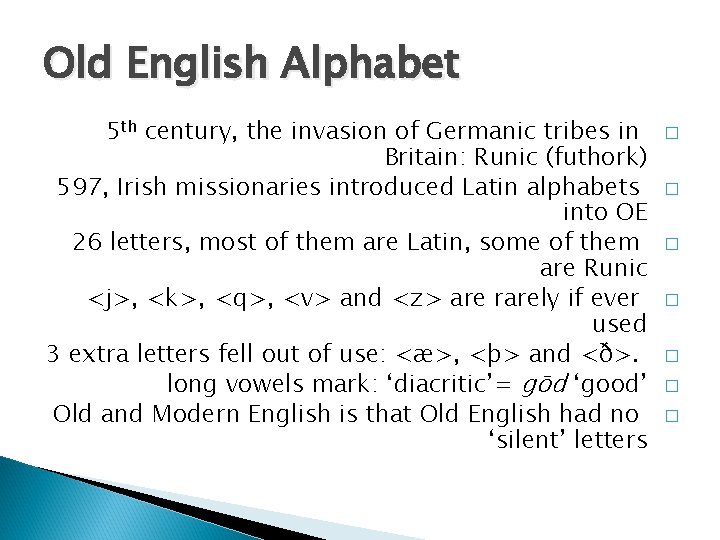
Old English Alphabet 5 th century, the invasion of Germanic tribes in Britain: Runic (futhork) 597, Irish missionaries introduced Latin alphabets into OE 26 letters, most of them are Latin, some of them are Runic <j>, <k>, <q>, <v> and <z> are rarely if ever used 3 extra letters fell out of use: <æ>, <þ> and <ð>. long vowels mark: ‘diacritic’= gōd ‘good’ Old and Modern English is that Old English had no ‘silent’ letters � � � �
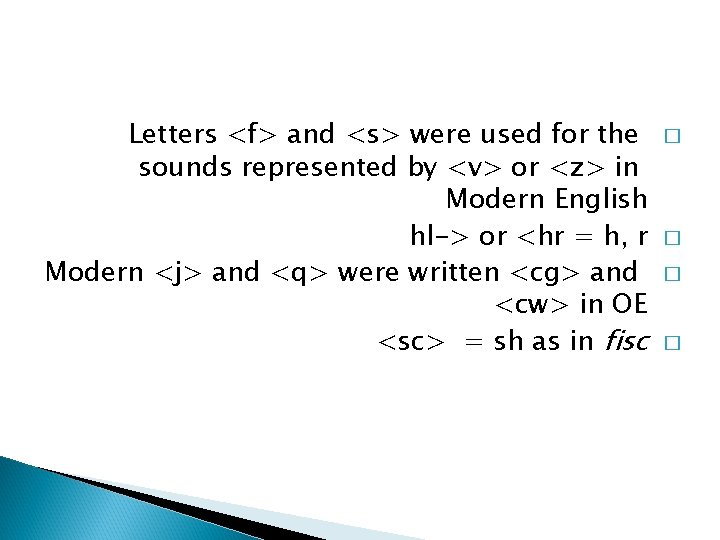
Letters <f> and <s> were used for the sounds represented by <v> or <z> in Modern English hl-> or <hr = h, r Modern <j> and <q> were written <cg> and <cw> in OE <sc> = sh as in fisc � �
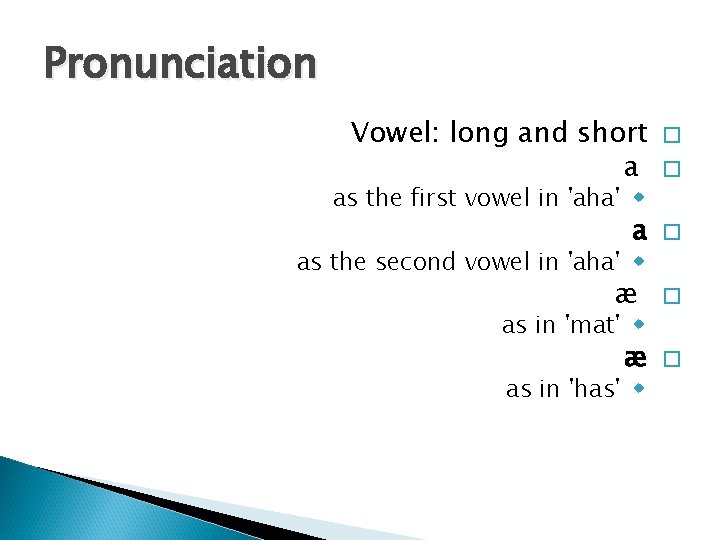
Pronunciation Vowel: long and short a � � as the first vowel in 'aha' w a � as the second vowel in 'aha' w æ � as in 'mat' w æ as in 'has' w �
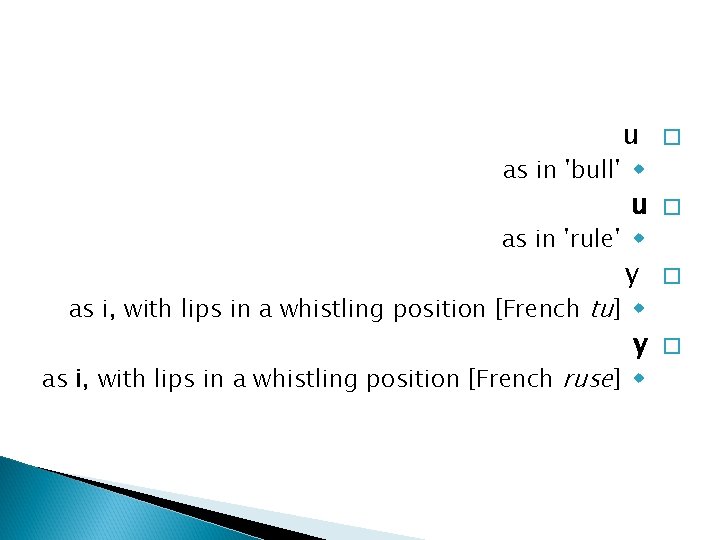
u � as in 'bull' w u � as in 'rule' w y � as i, with lips in a whistling position [French tu] w y as i, with lips in a whistling position [French ruse] w �
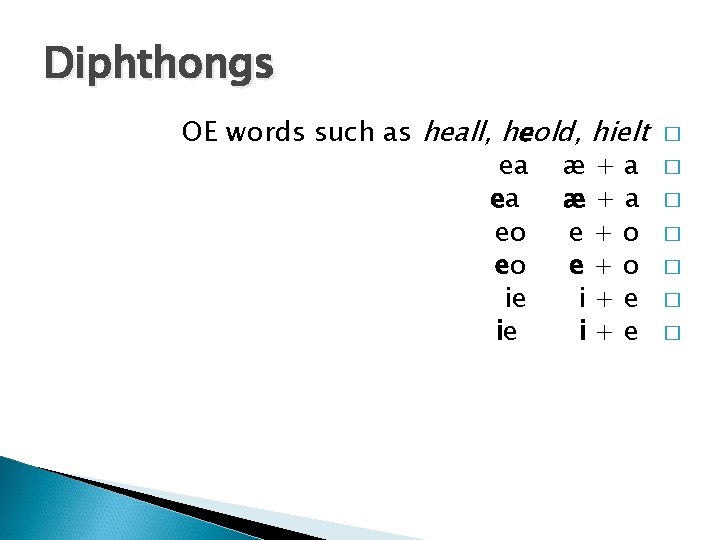
Diphthongs OE words such as heall, heold, hielt ea æ + a ea æ+a eo e+o ie i+e � � � �
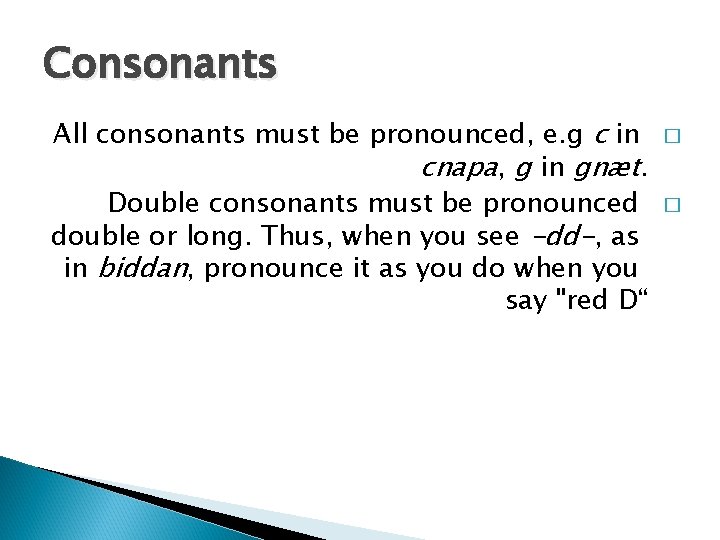
Consonants All consonants must be pronounced, e. g c in cnapa, g in gnæt. Double consonants must be pronounced double or long. Thus, when you see -dd-, as in biddan, pronounce it as you do when you say "red D“ � �
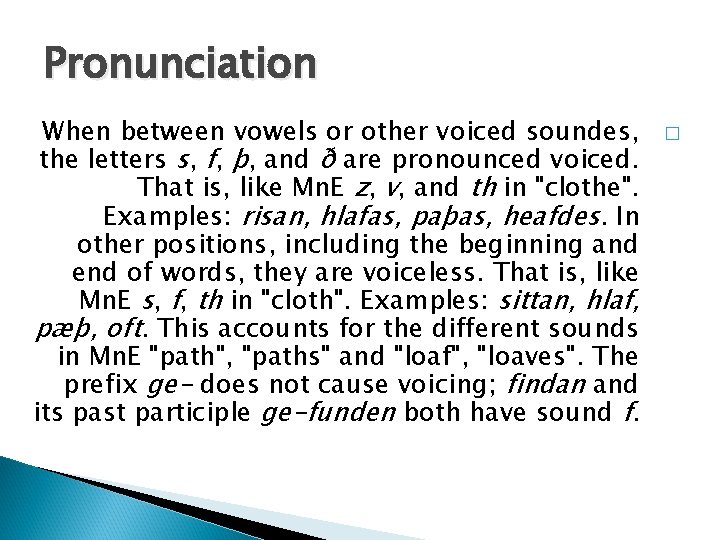
Pronunciation When between vowels or other voiced soundes, the letters s, f, þ, and ð are pronounced voiced. That is, like Mn. E z, v, and th in "clothe". Examples: risan, hlafas, paþas, heafdes. In other positions, including the beginning and end of words, they are voiceless. That is, like Mn. E s, f, th in "cloth". Examples: sittan, hlaf, pæþ, oft. This accounts for the different sounds in Mn. E "path", "paths" and "loaf", "loaves". The prefix ge- does not cause voicing; findan and its past participle ge-funden both have sound f. �
Pronunciation At the beginning of a word (initially) before a vowel, h is pronounced as in Mn. E "hound". Otherwise it is like German ch in ich. It can be pronounced like ch in Scots loch. Before a, o, u, y, c is pronounced k. Before e, i, c is pronounced like ch in Mn. E "child". When pronounced as ch, this is represented by c. � �
Pronunciation Before a, o, u, y, g is pronounced as in Mn. E "good". Before e, i, g is pronounced like y in Mn. E "yet". When pronounced as y, this is represented by g. After or between back vowels (a, o, u, y), g is pronounced roughly as w. For example: dragan, boga. � �
Pronunciation The combination sc is usually pronounced like Mn. E sh. Thus scip (ship) is pronounced the same in Mn. E and OE. But in ascian (ask), sc- is pronounced -sk-. The combination cg is usually pronounced like Mn. E dge. Thus ecg (edge) is pronounced the same in Mn. E and OE. � �
Grammar Old English was primarily a synthetic language whereas Modern English is primarily analytic. As a result, Old English is a highly inflected language. Inflections for N, Adj. , V. . Words going together have to agree by inflectional endings. Plural noun must have plural adjective. Masculine goes with masculine. � �
The Verb Present and past tense � Weak and strong verb forms �
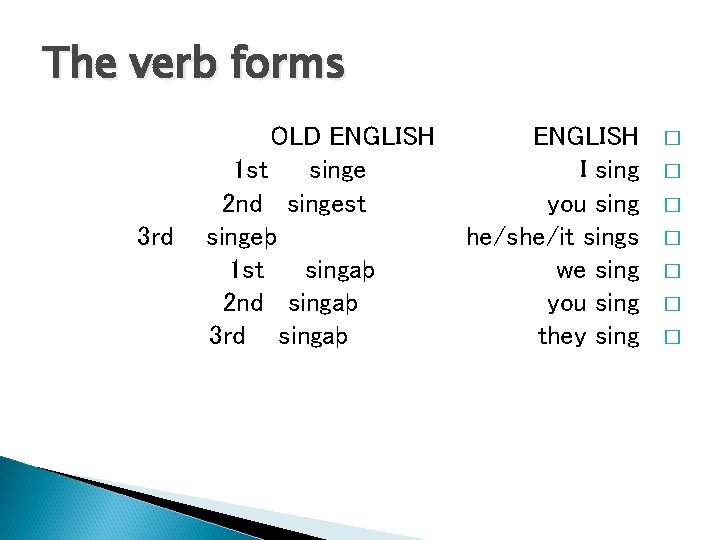
The verb forms 3 rd OLD ENGLISH 1 st singe 2 nd singest singeþ 1 st singaþ 2 nd singaþ 3 rd singaþ ENGLISH I sing you sing he/she/it sings we sing you sing they sing � � � �
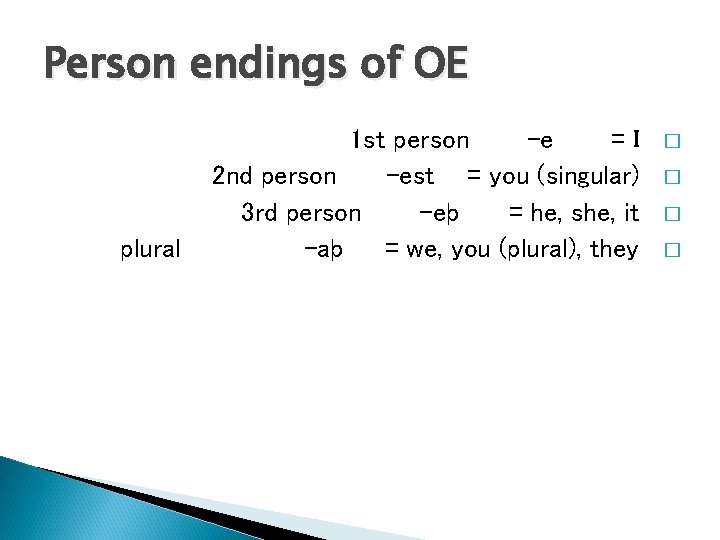
Person endings of OE plural 1 st person -e =I 2 nd person -est = you (singular) 3 rd person -eþ = he, she, it -aþ = we, you (plural), they � �
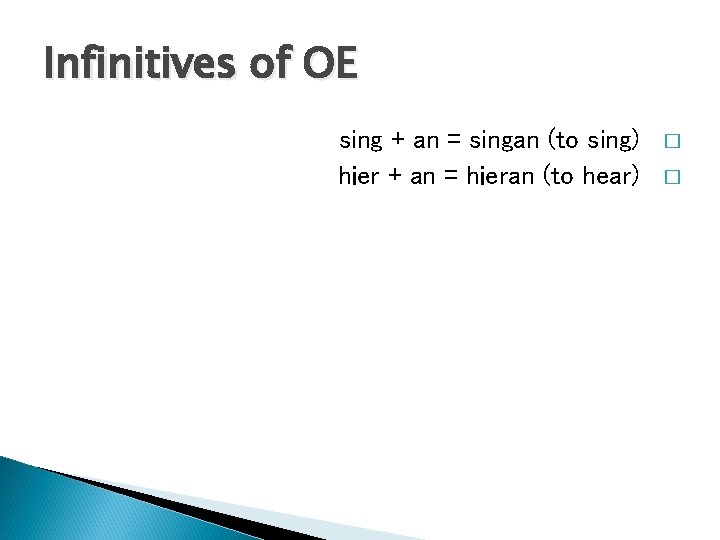
Infinitives of OE sing + an = singan (to sing) hier + an = hieran (to hear) � �
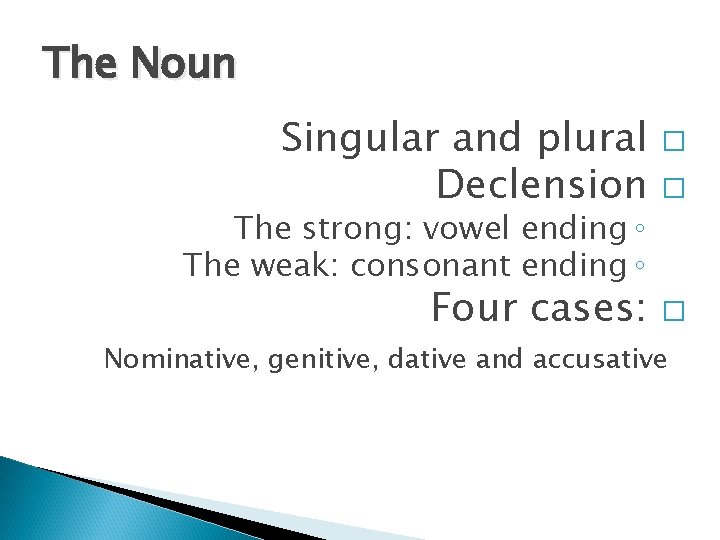
The Noun Singular and plural Declension � � The strong: vowel ending ◦ The weak: consonant ending ◦ Four cases: � Nominative, genitive, dative and accusative
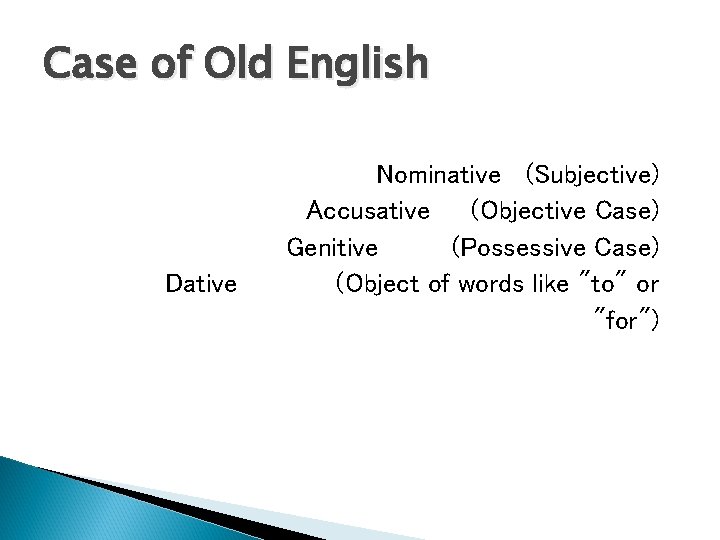
Case of Old English Dative Nominative (Subjective) Accusative (Objective Case) Genitive (Possessive Case) (Object of words like "to" or "for")
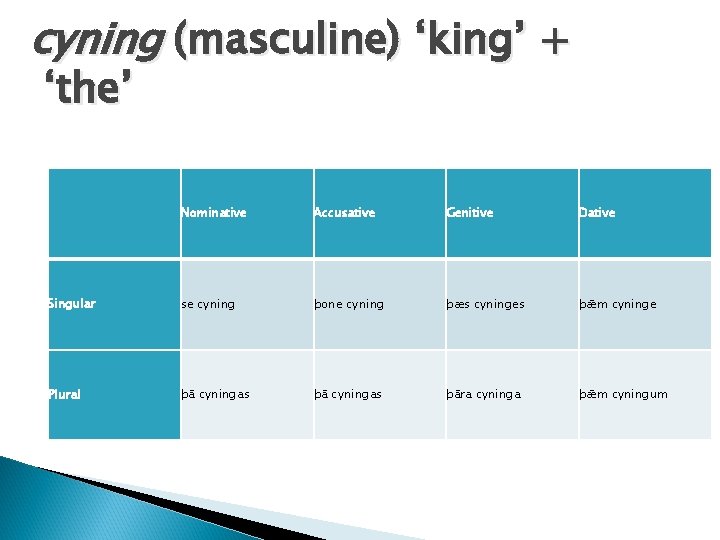
cyning (masculine) ‘king’ + ‘the’ Nominative Accusative Genitive Dative Singular se cyning þone cyning þæs cyninges þǣm cyninge Plural þā cyningas þāra cyninga þǣm cyningum
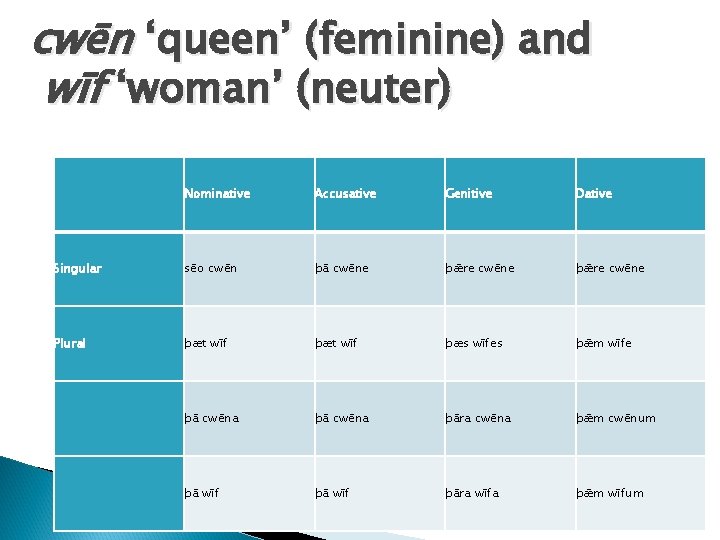
cwēn ‘queen’ (feminine) and wīf ‘woman’ (neuter) Nominative Accusative Genitive Dative Singular sēo cwēn þā cwēne þǣre cwēne Plural þæt wīf þæs wīfes þǣm wīfe þā cwēna þāra cwēna þǣm cwēnum þā wīf þāra wīfa þǣm wīfum
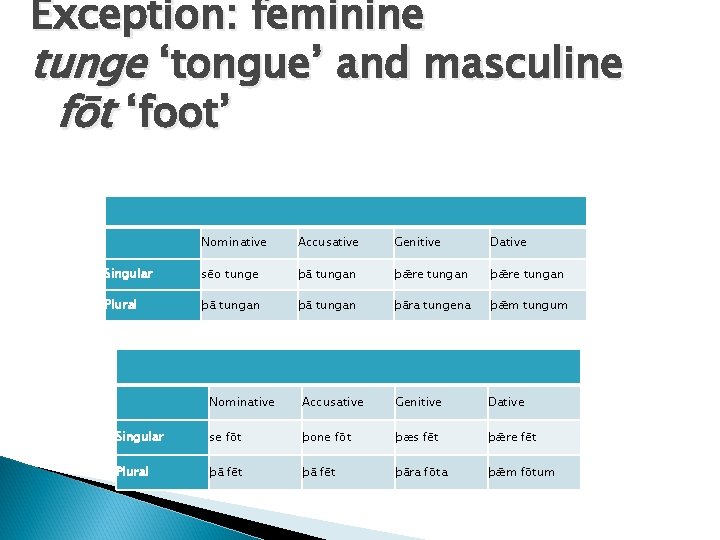
Exception: feminine tunge ‘tongue’ and masculine fōt ‘foot’ Nominative Accusative Genitive Dative Singular sēo tunge þā tungan þǣre tungan Plural þā tungan þāra tungena þǣm tungum Nominative Accusative Genitive Dative Singular se fōt þone fōt þæs fēt þǣre fēt Plural þā fēt þāra fōta þǣm fōtum
The plural form of Present-Day English ox/oxen is a relic of the -an inflection �
Grammatical Gender Masculine � Feminine � Neuter � The gender of old English � can be illogical
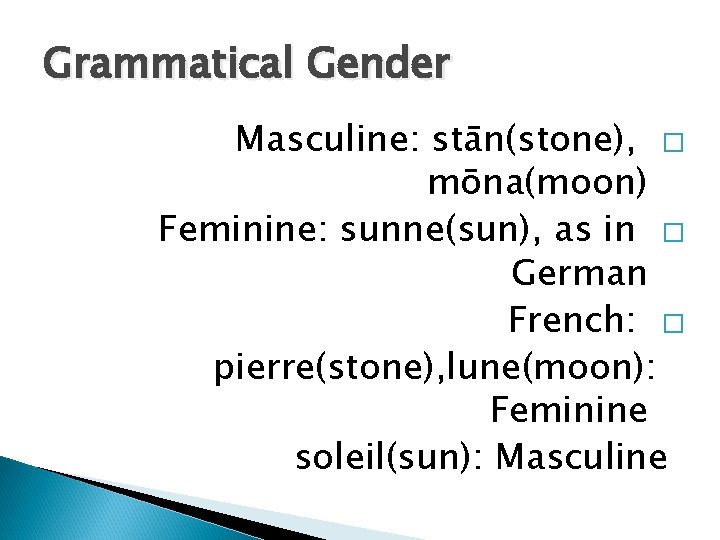
Grammatical Gender Masculine: stān(stone), � mōna(moon) Feminine: sunne(sun), as in � German French: � pierre(stone), lune(moon): Feminine soleil(sun): Masculine
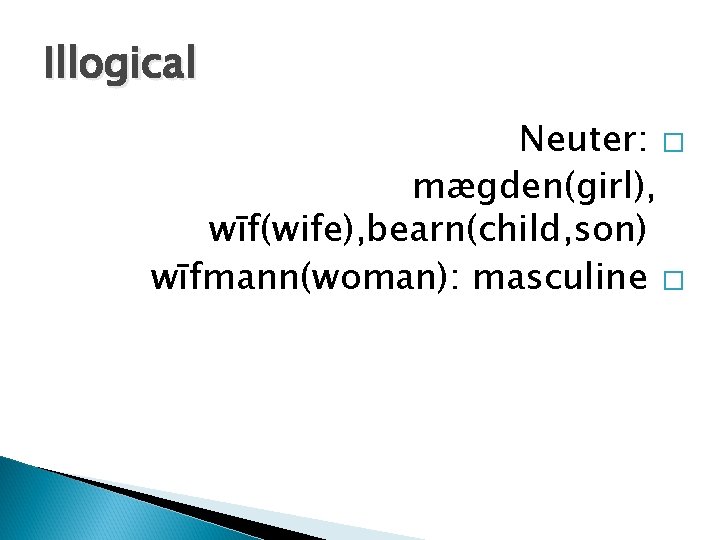
Illogical Neuter: � mægden(girl), wīf(wife), bearn(child, son) wīfmann(woman): masculine �
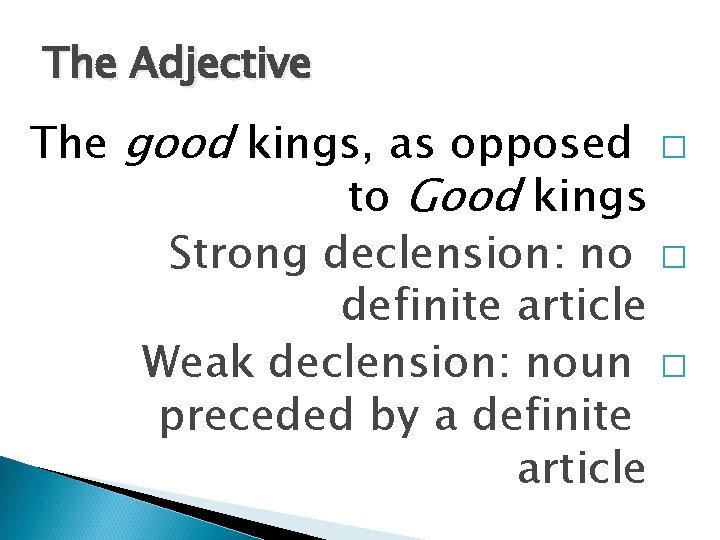
The Adjective The good kings, as opposed � to Good kings Strong declension: no � definite article Weak declension: noun � preceded by a definite article
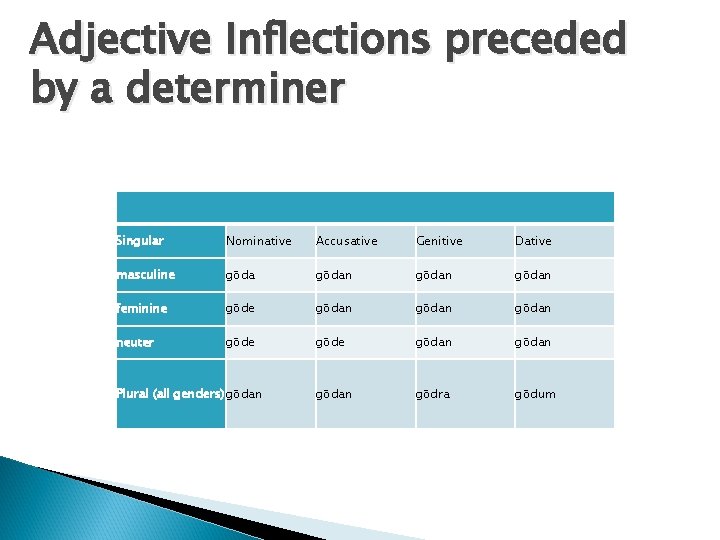
Adjective Inflections preceded by a determiner Singular Nominative Accusative Genitive Dative masculine gōdan feminine gōdan neuter gōde gōdan gōdra gōdum Plural (all genders) gōdan
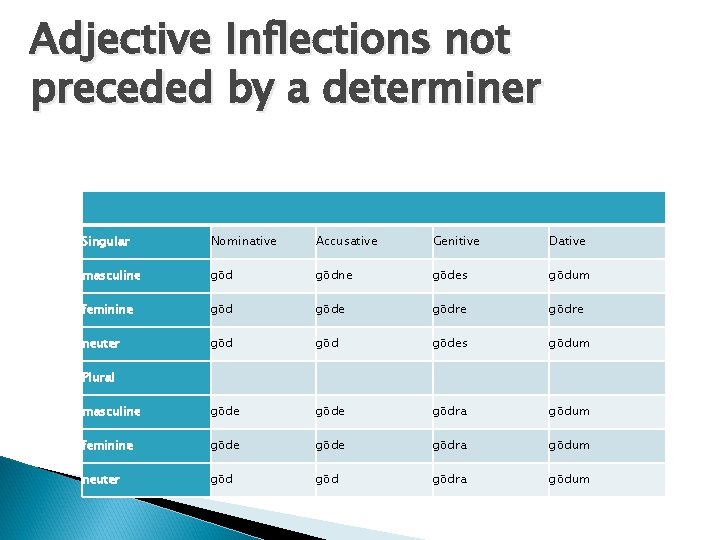
Adjective Inflections not preceded by a determiner Singular Nominative Accusative Genitive Dative masculine gōdne gōdes gōdum feminine gōde gōdre neuter gōd gōdes gōdum masculine gōde gōdra gōdum feminine gōde gōdra gōdum neuter gōd gōdra gōdum Plural
The Definite Article Fully inflected definite � article
The Personal Pronoun Genders, persons, cases, � the dual number
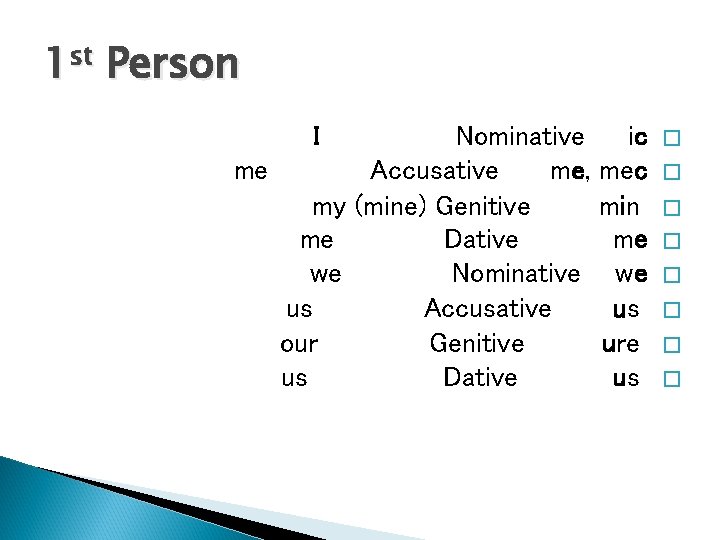
1 st Person I Nominative ic me Accusative me, mec my (mine) Genitive m in me Dative me we Nominative we us Accusative us our Genitive ure us Dative us � � � �
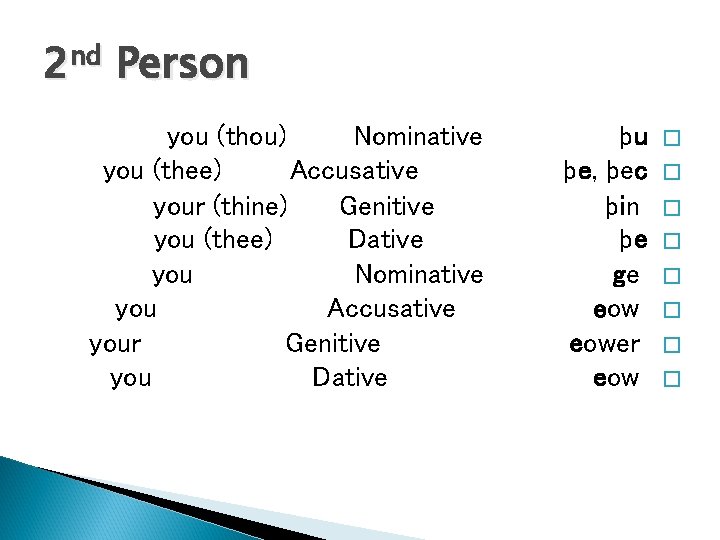
2 nd Person you (thou) Nominative you (thee) Accusative your (thine) Genitive you (thee) Dative you Nominative you Accusative your Genitive you Dative þu þe, þec þ in þe ge eower eow � � � �
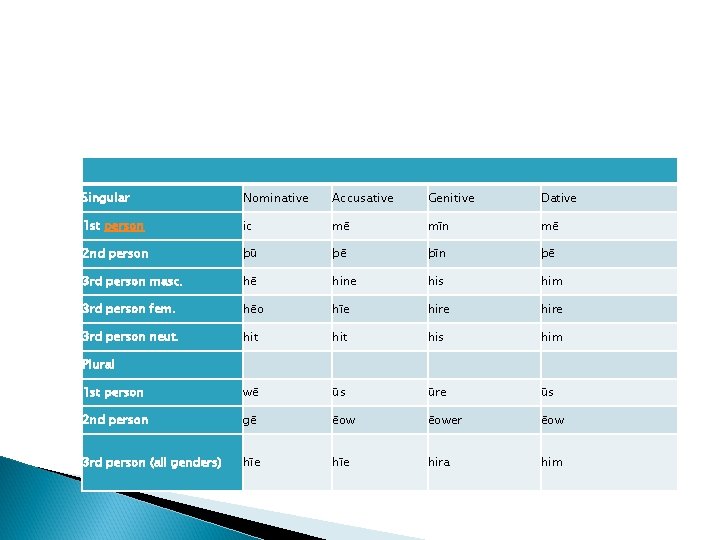
Singular Nominative Accusative Genitive Dative 1 st person ic mē mīn mē 2 nd person þū þē þīn þē 3 rd person masc. hē hine his him 3 rd person fem. hēo hīe hire 3 rd person neut. hit his him 1 st person wē ūs ūre ūs 2 nd person gē ēower ēow 3 rd person (all genders) hīe hira him Plural
- Slides: 33