
Lecture 6 Modeling Complex Code CSE 373 Data
![Binary Search public int binary. Search(int[] arr, int to. Find, int lo, int hi)](https://slidetodoc.com/presentation_image_h2/ba0ea56d7c3da7274023ec15e98952e5/image-11.jpg "Binary Search public int binary. Search(int[] arr, int to. Find, int lo, int hi)")
- Slides: 31
Lecture 6: Modeling Complex Code CSE 373: Data Structures and Algorithms 1
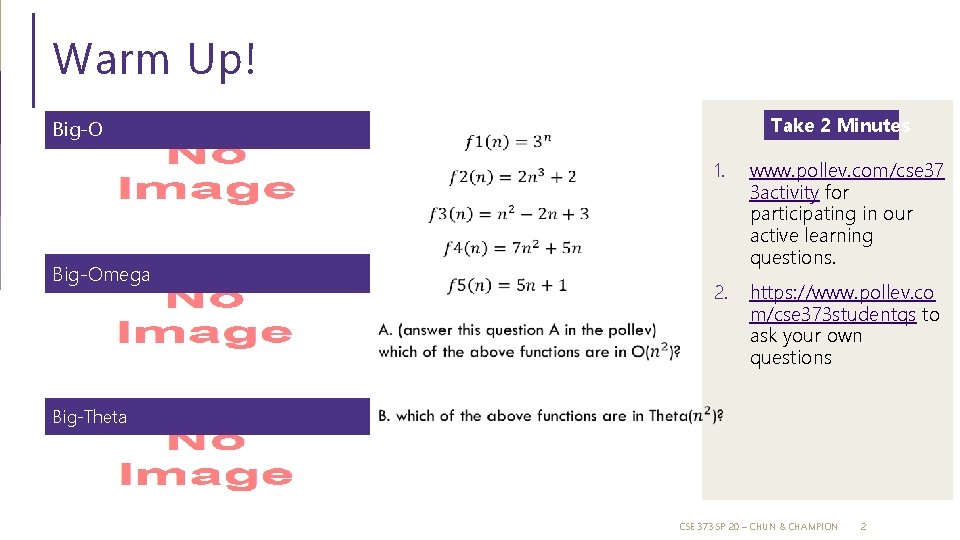
Warm Up! Take 2 Minutes Big-Omega 1. www. pollev. com/cse 37 3 activity for participating in our active learning questions. 2. https: //www. pollev. co m/cse 373 studentqs to ask your own questions Big-Theta CSE 373 SP 20 – CHUN & CHAMPION 2
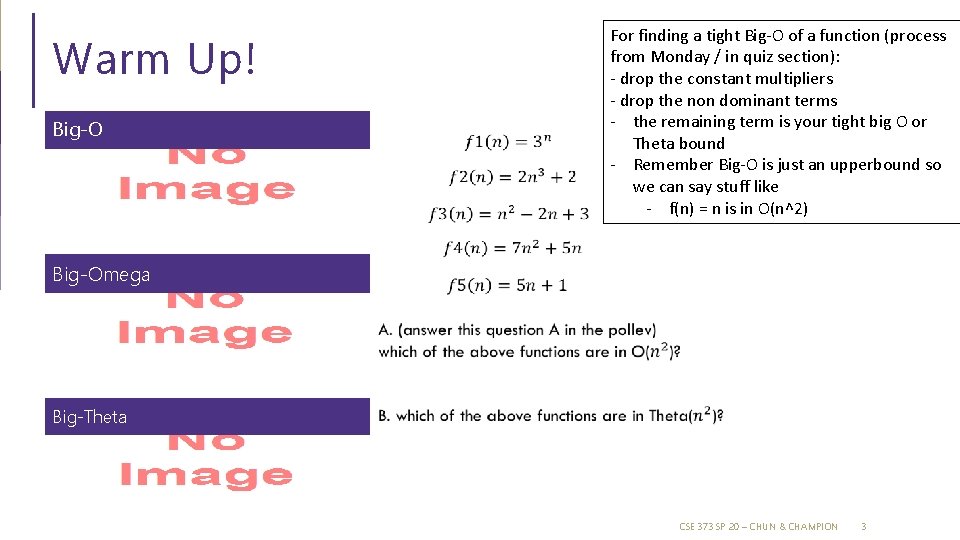
Warm Up! Big-O For finding a tight Big-O of a function (process from Monday / in quiz section): - drop the constant multipliers - drop the non dominant terms - the remaining term is your tight big O or Theta bound - Remember Big-O is just an upperbound so we can say stuff like - f(n) = n is in O(n^2) Big-Omega Big-Theta CSE 373 SP 20 – CHUN & CHAMPION 3
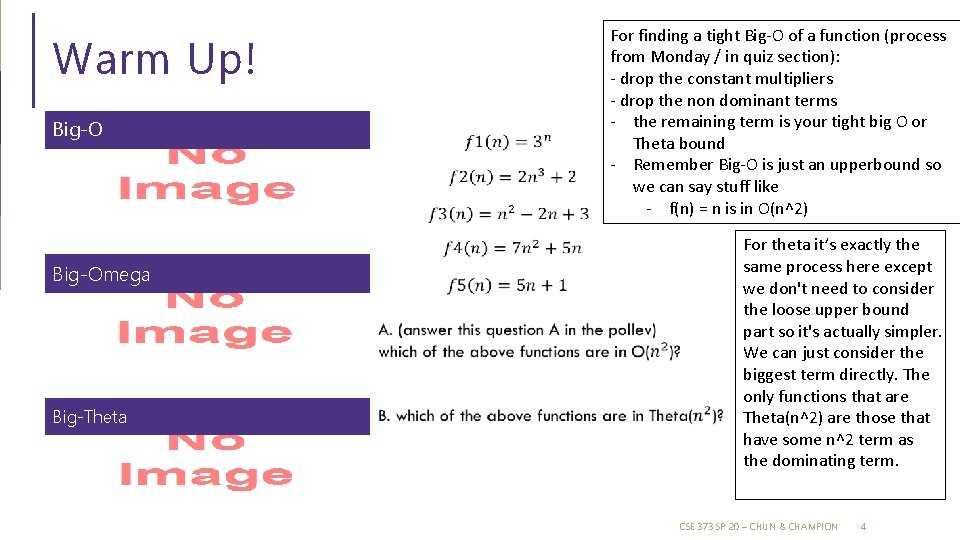
Warm Up! Big-Omega Big-Theta For finding a tight Big-O of a function (process from Monday / in quiz section): - drop the constant multipliers - drop the non dominant terms - the remaining term is your tight big O or Theta bound - Remember Big-O is just an upperbound so we can say stuff like - f(n) = n is in O(n^2) For theta it’s exactly the same process here except we don't need to consider the loose upper bound part so it's actually simpler. We can just consider the biggest term directly. The only functions that are Theta(n^2) are those that have some n^2 term as the dominating term. CSE 373 SP 20 – CHUN & CHAMPION 4
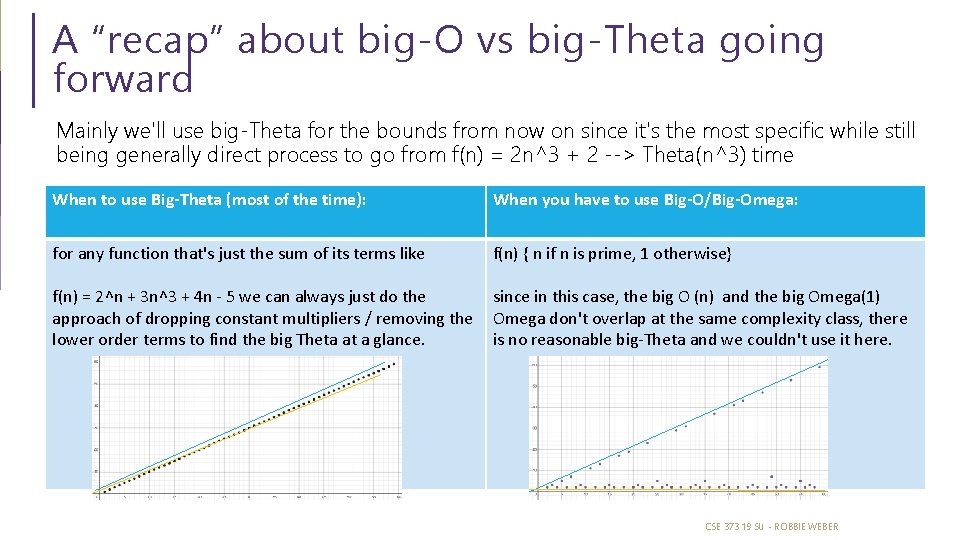
A “recap” about big-O vs big-Theta going forward Mainly we'll use big-Theta for the bounds from now on since it's the most specific while still being generally direct process to go from f(n) = 2 n^3 + 2 --> Theta(n^3) time When to use Big-Theta (most of the time): When you have to use Big-O/Big-Omega: for any function that's just the sum of its terms like f(n) { n if n is prime, 1 otherwise} f(n) = 2^n + 3 n^3 + 4 n - 5 we can always just do the approach of dropping constant multipliers / removing the lower order terms to find the big Theta at a glance. since in this case, the big O (n) and the big Omega(1) Omega don't overlap at the same complexity class, there is no reasonable big-Theta and we couldn't use it here. CSE 373 19 SU - ROBBIE WEBER
Administrivia project 1 released - grader-only tests and rate limiting - you get an additional submission every 10 minutes, can store up to 6 submissions (tokens) - we don’t want you spamming the auto-grader (extra computation on the server + guess and check is generally not that effective for your learning if you’re doing it a lot) – instead you can take a breather and investigate the problems / errors. We want to encourage you all to do more testing / reviewing your code to grow to become more independent programmers throughout this course. - Most students don’t bump into the limit / run out of submissions and have to wait to recharge – the point of this isn’t to block y’all. If you feel that it’s too strict then please bring it up for discussion after trying this assignment. exercise 1 - out by midnight tonight, due next Friday 11: 59 pm Piazza - try to use the search bar before you post / use descriptive summary titles when possible - thank you CSE 373 19 SU - ROBBIE WEBER
Questions CSE 373 20 SP – CHAMPION & CHUN 7
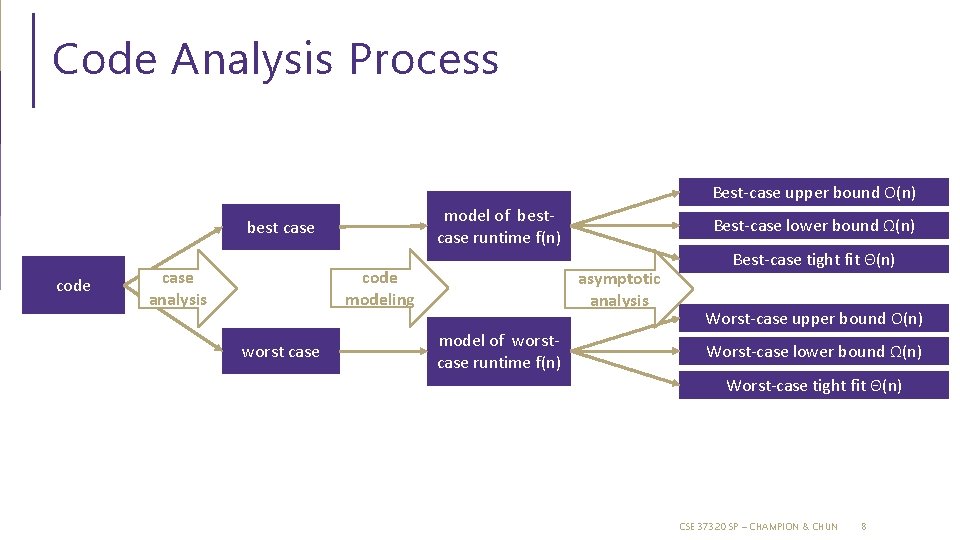
Code Analysis Process Best-case upper bound O(n) model of bestcase runtime f(n) best case code modeling case analysis worst case Best-case lower bound Ω(n) asymptotic analysis model of worstcase runtime f(n) Best-case tight fit Θ(n) Worst-case upper bound O(n) Worst-case lower bound Ω(n) Worst-case tight fit Θ(n) CSE 373 20 SP – CHAMPION & CHUN 8
Modeling Recursive Code CSE 373 20 SP – CHAMPION & CHUN 9
Recursive Patterns Modeling and analyzing recursive code is all about finding patterns in how the input changes between calls and how much work is done within each call Let’s explore some of the more common recursive patterns Pattern #1: Halving the Input Pattern #2: Constant size input and doing work Pattern #3: Doubling the Input CSE 373 20 SP – CHAMPION & CHUN 10
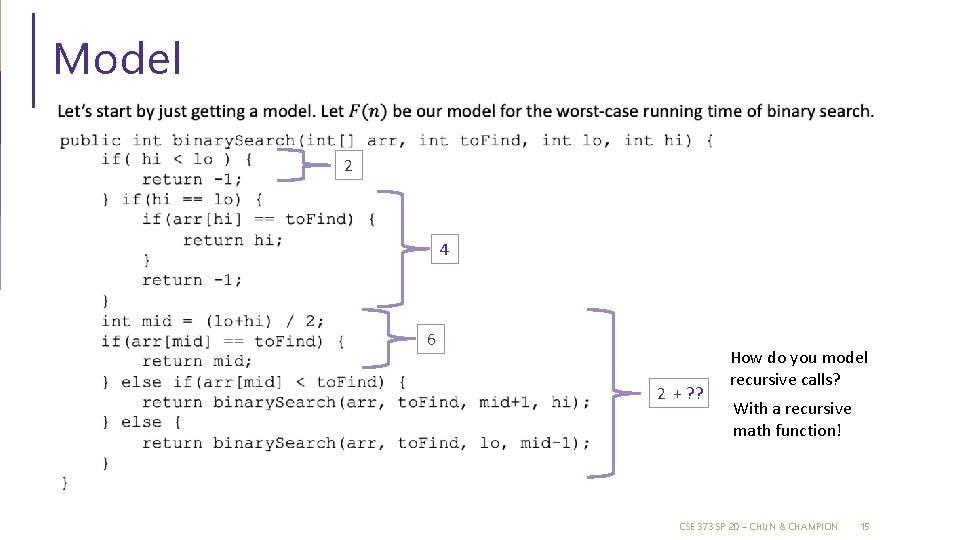
Binary Search public int binary. Search(int[] arr, int to. Find, int lo, int hi) { if( hi < lo ) { return -1; } if(hi == lo) { if(arr[hi] == to. Find) { return hi; } return -1; } int mid = (lo+hi) / 2; if(arr[mid] == to. Find) { return mid; } else if(arr[mid] < to. Find) { return binary. Search(arr, to. Find, mid+1, hi); } else { return binary. Search(arr, to. Find, lo, mid-1); } } ROBBIE WEBBER - CSE 373 SU 19
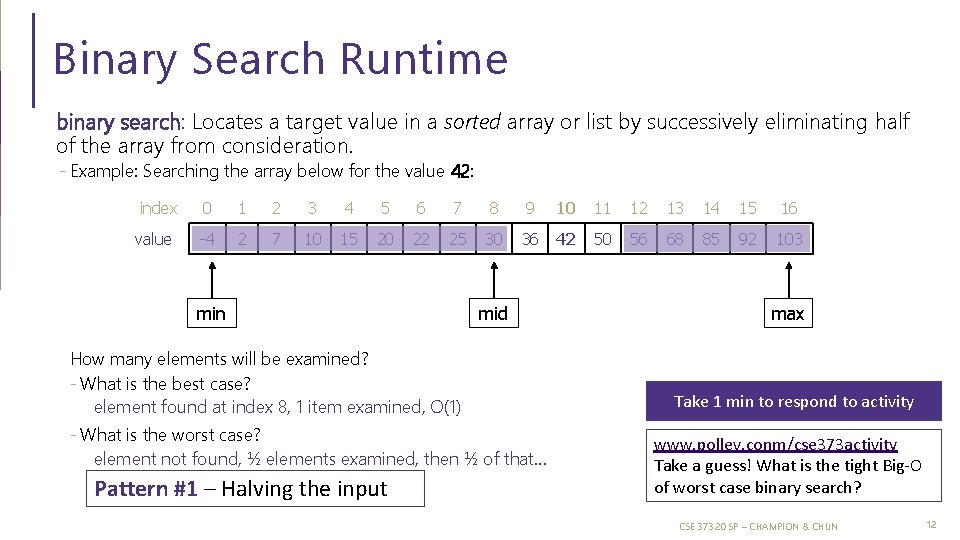
Binary Search Runtime binary search: Locates a target value in a sorted array or list by successively eliminating half of the array from consideration. - Example: Searching the array below for the value 42: index 0 1 2 3 4 5 6 7 8 9 10 11 12 13 14 15 16 value -4 2 7 10 15 20 22 25 30 36 42 50 56 68 85 92 103 min mid How many elements will be examined? - What is the best case? element found at index 8, 1 item examined, O(1) - What is the worst case? element not found, ½ elements examined, then ½ of that… Pattern #1 – Halving the input max Take 1 min to respond to activity www. pollev. conm/cse 373 activity Take a guess! What is the tight Big-O of worst case binary search? CSE 373 20 SP – CHAMPION & CHUN 12
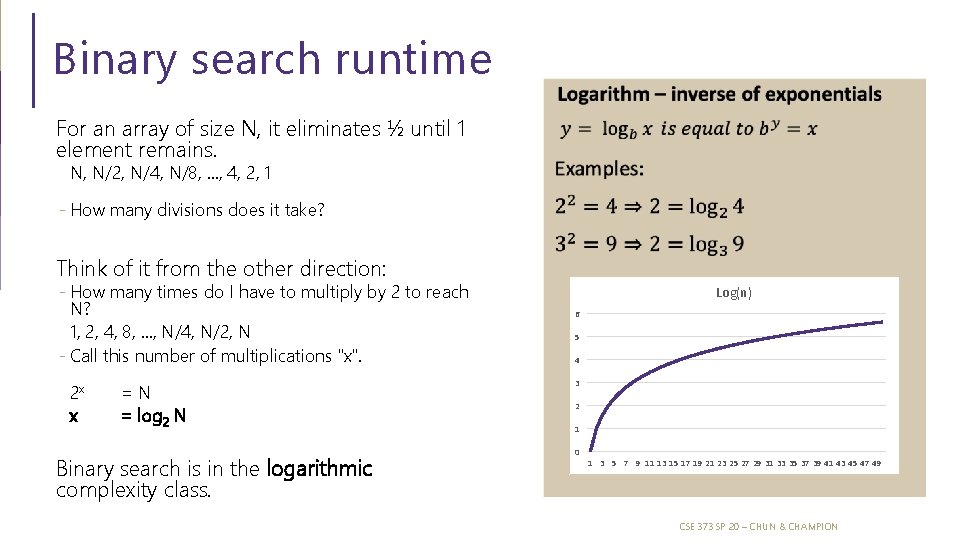
Binary search runtime For an array of size N, it eliminates ½ until 1 element remains. N, N/2, N/4, N/8, . . . , 4, 2, 1 - How many divisions does it take? Think of it from the other direction: - How many times do I have to multiply by 2 to reach N? 1, 2, 4, 8, . . . , N/4, N/2, N - Call this number of multiplications "x". 2 x x =N = log 2 N Binary search is in the logarithmic complexity class. Log(n) 6 5 4 3 2 1 0 1 3 5 7 9 11 13 15 17 19 21 23 25 27 29 31 33 35 37 39 41 43 45 47 49 CSE 373 SP 20 – CHUN & CHAMPION
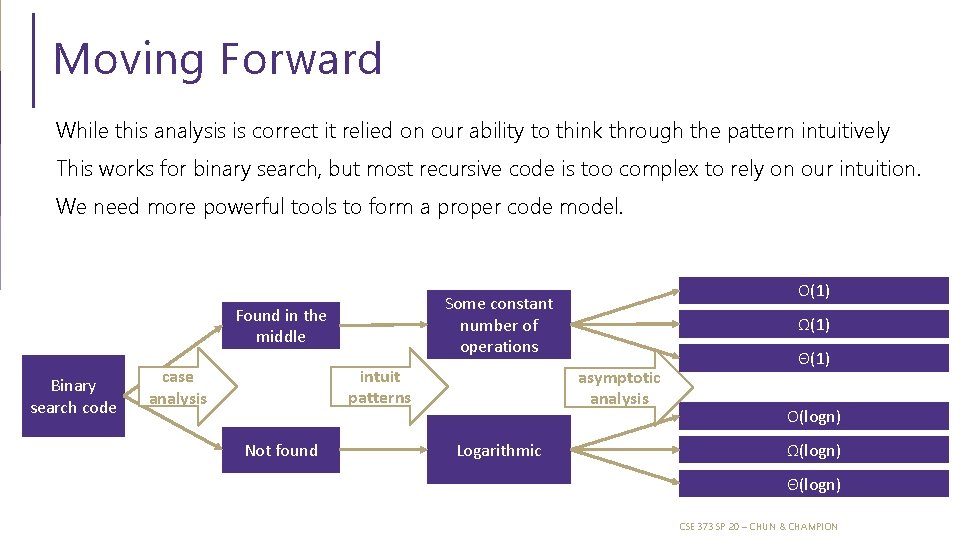
Moving Forward While this analysis is correct it relied on our ability to think through the pattern intuitively This works for binary search, but most recursive code is too complex to rely on our intuition. We need more powerful tools to form a proper code model. Found in the middle Binary search code intuit patterns case analysis Not found O(1) Some constant number of operations Ω(1) asymptotic analysis Logarithmic Θ(1) O(logn) Ω(logn) Θ(logn) CSE 373 SP 20 – CHUN & CHAMPION
Model 2 4 6 2 + ? ? How do you model recursive calls? With a recursive math function! CSE 373 SP 20 – CHUN & CHAMPION 15
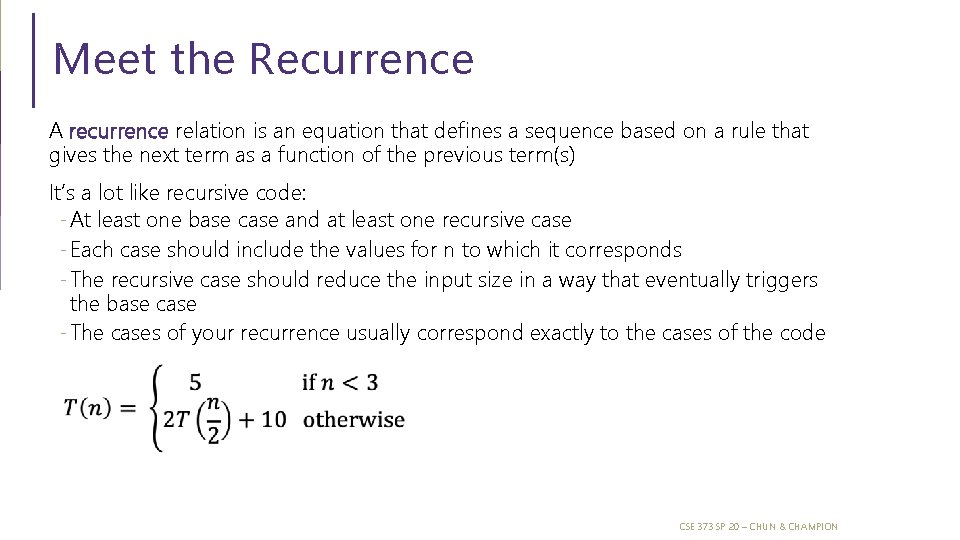
Meet the Recurrence A recurrence relation is an equation that defines a sequence based on a rule that gives the next term as a function of the previous term(s) It’s a lot like recursive code: - At least one base case and at least one recursive case - Each case should include the values for n to which it corresponds - The recursive case should reduce the input size in a way that eventually triggers the base case - The cases of your recurrence usually correspond exactly to the cases of the code CSE 373 SP 20 – CHUN & CHAMPION
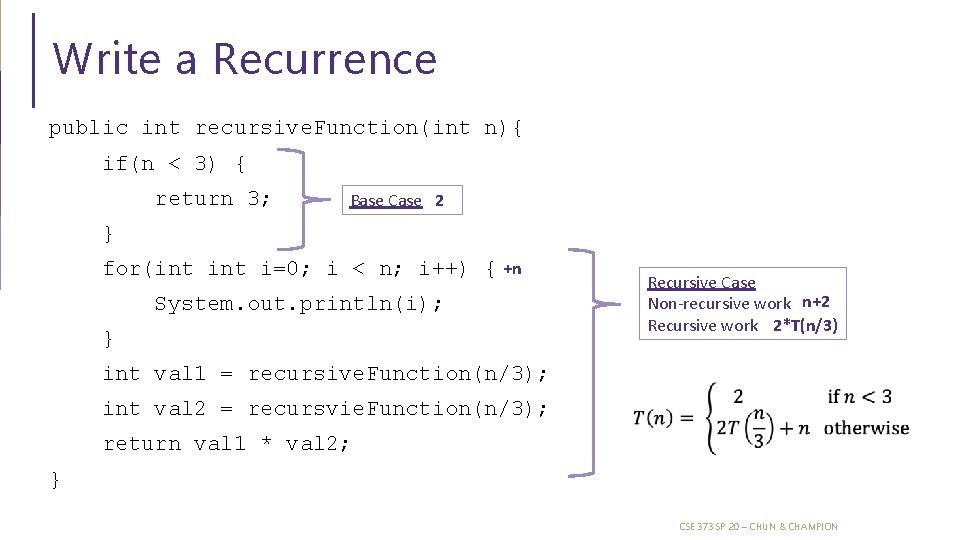
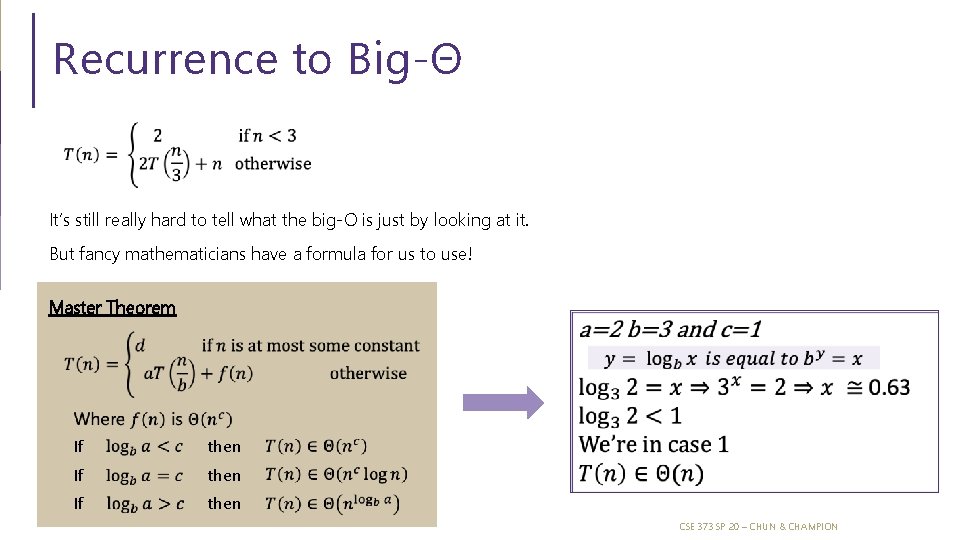
Write a Recurrence public int recursive. Function(int n){ if(n < 3) { return 3; Base Case 2 } for(int i=0; i < n; i++) { +n System. out. println(i); } Recursive Case Non-recursive work n+2 Recursive work 2*T(n/3) int val 1 = recursive. Function(n/3); int val 2 = recursvie. Function(n/3); return val 1 * val 2; } CSE 373 SP 20 – CHUN & CHAMPION
Recurrence to Big-Θ It’s still really hard to tell what the big-O is just by looking at it. But fancy mathematicians have a formula for us to use! Master Theorem If then CSE 373 SP 20 – CHUN & CHAMPION
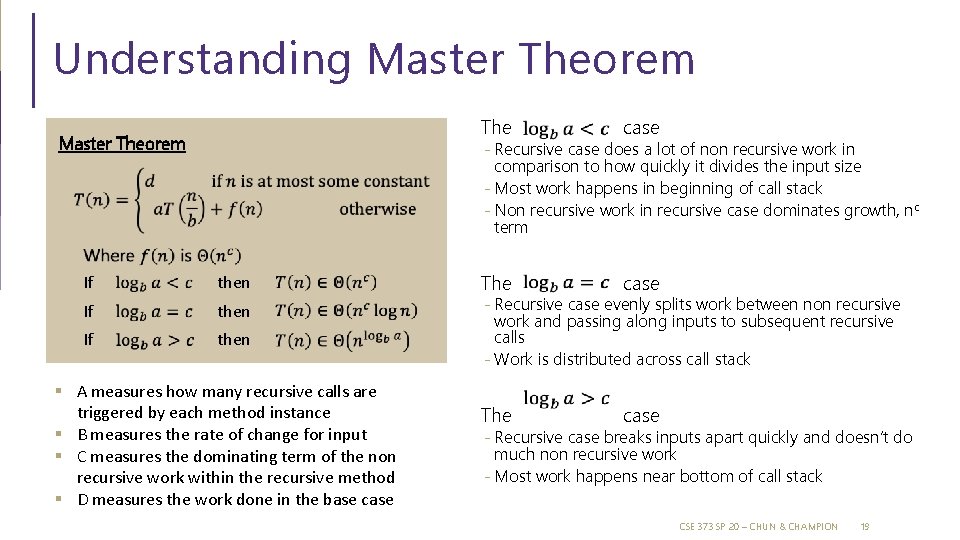
Understanding Master Theorem The case - Recursive case does a lot of non recursive work in comparison to how quickly it divides the input size - Most work happens in beginning of call stack - Non recursive work in recursive case dominates growth, n c term If then § A measures how many recursive calls are triggered by each method instance § B measures the rate of change for input § C measures the dominating term of the non recursive work within the recursive method § D measures the work done in the base case - Recursive case evenly splits work between non recursive work and passing along inputs to subsequent recursive calls - Work is distributed across call stack - Recursive case breaks inputs apart quickly and doesn’t do much non recursive work - Most work happens near bottom of call stack CSE 373 SP 20 – CHUN & CHAMPION 19
Questions CSE 373 20 SP – CHAMPION & CHUN 20
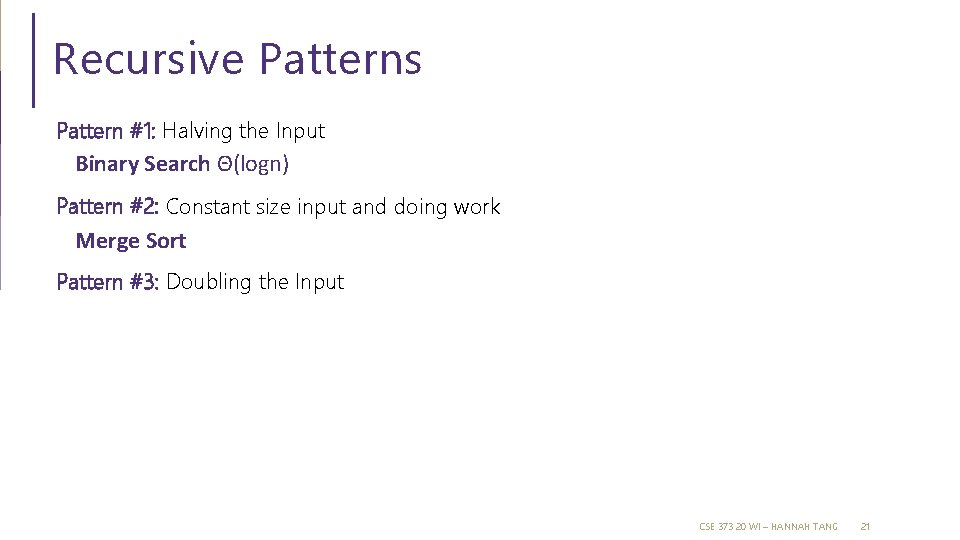
Recursive Patterns Pattern #1: Halving the Input Binary Search Θ(logn) Pattern #2: Constant size input and doing work Merge Sort Pattern #3: Doubling the Input CSE 373 20 WI – HANNAH TANG 21
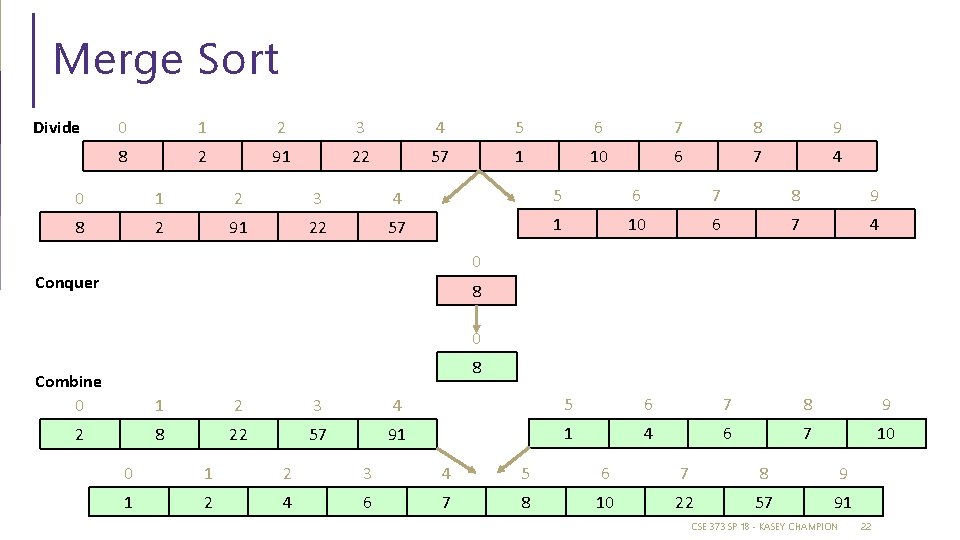
Merge Sort Divide 0 1 2 3 4 5 6 7 8 9 8 2 91 22 57 1 10 6 7 4 0 Conquer 8 0 8 Combine 0 2 1 2 3 4 5 6 7 8 9 8 22 57 91 1 4 6 7 10 0 1 2 3 4 5 6 7 8 9 1 2 4 6 7 8 10 22 57 91 CSE 373 SP 18 - KASEY CHAMPION 22
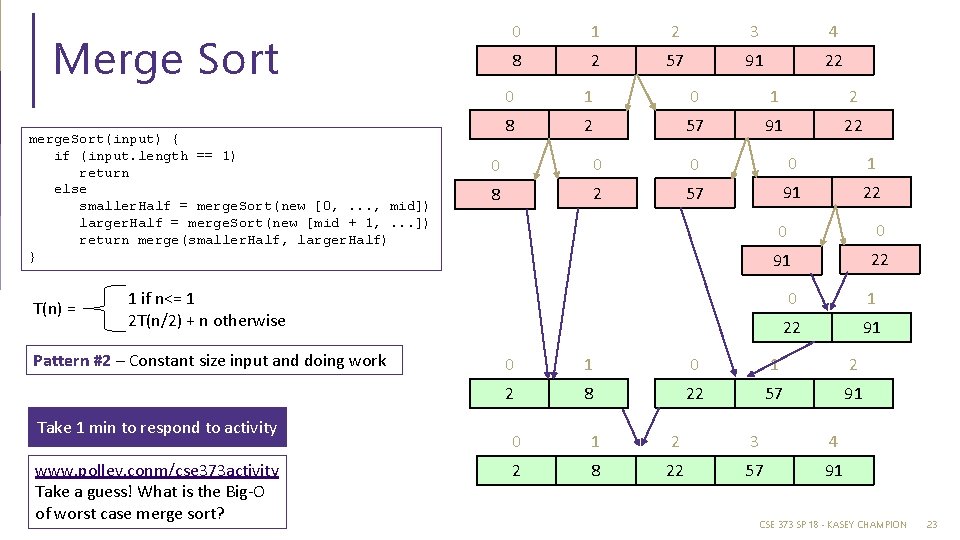
Merge Sort merge. Sort(input) { if (input. length == 1) return else smaller. Half = merge. Sort(new [0, . . . , mid]) larger. Half = merge. Sort(new [mid + 1, . . . ]) return merge(smaller. Half, larger. Half) } T(n) = 0 1 2 3 4 8 2 57 91 22 0 1 2 8 2 57 91 22 0 0 1 8 2 57 91 22 0 0 91 22 1 if n<= 1 2 T(n/2) + n otherwise Pattern #2 – Constant size input and doing work Take 1 min to respond to activity www. pollev. conm/cse 373 activity Take a guess! What is the Big-O of worst case merge sort? 0 1 22 91 0 1 2 2 8 22 57 91 0 1 2 3 4 2 8 22 57 91 CSE 373 SP 18 - KASEY CHAMPION 23
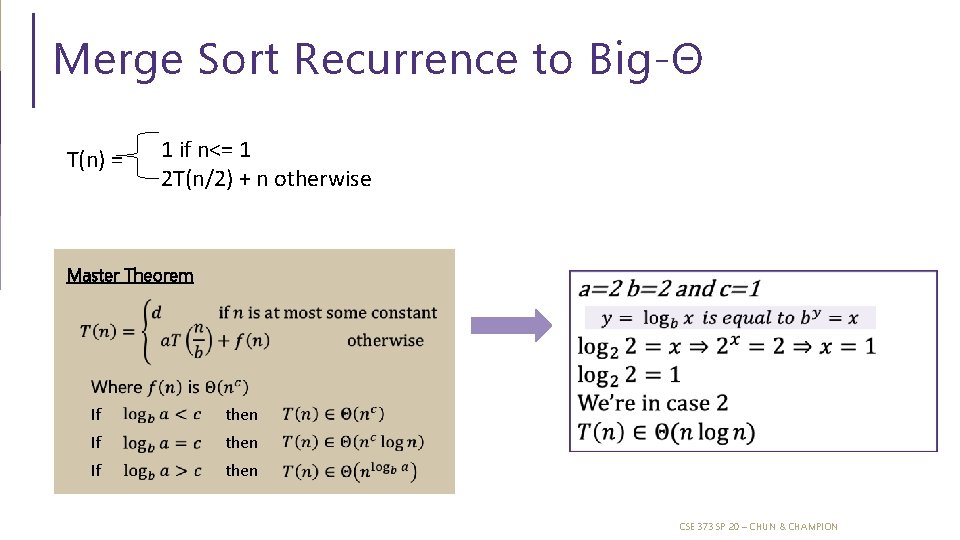
Merge Sort Recurrence to Big-Θ T(n) = 1 if n<= 1 2 T(n/2) + n otherwise Master Theorem If then CSE 373 SP 20 – CHUN & CHAMPION
Questions CSE 373 20 SP – CHAMPION & CHUN 25
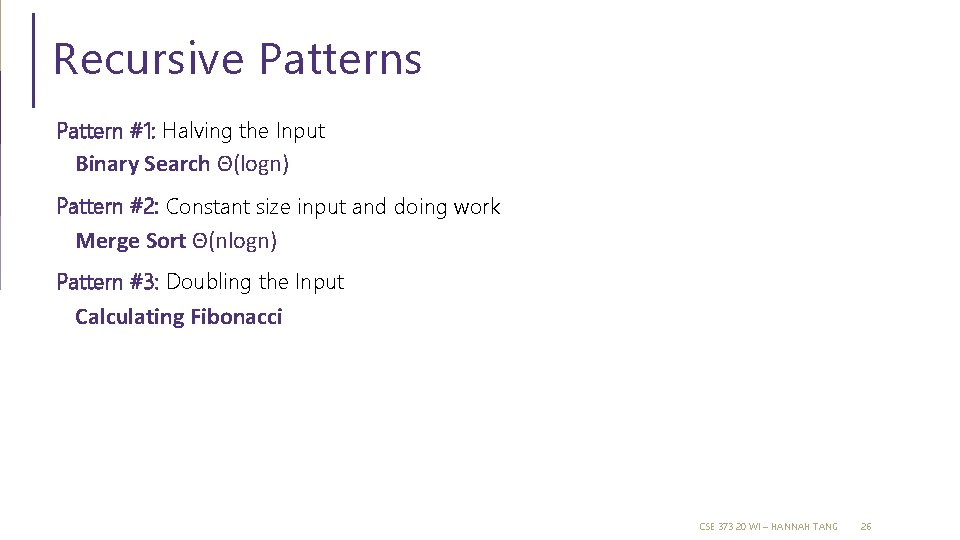
Recursive Patterns Pattern #1: Halving the Input Binary Search Θ(logn) Pattern #2: Constant size input and doing work Merge Sort Θ(nlogn) Pattern #3: Doubling the Input Calculating Fibonacci CSE 373 20 WI – HANNAH TANG 26
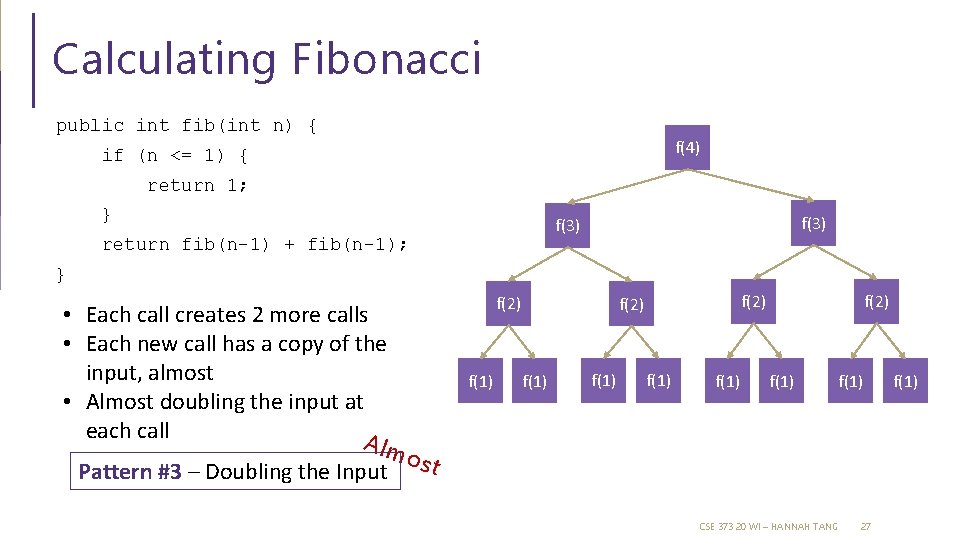
Calculating Fibonacci public int fib(int n) { f(4) if (n <= 1) { return 1; } f(3) return fib(n-1) + fib(n-1); } • Each call creates 2 more calls • Each new call has a copy of the input, almost • Almost doubling the input at each call Alm o Pattern #3 – Doubling the Input s t f(2) f(1) f(1) f(2) f(1) CSE 373 20 WI – HANNAH TANG 27 f(1)
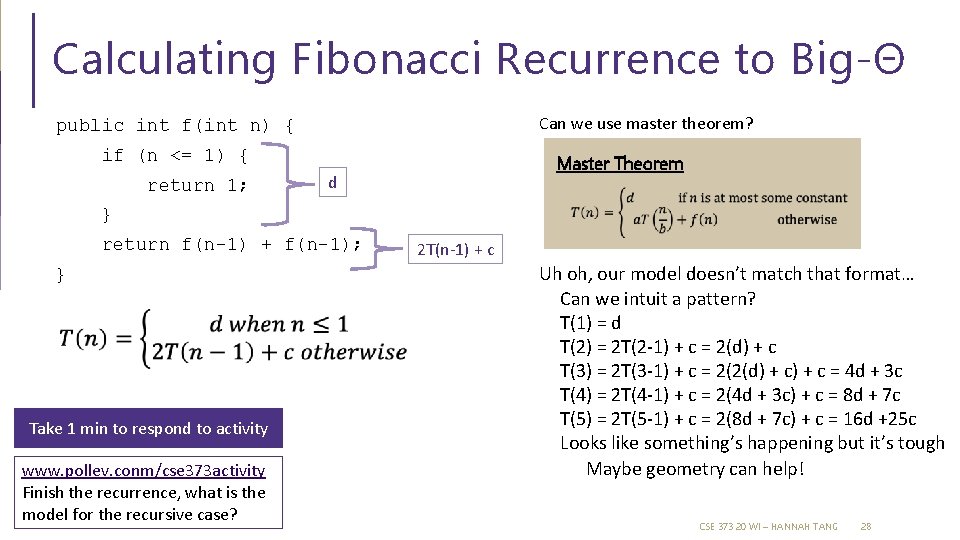
Calculating Fibonacci Recurrence to Big-Θ Can we use master theorem? public int f(int n) { if (n <= 1) { return 1; Master Theorem d } return f(n-1) + f(n-1); } Take 1 min to respond to activity www. pollev. conm/cse 373 activity Finish the recurrence, what is the model for the recursive case? 2 T(n-1) + c Uh oh, our model doesn’t match that format… Can we intuit a pattern? T(1) = d T(2) = 2 T(2 -1) + c = 2(d) + c T(3) = 2 T(3 -1) + c = 2(2(d) + c = 4 d + 3 c T(4) = 2 T(4 -1) + c = 2(4 d + 3 c) + c = 8 d + 7 c T(5) = 2 T(5 -1) + c = 2(8 d + 7 c) + c = 16 d +25 c Looks like something’s happening but it’s tough Maybe geometry can help! CSE 373 20 WI – HANNAH TANG 28
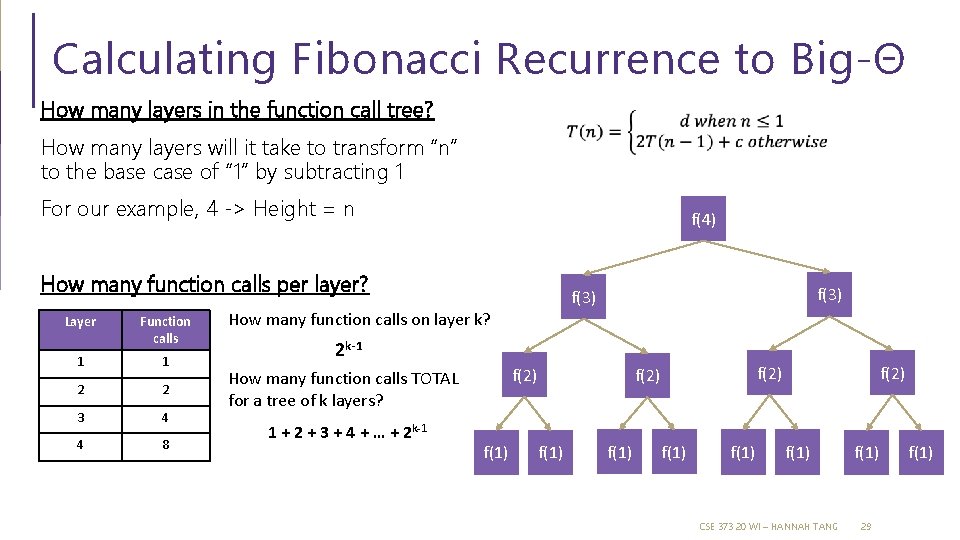
Calculating Fibonacci Recurrence to Big-Θ How many layers in the function call tree? How many layers will it take to transform “n” to the base case of “ 1” by subtracting 1 For our example, 4 -> Height = n f(4) How many function calls per layer? Layer Function calls 1 1 2 2 3 4 4 8 f(3) How many function calls on layer k? 2 k-1 f(2) How many function calls TOTAL for a tree of k layers? 1 + 2 + 3 + 4 + … + 2 k-1 f(1) f(2) f(1) CSE 373 20 WI – HANNAH TANG f(1) 29 f(1)
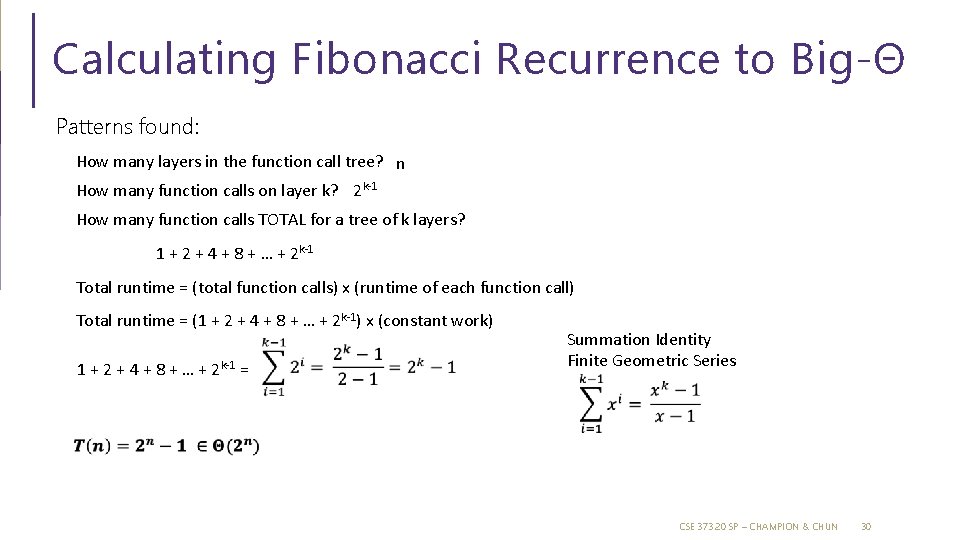
Calculating Fibonacci Recurrence to Big-Θ Patterns found: How many layers in the function call tree? n How many function calls on layer k? 2 k-1 How many function calls TOTAL for a tree of k layers? 1 + 2 + 4 + 8 + … + 2 k-1 Total runtime = (total function calls) x (runtime of each function call) Total runtime = (1 + 2 + 4 + 8 + … + 2 k-1) x (constant work) 1 + 2 + 4 + 8 + … + 2 k-1 = Summation Identity Finite Geometric Series CSE 373 20 SP – CHAMPION & CHUN 30
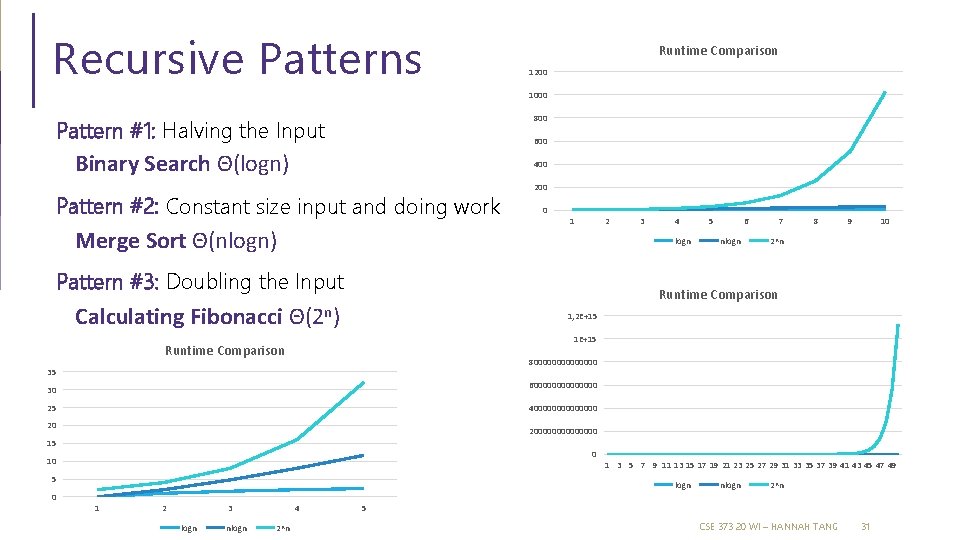
Recursive Patterns Runtime Comparison 1200 1000 800 Pattern #1: Halving the Input 600 Binary Search Θ(logn) 400 Pattern #2: Constant size input and doing work Merge Sort Θ(nlogn) 200 0 1 2 4 logn Pattern #3: Doubling the Input 5 6 nlogn 7 8 9 10 2^n Runtime Comparison Calculating Fibonacci Θ(2 n) 1, 2 E+15 1 E+15 Runtime Comparison 80000000 35 60000000 30 25 40000000 20 20000000 15 0 10 5 0 3 1 3 5 7 9 11 13 15 17 19 21 23 25 27 29 31 33 35 37 39 41 43 45 47 49 logn 1 2 3 logn nlogn 4 2^n nlogn 2^n 5 CSE 373 20 WI – HANNAH TANG 31