
Lecture 6 Logic Programming introduction to Prolog facts
![Software: download SWI Prolog Usage: ? - [likes]. # loads file likes. pl Content](https://slidetodoc.com/presentation_image_h2/641632c79a17060a151c85ef754b200b/image-3.jpg "Software: download SWI Prolog Usage: ? - [likes]. # loads file likes. pl Content")
![Am a list? predicate Let’s test is a value is a list([]). list([X|Xs]) :](https://slidetodoc.com/presentation_image_h2/641632c79a17060a151c85ef754b200b/image-14.jpg "Am a list? predicate Let’s test is a value is a list([]). list([X|Xs]) :")
![Let’s define the predicate member Desired usage: ? - member(b, [a, b, c]). true](https://slidetodoc.com/presentation_image_h2/641632c79a17060a151c85ef754b200b/image-15.jpg "Let’s define the predicate member Desired usage: ? - member(b, [a, b, c]). true")
![Lists car([X|Y], X). cdr([X|Y, Y). cons(X, R, [X|R]). meaning. . . The head (car)](https://slidetodoc.com/presentation_image_h2/641632c79a17060a151c85ef754b200b/image-16.jpg "Lists car([X|Y], X). cdr([X|Y, Y). cons(X, R, [X|R]). meaning. . . The head (car)")
![An operation on lists: The predicate member/2: member(X, [X|R]). member(X, [Y|R]) : - member(X,](https://slidetodoc.com/presentation_image_h2/641632c79a17060a151c85ef754b200b/image-17.jpg "An operation on lists: The predicate member/2: member(X, [X|R]). member(X, [Y|R]) : - member(X,")
![List Append append([], List). append([H|Tail], X, [H|New. Tail]) : append(Tail, X, New. Tail). ?](https://slidetodoc.com/presentation_image_h2/641632c79a17060a151c85ef754b200b/image-18.jpg "List Append append([], List). append([H|Tail], X, [H|New. Tail]) : append(Tail, X, New. Tail). ?")
![More on append ? - append(Y, X, [a, b, c, d]). Y = [],](https://slidetodoc.com/presentation_image_h2/641632c79a17060a151c85ef754b200b/image-19.jpg "More on append ? - append(Y, X, [a, b, c, d]). Y = [],")
- Slides: 24
Lecture 6 Logic Programming introduction to Prolog, facts, rules Ras Bodik Shaon Barman Thibaud Hottelier Hack Your Language! CS 164: Introduction to Programming Languages and Compilers, Spring 2012 UC Berkeley 1
Today Introduction to Prolog Assigned reading: a Prolog tutorial (link at the end) Today is no-laptop Thursday but you can use laptops to download SWI Prolog and solve excercises during lecture. 2
Software: download SWI Prolog Usage: ? - [likes]. # loads file likes. pl Content of file likes. pl: likes(john, mary). likes(mary, jim). After loading, we can ask query: ? - likes(X, mary). X = john ; false. #who likes mary? # type semicolon to ask “who else? ” # no one else 3
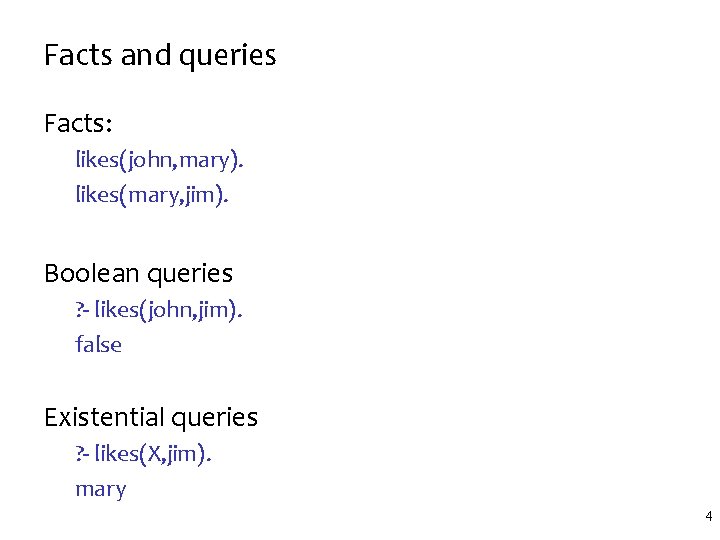
Facts and queries Facts: likes(john, mary). likes(mary, jim). Boolean queries ? - likes(john, jim). false Existential queries ? - likes(X, jim). mary 4
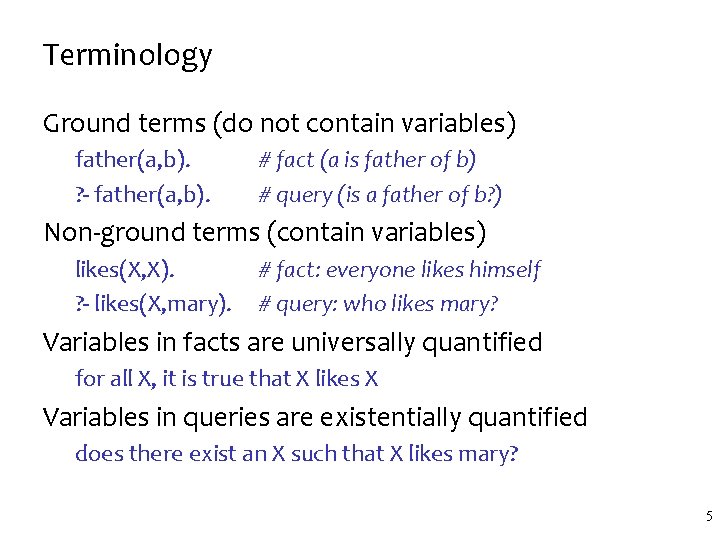
Terminology Ground terms (do not contain variables) father(a, b). ? - father(a, b). # fact (a is father of b) # query (is a father of b? ) Non-ground terms (contain variables) likes(X, X). ? - likes(X, mary). # fact: everyone likes himself # query: who likes mary? Variables in facts are universally quantified for all X, it is true that X likes X Variables in queries are existentially quantified does there exist an X such that X likes mary? 5
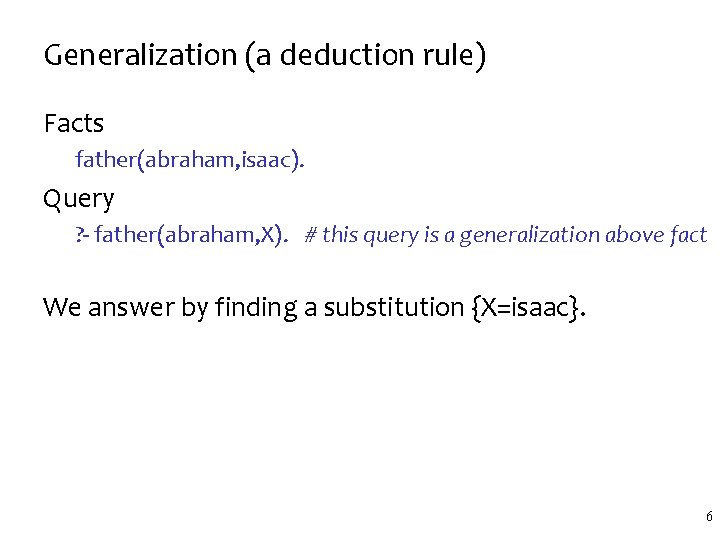
Generalization (a deduction rule) Facts father(abraham, isaac). Query ? - father(abraham, X). # this query is a generalization above fact We answer by finding a substitution {X=isaac}. 6
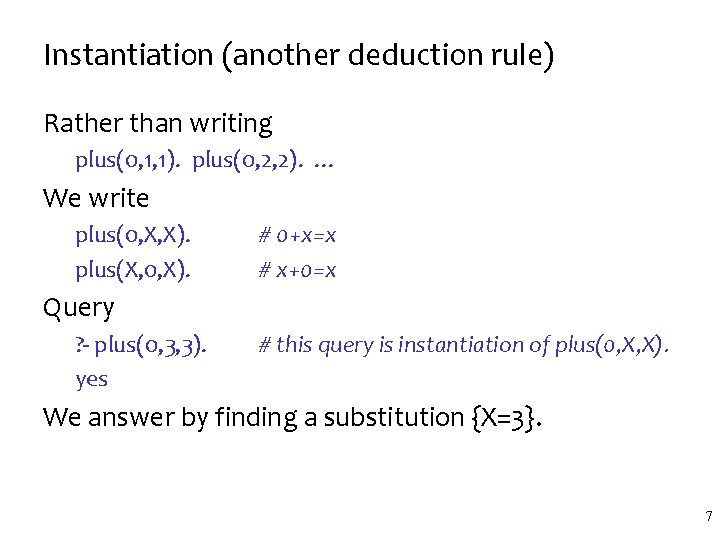
Instantiation (another deduction rule) Rather than writing plus(0, 1, 1). plus(0, 2, 2). … We write plus(0, X, X). plus(X, 0, X). # 0+x=x # x+0=x Query ? - plus(0, 3, 3). yes # this query is instantiation of plus(0, X, X). We answer by finding a substitution {X=3}. 7
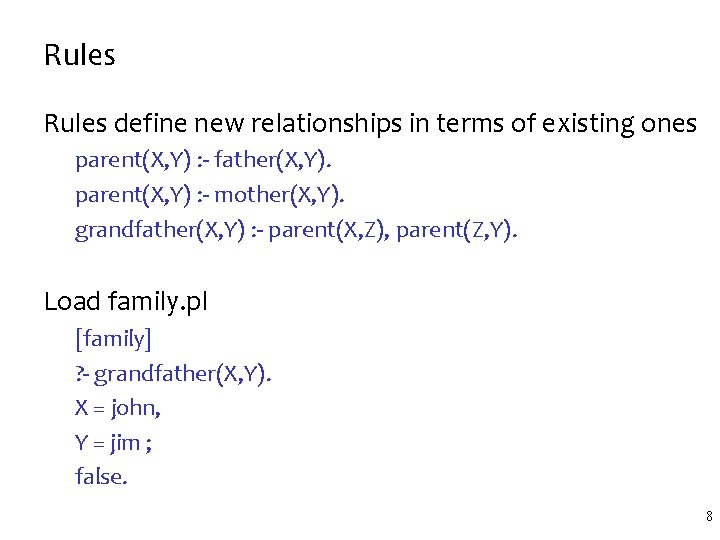
Rules define new relationships in terms of existing ones parent(X, Y) : - father(X, Y). parent(X, Y) : - mother(X, Y). grandfather(X, Y) : - parent(X, Z), parent(Z, Y). Load family. pl [family] ? - grandfather(X, Y). X = john, Y = jim ; false. 8
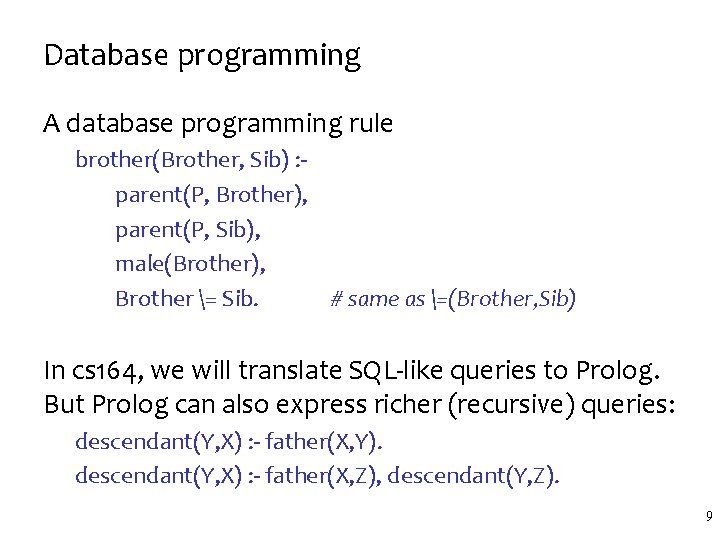
Database programming A database programming rule brother(Brother, Sib) : parent(P, Brother), parent(P, Sib), male(Brother), Brother = Sib. # same as =(Brother, Sib) In cs 164, we will translate SQL-like queries to Prolog. But Prolog can also express richer (recursive) queries: descendant(Y, X) : - father(X, Y). descendant(Y, X) : - father(X, Z), descendant(Y, Z). 9
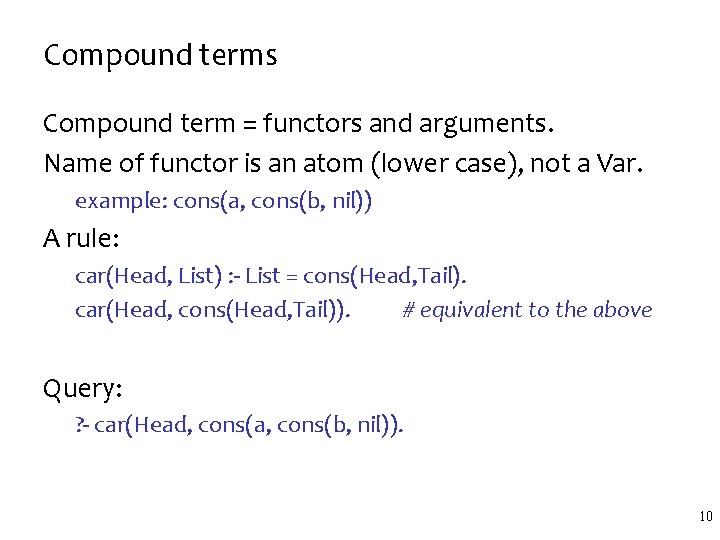
Compound terms Compound term = functors and arguments. Name of functor is an atom (lower case), not a Var. example: cons(a, cons(b, nil)) A rule: car(Head, List) : - List = cons(Head, Tail). car(Head, cons(Head, Tail)). # equivalent to the above Query: ? - car(Head, cons(a, cons(b, nil)). 10
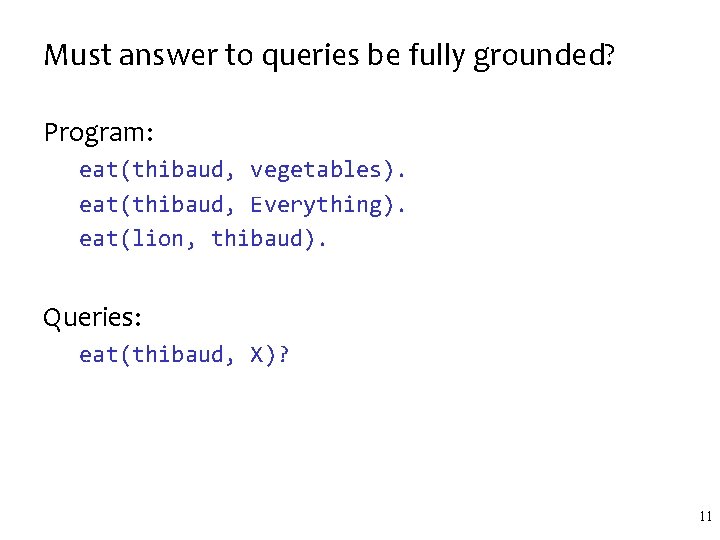
Must answer to queries be fully grounded? Program: eat(thibaud, vegetables). eat(thibaud, Everything). eat(lion, thibaud). Queries: eat(thibaud, X)? 11
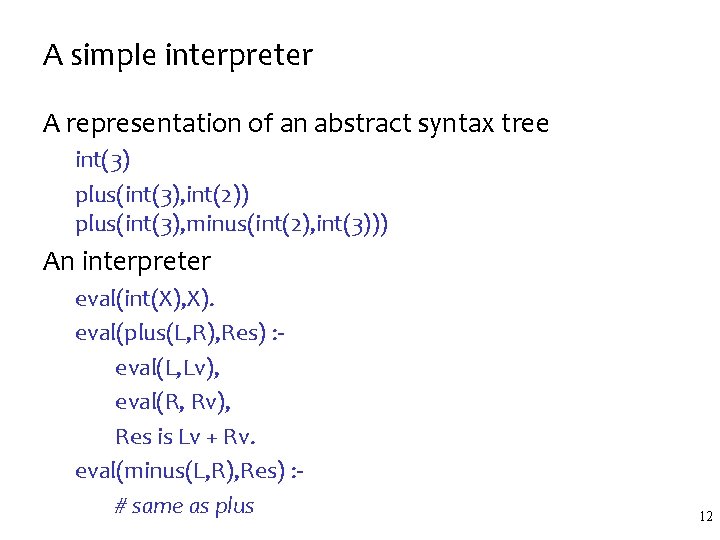
A simple interpreter A representation of an abstract syntax tree int(3) plus(int(3), int(2)) plus(int(3), minus(int(2), int(3))) An interpreter eval(int(X), X). eval(plus(L, R), Res) : eval(L, Lv), eval(R, Rv), Res is Lv + Rv. eval(minus(L, R), Res) : # same as plus 12
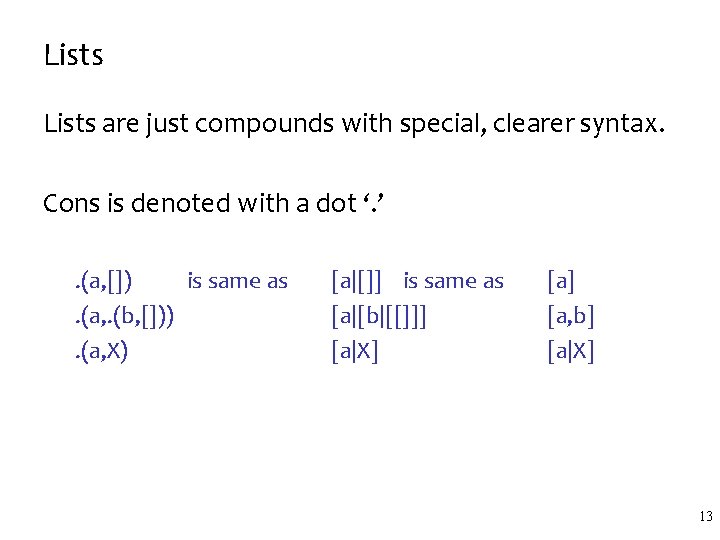
Lists are just compounds with special, clearer syntax. Cons is denoted with a dot ‘. ’. (a, []) is same as. (a, . (b, [])). (a, X) [a|[]] is same as [a|[b|[[]]] [a|X] [a, b] [a|X] 13
Am a list? predicate Let’s test is a value is a list([]). list([X|Xs]) : - list(Xs). Note the common Xs notation for a list of X’s. 14
Let’s define the predicate member Desired usage: ? - member(b, [a, b, c]). true 15
Lists car([X|Y], X). cdr([X|Y, Y). cons(X, R, [X|R]). meaning. . . The head (car) of [X|Y] is X. The tail (cdr) of [X|Y] is Y. Putting X at the head and Y as the tail constructs (cons) the list [X|R]. From: http: //www. csupomona. edu/~jrfisher/www/prolog_tutorial 16
An operation on lists: The predicate member/2: member(X, [X|R]). member(X, [Y|R]) : - member(X, R). One can read the clauses the following way: X is a member of a list whose first element is X. X is a member of a list whose tail is R if X is a member of R. 17
List Append append([], List). append([H|Tail], X, [H|New. Tail]) : append(Tail, X, New. Tail). ? - append([a, b], [c, d], X). X = [a, b, c, d]. ? - append([a, b], X, [a, b, c, d]). X = [c, d]. Hey, “bidirectional” programming! Variables can act as both inputs and outputs 18
More on append ? - append(Y, X, [a, b, c, d]). Y = [], X = [a, b, c, d] ; Y = [a], X = [b, c, d] ; Y = [a, b], X = [c, d] ; Y = [a, b, c], X = [d] ; Y = [a, b, c, d], X = [] ; false. 19
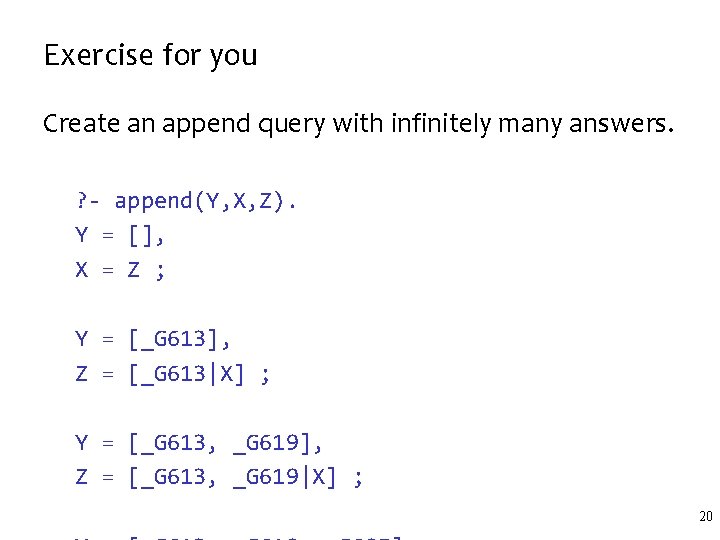
Exercise for you Create an append query with infinitely many answers. ? - append(Y, X, Z). Y = [], X = Z ; Y = [_G 613], Z = [_G 613|X] ; Y = [_G 613, _G 619], Z = [_G 613, _G 619|X] ; 20
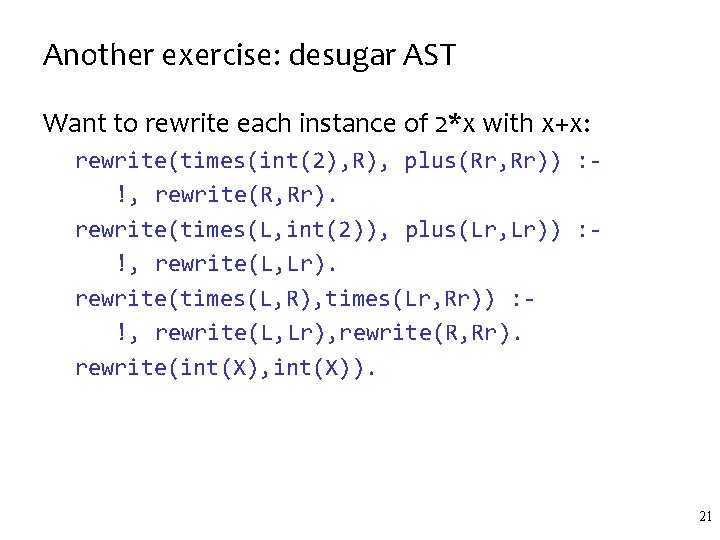
Another exercise: desugar AST Want to rewrite each instance of 2*x with x+x: rewrite(times(int(2), R), plus(Rr, Rr)) : !, rewrite(R, Rr). rewrite(times(L, int(2)), plus(Lr, Lr)) : !, rewrite(L, Lr). rewrite(times(L, R), times(Lr, Rr)) : !, rewrite(L, Lr), rewrite(R, Rr). rewrite(int(X), int(X)). 21
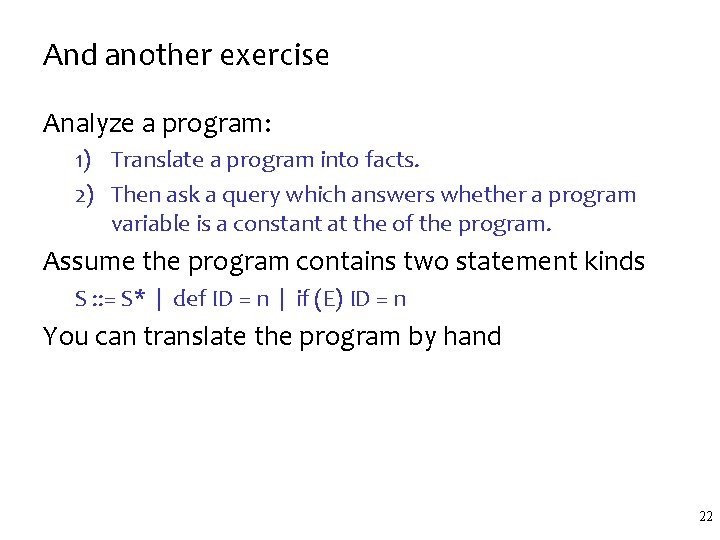
And another exercise Analyze a program: 1) Translate a program into facts. 2) Then ask a query which answers whether a program variable is a constant at the of the program. Assume the program contains two statement kinds S : : = S* | def ID = n | if (E) ID = n You can translate the program by hand 22
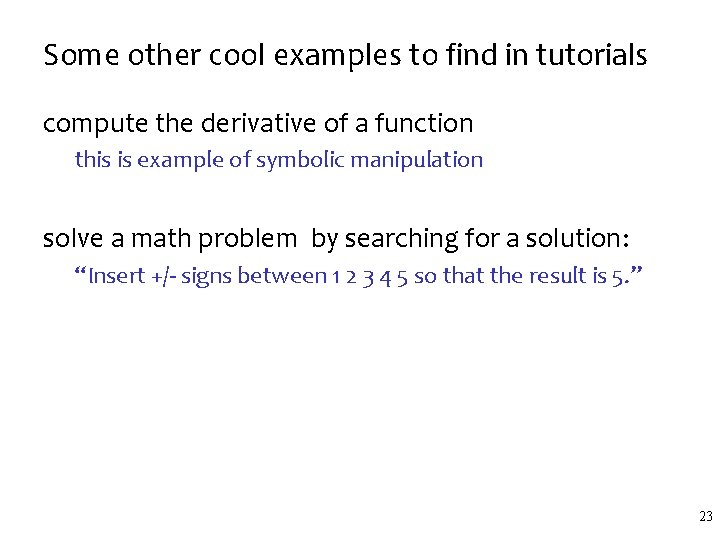
Some other cool examples to find in tutorials compute the derivative of a function this is example of symbolic manipulation solve a math problem by searching for a solution: “Insert +/- signs between 1 2 3 4 5 so that the result is 5. ” 23
Reading Required download SWI prolog go through a good prolog tutorial, including lists, recursion Recommended The Art of Prolog (this is required reading in next lecture) 24