
Lecture 6 Inventory Management Chapter 12 1 Types

- Slides: 25
Lecture 6 Inventory Management Chapter 12 1
Types of Inventories · Raw materials & purchased parts · Partially completed goods called work in progress · Finished-goods inventories · (manufacturing firms) or merchandise (retail stores) · Replacement parts, tools, & supplies · Goods-in-transit to warehouses or customers 2
Functions of Inventory · To meet anticipated demand · To smooth production requirements · To decouple operations · To protect against stock-outs · To take advantage of order cycles · To help hedge against price increases · To permit operations · To take advantage of quantity discounts 3
Objective of Inventory Control · To achieve satisfactory levels of customer service while keeping inventory costs within reasonable bounds · Level of customer service · Costs of ordering and carrying inventory 4
Key Inventory Terms Lead time: time interval between ordering and receiving the order · Holding (carrying) costs: cost to carry an item in inventory for a length of time, usually a year · Ordering costs: costs of ordering and receiving inventory · Shortage costs: costs when demand exceeds supply · 5
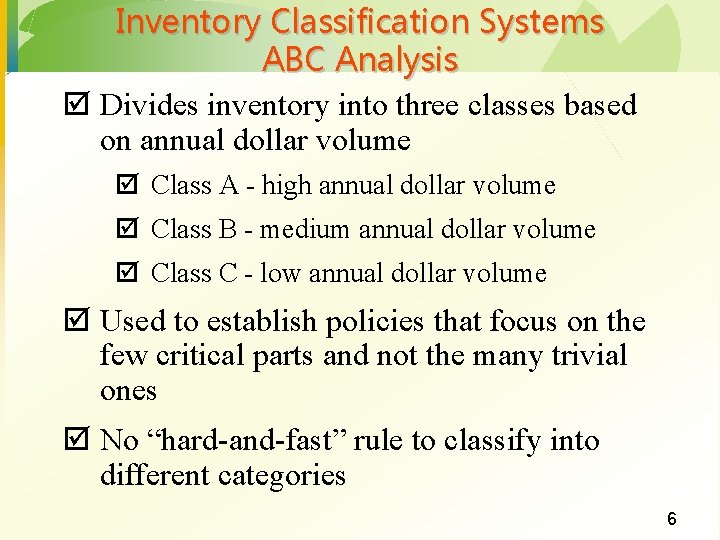
Inventory Classification Systems ABC Analysis þ Divides inventory into three classes based on annual dollar volume þ Class A - high annual dollar volume þ Class B - medium annual dollar volume þ Class C - low annual dollar volume þ Used to establish policies that focus on the few critical parts and not the many trivial ones þ No “hard-and-fast” rule to classify into different categories 6
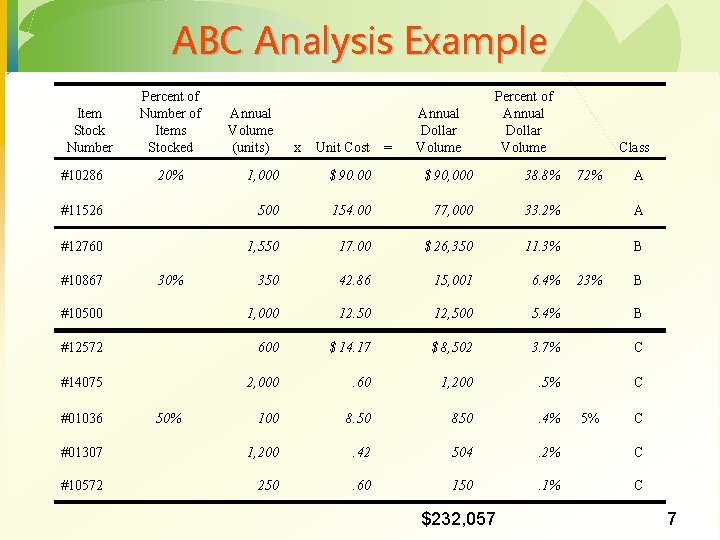
ABC Analysis Example Item Stock Number #10286 Percent of Number of Items Stocked x Unit Cost = Annual Dollar Volume Class 1, 000 $ 90, 000 38. 8% #11526 500 154. 00 77, 000 33. 2% A #12760 1, 550 17. 00 $ 26, 350 11. 3% B 350 42. 86 15, 001 6. 4% #10500 1, 000 12. 50 12, 500 5. 4% B #12572 600 $ 14. 17 $ 8, 502 3. 7% C #14075 2, 000 . 60 1, 200 . 5% C 100 8. 50 850 . 4% #01307 1, 200 . 42 504 . 2% C #10572 250 . 60 150 . 1% C #10867 #01036 20% Annual Volume (units) Percent of Annual Dollar Volume 30% 50% $232, 057 72% 23% 5% A B C 7
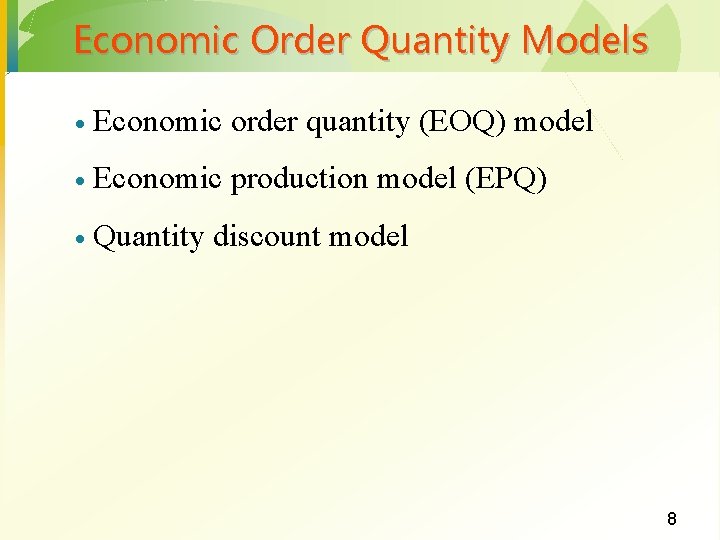
Economic Order Quantity Models · Economic order quantity (EOQ) model · Economic production model (EPQ) · Quantity discount model 8
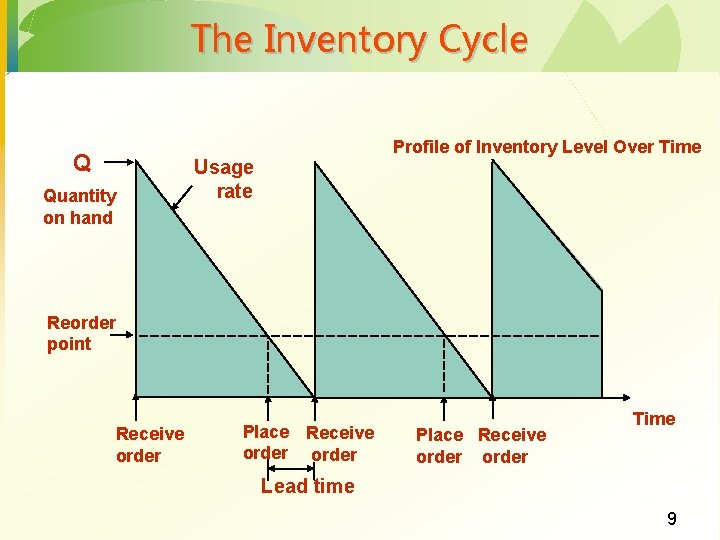
The Inventory Cycle Q Quantity on hand Profile of Inventory Level Over Time Usage rate Reorder point Receive order Place Receive order Time Lead time 9
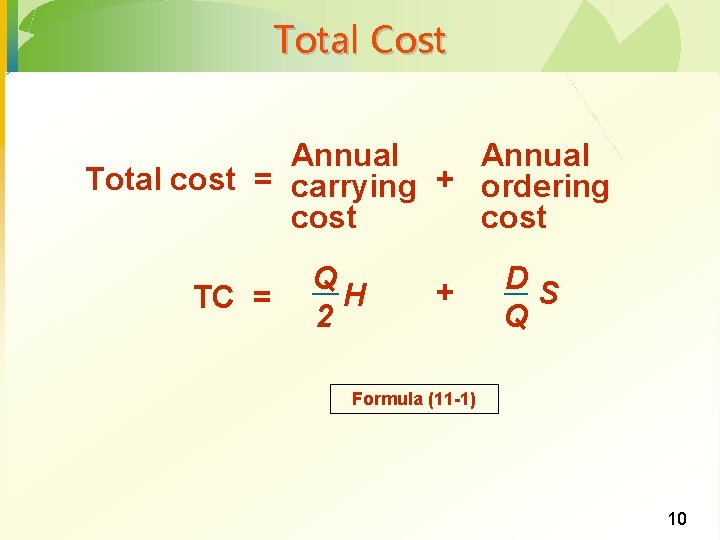
Total Cost Annual Total cost = carrying + ordering cost TC = Q H 2 + DS Q Formula (11 -1) 10
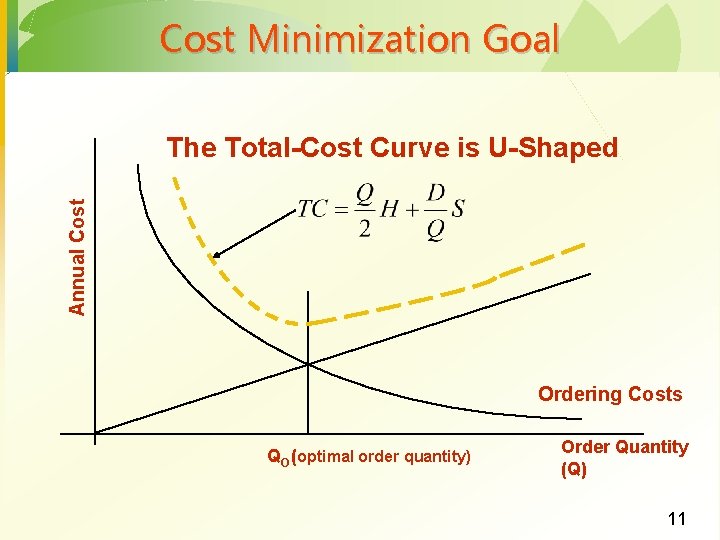
Cost Minimization Goal Annual Cost The Total-Cost Curve is U-Shaped Ordering Costs QO (optimal order quantity) Order Quantity (Q) 11
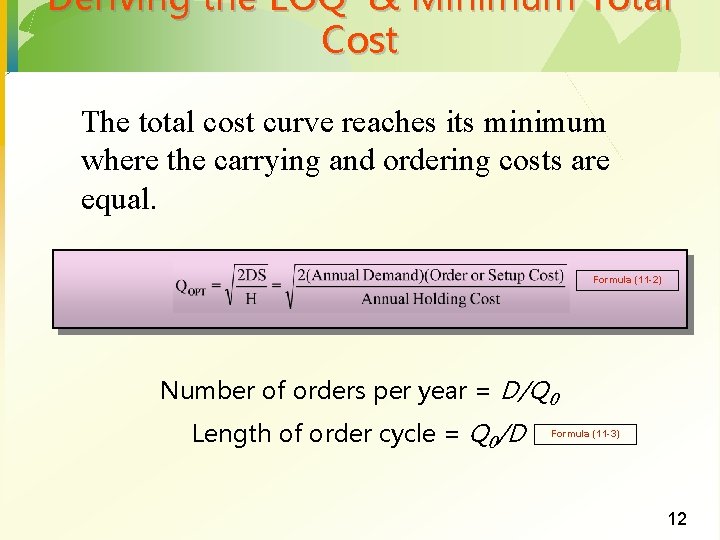
Deriving the EOQ & Minimum Total Cost The total cost curve reaches its minimum where the carrying and ordering costs are equal. Formula (11 -2) Number of orders per year = D/Q 0 Length of order cycle = Q 0/D Formula (11 -3) 12
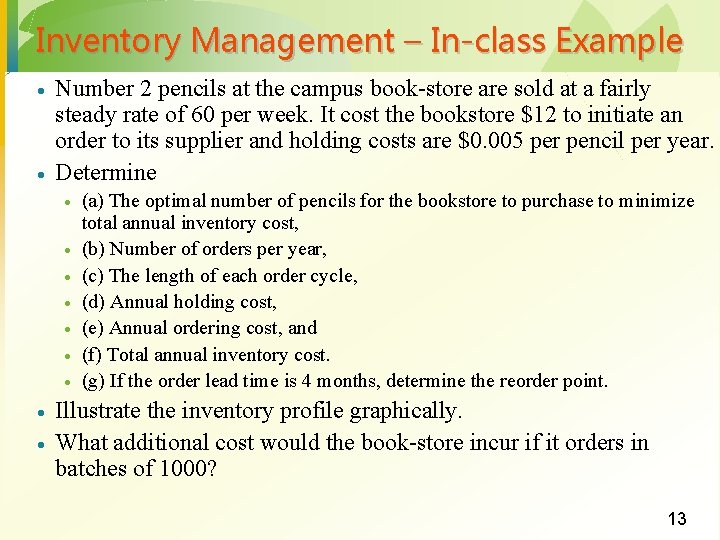
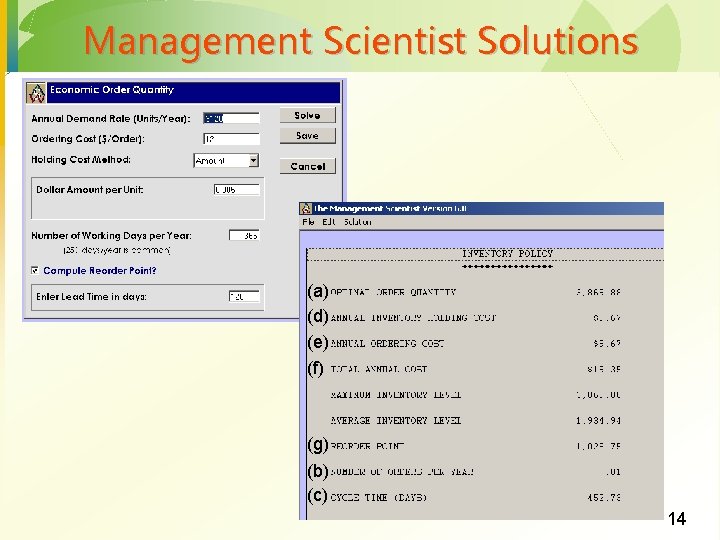
Inventory Management – In-class Example · · Number 2 pencils at the campus book-store are sold at a fairly steady rate of 60 per week. It cost the bookstore $12 to initiate an order to its supplier and holding costs are $0. 005 per pencil per year. Determine · · · · · (a) The optimal number of pencils for the bookstore to purchase to minimize total annual inventory cost, (b) Number of orders per year, (c) The length of each order cycle, (d) Annual holding cost, (e) Annual ordering cost, and (f) Total annual inventory cost. (g) If the order lead time is 4 months, determine the reorder point. Illustrate the inventory profile graphically. What additional cost would the book-store incur if it orders in batches of 1000? 13
Management Scientist Solutions (a) (d) (e) (f) (g) (b) (c) 14
Assumptions of EOQ Model · Only one product is involved · Annual demand requirements known · Demand is even throughout the year · Lead time does not vary · Each order is received in a single delivery · There are no quantity discounts 15
EOQ with Quantity Discounts The EOQ with quantity discounts model is applicable where a supplier offers a lower purchase cost when an item is ordered in larger quantities. · This model's variable costs are · Annual holding, · Ordering cost, and · Purchase costs · · For the optimal order quantity, the annual holding and ordering costs are not necessarily equal. 16
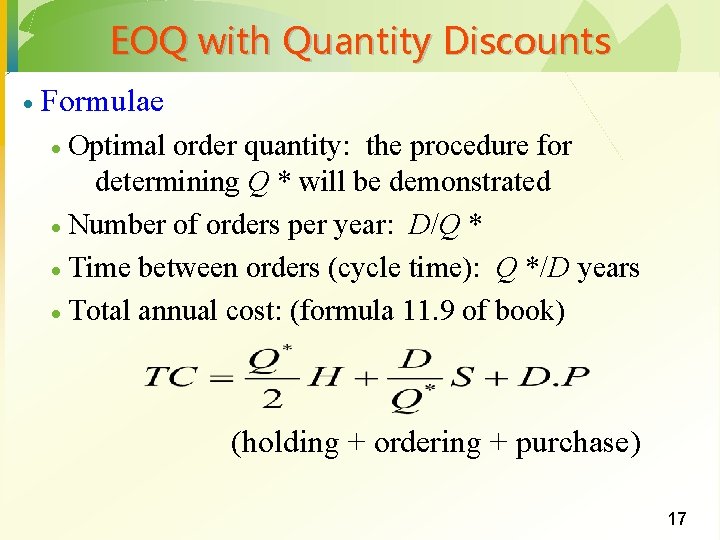
EOQ with Quantity Discounts · Formulae Optimal order quantity: the procedure for determining Q * will be demonstrated · Number of orders per year: D/Q * · Time between orders (cycle time): Q */D years · Total annual cost: (formula 11. 9 of book) · (holding + ordering + purchase) 17
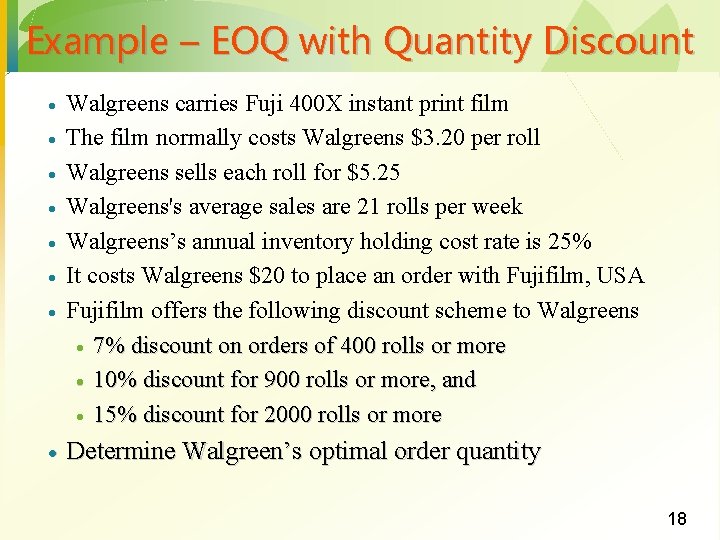
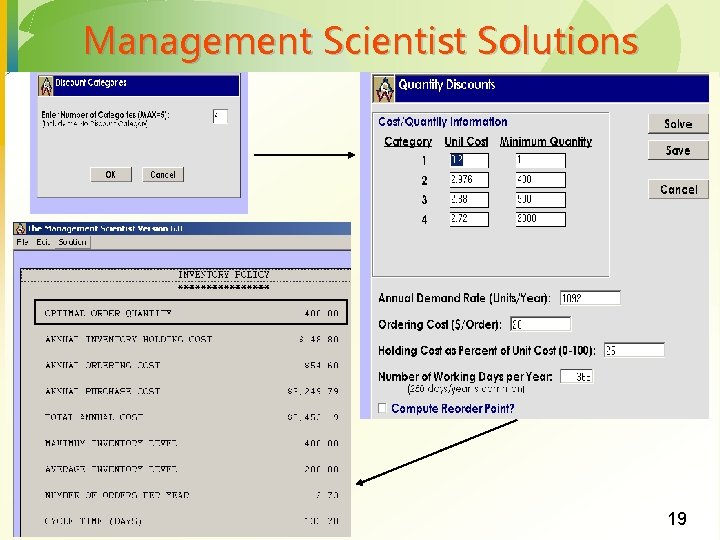
Example – EOQ with Quantity Discount · · · · Walgreens carries Fuji 400 X instant print film The film normally costs Walgreens $3. 20 per roll Walgreens sells each roll for $5. 25 Walgreens's average sales are 21 rolls per week Walgreens’s annual inventory holding cost rate is 25% It costs Walgreens $20 to place an order with Fujifilm, USA Fujifilm offers the following discount scheme to Walgreens · 7% discount on orders of 400 rolls or more · 10% discount for 900 rolls or more, and · 15% discount for 2000 rolls or more Determine Walgreen’s optimal order quantity 18
Management Scientist Solutions 19
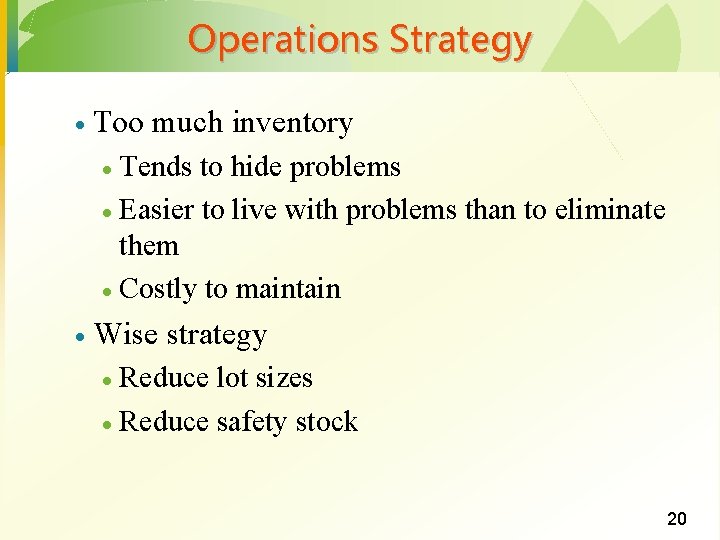
Operations Strategy · Too much inventory Tends to hide problems · Easier to live with problems than to eliminate them · Costly to maintain · · Wise strategy Reduce lot sizes · Reduce safety stock · 20
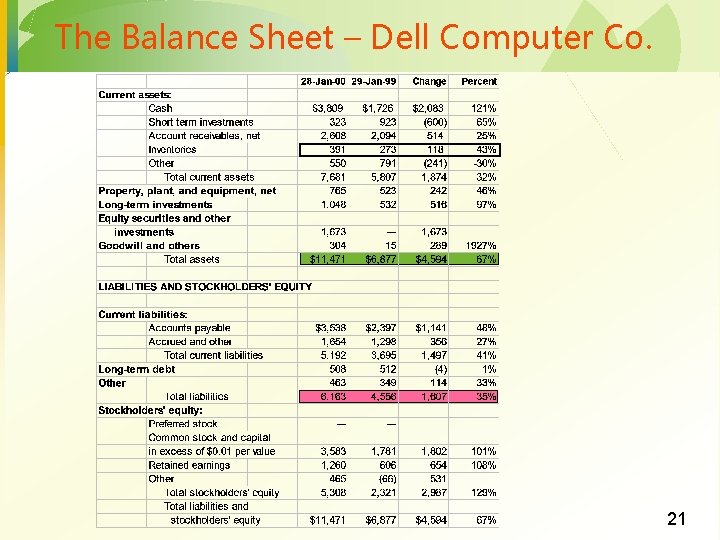
The Balance Sheet – Dell Computer Co. 21
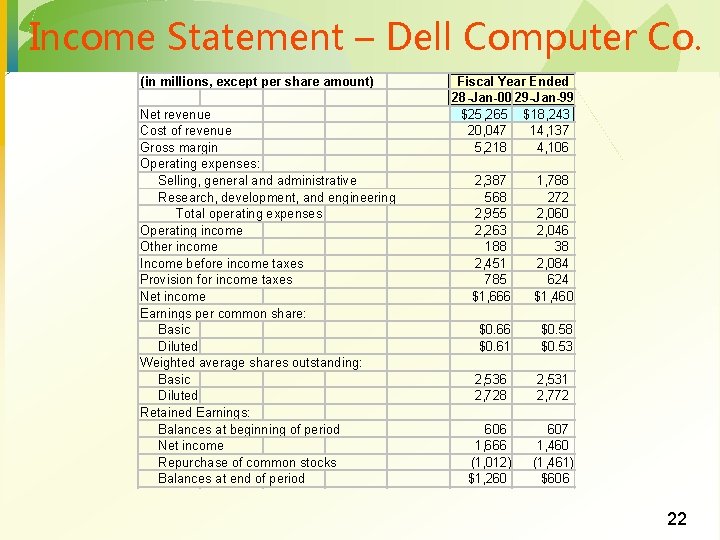
Income Statement – Dell Computer Co. (in millions, except per share amount) Net revenue Cost of revenue Gross margin Operating expenses: Selling, general and administrative Research, development, and engineering Total operating expenses Operating income Other income Income before income taxes Provision for income taxes Net income Earnings per common share: Basic Diluted Weighted average shares outstanding: Basic Diluted Retained Earnings: Balances at beginning of period Net income Repurchase of common stocks Balances at end of period Fiscal Year Ended 28 -Jan-00 29 -Jan-99 $25, 265 $18, 243 20, 047 14, 137 5, 218 4, 106 2, 387 568 2, 955 2, 263 188 2, 451 785 $1, 666 1, 788 272 2, 060 2, 046 38 2, 084 624 $1, 460 $0. 66 $0. 61 $0. 58 $0. 53 2, 536 2, 728 2, 531 2, 772 606 1, 666 (1, 012) $1, 260 607 1, 460 (1, 461) $606 22
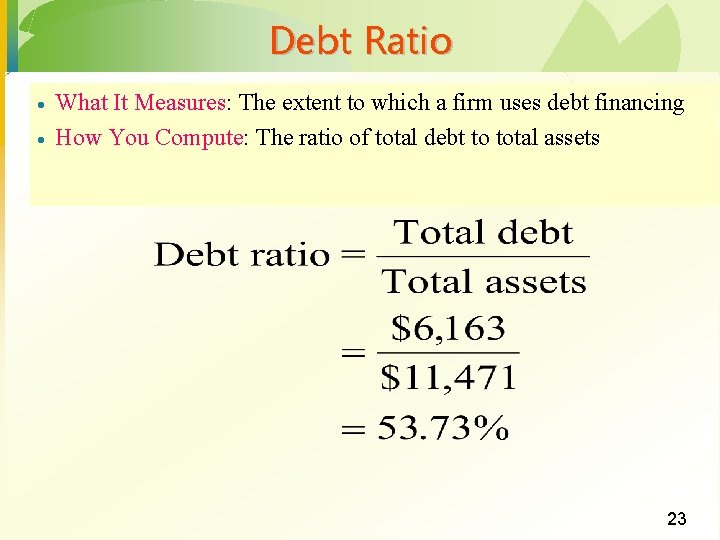
Debt Ratio · · What It Measures: The extent to which a firm uses debt financing How You Compute: The ratio of total debt to total assets 23
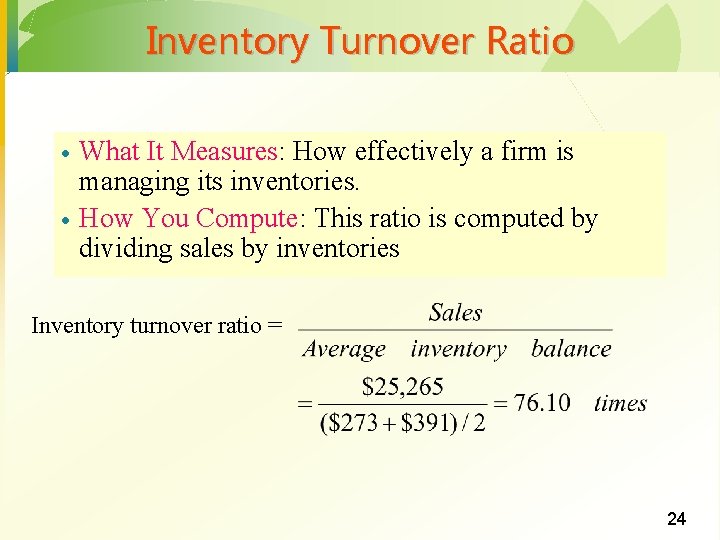
Inventory Turnover Ratio · · What It Measures: How effectively a firm is managing its inventories. How You Compute: This ratio is computed by dividing sales by inventories Inventory turnover ratio = 24
Course Conclusions · · Recognize that not every tool is the best fit for every problem Pay attention to variability · Forecasting · Inventory management - Deliveries from suppliers Build flexibility into models Pay careful attention to technology · Opportunities · · Improvement in service and response times Risks · Costs involved · Difficult to integrate · Need for periodic updates · Requires training · Garbage in, garbage out · Results and recommendations you present are only as reliable as the model and its inputs · Most decisions involve tradeoffs Not a good idea to make decisions to the exclusion of known information · 25