
LECTURE 6 Intercultural communication and training ORGANIZATION Rest


- Slides: 48
LECTURE 6 Intercultural communication and training
ORGANIZATION Rest of the course: � 28. 11. Stereotypes and prejudice � 5. 12. Critical thinking (in CCP) � 12. ? � 19. 12. test 12. � Option 1: Cross-cultural simulation game � Option 2: Shorter lectures on Food and eating + Religion
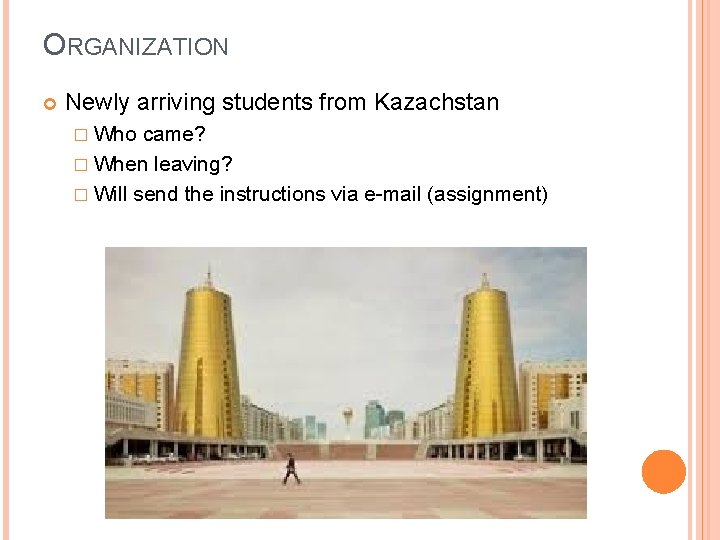
ORGANIZATION Newly arriving students from Kazachstan � Who came? � When leaving? � Will send the instructions via e-mail (assignment)
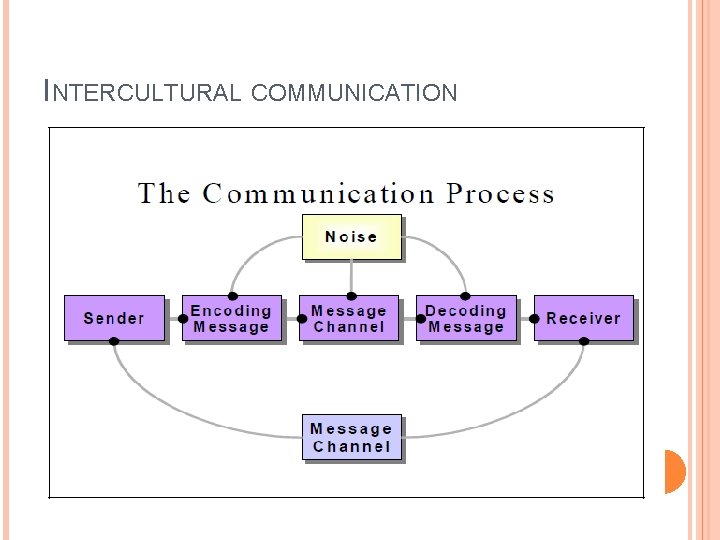
INTERCULTURAL COMMUNICATION AND TRAINING Content: � Intercultural communication Verbal Non-verbal � Theories of IC � Intercultural negotiation � Sojourners (Expatriates) � Intercultural training
INTERCULTURAL COMMUNICATION
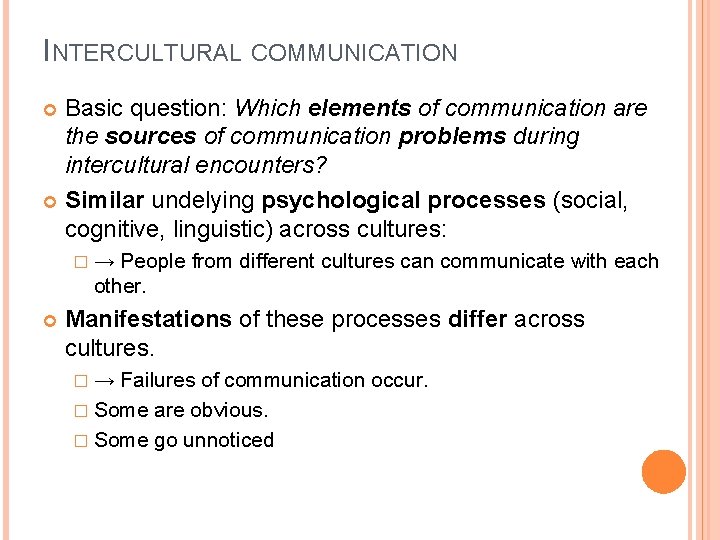
INTERCULTURAL COMMUNICATION Basic question: Which elements of communication are the sources of communication problems during intercultural encounters? Similar undelying psychological processes (social, cognitive, linguistic) across cultures: �→ People from different cultures can communicate with each other. Manifestations of these processes differ across cultures. �→ Failures of communication occur. � Some are obvious. � Some go unnoticed
Verbal communication
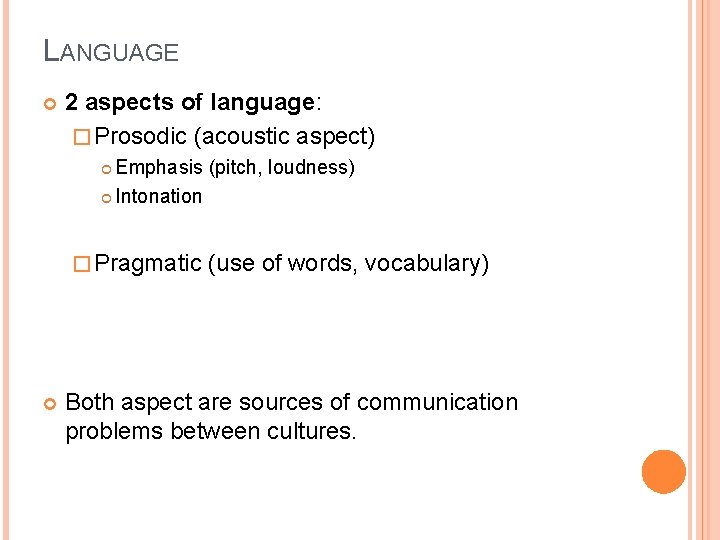
LANGUAGE 2 aspects of language: � Prosodic (acoustic aspect) Emphasis (pitch, loudness) Intonation � Pragmatic (use of words, vocabulary) Both aspect are sources of communication problems between cultures.
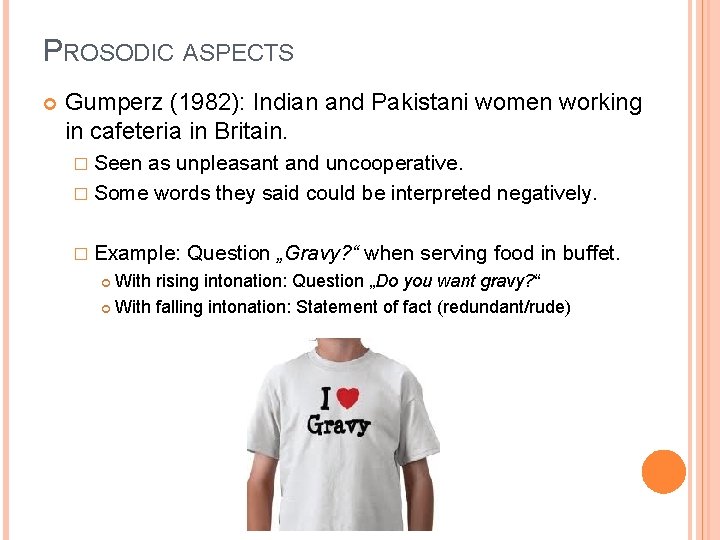
PROSODIC ASPECTS Gumperz (1982): Indian and Pakistani women working in cafeteria in Britain. � Seen as unpleasant and uncooperative. � Some words they said could be interpreted negatively. � Example: Question „Gravy? “ when serving food in buffet. With rising intonation: Question „Do you want gravy? “ With falling intonation: Statement of fact (redundant/rude)
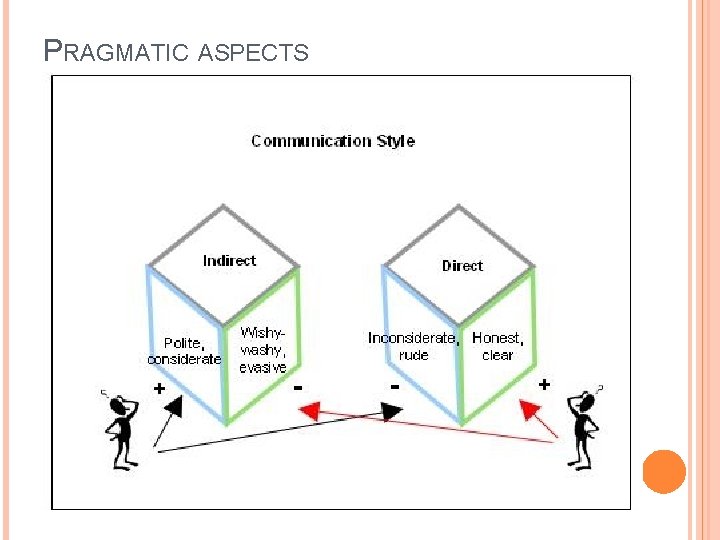
PRAGMATIC ASPECTS Indirect vs. direct style of communication � Direct: YES = YES, NO = NO � Indirect: YES = YES/MAYBE/NO, MAYBE = NO Example: Manager gets a poorly written report � Direct: You have made a number of errors and incorrect assumptions in this report. Go back, check your data and proofread your work. � Indirect: It seems there are some mistakes in this report and readers may question some of your assumptions. Could you check it over another time before finalizing it?
THEORIES OF INTERCULTURAL COMMUNICATION Direct and indirect communication Relationship attunement � Attention to relationship issues and emotions of others � Based on peoples comprehension of subtle and indirect cues in communication Speakers POV � Intention to transmit more than sentence meaning Listeners POV � Sensitivity meaning to discrepancies between sentence and speaker
PRAGMATIC ASPECTS
Non-verbal communication
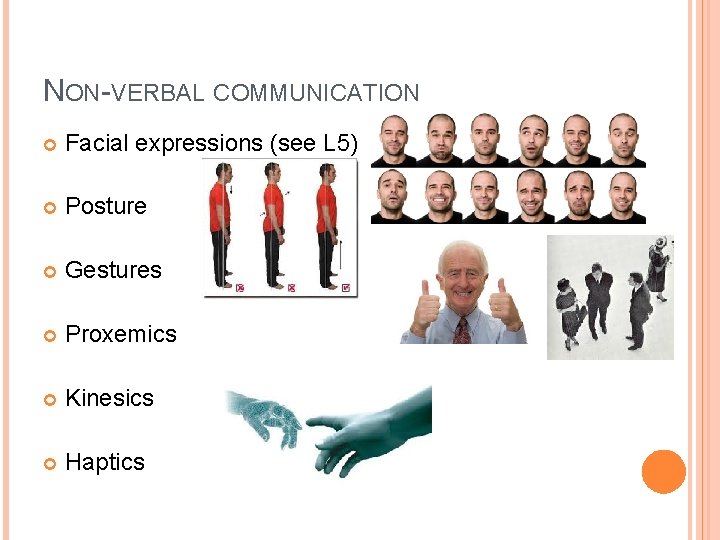
NON-VERBAL COMMUNICATION Facial expressions (see L 5) Posture Gestures Proxemics Kinesics Haptics
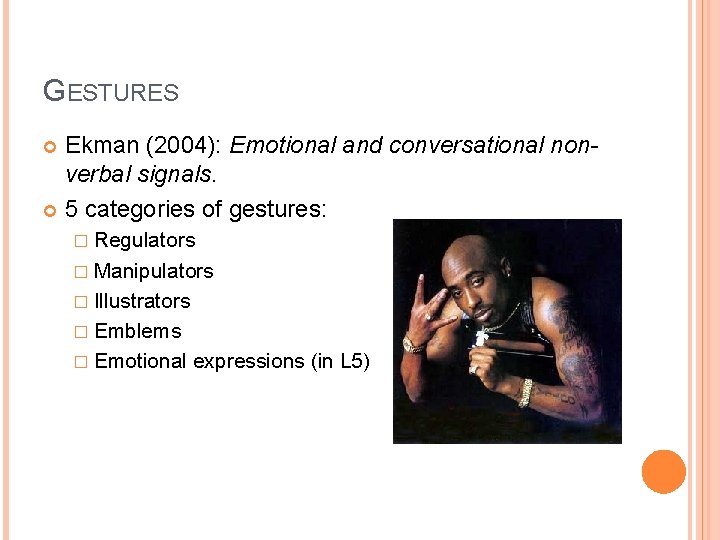
GESTURES Ekman (2004): Emotional and conversational nonverbal signals. 5 categories of gestures: � Regulators � Manipulators � Illustrators � Emblems � Emotional expressions (in L 5)
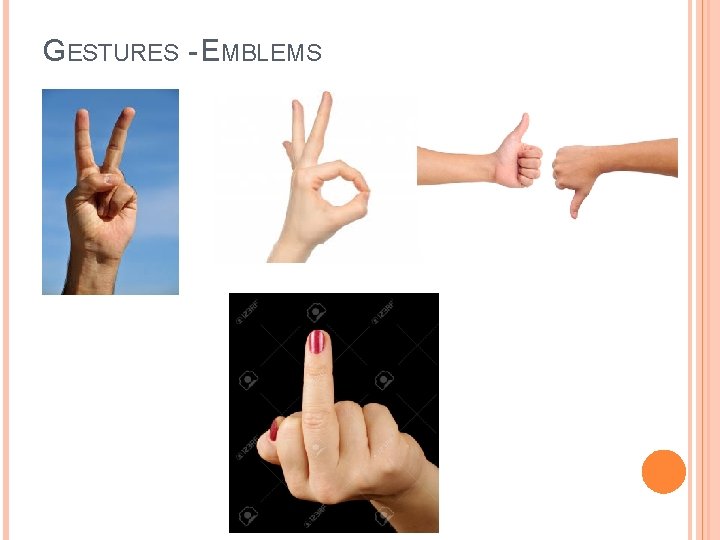
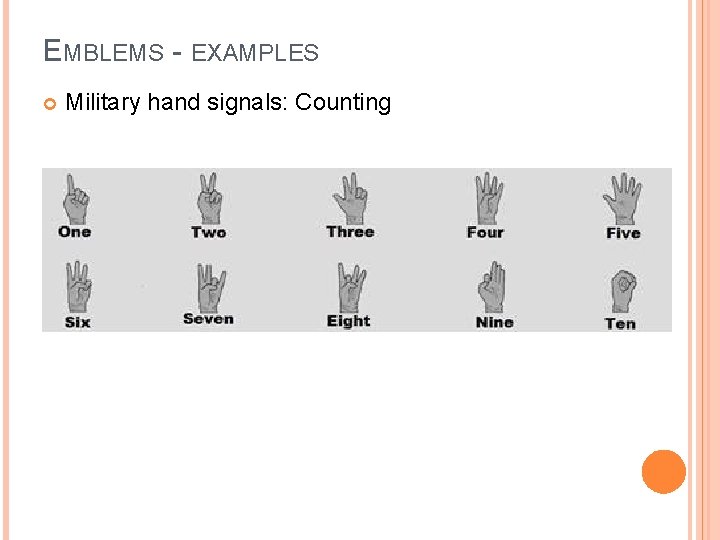
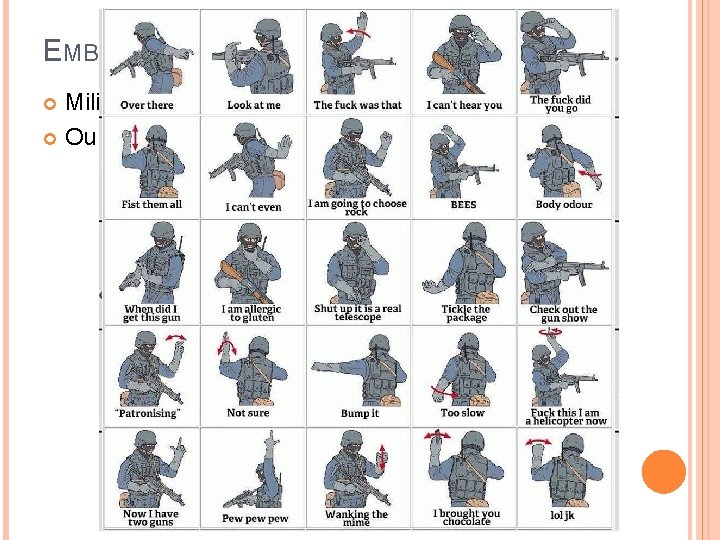
GESTURES Emblems: � Body � Set language of precise meanings for all members of culture � Socially learned → culturally specific (different meaning in 2 cultures) � Some � Have are multicultural („Come here!“) words equivalent, accompany words � Mostly hand movements, shrugging, head movements…
GESTURES - EMBLEMS
EMBLEMS - EXAMPLES Military hand signals: Counting
EMBLEMS - EXAMPLES Military hand signals: tactical signals Our interpretation?
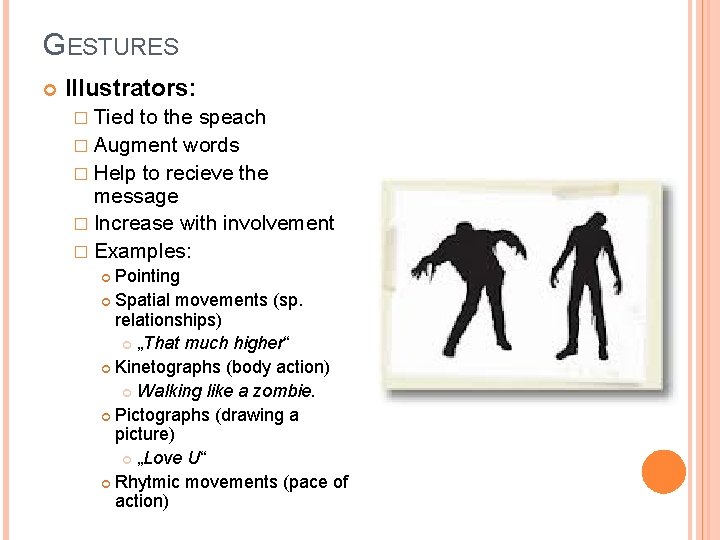
GESTURES Illustrators: � Tied to the speach � Augment words � Help to recieve the message � Increase with involvement � Examples: Pointing Spatial movements (sp. relationships) „That much higher“ Kinetographs (body action) Walking like a zombie. Pictographs (drawing a picture) „Love U“ Rhytmic movements (pace of action)
GESTURES Manipulators (adaptors) � One part of the body (or face) manipulates other part of the body. � No instrumental goal � Reflect nervousness, habitual activity � Some evolved from taboo activities (scratching nose instead of picking) � Examples: stroking, pressing, scratching, biting, licking, sucking… Exercise: Do not use manipulators for 5 minutes!!!!
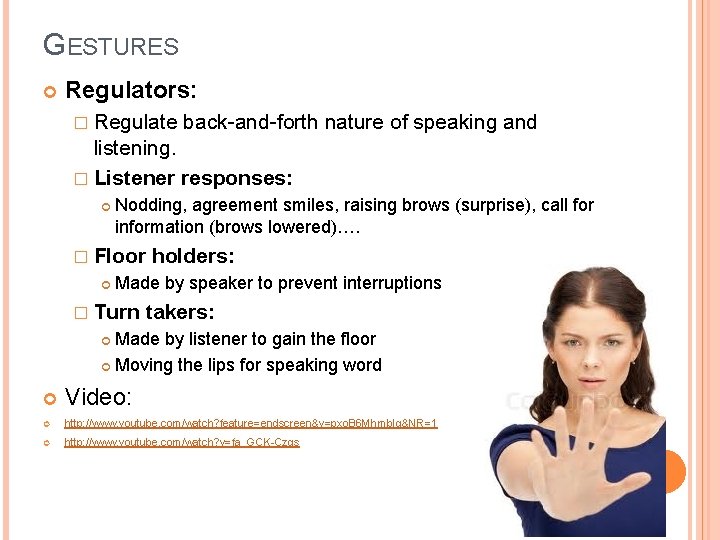
GESTURES Regulators: � Regulate back-and-forth nature of speaking and listening. � Listener responses: Nodding, agreement smiles, raising brows (surprise), call for information (brows lowered)…. � Floor holders: Made by speaker to prevent interruptions � Turn takers: Made by listener to gain the floor Moving the lips for speaking word Video: http: //www. youtube. com/watch? feature=endscreen&v=pxo. B 6 Mhmb. Ig&NR=1 http: //www. youtube. com/watch? v=fa_GCK-Czqs
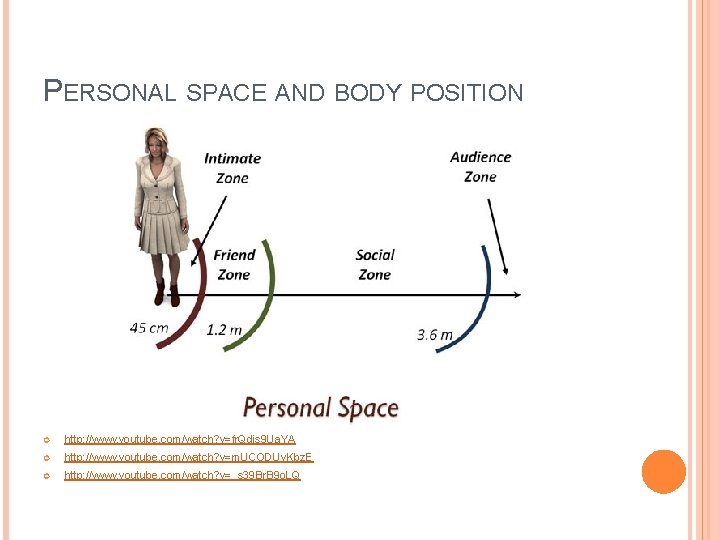
PERSONAL SPACE AND BODY POSITION http: //www. youtube. com/watch? v=fr. Qdjs 9 Ua. YA http: //www. youtube. com/watch? v=m. UCODUv. Kbz. E http: //www. youtube. com/watch? v=_s 39 Br. B 9 o. LQ
PERSONAL SPACE AND BODY POSITION Arabs, Southern Europeans, Latin Americans – stand close together. USA, Northern Europe – need for greater physical distance. Haptics – similar rules apply
Adaptation to a foreign culture
ACCULTURATION
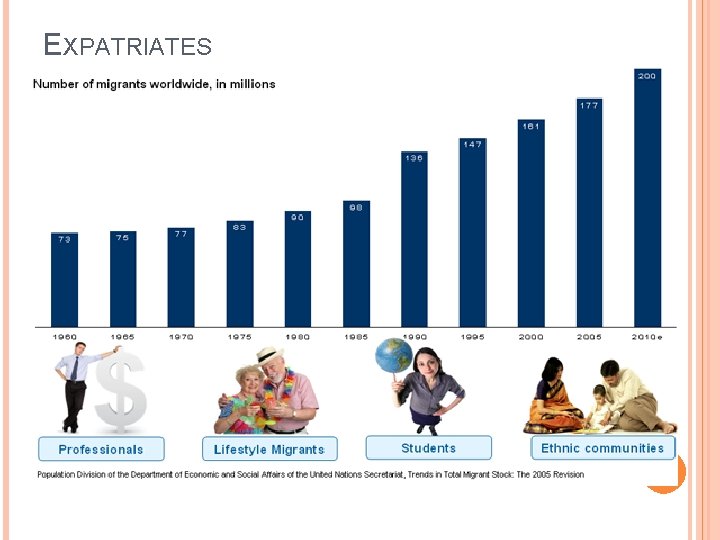
EXPATRIATES
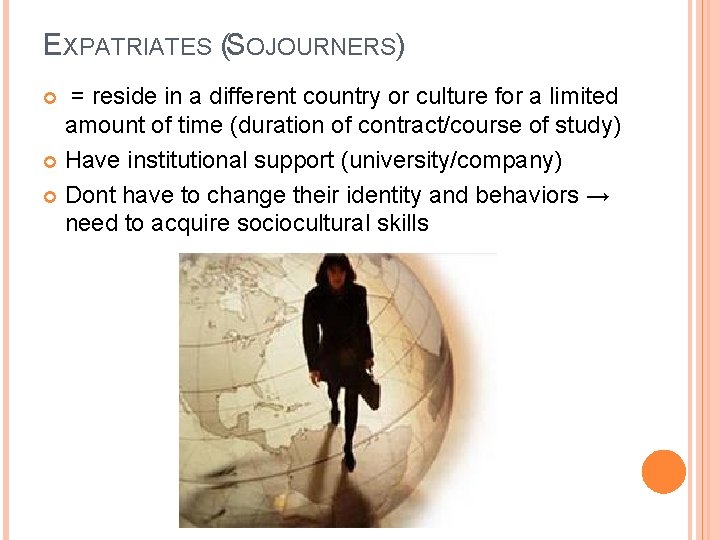
EXPATRIATES (SOJOURNERS) = reside in a different country or culture for a limited amount of time (duration of contract/course of study) Have institutional support (university/company) Dont have to change their identity and behaviors → need to acquire sociocultural skills
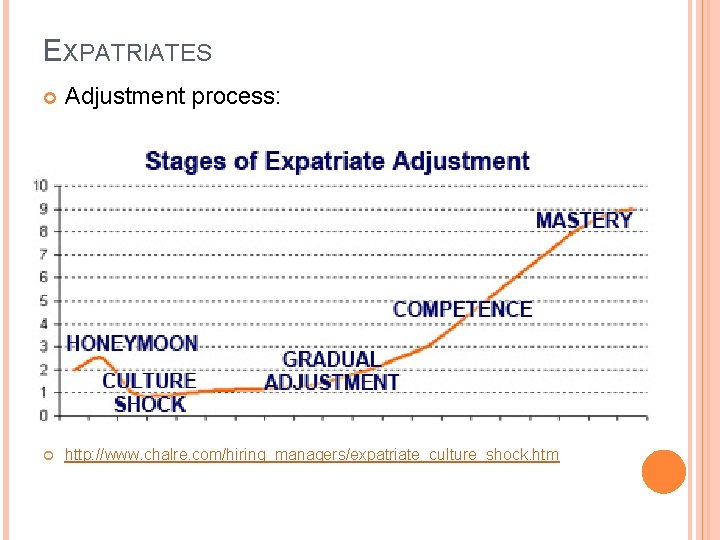
EXPATRIATES Adjustment process: http: //www. chalre. com/hiring_managers/expatriate_culture_shock. htm
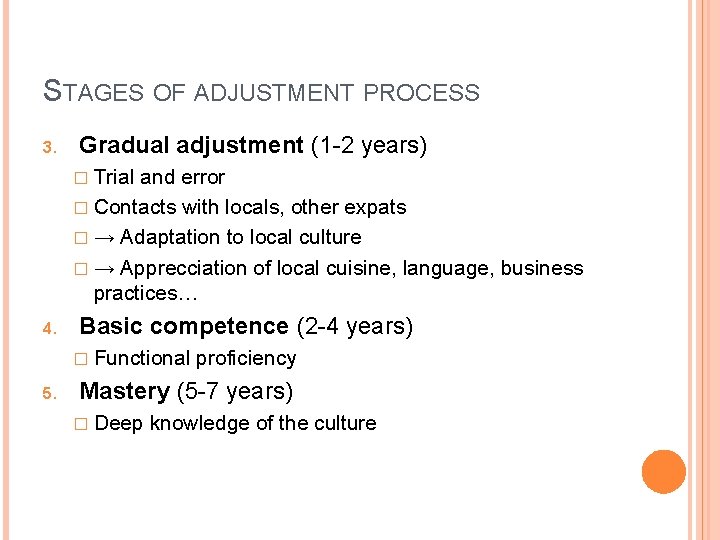
STAGES OF ADJUSTMENT PROCESS 1. Honeymoon (4 -6 weeks) � Excitation abour being in new country � Fascination with sights and sounds � Rise in status and standards of living (business expats in Asia) 2. Culture shock (6 -8 months) � Realisation of the cultural barriers � Ineffectivity in social interaction � Emotional distress � Traumatization of families � Frustration, anger, confusion, distrust
STAGES OF ADJUSTMENT PROCESS 3. Gradual adjustment (1 -2 years) � Trial and error � Contacts with locals, other expats � → Adaptation to local culture � → Apprecciation of local cuisine, language, business practices… 4. Basic competence (2 -4 years) � Functional 5. proficiency Mastery (5 -7 years) � Deep knowledge of the culture
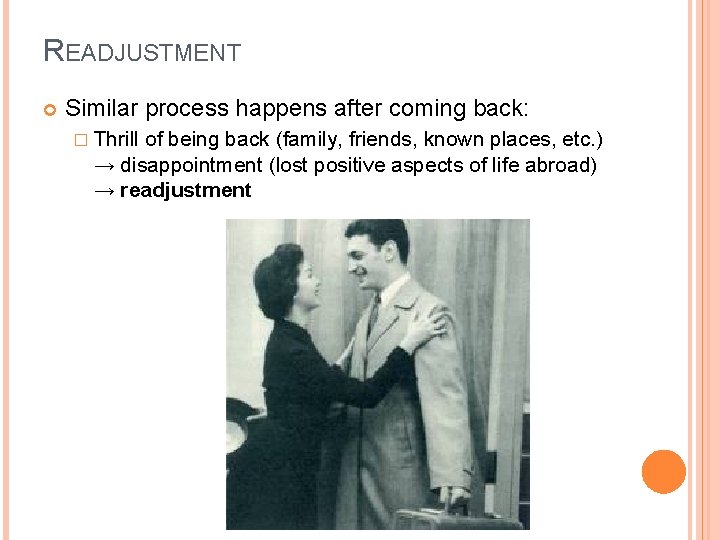
READJUSTMENT Similar process happens after coming back: � Thrill of being back (family, friends, known places, etc. ) → disappointment (lost positive aspects of life abroad) → readjustment
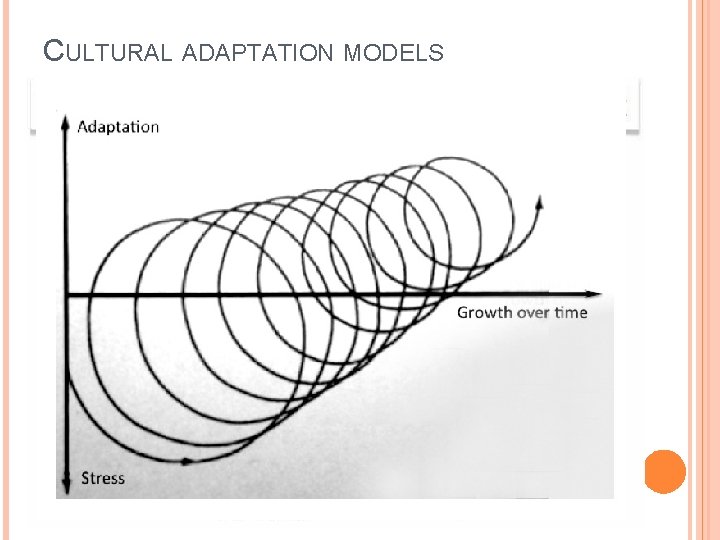
CULTURAL ADAPTATION MODELS More models, same principle
EXPATRIATES: INTERCULTURAL PERSONALITY What personal characteristics influence (accelerate) adaptation process? What types of people are suitable for becoming expats? How to predict individual performance in other culture? → identification of „overseas type“
EXPATRIATES: INTERCULTURAL PERSONALITY Personality traits: � Extraversion � Emotional stability � Ability to cooperate � Self-discipline Cultural-fit hypothesis: � „Fit“ between personal characteristics and norms of the host culture helps adaptation � Example: US expats in Singapore are more extraverted → feel frustrated and rejected
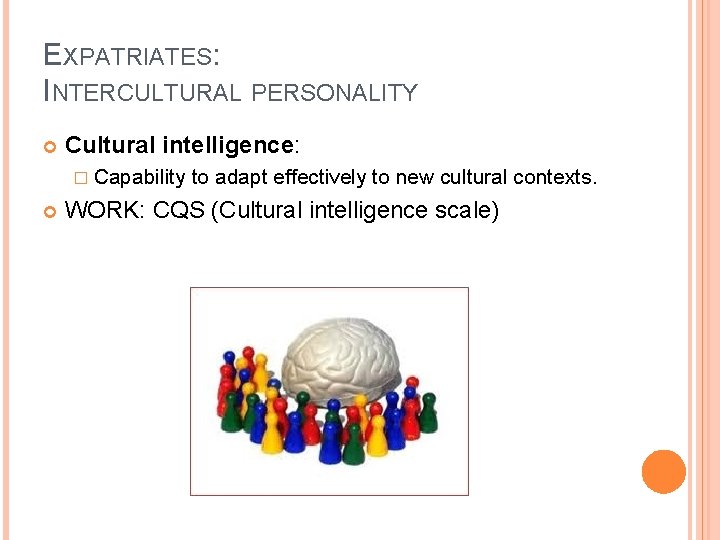
EXPATRIATES: INTERCULTURAL PERSONALITY Cultural intelligence: � Capability to adapt effectively to new cultural contexts. WORK: CQS (Cultural intelligence scale)
CQS – REFLECTION 1. Do your scores follow the same general pattern? Are they generally low, generally moderate, or generally high? 2. Do you have any low scores? 3. Do you have any high scores?
INTERCULTURAL TRAINING Some IT programs take weeks/months Types of training programs: 1. Language courses 2. T-groups 3. Simulation games 4. Bicultural contacts 5. Intercultural workshops 6. Culture assimilators
T-GROUPS = sensitivity training groups 8 -15 participants No strict agenda Participants share their emotional reactions (under guidance of facilitator) Try to understand their emotions, emotions they trigger in other people Anger, fear, envy…
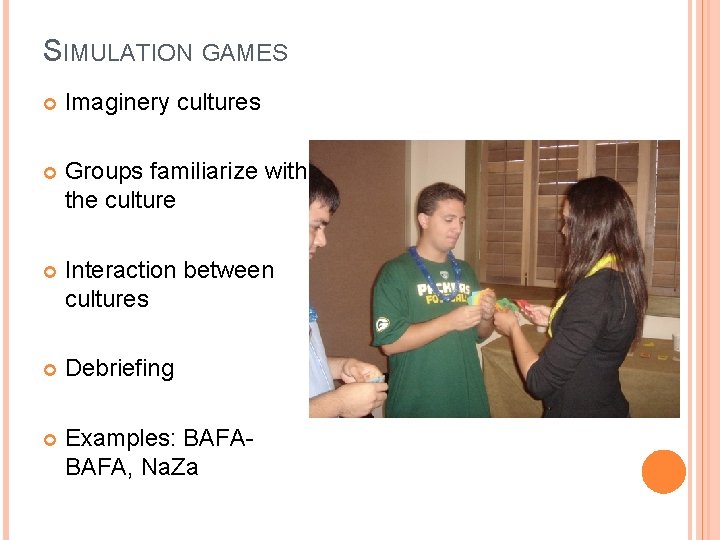
SIMULATION GAMES Imaginery cultures Groups familiarize with the culture Interaction between cultures Debriefing Examples: BAFA, Na. Za
CULTURE ASSIMILATORS Short epizodes decribing interactions between people of 2 cultures → something goes wrong → 4/5 possible reasons for communication failure (1 right/rest are distractors) → feedback with culturally relevant information
CULTURE ASSIMILATORS: EXAMPLE I One day a Thai administrator of middle academic rank kept two of his assistants waiting about an hour from an appointment. The assistants, although very angry, did not show it while they waited. When the administrator walked in at last, he acted as if he were not late. He made no apology or explanation. After he was settled in his office, he called his assistants in and they all began working on the business for which the administrator had set the meeting.
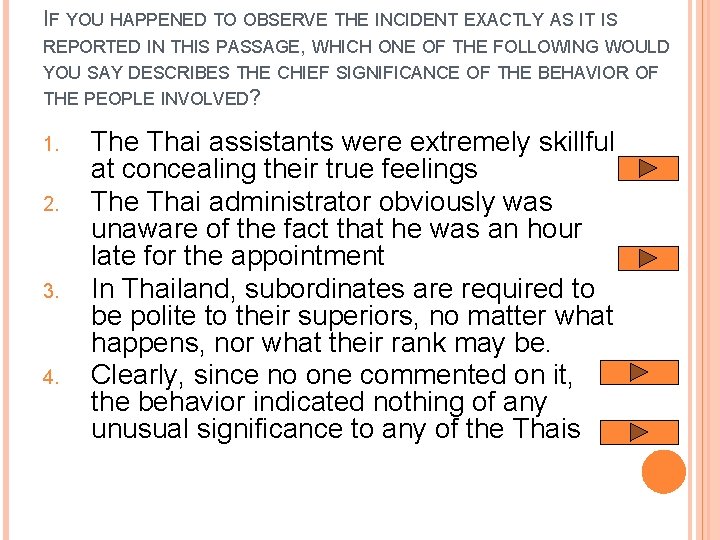
IF YOU HAPPENED TO OBSERVE THE INCIDENT EXACTLY AS IT IS REPORTED IN THIS PASSAGE, WHICH ONE OF THE FOLLOWING WOULD YOU SAY DESCRIBES THE CHIEF SIGNIFICANCE OF THE BEHAVIOR OF THE PEOPLE INVOLVED? 1. 2. 3. 4. The Thai assistants were extremely skillful at concealing their true feelings The Thai administrator obviously was unaware of the fact that he was an hour late for the appointment In Thailand, subordinates are required to be polite to their superiors, no matter what happens, nor what their rank may be. Clearly, since no one commented on it, the behavior indicated nothing of any unusual significance to any of the Thais
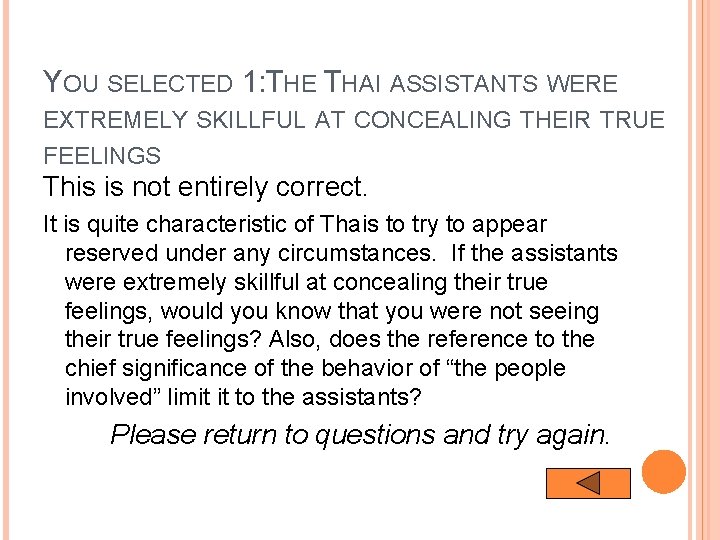
YOU SELECTED 1: THE THAI ASSISTANTS WERE EXTREMELY SKILLFUL AT CONCEALING THEIR TRUE FEELINGS This is not entirely correct. It is quite characteristic of Thais to try to appear reserved under any circumstances. If the assistants were extremely skillful at concealing their true feelings, would you know that you were not seeing their true feelings? Also, does the reference to the chief significance of the behavior of “the people involved” limit it to the assistants? Please return to questions and try again.
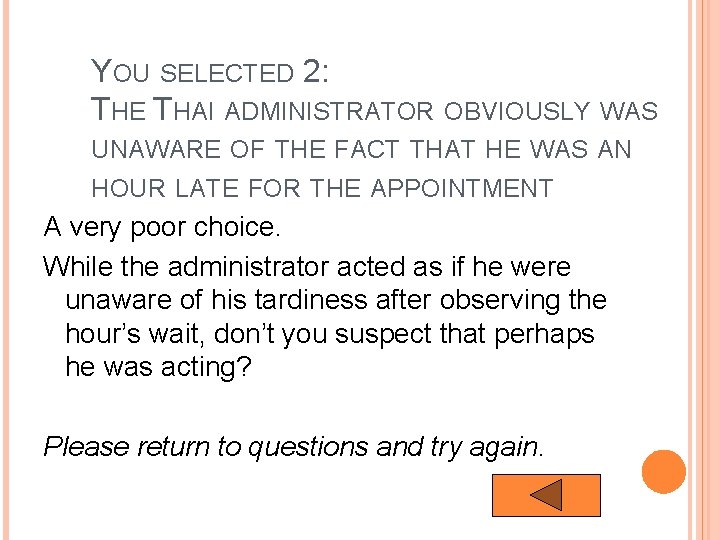
YOU SELECTED 2: THE THAI ADMINISTRATOR OBVIOUSLY WAS UNAWARE OF THE FACT THAT HE WAS AN HOUR LATE FOR THE APPOINTMENT A very poor choice. While the administrator acted as if he were unaware of his tardiness after observing the hour’s wait, don’t you suspect that perhaps he was acting? Please return to questions and try again.
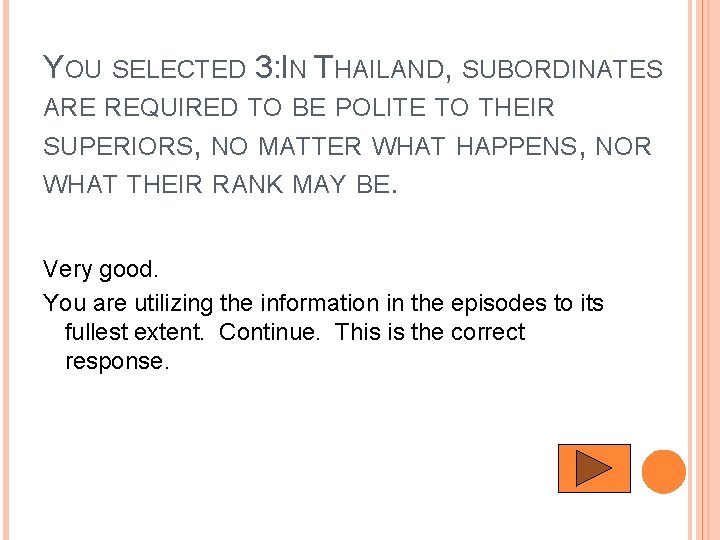
YOU SELECTED 3: IN THAILAND, SUBORDINATES ARE REQUIRED TO BE POLITE TO THEIR SUPERIORS, NO MATTER WHAT HAPPENS, NOR WHAT THEIR RANK MAY BE. Very good. You are utilizing the information in the episodes to its fullest extent. Continue. This is the correct response.
YOU SELECTED 4: CLEARLY, SINCE NO ONE COMMENTED ON IT, THE BEHAVIOR INDICATED NOTHING OF ANY UNUSUAL SIGNIFICANCE TO ANY OF THE THAIS This is completely wrong. While the behavior reported in the passage does not seem so significant for the Thais in this relationship as it might be to Americans, why was nothing said about the tardiness? And why were the assistants “very angry” although they “did not show it? ” Isn’t there a more significant level of meaning for this behavior? Please return to questions and try again.
FURTHER READING AND SOURCES Obligatory: Berry: 15 -Communication and training (407 -423)