
Lecture 6 Goals stacks Implementation of stack applications
- Slides: 17
Lecture 6 Goals: stacks Implementation of stack applications Postfix expression evaluation Convert infix to postfix Feb 12
Stack Overview Stack ADT Basic operations of stack push, pop, top, is. Empty etc. Implementations of stacks using Array Linked list Application to arithmetic expression evaluation
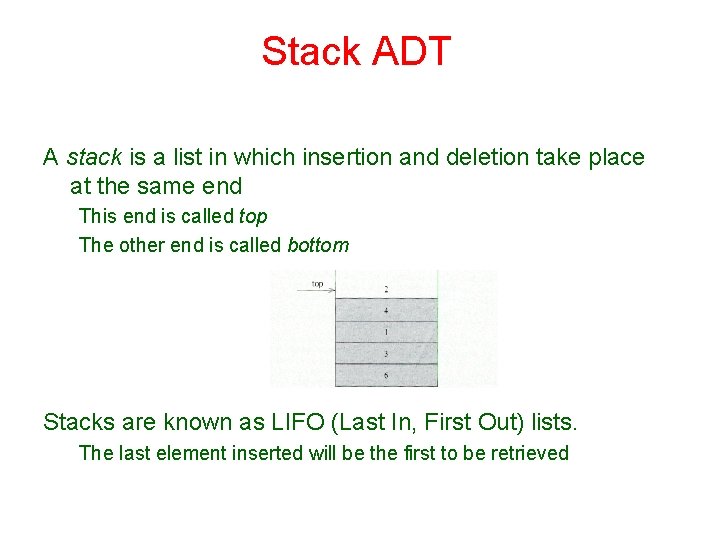
Stack ADT A stack is a list in which insertion and deletion take place at the same end This end is called top The other end is called bottom Stacks are known as LIFO (Last In, First Out) lists. The last element inserted will be the first to be retrieved
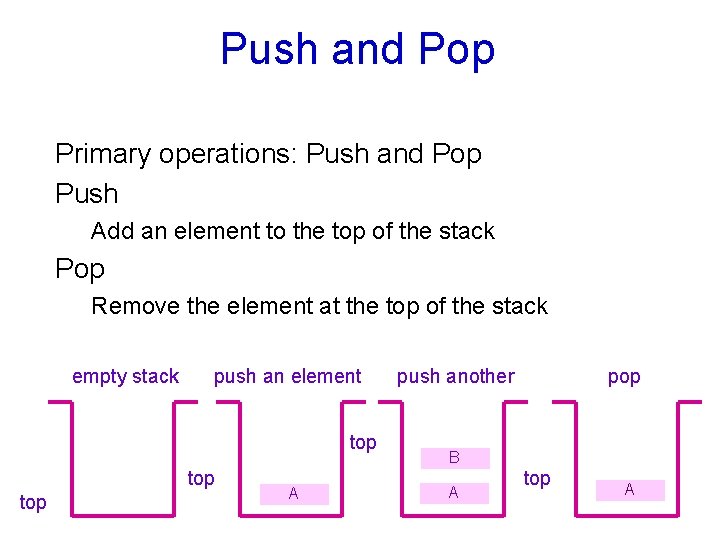
Push and Pop Primary operations: Push and Pop Push Add an element to the top of the stack Pop Remove the element at the top of the stack empty stack push an element top top A push another pop B A top A
Implementation of Stacks Any list implementation could be used to implement a stack arrays (static: the size of stack is given initially) n Linked lists (dynamic: never becomes full) n We will explore implementations based on array
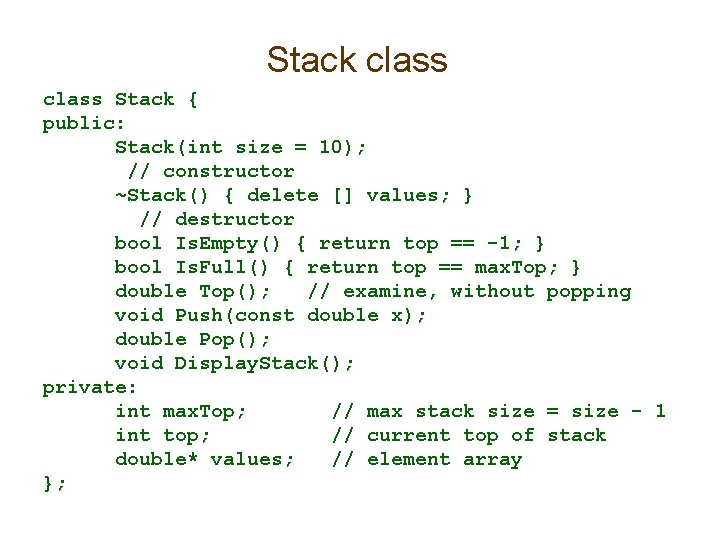
Stack class Stack { public: Stack(int size = 10); // constructor ~Stack() { delete [] values; } // destructor bool Is. Empty() { return top == -1; } bool Is. Full() { return top == max. Top; } double Top(); // examine, without popping void Push(const double x); double Pop(); void Display. Stack(); private: int max. Top; // max stack size = size - 1 int top; // current top of stack double* values; // element array };
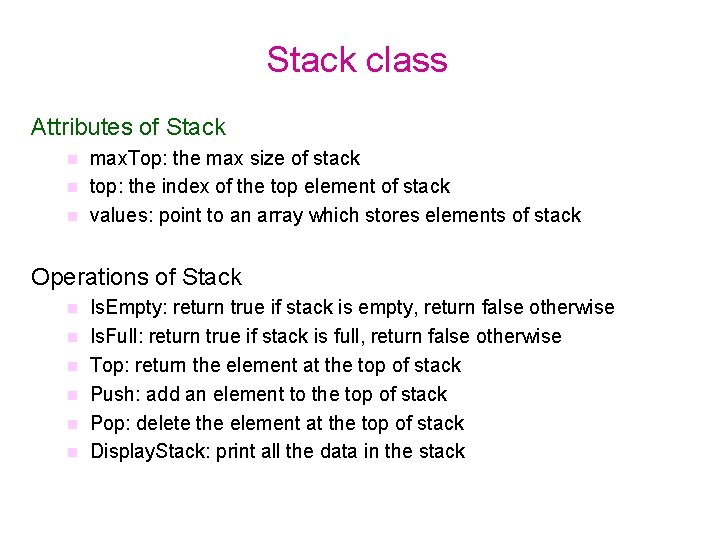
Stack class Attributes of Stack max. Top: the max size of stack n top: the index of the top element of stack n values: point to an array which stores elements of stack n Operations of Stack n n n Is. Empty: return true if stack is empty, return false otherwise Is. Full: return true if stack is full, return false otherwise Top: return the element at the top of stack Push: add an element to the top of stack Pop: delete the element at the top of stack Display. Stack: print all the data in the stack
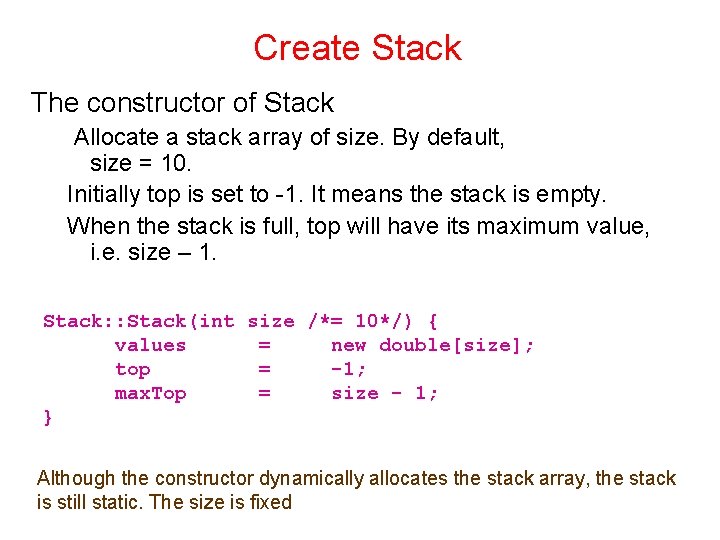
Create Stack The constructor of Stack Allocate a stack array of size. By default, size = 10. Initially top is set to -1. It means the stack is empty. When the stack is full, top will have its maximum value, i. e. size – 1. Stack: : Stack(int size /*= 10*/) { values = new double[size]; top = -1; max. Top = size - 1; } Although the constructor dynamically allocates the stack array, the stack is still static. The size is fixed after the initialization.
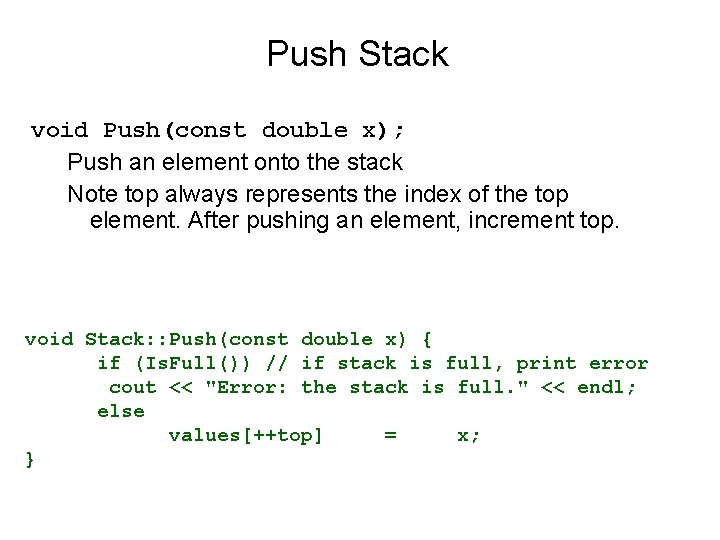
Push Stack void Push(const double x); Push an element onto the stack Note top always represents the index of the top element. After pushing an element, increment top. void Stack: : Push(const double x) { if (Is. Full()) // if stack is full, print error cout << "Error: the stack is full. " << endl; else values[++top] = x; }
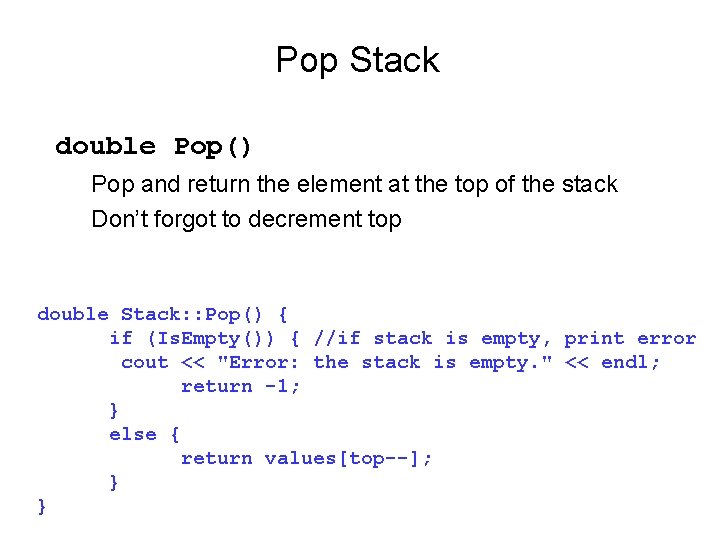
Pop Stack double Pop() Pop and return the element at the top of the stack Don’t forgot to decrement top double Stack: : Pop() { if (Is. Empty()) { //if stack is empty, print error cout << "Error: the stack is empty. " << endl; return -1; } else { return values[top--]; } }
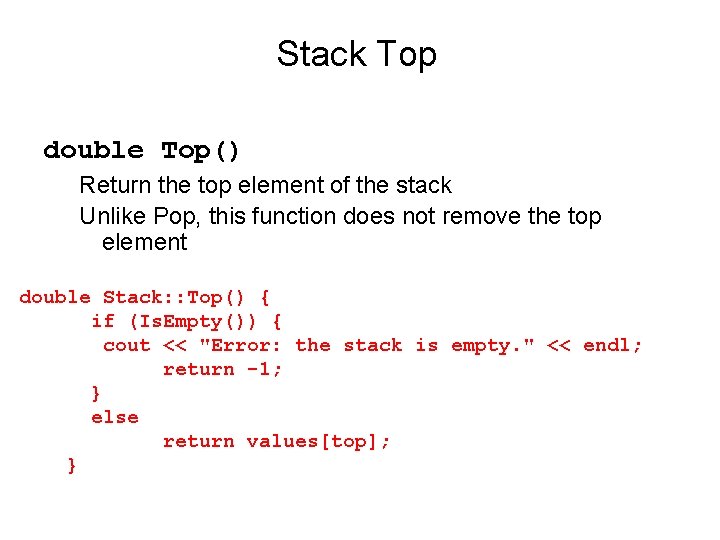
Stack Top double Top() Return the top element of the stack Unlike Pop, this function does not remove the top element double Stack: : Top() { if (Is. Empty()) { cout << "Error: the stack is empty. " << endl; return -1; } else return values[top]; }
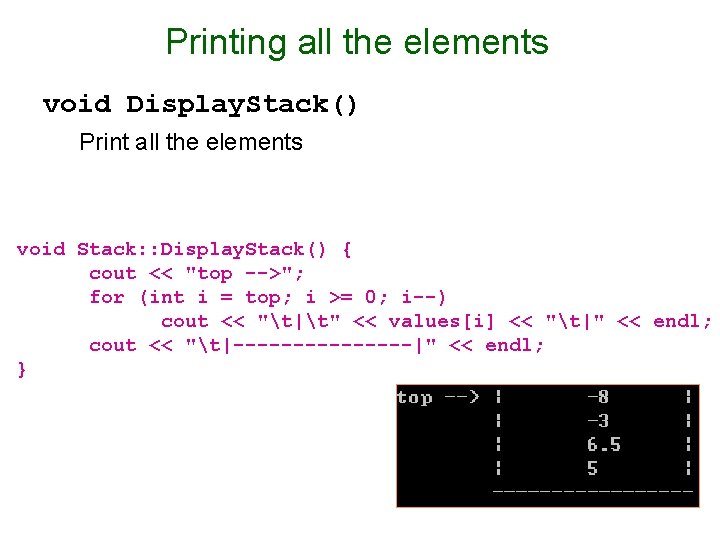
Printing all the elements void Display. Stack() Print all the elements void Stack: : Display. Stack() { cout << "top -->"; for (int i = top; i >= 0; i--) cout << "t|t" << values[i] << "t|" << endl; cout << "t|--------|" << endl; }
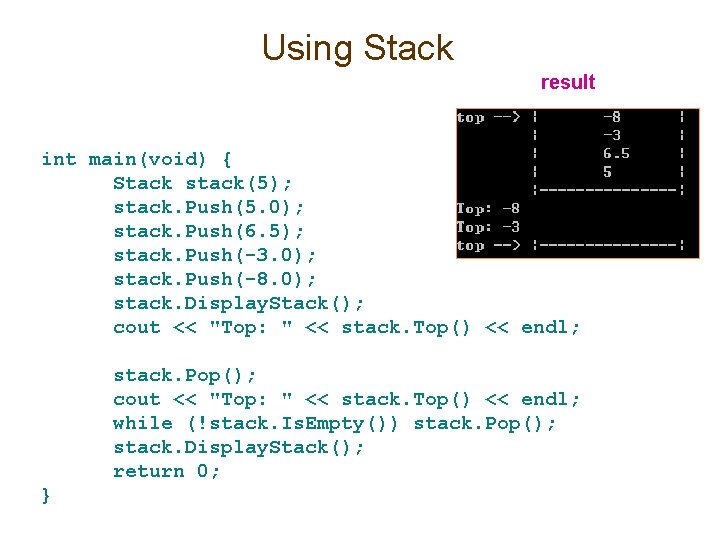
Using Stack result int main(void) { Stack stack(5); stack. Push(5. 0); stack. Push(6. 5); stack. Push(-3. 0); stack. Push(-8. 0); stack. Display. Stack(); cout << "Top: " << stack. Top() << endl; stack. Pop(); cout << "Top: " << stack. Top() << endl; while (!stack. Is. Empty()) stack. Pop(); stack. Display. Stack(); return 0; }
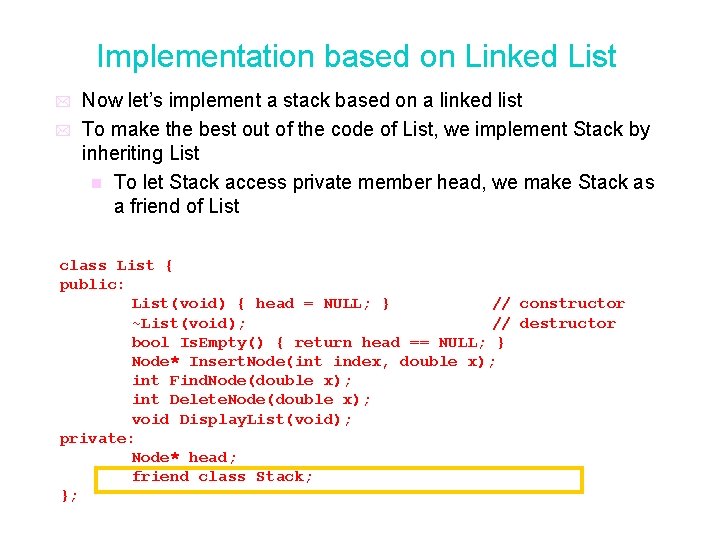
Implementation based on Linked List * * Now let’s implement a stack based on a linked list To make the best out of the code of List, we implement Stack by inheriting List n To let Stack access private member head, we make Stack as a friend of List class List { public: List(void) { head = NULL; } // constructor ~List(void); // destructor bool Is. Empty() { return head == NULL; } Node* Insert. Node(int index, double x); int Find. Node(double x); int Delete. Node(double x); void Display. List(void); private: Node* head; friend class Stack; };
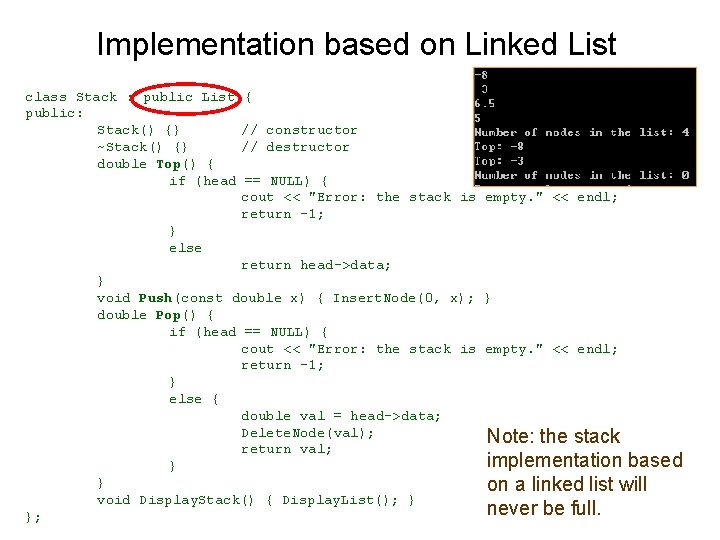
Implementation based on Linked List class Stack : public List public: Stack() {} ~Stack() {} double Top() { if (head { // constructor // destructor == NULL) { cout << "Error: the stack is empty. " << endl; return -1; } else return head->data; } void Push(const double x) { Insert. Node(0, x); } double Pop() { if (head == NULL) { cout << "Error: the stack is empty. " << endl; return -1; } else { double val = head->data; Delete. Node(val); Note: the stack return val; implementation based } } on a linked list will void Display. Stack() { Display. List(); } }; never be full.
Array implementation versus linked list implementations * push, pop, top are all constant-time operations in both array implementation and linked list implementation n For array implementation, the operations are performed in very fast constant time
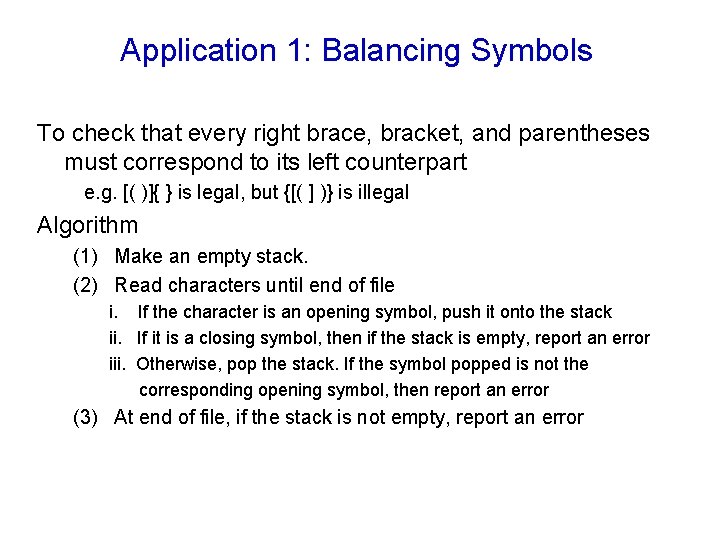
Application 1: Balancing Symbols To check that every right brace, bracket, and parentheses must correspond to its left counterpart e. g. [( )]{ } is legal, but {[( ] )} is illegal Algorithm (1) Make an empty stack. (2) Read characters until end of file i. If the character is an opening symbol, push it onto the stack ii. If it is a closing symbol, then if the stack is empty, report an error iii. Otherwise, pop the stack. If the symbol popped is not the corresponding opening symbol, then report an error (3) At end of file, if the stack is not empty, report an error