
Lecture 6 Export Market Entry Strategies NonExport Mode
- Slides: 25
Lecture 6 Export Market Entry Strategies Non-Export Mode
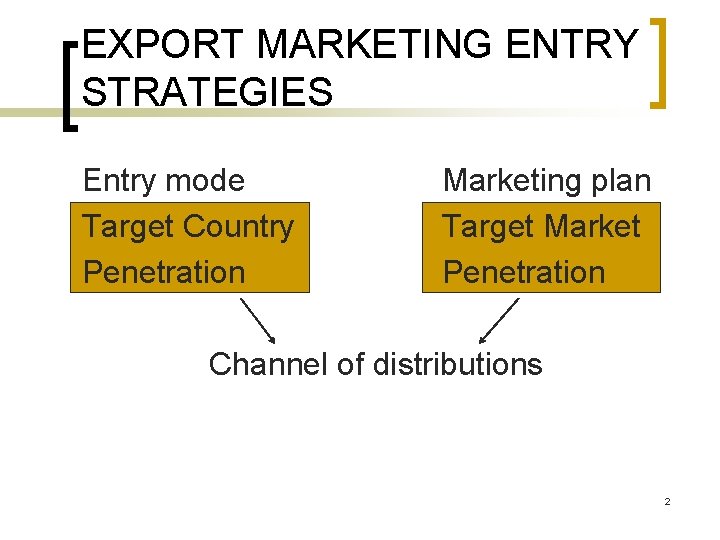
EXPORT MARKETING ENTRY STRATEGIES Entry mode Target Country Penetration Marketing plan Target Market Penetration Channel of distributions 2
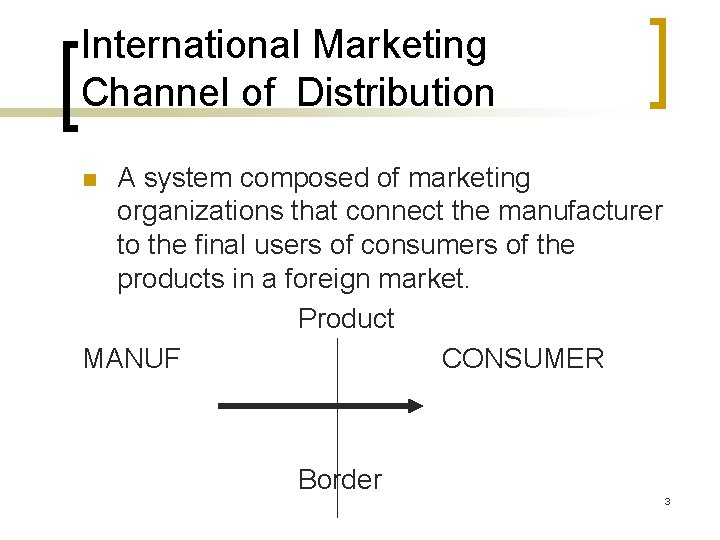
International Marketing Channel of Distribution A system composed of marketing organizations that connect the manufacturer to the final users of consumers of the products in a foreign market. Product MANUF CONSUMER n Border 3
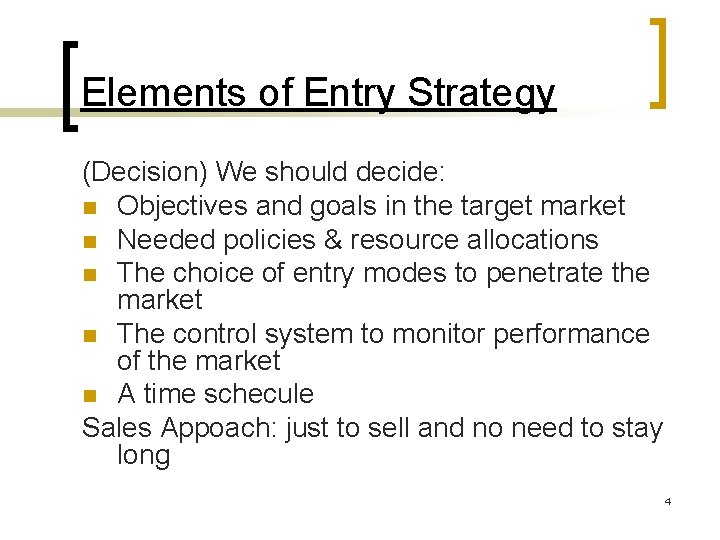
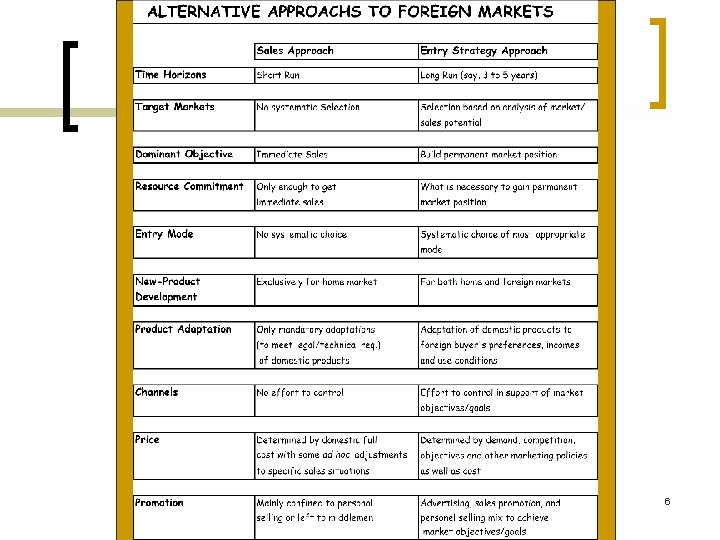
Elements of Entry Strategy (Decision) We should decide: n Objectives and goals in the target market n Needed policies & resource allocations n The choice of entry modes to penetrate the market n The control system to monitor performance of the market n A time schecule Sales Appoach: just to sell and no need to stay long 4
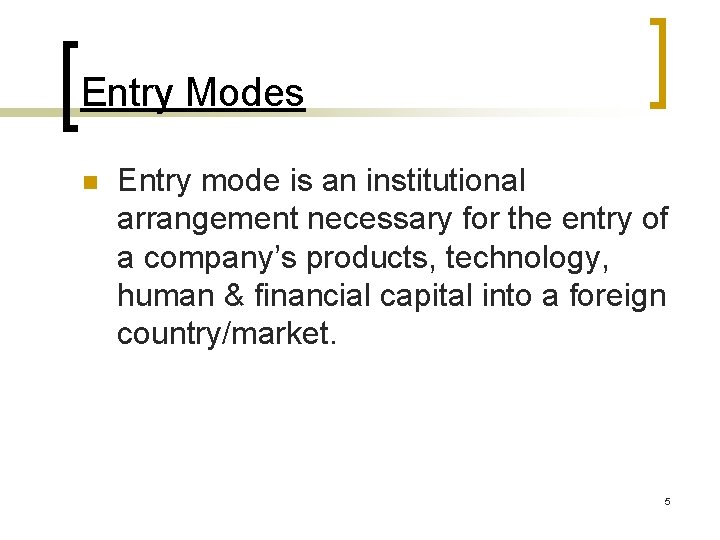
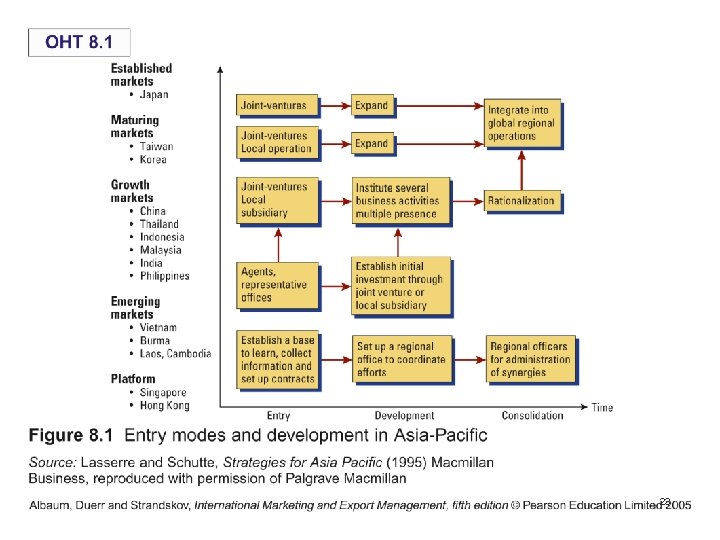
Entry Modes n Entry mode is an institutional arrangement necessary for the entry of a company’s products, technology, human & financial capital into a foreign country/market. 5
6
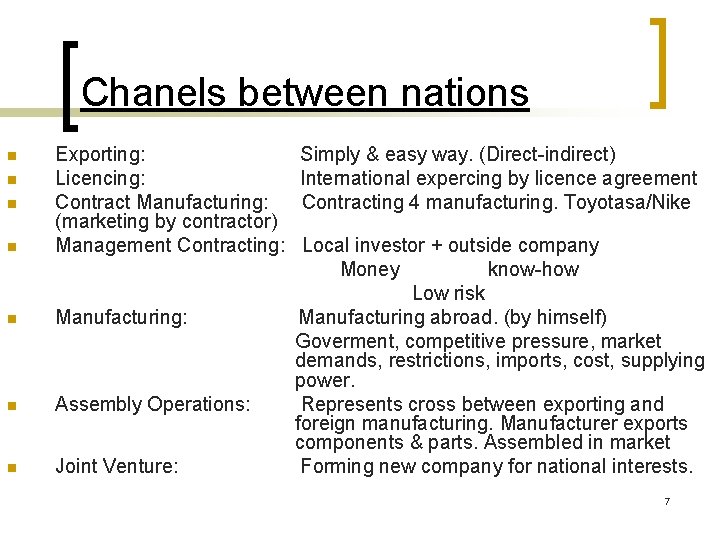
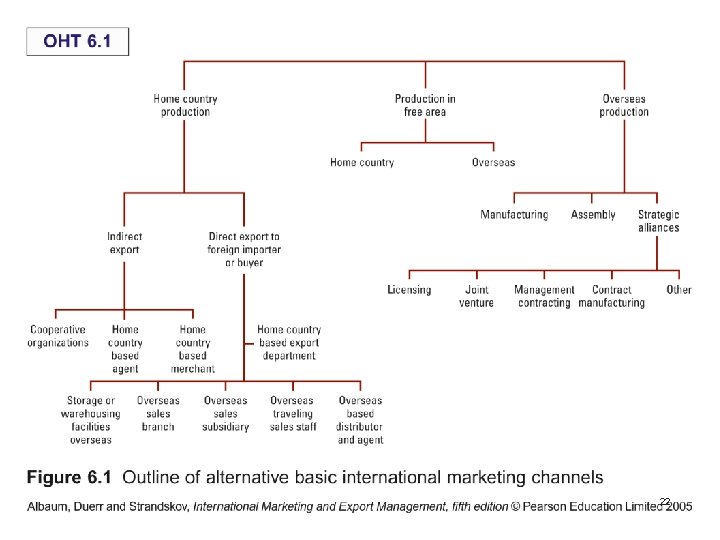
Chanels between nations n Exporting: Licencing: Contract Manufacturing: (marketing by contractor) Management Contracting: n Manufacturing: n Assembly Operations: n Joint Venture: n n n Simply & easy way. (Direct-indirect) International expercing by licence agreement Contracting 4 manufacturing. Toyotasa/Nike Local investor + outside company Money know-how Low risk Manufacturing abroad. (by himself) Goverment, competitive pressure, market demands, restrictions, imports, cost, supplying power. Represents cross between exporting and foreign manufacturing. Manufacturer exports components & parts. Assembled in market Forming new company for national interests. 7
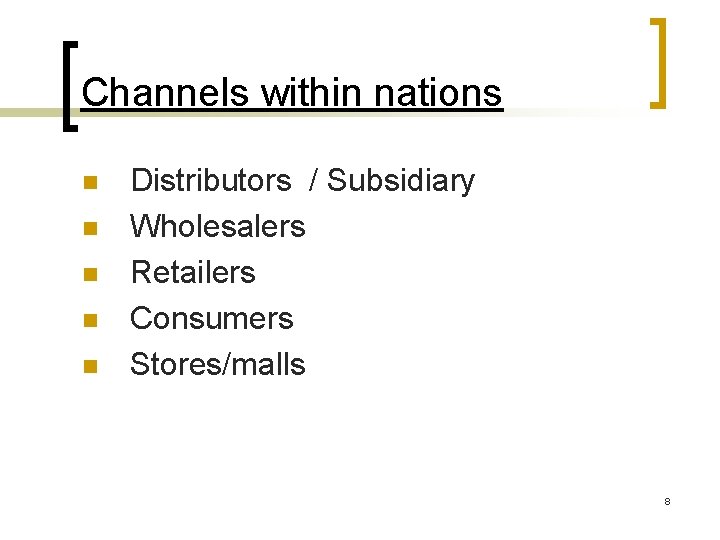
Channels within nations n n n Distributors / Subsidiary Wholesalers Retailers Consumers Stores/malls 8
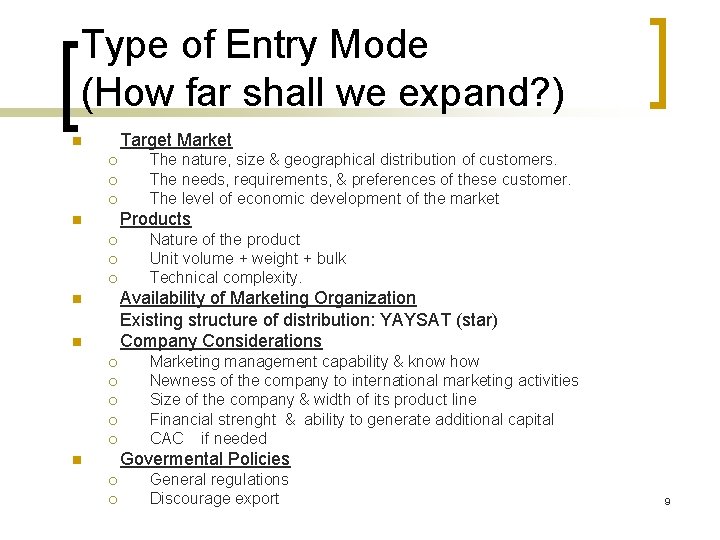
Type of Entry Mode (How far shall we expand? ) Target Market n ¡ ¡ ¡ The nature, size & geographical distribution of customers. The needs, requirements, & preferences of these customer. The level of economic development of the market Products n ¡ ¡ ¡ Nature of the product Unit volume + weight + bulk Technical complexity. Availability of Marketing Organization Existing structure of distribution: YAYSAT (star) Company Considerations n n ¡ ¡ ¡ Marketing management capability & know how Newness of the company to international marketing activities Size of the company & width of its product line Financial strenght & ability to generate additional capital CAC if needed Govermental Policies n ¡ ¡ General regulations Discourage export 9
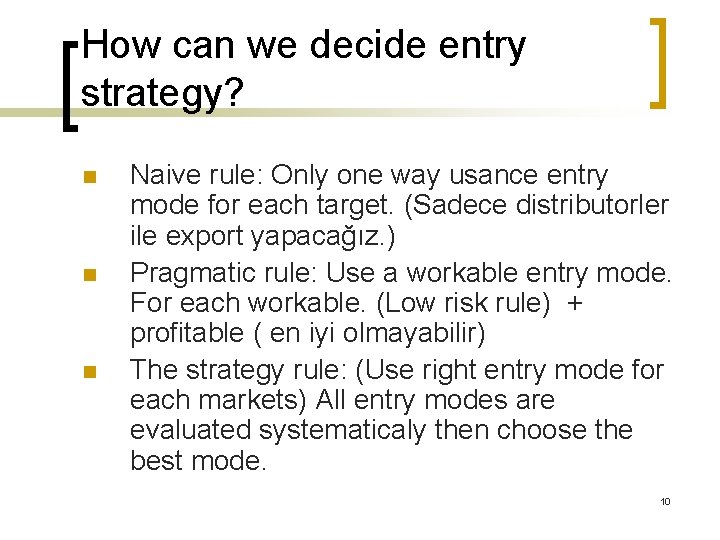
How can we decide entry strategy? n n n Naive rule: Only one way usance entry mode for each target. (Sadece distributorler ile export yapacağız. ) Pragmatic rule: Use a workable entry mode. For each workable. (Low risk rule) + profitable ( en iyi olmayabilir) The strategy rule: (Use right entry mode for each markets) All entry modes are evaluated systematicaly then choose the best mode. 10
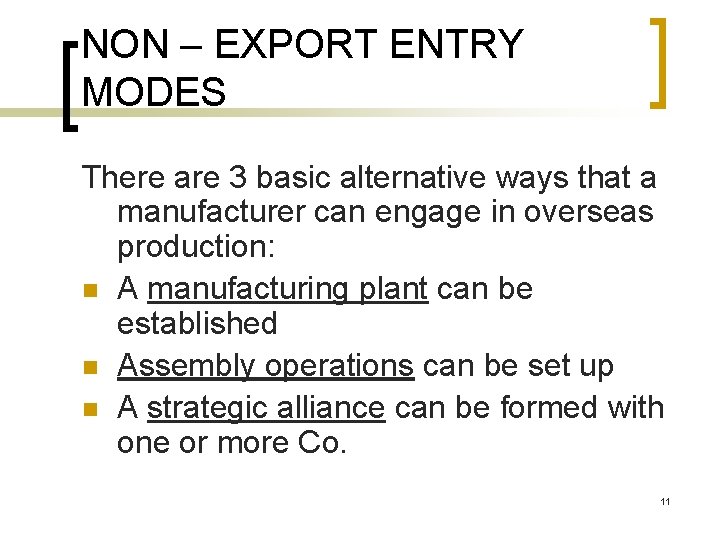
NON – EXPORT ENTRY MODES There are 3 basic alternative ways that a manufacturer can engage in overseas production: n A manufacturing plant can be established n Assembly operations can be set up n A strategic alliance can be formed with one or more Co. 11
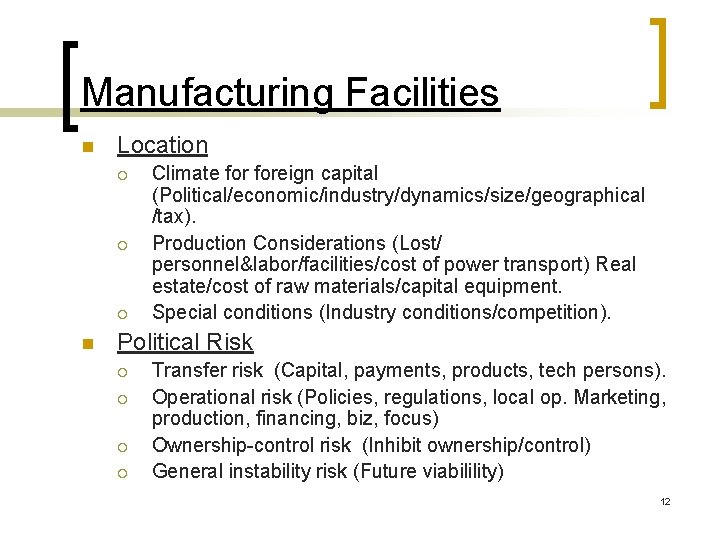
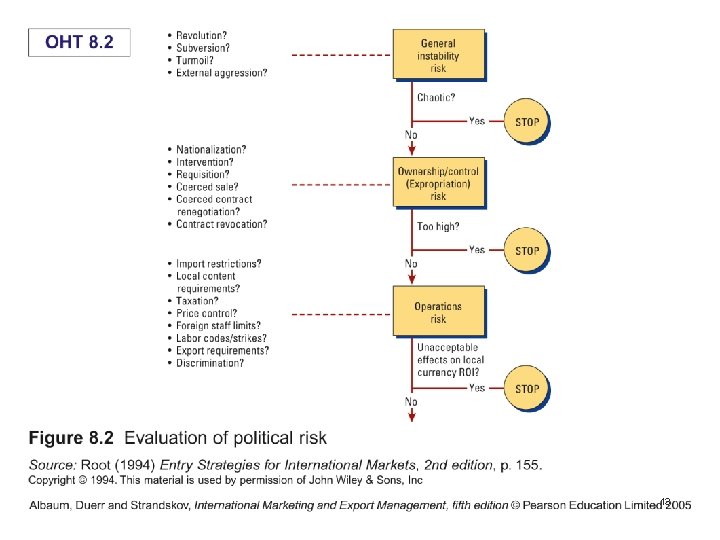
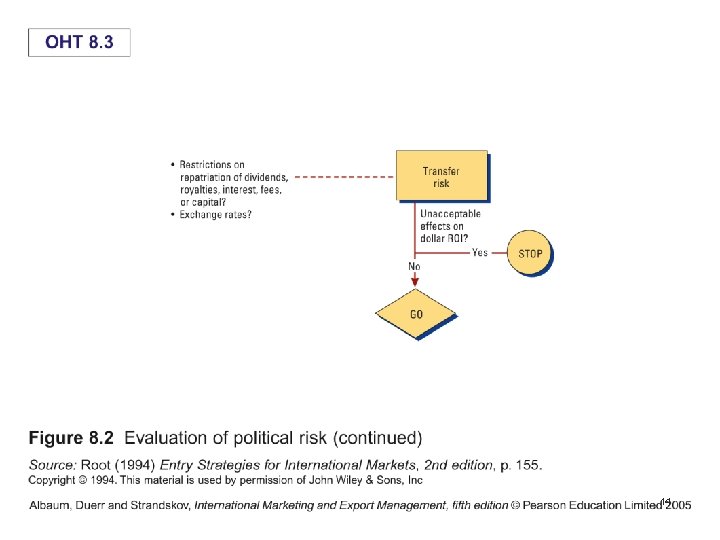
Manufacturing Facilities n Location ¡ ¡ ¡ n Climate foreign capital (Political/economic/industry/dynamics/size/geographical /tax). Production Considerations (Lost/ personnel&labor/facilities/cost of power transport) Real estate/cost of raw materials/capital equipment. Special conditions (Industry conditions/competition). Political Risk ¡ ¡ Transfer risk (Capital, payments, products, tech persons). Operational risk (Policies, regulations, local op. Marketing, production, financing, biz, focus) Ownership-control risk (Inhibit ownership/control) General instability risk (Future viabilility) 12
13
14
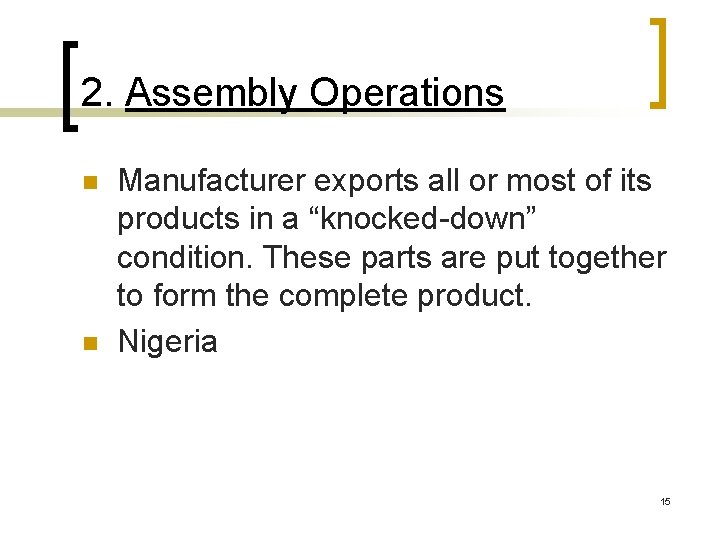
2. Assembly Operations n n Manufacturer exports all or most of its products in a “knocked-down” condition. These parts are put together to form the complete product. Nigeria 15
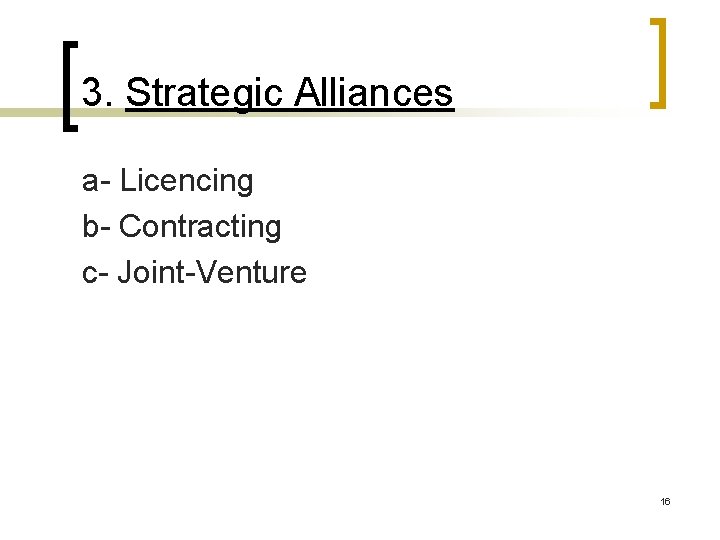
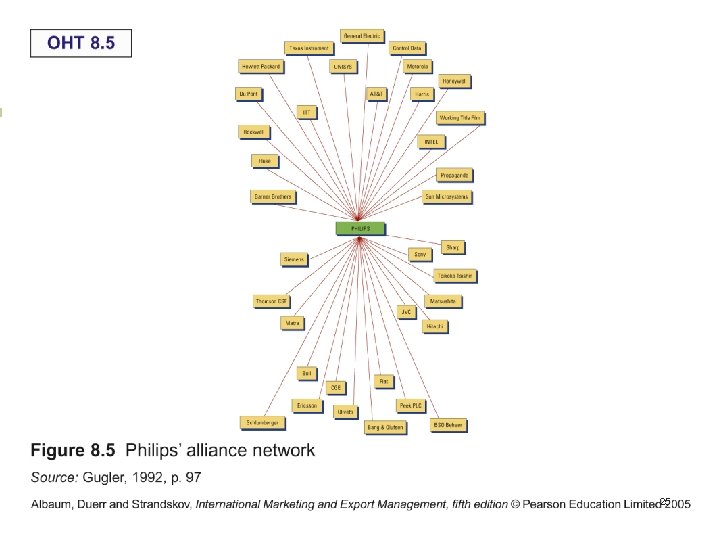
3. Strategic Alliances a- Licencing b- Contracting c- Joint-Venture 16
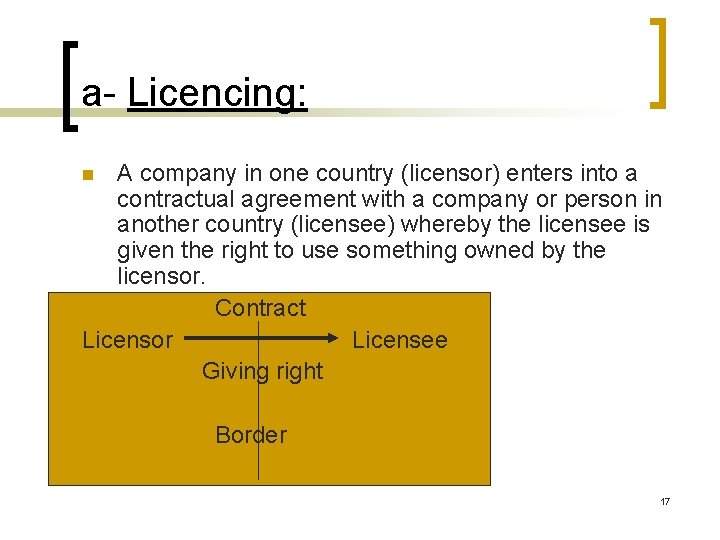
a- Licencing: A company in one country (licensor) enters into a contractual agreement with a company or person in another country (licensee) whereby the licensee is given the right to use something owned by the licensor. Contract Licensor Licensee Giving right n Border 17
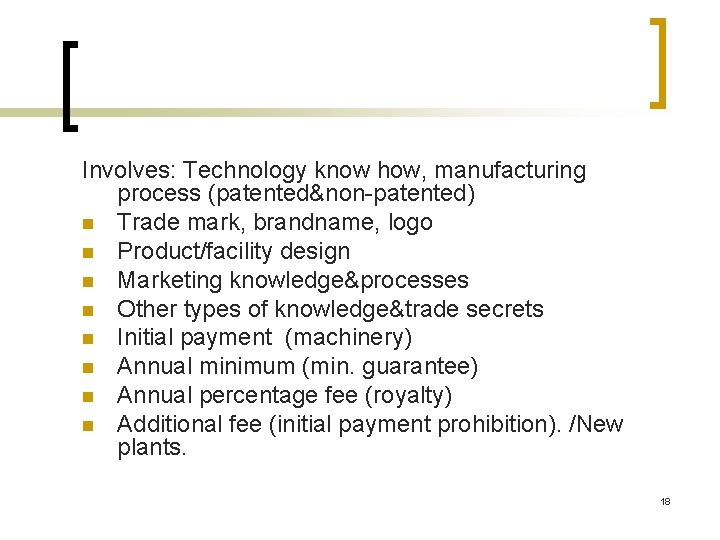
Involves: Technology know how, manufacturing process (patented&non-patented) n Trade mark, brandname, logo n Product/facility design n Marketing knowledge&processes n Other types of knowledge&trade secrets n Initial payment (machinery) n Annual minimum (min. guarantee) n Annual percentage fee (royalty) n Additional fee (initial payment prohibition). /New plants. 18
b- Contract Manufacturing: n Technology transfer + direct investment. (IBM, HP, DE produced by SCI, solectron, menix). 19
Management Contracting: n The local investor provides the capital for enterprise, while the international marketer provides the necessary know -how to manage the company. (Hilton) 20
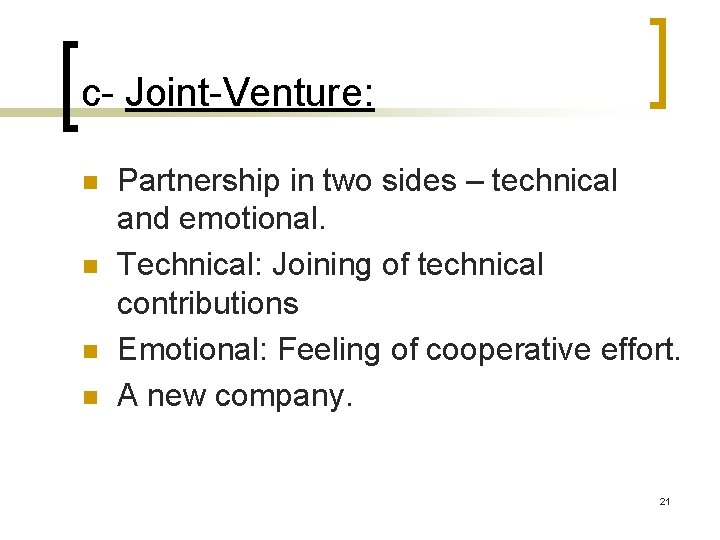
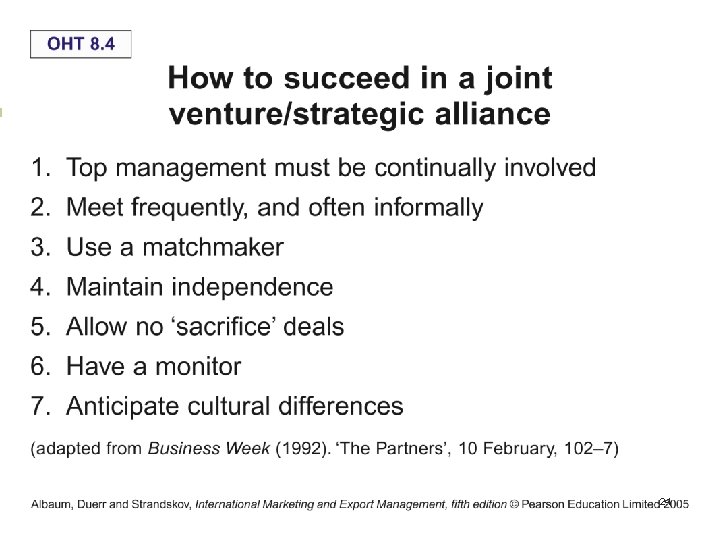
c- Joint-Venture: n n Partnership in two sides – technical and emotional. Technical: Joining of technical contributions Emotional: Feeling of cooperative effort. A new company. 21
22
23
24
25