
Lecture 6 Concept Generation 1 Introduction After identifying




- Slides: 53
Lecture 6 Concept Generation 1
Introduction ¤ After identifying a set of customer needs and establishing target product specifications, we are faced with the following questions: üWhat existing solution concepts, if any, could be successfully adopted for this application? üWhat new concepts might satisfy the established needs and specifications? üWhat methods can be used to facilitate the concept generation process? 2
The Activity of Concept Generation ¤ Product concept is an approximate description of the technology, working principles, and form of the product. ¤ Concept is usually expressed as a sketch or as a rough 3 -D model and a brief textual description ¤ Concept generation activity is not expensive spend adequate time & effort 3
The Activity of Concept Generation ¤ Team will generate hundreds of concepts, of which 5 to 20 will merit serious consideration during the concept selection activity ¤ Explore full space of design alternatives 4
Concept Generation Development Plan Mission Plan Identify Custom er. Needs Establish Target Specificatio ns Generat e Product Concept s Select Product Concept( s) Test Product Concept( s) Set Final Specificatio ns Plan Downstrea m Developme nt Perform Economic Analysis Benchmark Competitive Products Build and Test Models and Prototypes 5
Common dysfunctions during concept generation ¤ Consideration of 1 -2 alternatives (proposed by ¤ ¤ assertive members) Failure to consider usefulness of concepts employed by others firms in related and unrelated products Involvement of only few people Ineffective integration of promising partial solutions. Failure to consider entire categories of solutions. 6
Structured Approaches Reduce the Likelihood of Costly Problems ¤ Guide the team in the thorough exploration of alternatives ¤ Provide a mechanism for integrating partial solutions ¤ Step-by-step procedure for those members of the team who may be less experienced in design-intensive activities 7
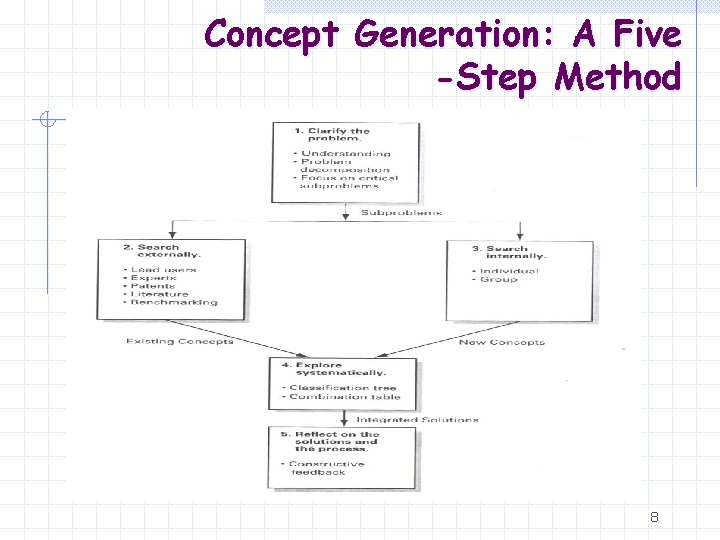
Concept Generation: A Five -Step Method 8
Step 1: Clarify The Problem ¤ Develop a general understanding and then breaking the problem down into subproblems if necessary ¤ The mission statement for the project, customer needs list, and the preliminary product specification are the ideal inputs to the concept generation process 9
Step 1: Clarify The Problem ¤ Example: Challenge was to “design a better handheld nailer” ¤ Some of the assumptions in the team’s mission statement were: ü The nailer will use nails(as opposed to adhesives, screws, etc. ) üThe nailer will be compatible with nail magazines on existing tools. üThe nailer will nail into wood. üThe nailer will be hand held. 10
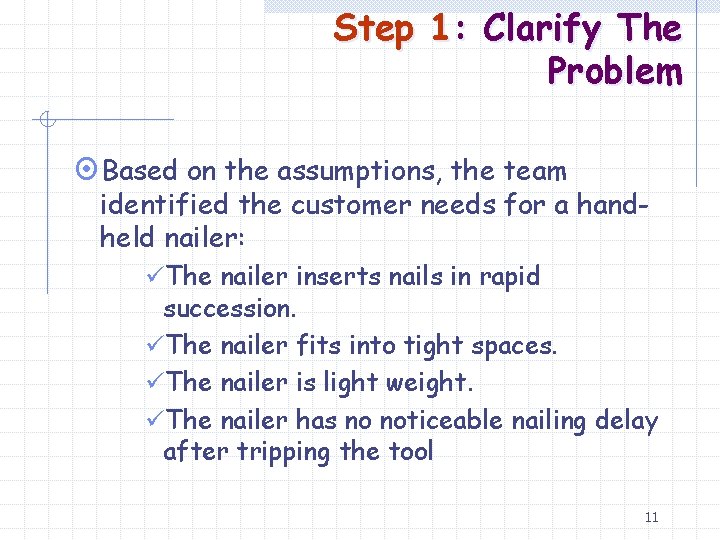
Step 1: Clarify The Problem ¤Based on the assumptions, the team identified the customer needs for a handheld nailer: üThe nailer inserts nails in rapid succession. üThe nailer fits into tight spaces. üThe nailer is light weight. üThe nailer has no noticeable nailing delay after tripping the tool 11
Step 1: Clarify The Problem ¤ Gather supplementary information to clarify and quantify the needs ü such as the approximate energy and speed of the nailing. 12
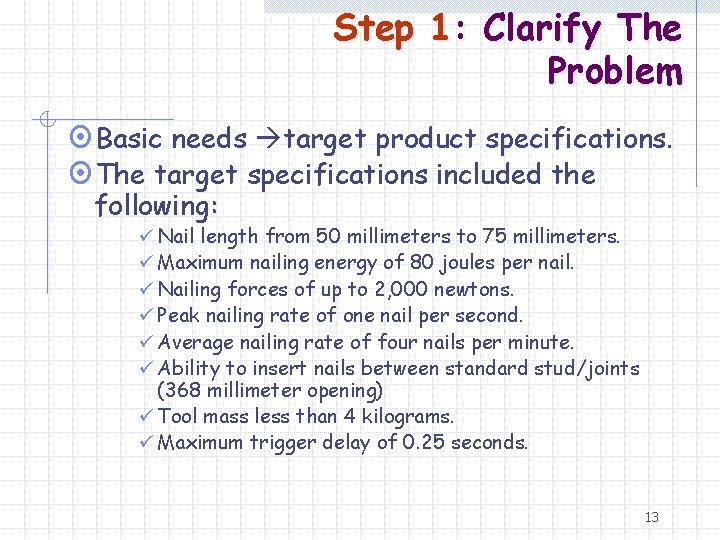
Step 1: Clarify The Problem ¤Basic needs target product specifications. ¤The target specifications included the following: ü Nail length from 50 millimeters to 75 millimeters. ü Maximum nailing energy of 80 joules per nail. ü Nailing forces of up to 2, 000 newtons. ü Peak nailing rate of one nail per second. ü Average nailing rate of four nails per minute. ü Ability to insert nails between standard stud/joints (368 millimeter opening) ü Tool mass less than 4 kilograms. ü Maximum trigger delay of 0. 25 seconds. 13
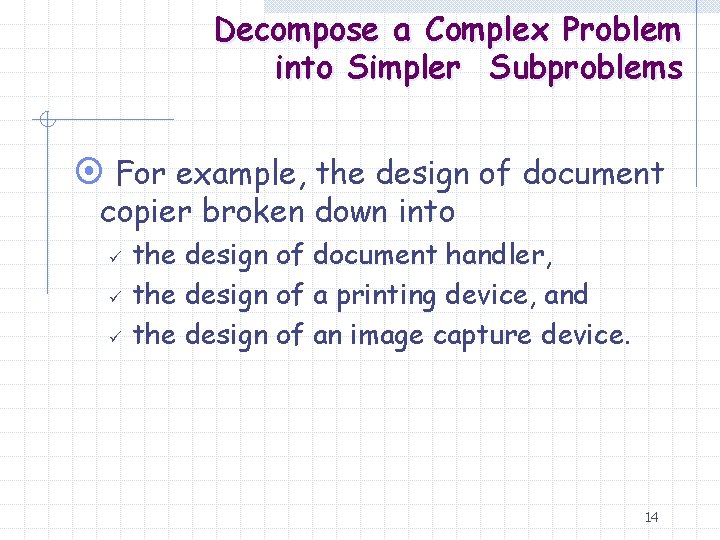
Decompose a Complex Problem into Simpler Subproblems ¤ For example, the design of document copier broken down into ü ü ü the design of document handler, the design of a printing device, and the design of an image capture device. 14
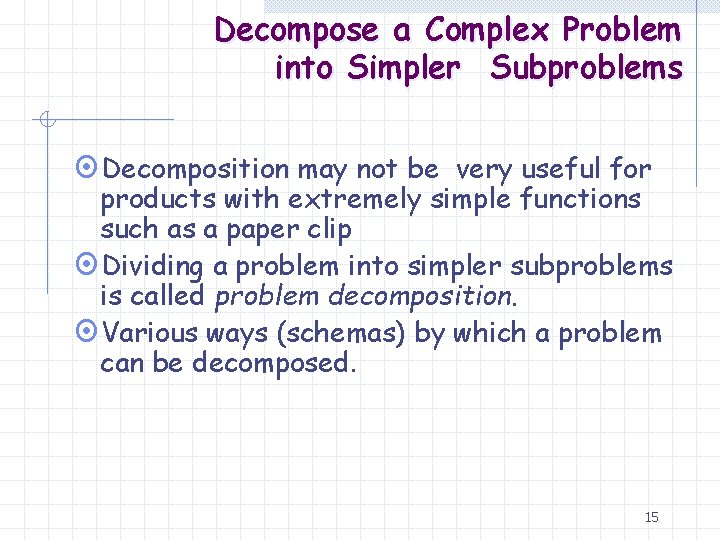
Decompose a Complex Problem into Simpler Subproblems ¤Decomposition may not be very useful for products with extremely simple functions such as a paper clip ¤Dividing a problem into simpler subproblems is called problem decomposition. ¤Various ways (schemas) by which a problem can be decomposed. 15
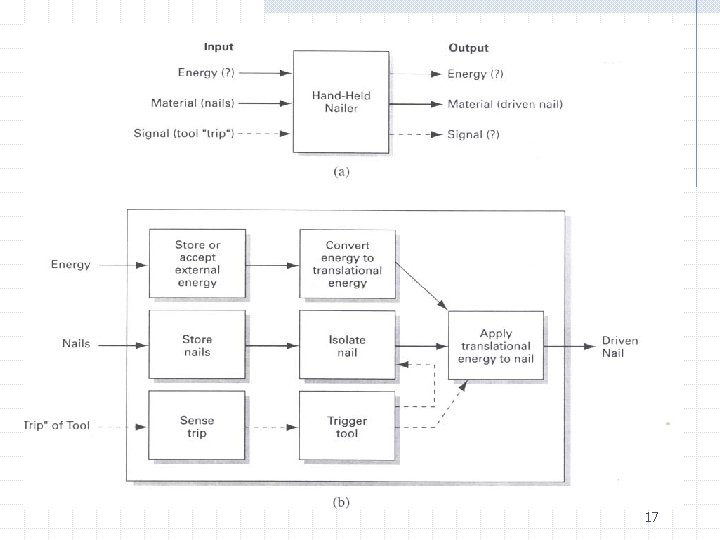
Functional decomposition ¤ Represent the overall function as a single black box operating on material, energy and signal flows ¤ Divide the black box into sub-functions (310 sub-functions) 16
Exhibit 6 -4 17
Functional decomposition ¤ Challenge: to describe the functional elements of the product without implying a specific technological working principle for the product concept. ¤ For example, the subfunction “isolate nail” expressed in such a way that it does not imply any particular physical solution concept, such as indexing the “stick” of nails into a slot or breaking a nail sideways off the stick. 18
Functional decomposition ¤Note that the function diagram is typically non unique. ¤Create several drafts and then work to refine them into a single diagram that the team is comfortable with. 19
Functional decomposition ¤If the material, energy, and signal flows are difficult to identify: A simple list of the subfunctions of the product, without connections between them, is often sufficient. ¤Functional decomposition is most applicable to technical products, but it can also be applied to simple and apparently nontechnical products. For example, an ice cream being separated, formed, transported, and deposited. 20
Decomposition by sequence of user actions ¤For example, the nailer problem might be broken down into three user actions: ü ü ü moving the tool to the gross nailing position, positioning the tool precisely, triggering the tool. ¤This approach is often useful for products with very simple technical functions involving a lot of user interaction. 21
Decomposition by key customer needs ¤ For the nailer, this decomposition might include the following subproblems: ü ü ü fires nails in rapid succession, fits in tight places, has a large nail capacity. ¤ This approach is often useful for products in which form, and not working principles or technology, is the primary problem. Examples of such products include toothbrushes (assuming the basic brush concept is retained) and storage containers. 22
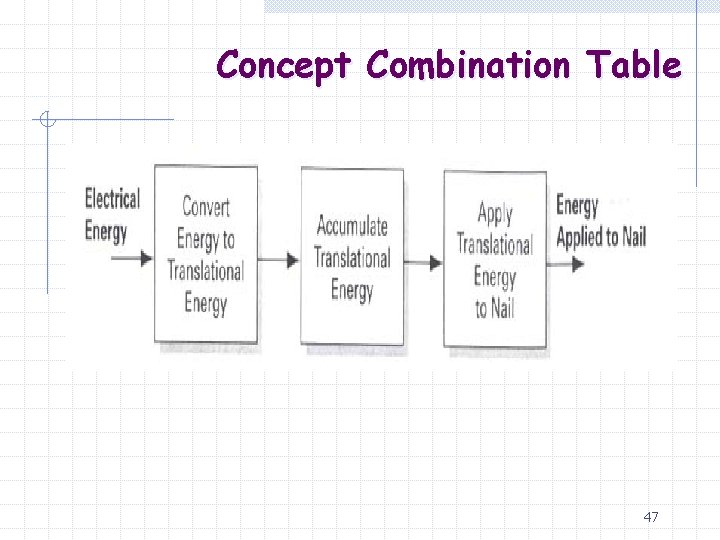
Focus Initial Efforts on the Critical Subproblems ¤ For example, the nailer team chose to focus on the subproblems of storing/accepting energy, converting the energy to transnational energy, and applying the transnational energy and nail 23
Step 2: Search Externality ¤External search is aimed at finding existing solutions to both overall problem and to the sub problems identified during the problem clarification step. ¤External search occurs continually throughout the development process. 24
Step 2: Search Externally ¤There at least five good ways to gather information from external sources: lead user interviews, expert consultation, patent searches, literature searches, and competitive benchmarking. 25
Interview Lead Users ¤Lead users are those users of a product who experience needs months or years before the majority of the market and stand to benefit substantially from a product innovation. Frequently these lead users will have already invented solutions to meet their needs. 26
Interview Lead Users ¤In the hand-held nailer case, the nailer team consulted with the building contractors from the BPS television series This Old House in order to solicit new concepts. ¤These lead users, who are exposed to tools from many manufacturers, made many observations about the weakness in existing tools, but in this case did not provide many new product concepts. 27
Consult Experts ¤Experts may include professionals at firms manufacturing related products, professional consultants, university faculty, and technical representatives of suppliers. ¤A good habit to develop is to always ask people consulted to suggest others who should be contacted. Best information often comes from pursuing these “second generation” leads 28
Search Patents ¤Patents are a rich and readily available source of technical information containing detailed drawings and explanations of how many products work. ¤Main disadvantage of patent searches is that concepts found in recent patents are protected (generally for 20 years from date of the patent application), so there may be a royalty involved in using them. 29
Search Patents ¤Concepts contained in foreign patents without global coverage and in expired patents can be used without payment of royalties. 30
Search Published Literature ¤Published literature includes journals: conference proceeding; trade magazines; government reports; and new product announcements ¤Electronic searches the most efficient ¤Examples: Mark’s Standard Handbook of Mechanical Engineering, Perry’s Chemical Engineer’s Handbook, and Mechanisms and Mechanical Devices Sourcebook 31
Benchmark Related Products ¤Benchmarking can reveal existing concepts that ü ü have been implemented to solve a particular problem information on the strength and weakness of the competition ¤Useful source: Thomas Register of American Manufacturers, a directory of manufacturers of industrial products organized by product type 32
Benchmark Related Products ¤For the nailer, ü the closely related products included a single-shut gunpowder-actuated tool for nailing into concrete, an electrical solenoid-actuated tacker, a pneumatic nailer for factory use, and a palm-held multiblow pneumatic nailer. 33
Benchmark Related Products ¤Team obtained and disassembled most of these related products ü ü to discover the general concepts on which they were based to get the names of the suppliers of specific components. 34
Step 3: Search Internally ¤ Use of personal and team knowledge and ¤ 1. 2. 3. 4. creativity to generate solution concepts. Four guidelines are useful for improving both individual and group internal search: Suspend Judgment Generate a lot of ideas Welcome ideas that may seem infeasible Use graphical and physical media 35
Both Individual and Group Sessions Can Be Useful ¤Formal studies of group and individual problem solving suggest that a set of people working alone for a period of time will generate more and better concepts than the same people working together for the same time period. 36
Hints for Generating Solution Concepts ¤Make analogues. what other devices solve a related problem; Think of a natural or biological analogy to the problem ¤Wish and Wonder. Beginning a thought or comment with “ I wish we could…” or “I wonder what would happen if…. ” helps to stimulate oneself or the group to consider new possibilities. 37
Hints for Generating Solution Concepts ¤Use related stimuli. Most individuals can think of a new idea when presented with a new stimulus. For example, one way to use related stimuli is for each individual in a group session to generate a list of ideas(working alone) and then pass the list to his or her neighbor. ¤Use unrelated stimuli. Occasionally random or unrelated stimuli can be effective in encouraging new ideas. 38
Hints for Generating Solution Concepts ¤Set quantitative goals. Have quantitative targets of 10 to 20 concepts. ¤Use gallery method. The gallery method is a way to display a large number of concepts simultaneously for discussion. Sketches, usually one concept to a sheet are taped or pinned to the walls of the meeting room. 39
Hints for Generating Solution Concepts ¤In the 1990 s a Russian Problem-solving methodology called TRIZ (A Russian acronym for theory of inventive problem solving) began to be disseminated in the United States. ¤The methodology is primarily useful in identifying physical working principles to solving technical problems. The key idea underlying TRIZ is to identify a contradiction that is implicit in a problem. 40
Step 4: Explore Systematically ¤As a result of external and internal search activities, the team will have collected tens or hundreds of concepts fragments – solutions to the subproblems. ¤Systematic exploration: navigating the space of possibilities by organizing and synthesizing these solution fragments. 41
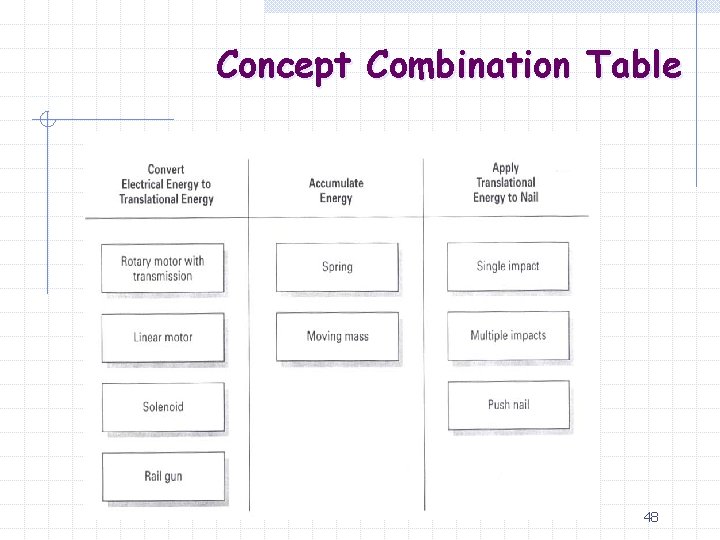
Step 4: Explore Systematically ¤Given 3 subproblems & average of 15 fragments for each subproblem, the team would have to consider 3, 375 combinations of fragments (15 x 15). ¤There are two specific tools for managing this complexity and organizing the thinking of the team: the concept classification tree and concept combination table 42
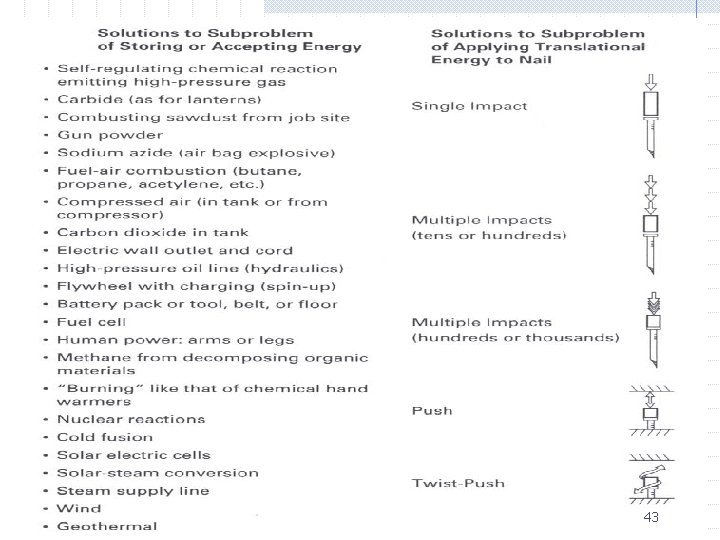
Exhibit 6 -6 43
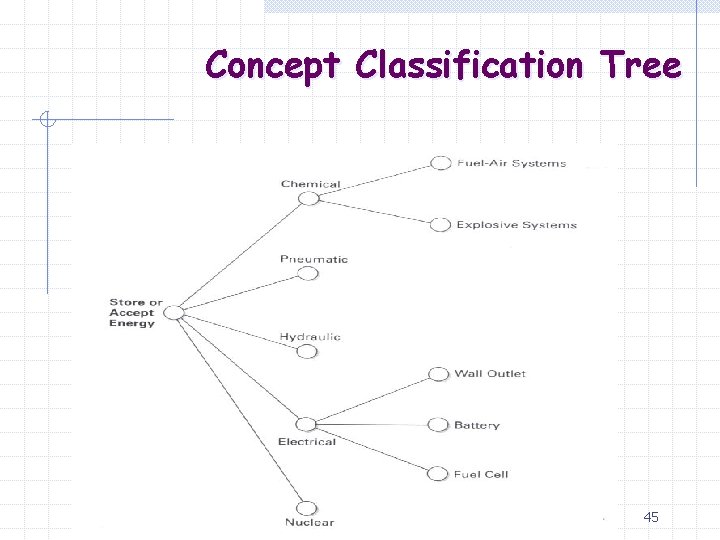
Concept Classification Tree ¤ Divide the entire space of possible solutions into several distinct classes which will facilitate comparison and pruning 44
Concept Classification Tree 45
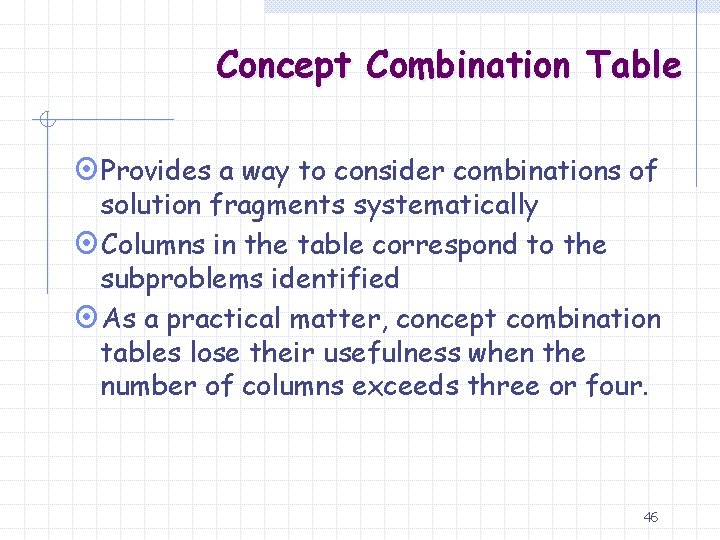
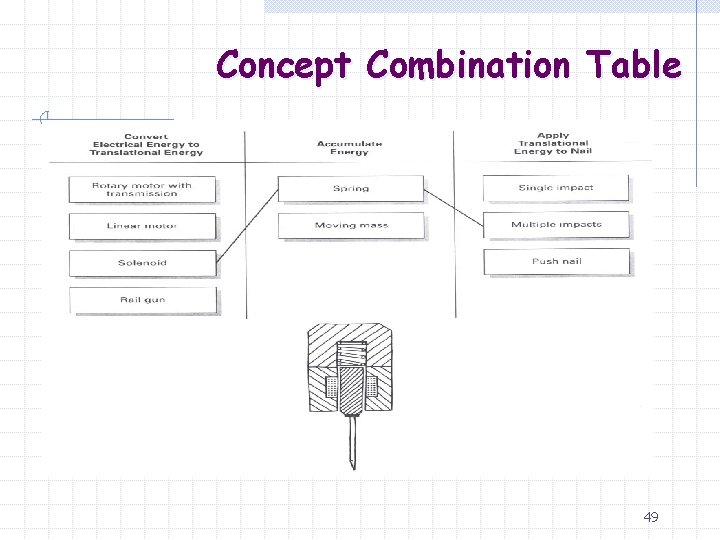
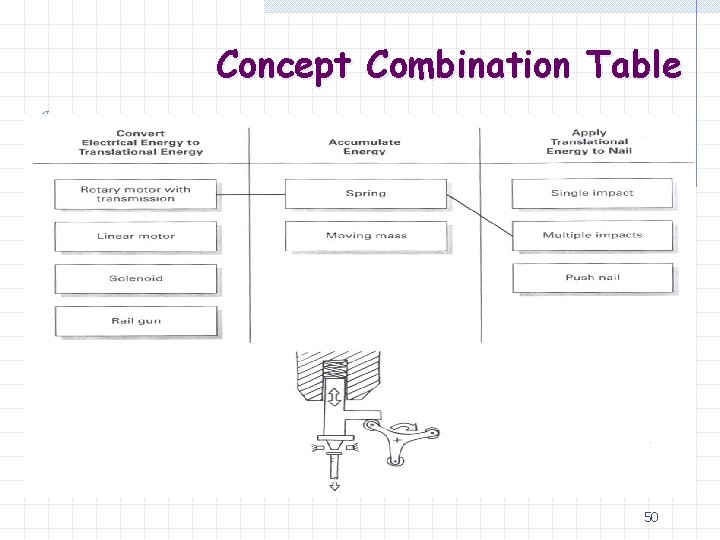
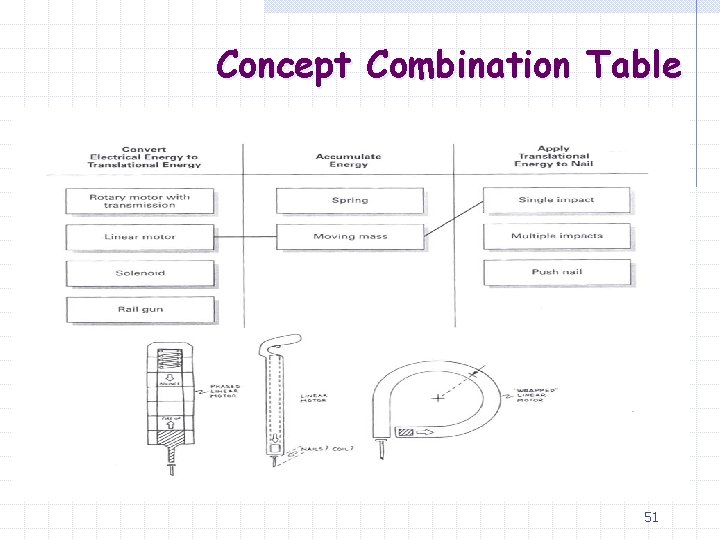
Concept Combination Table ¤Provides a way to consider combinations of solution fragments systematically ¤Columns in the table correspond to the subproblems identified ¤As a practical matter, concept combination tables lose their usefulness when the number of columns exceeds three or four. 46
Concept Combination Table 47
Concept Combination Table 48
Concept Combination Table 49
Concept Combination Table 50
Concept Combination Table 51
Managing the Exploration Process ¤Rarely do teams generate only one classification tree and one concept combination table. ¤More typically the team will create several alternative classification trees and several concept combination tables. 52
Step 5: Reflect on the Results and the Process ¤Team confidence that the solution space has been fully explored? ¤ Alternative functions diagrams? ¤Alternative ways to decompose the problem? ¤External sources been thoroughly pursued? ¤Have ideas from everyone been accepted and integrated in the process? 53