
Lecture 6 Chemical Reaction Engineering CRE is the
- Slides: 23
Lecture 6 Chemical Reaction Engineering (CRE) is the field that studies the rates and mechanisms of chemical reactions and the design of the reactors in which they take place.
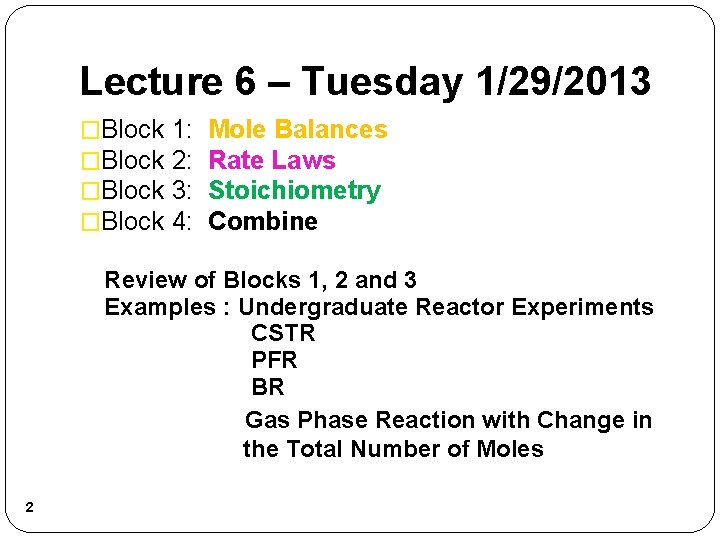
Lecture 6 – Tuesday 1/29/2013 �Block 1: 2: 3: 4: Mole Balances Rate Laws Stoichiometry Combine Review of Blocks 1, 2 and 3 Examples : Undergraduate Reactor Experiments CSTR PFR BR Gas Phase Reaction with Change in the Total Number of Moles 2
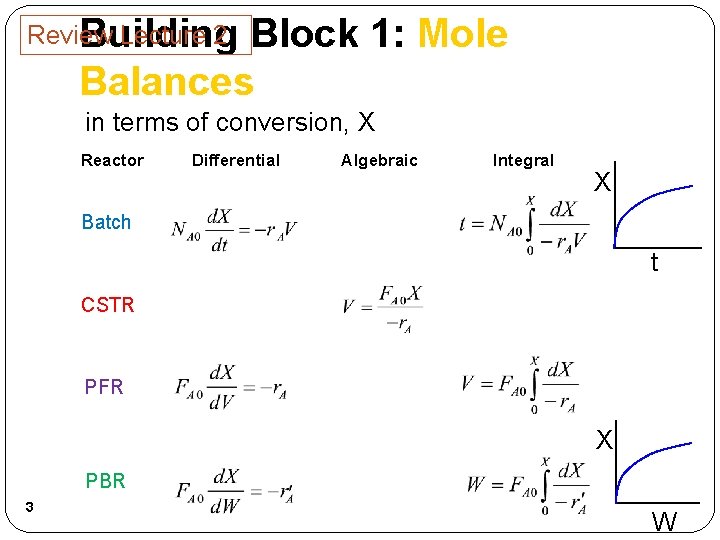
Review Lecture 2 Building Block 1: Mole Balances in terms of conversion, X Reactor Differential Algebraic Integral X Batch t CSTR PFR X PBR 3 W
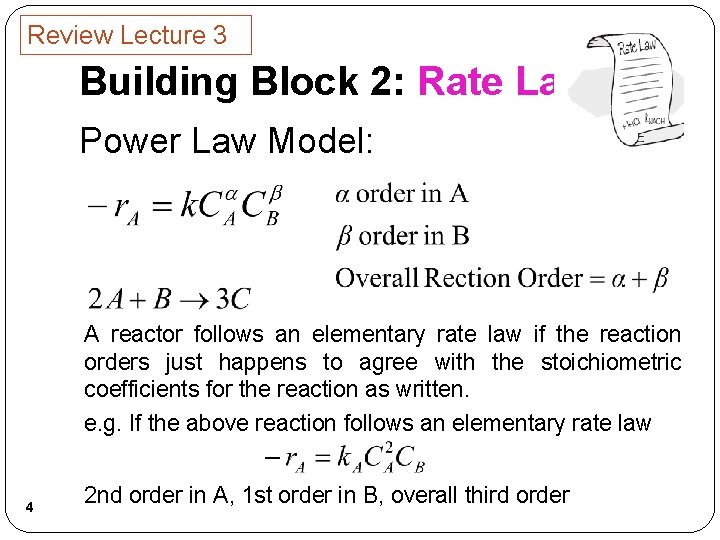
Review Lecture 3 Building Block 2: Rate Laws Power Law Model: A reactor follows an elementary rate law if the reaction orders just happens to agree with the stoichiometric coefficients for the reaction as written. e. g. If the above reaction follows an elementary rate law 4 2 nd order in A, 1 st order in B, overall third order
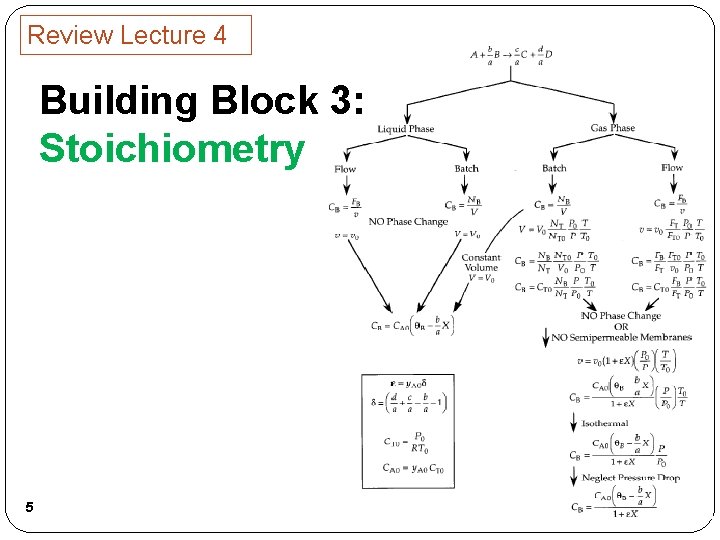
Review Lecture 4 Building Block 3: Stoichiometry 5
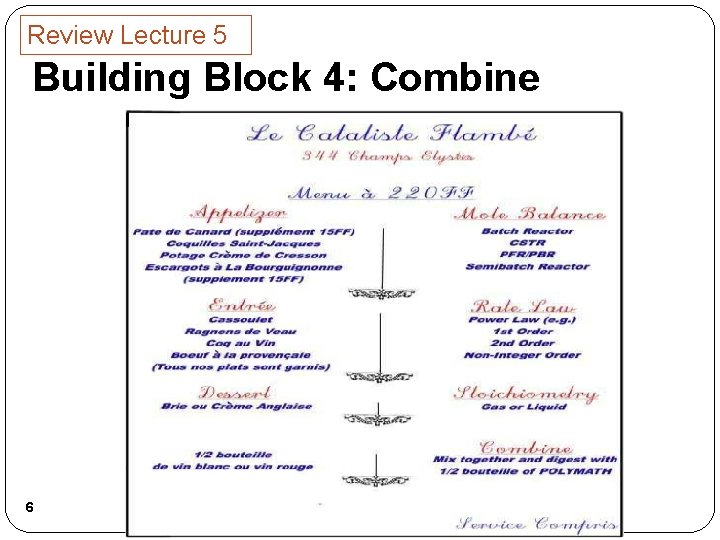
Review Lecture 5 Building Block 4: Combine 6
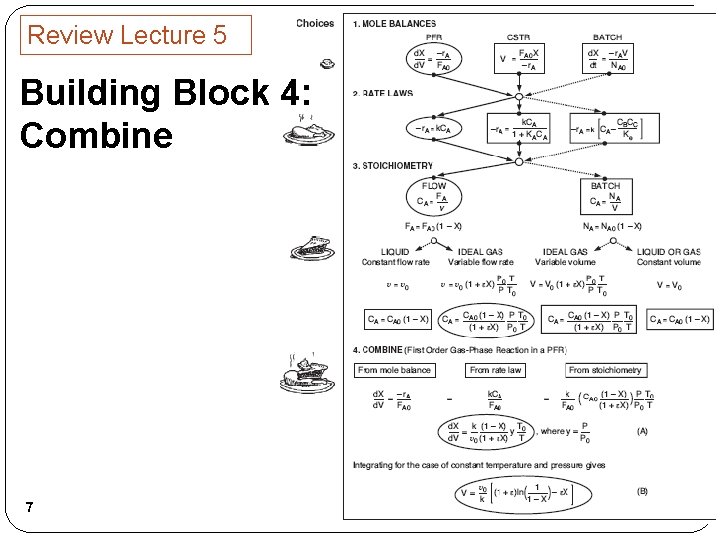
Review Lecture 5 Building Block 4: Combine 7
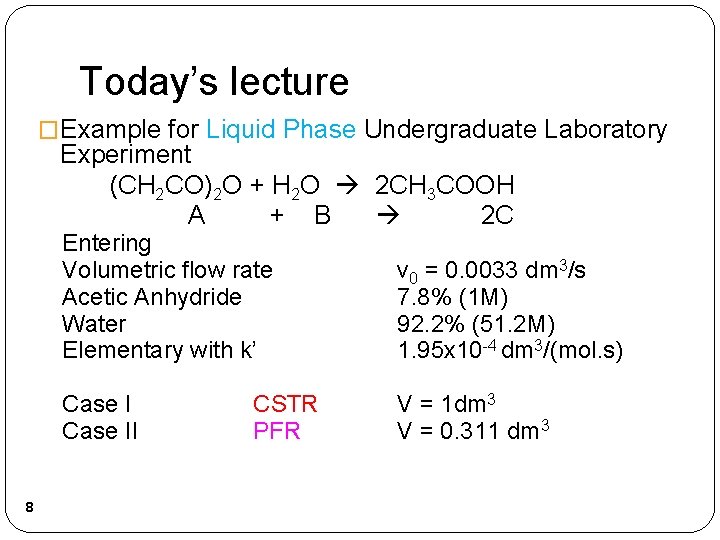
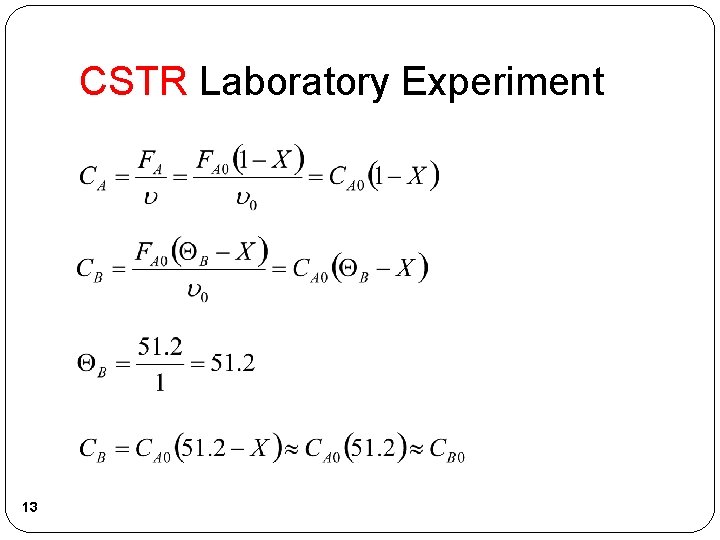
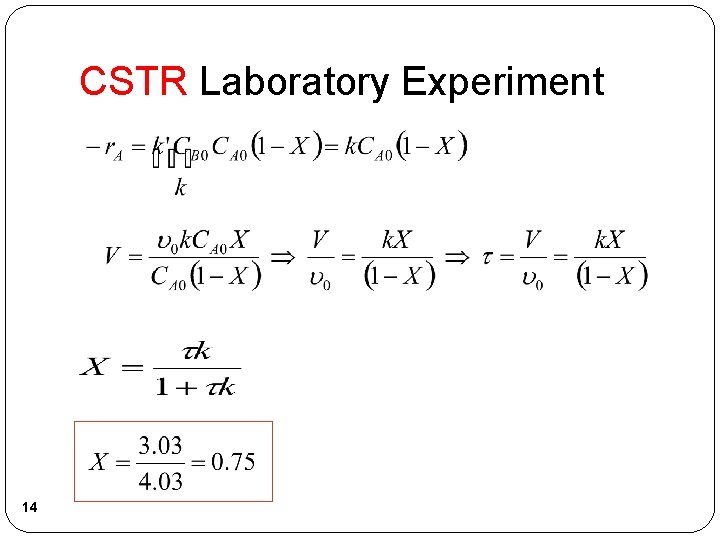
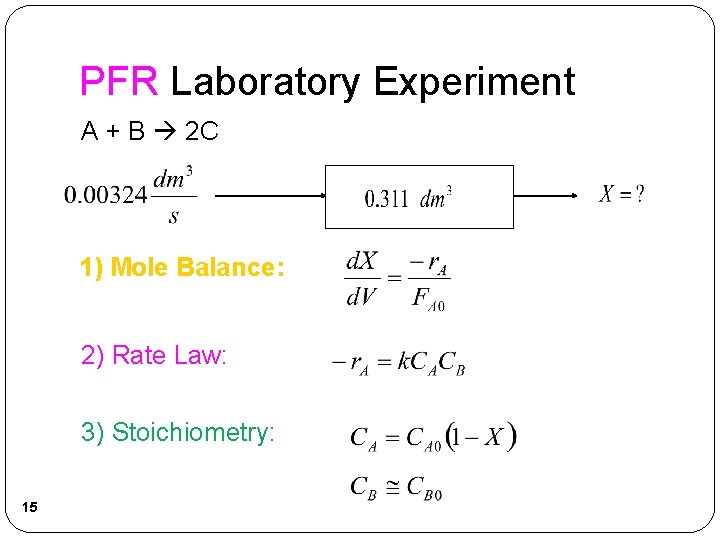
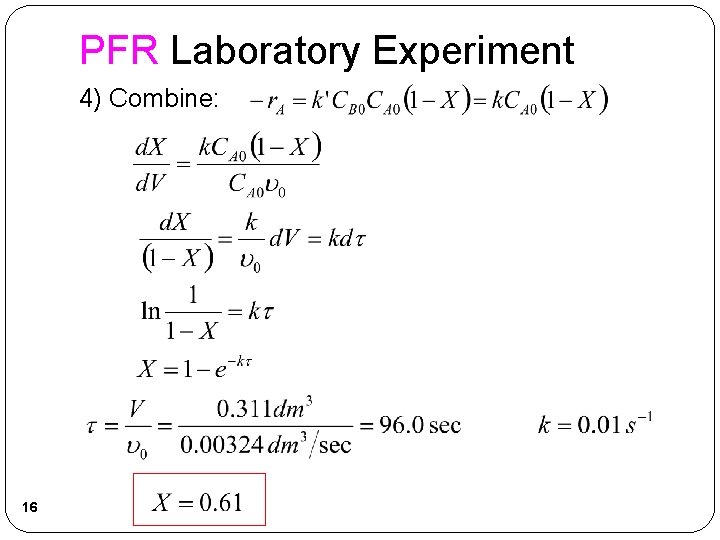
Today’s lecture �Example for Liquid Phase Undergraduate Laboratory Experiment (CH 2 CO)2 O + H 2 O 2 CH 3 COOH A + B 2 C 8 Entering Volumetric flow rate Acetic Anhydride Water Elementary with k’ v 0 = 0. 0033 dm 3/s 7. 8% (1 M) 92. 2% (51. 2 M) 1. 95 x 10 -4 dm 3/(mol. s) Case II V = 1 dm 3 V = 0. 311 dm 3 CSTR PFR
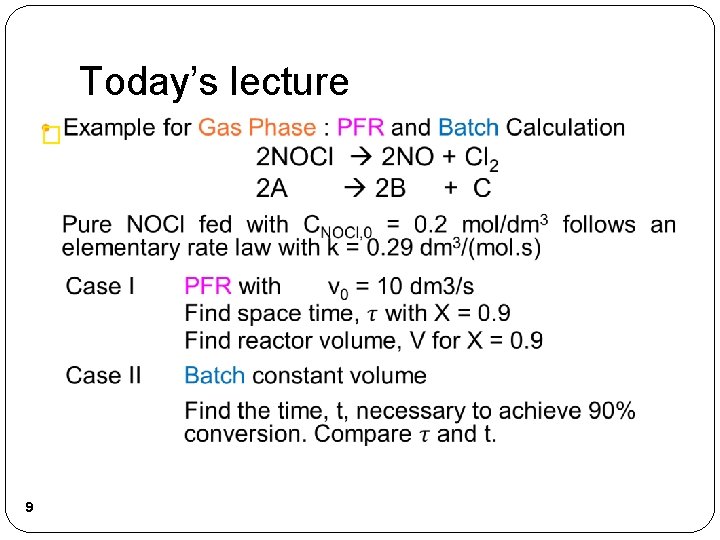
Today’s lecture � 9
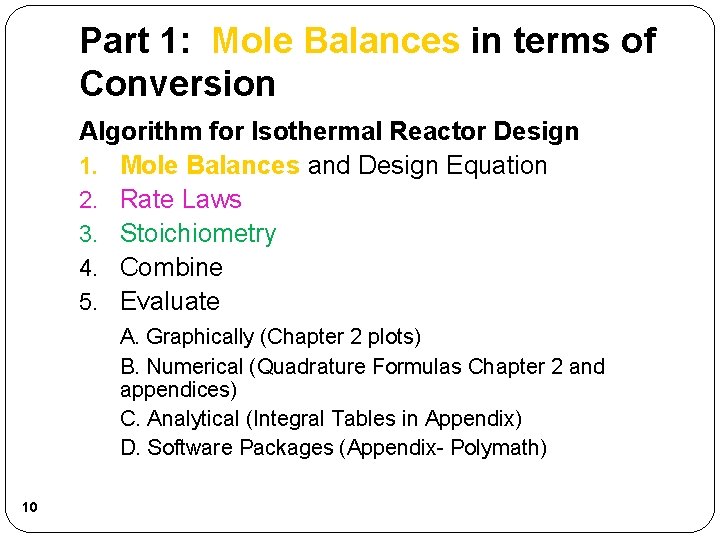
Part 1: Mole Balances in terms of Conversion Algorithm for Isothermal Reactor Design 1. Mole Balances and Design Equation 2. Rate Laws 3. Stoichiometry 4. Combine 5. Evaluate A. Graphically (Chapter 2 plots) B. Numerical (Quadrature Formulas Chapter 2 and appendices) C. Analytical (Integral Tables in Appendix) D. Software Packages (Appendix- Polymath) 10
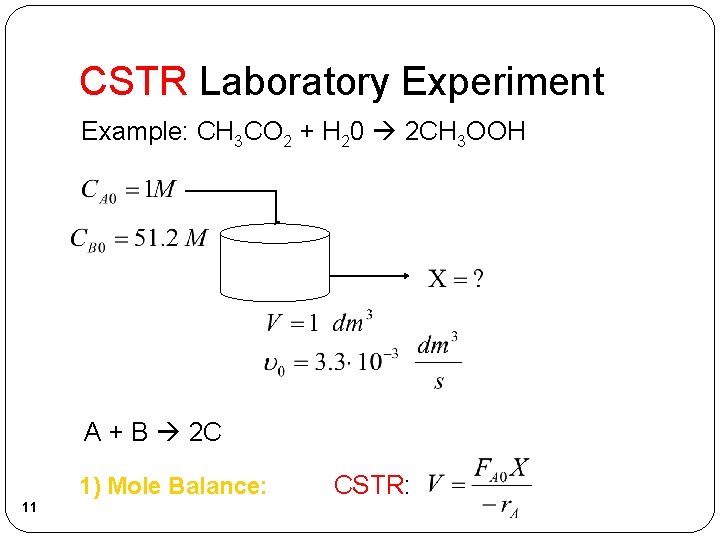
CSTR Laboratory Experiment Example: CH 3 CO 2 + H 20 2 CH 3 OOH A + B 2 C 1) Mole Balance: 11 CSTR:
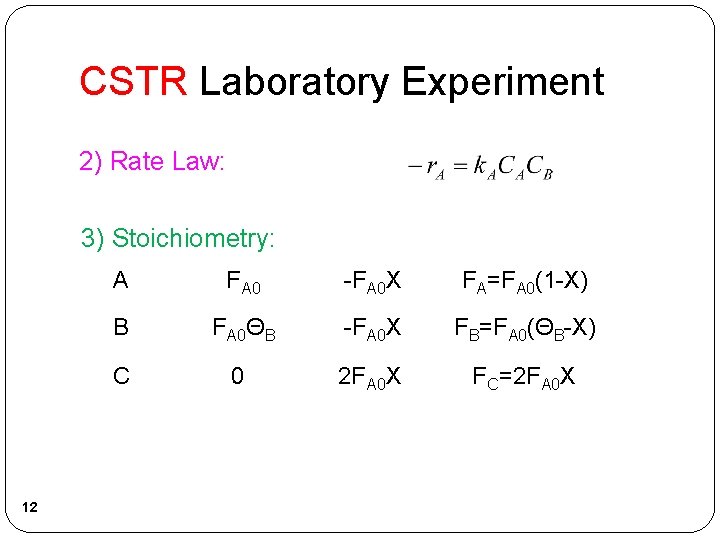
CSTR Laboratory Experiment 2) Rate Law: 3) Stoichiometry: 12 A FA 0 -FA 0 X FA=FA 0(1 -X) B FA 0ΘB -FA 0 X FB=FA 0(ΘB-X) C 0 2 FA 0 X FC=2 FA 0 X
CSTR Laboratory Experiment 13
CSTR Laboratory Experiment 14
PFR Laboratory Experiment A + B 2 C 1) Mole Balance: 2) Rate Law: 3) Stoichiometry: 15
PFR Laboratory Experiment 4) Combine: 16
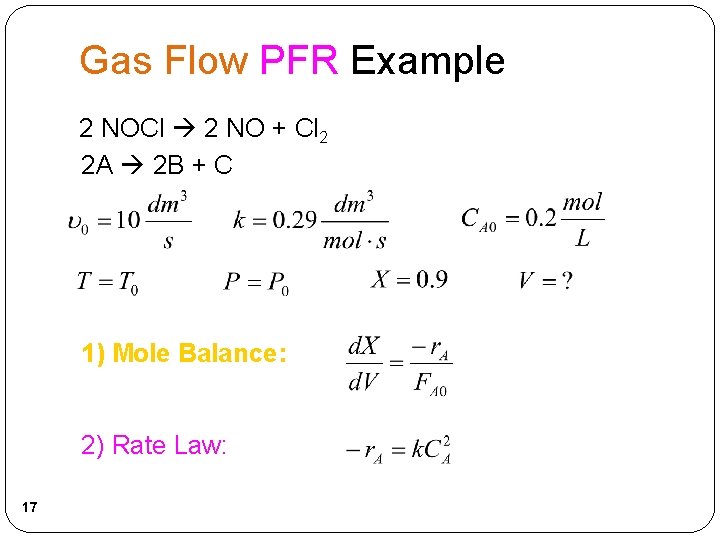
Gas Flow PFR Example 2 NOCl 2 NO + Cl 2 2 A 2 B + C 1) Mole Balance: 2) Rate Law: 17
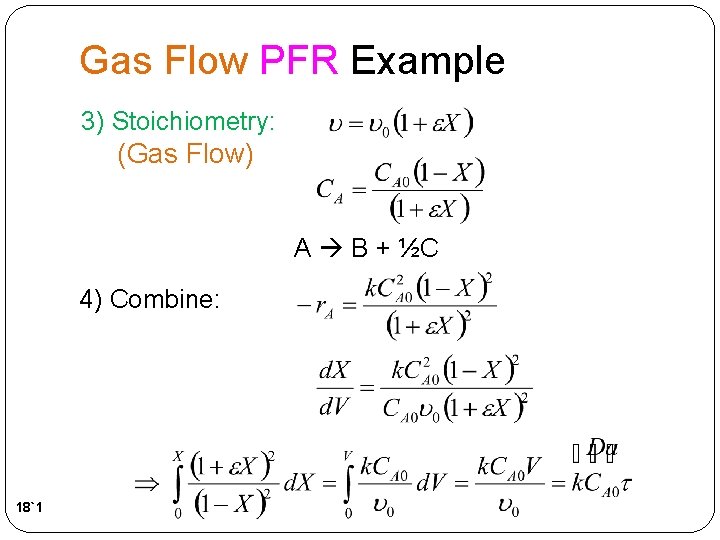
Gas Flow PFR Example 3) Stoichiometry: (Gas Flow) A B + ½C 4) Combine: 18`1
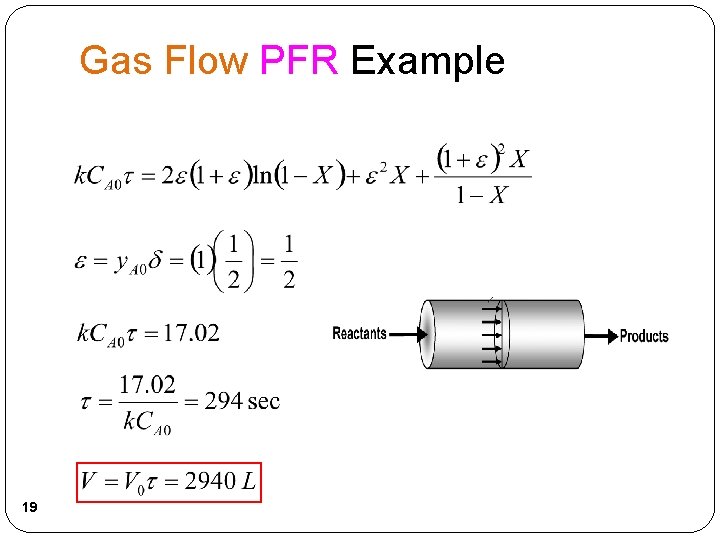
Gas Flow PFR Example 19
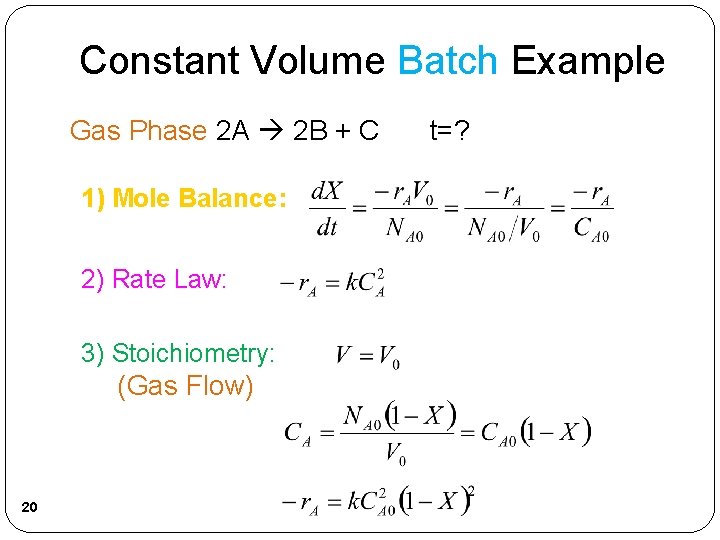
Constant Volume Batch Example Gas Phase 2 A 2 B + C 1) Mole Balance: 2) Rate Law: 3) Stoichiometry: (Gas Flow) 20 t=?
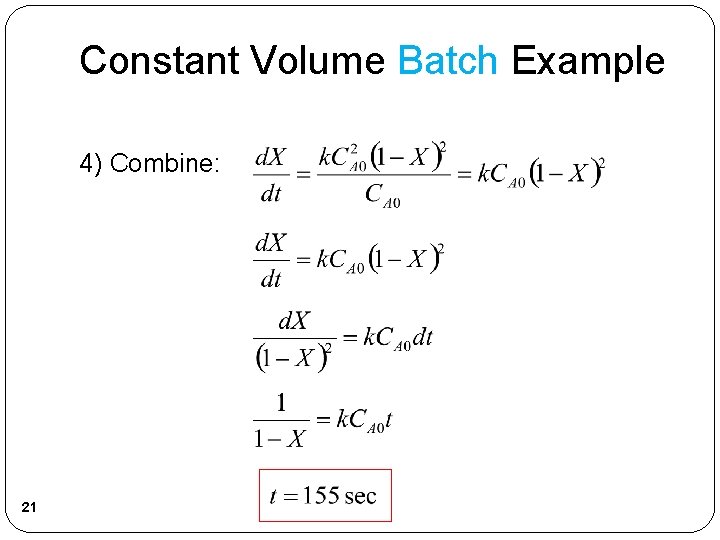
Constant Volume Batch Example 4) Combine: 21
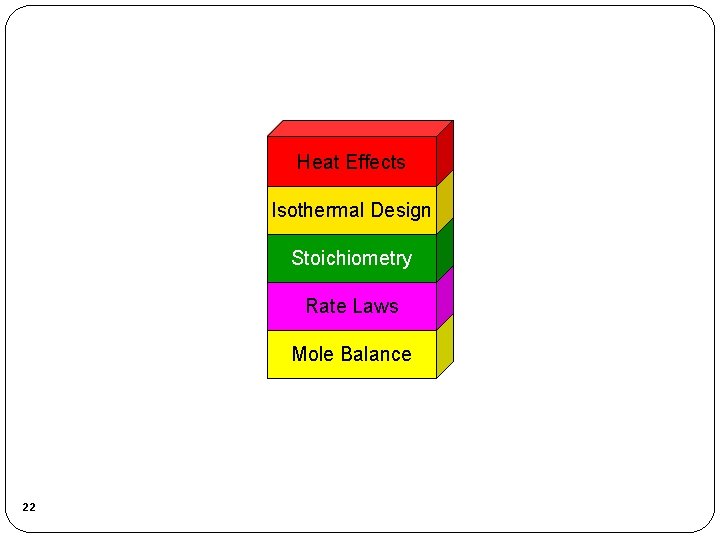
Heat Effects Isothermal Design Stoichiometry Rate Laws Mole Balance 22
End of Lecture 6 23