
Lecture 6 Chapter 3 Biology of the cell
Lecture 6 Chapter 3: Biology of the cell

Studying Cells Cell Theory: Four Basic Concepts • Basic building blocks of all animals and plants • Smallest functional units of life • Products of cell division • Basic homeostatic units Copyright © 2007 Pearson Education, Inc. , publishing as Benjamin Cummings
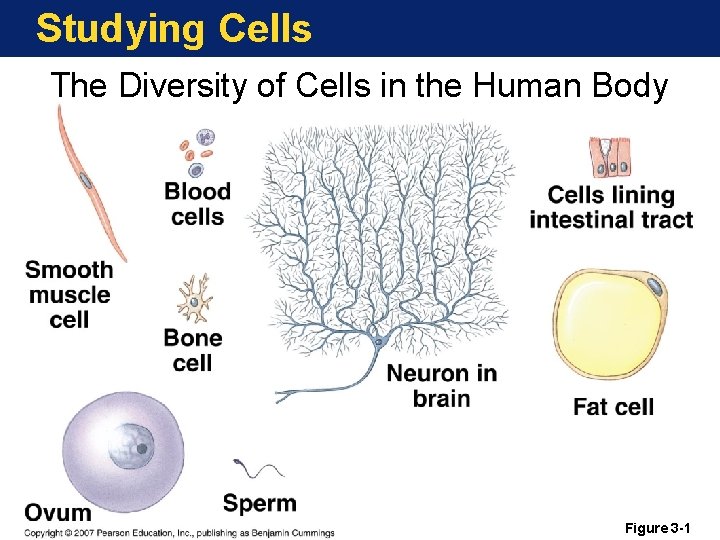
Studying Cells The Diversity of Cells in the Human Body Figure 3 -1

Studying Cells Cytology Study of structure and function of cells Cytology depends on seeing cells • Light microscopy (LM) • Electron Microscopy (EM) • Scanning EM (SEM) • Transmission EM (TEM) Copyright © 2007 Pearson Education, Inc. , publishing as Benjamin Cummings

Studying Cells Overview of Cell Anatomy • Extracellular fluid • Also called interstitial fluid • Cell Membrane • Lipid barrier between outside and inside • Cytoplasm (intracellular fluid) • Around nucleus • Cytosol + organelles Copyright © 2007 Pearson Education, Inc. , publishing as Benjamin Cummings
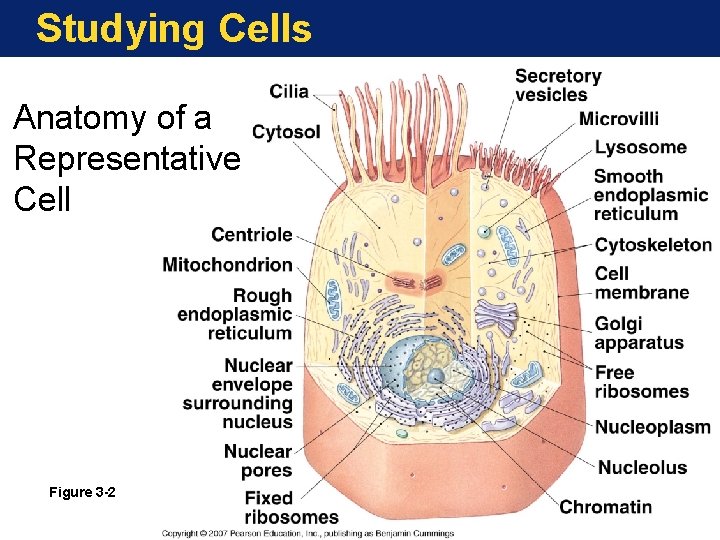
Studying Cells Anatomy of a Representative Cell Figure 3 -2
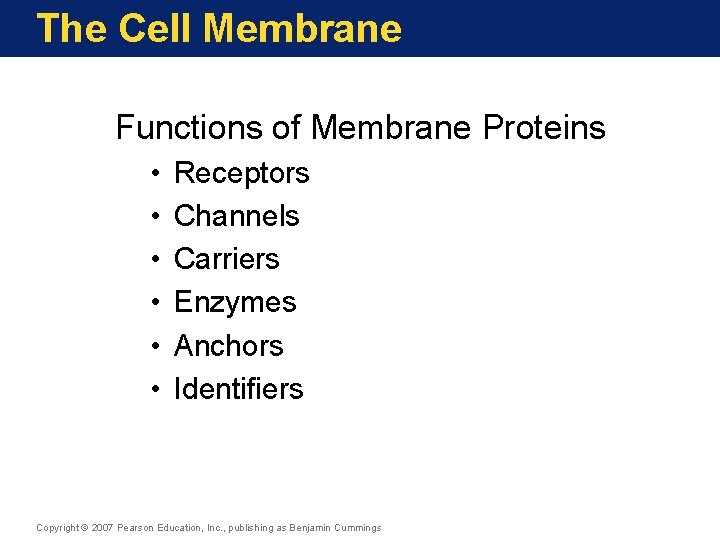
The Cell Membrane Functions of Membrane Proteins • • • Receptors Channels Carriers Enzymes Anchors Identifiers Copyright © 2007 Pearson Education, Inc. , publishing as Benjamin Cummings
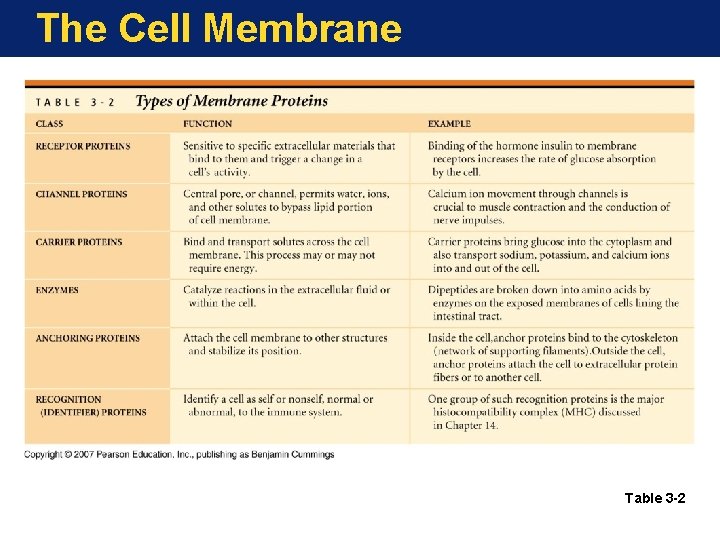
The Cell Membrane Table 3 -2
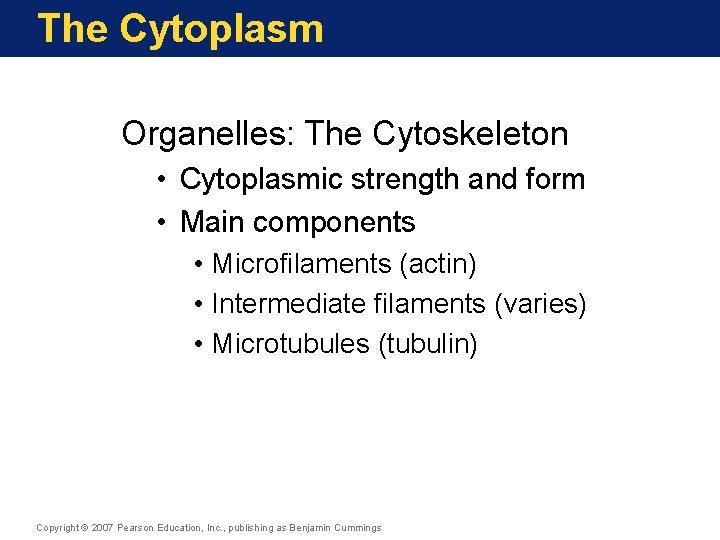
The Cytoplasm Organelles: The Cytoskeleton • Cytoplasmic strength and form • Main components • Microfilaments (actin) • Intermediate filaments (varies) • Microtubules (tubulin) Copyright © 2007 Pearson Education, Inc. , publishing as Benjamin Cummings
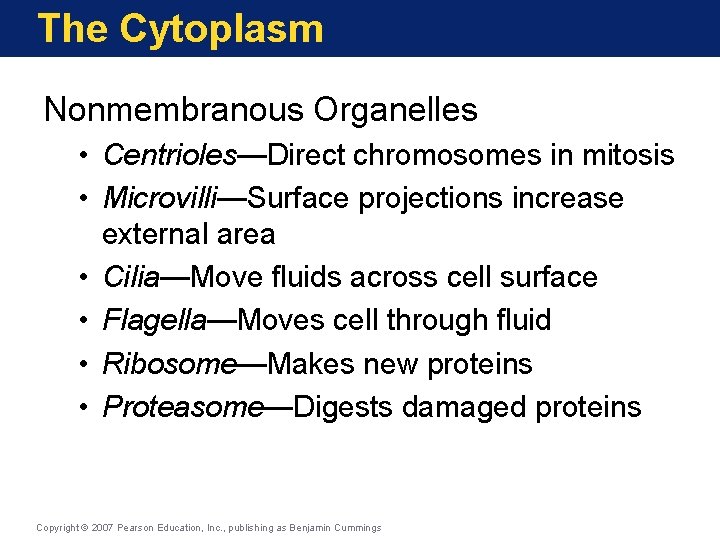
The Cytoplasm Nonmembranous Organelles • Centrioles—Direct chromosomes in mitosis • Microvilli—Surface projections increase external area • Cilia—Move fluids across cell surface • Flagella—Moves cell through fluid • Ribosome—Makes new proteins • Proteasome—Digests damaged proteins Copyright © 2007 Pearson Education, Inc. , publishing as Benjamin Cummings
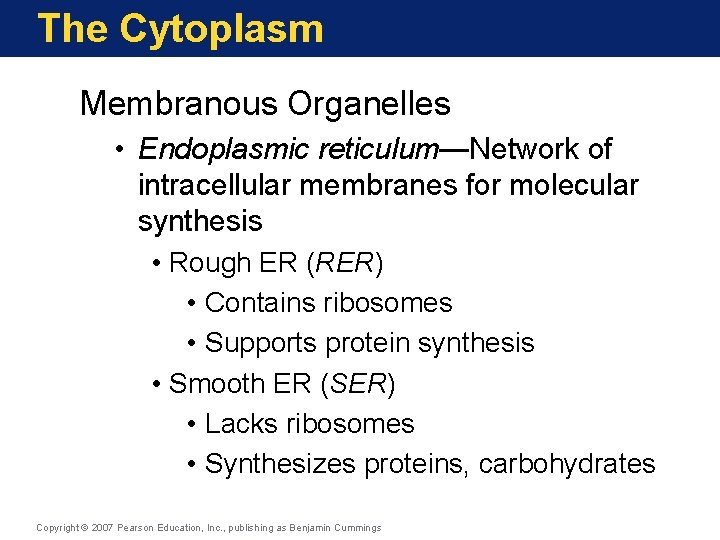
The Cytoplasm Membranous Organelles • Endoplasmic reticulum—Network of intracellular membranes for molecular synthesis • Rough ER (RER) • Contains ribosomes • Supports protein synthesis • Smooth ER (SER) • Lacks ribosomes • Synthesizes proteins, carbohydrates Copyright © 2007 Pearson Education, Inc. , publishing as Benjamin Cummings
The Cytoplasm Key Note Cells respond directly to their environment and help maintain homeostasis at the cellular level. They can also change their internal structure and physiological functions over time. Copyright © 2007 Pearson Education, Inc. , publishing as Benjamin Cummings
The Cytoplasm Key Note Mitochondria provide most of the energy needed to keep your cells (and you) alive. They consume oxygen and organic substrates, and they generate carbon dioxide and ATP. Copyright © 2007 Pearson Education, Inc. , publishing as Benjamin Cummings
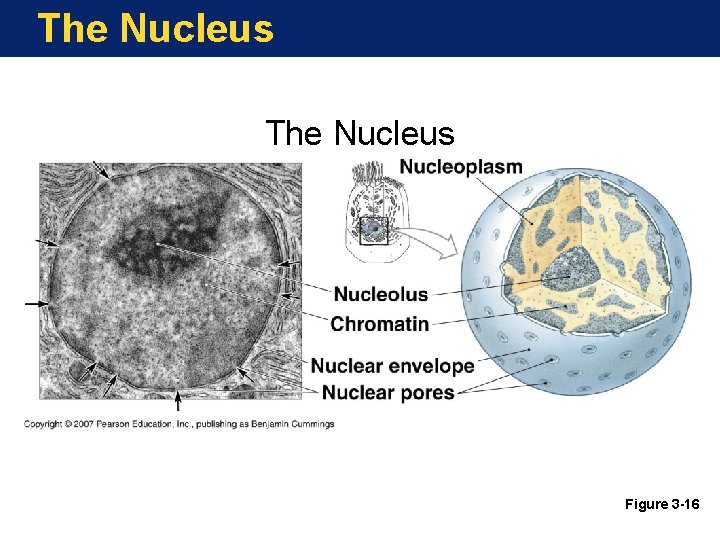
The Nucleus Figure 3 -16
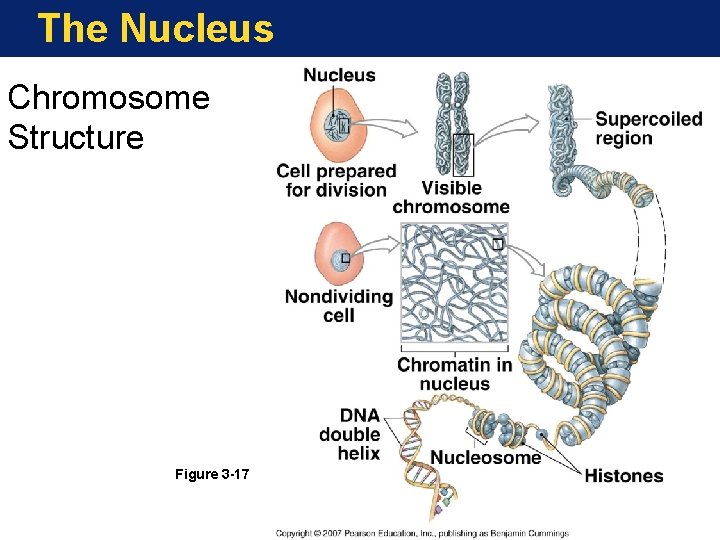
The Nucleus Chromosome Structure Figure 3 -17
The Nucleus The Genetic Code • Triplet code • Comprises three nitrogenous bases • Specifies a particular amino acid • A Gene • Heredity carried by genes • Sequence of triplets that codes for a specific protein Copyright © 2007 Pearson Education, Inc. , publishing as Benjamin Cummings
The Nucleus Protein Synthesis • Transcription—the production of RNA from a single strand of DNA • Occurs in nucleus • Produces messenger RNA (m. RNA) • Triplets specify codons on m. RNA Copyright © 2007 Pearson Education, Inc. , publishing as Benjamin Cummings
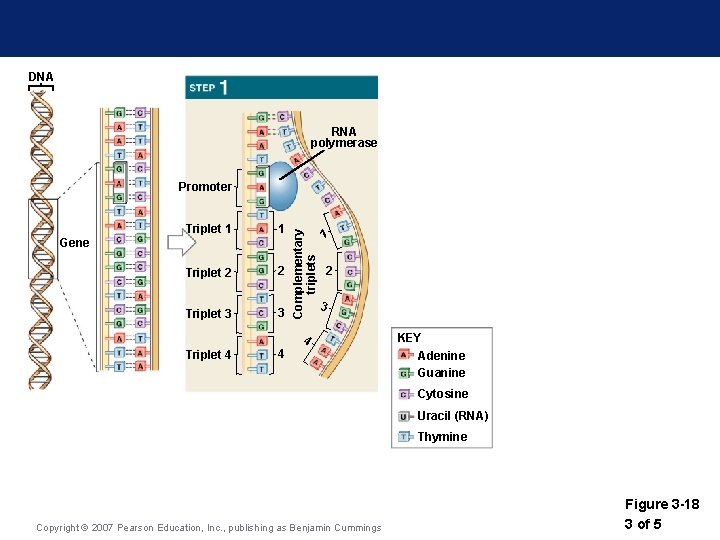
DNA RNA polymerase Triplet 1 1 Triplet 2 2 Triplet 3 3 Gene Complementary triplets Promoter 1 2 3 4 Triplet 4 4 KEY Adenine Guanine Cytosine Uracil (RNA) Thymine Copyright © 2007 Pearson Education, Inc. , publishing as Benjamin Cummings Figure 3 -18 3 of 5
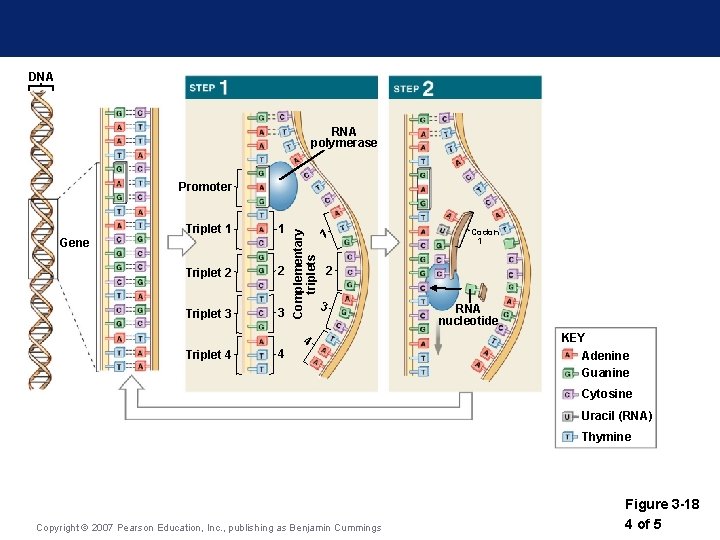
DNA RNA polymerase Triplet 1 1 Triplet 2 2 Triplet 3 3 Gene Complementary triplets Promoter 1 2 3 4 Triplet 4 Codon 1 4 RNA nucleotide KEY Adenine Guanine Cytosine Uracil (RNA) Thymine Copyright © 2007 Pearson Education, Inc. , publishing as Benjamin Cummings Figure 3 -18 4 of 5
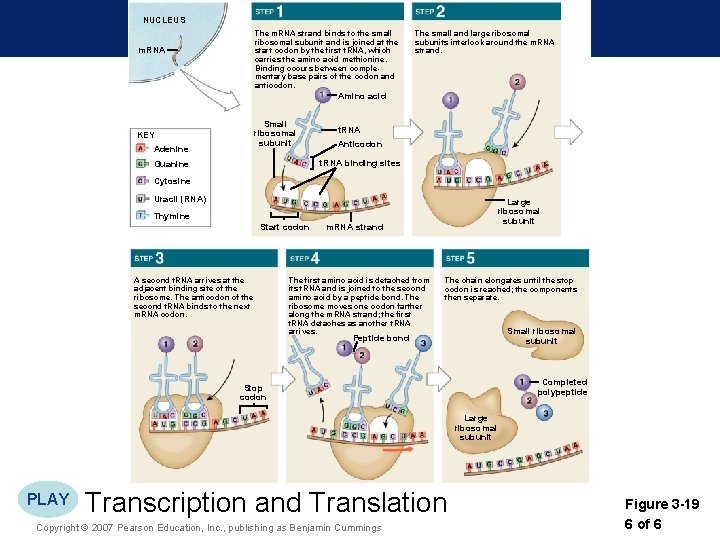
NUCLEUS The m. RNA strand binds to the small ribosomal subunit and is joined at the start codon by the first t. RNA, which carries the amino acid methionine. Binding occurs between complementary base pairs of the codon and anticodon. m. RNA The small and large ribosomal subunits interlock around the m. RNA strand. Amino acid Small ribosomal subunit KEY Adenine t. RNA Anticodon t. RNA binding sites Guanine Cytosine Uracil (RNA) Large ribosomal subunit Thymine Start codon A second t. RNA arrives at the adjacent binding site of the ribosome. The anticodon of the second t. RNA binds to the next m. RNA codon. m. RNA strand The first amino acid is detached from its t. RNA and is joined to the second amino acid by a peptide bond. The ribosome moves one codon farther along the m. RNA strand; the first t. RNA detaches as another t. RNA arrives. The chain elongates until the stop codon is reached; the components then separate. Small ribosomal subunit Peptide bond Completed polypeptide Stop codon Large ribosomal subunit PLAY Transcription and Translation Copyright © 2007 Pearson Education, Inc. , publishing as Benjamin Cummings Figure 3 -19 6 of 6
The Nucleus Key Note Genes are the functional units of DNA that contain the instructions for making one or more proteins. The creation of specific proteins involves multiple enzymes and three types of RNA. Copyright © 2007 Pearson Education, Inc. , publishing as Benjamin Cummings
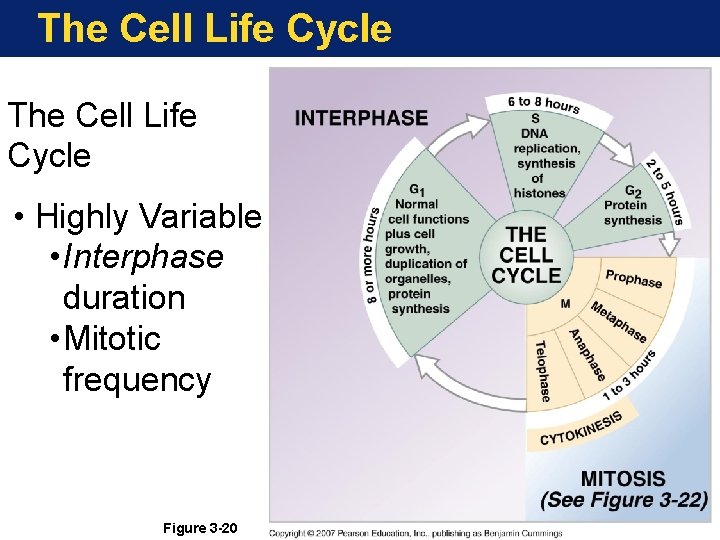
The Cell Life Cycle • Highly Variable • Interphase duration • Mitotic frequency Figure 3 -20
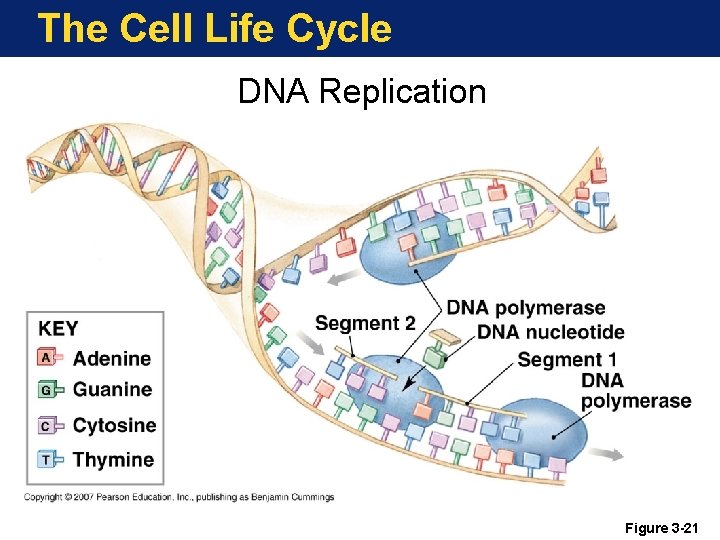
The Cell Life Cycle DNA Replication Figure 3 -21
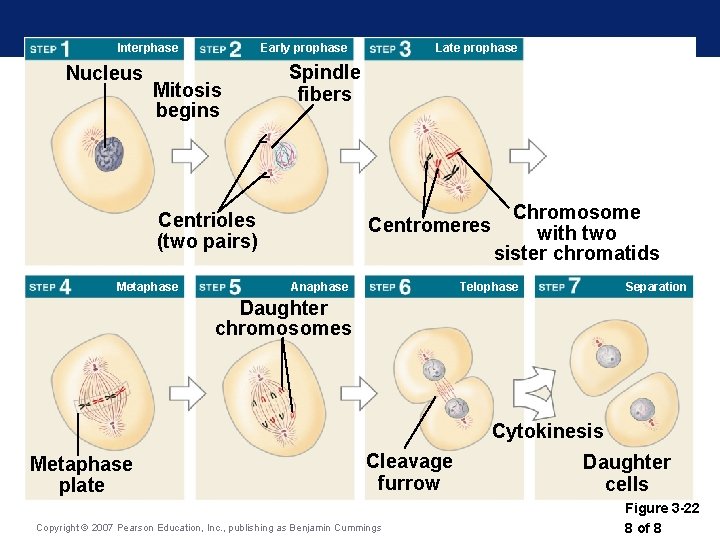
Interphase Nucleus Early prophase Mitosis begins Spindle fibers Chromosome Centromeres with two sister chromatids Centrioles (two pairs) Metaphase Late prophase Anaphase Telophase Separation Daughter chromosomes Cytokinesis Metaphase plate Cleavage furrow Copyright © 2007 Pearson Education, Inc. , publishing as Benjamin Cummings Daughter cells Figure 3 -22 8 of 8
The Cell Life Cycle Key Note Mitosis is the separation of duplicated chromosomes into two identical sets and nuclei in the process of somatic cell division. PLAY Interphase, Mitosis, and Cytokinesis Copyright © 2007 Pearson Education, Inc. , publishing as Benjamin Cummings
The Cell Life Cycle Cell Division and Cancer • Abnormal cell growth • Tumors (also called, neoplasm) • Benign • Encapsulated • Malignant • Invasion • Metastasis • Cancer—Disease that results from a malignant tumor Copyright © 2007 Pearson Education, Inc. , publishing as Benjamin Cummings
The Cell Life Cycle Key Note Cancer results from mutations that disrupt the control mechanism that regulates cell growth and division. Cancers most often begin where cells are dividing rapidly, because the more chromosomes are copied, the greater the chances of error. Copyright © 2007 Pearson Education, Inc. , publishing as Benjamin Cummings
Cell Diversity and Differentiation Somatic Cells • All have same genes • Some genes inactivate during development • Cells thus become functionally specialized • Specialized cells form distinct tissues • Tissue cells become differentiated Copyright © 2007 Pearson Education, Inc. , publishing as Benjamin Cummings
- Slides: 28