
LECTURE 6 AZURE IOT HUB AND THE SENSOR

LECTURE 6: AZURE IOT HUB AND THE SENSOR LIFECYCLE Ken Birman Spring, 2020 HTTP: //WWW. CS. CORNELL. EDU/COURSES/CS 5412/2020 SP 1
NEXT “ON BAT”… A 2 -LECTURE SEQUENCE We will be looking at Io. T again, but this time with the goal of thinking about how DHT sharding interacts with Io. T applications with sensors. It will stretch over 2 lectures, so you won’t see the whole story today. By the end we’ll have learned how big data systems compute on sharded data in a DHT, and then looked at how that approach could also work for large-scale collection of Io. T data from sensors. HTTP: //WWW. CS. CORNELL. EDU/COURSES/CS 5412/2020 SP 2
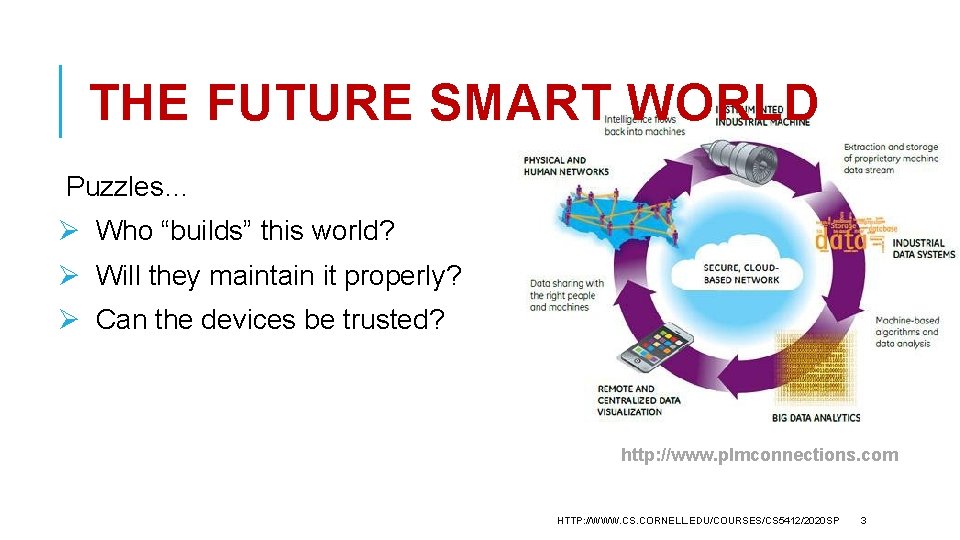
THE FUTURE SMART WORLD Puzzles… Ø Who “builds” this world? Ø Will they maintain it properly? Ø Can the devices be trusted? http: //www. plmconnections. com HTTP: //WWW. CS. CORNELL. EDU/COURSES/CS 5412/2020 SP 3
LONG-STANDING ISSUE WITH SENSORS People have talked about using sensors to create a “smart world” since 1980’s, but it hasn’t been as simple as they imagined! It is fairly easy to put RFID tags on devices, but those are passive. In fact “full fledged” Io. T with sophisticated sensors and actuators poses a wide range of challenges that we are only starting to appreciate. HTTP: //WWW. CS. CORNELL. EDU/COURSES/CS 5412/2020 SP 4

IOT IS EVERYWHERE, BUT POORLY MANAGED Your Internet router, and networked printer Cortana/Alexa/Siri/Google Nest Your TV and home entertainment system The network-connected microwave, fridge, range. Smart hot-water heater, and A/C, and room heating units Smart power meter, to connect them all together Smart water meter (might even be able to diagnose leaks) Solar panels on the roof, energy storage batteries in the wall HTTP: //WWW. CS. CORNELL. EDU/COURSES/CS 5412/2020 SP 5
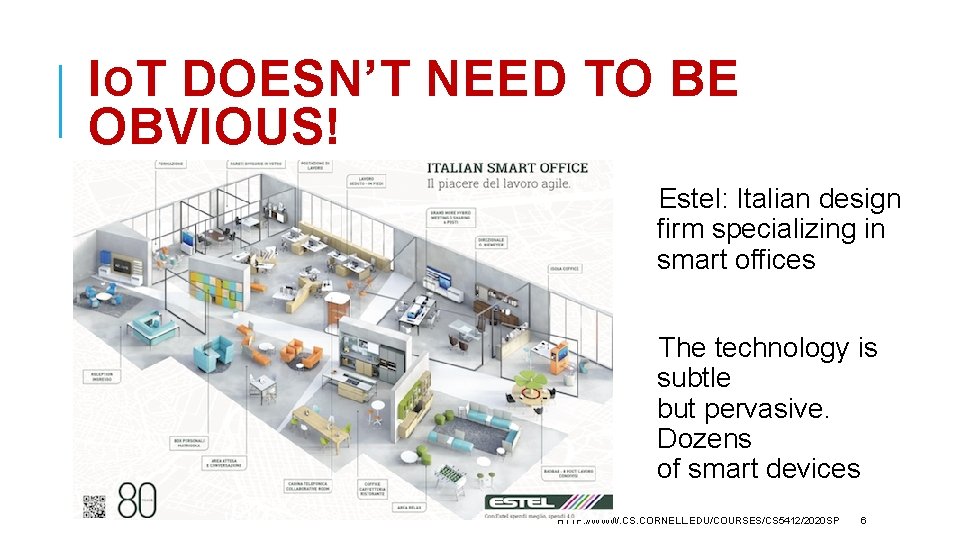
IOT DOESN’T NEED TO BE OBVIOUS! Estel: Italian design firm specializing in smart offices The technology is subtle but pervasive. Dozens of smart devices HTTP: //WWW. CS. CORNELL. EDU/COURSES/CS 5412/2020 SP 6
… EXAMPLES OF I OT IN THE OFFICE Room occupancy, temperature, humidity sensors and sector control Sensor to detect exterior light, actuator to control lights & window shades Desktop microphone for conferencing Smart copier/scanner with network-enabled functionality The elevator system The expresso machine that automatically orders new coffee packs Door locks that check ID cards HTTP: //WWW. CS. CORNELL. EDU/COURSES/CS 5412/2020 SP 7
… EVEN THE ELECTRIC POWER GRID IS SMART Most of the world’s bulk electric power systems are becoming smart This is Io. T on a “grand scale” and covers more than just power: coal/gas delivery, scheduling of power plants, maybe even water delivery, too. But this means that the power grid will need to keep a close eye on everything using electric power, or generating it. More Io. T! HTTP: //WWW. CS. CORNELL. EDU/COURSES/CS 5412/2020 SP 8
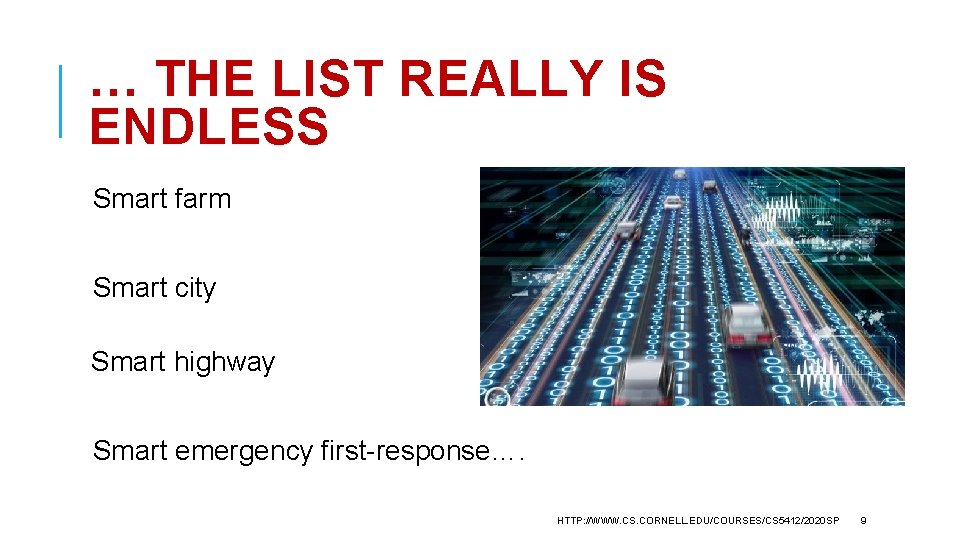
… THE LIST REALLY IS ENDLESS Smart farm Smart city Smart highway Smart emergency first-response…. HTTP: //WWW. CS. CORNELL. EDU/COURSES/CS 5412/2020 SP 9
MORE PUZZLES: CONTEXTUALIZATION How do Io. T devices know which room they are in? Ø Alexa, adjust the shades to block the glare on my display Ø Siri, use active noise cancellation to block that street noise Ø Cortana, find me a nearby conference room we can book for an hour. … in addition to the Io. T devices themselves we will need increasingly detailed “environmental maps” for everything, down to individual rooms! HTTP: //WWW. CS. CORNELL. EDU/COURSES/CS 5412/2020 SP 10
… CONTEXTUALIZATION IS A CLOUD COMPUTING TASK WE MIGHT DO IN A MICROSERVICE! We have a database of knowledge about the residents of a home We also have Io. T sensors and knowledge of where they are located. Occupant says “Hey Cortana, can you block this glare? ” You do a query to figure out that the sunlight from a particular window in the TV area is reflecting onto the occupant, who is on the couch there… HTTP: //WWW. CS. CORNELL. EDU/COURSES/CS 5412/2020 SP 11
WHO KEEPS THIS STUFF SECURE + ROBUST? Even if every light bulb “could” have a computer in it, why would this benefit anyone, and who would make sure the broken ones are replaced? How can we protect privacy and ensure that these things are secure? What costs could be incurred for violations? What if a sensor malfunctions? Can we figure out that it needs repair? HTTP: //WWW. CS. CORNELL. EDU/COURSES/CS 5412/2020 SP 12
SITUATION TODAY? Very poorly managed, huge numbers of Io. T devices yet very little attention to software upgrades, network security issues raised. There are network-enabled printers that turned out to have entire spy computing systems embedded in them, to retain copies of everything. Largest “zombie/bot” population? By one estimate, it may be Internet Wifi routers with default password settings! HTTP: //WWW. CS. CORNELL. EDU/COURSES/CS 5412/2020 SP 13
AZURE IOT TODAY: AIMING FOR A MINIMAL BUT ADEQUATE LAUNCH POINT. Microsoft has focused on Io. T for corporate customers with huge numbers of smart devices, and little control over them. And within that first step, they focus on management of the “fleet” of sensor and actuator devices: Ø Unmanaged sensors are a danger and a nightmare to the “owner” Ø Seems like a necessary first step, in any case Ø Can we “secure” the Io. T devices, and make them “trustworthy”? HTTP: //WWW. CS. CORNELL. EDU/COURSES/CS 5412/2020 SP 14
KEY ARCHITECTURAL ELEMENTS? Microsoft product: Azure Io. T Hub, Iot Edge and Intelligent Edge Ø First, the hub handles secure registration of devices and status tracking Ø Next, it automates software upgrades Ø It deals with issues of intermittent connectivity Ø For devices that can be controlled from the cloud, it creates a “model” to enable you to perform those control actions HTTP: //WWW. CS. CORNELL. EDU/COURSES/CS 5412/2020 SP 15
AZURE IOT: DATABASE OF SENSORS. The first step centers on secure registration of devices. The Azure Io. T Hub manages a scalable database of sensors and associated data. The enterprise owner also records information such as: Ø Device make and model, Ø Software revision level, battery lifetime, when it was last serviced Ø Where it is located, role it plays (information for contextualization) Ø Additional application-specific information or “knowledge” HTTP: //WWW. CS. CORNELL. EDU/COURSES/CS 5412/2020 SP 16
THIS MAKES IT AN ACTIVE DATABASE! In a normal database the data tuples are just plain old data objects. In Azure Io. T Hub, the objects in the database are intended to hold meta-data on behalf of the “real” sensors and actuators, and to keep this data in sync with the actual sensor or actuator when connectivity is possible. In effect, we now have meta-data describing the sensor combined with live properties (like battery level, photos cached, filter settings) that are wired to the actual device and change in real-time! HTTP: //WWW. CS. CORNELL. EDU/COURSES/CS 5412/2020 SP 17
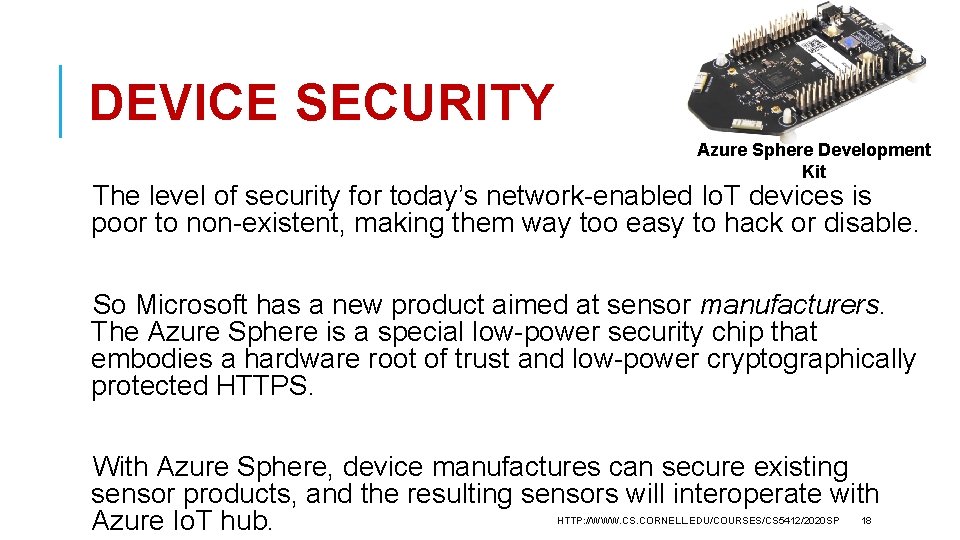
DEVICE SECURITY Azure Sphere Development Kit The level of security for today’s network-enabled Io. T devices is poor to non-existent, making them way too easy to hack or disable. So Microsoft has a new product aimed at sensor manufacturers. The Azure Sphere is a special low-power security chip that embodies a hardware root of trust and low-power cryptographically protected HTTPS. With Azure Sphere, device manufactures can secure existing sensor products, and the resulting sensors will interoperate with Azure Io. T hub. HTTP: //WWW. CS. CORNELL. EDU/COURSES/CS 5412/2020 SP 18
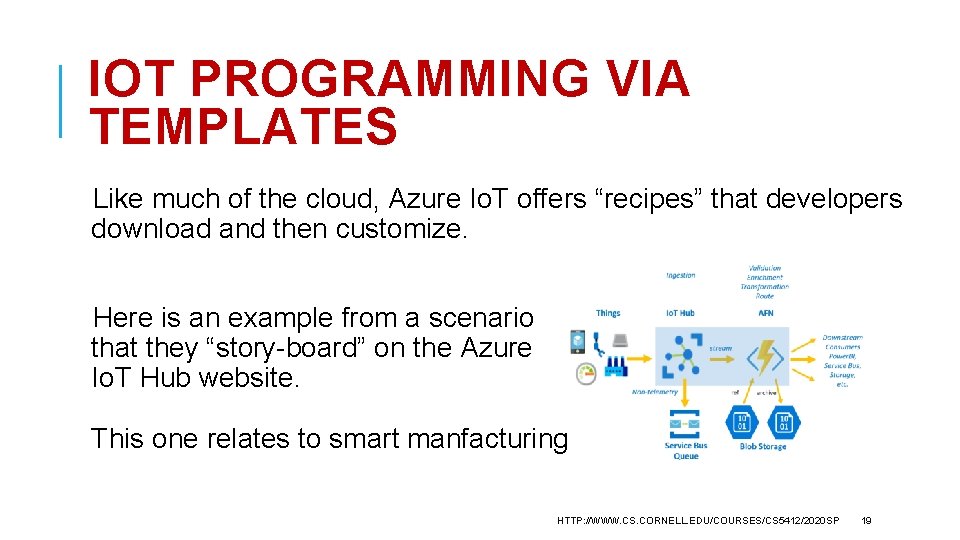
IOT PROGRAMMING VIA TEMPLATES Like much of the cloud, Azure Io. T offers “recipes” that developers download and then customize. Here is an example from a scenario that they “story-board” on the Azure Io. T Hub website. This one relates to smart manfacturing HTTP: //WWW. CS. CORNELL. EDU/COURSES/CS 5412/2020 SP 19
EVERY AZURE IOT DEVICE HAS A “PROXY” Many devices have limited network connectivity and won’t always be online. So in Azure Io. T Hub, every device has a cloud-hosted “representative”: a software agent that can respond to device operations 24 x 7, and then will push updates (like new software revisions) when an opportunity arises. The agent can also schedule maintenance operations. HTTP: //WWW. CS. CORNELL. EDU/COURSES/CS 5412/2020 SP 20
PROXY PROGRAMMING In this Azure proxy mode, you can send information to a device even if the device is currently disconnected! The proxy is always available. For example, a firmware update or patch, or new device configuration. But obviously the action can’t occur until the device connects. So there is always a back-and-forth: Event “to” the device, and later, an event “back”. Applications will need to work in this very HTTP: //WWW. CS. CORNELL. EDU/COURSES/CS 5412/2020 SP 21
QUALITY OF SERVICE ISSUES For many devices, network quality is also an issue. Over time, a network link might be unavailable, or available but slow, or temporarily very fast (at a high price). In normal networks we don’t think about this much. But for Io. T, our applications may need to be dynamically responsive as conditions change. HTTP: //WWW. CS. CORNELL. EDU/COURSES/CS 5412/2020 SP 22
THE QUALITY OF THE SENSOR ITSELF IS ALSO A SERIOUS CONCERN With large numbers of sensors we often get redundancy Wood and Marzullo explored this in a system called Meta here at Cornell. Key idea: first, that sensors have “range of accuracy”, and second that time also has a range of accuracy. Finally, that by leveraging this insight, we can actually identify and correct for many kinds of inaccuracy! HTTP: //WWW. CS. CORNELL. EDU/COURSES/CS 5412/2020 SP 23
CLOCKS ALSO HAVE LIMITED ACCURACY There are standard protocols for synchronizing them. But at any instant in time, clocks could still have drifted from the exact time. The term clock skew is an estimate of the worst-case drift between two non-faulty clocks, if you were to read them at the same instant in time. HTTP: //WWW. CS. CORNELL. EDU/COURSES/CS 5412/2020 SP 24
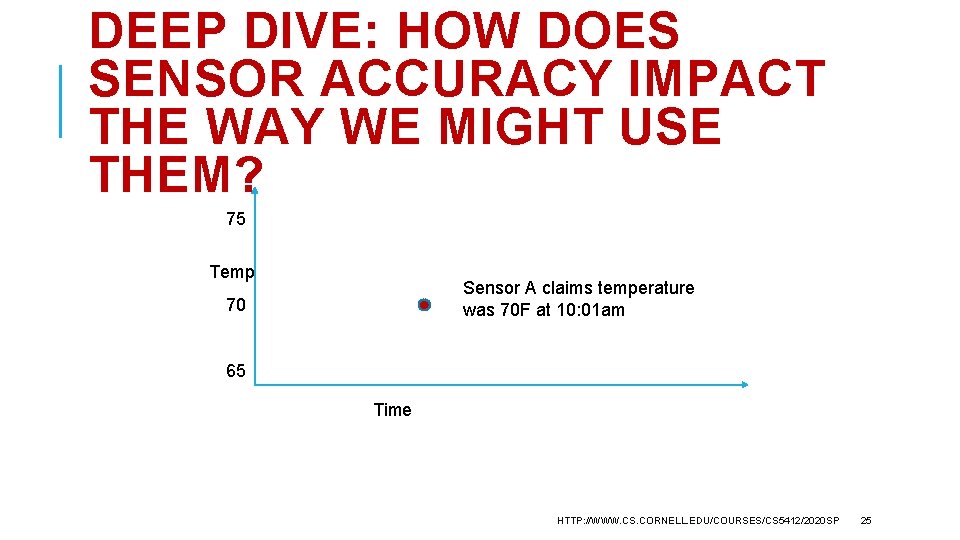
DEEP DIVE: HOW DOES SENSOR ACCURACY IMPACT THE WAY WE MIGHT USE THEM? 75 Temp Sensor A claims temperature was 70 F at 10: 01 am 70 65 Time HTTP: //WWW. CS. CORNELL. EDU/COURSES/CS 5412/2020 SP 25
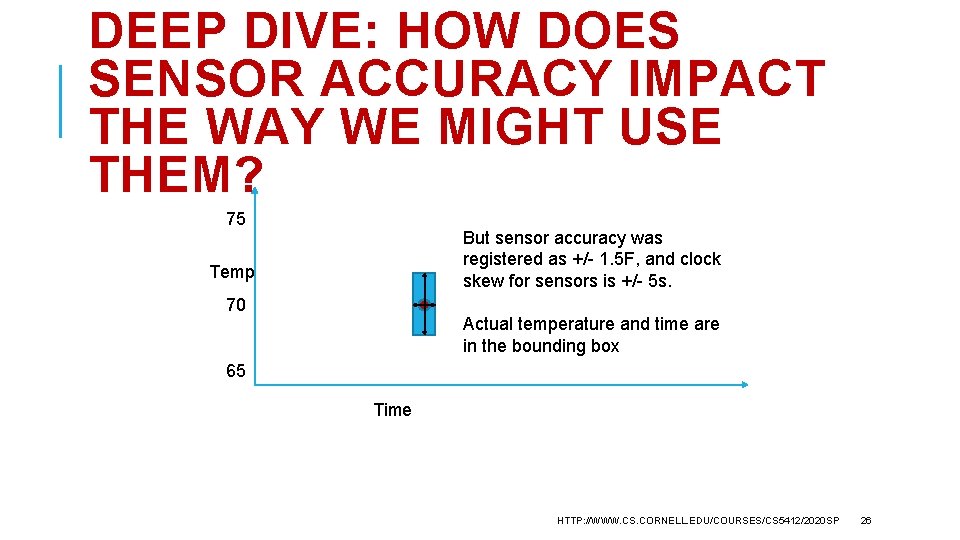
DEEP DIVE: HOW DOES SENSOR ACCURACY IMPACT THE WAY WE MIGHT USE THEM? 75 But sensor accuracy was registered as +/- 1. 5 F, and clock skew for sensors is +/- 5 s. Temp 70 Actual temperature and time are in the bounding box 65 Time HTTP: //WWW. CS. CORNELL. EDU/COURSES/CS 5412/2020 SP 26
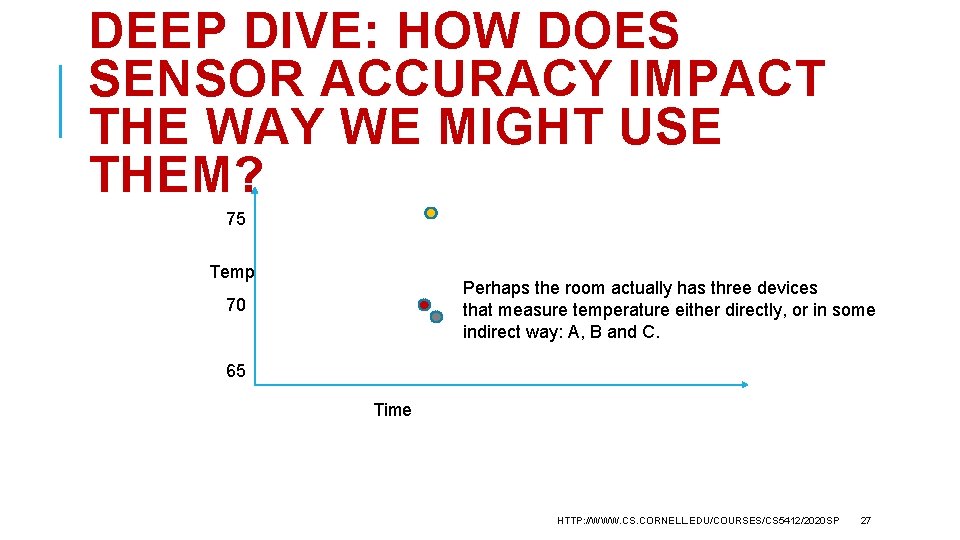
DEEP DIVE: HOW DOES SENSOR ACCURACY IMPACT THE WAY WE MIGHT USE THEM? 75 Temp Perhaps the room actually has three devices that measure temperature either directly, or in some indirect way: A, B and C. 70 65 Time HTTP: //WWW. CS. CORNELL. EDU/COURSES/CS 5412/2020 SP 27
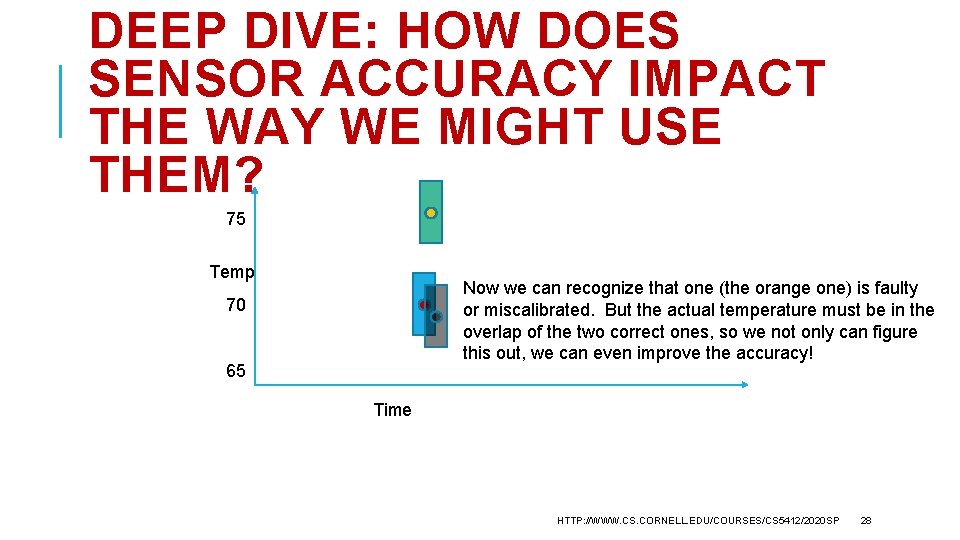
DEEP DIVE: HOW DOES SENSOR ACCURACY IMPACT THE WAY WE MIGHT USE THEM? 75 Temp Now we can recognize that one (the orange one) is faulty or miscalibrated. But the actual temperature must be in the overlap of the two correct ones, so we not only can figure this out, we can even improve the accuracy! 70 65 Time HTTP: //WWW. CS. CORNELL. EDU/COURSES/CS 5412/2020 SP 28
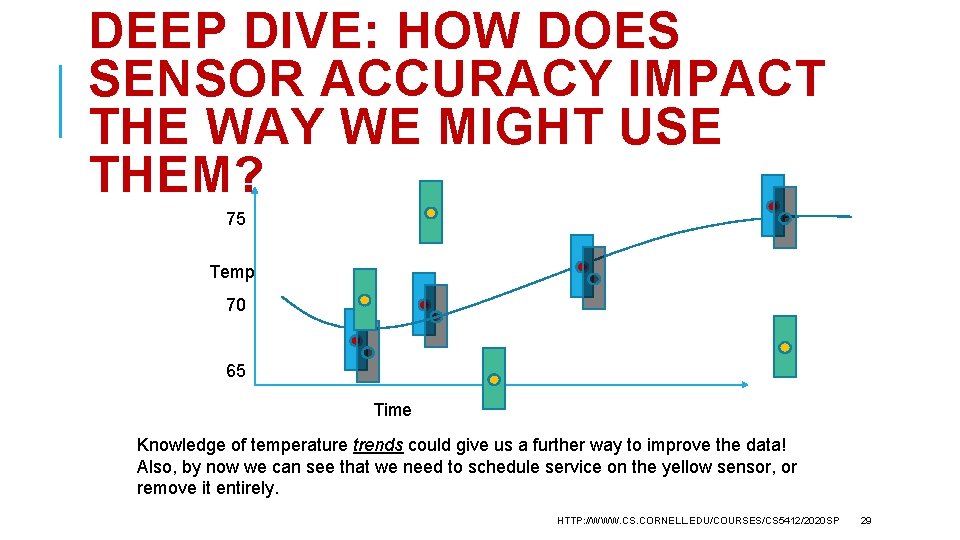
DEEP DIVE: HOW DOES SENSOR ACCURACY IMPACT THE WAY WE MIGHT USE THEM? 75 Temp 70 65 Time Knowledge of temperature trends could give us a further way to improve the data! Also, by now we can see that we need to schedule service on the yellow sensor, or remove it entirely. HTTP: //WWW. CS. CORNELL. EDU/COURSES/CS 5412/2020 SP 29
META: “RULES” FOR COMPUTING WITH IMPRECISE SENSORS Suppose we tell the smart system to “turn on the office A/C if the temperature rises above 71 F” Does this mean “if the temperature might be more than 71? ” Or “if the temperature is definitely more than 71? ” The correct action is very different! In our example, the temperature is probably 70. 1, but could be as high as 71. 6 HTTP: //WWW. CS. CORNELL. EDU/COURSES/CS 5412/2020 SP 30
“MIGHT” VERSUS “DEFINITELY” Might is a way to talk about “any value in the bounding box. ” Ø If the temperature is 70. 1 +/- 1. 5 at time 10: 03 +/- 5 s, it “might” have any value in the temperature range, or the time range. Definitely would mean that the allowed range has “no intersection” with the bounding box Ø In our example, the temperature is definitely more than 69 F HTTP: //WWW. CS. CORNELL. EDU/COURSES/CS 5412/2020 SP 31
TEMPORAL ACCURACY CONCERNS Fred Schneider likes to distinguish three properties: • Precision: How close is a clock to other non-faulty clocks? • Accuracy: How close is the clock to “true” time? • Drift: How quickly is a clock losing precision or accuracy? Recall: For a pair of clocks, the “skew” is their difference if measured at the same instant in true time. Drift is the “rate at which skew increases. ” Precision and accuracy are both forms of skew. HTTP: //WWW. CS. CORNELL. EDU/COURSES/CS 5412/2020 SP 32
PATRIOT MISSILE DEFENSE IN THE IRAQ WAR The Patriot anti-missile system was implemented as a twoprocessor system. A radar unit, on the ground, computed the trajectory of an incoming threat and tells the anti-missile when and where to intercept the target. Then the anti-missile launches and makes a pinpoint rendezvous. Would you prefer for the two clocks (the radar, and the defensive missile) to have the best possible precision, or accuracy? HTTP: //WWW. CS. CORNELL. EDU/COURSES/CS 5412/2020 SP 33
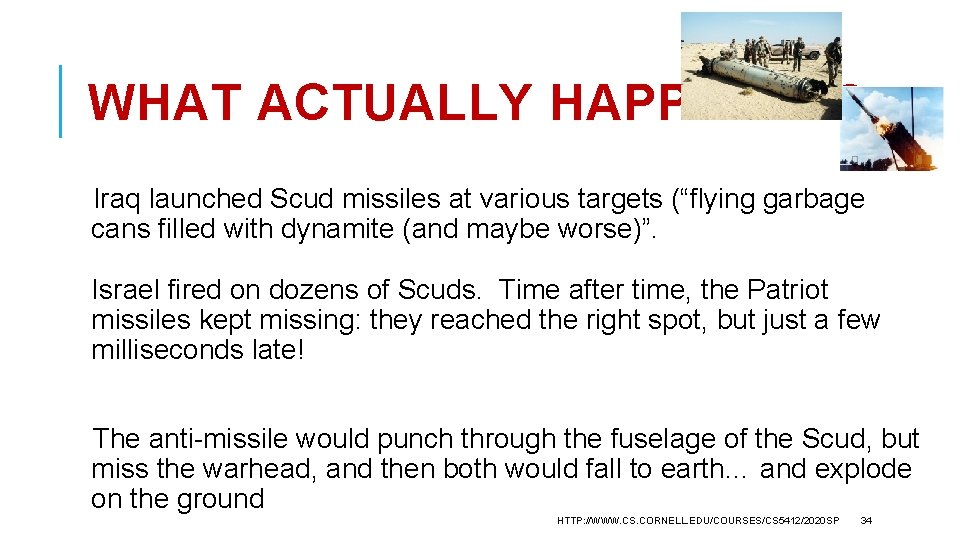
WHAT ACTUALLY HAPPENED? Iraq launched Scud missiles at various targets (“flying garbage cans filled with dynamite (and maybe worse)”. Israel fired on dozens of Scuds. Time after time, the Patriot missiles kept missing: they reached the right spot, but just a few milliseconds late! The anti-missile would punch through the fuselage of the Scud, but miss the warhead, and then both would fall to earth… and explode on the ground HTTP: //WWW. CS. CORNELL. EDU/COURSES/CS 5412/2020 SP 34
WHY WAS THE PATRIOT LATE? Later they discovered that the clocks in the radar computer system were drifting very slightly – they were slightly fast. After 3 or 5 days, this might add up to a few milliseconds of inaccuracy. So when the radar said to the patriot: “intercept a thread that will be at location (x, y, z) at time T, the time “T” was a few milliseconds late! Since then, the issue has been fixed (Iron. Dome works really well). HTTP: //WWW. CS. CORNELL. EDU/COURSES/CS 5412/2020 SP 35
OTHER SIMILAR CASES THAT COULD ARISE A smart highway tells two cars to follow some pattern: car A can enter the passing lane and pass car B. Car B should stay to the right until car A has passed by. If this is given by times, the same question arises. Or two drones scanning some field, taking commands from a control system. In Fred’s terminology: We need a high degree of precision for temporal coordination in such cases, but this is complicated by the tendency to use absolute time of day when computers interact with one-another. HTTP: //WWW. CS. CORNELL. EDU/COURSES/CS 5412/2020 SP 36
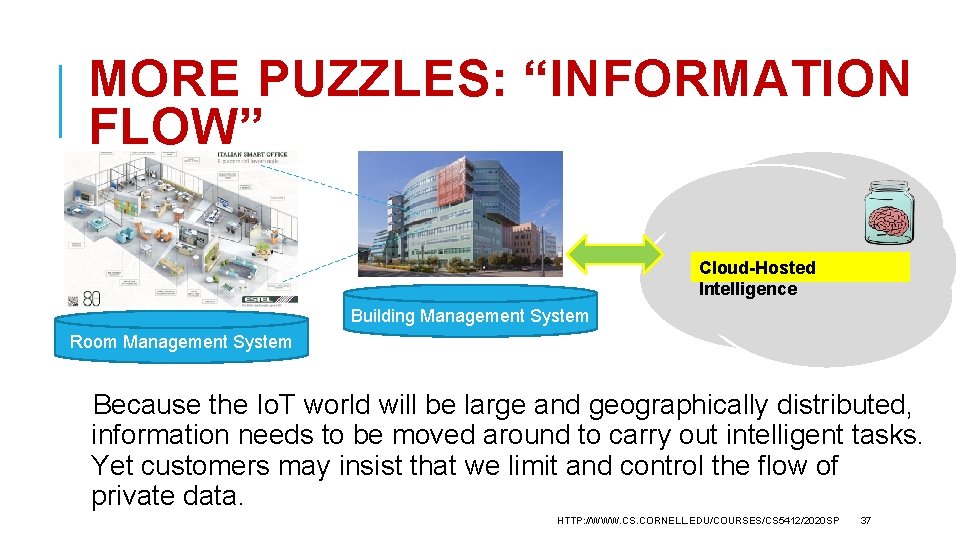
MORE PUZZLES: “INFORMATION FLOW” Cloud-Hosted Intelligence Building Management System Room Management System Because the Io. T world will be large and geographically distributed, information needs to be moved around to carry out intelligent tasks. Yet customers may insist that we limit and control the flow of private data. HTTP: //WWW. CS. CORNELL. EDU/COURSES/CS 5412/2020 SP 37
PRIVACY Suppose that the cloud learns sensitive information Ø If Siri/Alexa/Cortana can hear your commands, it can listen to you. Ø Who owns that information it gathered? Ø Who should be permitted to listen to it? It would be nice to say “all my private stuff stays in my house” but only the cloud really has the resources to understand everyone at largewillscale Extra: not important, cover if time HTTP: //WWW. CS. CORNELL. EDU/COURSES/CS 5412/2020 SP permits 38
SECURITY Beyond personal privacy, companies developing new products are at risk of competitors spying on them! They benefit from the technology, but if their IP gets stolen, they lose it all! So there are questions of protection not of private data, but also of company IP. But if you own your private data, how will the system figure out which remarks are private and which are related to your Extra: not important, will cover if time job? permits HTTP: //WWW. CS. CORNELL. EDU/COURSES/CS 5412/2020 SP 39
FAULT-TOLERANCE With so many moving parts, some will fail! In fact failures can occur at every level Ø A sensor could go offline Ø It could stay online but send confused/incorrect data, or bad timestamps Ø The network connection could freeze up or break Ø The cloud servers could shut down or be reconfigured Extra: not important, will cover if time permits HTTP: //WWW. CS. CORNELL. EDU/COURSES/CS 5412/2020 SP 40
EXAMPLE: LANDLORD’S MANAGEMENT TOOL To see how these can come into conflict, consider a solution aimed at the landlord of a large residential complex. It might have hundreds of units (apartments or condos) Landlord needs to operate this intelligently Extra: not important, will cover if time permits HTTP: //WWW. CS. CORNELL. EDU/COURSES/CS 5412/2020 SP 41
AVOIDING HARM TO A BUILDING In fact a major goal for smart buildings is to anticipate problems and fix them, perhaps even before they become serious. Think about an apartment complex with a forgetful tenant in a drought area. If he starts the shower running but forgets and goes shopping, huge water waste can occur. Someone should shut the water off! But then there is a privacy issue raised: will this reveal that the tenant has early senile dementia? He could be harmed if this Extra: not important, will cover if time HTTP: //WWW. CS. CORNELL. EDU/COURSES/CS 5412/2020 SP permits 42
SIMILAR ISSUES Window left open and yet heat is on. Stove was left on, or lights, or TV… but tenants aren’t home. Microwave was set to 30 minutes instead of 30 seconds. Tenant falls and can’t get to a phone or call for help. Fire in the area. First-responders need to know where people are located. Extra: not important, will cover if time permits HTTP: //WWW. CS. CORNELL. EDU/COURSES/CS 5412/2020 SP 43
IOT CAN HELP! The challenge is to build trustworthy solutions that won’t violate privacy and yet will help in cases like these. The answer is to create systems that safeguard your data by keeping it close to where they gather it (which is why Azure Io. T Edge is designed to even live right in the home). When data does get sent to the cloud, it should be for a specific task. Then, when finished with that task, “leave no trace behind”. HTTP: //WWW. CS. CORNELL. EDU/COURSES/CS 5412/2020 SP 44
SOCIETAL BALANCING ACT! Those of us who will build these systems need to decide what to do! And worse, we can’t even trust the sensors themselves! The law is far behind the technology curve. Don’t expect to find answers in courtrooms for a long time. Yet because companies ultimately have a revenue and profit motive, if you focus purely on corporate goals, you might do something evil. HTTP: //WWW. CS. CORNELL. EDU/COURSES/CS 5412/2020 SP 45
DOES EXISTING CLOUD ENCOUNTER THESE ISSUES? A few of the same issues arise in any cloud-scale system. So in fact our challenge isn’t really to invent everything from scratch, and some of these policy issues are familiar ones. . The actual challenge is more subtle: we need to learn to “repurpose” what the cloud is already able to do, in these new roles and ways. HTTP: //WWW. CS. CORNELL. EDU/COURSES/CS 5412/2020 SP 46
BIG PART OF THE ISSUE Leakage At very large scale, the cloud “mixes” tasks on behalf of different users (“multi-tenancy”), for cost-efficiency reasons. For example, AWS Dynamo and Azure Cosmos both hold data for huge numbers of applications. The same is true for the global file system. Of course they keep track of which data is owned by which user, and you don’t normally “see” other people’s data. But information could leak. HTTP: //WWW. CS. CORNELL. EDU/COURSES/CS 5412/2020 SP 47
SUMMARY Tackling the Io. T opportunity will be a huge opportunity, but also a huge investment and an enormous amount of work. Today’s cloud is incredibly powerful and this existing powerful solution will make a big difference. But getting from here to there will still require new technology development. HTTP: //WWW. CS. CORNELL. EDU/COURSES/CS 5412/2020 SP 48
- Slides: 48