
Lecture 6 2 Concurrent Queues and Stacks Companion
- Slides: 80
Lecture 6 -2 : Concurrent Queues and Stacks Companion slides for The Art of Multiprocessor Programming by Maurice Herlihy & Nir Shavit
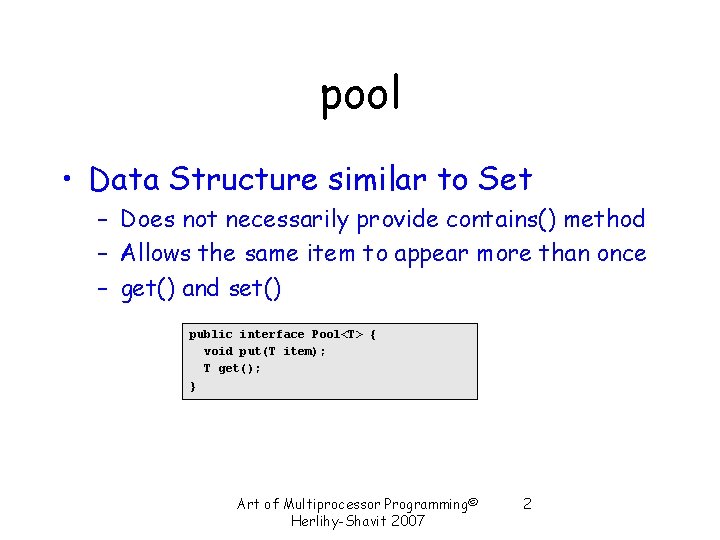
pool • Data Structure similar to Set – Does not necessarily provide contains() method – Allows the same item to appear more than once – get() and set() public interface Pool<T> { void put(T item); T get(); } Art of Multiprocessor Programming© Herlihy-Shavit 2007 2
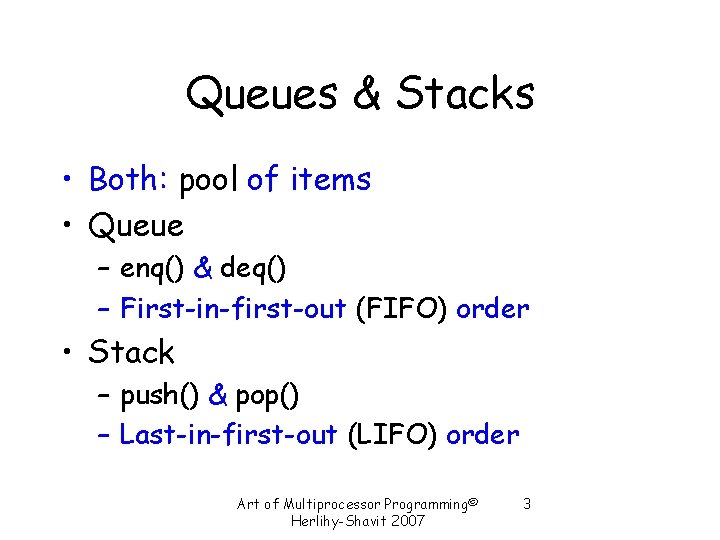
Queues & Stacks • Both: pool of items • Queue – enq() & deq() – First-in-first-out (FIFO) order • Stack – push() & pop() – Last-in-first-out (LIFO) order Art of Multiprocessor Programming© Herlihy-Shavit 2007 3
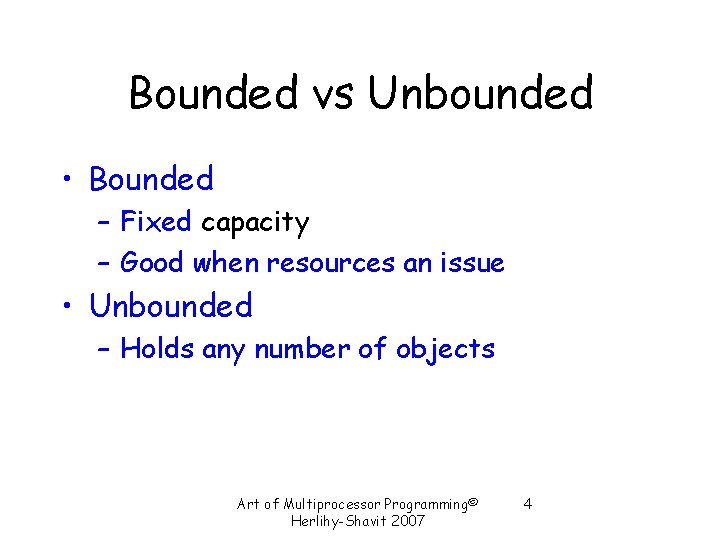
Bounded vs Unbounded • Bounded – Fixed capacity – Good when resources an issue • Unbounded – Holds any number of objects Art of Multiprocessor Programming© Herlihy-Shavit 2007 4
Blocking vs Non-Blocking • Problem cases: – Removing from empty pool – Adding to full (bounded) pool • Blocking – Caller waits until state changes • Non-Blocking – Method throws exception Art of Multiprocessor Programming© Herlihy-Shavit 2007 5
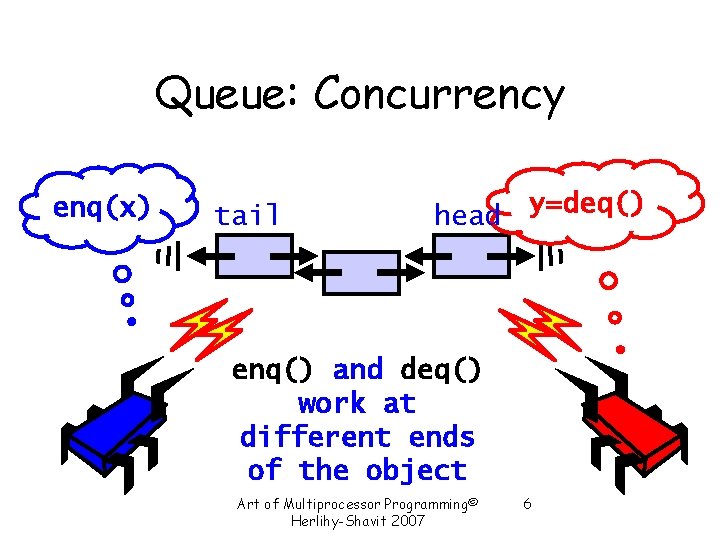
Queue: Concurrency enq(x) tail head y=deq() enq() and deq() work at different ends of the object Art of Multiprocessor Programming© Herlihy-Shavit 2007 6
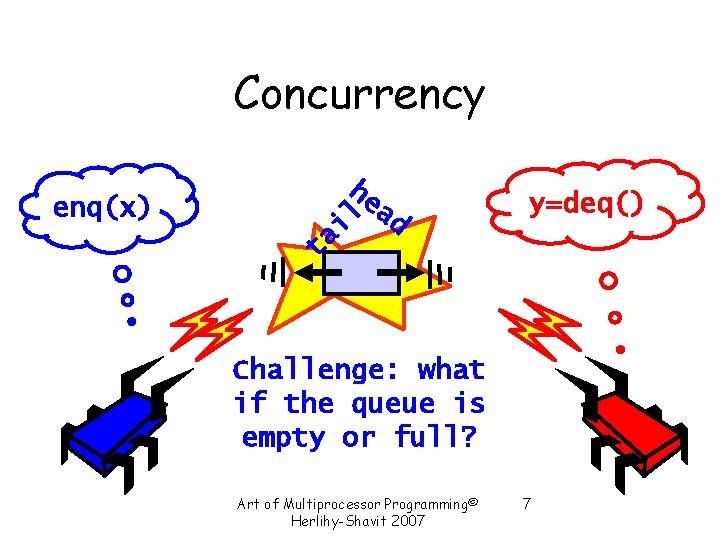
Concurrency he ad l ai enq(x) y=deq() t Challenge: what if the queue is empty or full? Art of Multiprocessor Programming© Herlihy-Shavit 2007 7
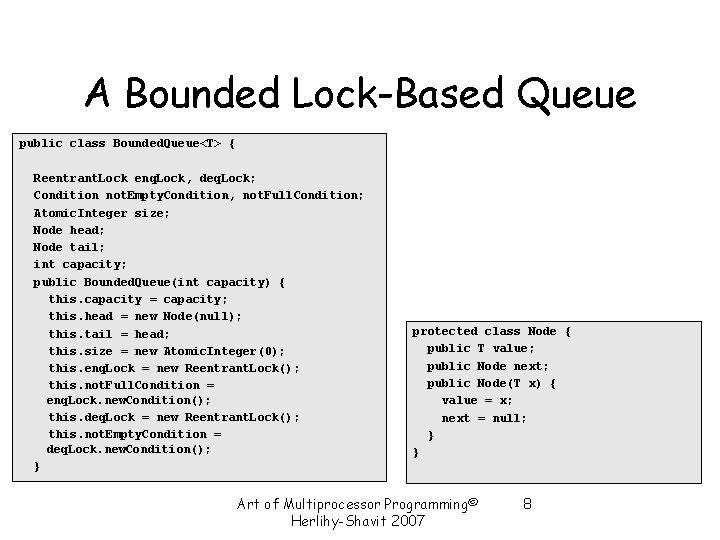
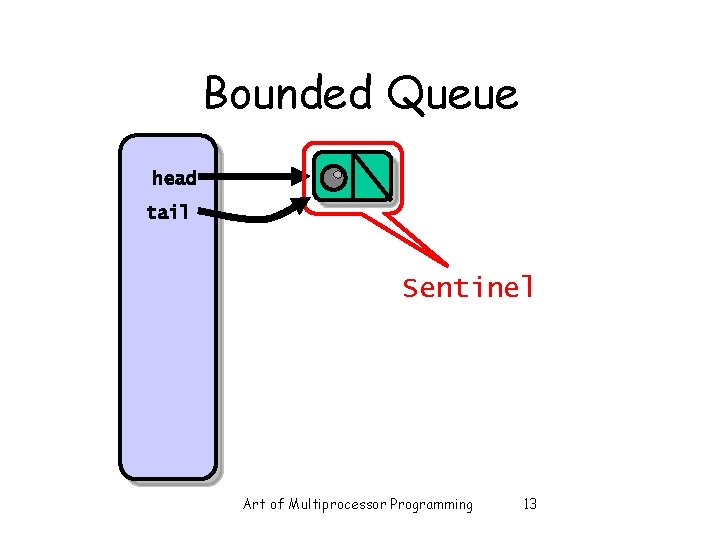
A Bounded Lock-Based Queue public class Bounded. Queue<T> { Reentrant. Lock enq. Lock, deq. Lock; Condition not. Empty. Condition, not. Full. Condition; Atomic. Integer size; Node head; Node tail; int capacity; public Bounded. Queue(int capacity) { this. capacity = capacity; this. head = new Node(null); this. tail = head; this. size = new Atomic. Integer(0); this. enq. Lock = new Reentrant. Lock(); this. not. Full. Condition = enq. Lock. new. Condition(); this. deq. Lock = new Reentrant. Lock(); this. not. Empty. Condition = deq. Lock. new. Condition(); } protected class Node { public T value; public Node next; public Node(T x) { value = x; next = null; } } Art of Multiprocessor Programming© Herlihy-Shavit 2007 8
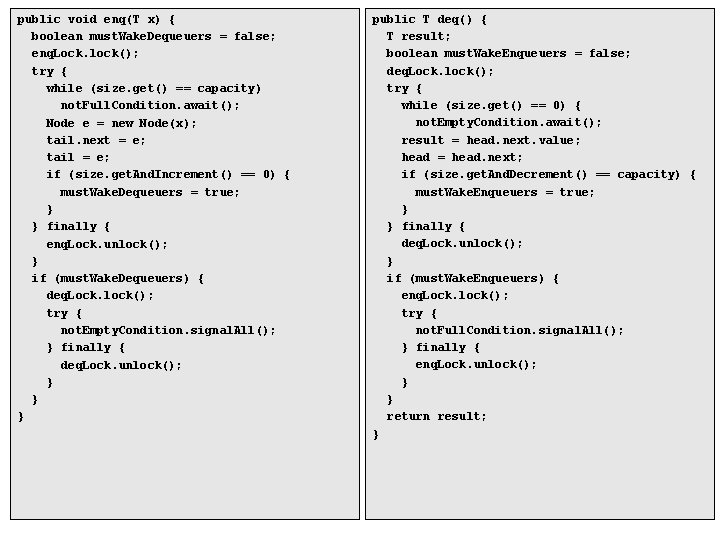
public void enq(T x) { boolean must. Wake. Dequeuers = false; enq. Lock. lock(); try { while (size. get() == capacity) not. Full. Condition. await(); Node e = new Node(x); tail. next = e; tail = e; if (size. get. And. Increment() == 0) { must. Wake. Dequeuers = true; } } finally { enq. Lock. unlock(); } if (must. Wake. Dequeuers) { deq. Lock. lock(); try { not. Empty. Condition. signal. All(); } finally { deq. Lock. unlock(); } } } public T deq() { T result; boolean must. Wake. Enqueuers = false; deq. Lock. lock(); try { while (size. get() == 0) { not. Empty. Condition. await(); result = head. next. value; head = head. next; if (size. get. And. Decrement() == capacity) { must. Wake. Enqueuers = true; } } finally { deq. Lock. unlock(); } if (must. Wake. Enqueuers) { enq. Lock. lock(); try { not. Full. Condition. signal. All(); } finally { enq. Lock. unlock(); } } return result; } 9
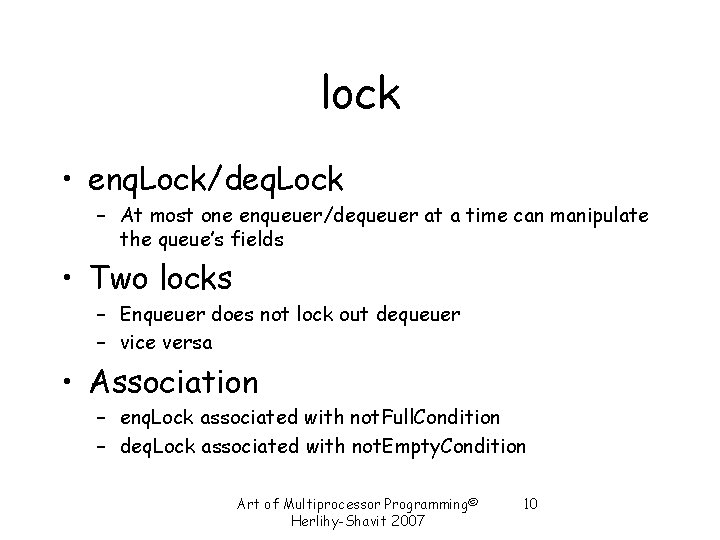
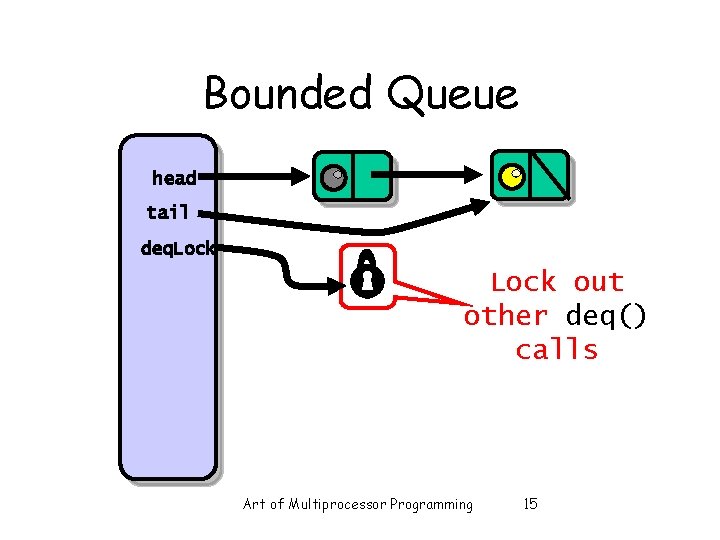
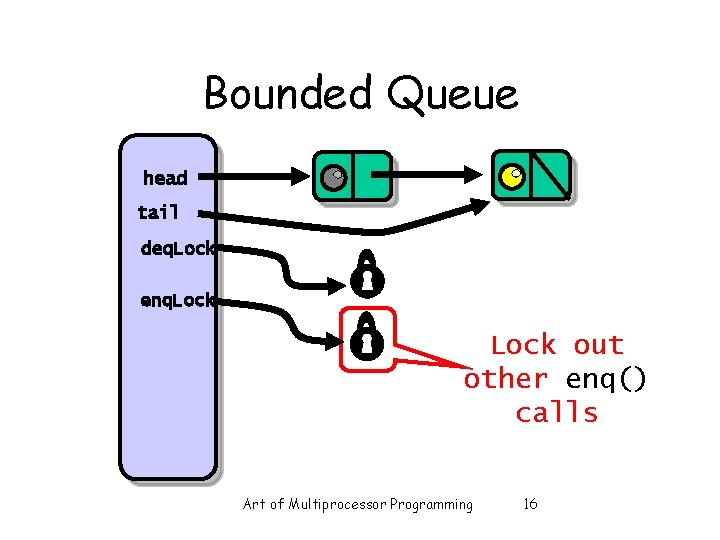
lock • enq. Lock/deq. Lock – At most one enqueuer/dequeuer at a time can manipulate the queue’s fields • Two locks – Enqueuer does not lock out dequeuer – vice versa • Association – enq. Lock associated with not. Full. Condition – deq. Lock associated with not. Empty. Condition Art of Multiprocessor Programming© Herlihy-Shavit 2007 10
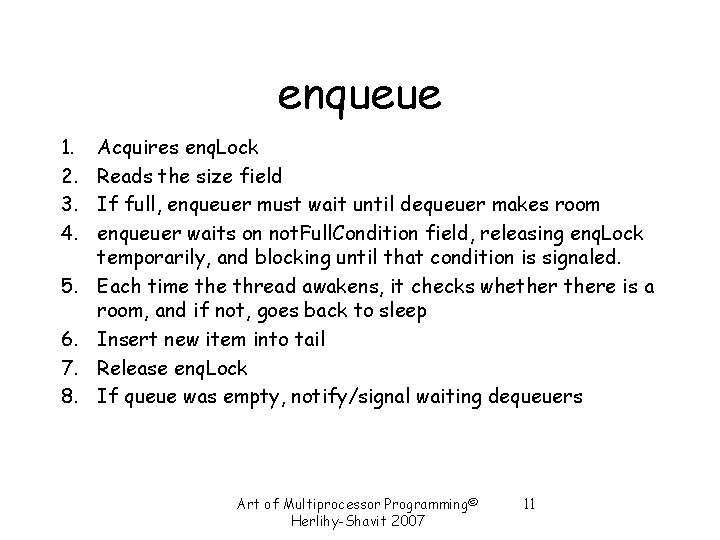
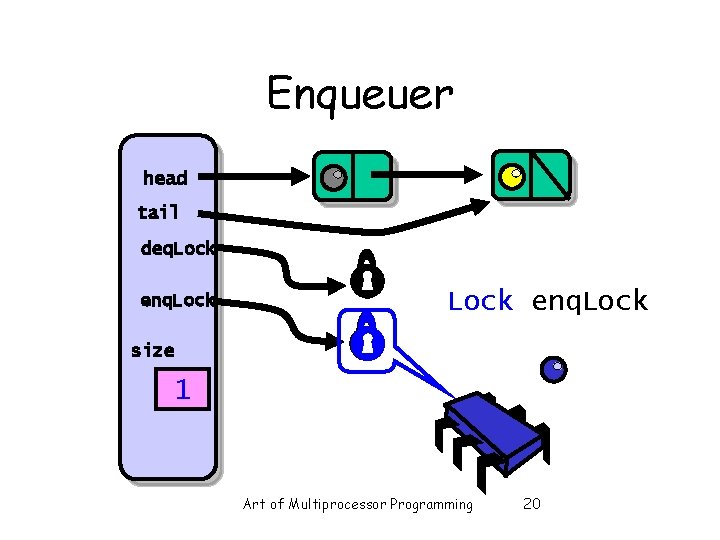
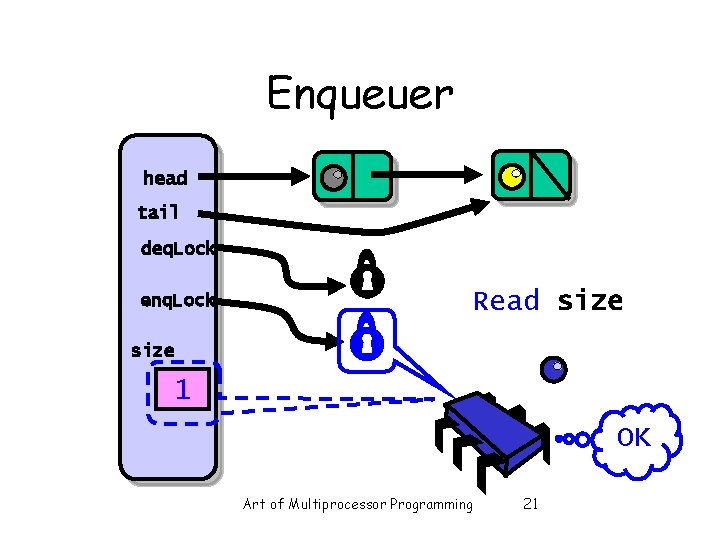
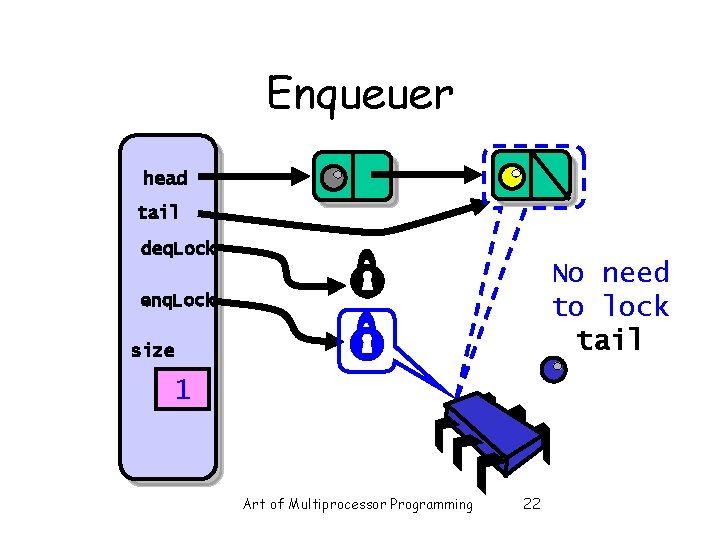
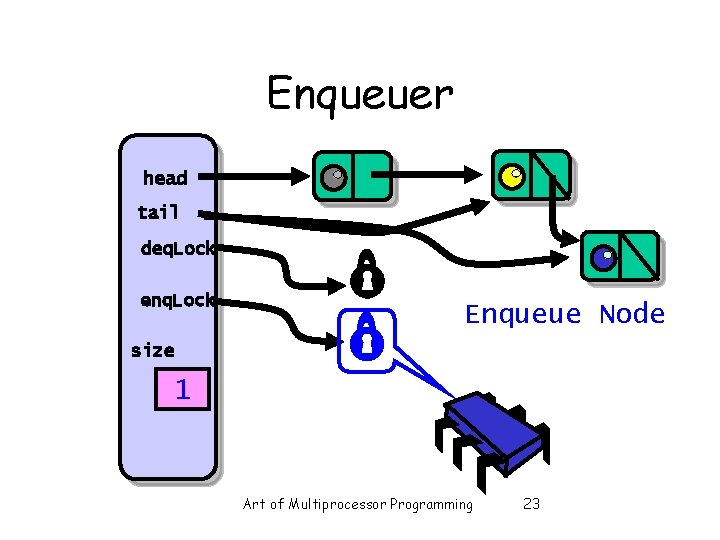
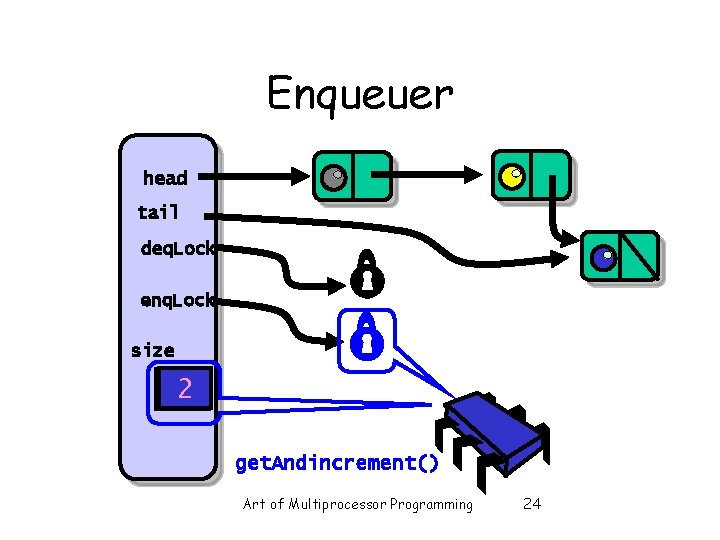
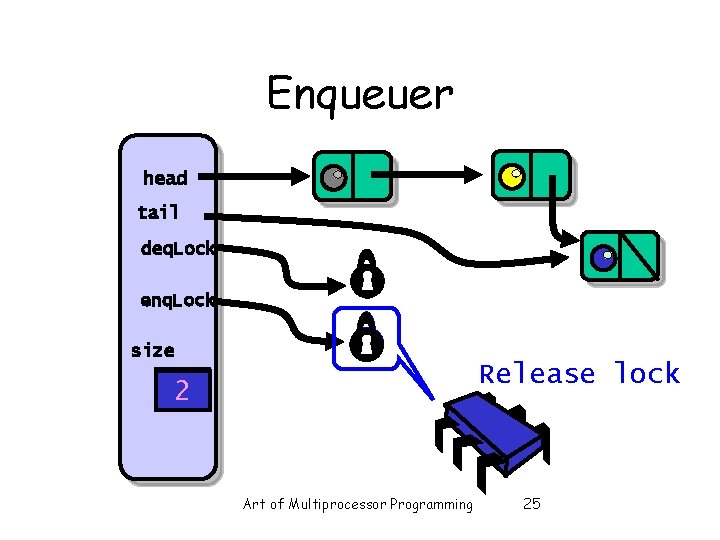
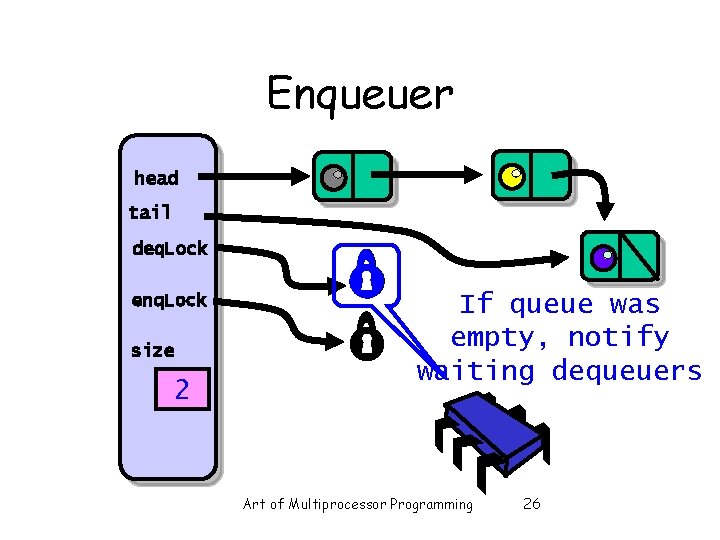
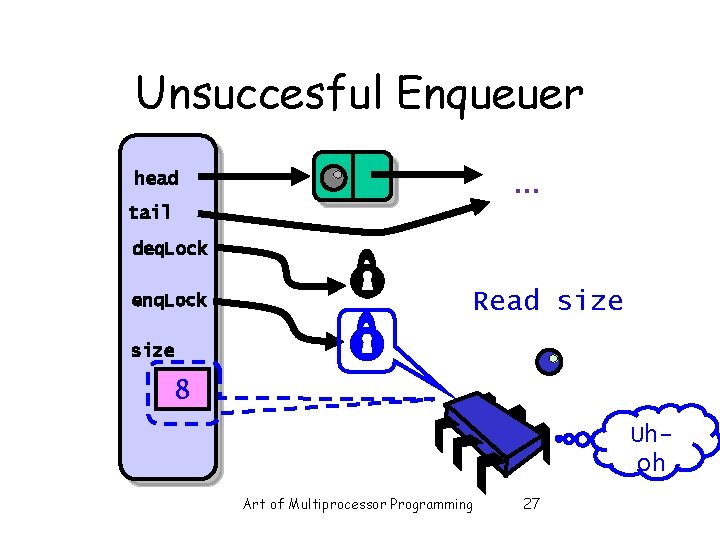
enqueue 1. 2. 3. 4. 5. 6. 7. 8. Acquires enq. Lock Reads the size field If full, enqueuer must wait until dequeuer makes room enqueuer waits on not. Full. Condition field, releasing enq. Lock temporarily, and blocking until that condition is signaled. Each time thread awakens, it checks whethere is a room, and if not, goes back to sleep Insert new item into tail Release enq. Lock If queue was empty, notify/signal waiting dequeuers Art of Multiprocessor Programming© Herlihy-Shavit 2007 11
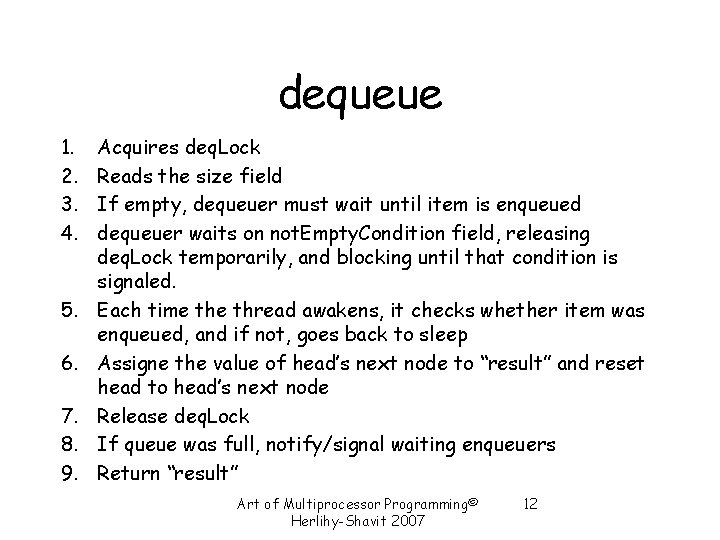
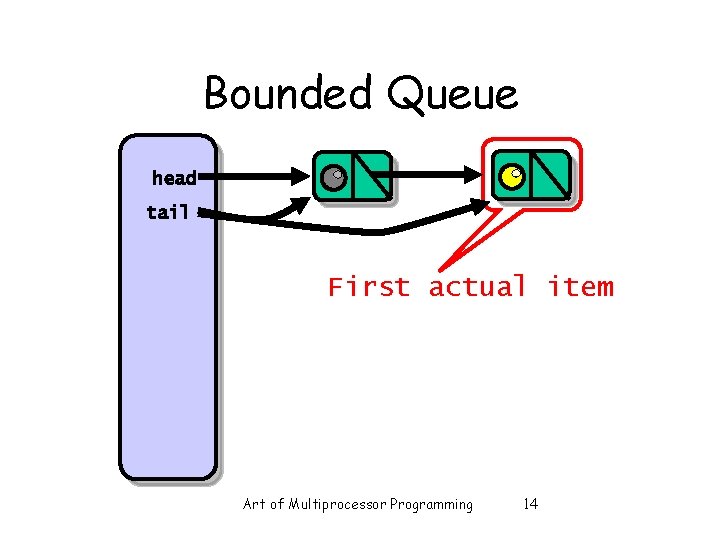
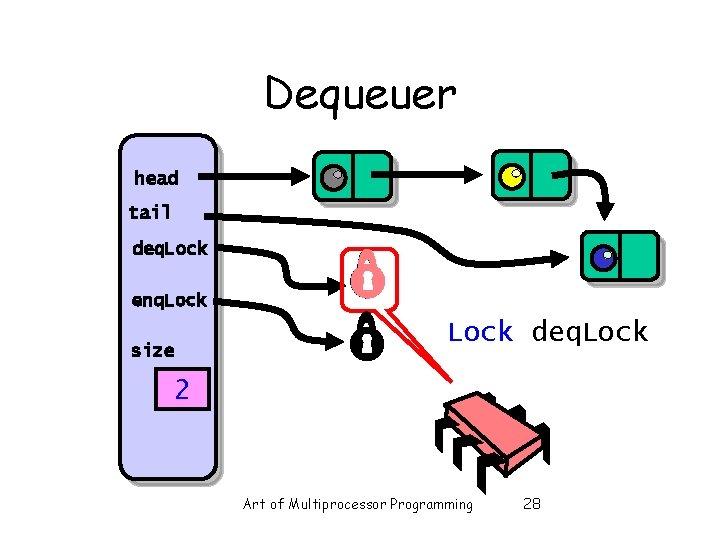
dequeue 1. 2. 3. 4. 5. 6. 7. 8. 9. Acquires deq. Lock Reads the size field If empty, dequeuer must wait until item is enqueued dequeuer waits on not. Empty. Condition field, releasing deq. Lock temporarily, and blocking until that condition is signaled. Each time thread awakens, it checks whether item was enqueued, and if not, goes back to sleep Assigne the value of head’s next node to “result” and reset head to head’s next node Release deq. Lock If queue was full, notify/signal waiting enqueuers Return “result” Art of Multiprocessor Programming© Herlihy-Shavit 2007 12
Bounded Queue head tail Sentinel Art of Multiprocessor Programming 13
Bounded Queue head tail First actual item Art of Multiprocessor Programming 14
Bounded Queue head tail deq. Lock out other deq() calls Art of Multiprocessor Programming 15
Bounded Queue head tail deq. Lock enq. Lock out other enq() calls Art of Multiprocessor Programming 16
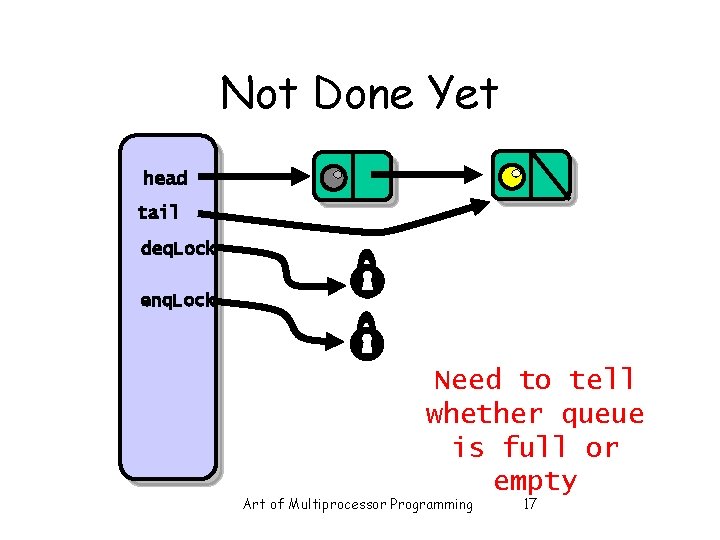
Not Done Yet head tail deq. Lock enq. Lock Need to tell whether queue is full or empty Art of Multiprocessor Programming 17
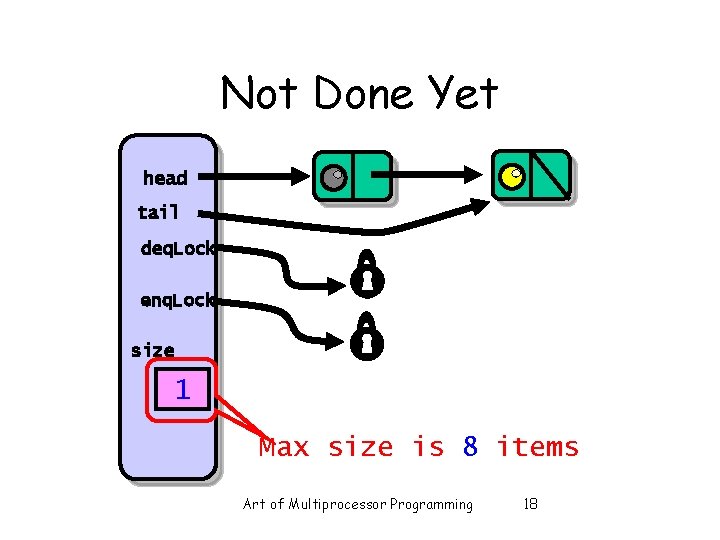
Not Done Yet head tail deq. Lock enq. Lock size 1 Max size is 8 items Art of Multiprocessor Programming 18
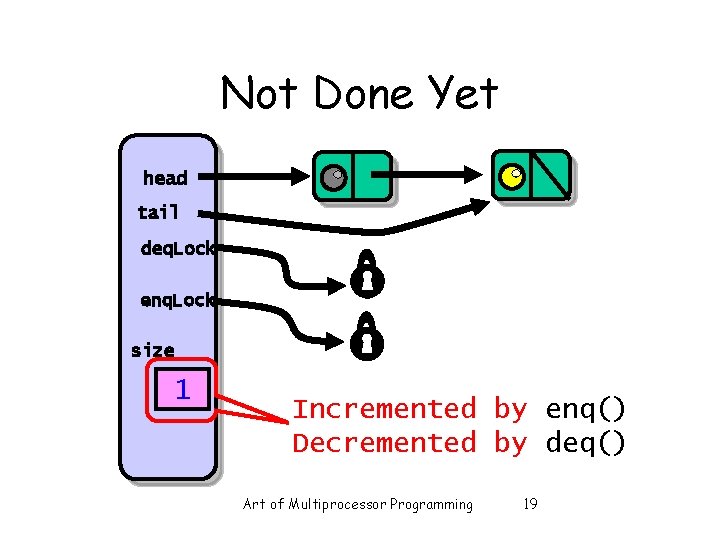
Not Done Yet head tail deq. Lock enq. Lock size 1 Incremented by enq() Decremented by deq() Art of Multiprocessor Programming 19
Enqueuer head tail deq. Lock enq. Lock size 1 Art of Multiprocessor Programming 20
Enqueuer head tail deq. Lock enq. Lock Read size 1 OK Art of Multiprocessor Programming 21
Enqueuer head tail deq. Lock No need to lock tail enq. Lock size 1 Art of Multiprocessor Programming 22
Enqueuer head tail deq. Lock enq. Lock Enqueue Node size 1 Art of Multiprocessor Programming 23
Enqueuer head tail deq. Lock enq. Lock size 2 1 get. Andincrement() Art of Multiprocessor Programming 24
Enqueuer head tail deq. Lock enq. Lock size Release lock 8 2 Art of Multiprocessor Programming 25
Enqueuer head tail deq. Lock enq. Lock size 2 If queue was empty, notify waiting dequeuers Art of Multiprocessor Programming 26
Unsuccesful Enqueuer … head tail deq. Lock enq. Lock Read size 8 Uhoh Art of Multiprocessor Programming 27
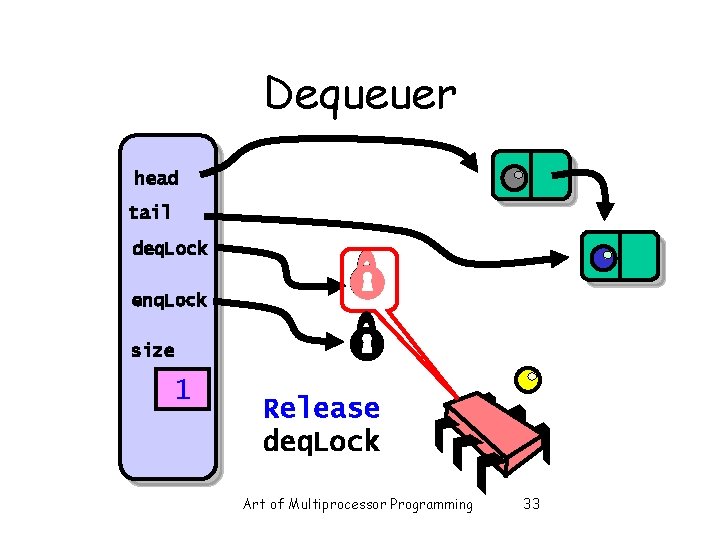
Dequeuer head tail deq. Lock enq. Lock size Lock deq. Lock 2 Art of Multiprocessor Programming 28
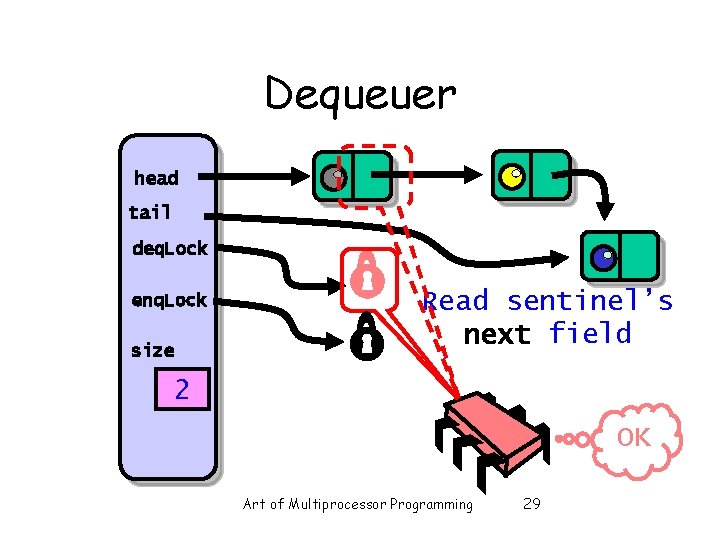
Dequeuer head tail deq. Lock enq. Lock size Read sentinel’s next field 2 OK Art of Multiprocessor Programming 29
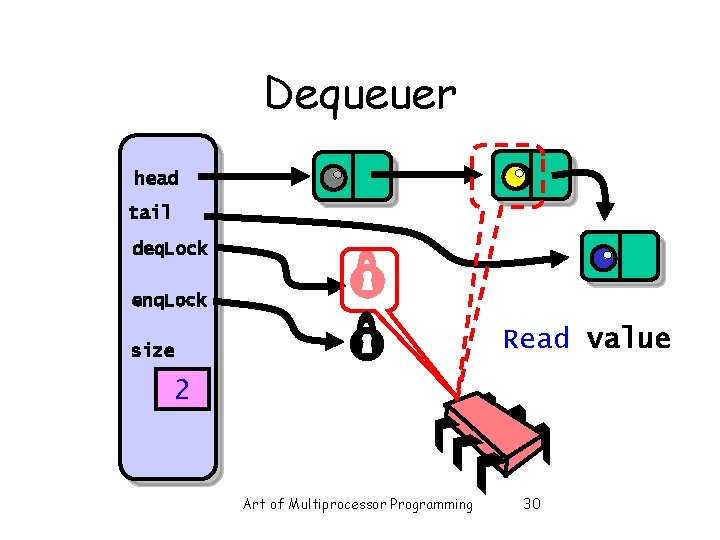
Dequeuer head tail deq. Lock enq. Lock Read value size 2 Art of Multiprocessor Programming 30
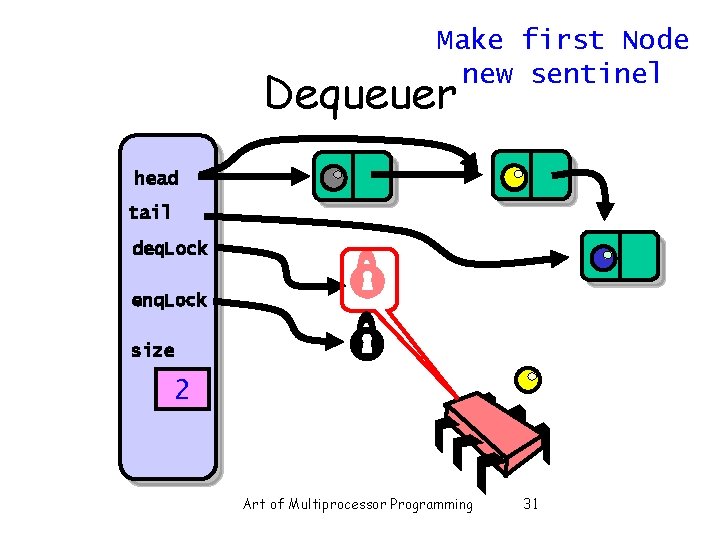
Make first Node new sentinel Dequeuer head tail deq. Lock enq. Lock size 2 Art of Multiprocessor Programming 31
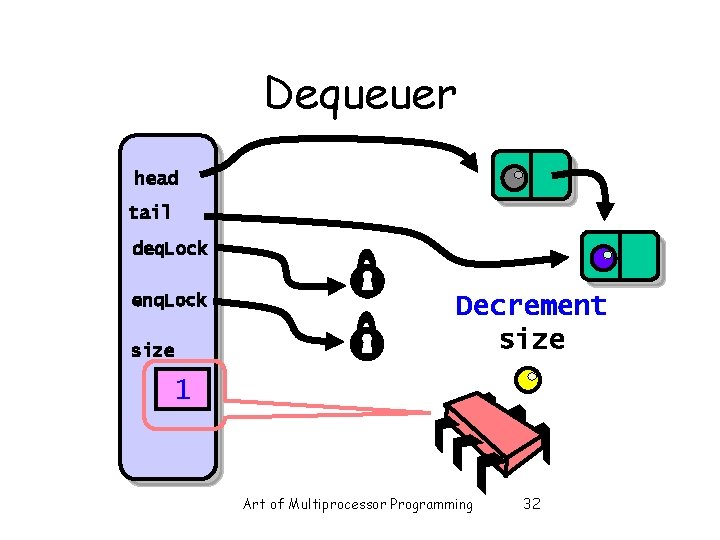
Dequeuer head tail deq. Lock enq. Lock size Decrement size 1 Art of Multiprocessor Programming 32
Dequeuer head tail deq. Lock enq. Lock size 1 Release deq. Lock Art of Multiprocessor Programming 33
Monitor Locks • Java Reentrant. Locks are monitors • Allow blocking on a condition rather than spinning • Threads: – acquire and release lock – wait on a condition Art of Multiprocessor Programming© Herlihy-Shavit 2007 34
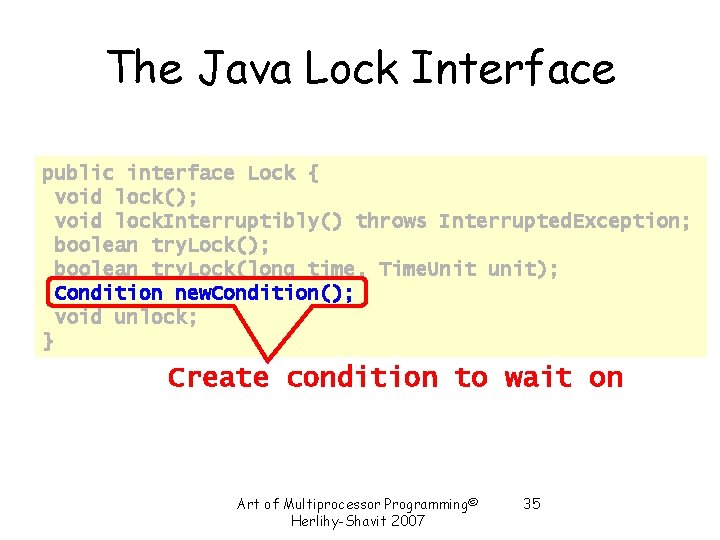
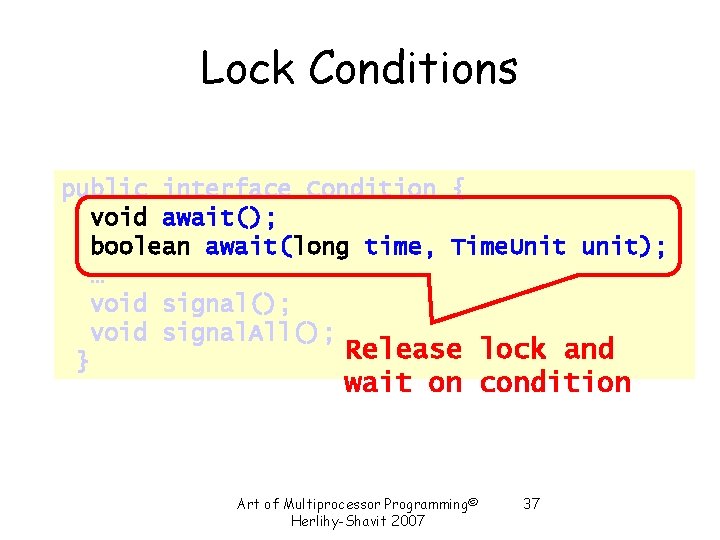
The Java Lock Interface public interface Lock { void lock(); void lock. Interruptibly() throws Interrupted. Exception; boolean try. Lock(); boolean try. Lock(long time, Time. Unit unit); Condition new. Condition(); void unlock; } Create condition to wait on Art of Multiprocessor Programming© Herlihy-Shavit 2007 35
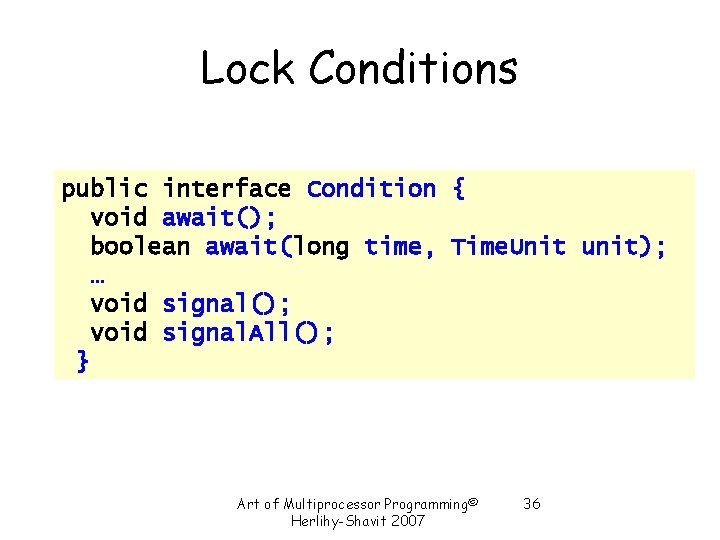
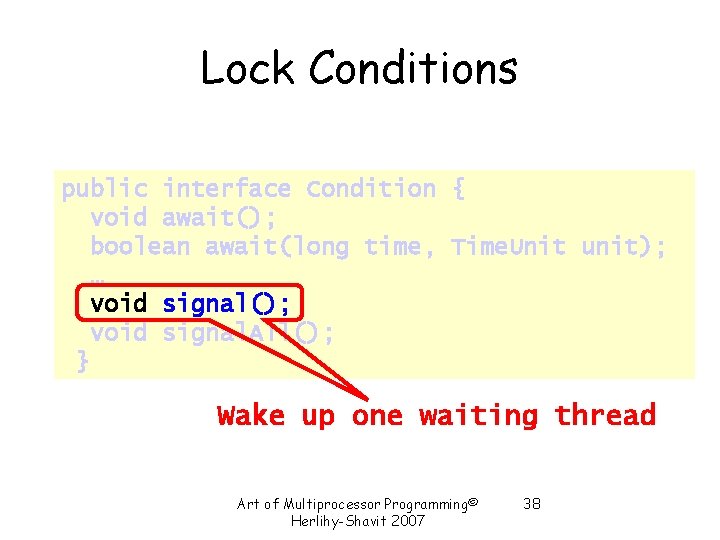
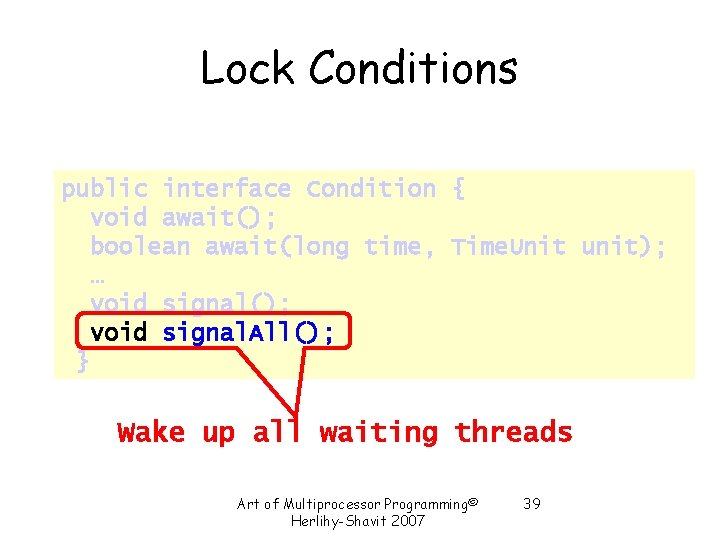
Lock Conditions public interface Condition { void await(); boolean await(long time, Time. Unit unit); … void signal(); void signal. All(); } Art of Multiprocessor Programming© Herlihy-Shavit 2007 36
Lock Conditions public interface Condition { void await(); boolean await(long time, Time. Unit unit); … void signal(); void signal. All(); Release lock and } wait on condition Art of Multiprocessor Programming© Herlihy-Shavit 2007 37
Lock Conditions public interface Condition { void await(); boolean await(long time, Time. Unit unit); … void signal(); void signal. All(); } Wake up one waiting thread Art of Multiprocessor Programming© Herlihy-Shavit 2007 38
Lock Conditions public interface Condition { void await(); boolean await(long time, Time. Unit unit); … void signal(); void signal. All(); } Wake up all waiting threads Art of Multiprocessor Programming© Herlihy-Shavit 2007 39
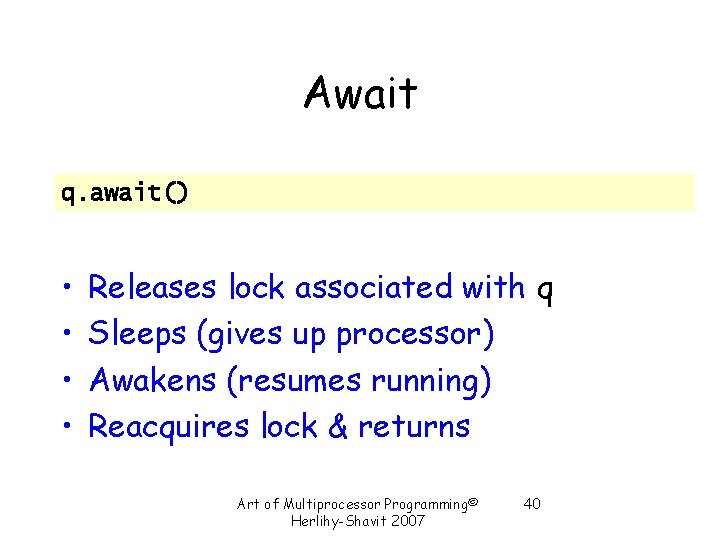
Await q. await() • • Releases lock associated with q Sleeps (gives up processor) Awakens (resumes running) Reacquires lock & returns Art of Multiprocessor Programming© Herlihy-Shavit 2007 40
Signal q. signal(); • Awakens one waiting thread – Which will reacquire lock Art of Multiprocessor Programming© Herlihy-Shavit 2007 41
Signal All q. signal. All(); • Awakens all waiting threads – Which will each reacquire lock Art of Multiprocessor Programming© Herlihy-Shavit 2007 42
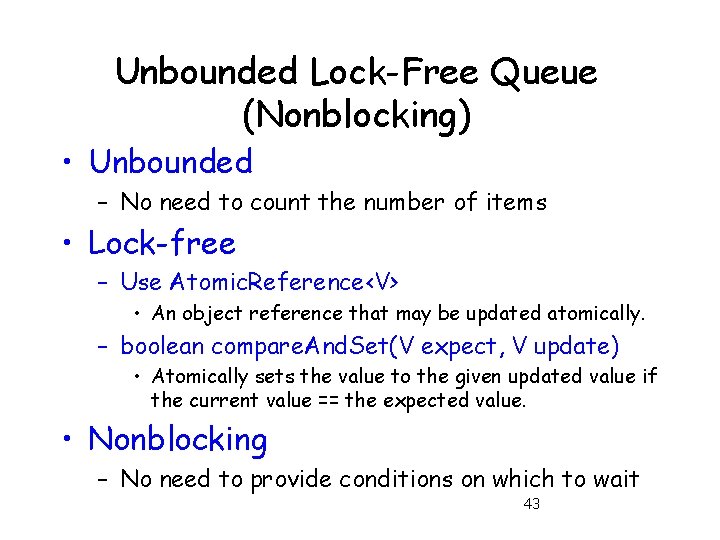
Unbounded Lock-Free Queue (Nonblocking) • Unbounded – No need to count the number of items • Lock-free – Use Atomic. Reference<V> • An object reference that may be updated atomically. – boolean compare. And. Set(V expect, V update) • Atomically sets the value to the given updated value if the current value == the expected value. • Nonblocking – No need to provide conditions on which to wait 43
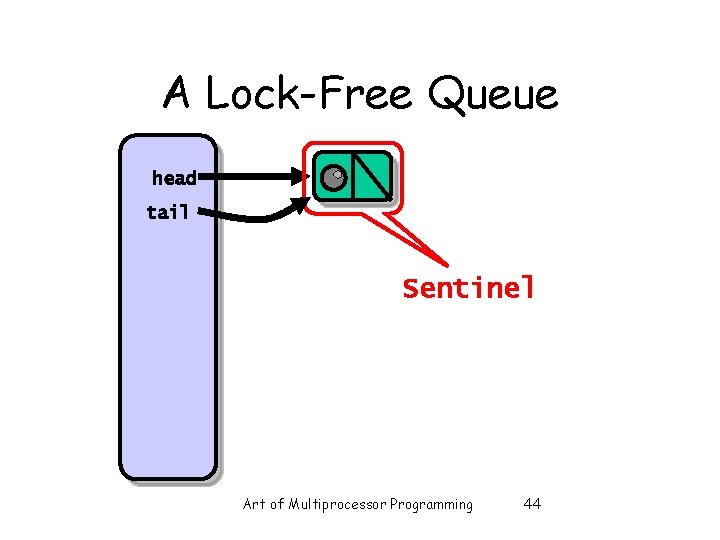
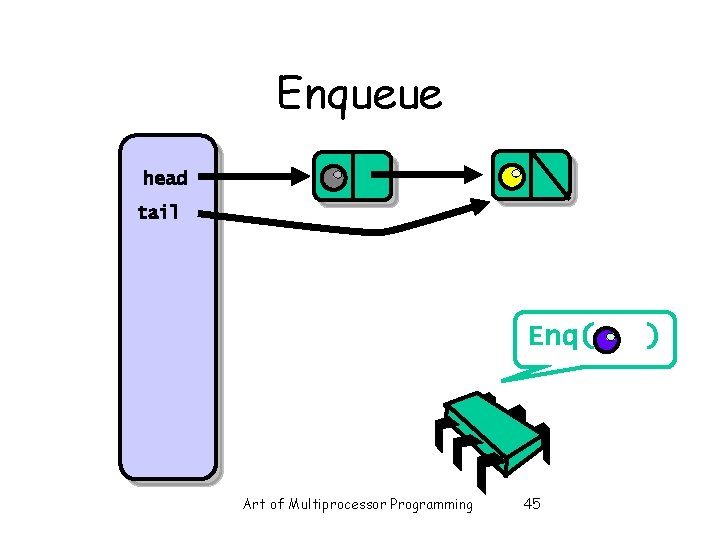
A Lock-Free Queue head tail Sentinel Art of Multiprocessor Programming 44
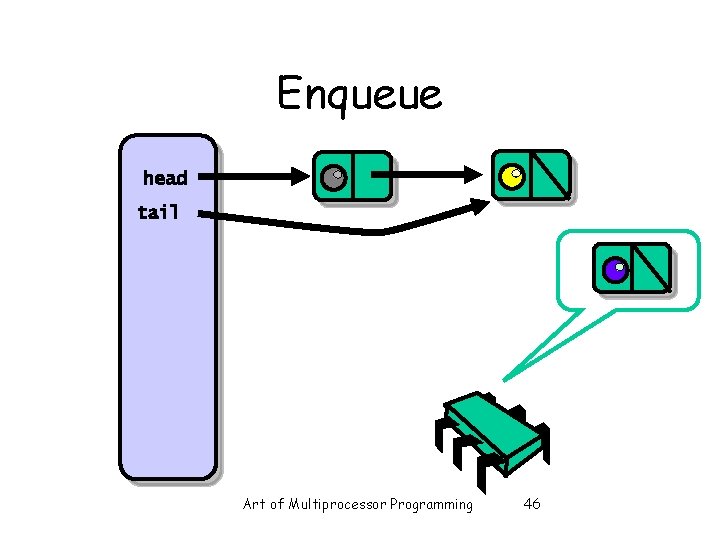
Enqueue head tail Enq( Art of Multiprocessor Programming 45 )
Enqueue head tail Art of Multiprocessor Programming 46
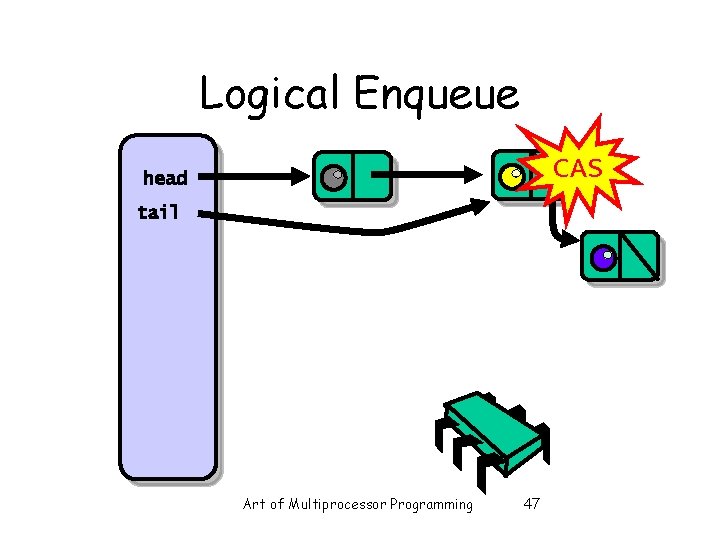
Logical Enqueue CAS head tail Art of Multiprocessor Programming 47
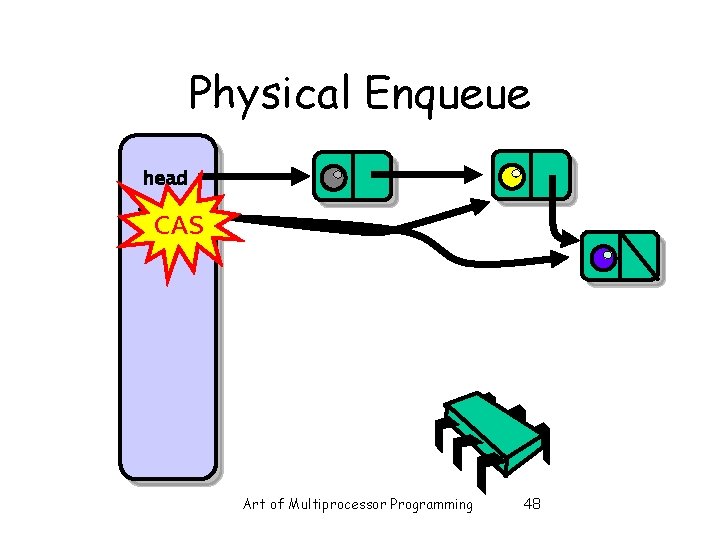
Physical Enqueue head tail CAS Art of Multiprocessor Programming 48
Enqueue • These two steps are not atomic • The tail field refers to either – Actual last Node (good) – Penultimate Node (not so good) • Be prepared! Art of Multiprocessor Programming 49
Enqueue • What do you do if you find – A trailing tail? • Stop and help fix it – If tail node has non-null next field – CAS the queue’s tail field to tail. next • As in the universal construction Art of Multiprocessor Programming 50
When CASs Fail • During logical enqueue – Abandon hope, restart – Still lock-free (why? ) • During physical enqueue – Ignore it (why? ) Art of Multiprocessor Programming 51
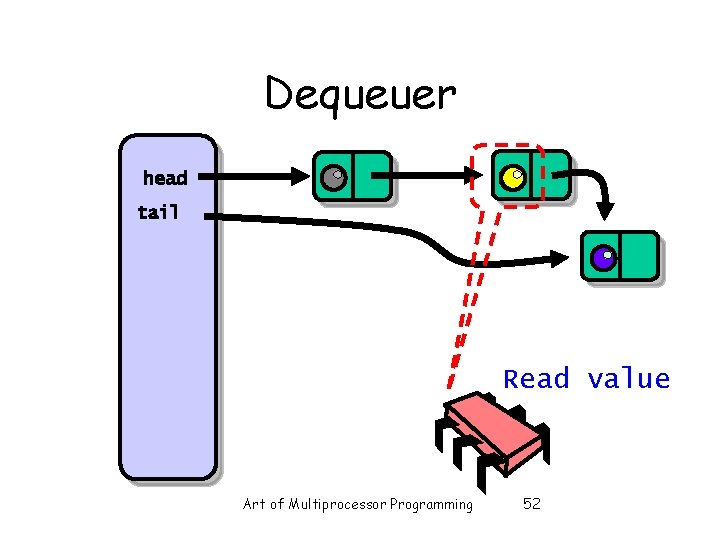
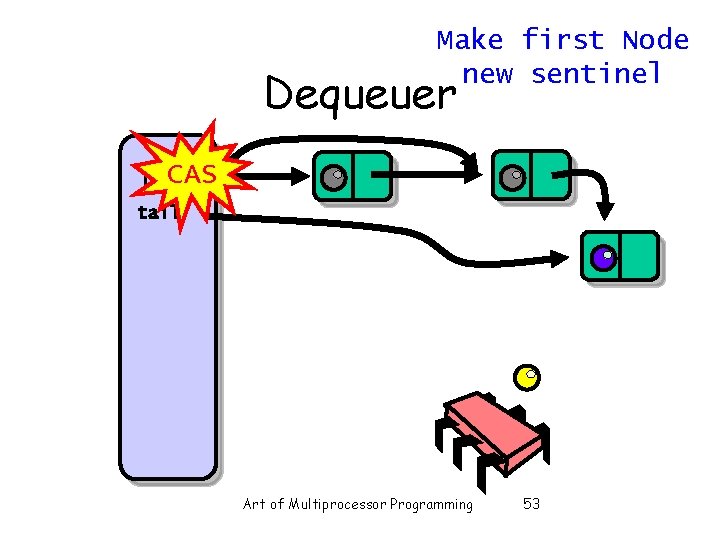
Dequeuer head tail Read value Art of Multiprocessor Programming 52
Make first Node new sentinel Dequeuer CAS head tail Art of Multiprocessor Programming 53
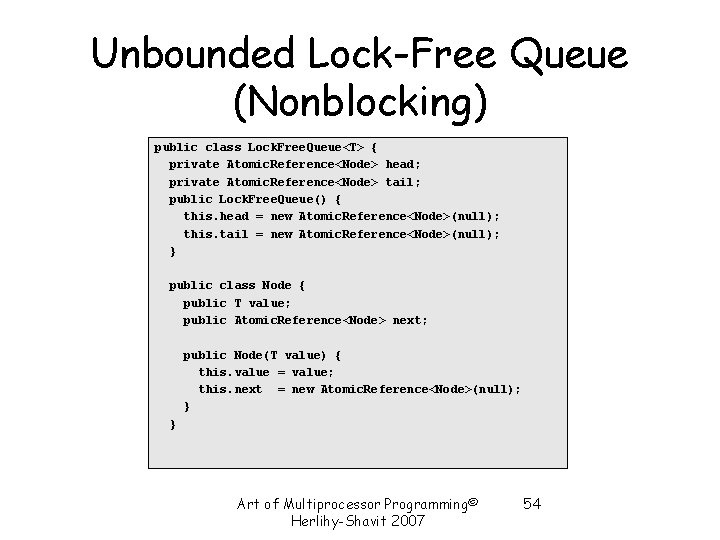
Unbounded Lock-Free Queue (Nonblocking) public class Lock. Free. Queue<T> { private Atomic. Reference<Node> head; private Atomic. Reference<Node> tail; public Lock. Free. Queue() { this. head = new Atomic. Reference<Node>(null); this. tail = new Atomic. Reference<Node>(null); } public class Node { public T value; public Atomic. Reference<Node> next; public Node(T value) { this. value = value; this. next = new Atomic. Reference<Node>(null); } } Art of Multiprocessor Programming© Herlihy-Shavit 2007 54
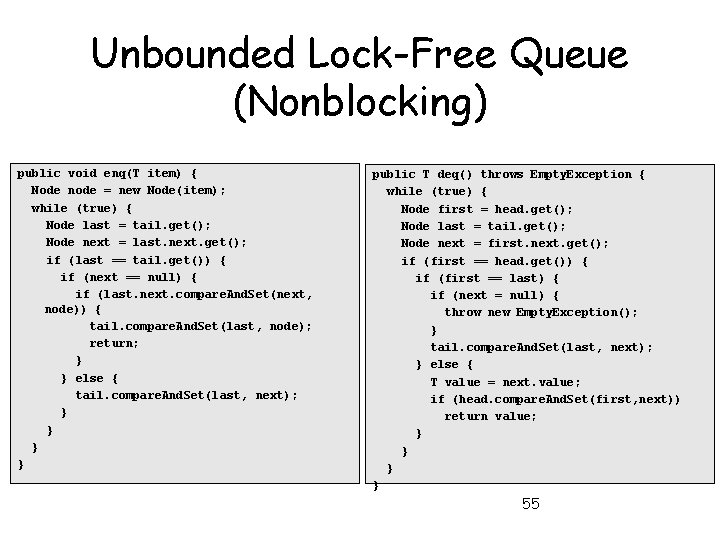
Unbounded Lock-Free Queue (Nonblocking) public void enq(T item) { Node node = new Node(item); while (true) { Node last = tail. get(); Node next = last. next. get(); if (last == tail. get()) { if (next == null) { if (last. next. compare. And. Set(next, node)) { tail. compare. And. Set(last, node); return; } } else { tail. compare. And. Set(last, next); } } public T deq() throws Empty. Exception { while (true) { Node first = head. get(); Node last = tail. get(); Node next = first. next. get(); if (first == head. get()) { if (first == last) { if (next = null) { throw new Empty. Exception(); } tail. compare. And. Set(last, next); } else { T value = next. value; if (head. compare. And. Set(first, next)) return value; } } 55
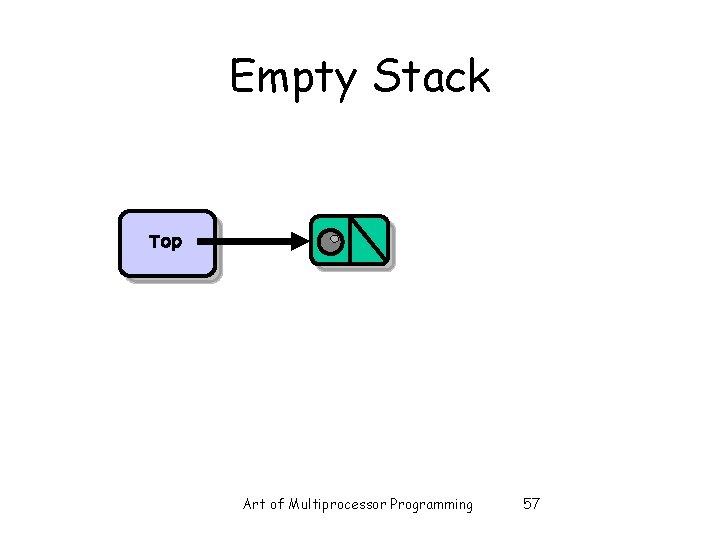
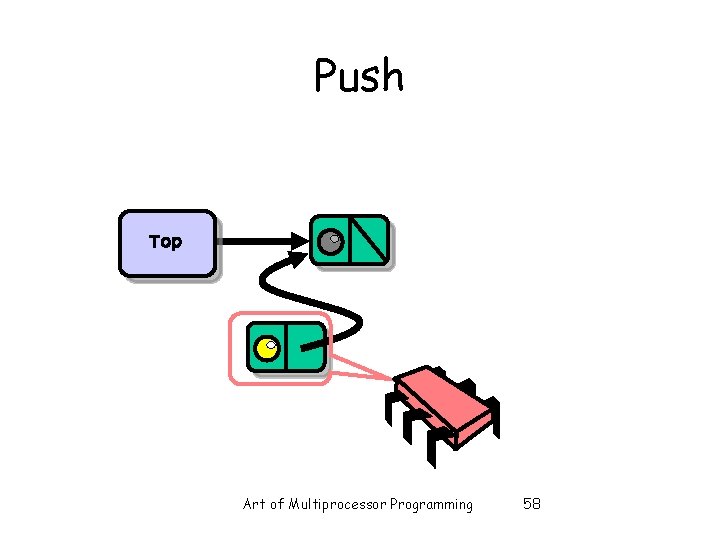
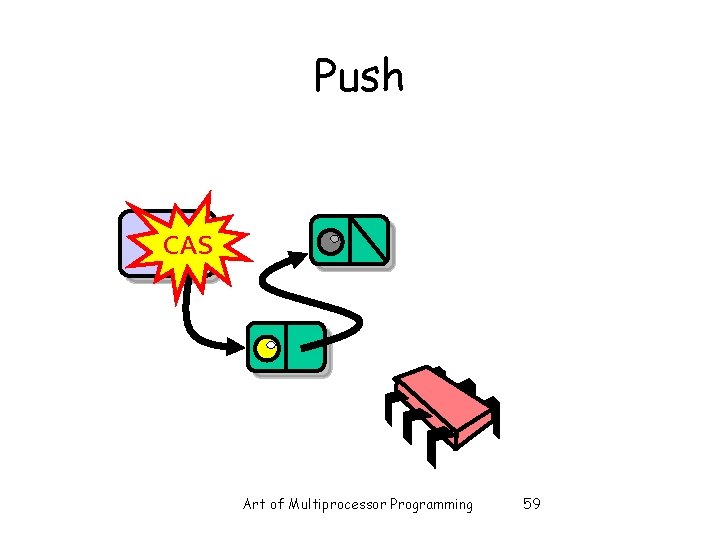
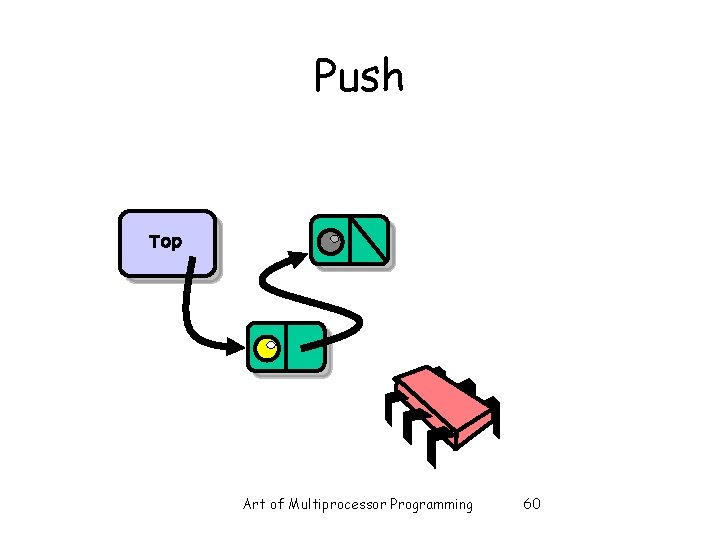
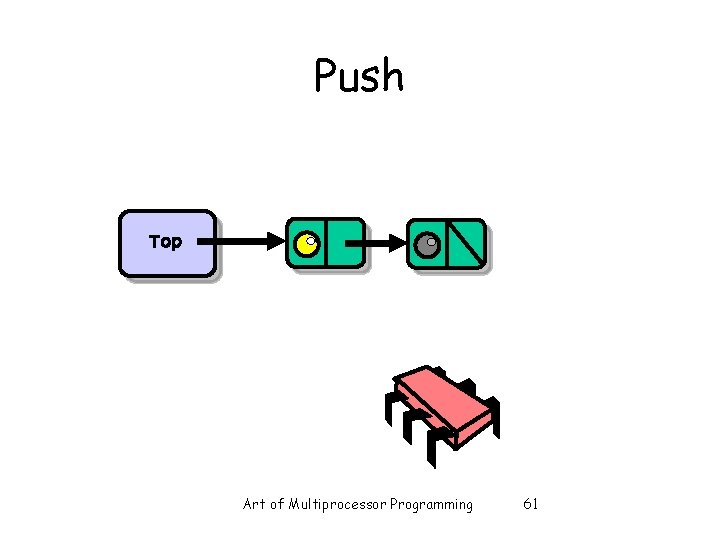
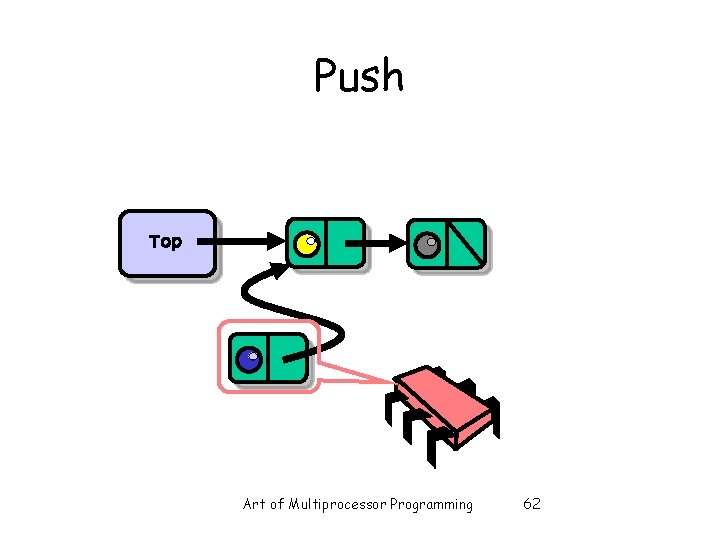
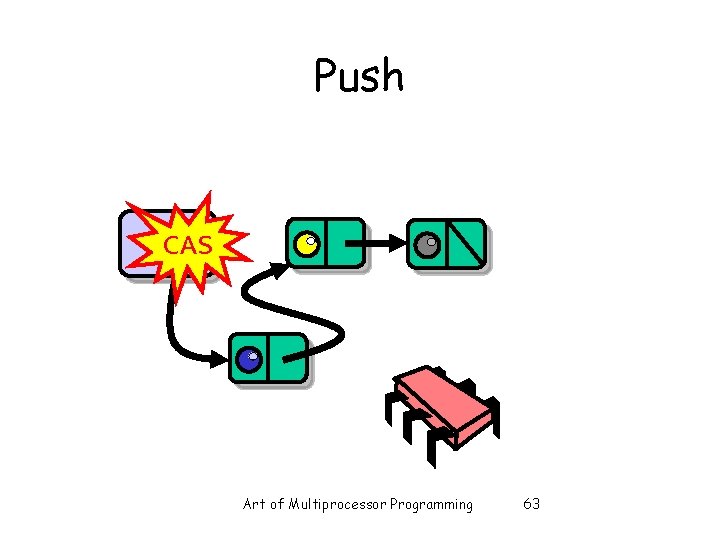
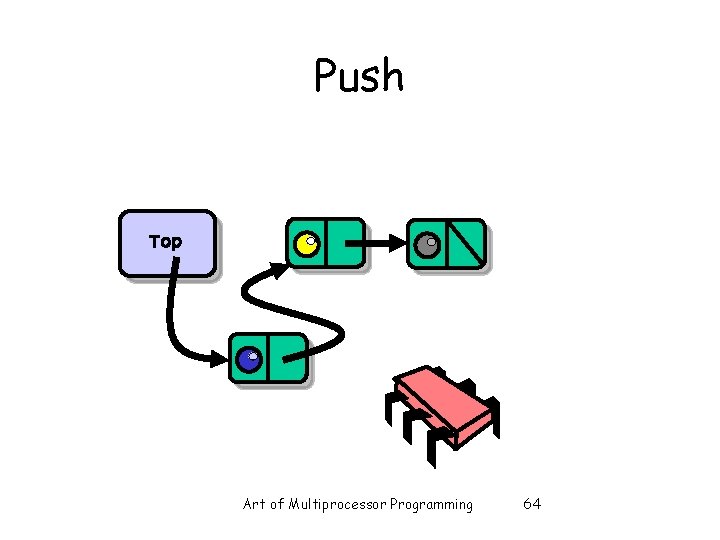
Concurrent Stack • Methods – push(x) – pop() • Last-in, First-out (LIFO) order • Lock-Free! Art of Multiprocessor Programming 56
Empty Stack Top Art of Multiprocessor Programming 57
Push Top Art of Multiprocessor Programming 58
Push Top CAS Art of Multiprocessor Programming 59
Push Top Art of Multiprocessor Programming 60
Push Top Art of Multiprocessor Programming 61
Push Top Art of Multiprocessor Programming 62
Push Top CAS Art of Multiprocessor Programming 63
Push Top Art of Multiprocessor Programming 64
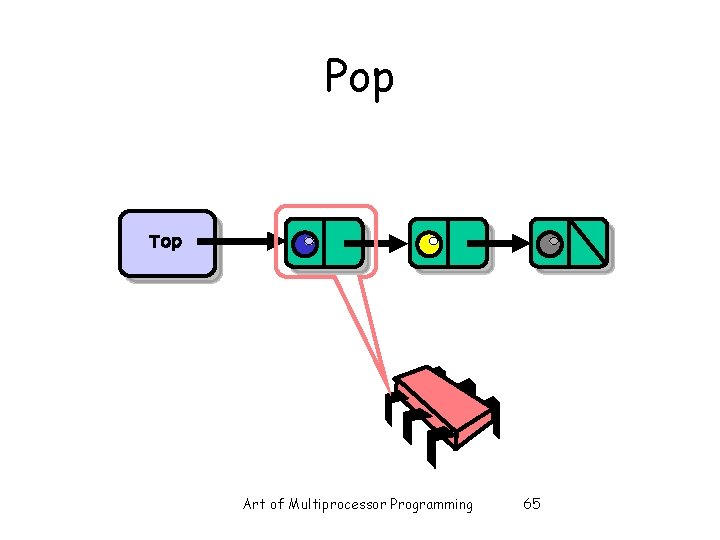
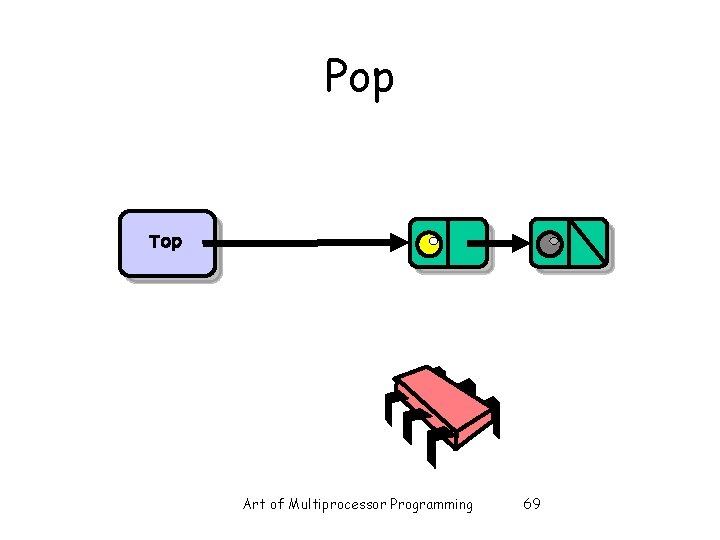
Pop Top Art of Multiprocessor Programming 65
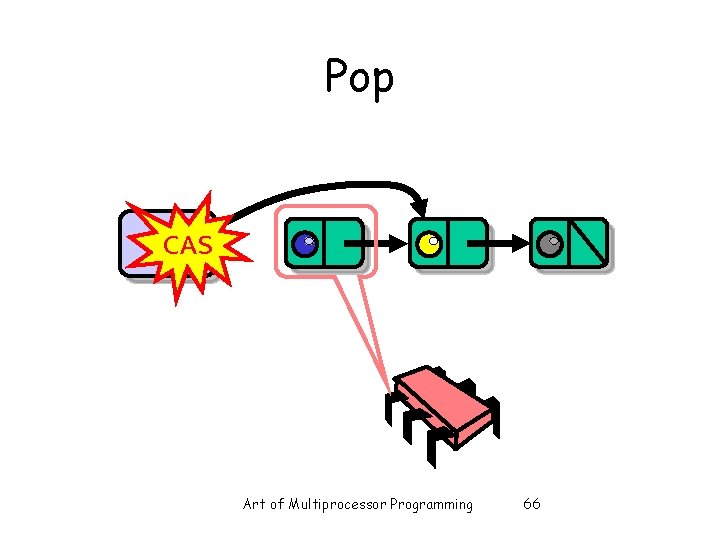
Pop Top CAS Art of Multiprocessor Programming 66
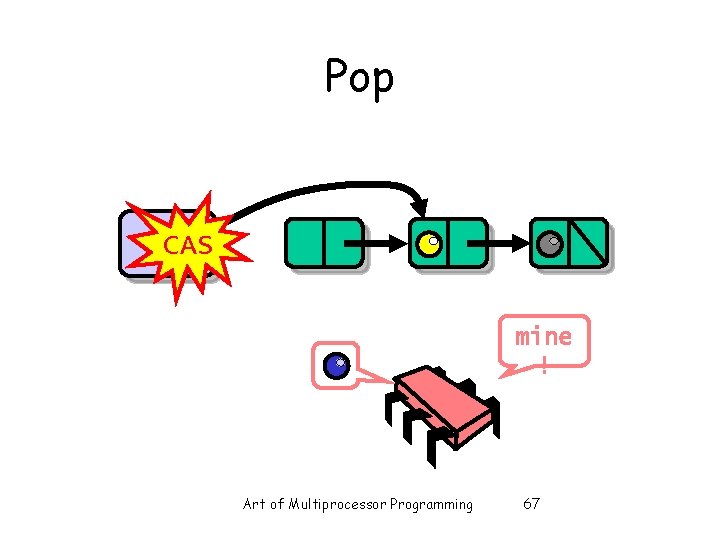
Pop Top CAS mine ! Art of Multiprocessor Programming 67
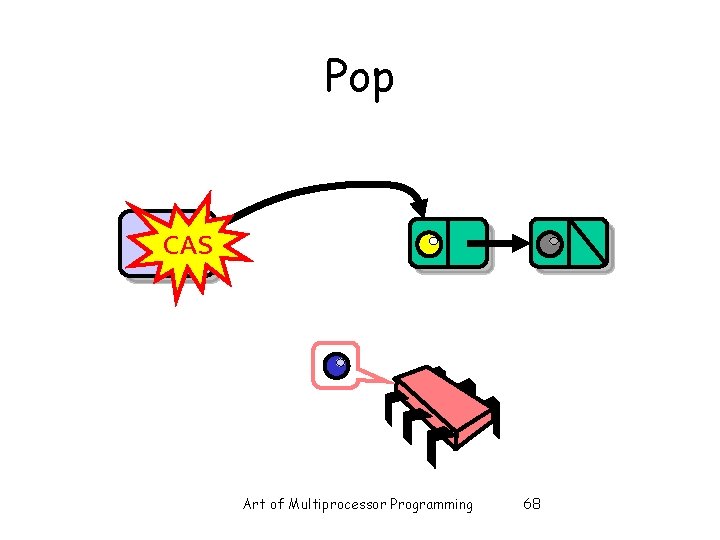
Pop Top CAS Art of Multiprocessor Programming 68
Pop Top Art of Multiprocessor Programming 69
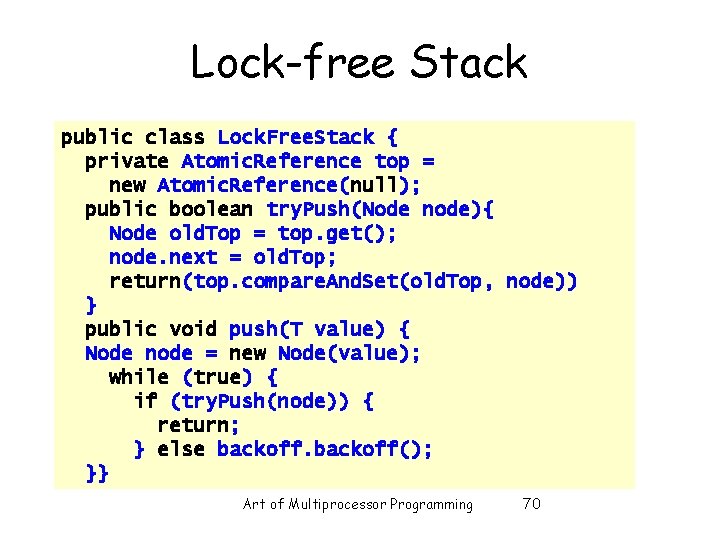
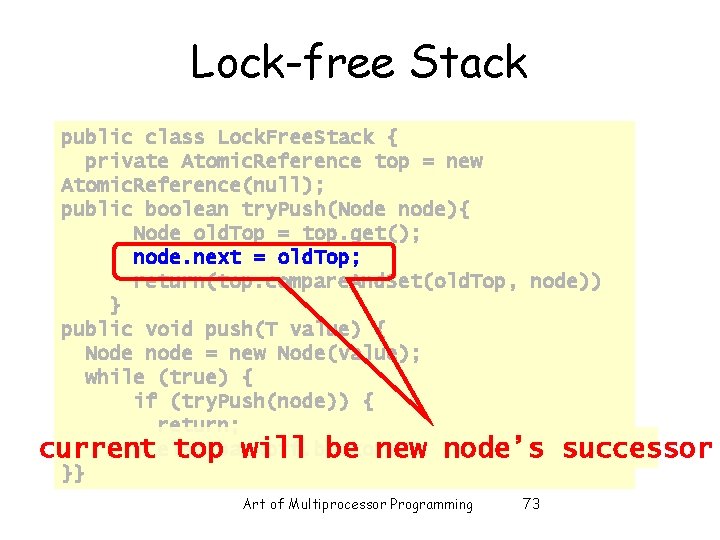
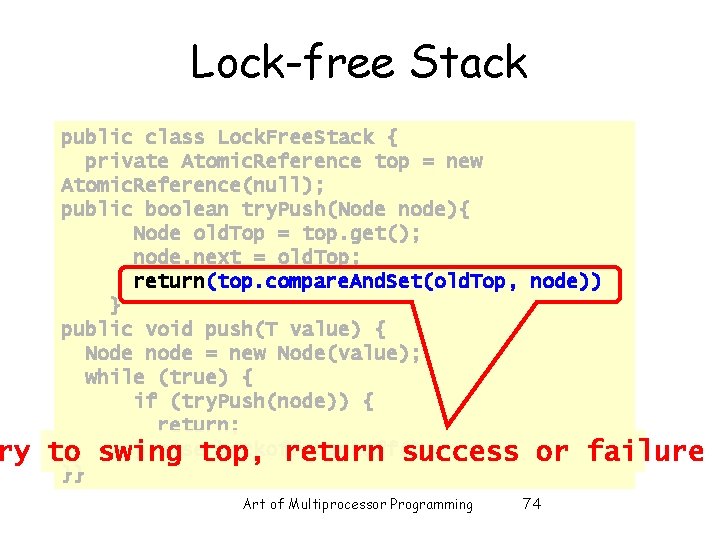
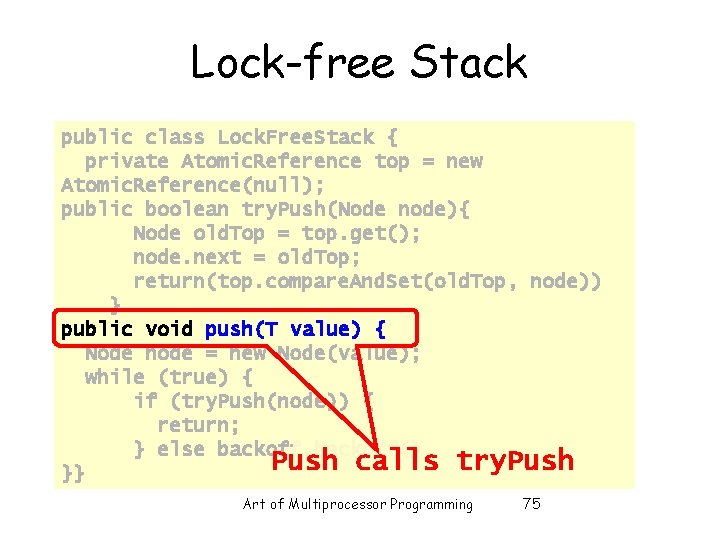
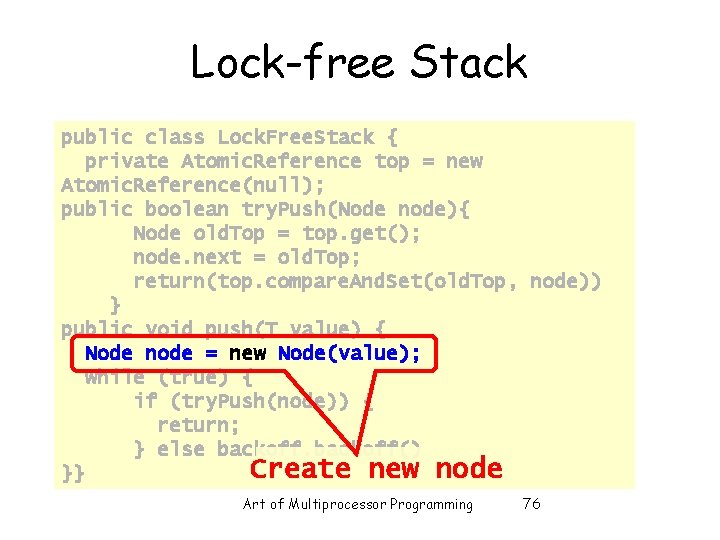
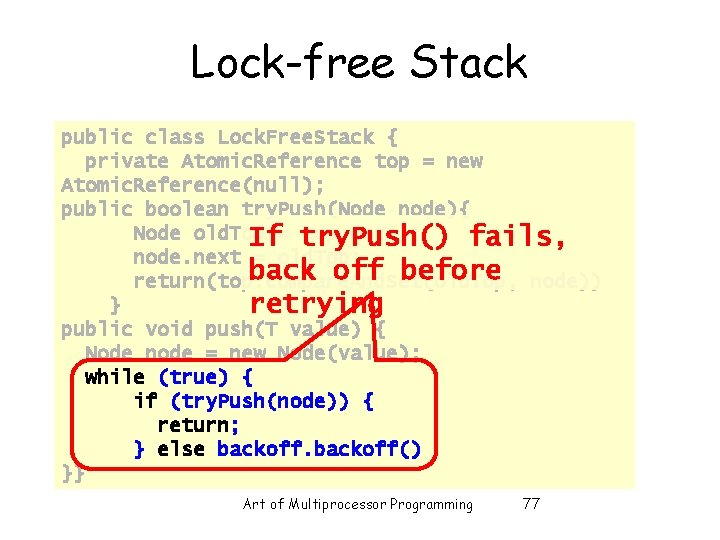
Lock-free Stack public class Lock. Free. Stack { private Atomic. Reference top = new Atomic. Reference(null); public boolean try. Push(Node node){ Node old. Top = top. get(); node. next = old. Top; return(top. compare. And. Set(old. Top, node)) } public void push(T value) { Node node = new Node(value); while (true) { if (try. Push(node)) { return; } else backoff(); }} Art of Multiprocessor Programming 70
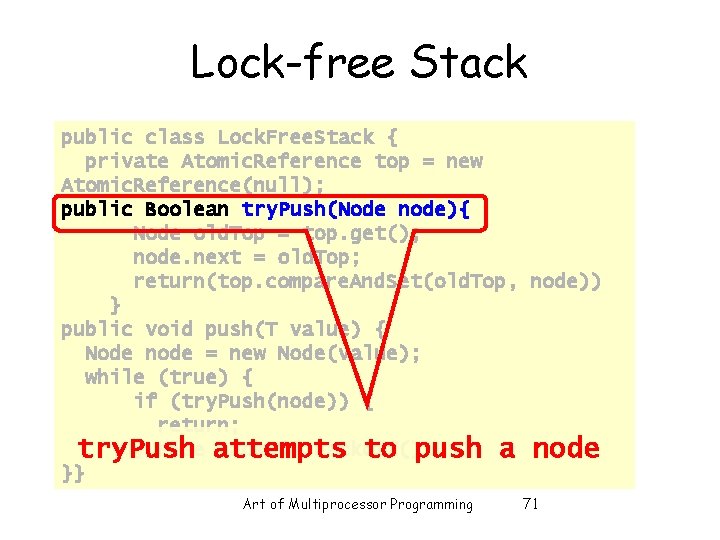
Lock-free Stack public class Lock. Free. Stack { private Atomic. Reference top = new Atomic. Reference(null); public Boolean try. Push(Node node){ Node old. Top = top. get(); node. next = old. Top; return(top. compare. And. Set(old. Top, node)) } public void push(T value) { Node node = new Node(value); while (true) { if (try. Push(node)) { return; } else attempts backoff() try. Push to push a node }} Art of Multiprocessor Programming 71
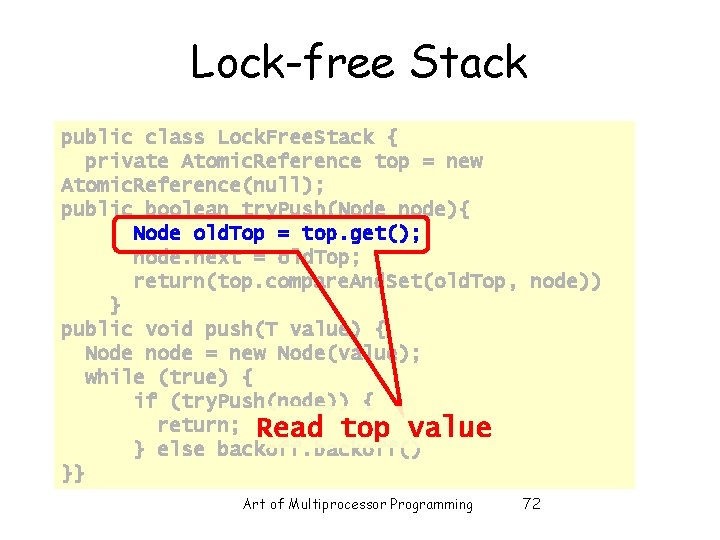
Lock-free Stack public class Lock. Free. Stack { private Atomic. Reference top = new Atomic. Reference(null); public boolean try. Push(Node node){ Node old. Top = top. get(); node. next = old. Top; return(top. compare. And. Set(old. Top, node)) } public void push(T value) { Node node = new Node(value); while (true) { if (try. Push(node)) { return; Read top value } else backoff() }} Art of Multiprocessor Programming 72
Lock-free Stack public class Lock. Free. Stack { private Atomic. Reference top = new Atomic. Reference(null); public boolean try. Push(Node node){ Node old. Top = top. get(); node. next = old. Top; return(top. compare. And. Set(old. Top, node)) } public void push(T value) { Node node = new Node(value); while (true) { if (try. Push(node)) { return; } else current topbackoff() will be new node’s successor }} Art of Multiprocessor Programming 73
ry Lock-free Stack public class Lock. Free. Stack { private Atomic. Reference top = new Atomic. Reference(null); public boolean try. Push(Node node){ Node old. Top = top. get(); node. next = old. Top; return(top. compare. And. Set(old. Top, node)) } public void push(T value) { Node node = new Node(value); while (true) { if (try. Push(node)) { return; } elsetop, backoff() to swing return success or failure }} Art of Multiprocessor Programming 74
Lock-free Stack public class Lock. Free. Stack { private Atomic. Reference top = new Atomic. Reference(null); public boolean try. Push(Node node){ Node old. Top = top. get(); node. next = old. Top; return(top. compare. And. Set(old. Top, node)) } public void push(T value) { Node node = new Node(value); while (true) { if (try. Push(node)) { return; } else backoff() Push calls try. Push }} Art of Multiprocessor Programming 75
Lock-free Stack public class Lock. Free. Stack { private Atomic. Reference top = new Atomic. Reference(null); public boolean try. Push(Node node){ Node old. Top = top. get(); node. next = old. Top; return(top. compare. And. Set(old. Top, node)) } public void push(T value) { Node node = new Node(value); while (true) { if (try. Push(node)) { return; } else backoff() Create new node }} Art of Multiprocessor Programming 76
Lock-free Stack public class Lock. Free. Stack { private Atomic. Reference top = new Atomic. Reference(null); public boolean try. Push(Node node){ Node old. Top top. get(); If= try. Push() fails, node. next = old. Top; back off before node)) return(top. compare. And. Set(old. Top, } retrying public void push(T value) { Node node = new Node(value); while (true) { if (try. Push(node)) { return; } else backoff() }} Art of Multiprocessor Programming 77
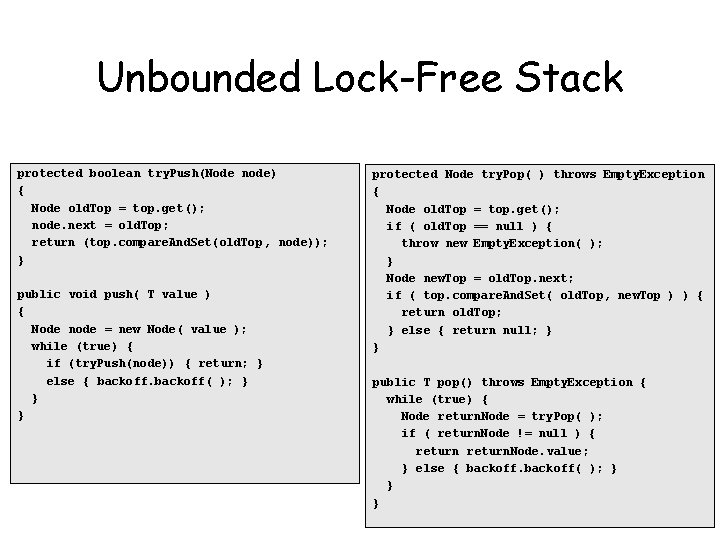
Unbounded Lock-Free Stack protected boolean try. Push(Node node) { Node old. Top = top. get(); node. next = old. Top; return (top. compare. And. Set(old. Top , node)); } public void push( T value ) { Node node = new Node( value ); while (true) { if (try. Push(node)) { return; } else { backoff( ); } } } protected Node try. Pop( ) throws Empty. Exception { Node old. Top = top. get(); if ( old. Top == null ) { throw new Empty. Exception( ); } Node new. Top = old. Top. next; if ( top. compare. And. Set( old. Top, new. Top ) ) { return old. Top; } else { return null; } } public T pop() throws Empty. Exception { while (true) { Node return. Node = try. Pop( ); if ( return. Node != null ) { return. Node. value; } else { backoff( ); } } } 78
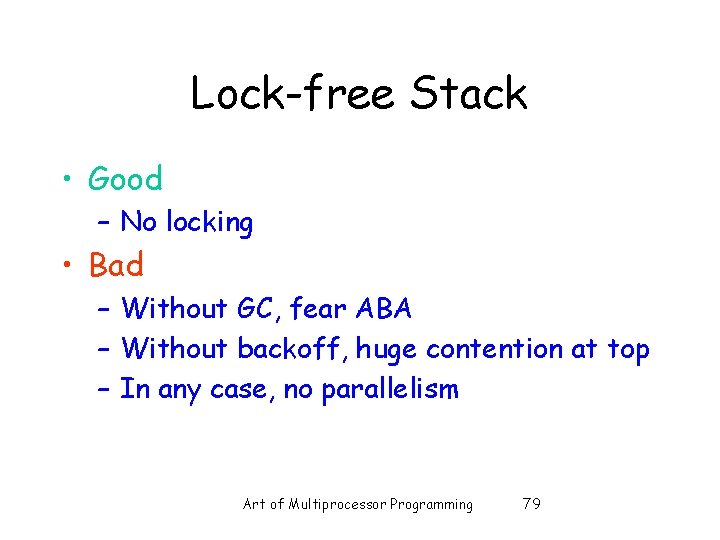
Lock-free Stack • Good – No locking • Bad – Without GC, fear ABA – Without backoff, huge contention at top – In any case, no parallelism Art of Multiprocessor Programming 79
Question • Are stacks inherently sequential? • Reasons why – Every pop() call fights for top item • Reasons why not – Think about it! Art of Multiprocessor Programming 80