
Lecture 5 The Legislature Part 1 Congressional Authority
- Slides: 19
Lecture 5 The Legislature Part 1: Congressional Authority over Internal Affairs: Institutional Independence and Integrity
This lecture will cover the first two sections of this chapter A brief overview of the legislative branch Authority over Congressional Internal Affairs Qualifications Term Limits Speech and Debate Clause For this lecture, you should read pages 121 -144. Before the next lecture, you should carefully read Article I, Section 8 of the Constitution. It is about a paragraph long.
The Legislative Branch Article I of the Constitution spells out information on the Legislative Branch of government You may notice that it is longer than either Articles II or III Perhaps the most important part is Article 1, Section 8 17 specific powers Necessary and proper clause (catch-all) The structure born of compromise Between large and small states Bicameralism
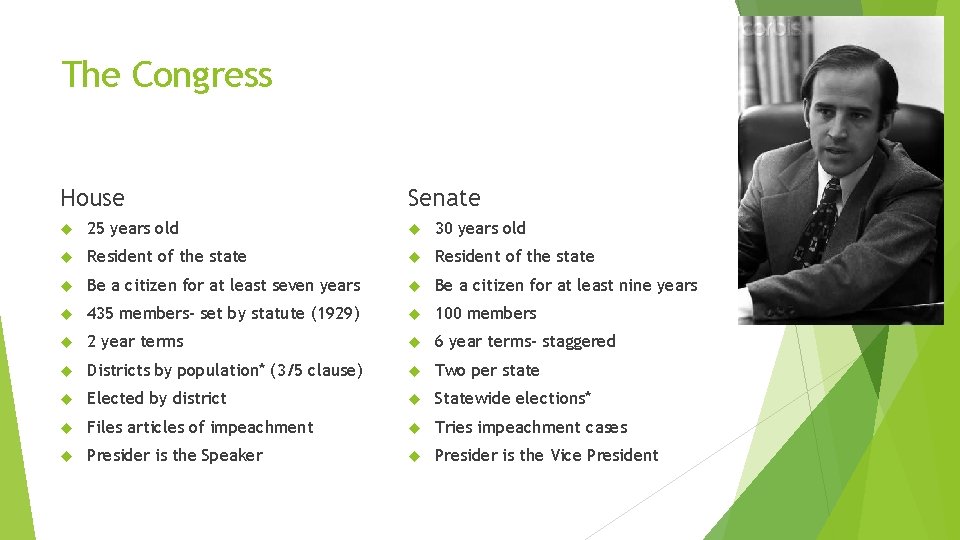
The Congress House Senate 25 years old 30 years old Resident of the state Be a citizen for at least seven years Be a citizen for at least nine years 435 members- set by statute (1929) 100 members 2 year terms 6 year terms- staggered Districts by population* (3/5 clause) Two per state Elected by district Statewide elections* Files articles of impeachment Tries impeachment cases Presider is the Speaker Presider is the Vice President
The Major Cases this Chapter Powell v. Mc. Cormick (1969) U. S. Term Limits v. Thornton (1995) Gravel v. United States (1972) Mc. Culloch v. Maryland (1819) Mc. Grain v. Daugherty (1927) Watkins v. United States (1957) Barenblatt v. United States (1959) South Carolina v. Katzenbach (1966)
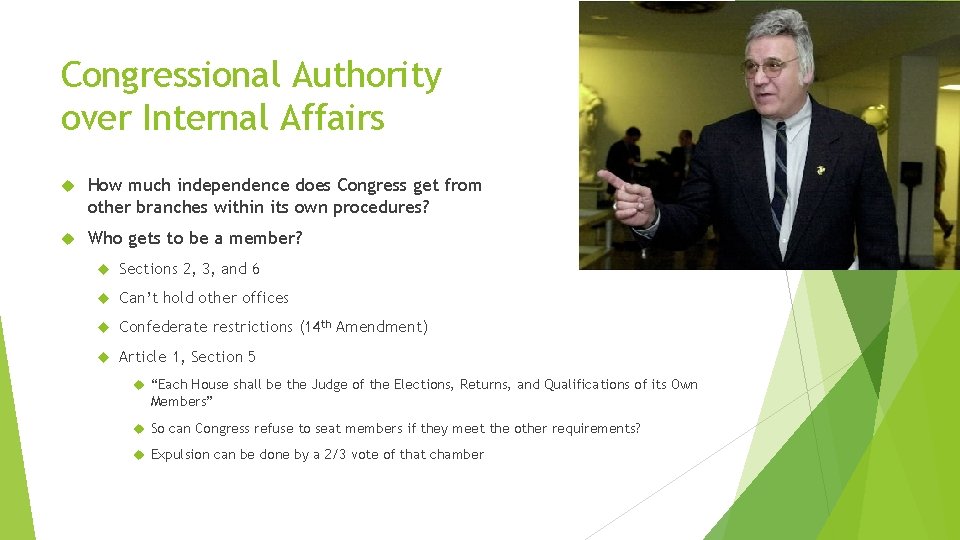
Congressional Authority over Internal Affairs How much independence does Congress get from other branches within its own procedures? Who gets to be a member? Sections 2, 3, and 6 Can’t hold other offices Confederate restrictions (14 th Amendment) Article 1, Section 5 “Each House shall be the Judge of the Elections, Returns, and Qualifications of its Own Members” So can Congress refuse to seat members if they meet the other requirements? Expulsion can be done by a 2/3 vote of that chamber
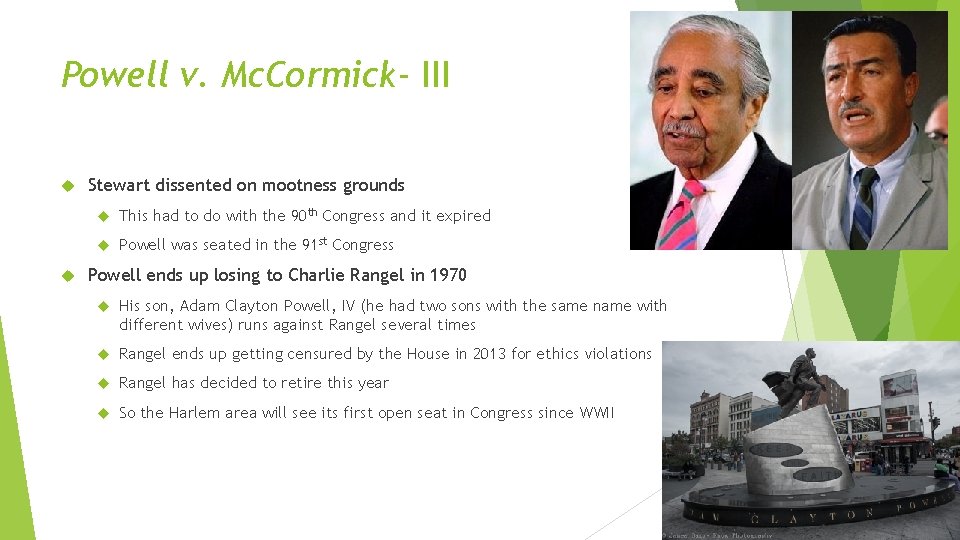
Powell v. Mc. Cormick (1969) Background Rep. Adam Clayton Powell, Jr. represented Harlem in Congress since 1944 Was a pastor at a church in Harlem Abyssinian Baptist He rose to become chair of the Education and Labor Committee But was stripped of that chair because of allegations of corruption He is reelected anyway in 1966, even with the investigation The House voted 307 -116 to exclude him from taking his seat as a result of the investigation, in March after he had been asked not to take his seat by the Speaker Powell gets reelected in 1968, does get seated then Why is this case now not moot? Back pay
Powell v. Mc. Cormick- II Powell said the Qualifications Clause does not allow the House to exclude someone The House said it was a political question And that the House was justified in how it proceeded Chief Justice Warren wrote for the majority By going back to the founding, the Court finds that the House did not have authority to exclude anyone who meets the qualifications for office and is duly elected to that office This is not a discretionary power of the House to deny someone a seat Congress can exclude someone who does not meet the qualifications for office Or, as somewhat suggested, the House could have seated Powell and then expelled him
Powell v. Mc. Cormick- III Stewart dissented on mootness grounds This had to do with the 90 th Congress and it expired Powell was seated in the 91 st Congress Powell ends up losing to Charlie Rangel in 1970 His son, Adam Clayton Powell, IV (he had two sons with the same name with different wives) runs against Rangel several times Rangel ends up getting censured by the House in 2013 for ethics violations Rangel has decided to retire this year So the Harlem area will see its first open seat in Congress since WWII
U. S. Term Limits v. Thornton (1995) Background: A lot of states pass referendum to limit the terms of members of Congress, including Arkansas in 1992 The Arkansas law was two Senate terms and three House terms Rep. Ray Thornton (D-Arkansas) and a number of voters sued, saying The Constitution sets out the requirements to be a member of Congress No one can either add or delete those This amounts to a new qualification for office The proponents of the law say It does not add a new qualification Even if it did, states have broad discretion over Congressional elections anyway This was not just the proponents- the Attorney General of Arkansas was also a petitioner
U. S. Term Limits v. Thornton- II Justice Stevens, for a 5 -4 Court States cannot add their own qualifications There is a national interest in having a uniform list of qualifications across states If proponents want term limits, they need to amend the Constitution- 22 nd Amendment on the Presidency Powell had said Congress could not add any new qualifications itself Qualifications are exclusive to the Constitution The people choose who govern them Stevens says that no one has found a prior case showing when a court anywhere approved of adding a new qualification by a state- in fact- the opposite Not reserved in the 10 th Amendment States divested of this authority by founders
U. S. Term Limits v. Thornton- III More from Stevens The Qualifications Clauses were written to prevent states from adding any more Hamilton had argued against mandatory rotation in favor of members needing to seek reelection The right to elect members of Congress belongs to the people, not the states He rejects that states have power under the Elections Clause as well He also rejects the argument of the write-in loophole
U. S. Term Limits v. Thornton- IV Thomas disagrees in his dissent Voters in Arkansas made an overwhelming choice for term limits The states did not divest of this power This power should be reserved to the states He says that the only prohibition is for states to abolish qualification requirements Some states did add disqualifications after the founding But Stevens said they didn’t last long Cook v. Gralike (2001) Missouri passed an amendment to “Disregarded Voters’ Instructions on Term Limits” next to the name of any incumbent that did not act to uphold term limits and added language for non-incumbents that did not sign a term limits pledge Stevens overturned this on the same logic
The Speech and Debate Clause Article 1, Section 6 The Senators and Representatives… shall in all Cases, except Treason, Felony and Breach of the Peace, be privileged from Arrest during their attendance at the Session of their Respective Houses, and in going to and from the same; and for any Speech or Debate in either House, they shall not be questioned in any other Place. This was to protect legislators from the executive branch Came from the British Bill of Rights Kilbourn v. Thompson (1881) When can Congress compel testimony? Inquiries must not "invade areas constitutionally reserved to the courts or the executive" Inquiries must deal "with subjects on which Congress could validly legislate" The resolution authorizing the investigation must specify " a congressional interest in legislating on that subject. " Where the inquiry can result in "no valid legislation, " then the "Private affairs of individuals" are not valid targets for inquiry
Gravel v. United States (1972) Background Sen. Mike Gravel (D-Alaska) read part of the Pentagon Papers into the committee record and asked them to be published The Justice Dept. investigated and subpoenaed an aide to Gravel and the publisher Questions: To whom do privileges under the speech and debate clause extend? Gravel said it extended to his staff, but the government says it only extends to the members Government says this can be abused by allowing members to exempt others Would punishing the publisher for publishing the papers violate the speech and debate clause because they had been written into the record Gravel says yes
Gravel v. United States- II White writes for the Court in a 5 -4 decision Privilege does extend to congressional aides Members can’t perform functions without them However, Rodberg does not get immunity here It only applies to things within the scope of legislative acts It isn’t a get out of jail free card for other actions of a member Publishing the papers were not “essential” to deliberations of the Senate An aide gets as much immunity as the member would The legislator has to invoke the privilege though But they find that these actions went beyond the legislative sphere
Gravel v. United States- III Several dissents (one isn’t in the book) By the time of this case, there were four Nixon appointees on the Court and it had shifted noticeably to the right Stewart Would have gone a lot further in protections He lists ways the executive could use its powers to intimidate the legislative branch Brennan They see to narrow a definition of legislative function He doesn’t see the distinction between releasing it on the Senate floor and then to a wider audience
Other cases on Speech and Debate Clause United States v. Brewster (1972) Protection for legislative acts, not all the legislative process So not a get out of jail free card on bribery Doe v. Mc. Millan (1973) Eastland v. U. S. Serviceman’s Fund (1975) Protection extends only to members and staff Extension to legislative counsel Davis v. Passman (1979) Involves sex discrimination- decided on other grounds
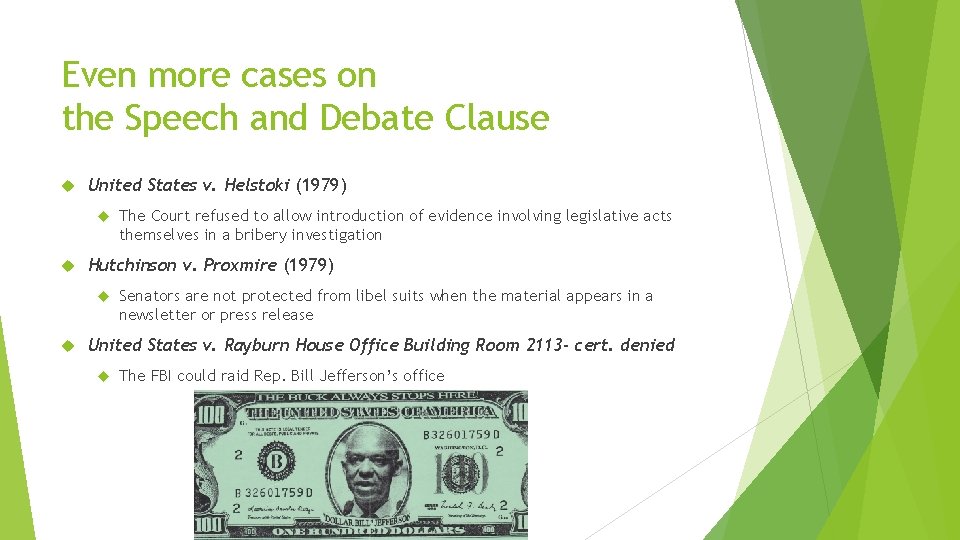
Even more cases on the Speech and Debate Clause United States v. Helstoki (1979) Hutchinson v. Proxmire (1979) The Court refused to allow introduction of evidence involving legislative acts themselves in a bribery investigation Senators are not protected from libel suits when the material appears in a newsletter or press release United States v. Rayburn House Office Building Room 2113 - cert. denied The FBI could raid Rep. Bill Jefferson’s office