
Lecture 5 The animal kingdom of heuristics Admissible

Lecture 5: The ”animal kingdom” of heuristics: Admissible, Consistent, zero, Relaxed, Dominant Mark Hasegawa-Johnson, January 2020 With some slides by Svetlana Lazebnik, 9/2016 Distributed under CC-BY 3. 0 Title image: By Harrison Weir - From reuseableart. com, Public Domain, https: //commons. wikimedia. org/w/index. php? curid=47 879234
Outline of lecture 1. 2. 3. 4. 5. Admissible heuristics Consistent heuristics The zero heuristic: Dijkstra’s algorithm Relaxed heuristics Dominant heuristics

A* Search • S m n G
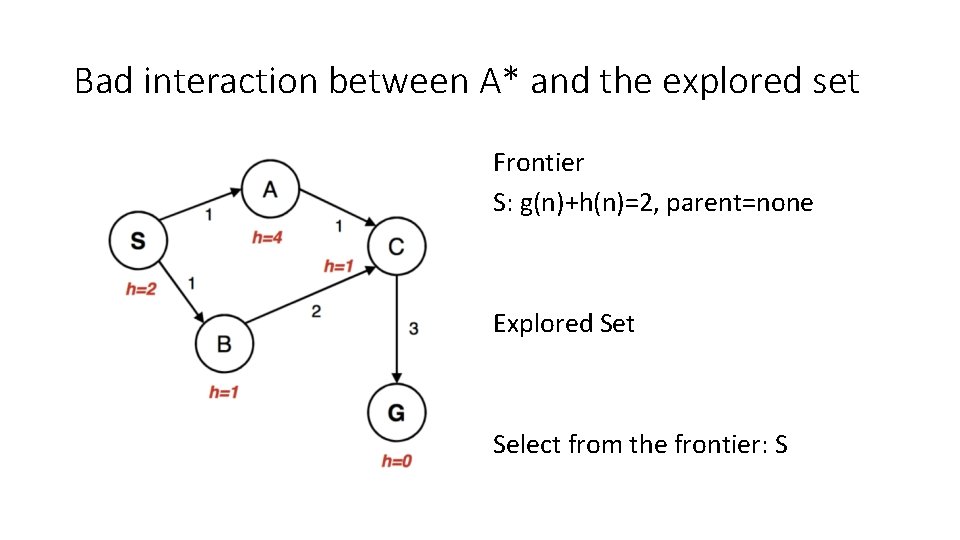
Bad interaction between A* and the explored set Frontier S: g(n)+h(n)=2, parent=none Explored Set Select from the frontier: S
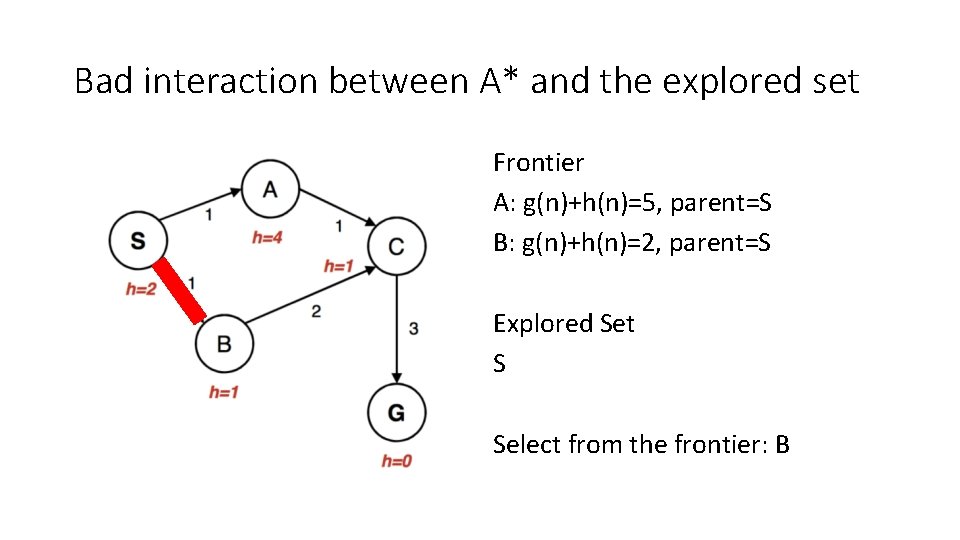
Bad interaction between A* and the explored set Frontier A: g(n)+h(n)=5, parent=S B: g(n)+h(n)=2, parent=S Explored Set S Select from the frontier: B
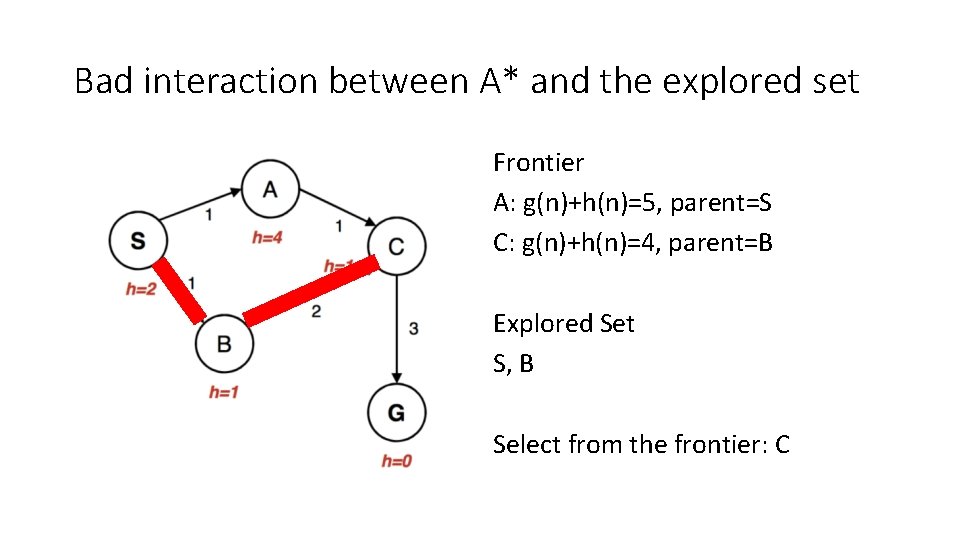
Bad interaction between A* and the explored set Frontier A: g(n)+h(n)=5, parent=S C: g(n)+h(n)=4, parent=B Explored Set S, B Select from the frontier: C
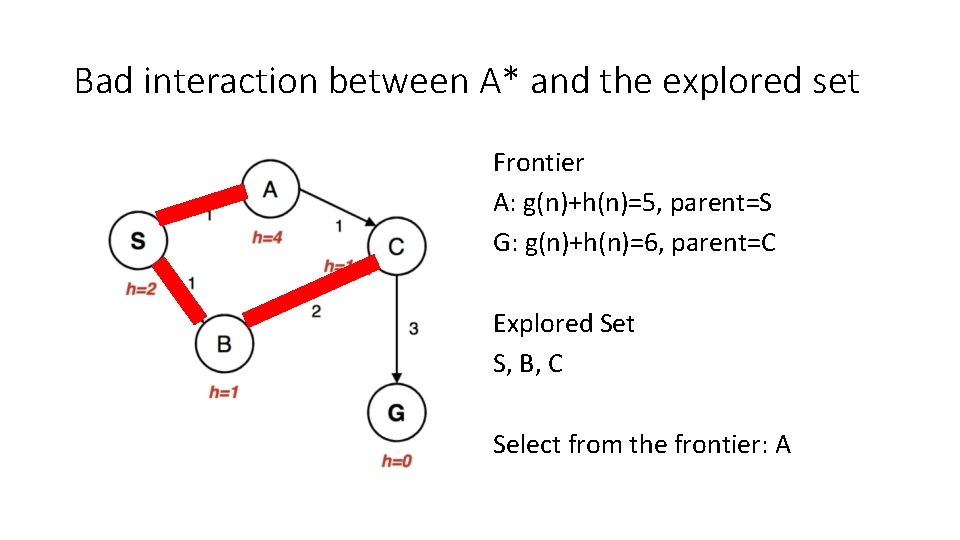
Bad interaction between A* and the explored set Frontier A: g(n)+h(n)=5, parent=S G: g(n)+h(n)=6, parent=C Explored Set S, B, C Select from the frontier: A
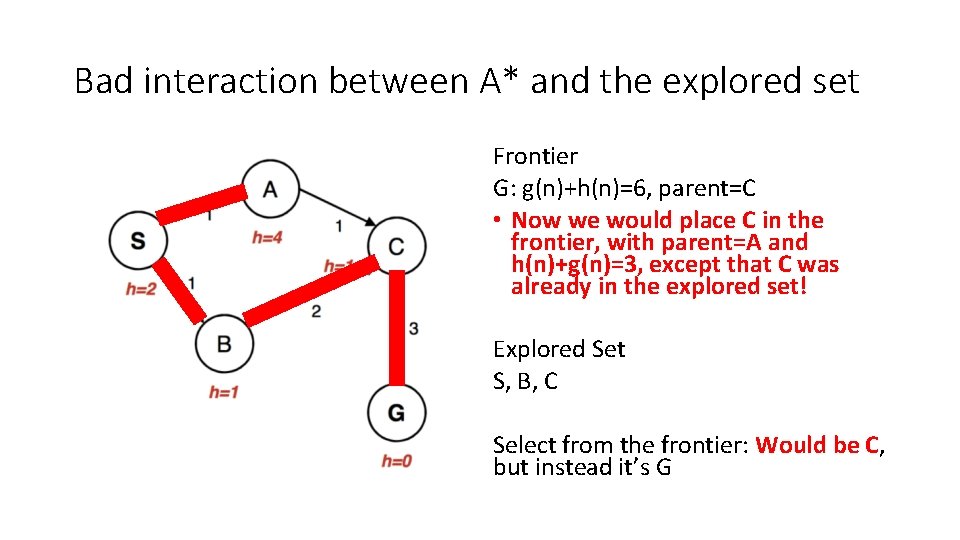
Bad interaction between A* and the explored set Frontier G: g(n)+h(n)=6, parent=C • Now we would place C in the frontier, with parent=A and h(n)+g(n)=3, except that C was already in the explored set! Explored Set S, B, C Select from the frontier: Would be C, but instead it’s G
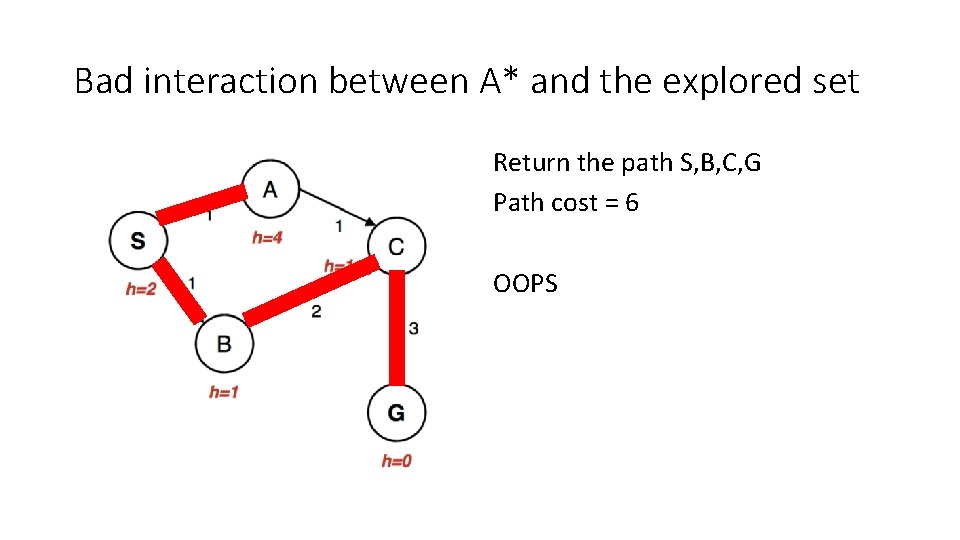
Bad interaction between A* and the explored set Return the path S, B, C, G Path cost = 6 OOPS
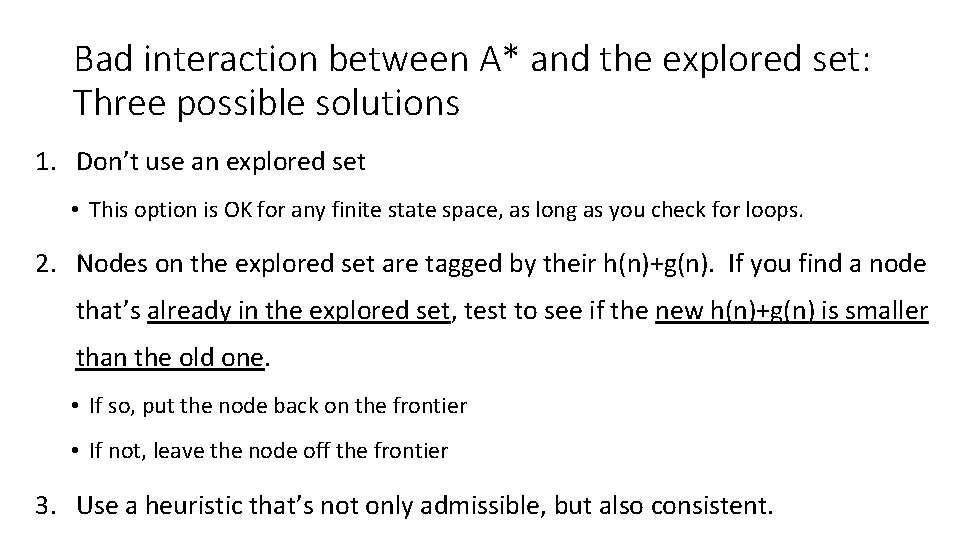
Bad interaction between A* and the explored set: Three possible solutions 1. Don’t use an explored set • This option is OK for any finite state space, as long as you check for loops. 2. Nodes on the explored set are tagged by their h(n)+g(n). If you find a node that’s already in the explored set, test to see if the new h(n)+g(n) is smaller than the old one. • If so, put the node back on the frontier • If not, leave the node off the frontier 3. Use a heuristic that’s not only admissible, but also consistent.
Outline of lecture 1. 2. 3. 4. 5. Admissible heuristics Consistent heuristics The zero heuristic: Dijkstra’s algorithm Relaxed heuristics Dominant heuristics
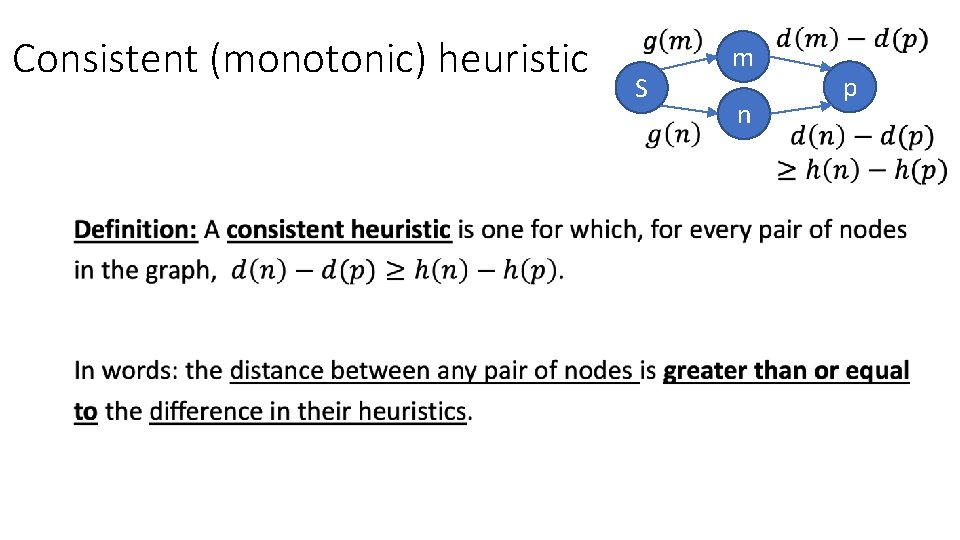
Consistent (monotonic) heuristic • S m n p
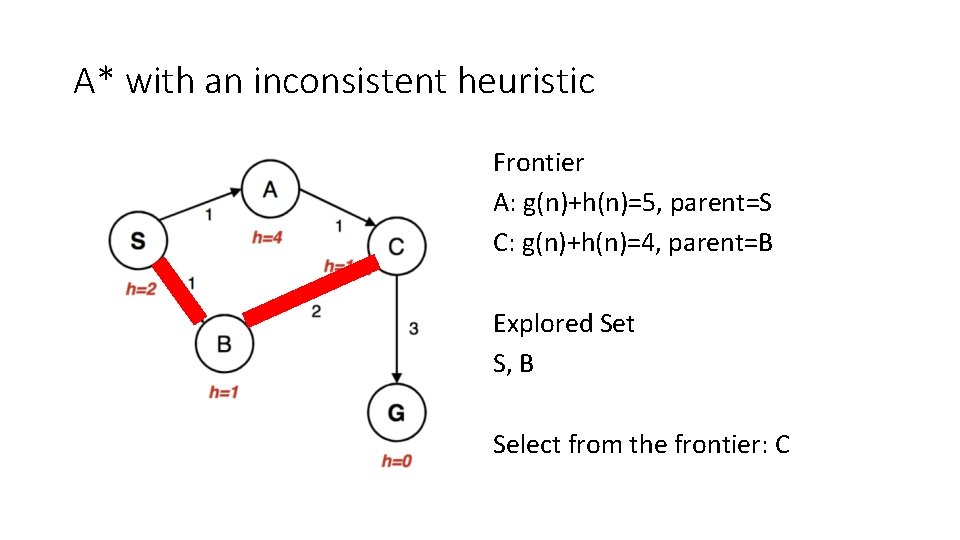
A* with an inconsistent heuristic Frontier A: g(n)+h(n)=5, parent=S C: g(n)+h(n)=4, parent=B Explored Set S, B Select from the frontier: C
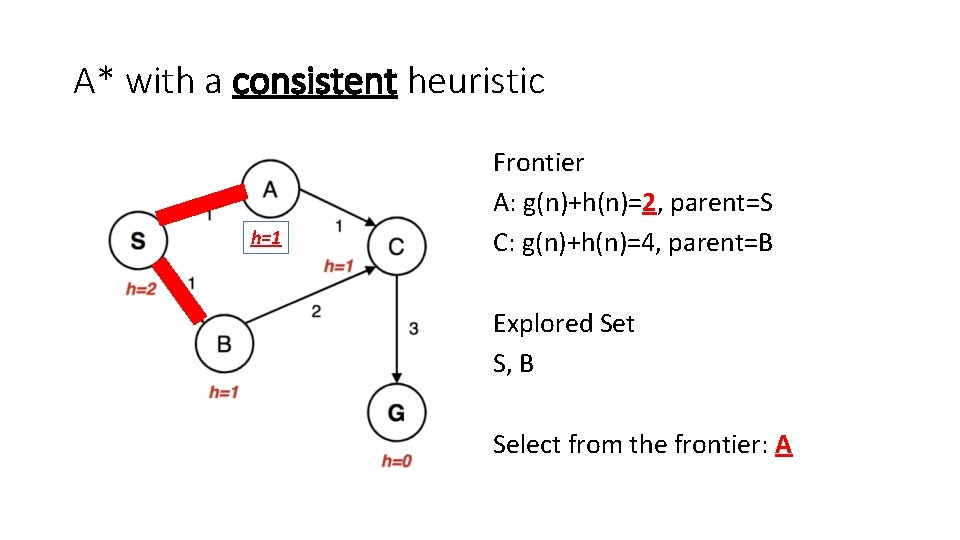
A* with a consistent heuristic h=1 Frontier A: g(n)+h(n)=2, parent=S C: g(n)+h(n)=4, parent=B Explored Set S, B Select from the frontier: A
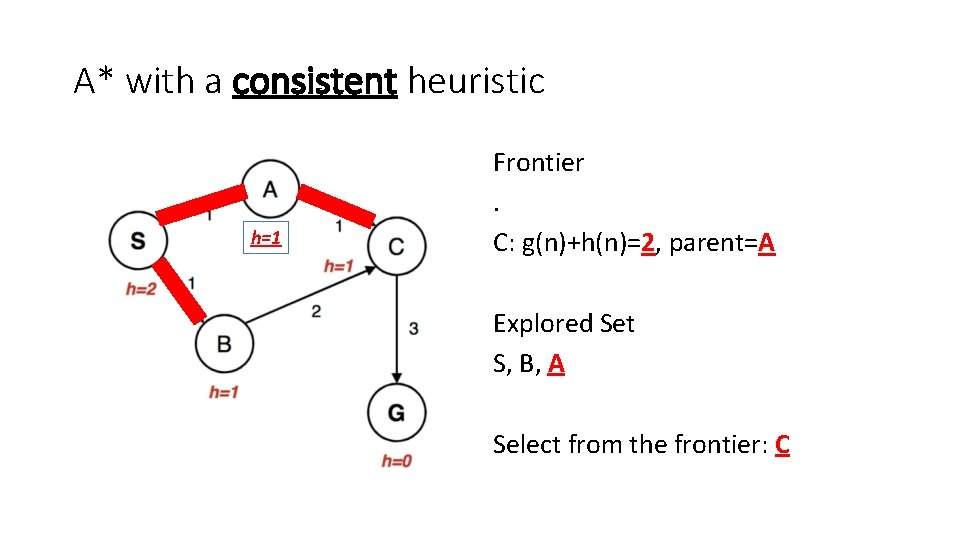
A* with a consistent heuristic h=1 Frontier. C: g(n)+h(n)=2, parent=A Explored Set S, B, A Select from the frontier: C
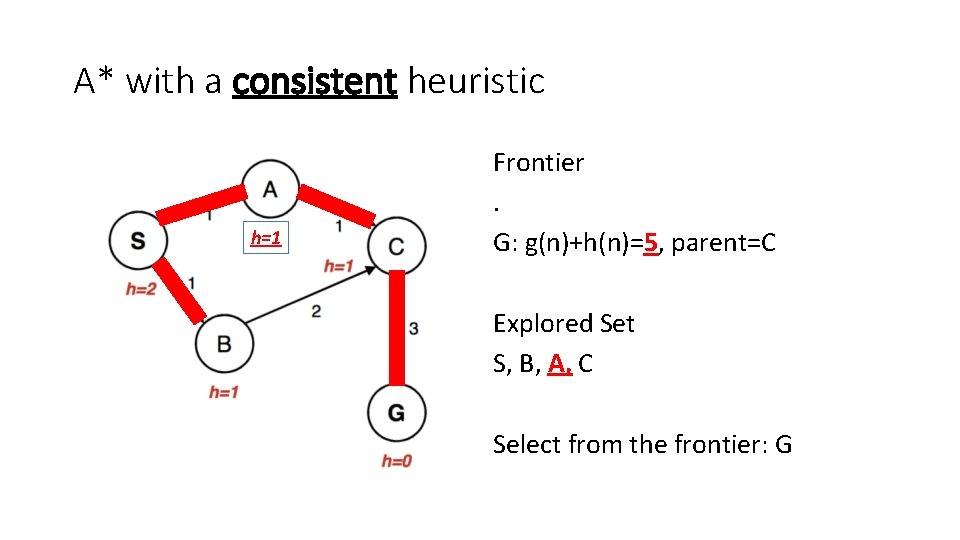
A* with a consistent heuristic h=1 Frontier. G: g(n)+h(n)=5, parent=C Explored Set S, B, A, C Select from the frontier: G
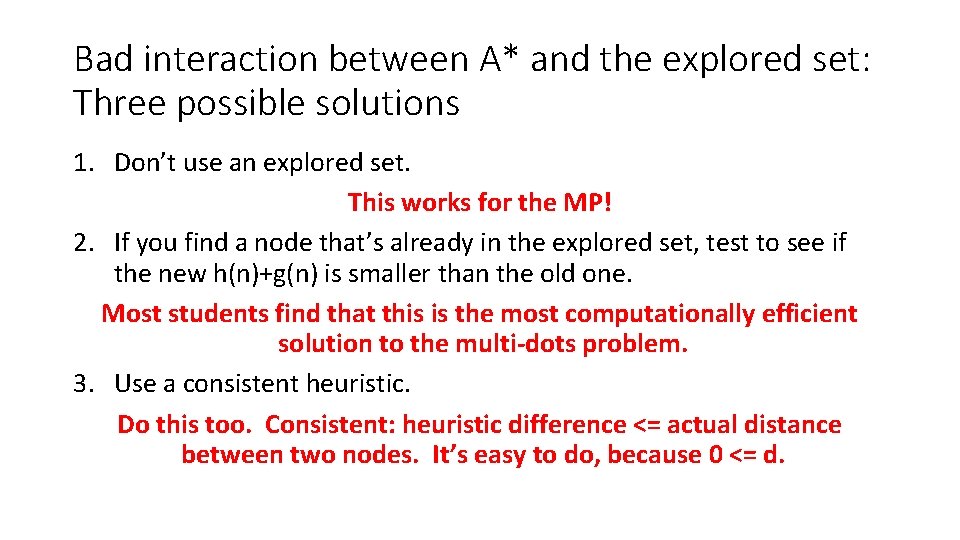
Bad interaction between A* and the explored set: Three possible solutions 1. Don’t use an explored set. This works for the MP! 2. If you find a node that’s already in the explored set, test to see if the new h(n)+g(n) is smaller than the old one. Most students find that this is the most computationally efficient solution to the multi-dots problem. 3. Use a consistent heuristic. Do this too. Consistent: heuristic difference <= actual distance between two nodes. It’s easy to do, because 0 <= d.
Outline of lecture 1. 2. 3. 4. 5. Admissible heuristics Consistent heuristics The zero heuristic: Dijkstra’s algorithm Relaxed heuristics Dominant heuristics
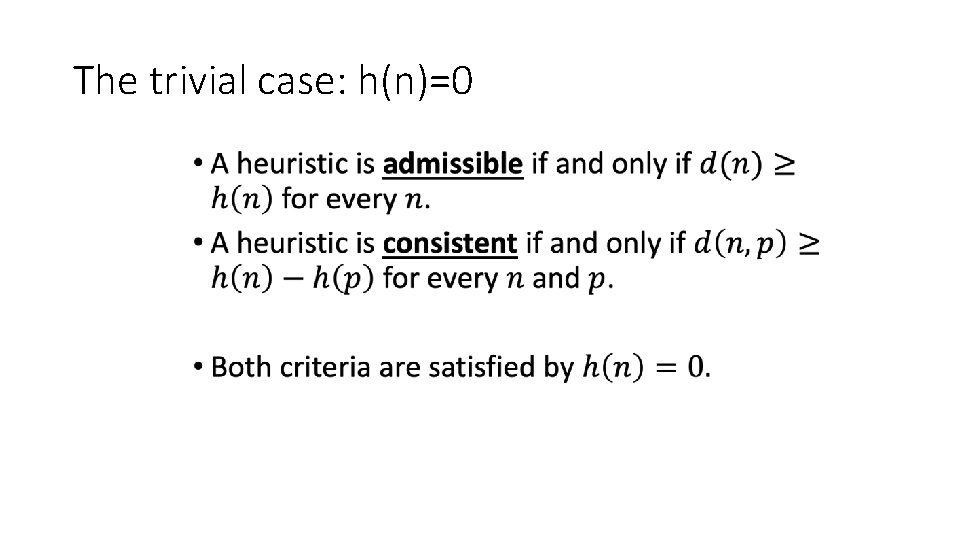
The trivial case: h(n)=0 •
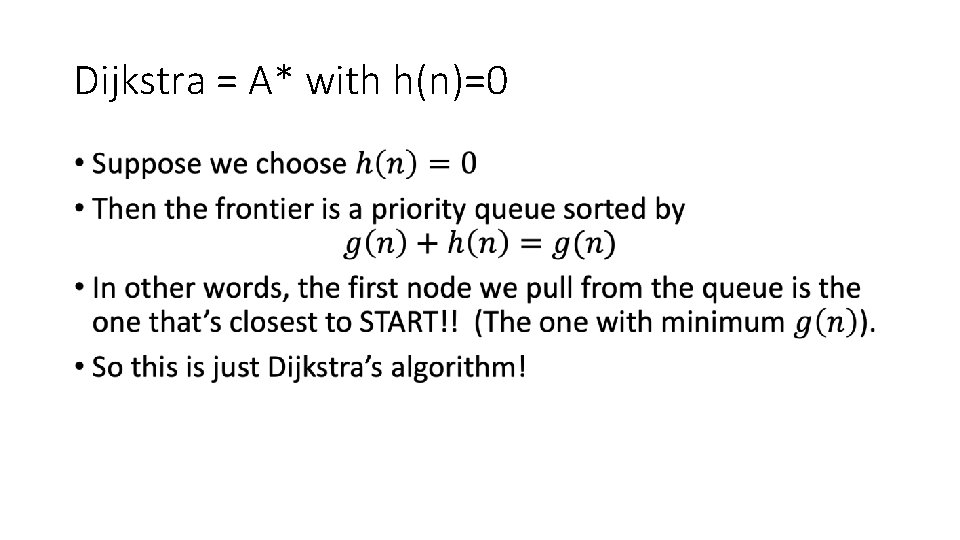
Dijkstra = A* with h(n)=0 •
Outline of lecture 1. 2. 3. 4. 5. Admissible heuristics Consistent heuristics The zero heuristic: Dijkstra’s algorithm Relaxed heuristics Dominant heuristics
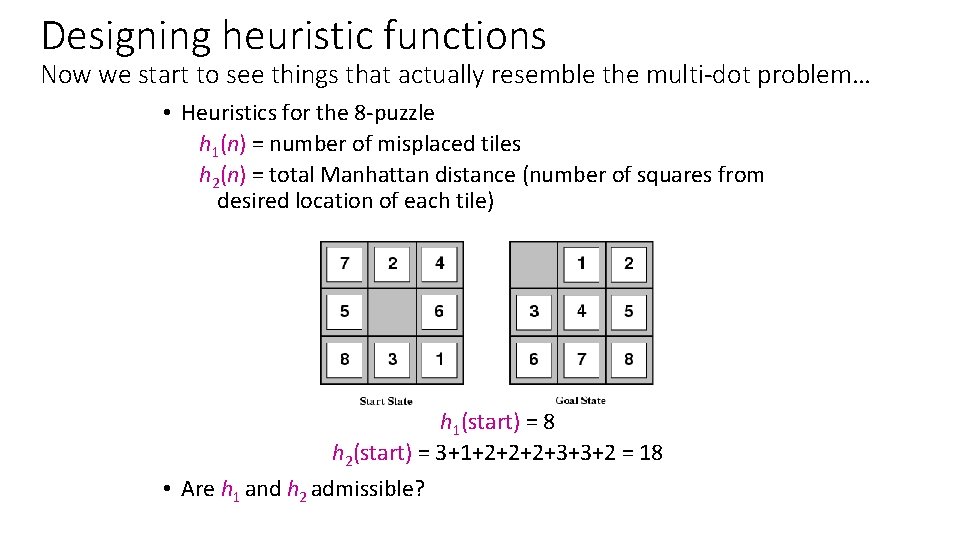
Designing heuristic functions Now we start to see things that actually resemble the multi-dot problem… • Heuristics for the 8 -puzzle h 1(n) = number of misplaced tiles h 2(n) = total Manhattan distance (number of squares from desired location of each tile) h 1(start) = 8 h 2(start) = 3+1+2+2+2+3+3+2 = 18 • Are h 1 and h 2 admissible?
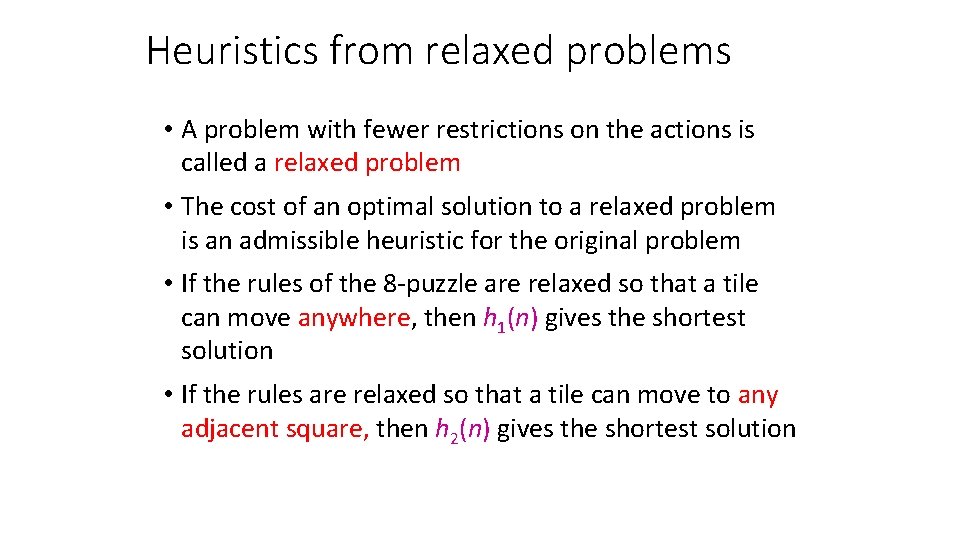
Heuristics from relaxed problems • A problem with fewer restrictions on the actions is called a relaxed problem • The cost of an optimal solution to a relaxed problem is an admissible heuristic for the original problem • If the rules of the 8 -puzzle are relaxed so that a tile can move anywhere, then h 1(n) gives the shortest solution • If the rules are relaxed so that a tile can move to any adjacent square, then h 2(n) gives the shortest solution
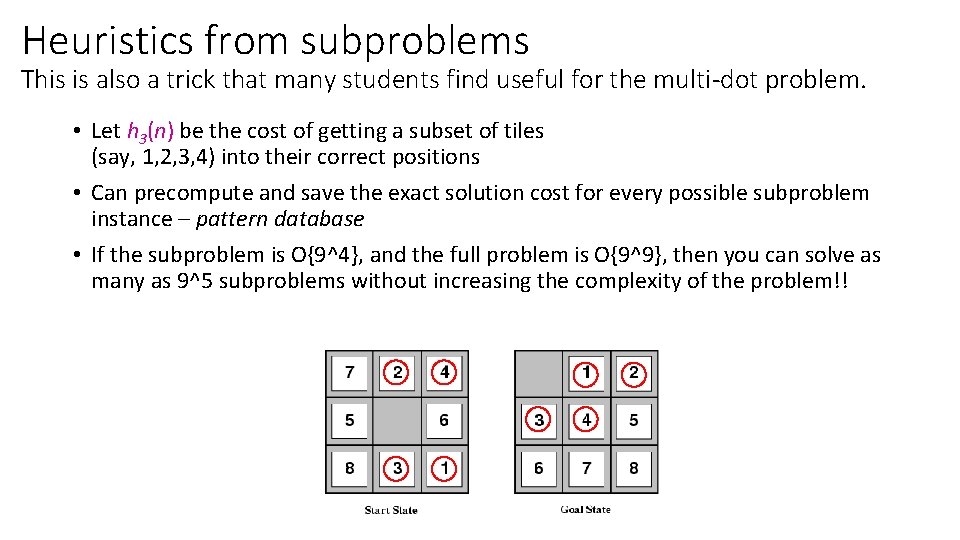
Heuristics from subproblems This is also a trick that many students find useful for the multi-dot problem. • Let h 3(n) be the cost of getting a subset of tiles (say, 1, 2, 3, 4) into their correct positions • Can precompute and save the exact solution cost for every possible subproblem instance – pattern database • If the subproblem is O{9^4}, and the full problem is O{9^9}, then you can solve as many as 9^5 subproblems without increasing the complexity of the problem!!
Outline of lecture 1. 2. 3. 4. 5. Admissible heuristics Consistent heuristics The zero heuristic: Dijkstra’s algorithm Relaxed heuristics Dominant heuristics
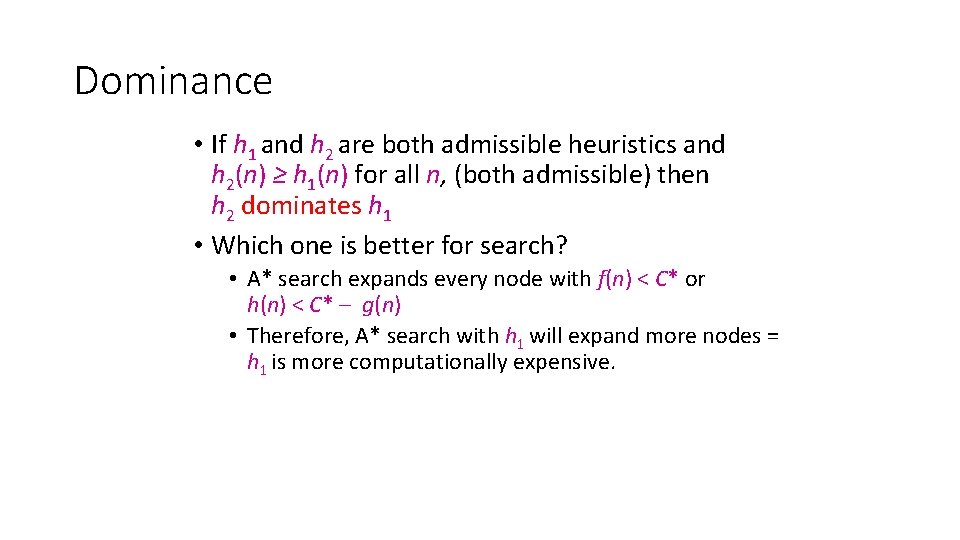
Dominance • If h 1 and h 2 are both admissible heuristics and h 2(n) ≥ h 1(n) for all n, (both admissible) then h 2 dominates h 1 • Which one is better for search? • A* search expands every node with f(n) < C* or h(n) < C* – g(n) • Therefore, A* search with h 1 will expand more nodes = h 1 is more computationally expensive.
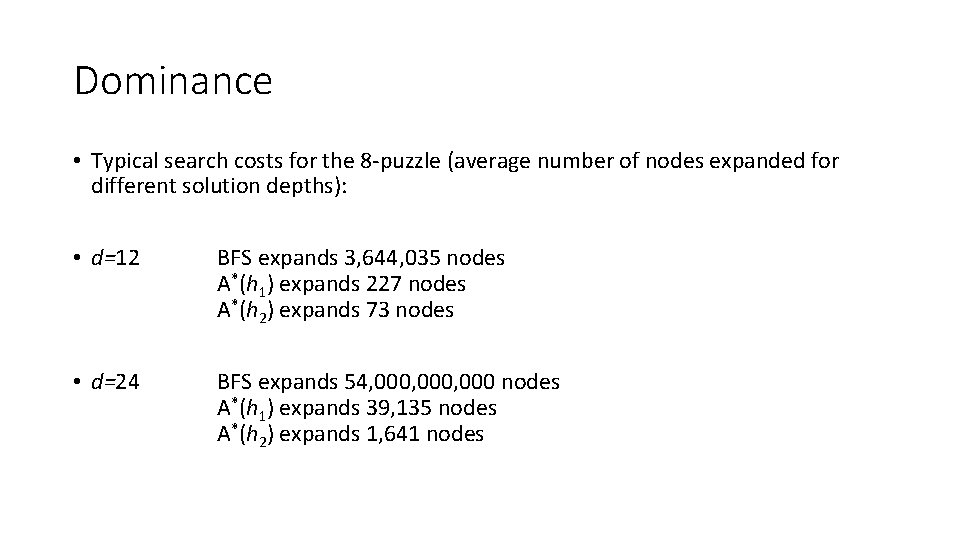
Dominance • Typical search costs for the 8 -puzzle (average number of nodes expanded for different solution depths): • d=12 BFS expands 3, 644, 035 nodes A*(h 1) expands 227 nodes A*(h 2) expands 73 nodes • d=24 BFS expands 54, 000, 000 nodes A*(h 1) expands 39, 135 nodes A*(h 2) expands 1, 641 nodes
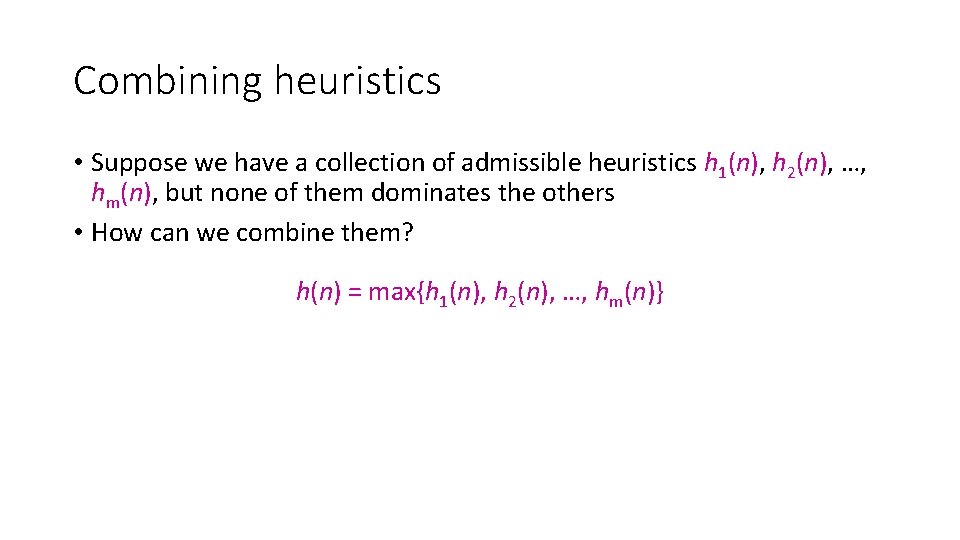
Combining heuristics • Suppose we have a collection of admissible heuristics h 1(n), h 2(n), …, hm(n), but none of them dominates the others • How can we combine them? h(n) = max{h 1(n), h 2(n), …, hm(n)}
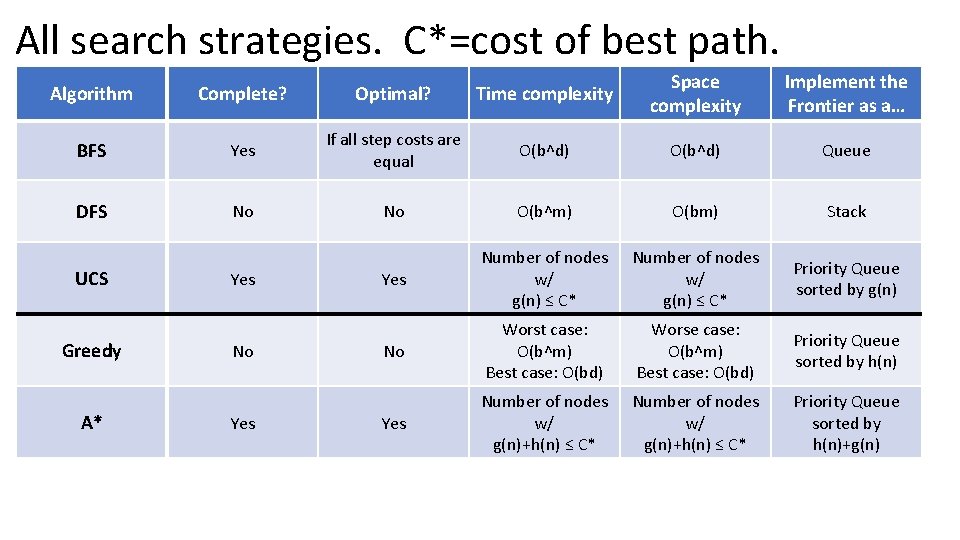
All search strategies. C*=cost of best path. Algorithm Complete? Optimal? Time complexity Space complexity Implement the Frontier as a… BFS Yes If all step costs are equal O(b^d) Queue DFS No No O(b^m) O(bm) Stack Yes Number of nodes w/ g(n) ≤ C* Priority Queue sorted by g(n) No Worst case: O(b^m) Best case: O(bd) Worse case: O(b^m) Best case: O(bd) Priority Queue sorted by h(n) Yes Number of nodes w/ g(n)+h(n) ≤ C* Priority Queue sorted by h(n)+g(n) UCS Greedy A* Yes No Yes
- Slides: 29