
Lecture 5 Static ILP Basics Topics loop unrolling

Lecture 5: Static ILP Basics • Topics: loop unrolling, VLIW (Sections 2. 1 – 2. 2) 1

Static vs Dynamic Scheduling • Arguments against dynamic scheduling: Ø requires complex structures to identify independent instructions (scoreboards, issue queue) § high power consumption § low clock speed § high design and verification effort Ø the compiler can “easily” compute instruction latencies and dependences – complex software is always preferred to complex hardware (? ) 2
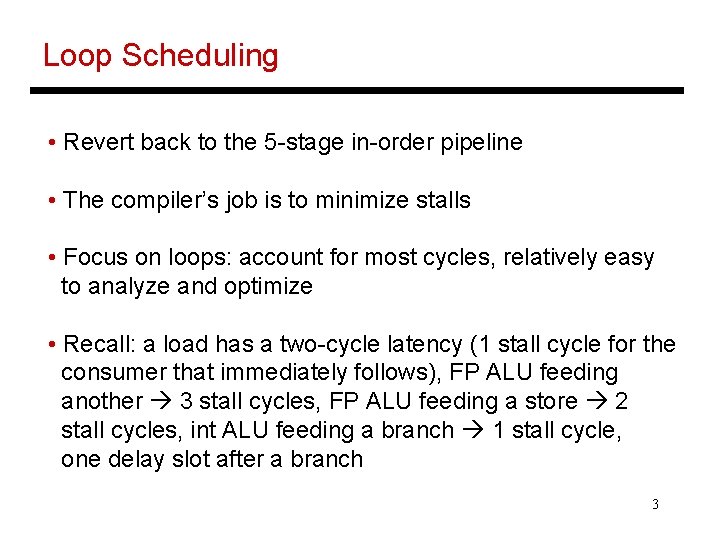
Loop Scheduling • Revert back to the 5 -stage in-order pipeline • The compiler’s job is to minimize stalls • Focus on loops: account for most cycles, relatively easy to analyze and optimize • Recall: a load has a two-cycle latency (1 stall cycle for the consumer that immediately follows), FP ALU feeding another 3 stall cycles, FP ALU feeding a store 2 stall cycles, int ALU feeding a branch 1 stall cycle, one delay slot after a branch 3
![Loop Example for (i=1000; i>0; i--) x[i] = x[i] + s; Loop: Source code](http://slidetodoc.com/presentation_image/d8966c0ba4afe802257db6a0c1a86247/image-4.jpg "Loop Example for (i=1000; i>0; i--) x[i] = x[i] + s; Loop: Source code")
Loop Example for (i=1000; i>0; i--) x[i] = x[i] + s; Loop: Source code L. D F 0, 0(R 1) ADD. D F 4, F 0, F 2 S. D F 4, 0(R 1) DADDUI R 1, # -8 BNE R 1, R 2, Loop ; F 0 = array element ; add scalar ; store result ; decrement address pointer ; branch if R 1 != R 2 Assembly code 4
![Loop Example for (i=1000; i>0; i--) x[i] = x[i] + s; Loop: Source code](http://slidetodoc.com/presentation_image/d8966c0ba4afe802257db6a0c1a86247/image-5.jpg "Loop Example for (i=1000; i>0; i--) x[i] = x[i] + s; Loop: Source code")
Loop Example for (i=1000; i>0; i--) x[i] = x[i] + s; Loop: Source code L. D F 0, 0(R 1) ADD. D F 4, F 0, F 2 S. D F 4, 0(R 1) DADDUI R 1, # -8 BNE R 1, R 2, Loop ; F 0 = array element ; add scalar ; store result ; decrement address pointer ; branch if R 1 != R 2 L. D F 0, 0(R 1) stall ADD. D F 4, F 0, F 2 stall S. D F 4, 0(R 1) DADDUI R 1, # -8 stall BNE R 1, R 2, Loop stall ; F 0 = array element Assembly code ; add scalar ; store result ; decrement address pointer 10 -cycle schedule ; branch if R 1 != R 2 5
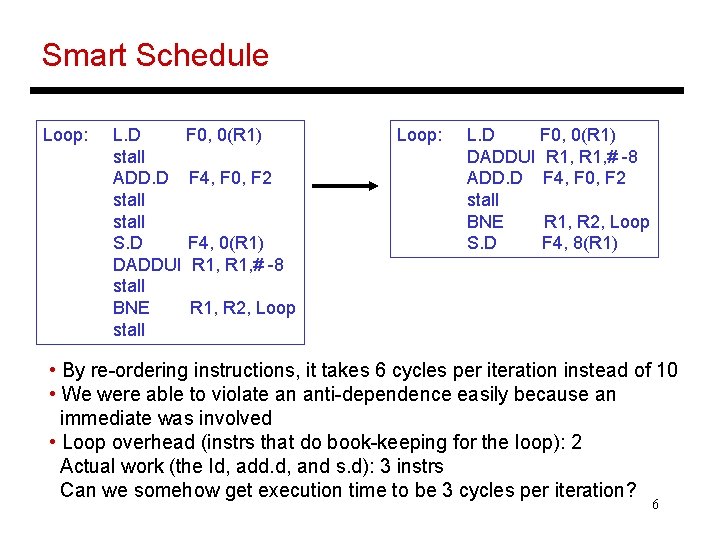
Smart Schedule Loop: L. D F 0, 0(R 1) stall ADD. D F 4, F 0, F 2 stall S. D F 4, 0(R 1) DADDUI R 1, # -8 stall BNE R 1, R 2, Loop stall Loop: L. D F 0, 0(R 1) DADDUI R 1, # -8 ADD. D F 4, F 0, F 2 stall BNE R 1, R 2, Loop S. D F 4, 8(R 1) • By re-ordering instructions, it takes 6 cycles per iteration instead of 10 • We were able to violate an anti-dependence easily because an immediate was involved • Loop overhead (instrs that do book-keeping for the loop): 2 Actual work (the ld, add. d, and s. d): 3 instrs Can we somehow get execution time to be 3 cycles per iteration? 6
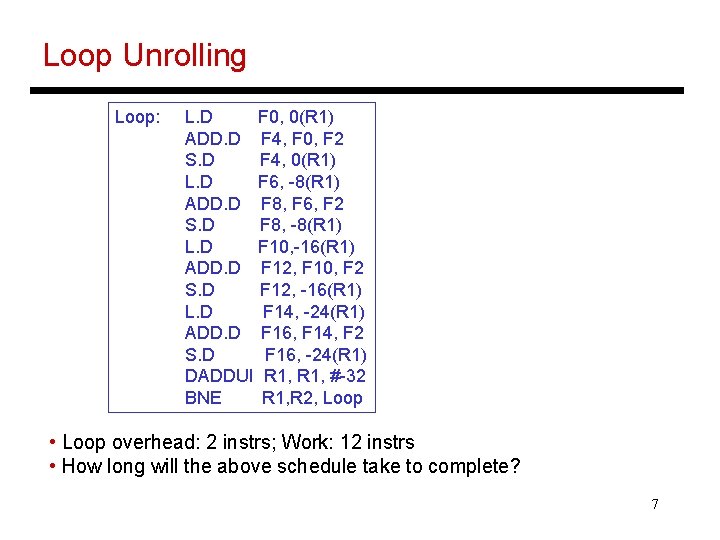
Loop Unrolling Loop: L. D F 0, 0(R 1) ADD. D F 4, F 0, F 2 S. D F 4, 0(R 1) L. D F 6, -8(R 1) ADD. D F 8, F 6, F 2 S. D F 8, -8(R 1) L. D F 10, -16(R 1) ADD. D F 12, F 10, F 2 S. D F 12, -16(R 1) L. D F 14, -24(R 1) ADD. D F 16, F 14, F 2 S. D F 16, -24(R 1) DADDUI R 1, #-32 BNE R 1, R 2, Loop • Loop overhead: 2 instrs; Work: 12 instrs • How long will the above schedule take to complete? 7
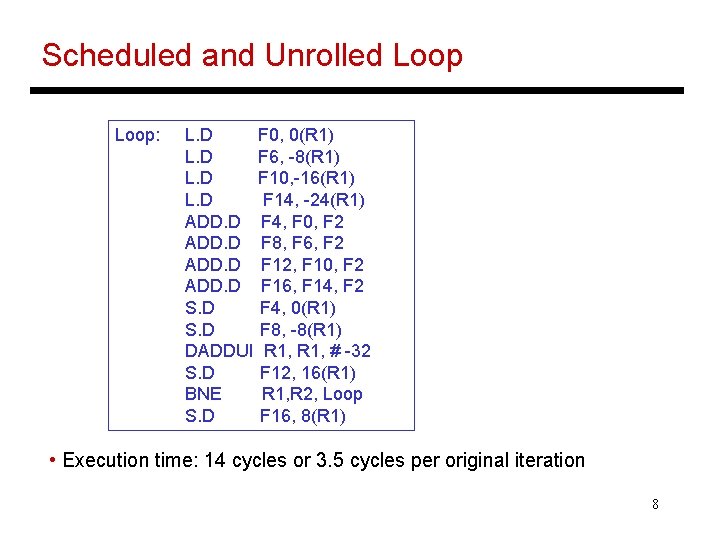
Scheduled and Unrolled Loop: L. D F 0, 0(R 1) L. D F 6, -8(R 1) L. D F 10, -16(R 1) L. D F 14, -24(R 1) ADD. D F 4, F 0, F 2 ADD. D F 8, F 6, F 2 ADD. D F 12, F 10, F 2 ADD. D F 16, F 14, F 2 S. D F 4, 0(R 1) S. D F 8, -8(R 1) DADDUI R 1, # -32 S. D F 12, 16(R 1) BNE R 1, R 2, Loop S. D F 16, 8(R 1) • Execution time: 14 cycles or 3. 5 cycles per original iteration 8
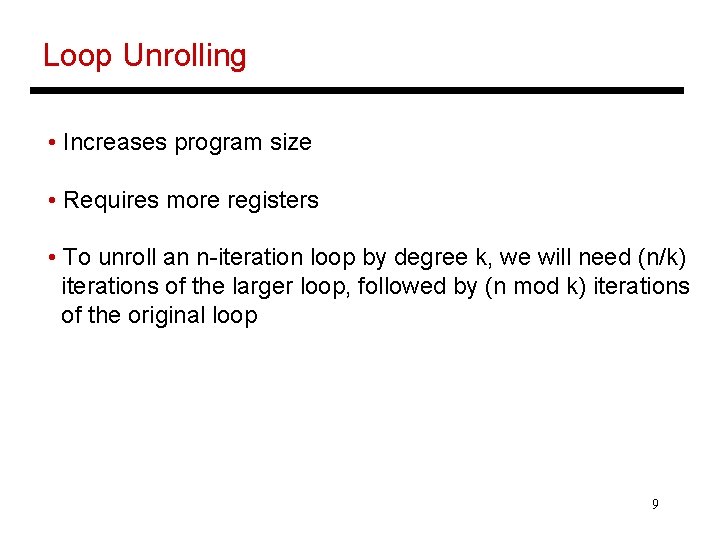
Loop Unrolling • Increases program size • Requires more registers • To unroll an n-iteration loop by degree k, we will need (n/k) iterations of the larger loop, followed by (n mod k) iterations of the original loop 9
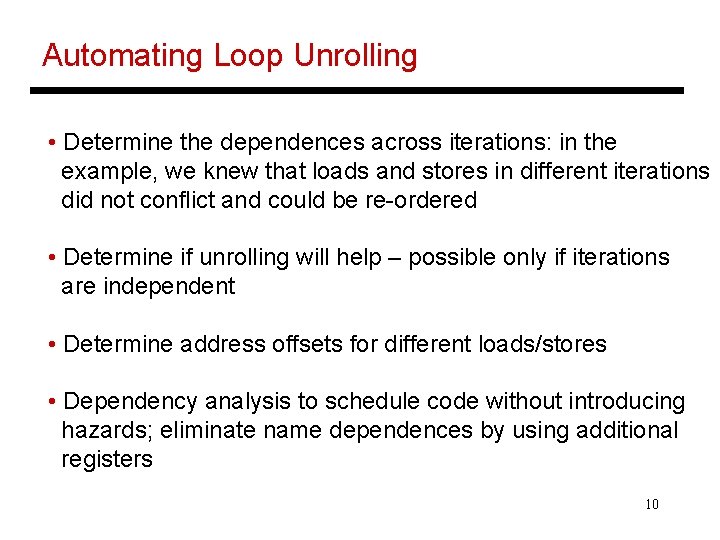
Automating Loop Unrolling • Determine the dependences across iterations: in the example, we knew that loads and stores in different iterations did not conflict and could be re-ordered • Determine if unrolling will help – possible only if iterations are independent • Determine address offsets for different loads/stores • Dependency analysis to schedule code without introducing hazards; eliminate name dependences by using additional registers 10
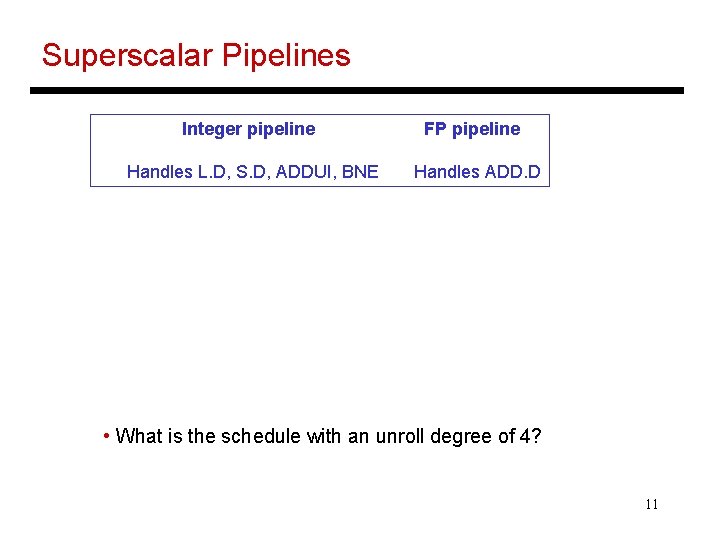
Superscalar Pipelines Integer pipeline FP pipeline Handles L. D, S. D, ADDUI, BNE Handles ADD. D • What is the schedule with an unroll degree of 4? 11
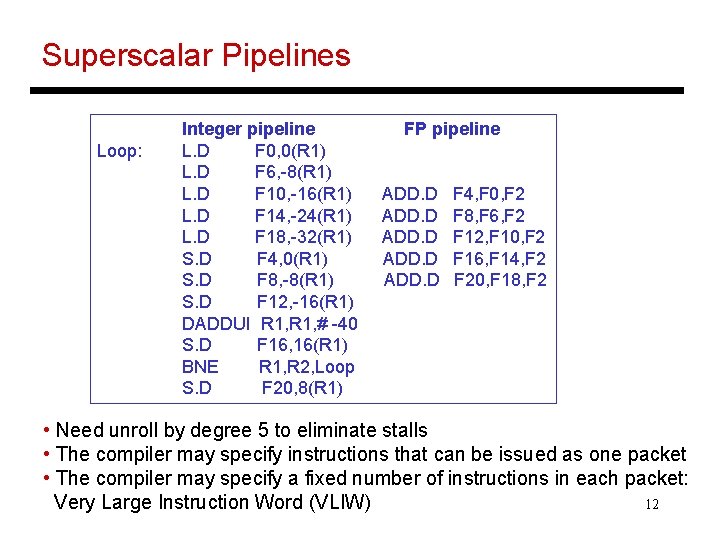
Superscalar Pipelines Loop: Integer pipeline L. D F 0, 0(R 1) L. D F 6, -8(R 1) L. D F 10, -16(R 1) L. D F 14, -24(R 1) L. D F 18, -32(R 1) S. D F 4, 0(R 1) S. D F 8, -8(R 1) S. D F 12, -16(R 1) DADDUI R 1, # -40 S. D F 16, 16(R 1) BNE R 1, R 2, Loop S. D F 20, 8(R 1) FP pipeline ADD. D F 4, F 0, F 2 F 8, F 6, F 2 F 12, F 10, F 2 F 16, F 14, F 20, F 18, F 2 • Need unroll by degree 5 to eliminate stalls • The compiler may specify instructions that can be issued as one packet • The compiler may specify a fixed number of instructions in each packet: Very Large Instruction Word (VLIW) 12
Title • Bullet 13
- Slides: 13