
Lecture 5 Scientific Method Case Study Astronomy Dr
- Slides: 22
Lecture 5 Scientific Method Case Study: Astronomy Dr. Ann T. Orlando October 2, 2008
Outline l l l Ancient cosmology and physics Augustine’s cosmology Aquinas’ physics Galileo and the aftermath What did Augustine (and Church) really teach?
Aristotle and Greek Physics l Aristotle (384 -322 BC), wrote On Physics – l l All physical things made of matter and form All things through velocity seek their own level – – l l l Metaphysics was treatise after physics that considered nonmaterial things Velocity defined as inversely proportional to density of medium through which a body travels Vacuums cannot exist World is eternal Region above sun is unchanging Observations of nature (empiricism) important to know how to categorize particulars
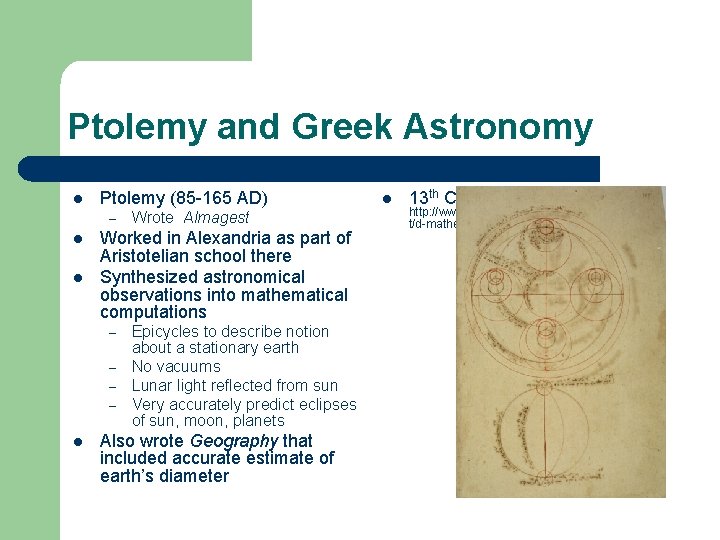
Ptolemy and Greek Astronomy l Ptolemy (85 -165 AD) – l l Worked in Alexandria as part of Aristotelian school there Synthesized astronomical observations into mathematical computations – – l Wrote Almagest Epicycles to describe notion about a stationary earth No vacuums Lunar light reflected from sun Very accurately predict eclipses of sun, moon, planets Also wrote Geography that included accurate estimate of earth’s diameter l 13 th C Manuscript http: //www. ibiblio. org/expo/vatican. exhibit/exhibi t/d-mathematics/Greek_astro. html
Augustine’s Physics l Understanding natural world important to Augustine – l l When does he begin to doubt Manichees? Basically he accepts the Aristotelian. Ptolemaic world view of geography and astronomy Knows the earth is round, lunar light is reflected from sun, planetary order and epicycles
Significance of Physics in Augustine l Understanding Genesis – l l l Cosmos not eternal but created ex nihilo What is time What is formless matter What is relation between heavens and Heaven
Aquinas and Physics l l Wrote a commentary on Aristotle’s On Physics For the most part accepted Aristotle-Ptolemy – l Notable exception: definition of velocity as time rate of change of distance Used Aristotle as primary philosophical tool in theology
Excursus: Columbus (1451 -1506) l l Recall reading ST Ia Q 1 Did Europeans in general, or Church in particular, think the world was flat? – l Why are we so often taught this now No one tried to sail from Europe to China because did not have the technology
Copernicus (1473 -1543) l l l Assisted Vatican on revision of calendar Published De Revolutionibus shortly before his death Hypothesizes a heliocentric system
Galileo (1564 -1642) l Impact of Telescope – – l Mathematical simplicity of heliocentric system very appealing – l Circular orbits Note Galileo’s contributions to physics far beyond astronomy – – – l Becomes obvious that entities above the sun do change Far more variety in celestial sphere than previously imagined Dynamics (pendula) Motion (weight not relevant to speed at which a body falls, Tower of Pisa experiment) But most of all using mathematics to describe laws of physics Reaction against Aristotelianism
St. Robert Bellarmine (1542 -1621) l l l Concerned about interpretation of Scripture, especially Joshua 10 Heliocentric system okay to make math easier, draws distinction between easier math and reality But also concerned that circular-orbit heliocentric system not as accurate as epicycles and geocentric system – And he was right
Galileo vs Church l Conflict begins during Pope Paul V pontificate – l 1616 “Copernicanism” condemned, – – l Admirer of Galileo 1632 Galileo publishes Diologue Concerning the Two Chief World Systems, Ptolemaic and Copernican – – l De Revolutionibus placed on index Galileo told not to teach it 1623 Maffeo Barberini becomes Pope Urban VIII – l Background of Reformation and Council of Trent Published with approval of censors in Rome and Florence Made fun of Pope, who saw himself as Simplicio, defender of Ptolemy 1633 Galileo brought before Inquisition – – House arrest Allowed to return to Florence after recanting
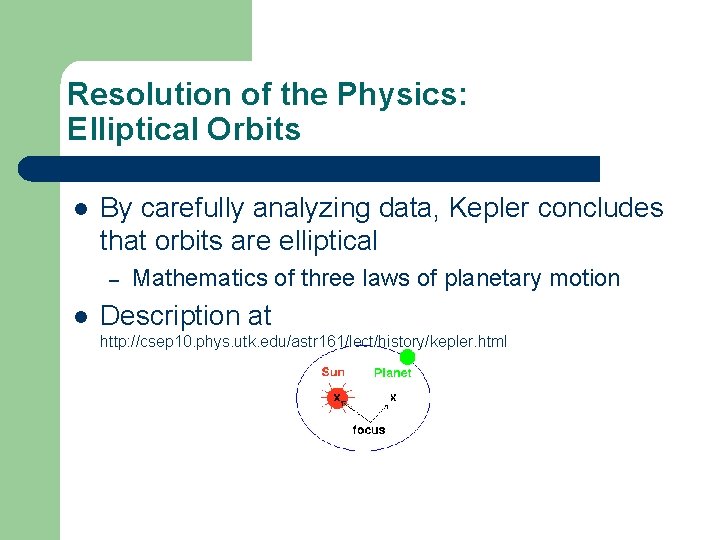
Resolution of the Physics: Elliptical Orbits l By carefully analyzing data, Kepler concludes that orbits are elliptical – l Mathematics of three laws of planetary motion Description at http: //csep 10. phys. utk. edu/astr 161/lect/history/kepler. html
Enlightenment Mythology of Galileo l “Despite all its enlightenment about other matters, the eighteenth century was almost a golden age for the invention and diffusion of myths about Galileo’s trial. ” – Finocchiaro, Retrying Galileo, 111 – – – Galileo held in prison Galileo had his eyes gauged out Galileo had to live on bread and water
Situation Today: Benedict XVI and Sapienza l 20 th and 21 st Centuries no strangers to embellishing Galileo affair – l Bertold Brecht, Galileo, expands on clash of faith and reason Most recently the controversy around Pope Benedict XVI planned visit to Sapienza University in January 2008 – – – Physics faculty protest Pope’s visit because of reputed comments he made in 1992 about Galileo; ‘authoritative’ reference was a wikipedia article Pope cancels visit Rector of Sapienza eventually acknowledges criticism misdirected, and invites Pope to return
Augustine, On Literal Interpretation of Genesis l Augustine wrote many works with Genesis as the focus – – – l l De Genesi ad litteram liber written between 399 -415 Understanding what Augustine meant by ‘literal’ meaning of Genesis – – l Exegesis that is not figurative of Christ (not typological) May include symbolic understanding; e. g. days of creation Twelve books, divided into three parts – – – l Confessions Books XI-XIII Against the Manichees Against Faustus Part 1: Books 1 -5; days of creation Part 2: Books 6 -11; commentary on Genesis 2 -3; expulsion form paradise Part 3: Book 12; experiencing paradise (types of ecstasy) Readings from Part 1 – 1. 18. 36 -19. 39 and 2. 9. 20 -2. 10. 23 and 2. 18. 38
Thomas Aquinas, Summa Contra Gentiles l Relation between truth of observation and truth of faith very important – l l SCG written to provide arguments against unbelievers, 12611264 Written in four parts – – l Aristotelian empiricism Part I: Of God as He Is in Himself Part II: Of God and Origin of Creatures Part III: Of God the End of Creatures Part IV: Of God in His Revelation Read I. vii, “The Truth of Reason Is Not Contrary to Truth of Faith”
Thomas Aquinas Summa Theologiae Ia 68 a 1 and a 3 l l Question 68 begins in a 1 with the proper way to interpret Scripture according to Augustine Does Aquinas go beyond Augustine in a 3?
Galileo and Bellarmine Letters in 1615 l Galileo, Letter to Grand Duchess Christina – – l Written to important patron, Grand Duchess Christina Published more widely 1636 Bellarmine, Letter to Rev. Foscarini – Rev. Foscarini was a Carmelite astronomer who was a friend and supporter of Galileo
Voltaire, " Preface” and “Authority” Philosophical Dictionary l Voltaire (1694 -1778) – – – l Philosophical Dictionary – – l Leading light of French Enlightenment (philosophe) Deist Wrote extensively on history, physics, religion, art in many genres (poems, articles, treatises, plays) Published 1764 Part of program of philsosphes to provide knowledge free from influences of superstition (religion) Available at http: //www. gutenberg. org/catalog/world/readfile? pag eno=24&fk_files=237218
John Paul II: Address to Pontifical Academy of Sciences l l l Address given Oct 31, 1992 Pope charged the Academy of Sciences with reevaluating the Galileo Affair Similar address in 1996 on evolution, http: //www. catholic. net/RCC/Periodicals/Insid e/01 -97/creat 2. html
Assignment l l l l Augustine, On Literal Interpretation of Genesis, 1. 18. 36 -19. 39 and 2. 9. 20 -2. 10. 23 and 2. 18. 38 Aquinas, SCG available at http: //www 2. nd. edu/Departments/Maritain/etext/gc 1_7. htm Aquinas, Ia Q 68 a 1 and a 3 Galileo, Letter to Grand Duchess Christina, Bellarmine, Letter to Rev. Foscarini, http: //www. fordham. edu/halsall/mod/galileo-tuscany. html http: //www. fordham. edu/halsall/mod/1615 bellarmine-letter. html Voltaire, “Authority, ” Philosophical Dictionary, available at Project Guttenburg, www. gutenberg. org pp 1 and 24 -25. JPII, http: //www. its. caltech. edu/~nmcenter/sci-cp/sci-9211. html – l French, Italian and German versions available on Vatican website How did Aquinas and Galileo use Augustine? How are preconceived prejudices at work in reactions from Voltaire to today?