
Lecture 5 of 42 Informed Search Best First
Lecture 5 of 42 Informed Search: Best First Search (Greedy, A/A*) and Heuristics Discussion: Project Topics 5 of 5 Friday, 04 September 2009 William H. Hsu Department of Computing and Information Sciences, KSU KSOL course page: http: //snipurl. com/v 9 v 3 Course web site: http: //www. kddresearch. org/Courses/Fall-2009/CIS 730 Instructor home page: http: //www. cis. ksu. edu/~bhsu Reading for Next Class: Section 4. 3, p. 110 - 118, Russell & Norvig 2 nd edition Instructions for writing project plans, submitting homework CIS 530 / 730 Artificial Intelligence Lecture 5 of 42 Friday, 04 Sep 2009 Computing & Information Sciences Kansas State University
Lecture Outline l Reading for Next Class: Section 4. 3, R&N 2 e l Coming Week: Chapter 4 concluded, Chapter 5 Properties of search algorithms, heuristics Local search (hill-climbing, Beam) vs. nonlocal search Genetic and evolutionary computation (GEC) State space search: graph vs. constraint representations l Today: Sections 4. 1 (Informed Search), 4. 2 (Heuristics) Properties of heuristics: consistency, admissibility, monotonicity Impact on A/A* l Next Class: Section 4. 3 on Local Search and Optimization Problems in heuristic search: plateaux, “foothills”, ridges Escaping from local optima Wide world of global optimization: genetic algorithms, simulated annealing l Next Week: Chapter 5 on CSP CIS 530 / 730 Artificial Intelligence Lecture 5 of 42 Friday, 04 Sep 2009 Computing & Information Sciences Kansas State University
Search-Based Problem Solving: Quick Review l function General-Search (problem, strategy) returns a solution or failure Queue: represents search frontier (see: Nilsson – OPEN / CLOSED lists) Variants: based on “add resulting nodes to search tree” l Previous Topics Formulating problem Uninformed search ð No heuristics: only g(n), if any cost function used ð Variants: BFS (uniform-cost, bidirectional), DFS (depth-limited, ID-DFS) Heuristic search ð Based on h – (heuristic) function, returns estimate of min cost to goal ð h only: greedy (aka myopic) informed search ð A/A*: f(n) = g(n) + h(n) – frontier based on estimated + accumulated cost l Today: More Heuristic Search Algorithms A* extensions: iterative deepening (IDA*), simplified memory-bounded (SMA*) Iterative improvement: hill-climbing, MCMC (simulated annealing) Problems and solutions (macros and global optimization) CIS 530 / 730 Artificial Intelligence Lecture 5 of 42 Friday, 04 Sep 2009 Computing & Information Sciences Kansas State University
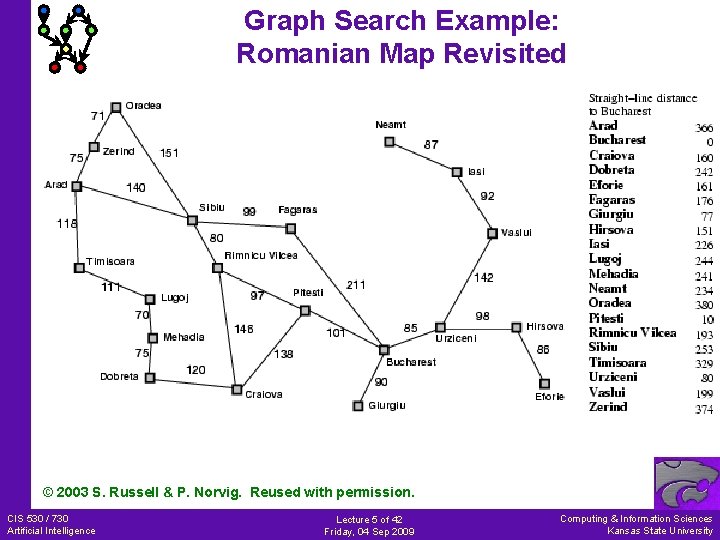
Graph Search Example: Romanian Map Revisited © 2003 S. Russell & P. Norvig. Reused with permission. CIS 530 / 730 Artificial Intelligence Lecture 5 of 42 Friday, 04 Sep 2009 Computing & Information Sciences Kansas State University
![Greedy Search [1]: A Best-First Algorithm l function Greedy-Search (problem) returns solution or failure](http://slidetodoc.com/presentation_image_h/74aad0a06a178a9fb70729e03616813c/image-5.jpg "Greedy Search [1]: A Best-First Algorithm l function Greedy-Search (problem) returns solution or failure")
Greedy Search [1]: A Best-First Algorithm l function Greedy-Search (problem) returns solution or failure // recall: solution Option return Best-First-Search (problem, h) l Example of Straight-Line Distance (SLD) Heuristic: Figure 4. 2 R&N Can only calculate if city locations (coordinates) are known Discussion: Why is h. SLD useful? ð Underestimate ð Close estimate l Example: Figure 4. 3 R&N Is solution optimal? Why or why not? CIS 530 / 730 Artificial Intelligence Lecture 5 of 42 Friday, 04 Sep 2009 Computing & Information Sciences Kansas State University
![Greedy Search [2]: Example Arad 366=0+366 Sibiu 253 Arad 366 Fagaras 176 Sibiu 253](http://slidetodoc.com/presentation_image_h/74aad0a06a178a9fb70729e03616813c/image-6.jpg "Greedy Search [2]: Example Arad 366=0+366 Sibiu 253 Arad 366 Fagaras 176 Sibiu 253")
Greedy Search [2]: Example Arad 366=0+366 Sibiu 253 Arad 366 Fagaras 176 Sibiu 253 Arad Oradea 380 Zerind 374 Rîmnicu Vîlcea 366 Adapted from slides © 2003 S. Russell & P. Norvig. Reused with permission. Bucharest 0 CLOSED List OPEN List {} Arad Sibiu Arad 366 Sibiu 253 Fagaras 176 Sibiu Fagaras Bucharest 0 Timisoara 329 T 329 S 253 RV 366 T 329 Zerind 374 A 366 RV 366 Z 374 A 366 O 380 Z 374 O 380 Bucharest Path found: (Arad CIS 530 / 730 Artificial Intelligence Timisoara 329 Sibiu Fagaras Lecture 5 of 42 Friday, 04 Sep 2009 Bucharest)450 Computing & Information Sciences Kansas State University
![Greedy Search [3]: Properties l Similar to DFS Prefers single path to goal Backtracks](http://slidetodoc.com/presentation_image_h/74aad0a06a178a9fb70729e03616813c/image-7.jpg "Greedy Search [3]: Properties l Similar to DFS Prefers single path to goal Backtracks")
Greedy Search [3]: Properties l Similar to DFS Prefers single path to goal Backtracks l Same Drawbacks as DFS? Not optimal ð First solution ð Not necessarily best ð Discussion: How is this problem mitigated by quality of h? Not complete: doesn’t consider cumulative cost “so-far” (g) l Worst-Case Time Complexity: (bm) – Why? l Worst-Case Space Complexity: (bm) – Why? CIS 530 / 730 Artificial Intelligence Lecture 5 of 42 Friday, 04 Sep 2009 Computing & Information Sciences Kansas State University
![Greedy Search [4]: More Properties l Good Heuristics Reduce Practical Space/Time Complexity “Your mileage](http://slidetodoc.com/presentation_image_h/74aad0a06a178a9fb70729e03616813c/image-8.jpg "Greedy Search [4]: More Properties l Good Heuristics Reduce Practical Space/Time Complexity “Your mileage")
Greedy Search [4]: More Properties l Good Heuristics Reduce Practical Space/Time Complexity “Your mileage may vary”: actual reduction ð Domain-specific ð Depends on quality of h (what quality h can we achieve? ) “You get what you pay for”: computational costs or knowledge required l Discussions and Questions to Think About How much is search reduced using straight-line distance heuristic? When do we prefer analytical vs. search-based solutions? What is the complexity of an exact solution? Can “meta-heuristics” be derived that meet our desiderata? ð Underestimate ð Close estimate When is it feasible to develop parametric heuristics automatically? ð Finding underestimates ð Discovering close estimates CIS 530 / 730 Artificial Intelligence Lecture 5 of 42 Friday, 04 Sep 2009 Computing & Information Sciences Kansas State University
![Algorithm A/A* [1]: Methodology l Idea: Combine Evaluation Functions g and h Get “best](http://slidetodoc.com/presentation_image_h/74aad0a06a178a9fb70729e03616813c/image-9.jpg "Algorithm A/A* [1]: Methodology l Idea: Combine Evaluation Functions g and h Get “best")
Algorithm A/A* [1]: Methodology l Idea: Combine Evaluation Functions g and h Get “best of both worlds” Discussion: Importance of taking both components into account? l function A-Search (problem) returns solution or failure // recall: solution Option return Best-First-Search (problem, g + h) l Requirement: Monotone Restriction on f Recall: monotonicity of h ð Requirement for completeness of uniform-cost search ð Generalize to f = g + h aka triangle inequality l Requirement for A = A*: Admissibility of h h must be underestimate of true optimal cost ( n. h(n) h*(n)) CIS 530 / 730 Artificial Intelligence Lecture 5 of 42 Friday, 04 Sep 2009 Computing & Information Sciences Kansas State University
![Algorithm A/A* [2]: Example Nodes found/scheduled (opened): {A, S, T, Z, F, O, RV,](http://slidetodoc.com/presentation_image_h/74aad0a06a178a9fb70729e03616813c/image-10.jpg "Algorithm A/A* [2]: Example Nodes found/scheduled (opened): {A, S, T, Z, F, O, RV,")
Algorithm A/A* [2]: Example Nodes found/scheduled (opened): {A, S, T, Z, F, O, RV, S, B, C, P} Nodes visited (closed): {A, S, F, RV, P, B} Path found: (Arad Sibiu Rîmnicu Vîlcea Pitesti Bucharest)416 © 2003 S. Russell & P. Norvig. Reused with permission. CIS 530 / 730 Artificial Intelligence Lecture 5 of 42 Friday, 04 Sep 2009 Computing & Information Sciences Kansas State University
![Algorithm A/A* [3]: Properties l Completeness (p. 100 R&N 2 e) Expand lowest-cost node](http://slidetodoc.com/presentation_image_h/74aad0a06a178a9fb70729e03616813c/image-11.jpg "Algorithm A/A* [3]: Properties l Completeness (p. 100 R&N 2 e) Expand lowest-cost node")
Algorithm A/A* [3]: Properties l Completeness (p. 100 R&N 2 e) Expand lowest-cost node on fringe Requires Insert function to insert into increasing order l Optimality (p. 99 -101 R&N 2 e) l Optimal Efficiency (p. 97 -99 R&N 2 e) For any given heuristic function No other optimal algorithm is guaranteed to expand fewer nodes Proof sketch: by contradiction (on what partial correctness condition? ) l Worst-Case Time Complexity (p. 100 -101 R&N 2 e) Still exponential in solution length Practical consideration: optimally efficient for any given heuristic function CIS 530 / 730 Artificial Intelligence Lecture 5 of 42 Friday, 04 Sep 2009 Computing & Information Sciences Kansas State University
![Algorithm A/A* [4]: Performance l Admissibility: Requirement for A* Search to Find Min-Cost Solution](http://slidetodoc.com/presentation_image_h/74aad0a06a178a9fb70729e03616813c/image-12.jpg "Algorithm A/A* [4]: Performance l Admissibility: Requirement for A* Search to Find Min-Cost Solution")
Algorithm A/A* [4]: Performance l Admissibility: Requirement for A* Search to Find Min-Cost Solution l Related Property: Monotone Restriction on Heuristics For all nodes m, n such that m is a descendant of n: h(m) h(n) - c(n, m) Change in h is less than true cost Intuitive idea: “No node looks artificially distant from a goal” Discussion questions ð Admissibility monotonicity? Monotonicity admissibility? ð Always realistic, i. e. , can always be expected in real-world situations? ð What happens if monotone restriction is violated? (Can we fix it? ) l Optimality and Completeness Necessarily and sufficient condition (NASC): admissibility of h Proof: p. 99 -100 R&N (contradiction from inequalities) l Behavior of A*: Optimal Efficiency l Empirical Performance Depends very much on how tight h is How weak is admissibility as a practical requirement? CIS 530 / 730 Artificial Intelligence Lecture 5 of 42 Friday, 04 Sep 2009 Computing & Information Sciences Kansas State University
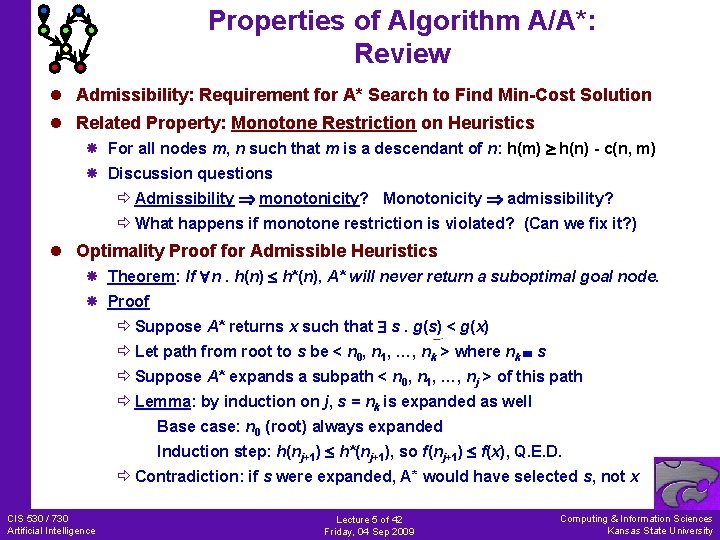
Properties of Algorithm A/A*: Review l Admissibility: Requirement for A* Search to Find Min-Cost Solution l Related Property: Monotone Restriction on Heuristics For all nodes m, n such that m is a descendant of n: h(m) h(n) - c(n, m) Discussion questions ð Admissibility monotonicity? Monotonicity admissibility? ð What happens if monotone restriction is violated? (Can we fix it? ) l Optimality Proof for Admissible Heuristics Theorem: If n. h(n) h*(n), A* will never return a suboptimal goal node. Proof ð Suppose A* returns x such that s. g(s) < g(x) ð Let path from root to s be < n 0, n 1, …, nk > where nk s ð Suppose A* expands a subpath < n 0, n 1, …, nj > of this path ð Lemma: by induction on j, s = nk is expanded as well Base case: n 0 (root) always expanded Induction step: h(nj+1) h*(nj+1), so f(nj+1) f(x), Q. E. D. ð Contradiction: if s were expanded, A* would have selected s, not x CIS 530 / 730 Artificial Intelligence Lecture 5 of 42 Friday, 04 Sep 2009 Computing & Information Sciences Kansas State University
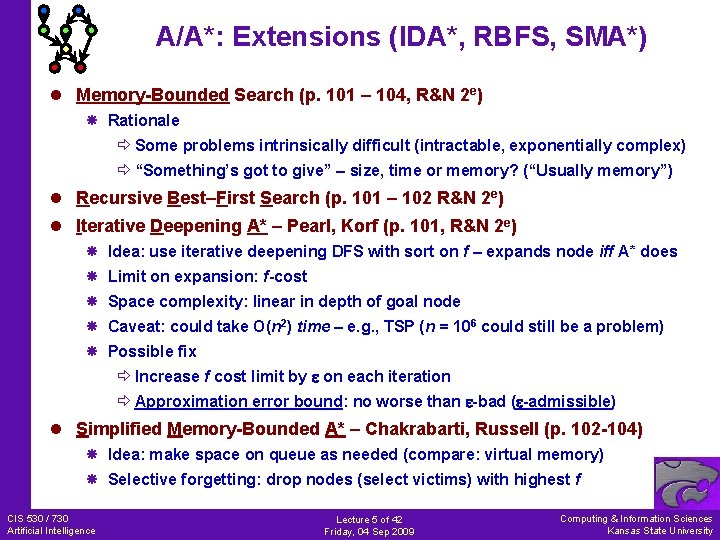
A/A*: Extensions (IDA*, RBFS, SMA*) l Memory-Bounded Search (p. 101 – 104, R&N 2 e) Rationale ð Some problems intrinsically difficult (intractable, exponentially complex) ð “Something’s got to give” – size, time or memory? (“Usually memory”) l Recursive Best–First Search (p. 101 – 102 R&N 2 e) l Iterative Deepening A* – Pearl, Korf (p. 101, R&N 2 e) Idea: use iterative deepening DFS with sort on f – expands node iff A* does Limit on expansion: f-cost Space complexity: linear in depth of goal node Caveat: could take O(n 2) time – e. g. , TSP (n = 106 could still be a problem) Possible fix ð Increase f cost limit by on each iteration ð Approximation error bound: no worse than -bad ( -admissible) l Simplified Memory-Bounded A* – Chakrabarti, Russell (p. 102 -104) Idea: make space on queue as needed (compare: virtual memory) Selective forgetting: drop nodes (select victims) with highest f CIS 530 / 730 Artificial Intelligence Lecture 5 of 42 Friday, 04 Sep 2009 Computing & Information Sciences Kansas State University
CIS 530 / 730 Artificial Intelligence CIS 490 / 730: Artificial Lecture 5 of 42 Friday, 052009 Sep Friday, 04 Sep Computing & Information Sciences Kansas State University
![Best-First Search Problems [1]: Global vs. Local Search l Optimization-Based Problem Solving as Function](http://slidetodoc.com/presentation_image_h/74aad0a06a178a9fb70729e03616813c/image-16.jpg "Best-First Search Problems [1]: Global vs. Local Search l Optimization-Based Problem Solving as Function")
Best-First Search Problems [1]: Global vs. Local Search l Optimization-Based Problem Solving as Function Maximization Visualize function space ð Criterion (z axis) ð Solutions (x-y plane) Objective: maximize criterion subject to ð Solution spec ð Degrees of freedom l Foothills aka Local Optima aka relative minima (of error), relative maxima (of criterion) Qualitative description ð All applicable operators produce suboptimal results (i. e. , neighbors) ð However, solution is not optimal! Discussion: Why does this happen in optimization? CIS 530 / 730 Artificial Intelligence Lecture 5 of 42 Friday, 04 Sep 2009 Computing & Information Sciences Kansas State University
![Best-First Search Problems [2] l Lack of Gradient aka Plateaux Qualitative description ð All](http://slidetodoc.com/presentation_image_h/74aad0a06a178a9fb70729e03616813c/image-17.jpg "Best-First Search Problems [2] l Lack of Gradient aka Plateaux Qualitative description ð All")
Best-First Search Problems [2] l Lack of Gradient aka Plateaux Qualitative description ð All neighbors indistinguishable ð According to evaluation function f Related problem: jump discontinuities in function space Discussion: When does this happen in heuristic problem solving? l Single-Step Traps aka Ridges Qualitative description: unable to move along steepest gradient Discussion: How might this problem be overcome? CIS 530 / 730 Artificial Intelligence Lecture 5 of 42 Friday, 04 Sep 2009 Computing & Information Sciences Kansas State University

Project Topic 5 of 5: Topics in Computer Vision Image Processing © 2009 Maas Digital, LLC © 2009 Variscope, Inc. © 2005 U. of Washington Autonomous Mars Rover (Artist’s Conception) Binocular Stereo Microscopy Edge Detection &Segmentation Li, 2005 http: //tr. im/y 7 d 1 Scene Classification Kansas State University © 2007 AAAI © 2007 Wired Magazine KSU Willie (Pioneer P 3 AT) Gustafson et al. , 2007 http: //tr. im/y 75 U Emotion Recognition Gevers & Sebe, 2007 http: //tr. im/y 7 bi Line Labeling and Scene Understanding © 2009 Purdue U. © 2008 INRIA Waltz Line Labeling Siskind, 2009 http: //tr. im/y 7 ae CIS 530 / 730 Artificial Intelligence Hollywood Human Actions Dataset Laptev et al. (2008) http: //lear. inrialpes. fr Lecture 5 of 42 Friday, 04 Sep 2009 Computing & Information Sciences Kansas State University

Plan Interviews: Week of 14 Sep 2009 l 10 -15 Minute Meeting l Discussion Topics Background resources Revisions needed to project plan Literature review: bibliographic sources Source code provided for project Evaluation techniques Interim goals Your timeline l Dates and Venue Week of Mon 14 Sep 2009 Sign up for times by e-mailing CIS 730 TA-L@listserv. ksu. edu l Come Prepared Hard copy of plan draft Screenshots or running demo for existing system you are building on ð Installed on notebook if you have one ð Remote desktop (RDP), VNC, or SSH otherwise ð Link sent to CIS 730 TA-L@listserv. ksu. edu before interview CIS 530 / 730 Artificial Intelligence Lecture 5 of 42 Friday, 04 Sep 2009 Computing & Information Sciences Kansas State University
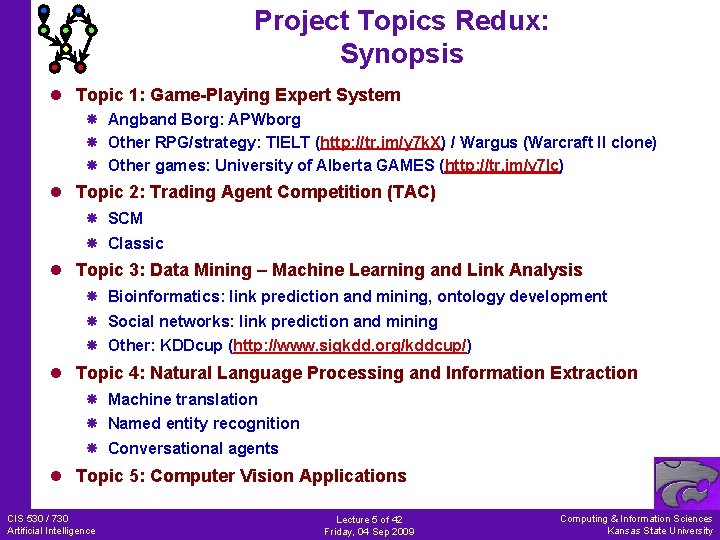
Project Topics Redux: Synopsis l Topic 1: Game-Playing Expert System Angband Borg: APWborg Other RPG/strategy: TIELT (http: //tr. im/y 7 k. X) / Wargus (Warcraft II clone) Other games: University of Alberta GAMES (http: //tr. im/y 7 lc) l Topic 2: Trading Agent Competition (TAC) SCM Classic l Topic 3: Data Mining – Machine Learning and Link Analysis Bioinformatics: link prediction and mining, ontology development Social networks: link prediction and mining Other: KDDcup (http: //www. sigkdd. org/kddcup/) l Topic 4: Natural Language Processing and Information Extraction Machine translation Named entity recognition Conversational agents l Topic 5: Computer Vision Applications CIS 530 / 730 Artificial Intelligence Lecture 5 of 42 Friday, 04 Sep 2009 Computing & Information Sciences Kansas State University

Instructions for Project Plans l Note: Project Plans Are Not Proposals! Subject to (one) revision Choose one topic among three l Plan Outline: 1 -2 Pages 1. Problem Statement ð Objectives ð Scope 2. Background ð Related work ð Brief survey of existing agents and approaches 3. Methodology ð Data resources ð Tentative list of algorithms to be implemented or adapted 4. Evaluation Methods 5. Milestones 6. References CIS 530 / 730 Artificial Intelligence Lecture 5 of 42 Friday, 04 Sep 2009 Computing & Information Sciences Kansas State University

Project Calendar for CIS 530 and CIS 730 l Plan Drafts – send by Fri 11 Sep 2009 (soft deadline, but by Monday) l Plan Interviews – Mon 14 Sep 2009 – Wed 16 Sep 2009 l Revised Plans – submit by Fri 18 Sep 2009 (hard deadline) l Interim Reports – submit by 18 Oct 2009 (hard deadline) l Interim Interviews – around 19 Oct 2009 l Final Reports – Wed 03 Dec 2009 (hard deadline) l Final Interviews – around Fri 05 Dec 2009 CIS 530 / 730 Artificial Intelligence Lecture 5 of 42 Friday, 04 Sep 2009 Computing & Information Sciences Kansas State University
Terminology l Properties of Search Soundness: returned candidate path satisfies specification Completeness: finds path if one exists Optimality: (usually means) achieves maximal online path cost Optimal efficiency: (usually means) maximal offline cost l Heuristic Search Algorithms Properties of heuristics ð Monotonicity (consistency) ð Admissibility Properties of algorithms ð Admissibility (soundness) ð Completeness ð Optimality ð Optimal efficiency CIS 530 / 730 Artificial Intelligence Lecture 5 of 42 Friday, 04 Sep 2009 Computing & Information Sciences Kansas State University
Summary Points l Heuristic Search Algorithms Properties of heuristics: monotonicity, admissibility, completeness Properties of algorithms: (soundness), completeness, optimality, optimal efficiency Iterative improvement ð Hill-climbing ð Beam search ð Simulated annealing (SA) Function maximization formulation of search Problems ð Ridge ð Foothill aka local (relative) optimum aka local minimum (of error) ð Plateau, jump discontinuity Solutions ð Macro operators ð Global optimization (genetic algorithms / SA) l Constraint Satisfaction Search CIS 530 / 730 Artificial Intelligence Lecture 5 of 42 Friday, 04 Sep 2009 Computing & Information Sciences Kansas State University
- Slides: 24